
Why the Speed of Light Defines the Metre in Modern SI
Learn how atomic clocks, the exact value of the speed of light, and interferometry connect time and distance in modern SI measurement.
Imagine two physics laboratories on opposite sides of the world need to reproduce exactly the same metre. Sending both labs copies of one “perfect” ruler sounds sensible. But what happens when one ruler warms by \(0.1^\circ\text{C}\), gets scratched, or changes slightly with age?
There is a stranger option. Give each lab an atomic clock and a laser, then tell them the exact speed of light in vacuum. Now they can recreate length from time without needing the same physical ruler.
Before reading on, predict which approach modern physics uses: preserve the best possible metre stick, or define length using a property of nature?
Modern SI uses the second approach. But there is one important correction to the title: the speed of light does not define the second. The second is defined using a transition in caesium-133 atoms. The exact value of the speed of light then connects that unit of time to the metre. In other words, atomic physics gives us the second, and \(c\) lets us turn seconds into metres.
01The problem with keeping a perfect ruler
For everyday measurements, a ruler is excellent. For fundamental measurement, a physical object causes trouble.
A metal bar changes length slightly with temperature. Its surface can be damaged. Different copies cannot be guaranteed to remain identical forever. Most importantly, every laboratory would somehow need to trace its measurements back to the same object.
That was once exactly how the metre worked. In 1889, the international metre was tied to a platinum-iridium prototype. In 1960, the physical bar was replaced by a definition based on a particular wavelength of light emitted by krypton-86. Then, in 1983, the metre was redefined using the distance travelled by light in vacuum during a specified time.
| Period | Basis of the metre | Main idea |
|---|---|---|
| 1889-1960 | Platinum-iridium prototype | Compare lengths with a physical artefact |
| 1960-1983 | Krypton-86 radiation | Reproduce a particular atomic wavelength |
| From 1983 | Speed of light in vacuum | Derive length from accurately measured time |
| Modern SI wording, effective from 2019 | Fixed value of \(c\) | Define the metre through an exact constant |
The changes were not made because the older definitions were foolish. Each had become a limit on measurements that were getting better.
That is a recurring theme in metrology, the science of measurement: eventually, your measuring standard can become worse than the experiment you are trying to perform.
02First, physicists needed a better second
Length could only be connected precisely to light once time itself was defined precisely.
An obvious way to define a second is from Earth’s rotation. A day is familiar and easy to picture, so an early second was based on dividing the mean solar day into \(86\,400\) parts.
The problem is that Earth is not a perfect clock. Its rotation is not sufficiently uniform for high-precision metrology. A later definition used Earth’s orbital motion, but atomic transitions turned out to be much more reproducible. In 1967, the SI second was therefore tied to caesium-133. The modern wording fixes the caesium hyperfine transition frequency, \(\Delta \nu_{\text{Cs}}\), at exactly
\[
\Delta \nu_{\text{Cs}}=9\,192\,631\,770\ \text{Hz}.
\]
Here, \(\Delta \nu_{\text{Cs}}\) is the frequency associated with a particular transition between two hyperfine energy levels of the unperturbed ground state of caesium-133, and Hz means cycles per second.
So one second corresponds to \(9\,192\,631\,770\) periods of this radiation.
One period lasts approximately
\[
T=\frac{1}{9\,192\,631\,770}
\approx 1.09\times10^{-10}\ \text{s}.
\]
That is about \(0.109\) nanoseconds per cycle.
What an atomic clock is actually doing
It is tempting to picture a caesium atom as a tiny clock going “tick, tick, tick” \(9.2\) billion times each second. That picture is useful for about ten seconds, then it starts lying to you.
A modern caesium fountain clock works more like an extremely precise tuning experiment.
In spatial order:
- Caesium atoms enter a vacuum chamber.
- Laser beams slow the atoms, forming a very cold cloud.
- The cloud is launched upwards.
- On the way up, the atoms pass through a region containing microwaves.
- Gravity slows the cloud, stops it, then brings it back down through the microwave region.
- Lasers and detectors determine how many atoms changed quantum state.
- The microwave frequency is adjusted until the atomic response shows that it matches the caesium resonance extremely closely.
The clock then uses that atomic resonance to control an oscillator whose cycles can be counted.
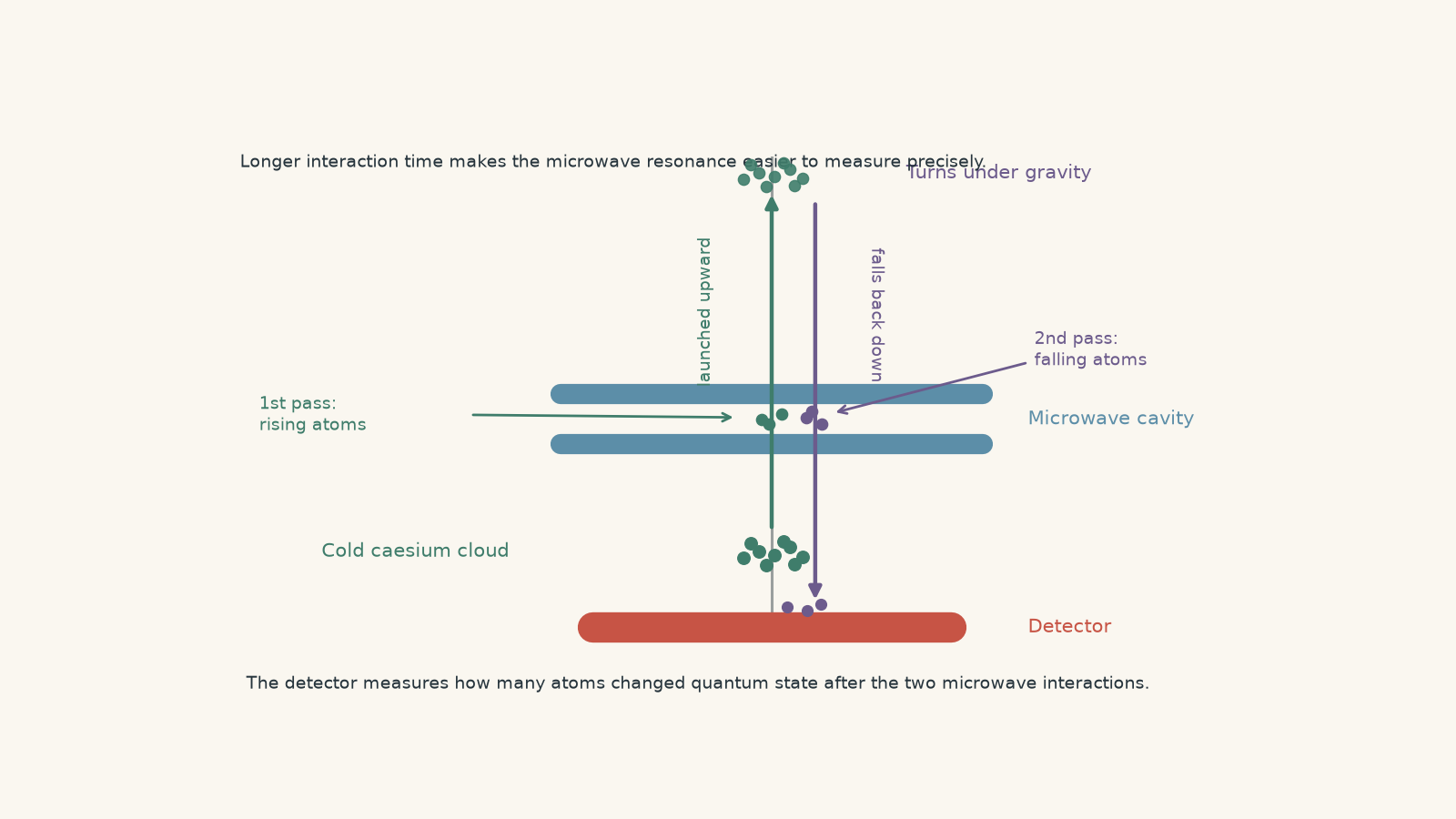
Think of tuning an old radio. You turn the dial until the station comes through most strongly. The caesium atoms provide the reference that tells the clock when its microwave oscillator is correctly tuned.
The analogy breaks because the atoms are not broadcasting a little radio station. Their quantum-state response is being measured to determine how closely the applied microwave frequency matches their natural transition frequency.
The fountain design also improves on older atomic-beam clocks. Hot atoms moving quickly through an apparatus interact with the microwaves for only a short time. Cold atoms moving slowly upwards and downwards can be observed for much longer, allowing the resonance frequency to be identified more sharply.
03Now light can turn time into length
Once a second can be reproduced accurately, suppose you send light through a vacuum for a known time.
The distance is
\[
d=ct,
\]
where:
- \(d\) is distance in metres,
- \(c\) is the speed of light in vacuum, and
- \(t\) is time in seconds.
In modern SI,
\[
c=299\,792\,458\ \text{m s}^{-1}
\]
exactly. The metre is defined by fixing this numerical value of \(c\), with the second already defined using caesium.
This means light travels exactly one metre in
\[
t=\frac{1}{299\,792\,458}
\approx 3.33564\times10^{-9}\ \text{s}.
\]
So a metre corresponds to about \(3.34\) nanoseconds of light travel in vacuum.
That is the basic mental model: an atomic clock supplies an extremely precise time interval, and light converts that interval into a distance.
Worked example: Find a distance from a laser’s return time
A laser pulse is sent towards a reflector and returns to its starting point \(240\ \text{ns}\) later. Assume the pulse travels through vacuum. How far away is the reflector?
Step 1
The pulse travels to the reflector and then back again, so the total distance travelled is \(2d\).
Therefore,
\[
2d=ct.
\]
Step 2
\[
d=\frac{ct}{2}.
\]
Step 3
Since \(240\ \text{ns}=240\times10^{-9}\ \text{s}\),
\[
\begin{aligned}
d
&=\frac{(299\,792\,458)(240\times10^{-9})}{2}\\
&=35.9751\ \text{m}.
\end{aligned}
\]
Step 4
The reflector is approximately
\[
d=36.0\ \text{m}
\]
from the laser.
The common mistake is \(d=ct\), which would give about \(72\ \text{m}\). That result treats the complete out-and-back path as though it were the distance to the reflector.
04An interferometer can use light as a ruler
Time-of-flight is not the only way to turn \(c\) into a measurement of length.
For smaller distances, an interferometer can compare a distance with the wavelength of a laser.
Picture the apparatus in order. A laser beam reaches a beam splitter. Part of the light travels along one arm to a mirror, while the rest travels along a second arm to another mirror. Both beams reflect back to the beam splitter, recombine, and travel towards a detector.
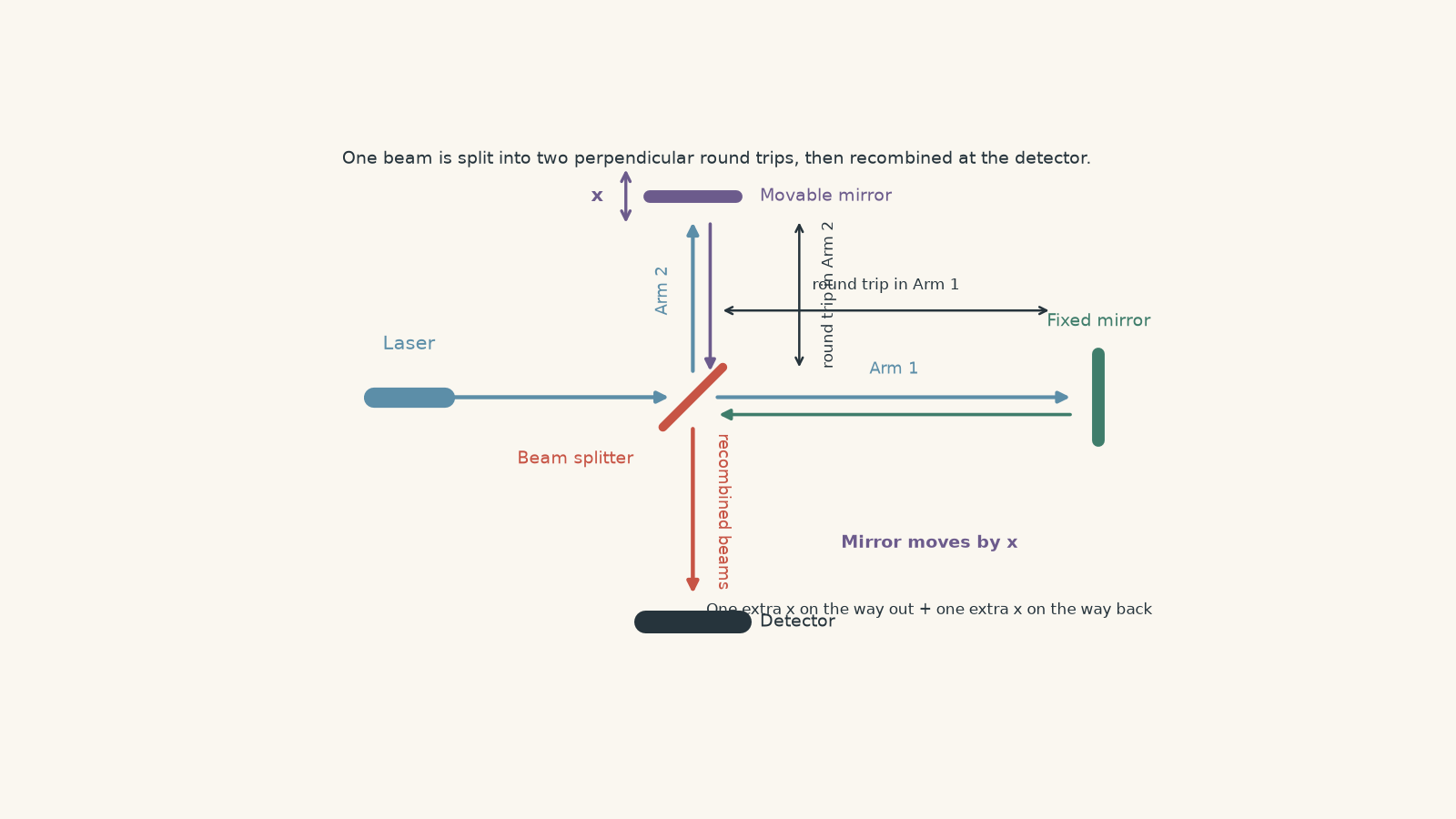
When the returning waves overlap, their electric fields combine. Depending on their relative phase, they produce constructive or destructive interference.
Now predict what happens if one mirror moves a tiny distance \(x\).
The light travels the extra distance once on the way to the mirror and again on the way back. So moving the mirror by \(x\) changes the optical path by \(2x\).
If the path difference changes by one wavelength \(\lambda\), the interference pattern goes through one complete fringe cycle. Therefore, if \(N\) fringes pass the detector,
\[
2x=N\lambda,
\]
so
\[
x=\frac{N\lambda}{2}.
\]
That factor of two is the interferometer version of the same trap we saw in laser ranging: light travels to the mirror and back.
05Where does the wavelength come from?
For electromagnetic waves in vacuum,
\[
c=f\lambda,
\]
where:
- \(c\) is the speed of light in vacuum,
- \(f\) is frequency in hertz, and
- \(\lambda\) is wavelength in metres.
Rearranging,
\[
\lambda=\frac{c}{f}.
\]
This is where modern time and length measurement lock together.
If the laser frequency \(f\) is measured using a frequency standard traceable to the SI second, and \(c\) has its exact SI value, the corresponding vacuum wavelength can be calculated. That wavelength can then be used in interferometry to measure length. This is one practical route connecting an atomic time standard to a physical distance.
Worked example: Turn a laser frequency into a displacement
A stabilised laser has a vacuum frequency of \(4.74\times10^{14}\ \text{Hz}\). In an interferometer, \(790\) complete fringes pass the detector as one mirror moves. Find the mirror displacement.
Step 1
Using
\[
\lambda=\frac{c}{f},
\]
we get
\[
\begin{aligned}
\lambda
&=\frac{299\,792\,458}{4.74\times10^{14}}\\
&=6.32474\times10^{-7}\ \text{m}.
\end{aligned}
\]
So the wavelength is about \(632\ \text{nm}\).
Step 2
Each movement \(x\) changes the round-trip path by \(2x\), so
\[
2x=N\lambda.
\]
Therefore,
\[
x=\frac{N\lambda}{2}.
\]
Step 3
\[
\begin{aligned}
x
&=\frac{790(6.32474\times10^{-7})}{2}\\
&=2.49827\times10^{-4}\ \text{m}.
\end{aligned}
\]
Step 4
\[
x\approx0.250\ \text{mm}.
\]
The important idea is not merely that lasers have tiny wavelengths. The frequency can be connected to the atomic definition of time, and the exact value of \(c\) then fixes the wavelength in metres.
06The strange reversal that happened in 1983
Here is the historical turning point.
Before 1983, physicists could use
\[
c=f\lambda
\]
to experimentally determine the speed of light.
The frequency \(f\) could be measured against an increasingly accurate time standard. The wavelength \(\lambda\) could be measured against the existing definition of the metre.
As laser and frequency-measurement technology improved, measurements of \(c\) became so good that their main limitation was no longer the laser frequency. The limitation was how accurately the existing metre itself could be realised.
That creates an odd situation.
Suppose you are trying to measure \(c\) more accurately, but the largest uncertainty comes from your definition of length. Improving the light experiment does not solve the bottleneck. Your ruler is now the weakest part of the experiment.
By 1983, the General Conference on Weights and Measures noted that stabilised lasers were more reproducible than the krypton-86 length standard and that measurements of light’s frequency and wavelength were giving consistent values of \(c\), with accuracy limited mainly by the existing realisation of the metre. The solution was to reverse the relationship: instead of using the metre to measure \(c\), fix \(c\) and use it to define the metre.
The adopted value was
\[
c=299\,792\,458\ \text{m s}^{-1}.
\]
Why not round that to a prettier \(300\,000\,000\ \text{m s}^{-1}\)?
Because the purpose was not to invent a noticeably different metre. The chosen exact value matched the best existing measurements closely enough that ordinary lengths did not suddenly change when the definition changed. The 1983 resolution specifically considered continuity with the previous metre.
This is an important difference between a measured value and a defined value.
Before the change, experiments asked:
Given our definitions of metres and seconds, what numerical value does \(c\) have?
After the change, the logic became:
We fix the numerical value of \(c\). Given our second, what length counts as one metre?
In 2018, the SI was rewritten more systematically around seven defining constants, with the revised definitions taking effect on 20 May 2019. The physical connection between the metre and the exact value of \(c\) remained.
07So is the speed of light no longer measured?
The number
\[
299\,792\,458\ \text{m s}^{-1}
\]
for \(c\) is exact in SI. There are no extra decimal places waiting to be discovered.
This sounds suspicious at first. How can a physical quantity have no measurement uncertainty?
A useful analogy is the relation
\[
1\ \text{inch}=2.54\ \text{cm}.
\]
That conversion is exact because of how the units are defined. Repeatedly measuring rulers will not uncover a more accurate conversion such as \(2.5399998\ \text{cm}\).
There is an important place where this analogy breaks. The number \(2.54\) is essentially a unit convention. The value chosen for \(c\) came from experimental physics: light’s behaviour had first been measured with great precision, and the fixed numerical value was selected to preserve continuity with existing units.
Defining \(c\) exactly also does not make experimental physics circular in general.
Physicists can still test whether electromagnetic propagation behaves according to relativity, compare resonator frequencies in different orientations, examine whether physical laws show Lorentz-symmetry violations, or measure the speed of light in materials. What they do not do is discover more digits of the SI value of \(c\) by measuring metres divided by seconds whose definitions already incorporate that same value.
08Does the speed of light define the second?
No.
This is one of the most useful distinctions to remember.
| Quantity | What fixes it in modern SI? |
|---|---|
| Second, \(\text{s}\) | Exact caesium-133 transition frequency |
| Speed of light, \(c\) | Exact value \(299\,792\,458\ \text{m s}^{-1}\) |
| Metre, \(\text{m}\) | Obtained from the exact value of \(c\) and the already-defined second |
The chain is therefore
\[
\text{caesium frequency}
\longrightarrow
\text{second}
\longrightarrow
\text{metre using }c.
\]
So why do people say that light connects space and time?
Because once the second is established, \(c\) provides an exact conversion between a time interval and the distance light travels in vacuum during that interval. That link also has much deeper importance in special relativity, where \(c\) connects temporal and spatial coordinates.
But the SI definition itself should not be confused with the physical postulates of relativity. Defining the numerical value of \(c\) does not prove that every inertial observer measures the same vacuum light speed. Relativity is a physical model supported by experiment; the SI definition is a measurement convention built to work with that physics.
09Why does the definition keep saying “in vacuum”?
Light does not travel at \(299\,792\,458\ \text{m s}^{-1}\) through ordinary glass, water, or air.
For a material with refractive index \(n\),
\[
n=\frac{c}{v},
\]
so
\[
v=\frac{c}{n},
\]
where \(v\) is the phase speed of light in that material.
For \(n>1\), \(v<c\).
That does not mean the metre changes when a laser enters glass. The defining constant is the speed of light in vacuum.
A high-precision optical measurement performed in air must therefore account for the refractive index of the air, or the optical path must be evacuated. Otherwise, treating the wavelength as simply
\[
\lambda=\frac{c}{f}
\]
inside the material gives the wrong physical wavelength there.
The vacuum wavelength is
\[
\lambda_0=\frac{c}{f},
\]
while, for a simple medium,
\[
\lambda=\frac{v}{f}
=\frac{c}{nf}
=\frac{\lambda_0}{n}.
\]
Frequency stays the same as the wave crosses a stationary boundary, while its speed and wavelength change.
10Why light was a particularly useful choice
Light sits in an unusually useful position. It is fast, electromagnetic, and can be generated in extremely stable, sharply defined frequencies.
The HSC story underneath this began much earlier. Maxwell’s unification of electricity and magnetism showed that electric and magnetic fields belong to one connected theory. His equations then implied travelling electromagnetic disturbances, explored further in Maxwell’s prediction of electromagnetic waves.
The metrology story comes later. Once lasers, atomic clocks, and frequency measurements became sufficiently precise, electromagnetic waves were not merely something whose speed could be measured. They became part of the machinery used to reproduce the unit of length.
11Four traps worth catching in HSC problems
| Tempting idea | What actually happens |
|---|---|
| “\(c\) is approximately \(3.00\times10^8\ \text{m s}^{-1}\), so that must be its defined value.” | \(3.00\times10^8\) is a convenient approximation. The SI value is exactly \(299\,792\,458\ \text{m s}^{-1}\). |
| “The speed of light defines the second.” | The second is defined through caesium-133. \(c\) then connects that second to the metre. |
| “A reflected pulse taking time \(t\) gives distance \(ct\).” | If \(t\) is the complete return time, the target distance is \(ct/2\). |
| “Moving an interferometer mirror by one wavelength changes the path by one wavelength.” | The beam travels to the mirror and back, so a mirror movement \(x\) changes the path by \(2x\). |
| “Light always travels at \(c\).” | \(c\) is the vacuum speed. Light generally propagates more slowly through materials. |
A useful decision rule is simple: whenever \(c\) appears, first ask what is actually being measured. Is the light in vacuum or a material? Is the given time one-way or round-trip? Is \(c\) being used as a defined constant, or are you discussing the historical experiment that originally determined it?
12Questions and solutions
Question 1
A laser pulse travels through vacuum to a reflector and returns to the source after \(2.00\ \mu\text{s}\).
Calculate the distance from the source to the reflector.
Solution 1
The reflector is approximately \(300\ \text{m}\) from the source.
The measured time is for the complete out-and-back journey, so the total path is \(2d\):
\[
2d=ct.
\]
Therefore,
\[
d=\frac{ct}{2}.
\]
Using \(t=2.00\times10^{-6}\ \text{s}\),
\[
\begin{aligned}
d
&=\frac{(299\,792\,458)(2.00\times10^{-6})}{2}\\
&=299.792458\ \text{m}.
\end{aligned}
\]
To three significant figures,
\[
d=300\ \text{m}.
\]
The tempting mistake is to use \(d=ct\). That gives the total distance travelled by the pulse, not the one-way distance to the reflector.
Question 2
A laser has a vacuum frequency of \(5.00\times10^{14}\ \text{Hz}\). It is used in a Michelson interferometer. As one mirror moves, \(1200\) complete fringes pass the detector.
Calculate:
a. the laser’s vacuum wavelength
b. the distance moved by the mirror.
Assume the optical paths are in vacuum.
Solution 2
The wavelength is \(5.996\times10^{-7}\ \text{m}\), and the mirror moves approximately \(3.60\times10^{-4}\ \text{m}\), or \(0.360\ \text{mm}\).
For part a, use
\[
c=f\lambda.
\]
Therefore,
\[
\begin{aligned}
\lambda
&=\frac{c}{f}\\
&=\frac{299\,792\,458}{5.00\times10^{14}}\\
&=5.99585\times10^{-7}\ \text{m}.
\end{aligned}
\]
For part b, moving the mirror a distance \(x\) changes the round-trip path by \(2x\). If \(N=1200\) fringes pass,
\[
2x=N\lambda.
\]
Hence,
\[
\begin{aligned}
x
&=\frac{N\lambda}{2}\\
&=\frac{1200(5.99585\times10^{-7})}{2}\\
&=3.59751\times10^{-4}\ \text{m}.
\end{aligned}
\]
Therefore,
\[
x\approx0.360\ \text{mm}.
\]
A plausible wrong approach is \(x=N\lambda\). It misses the second journey between the beam splitter and the moving mirror: any mirror displacement changes both the outgoing and returning path.
Question 3
In a late-1970s measurement, a laboratory determines the frequency \(f\) of a stabilised laser using an atomic time standard and its wavelength \(\lambda\) using the existing krypton-86 metre standard. It calculates
\[
c=f\lambda.
\]
Suppose improvements make the uncertainty in \(f\) much smaller than the uncertainty in \(\lambda\).
Explain:
a. which measurement now limits the precision of the calculated value of \(c\)
b. why this situation supports fixing \(c\) and redefining the metre
c. why doing so does not remove all uncertainty from real length measurements.
Solution 3
The wavelength measurement, and therefore the realisation of the old metre, becomes the limiting measurement; fixing \(c\) allows the more reproducible frequency standard to be used to realise length, but practical length measurements still have experimental uncertainty.
For part a, the calculation is
\[
c=f\lambda.
\]
If \(f\) is known much more precisely than \(\lambda\), improving \(f\) further barely improves the final result. The uncertainty associated with \(\lambda\) dominates. Historically, this was essentially the situation recognised before the 1983 redefinition: measurements involving stabilised lasers had reached the point where the existing metre standard was a major limit.
For part b, fixing
\[
c=299\,792\,458\ \text{m s}^{-1}
\]
reverses the calculation. Instead of using \(f\) and \(\lambda\) to determine \(c\), a precisely measured frequency can be used to determine the corresponding vacuum wavelength:
\[
\lambda=\frac{c}{f}.
\]
The stronger time and frequency measurement therefore helps realise the unit of length.
The tempting conclusion is that the new definition somehow made every distance exact. It did not.
For part c, an actual experiment still has uncertainties. A laser frequency is realised with finite experimental accuracy. Mirrors must be aligned. Interference fringes must be counted correctly. Air may need to be removed or its refractive index measured. Thermal expansion can change the object being measured.
The definition of the metre does not have uncertainty from \(c\). A particular realisation or measurement of a length still can.
Question 4
A laser-ranging instrument measures a reflector through air with refractive index
\[
n=1.000270.
\]
Its clock has a fractional frequency error of \(+2.0\times10^{-8}\), meaning it runs fast. During a true time interval \(t\), it therefore reports
\[
t_{\text{reported}}=(1+2.0\times10^{-8})t.
\]
The instrument reports a round-trip time of exactly \(2.000000\ \mu\text{s}\). Its software incorrectly assumes both a perfect clock and vacuum propagation, so it calculates
\[
d_{\text{reported}}=\frac{ct_{\text{reported}}}{2}.
\]
Find the corrected distance to the reflector. Also determine approximately how much the incorrect result differs from the corrected one, and identify which neglected effect matters more.
Solution 4
The corrected distance is approximately \(299.712\ \text{m}\), about \(80.9\ \text{mm}\) less than the instrument’s uncorrected result. The refractive index of the air is by far the larger correction.
The software first reports
\[
\begin{aligned}
d_{\text{reported}}
&=\frac{(299\,792\,458)(2.000000\times10^{-6})}{2}\\
&=299.792458\ \text{m}.
\end{aligned}
\]
However, two assumptions are wrong.
First, the light travels through air at
\[
v=\frac{c}{n}.
\]
Second, because the clock runs fast,
\[
t_{\text{reported}}=(1+\epsilon)t_{\text{true}},
\]
where
\[
\epsilon=2.0\times10^{-8}.
\]
Therefore,
\[
t_{\text{true}}
=\frac{t_{\text{reported}}}{1+\epsilon}.
\]
The true distance is consequently
\[
d_{\text{true}}
=\frac{vt_{\text{true}}}{2}
=\frac{ct_{\text{reported}}}{2n(1+\epsilon)}.
\]
Substituting,
\[
\begin{aligned}
d_{\text{true}}
&=
\frac{(299\,792\,458)(2.000000\times10^{-6})}
{2(1.000270)(1+2.0\times10^{-8})}\\
&\approx299.711530\ \text{m}.
\end{aligned}
\]
So the error in the uncorrected result is
\[
\begin{aligned}
\Delta d
&=299.792458-299.711530\\
&\approx0.080928\ \text{m}\\
&\approx80.9\ \text{mm}.
\end{aligned}
\]
The clock error has fractional size only \(2.0\times10^{-8}\). Over a distance of about \(300\ \text{m}\), that corresponds to only a few micrometres.
The refractive-index correction has fractional size of roughly
\[
n-1=2.70\times10^{-4},
\]
which is more than ten thousand times larger than the clock’s fractional error.
The subtle trap is to think that because \(c\) is exact, using \(c\) must automatically give an exact distance. Exact \(c\) does not rescue an experiment that uses the wrong propagation speed or a miscalibrated clock.
Question 5
A student proposes the following experiment to “check whether the speed of light is still exactly \(299\,792\,458\ \text{m s}^{-1}\)”.
First, they place a mirror some distance away. They measure a vacuum laser pulse’s round-trip time \(t_0\) and define the mirror distance as
\[
L=\frac{ct_0}{2},
\]
using the exact SI value of \(c\).
The next day, with the apparatus unchanged, they measure the same round-trip time \(t_0\) and calculate the speed of light from
\[
v=\frac{2L}{t_0}.
\]
They obtain exactly \(299\,792\,458\ \text{m s}^{-1}\) and claim this is an experimental confirmation of the value of \(c\).
a. Show why their result was guaranteed by their method.
b. Explain what is circular about the claimed test.
c. If \(c\) has an exact SI value, explain how experiments can still test physical claims about the behaviour of light and special relativity.
Solution 5
The experiment does not independently measure \(c\); its second calculation must reproduce the value inserted into the first calculation, so the claimed confirmation is circular.
For part a, the student defined the distance by
\[
L=\frac{ct_0}{2}.
\]
They then calculate
\[
v=\frac{2L}{t_0}.
\]
Substitute the first equation into the second:
\[
\begin{aligned}
v
&=\frac{2(ct_0/2)}{t_0}\\
&=c.
\end{aligned}
\]
The measured time cancels completely. As long as they reuse the same \(t_0\), obtaining \(v=c\) is built into the procedure.
For part b, the distance \(L\) was not established independently of \(c\). It was created from the same light-travel relationship that the student later claims to test.
This is similar to using a calculator to define a mystery number as \(7\times6\), then proudly “measuring” it by dividing \(42\) by \(6\) and announcing that the original \(7\) has been experimentally confirmed. The arithmetic is fine. The independence is missing.
The exact constraint that breaks the student’s reasoning is the calibration step:
\[
L=\frac{ct_0}{2}.
\]
Once \(c\) has been used to assign the numerical length, calculating \(2L/t_0\) with the same timing information cannot provide an independent value of \(c\).
For part c, fixing the SI numerical value of \(c\) does not prevent physicists from testing the physical theory behind light propagation.
A useful experiment could compare dimensionless quantities that do not simply insert \(c\) and recover it again. For example, an experiment might compare the resonant frequencies of carefully controlled optical cavities pointing in different directions, rotate the apparatus, and look for an orientation-dependent change. Other experiments can compare different types of atomic clocks or test relativistic predictions for frequency shifts.
If a reproducible discrepancy appeared after systematic effects were excluded, the correct conclusion would not simply be “the new measured value of \(c\) is \(299\,792\,450\ \text{m s}^{-1}\)”. Under the current SI, the numerical value assigned to \(c\) is exact. Instead, the result would show that some physical assumption used in connecting the experiment, the unit realisation, and the underlying theory needed revision.
That is the conceptual hinge: a defined constant can be exact as part of a unit system while the physical theory that makes that definition useful remains experimentally testable.
The next useful step is therefore special relativity’s deeper claim about \(c\): not its number of metres per second, but why the same invariant speed links measurements of space and time made by different inertial observers.