
How to Perform a Solution Dilution in HSC Chemistry
Learn how to use a volumetric pipette and volumetric flask to prepare an accurate dilution, then identify and explain common experimental errors.
You need 250.0 mL of \(0.100\ \mathrm{mol\,L^{-1}}\) sodium chloride, but the bottle on the bench contains \(1.00\ \mathrm{mol\,L^{-1}}\) \(\ce{NaCl}\). A tempting plan is to measure 25.0 mL of stock solution, add 225.0 mL of water, and call it done.
Predict the problem. Is the chemistry wrong, or is the measuring wrong?
The main problem is the measuring. A good dilution does not depend on measuring the amount of water added. It depends on transferring an accurate amount of solute, then making the whole solution up to an accurate final volume. That is exactly why we use a volumetric pipette and a volumetric flask.
01What a dilution is actually doing
Picture cordial concentrate. You take one accurately measured shot of concentrate, put it into a larger bottle, then add water until the whole drink reaches a fixed volume.
The pipette controls the “shot”. The volumetric flask controls the final volume.
The analogy is useful, but it has a limit. In chemistry, we care about moles of solute, not how cordial-like the liquid looks. We also should not assume that 25.0 mL of one liquid plus 225.0 mL of another will always produce exactly 250.0 mL of solution. The final volume must be measured directly.
Suppose a stock solution has concentration \(c_1\). If a volume \(V_1\) is transferred with a pipette, the number of moles transferred is
\[ n = c_1V_1 \]
where:
- \(n\) is the amount of solute in moles,
- \(c_1\) is the concentration of the stock solution in \(\mathrm{mol\,L^{-1}}\), and
- \(V_1\) is the volume transferred in litres.
Water is then added. Assuming no solute is lost and no reaction occurs, the number of moles of solute does not change.
After dilution,
\[ n = c_2V_2 \]
where \(c_2\) is the new concentration and \(V_2\) is the final solution volume.
Because the same moles appear on both sides,
\[ c_1V_1 = c_2V_2 \]
This equation is not a separate law to memorise. It is just conservation of solute during dilution.
If the units for \(V_1\) and \(V_2\) are the same, they cancel in this equation. For example, both volumes may be in mL. If you return to \(c=n/V\), though, volume must be in litres when concentration is in \(\mathrm{mol\,L^{-1}}\).
For more practice with the calculation itself, see Solution dilution calculations for HSC Chemistry.
02What each piece of glassware controls
A dilution works because different pieces of equipment have different jobs.
| Equipment | Job in the dilution | What it does not do |
|---|---|---|
| Volumetric pipette | Transfers one highly accurate volume of stock solution | Measure the final solution volume |
| Volumetric flask | Sets one highly accurate final solution volume | Measure how much water was added |
| Beaker | Holds a convenient portion of stock solution | Provide an accurate measured volume |
| Dropper | Adds the last few drops near the flask mark | Measure a known volume accurately |
| Pipette filler | Safely draws solution into the pipette | Change the measured volume |
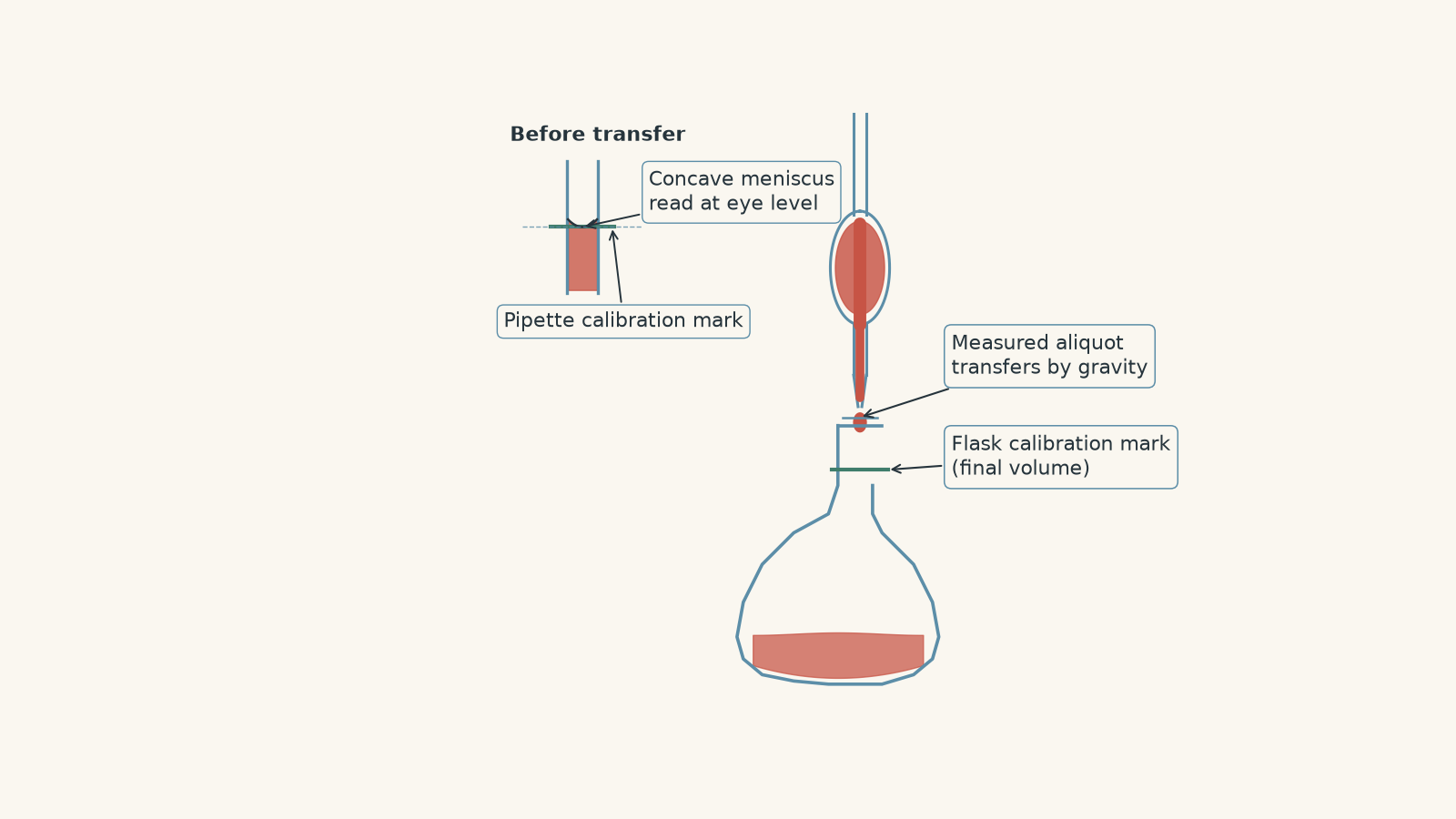
A volumetric pipette usually has one calibration line. It is designed to transfer one particular volume very accurately, such as 10.00 mL or 25.00 mL.
A volumetric flask also has one calibration line. A 250.0 mL flask is designed so that, when the meniscus is correctly positioned on that line, the flask contains the calibrated volume.
That distinction is the whole method: accurate aliquot first, accurate final volume second.
03The correct dilution procedure
Suppose your calculation says you need a 25.00 mL aliquot of stock solution diluted to 250.0 mL.
1. Choose the correct volumetric glassware
Use a 25.00 mL volumetric pipette and a 250.0 mL volumetric flask if those volumes match the calculation.
A measuring cylinder is less appropriate because it is not designed to measure these volumes with the same accuracy.
2. Rinse the volumetric flask with distilled or deionised water
The flask does not have to be dry.
That can feel wrong at first. If there is already some distilled water in the flask, haven’t you added an unknown volume?
Yes, but that unknown volume does not matter. You will eventually add water until the total solution reaches the calibration mark. The flask controls the final volume.
Any clean distilled water already present simply becomes part of that final volume.
3. Rinse, then condition, the pipette
First rinse the pipette with distilled or deionised water if required.
Then rinse it with a small amount of the stock solution. This second rinse is called conditioning the pipette.
Why does the pipette need stock solution when the flask does not?
Predict what happens if a film of pure water remains inside the pipette. When the stock solution enters, that water dilutes it. The pipette may still deliver 25.00 mL of liquid, but that liquid now contains slightly fewer moles of solute than 25.00 mL of the original stock solution should contain.
So:
- distilled water left in the volumetric flask is acceptable,
- distilled water left in the volumetric pipette can create a low concentration error.
This difference is one of the most useful practical ideas to understand rather than memorise.
4. Take stock solution from a small clean beaker
Pour a suitable amount of stock solution into a clean beaker rather than repeatedly placing the pipette into the original stock bottle.
This reduces the chance of contaminating the stock solution.
Do not return unused solution from the beaker to the stock bottle unless your laboratory procedure specifically permits it.
5. Fill the pipette using a pipette filler
Never pipette by mouth.
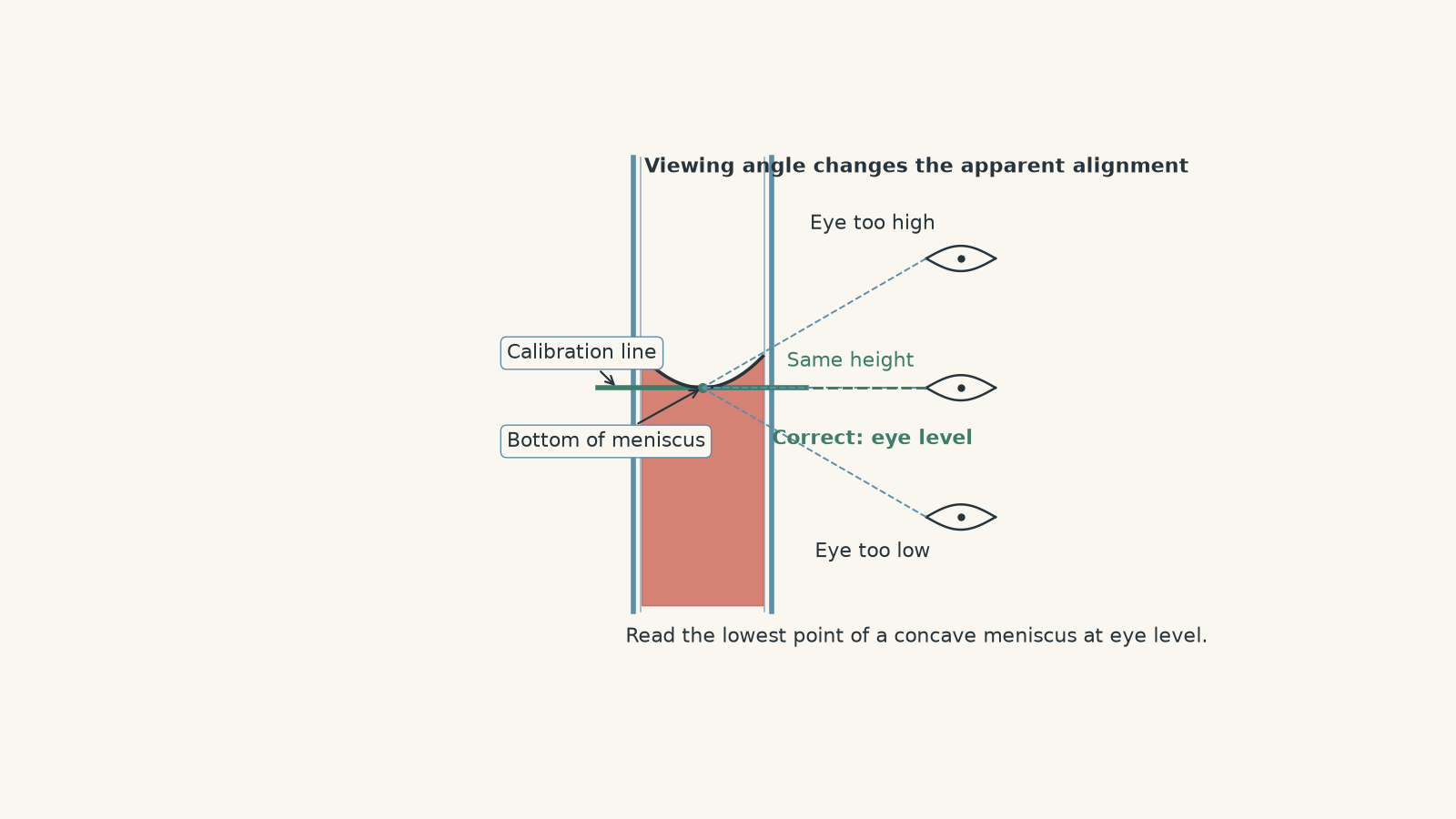
Draw the stock solution above the calibration line, then carefully lower the liquid level until the bottom of the concave meniscus sits on the line.
Your eye should be level with the meniscus. Looking from above or below introduces parallax error.
6. Transfer the aliquot into the volumetric flask
Allow the pipette to drain into the flask according to its calibrated method.
For a standard volumetric pipette, let the liquid drain under gravity. Do not blow out the small amount that remains in the tip unless the pipette is specifically marked as a blow-out pipette.
That leftover liquid can look like wasted solution, but it is normally part of the pipette’s calibration. The pipette has been designed to deliver the stated volume while leaving that residual film behind.
Forcing it out transfers too much stock solution.
7. Add distilled water, but stop well below the mark at first
Add distilled or deionised water until the flask is perhaps two-thirds to three-quarters full.
Swirl the flask gently so the transferred solution begins to mix.
If the dilution causes a noticeable temperature change, allow the solution to return close to the glassware’s calibration temperature before setting the final volume. Volumetric measurements depend slightly on temperature.
8. Approach the calibration mark carefully
Add more water until the liquid is close to the line. Then use a dropper for the final few drops.
Place the flask on a level surface and bring your eye to the height of the calibration line.
For a clear aqueous solution with a concave meniscus, line up the bottom of the meniscus with the mark.
Do not rush the last millimetre. One careless squeeze of a wash bottle can turn an accurate preparation into an overfilled flask.
9. Stopper and mix thoroughly
Once the meniscus is correctly set, stopper the flask and invert it several times.
This step is not decorative.
Immediately after water has been added, the solution may not have uniform concentration throughout the flask. Mixing makes the solution homogeneous, meaning a sample taken from one part should have the same concentration as a sample taken from another.
10. Label the solution
Record the substance, concentration, and any other details required by your laboratory procedure.
04Worked example: Preparing a ten-fold dilution
Prepare 250.0 mL of \(0.100\ \mathrm{mol\,L^{-1}}\) \(\ce{NaCl}\) from a \(1.00\ \mathrm{mol\,L^{-1}}\) stock solution. Determine the volume of stock required and describe how it should be prepared.
Step 1
Dilution changes the volume and concentration, but the moles transferred from the stock remain in the flask.
Use
\[ c_1V_1=c_2V_2 \]
where \(c_1=1.00\ \mathrm{mol\,L^{-1}}\), \(c_2=0.100\ \mathrm{mol\,L^{-1}}\), and \(V_2=250.0\ \mathrm{mL}\).
Step 2
\[ \begin{aligned} V_1 &= \frac{c_2V_2}{c_1}\\ &=\frac{(0.100)(250.0)}{1.00}\\ &=25.0\ \mathrm{mL} \end{aligned} \]
A 25.00 mL volumetric pipette is therefore suitable.
Step 3
Condition the pipette with the \(1.00\ \mathrm{mol\,L^{-1}}\) stock solution, then transfer 25.00 mL into a 250.0 mL volumetric flask.
Step 4
Add distilled water to near the calibration mark, then use a dropper to bring the bottom of the meniscus exactly to the line.
Do not measure 225.0 mL of water. The important quantity is a final solution volume of 250.0 mL.
Step 5
Stopper and invert the flask several times.
The result is approximately \(250.0\ \mathrm{mL}\) of \(0.100\ \mathrm{mol\,L^{-1}}\) \(\ce{NaCl}\). The dilution factor is 10 because the final concentration is one-tenth of the original concentration.
05Why the flask is rinsed with water, not stock solution
This deserves its own example because it catches many students.
Suppose you correctly pipette 25.00 mL of stock solution into a volumetric flask. If the flask already contains some distilled water, those moles of solute are unchanged. You simply add less water later before reaching the mark.
Now imagine the flask was rinsed with stock solution instead, and some stock remained inside.
There are now extra moles of solute in the flask before the measured aliquot even arrives.
The volumetric flask can still give you an accurate final volume, but you no longer know the amount of solute accurately.
Accurate volume does not rescue inaccurate moles.
Worked example: A flask incorrectly rinsed with stock solution
A student wants to prepare 500.0 mL of \(0.0200\ \mathrm{mol\,L^{-1}}\) \(\ce{CuSO4}\) from a \(0.400\ \mathrm{mol\,L^{-1}}\) stock solution.
They correctly calculate that 25.00 mL of stock is required. However, before transferring this aliquot, they rinse the volumetric flask with stock solution and accidentally leave 1.00 mL of stock in the flask.
Assume that all of this remaining stock enters the final solution. What concentration is actually prepared?
Step 1
\[ \begin{aligned} V_1&=\frac{c_2V_2}{c_1}\\ &=\frac{(0.0200)(500.0)}{0.400}\\ &=25.0\ \mathrm{mL} \end{aligned} \]
So the planned 25.00 mL aliquot is correct.
Step 2
There is 25.00 mL from the pipette plus 1.00 mL accidentally left from rinsing.
The total stock-equivalent volume is therefore
\[ 25.00+1.00=26.00\ \mathrm{mL}=0.02600\ \mathrm{L} \]
Step 3
\[ \begin{aligned} n&=cV\\ &=(0.400)(0.02600)\\ &=0.01040\ \mathrm{mol} \end{aligned} \]
Step 4
The flask was still filled correctly to 500.0 mL, or 0.5000 L.
\[ \begin{aligned} c&=\frac{n}{V}\\ &=\frac{0.01040}{0.5000}\\ &=0.02080\ \mathrm{mol\,L^{-1}} \end{aligned} \]
The prepared solution is \(0.02080\ \mathrm{mol\,L^{-1}}\), not \(0.0200\ \mathrm{mol\,L^{-1}}\).
The concentration is 4.0% too high. The flask volume was accurate; the error came from transferring extra, unmeasured moles.
06Evaluating accuracy: ask what happened to moles and volume
When something goes wrong in a dilution, do not try to memorise a giant error table.
Ask two questions:
- Were too many, too few, or the correct number of moles of solute transferred?
- Was the final volume too large, too small, or correct?
Then use the idea
\[ c=\frac{n}{V} \]
More moles with the same volume means a higher concentration. The same moles in a larger volume means a lower concentration.
| Error | Effect on prepared concentration | Why |
|---|---|---|
| Volumetric flask is wet with distilled water | Ideally no systematic change | Final volume is still set to the calibration mark |
| Pipette is wet with distilled water and is not conditioned | Too low | The stock inside the pipette is diluted, so fewer moles are transferred |
| Flask contains residual stock solution | Too high | Extra, unmeasured moles enter the flask |
| Pipette is filled below its calibration line | Too low | Too little stock solution is transferred |
| Air bubble remains in the pipette tip | Usually too low | Part of the nominal pipette volume is occupied by air rather than stock solution |
| A standard volumetric pipette is blown out | Too high | More stock solution is delivered than its calibration intends |
| Flask is filled above the mark | Too low | The intended moles are spread through too large a volume |
| Flask is filled below the mark | Too high | The intended moles occupy too small a volume |
| Meniscus is read with parallax | Could be high or low | The final volume may be misjudged in either direction |
| Solution is not mixed after dilution | Concentration is not uniform | Samples from different parts of the flask may not represent the intended concentration |
That final row is subtle. The average amount of solute divided by the total volume may still be correct, but an individual sample can be wrong because the liquid is not homogeneous yet.
07The most tempting mistake: fixing an overfilled flask by removing solution
Suppose you accidentally go above the volumetric mark.
A common instinct is to remove liquid with a dropper until the meniscus returns to the line.
Will that restore the concentration?
If the solution has already been thoroughly mixed, no.
Imagine the flask contains soup that is slightly too watery. Once the soup is completely mixed, removing one spoonful removes broth and everything dissolved in it in the same proportion. The soup left behind has the same concentration as before.
A homogeneous solution behaves the same way.
If an overfilled solution has concentration \(0.098\ \mathrm{mol\,L^{-1}}\), removing some of that solution does not magically turn what remains into \(0.100\ \mathrm{mol\,L^{-1}}\). You remove solute and solvent together.
For an accurate analytical preparation, the normal response to a significant overshoot is to discard the preparation and make it again.
08Accuracy is more than reading the meniscus carefully
Volumetric glassware itself also has a tolerance.
For example, a pipette might be labelled \(25.00\pm0.03\ \mathrm{mL}\). This means its delivered volume is expected to lie within the stated tolerance when it is used correctly.
A flask may likewise have a tolerance around its stated capacity.
For a dilution,
\[ c_2=c_1\frac{V_1}{V_2} \]
so errors in both measured volumes can affect the final concentration.
A simple conservative estimate of the maximum percentage contribution from the glassware is to add the percentage tolerances:
\[ \text{percentage contribution} \approx \frac{\Delta V_1}{V_1}\times100 + \frac{\Delta V_2}{V_2}\times100 \]
This is a worst-case estimate, not a claim that the actual error must have exactly that size.
Technique can also introduce systematic errors that are much larger than the printed tolerance. A perfectly manufactured pipette will not save a dilution if it contains an air bubble or is used incorrectly.
09Questions and solutions
Question 1
A student transfers 20.00 mL of \(0.750\ \mathrm{mol\,L^{-1}}\) \(\ce{KNO3}\) into a 250.0 mL volumetric flask and dilutes to the mark.
Calculate the final concentration and state the role of the volumetric flask.
Solution 1
The final concentration is \(0.0600\ \mathrm{mol\,L^{-1}}\), and the volumetric flask sets the accurate final solution volume.
Use
\[ c_1V_1=c_2V_2 \]
and rearrange for \(c_2\):
\[ \begin{aligned} c_2&=\frac{c_1V_1}{V_2}\\ &=\frac{(0.750)(20.00)}{250.0}\\ &=0.0600\ \mathrm{mol\,L^{-1}} \end{aligned} \]
The volume units cancel because both \(V_1\) and \(V_2\) were given in mL.
A tempting description is that the flask measures the water added. It does not. It establishes a total solution volume of 250.0 mL.
The moles transferred are fixed by the pipette and stock concentration, while the flask determines the volume through which those moles are distributed.
Question 2
A \(25.00\pm0.03\ \mathrm{mL}\) volumetric pipette is used to transfer a \(0.500\ \mathrm{mol\,L^{-1}}\) stock solution into a \(250.0\pm0.12\ \mathrm{mL}\) volumetric flask.
Assume the stock concentration is exact for this question.
- Calculate the nominal final concentration.
- Find a simple worst-case concentration range caused only by the stated glassware tolerances.
- Explain why this range does not tell you the exact experimental error.
Solution 2
The nominal concentration is \(0.0500\ \mathrm{mol\,L^{-1}}\), with a simple worst-case glassware range of approximately \(0.04992\) to \(0.05008\ \mathrm{mol\,L^{-1}}\).
For the nominal concentration,
\[ \begin{aligned} c_2&=c_1\frac{V_1}{V_2}\\ &=(0.500)\frac{25.00}{250.0}\\ &=0.0500\ \mathrm{mol\,L^{-1}} \end{aligned} \]
To obtain the largest possible concentration allowed by the stated tolerances, use the largest pipette volume and the smallest flask volume:
\[ \begin{aligned} c_{\text{max}} &=(0.500)\frac{25.03}{249.88}\\ &=0.050084\ \mathrm{mol\,L^{-1}} \end{aligned} \]
For the smallest possible concentration, use the smallest pipette volume and largest flask volume:
\[ \begin{aligned} c_{\text{min}} &=(0.500)\frac{24.97}{250.12}\\ &=0.049916\ \mathrm{mol\,L^{-1}} \end{aligned} \]
So a reasonable worst-case range from these tolerances alone is
\[ 0.04992\ \mathrm{mol\,L^{-1}} \lesssim c_2 \lesssim 0.05008\ \mathrm{mol\,L^{-1}} \]
The approximate maximum relative deviation is about \(0.168\%\).
The trap is to interpret the tolerance as the actual error. It is not. We do not know whether either piece of glassware is exactly at one extreme of its tolerance, or even in which direction its small calibration difference lies.
The calculation also assumes perfect technique. Pipette conditioning, meniscus reading, bubbles, temperature, transfer technique, and mixing can introduce additional errors.
Question 3
A student intends to prepare 100.0 mL of \(0.100\ \mathrm{mol\,L^{-1}}\) \(\ce{NaCl}\) by transferring 10.00 mL of \(1.00\ \mathrm{mol\,L^{-1}}\) stock solution.
Consider three separate experiments.
- Experiment A: the volumetric flask is still wet with distilled water before the stock is transferred.
- Experiment B: the pipette is still wet with distilled water and is not conditioned with stock solution.
- Experiment C: the pipette is used correctly, but the student fills the flask to 102.0 mL. They mix the solution thoroughly, then remove 2.0 mL of solution so that 100.0 mL remains.
For each experiment, determine whether the final concentration is correct, too high, or too low. For Experiment C, calculate the final concentration.
Solution 3
Experiment A should still give the correct concentration, Experiment B gives a concentration that is too low, and Experiment C gives \(0.0980\ \mathrm{mol\,L^{-1}}\), which is also too low.
For Experiment A, the water already inside the flask does not add any solute. The final volume is still adjusted to exactly 100.0 mL. The flask simply requires slightly less additional water later.
So the important quantities remain
\[ n=(1.00)(0.01000)=0.0100\ \mathrm{mol} \]
and
\[ V=0.1000\ \mathrm{L} \]
giving the intended concentration.
For Experiment B, residual distilled water inside the pipette mixes with the stock solution. The pipette can still deliver its nominal liquid volume, but that liquid contains fewer moles of \(\ce{NaCl}\) than an undiluted 10.00 mL stock aliquot would contain.
The final volume is correct, but \(n\) is too small. Therefore \(c=n/V\) is too low.
Experiment C contains the more deceptive error.
The correctly transferred moles are
\[ n=(1.00)(0.01000)=0.0100\ \mathrm{mol} \]
but these moles are initially diluted to 102.0 mL:
\[ \begin{aligned} c&=\frac{0.0100}{0.1020}\\ &=0.0980\ \mathrm{mol\,L^{-1}} \end{aligned} \]
Once the solution has been mixed, every 1 mL removed contains solute and water in the same proportion as the rest of the flask.
Removing 2.0 mL therefore reduces both moles and volume by the same fraction. It does not change the concentration.
The tempting route is to think, “The volume is back to 100.0 mL, so the preparation must now be right.” The missing constraint is that some solute was removed along with the excess liquid.
Question 4
A laboratory needs \(0.0120\ \mathrm{mol\,L^{-1}}\) solution from a \(0.600\ \mathrm{mol\,L^{-1}}\) stock solution.
Two routes are possible using the available glassware.
Route A:
- transfer \(5.00\pm0.01\ \mathrm{mL}\) directly into a \(250.0\pm0.12\ \mathrm{mL}\) volumetric flask.
Route B:
- first transfer \(25.00\pm0.03\ \mathrm{mL}\) into a \(250.0\pm0.12\ \mathrm{mL}\) flask,
- then transfer \(20.00\pm0.03\ \mathrm{mL}\) of that diluted solution into a \(100.0\pm0.08\ \mathrm{mL}\) flask.
- Show that both routes give the required nominal concentration.
- Using the sum of relative volume tolerances as a simple worst-case estimate, determine which route has the smaller glassware contribution to uncertainty.
- Explain why the result is not obvious just from noticing that Route B uses larger pipette volumes.
Solution 4
Both routes give \(0.0120\ \mathrm{mol\,L^{-1}}\), but Route A has the smaller stated glassware contribution: about \(0.248\%\) compared with about \(0.398\%\) for Route B.
For Route A, the dilution factor is
\[ \frac{250.0}{5.00}=50.0 \]
so
\[ \begin{aligned} c_2&=\frac{0.600}{50.0}\\ &=0.0120\ \mathrm{mol\,L^{-1}} \end{aligned} \]
For Route B, the first step gives a dilution factor of
\[ \frac{250.0}{25.00}=10.0 \]
and the second gives
\[ \frac{100.0}{20.00}=5.00 \]
The total dilution factor is therefore
\[ 10.0\times5.00=50.0 \]
so Route B also gives
\[ c=\frac{0.600}{50.0}=0.0120\ \mathrm{mol\,L^{-1}} \]
Now compare the relative tolerances.
For Route A,
\[ \begin{aligned} \text{relative contribution} &\approx \frac{0.01}{5.00}\times100 + \frac{0.12}{250.0}\times100\\ &=0.200\%+0.048\%\\ &=0.248\% \end{aligned} \]
For Route B, four calibrated volumes contribute:
\[ \begin{aligned} \text{relative contribution} &\approx \frac{0.03}{25.00}\times100 + \frac{0.12}{250.0}\times100\\ &\quad+ \frac{0.03}{20.00}\times100 + \frac{0.08}{100.0}\times100\\ &=0.120\%+0.048\%+0.150\%+0.080\%\\ &=0.398\% \end{aligned} \]
So Route A has the smaller worst-case glassware contribution under the assumptions given.
The tempting argument for Route B is that larger pipette volumes usually have smaller percentage uncertainties. That part is reasonable: \(0.03\ \mathrm{mL}\) is a smaller fraction of 25.00 mL than \(0.01\ \mathrm{mL}\) is of 5.00 mL.
But Route B requires two separate pipette measurements and two separate flask volumes. Each measurement contributes uncertainty. The extra dilution stage outweighs the advantage of the larger individual pipette volumes in this case.
This comparison concerns only the stated glassware tolerances. Real technique could change the practical result.
Question 5
A student needs 250.0 mL of \(0.1000\ \mathrm{mol\,L^{-1}}\) solution from a \(1.000\ \mathrm{mol\,L^{-1}}\) stock.
They correctly transfer 25.00 mL of stock, but accidentally dilute the solution to 260.0 mL instead of 250.0 mL. They mix the solution thoroughly.
They then remove 10.0 mL of the mixed solution, leaving exactly 250.0 mL.
- Calculate the concentration before and after the 10.0 mL is removed.
- Explain why returning the volume to 250.0 mL does not restore the intended concentration.
- A student suggests a theoretical rescue: remove a volume \(x\) of the incorrect 250.0 mL solution and replace it with exactly the same volume \(x\) of \(1.000\ \mathrm{mol\,L^{-1}}\) stock solution. Calculate \(x\) so that the resulting 250.0 mL solution would have the target concentration.
- Explain why remaking the solution would still normally be the better laboratory procedure.
Assume all stated volumes are exact for the calculation and no solute is lost except through deliberate removal.
Solution 5
After both the overshoot and the first attempted correction, the concentration remains \(0.09615\ \mathrm{mol\,L^{-1}}\). In theory, replacing about \(1.064\ \mathrm{mL}\) of that solution with stock would restore the target concentration, but an accurate preparation should normally be remade.
First calculate the moles originally transferred:
\[ \begin{aligned} n&=cV\\ &=(1.000)(0.02500)\\ &=0.02500\ \mathrm{mol} \end{aligned} \]
Those moles are accidentally diluted to 260.0 mL, or 0.2600 L:
\[ \begin{aligned} c&=\frac{0.02500}{0.2600}\\ &=0.0961538\ \mathrm{mol\,L^{-1}} \end{aligned} \]
So before removal, the concentration is approximately
\[ 0.09615\ \mathrm{mol\,L^{-1}} \]
Now 10.0 mL of the thoroughly mixed solution is removed.
Because the solution is homogeneous, the removed portion has exactly the same concentration as the solution left behind. Removing it therefore does not alter the concentration.
The remaining 250.0 mL is still
\[ 0.09615\ \mathrm{mol\,L^{-1}} \]
Its remaining number of moles is
\[ \begin{aligned} n&=cV\\ &=(0.0961538)(0.2500)\\ &=0.0240385\ \mathrm{mol} \end{aligned} \]
The target 250.0 mL solution needs
\[ \begin{aligned} n_{\text{target}} &=(0.1000)(0.2500)\\ &=0.02500\ \mathrm{mol} \end{aligned} \]
So the flask is short by
\[ 0.02500-0.0240385=0.0009615\ \mathrm{mol} \]
The clever part is that simply adding \(0.0009615\) mol of stock is not enough to solve the replacement problem, because removing \(x\) mL of the incorrect solution first also removes some solute.
Let \(x\) be the volume replaced, measured in litres.
Removing \(x\) litres removes
\[ (0.0961538)x \]
moles.
Replacing it with the same volume of \(1.000\ \mathrm{mol\,L^{-1}}\) stock adds
\[ (1.000)x \]
moles.
The final amount must be \(0.02500\) mol:
\[ 0.0240385-(0.0961538)x+(1.000)x=0.02500 \]
Therefore,
\[ \begin{aligned} 0.9038462x&=0.0009615\\ x&=0.0010638\ \mathrm{L}\\ &=1.064\ \mathrm{mL} \end{aligned} \]
So, under the stated assumptions, replacing approximately 1.064 mL of the incorrect solution with 1.064 mL of stock would mathematically restore the target concentration.
The tempting first answer is that once the flask contains exactly 250.0 mL again, its concentration must be correct. The crucial constraint is that volume alone does not determine concentration. The flask must contain both the correct volume and the correct number of moles.
This theoretical repair is not a good normal preparation method. It requires another accurately measured small volume, adds extra transfer uncertainty, and depends on knowing the size of the original overshoot accurately. In routine quantitative work, remaking the dilution with the correct pipette and volumetric-flask technique gives a cleaner and more defensible result.
Once this distinction between controlling moles and controlling final volume is secure, the same reasoning carries directly into serial dilutions, calibration standards, and quantitative analysis. It also makes the reverse process clearer: when the required concentration must be made from a solid rather than an existing stock solution, the key task becomes accurately fixing the number of moles before making up the final volume, as in preparing a standard solution.