
How Electromagnetic Waves Are Produced and Propagate
Learn how accelerating charges produce electromagnetic radiation, why electric and magnetic fields are transverse, and how waves carry energy through space.
A radio antenna can send energy across kilometres of empty space even though the electrons in the antenna stay inside the metal. So what actually leaves the antenna?
Make a prediction first. Suppose a charged particle simply moves in a straight line at constant velocity. Is that enough to produce an electromagnetic wave? It feels like it should be: moving charge means electricity in motion, and electricity in motion is related to magnetism. But uniform motion is not the key. The charge must accelerate.
That distinction gives us the whole story. Accelerating charges disturb the electromagnetic field around them. Part of that disturbance can detach from the immediate region of the charge and propagate outwards as an electromagnetic wave, carrying energy with it.
01Why acceleration matters
Start with a stationary positive charge. It produces an electric field around itself. We often draw this as arrows pointing radially away from the charge.
Now imagine the charge suddenly accelerates upwards. The nearby electric field responds to the charge’s new motion, but a distant point cannot respond instantly. Information about what the charge has done has to travel outwards.
A useful mental picture is a ridiculously long sheet covered in field arrows. Move one end, and nearby arrows change first. The changed pattern then travels along the sheet. The analogy breaks because an electromagnetic field is not a material sheet, and electromagnetic waves do not require a physical medium. The useful part is simply this: a change at the source reaches distant places later, not instantly.
For electromagnetic radiation, the relevant change is acceleration of charge.
| Motion of a charge | Does it radiate simply because of this motion? | Main idea |
|---|---|---|
| Stationary | No | It can produce an electric field, but there is no outgoing electromagnetic radiation |
| Constant velocity in a straight line | No | Uniform motion alone does not produce radiation |
| Changing speed | Yes | The velocity is changing, so the charge is accelerating |
| Changing direction | Yes | Velocity is a vector, so changing direction is also acceleration |
| Oscillating back and forth | Yes | The charge is continually accelerating |
This last case is especially useful because it is what a simple transmitting antenna does.
A warning about the mental model: the complete field around an accelerating charge has both near-field behaviour associated closely with the source and a radiation component that can carry energy to large distances. For HSC Physics, the important part is the outgoing electromagnetic radiation produced by the accelerating charge.
02How an antenna produces an electromagnetic wave
Consider a straight vertical transmitting antenna connected to an alternating voltage.
The voltage repeatedly drives electrons one way and then the other. They do not leave the antenna and fly towards the receiver. Instead, they oscillate within the conductor.
Because their velocity is continually changing, the electrons are accelerating charges. Their motion produces changing electric and magnetic fields. The radiative part of those changing fields moves away from the antenna.
So the chain is:
- an alternating voltage drives charges back and forth;
- the charges accelerate;
- the electromagnetic field around the charges changes;
- an electromagnetic disturbance propagates away;
- the disturbance carries energy through space.
There is an important trap here. An electron can have zero velocity at one instant and still have a large acceleration.
Think of a ball thrown vertically upwards. At the very top, its velocity is momentarily zero, but its acceleration is still \(9.8\text{ m s}^{-2}\) downwards. An oscillating charge behaves similarly at the ends of its motion: its speed can be zero while its acceleration is greatest.
So “the charge isn’t moving at this instant” does not imply “the charge isn’t producing radiation at this instant”.
03The electric and magnetic fields are transverse
Now picture an electromagnetic wave moving horizontally towards the right.
Which way do its electric and magnetic fields point?
For an ideal plane electromagnetic wave:
- the electric field, \(\mathbf E\), is perpendicular to the direction of propagation;
- the magnetic field, \(\mathbf B\), is also perpendicular to the direction of propagation;
- \(\mathbf E\) and \(\mathbf B\) are perpendicular to each other.
That makes an electromagnetic wave a transverse wave.
Suppose the wave travels in the positive \(x\)-direction. One possible arrangement is:
- propagation: \(+x\);
- electric field: along the \(y\)-axis;
- magnetic field: along the \(z\)-axis.
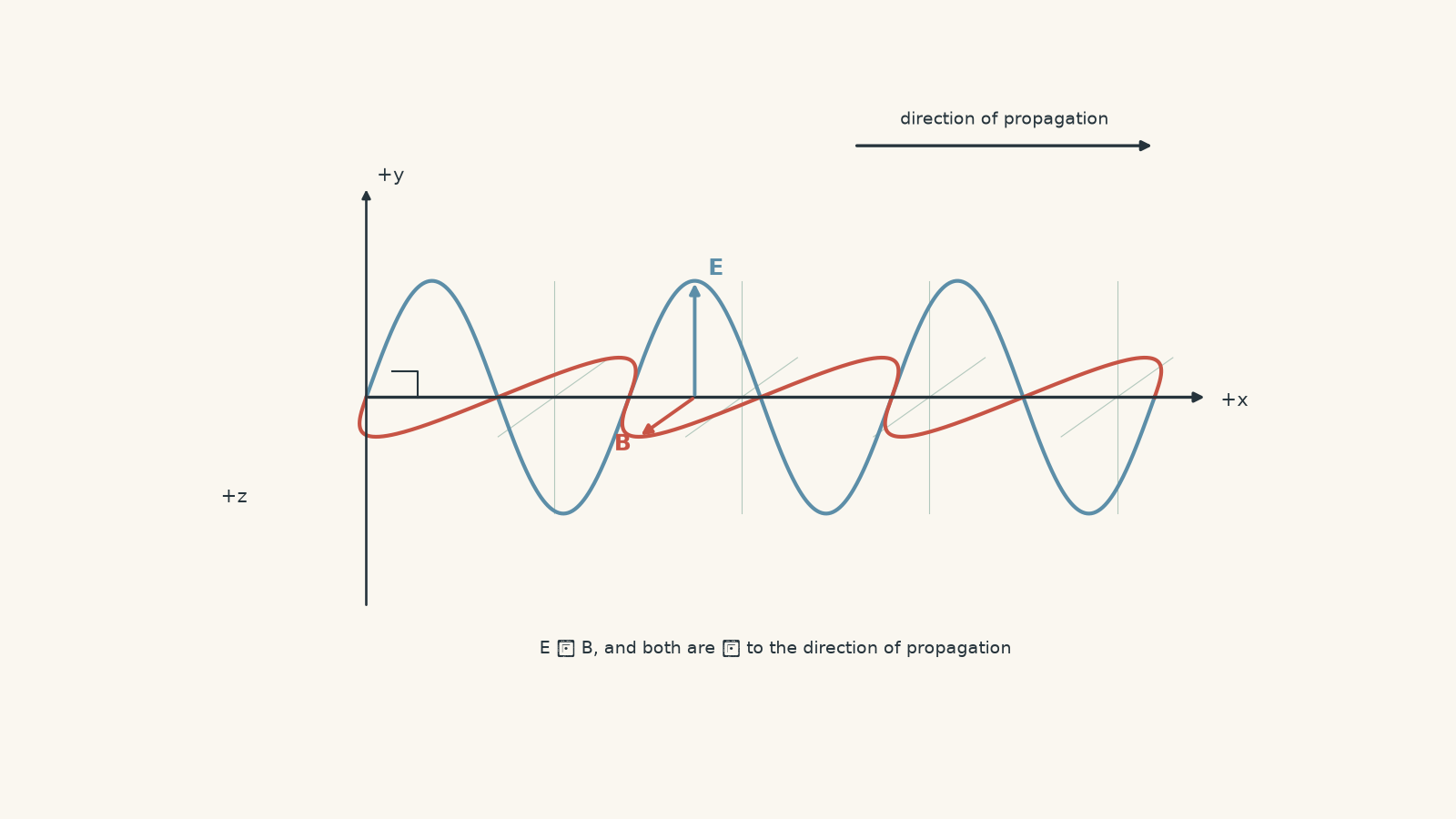
In an ideal sinusoidal plane wave, the electric and magnetic fields oscillate together. When one reverses direction, the other reverses too.
Here’s a useful prediction. Half a cycle later, both \(\mathbf E\) and \(\mathbf B\) have reversed. Does that mean the wave’s energy now travels backwards?
No. The direction of energy flow is associated with the vector direction
\[
\mathbf E \times \mathbf B.
\]
If both fields reverse, then
\[
(-\mathbf E)\times(-\mathbf B)=\mathbf E\times\mathbf B.
\]
So the energy continues travelling in the same direction.
That is easy to miss if you imagine the wave as one wiggly line. There are really two oscillating vector fields, perpendicular to each other and to the direction in which energy propagates.
Worked example: wavelength and field directions
A transmitting antenna produces electromagnetic waves with a frequency of \(96.5\text{ MHz}\). The wave travels east through air, which we approximate as vacuum. At one instant, its electric field points vertically upwards.
Calculate the wavelength and determine the magnetic-field direction at that instant.
Step 1
The prefix mega means \(10^6\), so
\[
f=96.5\times10^6\text{ Hz}.
\]
Step 2
In vacuum,
\[
c=f\lambda,
\]
where:
- \(c=3.00\times10^8\text{ m s}^{-1}\) is the speed of light;
- \(f\) is frequency in hertz;
- \(\lambda\) is wavelength in metres.
Rearranging,
\[
\lambda=\frac{c}{f}
=\frac{3.00\times10^8}{96.5\times10^6}
=3.11\text{ m}.
\]
So the wavelength is
\[
\boxed{\lambda=3.11\text{ m}}.
\]
Step 3
Take east as \(+x\), up as \(+y\), and north as \(+z\).
The wave’s energy travels east, and its electric field points upwards. We need
\[
\mathbf E\times\mathbf B
\]
to point east.
Since
\[
(+y)\times(+z)=+x,
\]
the magnetic field points north at that instant.
The result tells us more than the wavelength. The electric field, magnetic field, and propagation direction form three mutually perpendicular directions.
04How can the wave keep travelling after leaving the antenna?
This is where a common explanation becomes a little too neat.
You may hear that “a changing electric field creates a magnetic field, which creates another electric field, which creates another magnetic field”, as though the two fields are playing an endless game of electromagnetic tag.
That picture can be useful at first, but it should not be taken literally as a sequence of separate events.
Electric and magnetic fields are coupled parts of the electromagnetic field. Maxwell’s equations show that spatially and temporally varying electric and magnetic fields can exist as travelling-wave solutions. Once electromagnetic radiation has been produced, the disturbance does not need a wire, air, or some invisible substance to carry it.
This was one of the major consequences of Maxwell’s prediction of electromagnetic waves: the equations of electricity and magnetism allow waves that propagate through vacuum.
A stadium wave gives one limited analogy. The people do not run around the stadium; the pattern travels while individuals move locally. Similarly, electrons in a transmitting antenna do not travel all the way to the receiver. But the analogy stops there. A stadium wave needs people as a medium. An electromagnetic wave does not.
In vacuum, electromagnetic waves travel at
\[
c=3.00\times10^8\text{ m s}^{-1}.
\]
Their frequency and wavelength are related by
\[
c=f\lambda.
\]
The source determines the frequency. Once the wave is travelling through vacuum, its wavelength follows from that frequency and the fixed value of \(c\).
05What actually travels? Energy does
Suppose a transmitting antenna is turned on, sends a short radio pulse, and is then turned off.
The pulse does not vanish when the antenna stops. Energy that has already been transferred into the electromagnetic field continues moving away from the source.
This is why a receiver some distance away can detect the signal after the transmitter has already changed what it is doing. The receiver responds to the state of the source at an earlier time.
If the transmitter and receiver are separated by distance \(d\), the propagation time in vacuum is
\[
t=\frac{d}{c},
\]
where \(t\) is the travel time in seconds.
Electromagnetic radiation therefore transfers both information and energy with a finite propagation speed.
Energy spreading with distance
Imagine an ideal source radiating equally in every direction.
After travelling a distance \(r\), its energy is spread over the surface of a sphere with area
\[
A=4\pi r^2.
\]
If the source has power \(P\), the average intensity is
\[
I=\frac{P}{4\pi r^2},
\]
where:
- \(I\) is intensity in watts per square metre, \(\text{W m}^{-2}\);
- \(P\) is radiated power in watts;
- \(r\) is distance from the source in metres.
This gives the inverse-square relationship
\[
I\propto\frac{1}{r^2}.
\]
Double the distance, and the same power is spread over four times the area, so the intensity becomes one quarter as large.
Real antennas are not usually isotropic. They can send more power in some directions than others. The spherical model is useful when the question explicitly says that the source radiates uniformly in all directions.
Worked example: energy arriving at a distant receiver
An ideal transmitter radiates \(120\text{ W}\) uniformly in all directions. A receiver is \(40.0\text{ m}\) away.
Calculate:
- the time taken for a change in the transmitted signal to reach the receiver;
- the intensity at the receiver;
- the intensity at \(80.0\text{ m}\).
Step 1
Using
\[
t=\frac{d}{c},
\]
we get
\[
t=\frac{40.0}{3.00\times10^8}
=1.33\times10^{-7}\text{ s}.
\]
So
\[
\boxed{t=1.33\times10^{-7}\text{ s}}.
\]
The receiver responds about \(0.133\,\mu\text{s}\) after the relevant change occurred at the transmitter.
Step 2
For uniform spherical spreading,
\[
I=\frac{P}{4\pi r^2}.
\]
Substituting,
\[
I=\frac{120}{4\pi(40.0)^2}
=5.97\times10^{-3}\text{ W m}^{-2}.
\]
Therefore,
\[
\boxed{I=5.97\times10^{-3}\text{ W m}^{-2}}.
\]
Step 3
The distance has doubled, so we can immediately predict that the intensity should become one quarter as large.
Checking directly,
\[
I=\frac{120}{4\pi(80.0)^2}
=1.49\times10^{-3}\text{ W m}^{-2}.
\]
Thus,
\[
\boxed{I=1.49\times10^{-3}\text{ W m}^{-2}}.
\]
The transmitter has not started producing less power. The energy is simply spread over a larger area.
06Production and propagation are different parts of the story
It helps to separate two questions that students often merge.
How is an electromagnetic wave produced?
An accelerating charge produces a changing electromagnetic field with a radiative component that can carry energy away.
How does the wave propagate once produced?
The electromagnetic disturbance travels through space as mutually perpendicular, varying electric and magnetic fields. In vacuum, it moves at \(c\).
The charge does not need to keep “pushing” the same piece of radiation once that radiation is travelling away.
Think about switching off a torch while its light is halfway to the Moon. Switching off the source prevents later light from being emitted. It cannot reach out and erase light that has already left.
That finite propagation time is not just an inconvenience. It is built into electromagnetism.
07The most tempting misconceptions
“Moving charges produce electromagnetic radiation”
Not quite.
A charge moving at constant velocity does not radiate merely because it is moving. Radiation is associated with acceleration, meaning a change in the charge’s velocity vector.
“If the charge is momentarily stationary, it cannot radiate”
Also false.
At the turning point of an oscillation, velocity can be zero while acceleration is large.
“The electrons travel from the transmitting antenna to the receiving antenna”
They do not.
The electrons in each conductor move locally. The electromagnetic disturbance and its energy propagate through the space between the antennas.
“The electric and magnetic fields point along the direction of travel”
They do not in an ideal electromagnetic wave.
Both fields are transverse. They are perpendicular to the propagation direction and perpendicular to one another.
“When the transmitter switches off, the wave already in space disappears”
It cannot.
The information that the transmitter has switched off must itself propagate outwards. A distant receiver continues detecting the earlier signal until that later change reaches it.
08A compact model to remember
For a simple transmitting antenna, keep this sequence straight:
\[
\text{oscillating charge}
\rightarrow
\text{accelerating charge}
\rightarrow
\text{changing electromagnetic field}
\rightarrow
\text{outgoing electromagnetic wave}
\rightarrow
\text{energy transfer}.
\]
For the propagating wave:
\[
\mathbf E\perp\mathbf B,\qquad
\mathbf E\perp\text{propagation},\qquad
\mathbf B\perp\text{propagation}.
\]
And in vacuum:
\[
c=f\lambda.
\]
Those three ideas – acceleration at the source, transverse fields, and energy propagating at finite speed – do most of the work.
09Questions and solutions
Question 1
A radio antenna causes charges to oscillate at a frequency of \(75.0\text{ MHz}\).
a. Calculate the wavelength of the electromagnetic waves in vacuum.
b. At one instant, a charge in the antenna is moving upwards but slowing down. Is the charge accelerating? Explain why this matters for electromagnetic radiation.
Solution 1
The wavelength is \(4.00\text{ m}\), and the charge is accelerating downwards because its upward velocity is decreasing.
For part a, use
\[
c=f\lambda.
\]
The frequency is
\[
f=75.0\times10^6\text{ Hz}.
\]
Therefore,
\[
\lambda=\frac{c}{f}
=\frac{3.00\times10^8}{75.0\times10^6}
=4.00\text{ m}.
\]
So
\[
\boxed{\lambda=4.00\text{ m}}.
\]
For part b, acceleration means a change in velocity, not merely an increase in speed. The charge is moving upwards but slowing, so its acceleration points downwards.
That acceleration is important because an accelerating charge can produce electromagnetic radiation. The tempting mistake is to ask only whether the charge is moving. Constant-velocity motion is not enough; the velocity vector must be changing.
Question 2
Model a charge as undergoing simple harmonic motion vertically.
At instant A, the charge passes through the centre of its oscillation. Its speed is maximum and its acceleration is zero.
One quarter-cycle later, at instant B, it reaches its upper turning point. Its speed is zero and the magnitude of its acceleration is maximum.
Using the simple accelerating-charge model, compare the radiation being produced at A and B. Explain why judging radiation only from the charge’s instantaneous speed gives the wrong conclusion.
Solution 2
In the idealised accelerating-point-charge model, radiation production is weakest at A and strongest at B, despite the charge moving fastest at A and being momentarily stationary at B.
At A, the charge is passing through equilibrium. In simple harmonic motion,
\[
a=0
\]
at the equilibrium position, even though the speed is maximum.
At B, the charge has reached its turning point. Its speed is
\[
v=0,
\]
but its acceleration has maximum magnitude because the acceleration points back towards equilibrium.
The governing idea is that electromagnetic radiation is linked to acceleration of charge, not simply to its speed.
The tempting route is:
faster charge \(\rightarrow\) more radiation.
That is not the correct criterion. A charge can move quickly with zero acceleration, or be instantaneously stationary with a large acceleration.
There is one further timing detail. A distant observer does not detect “what the charge is doing right now”. The observer detects radiation that left the charge earlier, after a propagation delay of \(d/c\).
Question 3
Two perpendicular transmitting dipoles are located at the same point. One dipole is vertical and the other horizontal.
From \(t=0\), only the vertical dipole transmits. At \(t=40\,\mu\text{s}\), it switches off and the horizontal dipole immediately begins transmitting at the same frequency and power.
Receiver A is \(6.00\text{ km}\) from the transmitter. Receiver B is \(18.0\text{ km}\) away along the same direction. Assume propagation through vacuum, no reflections, and an instantaneous switch.
At \(t=70\,\mu\text{s}\):
a. which dipole’s radiation is Receiver A detecting?
b. which dipole’s radiation is Receiver B detecting?
c. explain why two receivers at the same clock time can detect different states of the transmitter.
Solution 3
At \(70\,\mu\text{s}\), Receiver A detects the horizontal transmission, while Receiver B still detects the vertical transmission.
For Receiver A,
\[
t_A=\frac{d}{c}
=\frac{6.00\times10^3}{3.00\times10^8}
=2.00\times10^{-5}\text{ s}
=20.0\,\mu\text{s}.
\]
At an observation time of \(70\,\mu\text{s}\), Receiver A is therefore detecting radiation emitted at
\[
70-20=50\,\mu\text{s}.
\]
The transmitter switched to the horizontal dipole at \(40\,\mu\text{s}\), so Receiver A detects the horizontal transmission.
For Receiver B,
\[
t_B=\frac{18.0\times10^3}{3.00\times10^8}
=6.00\times10^{-5}\text{ s}
=60.0\,\mu\text{s}.
\]
Receiver B at \(70\,\mu\text{s}\) is detecting radiation emitted at
\[
70-60=10\,\mu\text{s}.
\]
At \(10\,\mu\text{s}\), the vertical dipole was still transmitting. Receiver B therefore detects the vertical transmission.
The key results are
\[
\boxed{\text{Receiver A: horizontal}}
\]
and
\[
\boxed{\text{Receiver B: vertical}}.
\]
The tempting assumption is that every point in space somehow knows the transmitter’s present state. It does not. Each receiver sees a delayed version of the source, with the delay determined by its distance.
The electromagnetic field at a location contains information about what the source was doing at the appropriate earlier time.
Question 4
An ideal isotropic transmitter emits electromagnetic radiation at a constant power of \(600\text{ W}\) for exactly \(10.0\,\mu\text{s}\), then stops completely.
At \(t=1.00\text{ ms}\) after the transmission began, assume the radiation is travelling through vacuum and has suffered no absorption.
a. Calculate the outer radius of the region containing the pulse.
b. Calculate the inner radius and hence the radial thickness of the pulse.
c. Calculate the total electromagnetic energy in the pulse.
d. At that instant, would ideal point receivers located \(299\text{ km}\) and \(296\text{ km}\) from the transmitter be receiving the pulse?
e. Explain why this situation disproves the idea that electromagnetic radiation disappears as soon as the source stops accelerating charges.
Solution 4
At \(1.00\text{ ms}\), the pulse occupies a spherical shell from \(297\text{ km}\) to \(300\text{ km}\), is \(3.00\text{ km}\) thick, and contains \(6.00\times10^{-3}\text{ J}\) of energy. The receiver at \(299\text{ km}\) is inside the pulse, while the receiver at \(296\text{ km}\) is not.
For part a, the front of the pulse was emitted at \(t=0\), so it has travelled for the full \(1.00\text{ ms}\):
\[
r_{\text{outer}}=ct
=(3.00\times10^8)(1.00\times10^{-3})
=3.00\times10^5\text{ m}.
\]
Thus,
\[
\boxed{r_{\text{outer}}=300\text{ km}}.
\]
For part b, the back of the pulse was emitted \(10.0\,\mu\text{s}\) later. At \(t=1.00\text{ ms}\), it has therefore travelled for
\[
1.00\text{ ms}-10.0\,\mu\text{s}
=0.990\text{ ms}.
\]
Hence,
\[
r_{\text{inner}}
=(3.00\times10^8)(0.990\times10^{-3})
=2.97\times10^5\text{ m}
=297\text{ km}.
\]
The pulse thickness is
\[
\Delta r
=300-297
=3.00\text{ km}.
\]
So
\[
\boxed{\Delta r=3.00\text{ km}}.
\]
Notice that the same result follows directly from
\[
\Delta r=c\Delta t
=(3.00\times10^8)(10.0\times10^{-6})
=3.00\times10^3\text{ m}.
\]
For part c, power is energy transferred per unit time:
\[
P=\frac{E}{\Delta t}.
\]
Therefore,
\[
E=P\Delta t
=(600)(10.0\times10^{-6})
=6.00\times10^{-3}\text{ J}.
\]
Thus,
\[
\boxed{E=6.00\times10^{-3}\text{ J}}.
\]
That energy is spread throughout the expanding shell.
For part d, \(299\text{ km}\) lies between \(297\text{ km}\) and \(300\text{ km}\), so that receiver is currently within the pulse.
However,
\[
296\text{ km}<297\text{ km},
\]
so the trailing edge has already passed the receiver at \(296\text{ km}\).
Therefore,
\[
\boxed{299\text{ km: receiving the pulse}}
\]
and
\[
\boxed{296\text{ km: pulse has already passed}}.
\]
The tempting picture is that the field everywhere is somehow attached to the present motion of the antenna. If that were true, switching off the source would make the radiation vanish everywhere simultaneously.
That would require information about the switch-off to travel infinitely fast.
Instead, stopping the source creates a later change in the electromagnetic field. That later change also propagates at \(c\). Radiation emitted earlier continues outwards carrying the energy already supplied by the transmitter.
Question 5
A proton moves in a circular path perpendicular to a uniform magnetic field. Initially, assume its speed is well below the speed of light.
A student argues:
“The proton can’t radiate because its speed is constant. But if it somehow did radiate, that would also be impossible because the magnetic force does no work, so there is nowhere for the radiated energy to come from.”
Suppose classical electromagnetic radiation from the accelerating proton is now included. Assume the energy loss is extremely slow, so the motion can be treated as a sequence of nearly circular orbits.
Determine what happens over time to:
a. the proton’s kinetic energy;
b. its speed;
c. the radius of its orbit;
d. its orbital angular frequency.
Then resolve the apparent contradiction about the magnetic force doing no work.
Solution 5
The proton loses kinetic energy, slows down, spirals to a smaller radius, and – in the non-relativistic, slowly damped approximation – keeps approximately the same orbital angular frequency, \(qB/m\). Its radiated energy comes from its kinetic energy, not from work done by the magnetic field.
First, the student’s claim that the proton is not accelerating is incorrect.
Acceleration is a change in velocity. In circular motion, the magnitude of the velocity can remain nearly constant over one orbit while its direction continually changes. The proton therefore has centripetal acceleration.
An accelerating charge can radiate electromagnetic energy.
For part a, if radiation carries energy away, conservation of energy requires the proton’s mechanical energy to decrease. With no changing gravitational or electric potential energy involved, this means its kinetic energy decreases:
\[
\boxed{K\text{ decreases}}.
\]
Since
\[
K=\frac12mv^2
\]
in the non-relativistic approximation, its speed must also decrease:
\[
\boxed{v\text{ decreases}}.
\]
For a charged particle moving approximately perpendicular to a uniform magnetic field,
\[
qvB=\frac{mv^2}{r},
\]
where \(q\) is the magnitude of the charge, \(v\) is speed, \(B\) is magnetic-field strength, \(m\) is mass, and \(r\) is orbital radius.
Cancelling one factor of \(v\) gives
\[
r=\frac{mv}{qB}.
\]
Since \(m\), \(q\), and \(B\) remain constant while \(v\) decreases,
\[
\boxed{r\text{ decreases}}.
\]
The proton therefore follows an inward spiral rather than repeating exactly the same circle.
Now consider the angular frequency \(\omega\). For nearly circular motion,
\[
\omega=\frac{v}{r}.
\]
Using
\[
r=\frac{mv}{qB},
\]
we obtain
\[
\omega
=\frac{v}{mv/(qB)}
=\frac{qB}{m}.
\]
Therefore,
\[
\boxed{\omega\approx\frac{qB}{m}},
\]
which is approximately constant under the assumptions of the question.
This is the less obvious part. The proton slows down, but its orbit also gets smaller. Those changes compensate in the ratio \(v/r\).
Finally, there is no contradiction with the statement that a magnetic force does no work.
For a magnetic force,
\[
\mathbf F_B=q\mathbf v\times\mathbf B,
\]
so the force is perpendicular to the instantaneous velocity. The magnetic force itself therefore does not supply or remove kinetic energy.
The energy loss occurs because an accelerating charge interacts with its own electromagnetic field and radiates energy. In a more complete description, the associated radiation-reaction effect removes mechanical energy from the particle.
So the energy chain is
\[
\text{proton kinetic energy}
\rightarrow
\text{electromagnetic radiation}
\rightarrow
\text{energy carried away through space}.
\]
The magnetic field bends the trajectory; it is not the energy source.
This question ties together two parts of HSC Physics that are easy to keep in separate boxes: circular motion of charged particles and radiation from accelerating charges. Once you combine them, “constant speed” is clearly not the same thing as “zero acceleration”.
The next useful step is to connect this travelling-field picture to why Maxwell concluded that light itself is electromagnetic radiation. Maxwell’s unification of electricity and magnetism shows how the electric and magnetic ideas developed separately above become one theory.