
The Contact Process Explained: Industrial Sulfuric Acid Production
Learn how the Contact process is used to produce sulfuric acid on an industrial scale. Understand the reactions, catalysts, conditions, and trade-offs behind the process.
Imagine you are running a factory that needs millions of tonnes of sulfuric acid each year. You have a simple chemical goal: turn sulfur dioxide gas into sulfuric acid. The problem is that the fastest possible conditions are not always the best ones. A very hot reaction might make products quickly, but it can also reduce the amount of product you collect. A catalyst can speed things up, but it does not magically change the amount of product at equilibrium.
So how does industry make the right decisions?
The answer is the Contact process, a carefully controlled sequence of reactions used to produce sulfuric acid on a large scale.
01Why sulfuric acid production is a balancing act
Sulfuric acid is one of the most important industrial chemicals. It is used in fertiliser production, mineral processing, batteries, and many chemical manufacturing processes.
The raw material problem is straightforward: sulfur is not directly useful as sulfuric acid. It must be chemically transformed through several stages.
The main challenge is this reaction:
\[ \ce{2SO2(g) + O2(g) <=> 2SO3(g)} \]
Sulfur dioxide, \(\ce{SO2}\), must react with oxygen to form sulfur trioxide, \(\ce{SO3}\). This reaction is reversible, meaning it can move forwards and backwards.
Before looking at the exact conditions, predict something:
If we increase the temperature, will the reaction always produce more sulfur trioxide?
It feels like the answer should be yes because hotter particles move faster and collide more often. That helps the reaction rate, but equilibrium introduces a second idea. If the forward reaction releases heat, increasing temperature actually favours the reverse reaction and reduces the amount of \(\ce{SO3}\) at equilibrium.
Industry has to compromise: choose conditions that make enough product while still producing it quickly.
02The Contact process in four stages
The Contact process can be organised into four main steps:
- Production of sulfur dioxide
- Purification of sulfur dioxide
- Conversion of sulfur dioxide to sulfur trioxide
- Conversion of sulfur trioxide to sulfuric acid
Each stage solves a different problem.
03Stage 1: Producing sulfur dioxide
Sulfur dioxide is usually produced by burning sulfur in oxygen.
\[ \ce{S(s) + O2(g) -> SO2(g)} \]
The sulfur is heated until it reacts with oxygen. The product gas contains sulfur dioxide, but it is not yet ready for the catalyst stage.

04Stage 2: Purifying the sulfur dioxide gas
The next stage is often overlooked by students, but it is essential.
The gas mixture must be cleaned before entering the catalytic converter. Impurities can poison the catalyst by blocking active sites on its surface.
Think of the catalyst like a row of seats at a crowded concert. The reactant molecules need places to sit briefly so the reaction can happen. If unwanted molecules occupy those seats, the useful reaction slows down.
The analogy is not perfect. A catalyst is not simply a surface that holds molecules. It provides an alternative reaction pathway with lower activation energy. But the idea of limited useful spaces helps explain why impurities are a problem.
05Stage 3: Making sulfur trioxide
This is the key equilibrium reaction:
\[ \ce{2SO2(g) + O2(g) <=> 2SO3(g)} \]
The reaction conditions are carefully chosen:
| Factor | Industrial choice | Why? |
|---|---|---|
| Temperature | About \(450^\circ\text{C}\) | A compromise between equilibrium yield and reaction rate |
| Pressure | About 1-2 atm | Higher pressure helps yield, but large pressure increases cost |
| Catalyst | Vanadium(V) oxide, \(\ce{V2O5}\) | Speeds up the reaction without changing equilibrium position |
The forward reaction is exothermic, meaning it releases heat.
\[ \ce{2SO2(g) + O2(g) -> 2SO3(g) + heat} \]
A lower temperature would favour \(\ce{SO3}\) formation, so why not run the factory colder?
Because the reaction would become too slow. A factory producing tiny amounts of sulfur trioxide per hour is not useful.
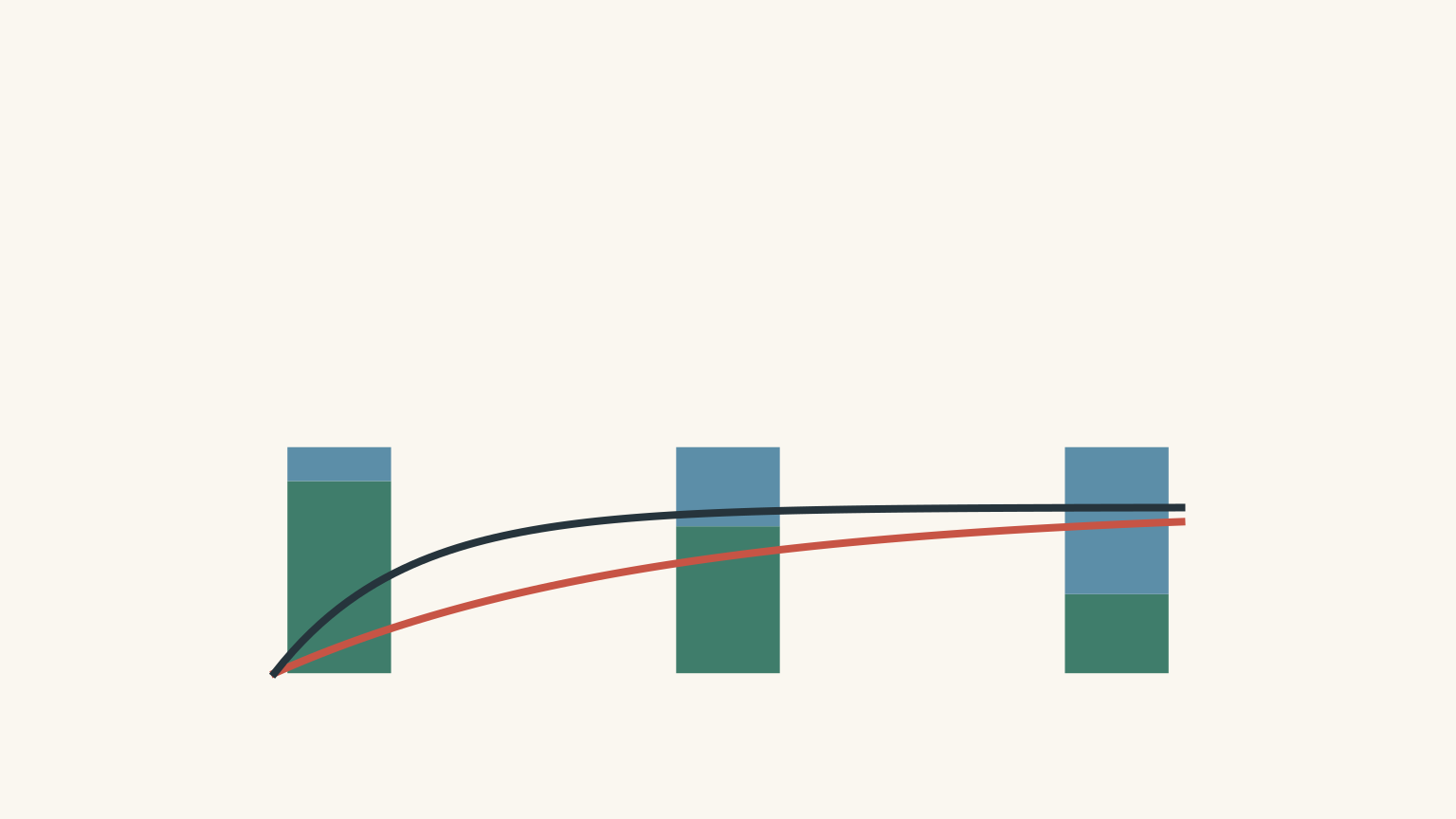
This is the central trade-off of the Contact process:
- Lower temperature: better equilibrium yield, slower reaction
- Higher temperature: faster reaction, lower equilibrium yield
The catalyst helps solve part of the problem. It makes the reaction faster at the chosen temperature, but it does not move the equilibrium towards products.
06Stage 4: Turning sulfur trioxide into sulfuric acid
A common mistake is to think the factory simply mixes sulfur trioxide with water:
\[ \ce{SO3(g) + H2O(l) -> H2SO4(aq)} \]
The reaction is possible, but it creates a dangerous mist of sulfuric acid droplets that is difficult to control.
Instead, sulfur trioxide is absorbed into concentrated sulfuric acid to form oleum:
\[ \ce{SO3(g) + H2SO4(l) -> H2S2O7(l)} \]
Then water is added carefully:
\[ \ce{H2S2O7(l) + H2O(l) -> 2H2SO4(aq)} \]
This gives a controlled production of sulfuric acid.

07How catalysts and equilibrium actually work together
Students often learn:
“A catalyst speeds up a reaction.”
That statement is true, but incomplete.
A catalyst lowers the activation energy for both the forward and reverse reactions. This means both reactions become faster.
It does not:
- increase the percentage yield at equilibrium,
- change the equilibrium constant,
- force more reactants into products.
A useful way to picture it is a race where both teams become faster. The finish line does not move. The balance point stays the same.
08Worked example: Choosing the best temperature
A chemical engineer must choose between two operating temperatures for the reaction:
\[ \ce{2SO2(g) + O2(g) <=> 2SO3(g)} \]
At \(300^\circ\text{C}\), the equilibrium mixture contains more \(\ce{SO3}\), but the reaction is very slow. At \(450^\circ\text{C}\), the reaction is much faster, but the equilibrium mixture contains slightly less \(\ce{SO3}\).
Which temperature is preferred in industry?
Step 1
The forward reaction is exothermic, so a lower temperature favours the products. However, lower temperature reduces the reaction rate.
Step 2
The \(\ce{V2O5}\) catalyst increases the rate of reaction at the chosen temperature. It does not fix the slow rate problem enough at very low temperatures.
Step 3
The preferred temperature is approximately \(450^\circ\text{C}\).
Step 4
Industry accepts a slightly lower equilibrium yield because the faster reaction rate produces more sulfur trioxide over time.
09Worked example: Explaining the effect of pressure
A factory increases the pressure of the sulfur dioxide oxidation reaction:
\[ \ce{2SO2(g) + O2(g) <=> 2SO3(g)} \]
Predict the effect on equilibrium position.
Step 1
The reactant side has:
- 2 moles of \(\ce{SO2}\)
- 1 mole of \(\ce{O2}\)
Total = 3 moles of gas.
The product side has:
- 2 moles of \(\ce{SO3}\)
Total = 2 moles of gas.
Step 2
Increasing pressure favours the side with fewer gas particles.
Step 3
The equilibrium shifts to the right, increasing \(\ce{SO3}\) formation.
Step 4
Very high pressure would require expensive equipment and large energy costs. The improvement in yield is not worth the extra cost.
10Common misconception: “More catalyst means more sulfuric acid”
This sounds reasonable. If a catalyst makes reactions faster, adding more catalyst should create more product.
The missing idea is time versus equilibrium.
More catalyst can help a factory reach equilibrium faster. It can increase the amount of product made in a given time because the process runs faster.
But once equilibrium is reached, the final ratio of reactants and products is unchanged.
The catalyst changes the speed of reaching the destination, not the destination itself.
11Why the Contact process matters beyond sulfuric acid
The Contact process is a model for industrial chemistry decisions.
Chemists are rarely choosing conditions that maximise one factor. They balance:
- reaction rate,
- equilibrium yield,
- energy use,
- safety,
- equipment cost,
- environmental impact.
The same thinking appears in ammonia production, fuel processing, and many other industrial reactions.
Understanding the Contact process gives you a framework for analysing any situation where a chemical reaction has to work outside a laboratory and inside a real factory.
12Questions and solutions
Question 1
Sulfur dioxide reacts with oxygen according to:
\[ \ce{2SO2(g) + O2(g) <=> 2SO3(g)} \]
A student says, “Increasing the amount of \(\ce{V2O5}\) catalyst will increase the equilibrium yield of sulfur trioxide.”
Is the student correct?
Solution 1
No, the student is incorrect. A catalyst increases the rate at which equilibrium is reached, but it does not change the equilibrium position.
The tempting idea is that a faster reaction must produce more product. However, the catalyst speeds up both the forward and reverse reactions. The final equilibrium mixture contains the same proportions of \(\ce{SO2}\), \(\ce{O2}\), and \(\ce{SO3}\).
A larger amount of catalyst may allow the factory to produce sulfur trioxide faster, but it will not increase the percentage yield at equilibrium.
Question 2
A Contact process plant accidentally operates the sulfur dioxide oxidation stage at \(700^\circ\text{C}\) instead of \(450^\circ\text{C}\).
Predict two effects this would have on the process.
Solution 2
The plant would produce sulfur trioxide faster but with a lower equilibrium yield.
The forward reaction is exothermic:
\[ \ce{2SO2(g) + O2(g) <=> 2SO3(g) + heat} \]
Increasing temperature adds heat to the system. According to Le Chatelier’s principle, the equilibrium shifts left to remove the added heat, reducing the amount of \(\ce{SO3}\) formed.
At the same time, higher temperature increases particle kinetic energy, increasing the rate of collisions. The reaction happens faster, but the final amount of product is lower.
Question 3
A factory removes sulfur trioxide from the reaction vessel as it forms.
Explain why this can increase sulfur trioxide production.
Solution 3
Removing sulfur trioxide shifts the equilibrium to the right, increasing sulfur trioxide production.
The reaction is:
\[ \ce{2SO2(g) + O2(g) <=> 2SO3(g)} \]
When \(\ce{SO3}\) is removed, the amount of product decreases. The system responds by making more \(\ce{SO3}\) to oppose this change.
The trap is thinking that removing product only reduces production because there is less product present. In an equilibrium system, the removal creates a new imbalance, causing more forward reaction.
Question 4
A chemical engineer suggests operating the Contact process at very high pressure because the product side contains fewer gas molecules.
Evaluate this suggestion.
Solution 4
Very high pressure would increase sulfur trioxide yield, but it is not the best industrial choice because the extra cost and complexity outweigh the benefit.
The reaction:
\[ \ce{2SO2(g) + O2(g) <=> 2SO3(g)} \]
has 3 moles of gas on the left and 2 moles on the right. Increasing pressure favours the right side, so yield increases.
However, industrial chemistry considers more than equilibrium. High-pressure equipment is expensive, requires more energy, and introduces additional safety challenges. The Contact process therefore uses only moderate pressure because it gives a practical balance between yield and cost.
Question 5
A factory manager proposes two changes:
- increase the amount of \(\ce{V2O5}\) catalyst,
- lower the operating temperature from \(450^\circ\text{C}\) to \(250^\circ\text{C}\).
The manager argues both changes should increase sulfuric acid production because both “help the reaction move towards products”.
Assess this reasoning.
Solution 5
The reasoning is partly incorrect because only the temperature change affects the equilibrium position, and it does not necessarily improve overall production.
Adding more \(\ce{V2O5}\) catalyst will increase the rate of reaching equilibrium, but it will not shift equilibrium towards \(\ce{SO3}\). It helps the factory reach its operating conditions faster.
Lowering the temperature does favour the forward reaction because the reaction is exothermic. More \(\ce{SO3}\) would be present at equilibrium. However, at \(250^\circ\text{C}\), the reaction rate becomes much slower, even with a catalyst.
The tempting route is to treat “more product at equilibrium” as the only goal. Industrial production depends on the amount of sulfuric acid produced per unit time while keeping costs reasonable. The chosen \(450^\circ\text{C}\) condition is a compromise because it gives a practical production rate with a high enough yield.
The next step after understanding the Contact process is applying the same equilibrium ideas to other industrial reactions, where temperature, pressure, catalysts, and economics must all be considered together.