
How to Read Gravitational Energy Graphs for Escape Speed
Learn how gravitational potential energy, kinetic energy, and total mechanical energy curves reveal whether an object can escape a planet. Follow worked examples to interpret energy changes, identify turning points, and avoid common graph-reading mistakes.
A probe is fired straight away from a planet at exactly escape speed. Gravity keeps pulling it backwards, so its kinetic energy falls as it climbs. Does it eventually stop at some enormous but finite distance, or can it keep moving while its speed approaches zero?
Predict before reading on. If the probe stops at a finite distance, its kinetic-energy curve must reach zero at that point. But for a probe launched at exactly escape speed, there is no finite turning point. Its kinetic energy approaches zero only as its distance from the planet approaches infinity.
The reason becomes clear when you read gravitational potential energy, kinetic energy, and total mechanical energy together on the same graph.

01Start with the gravitational potential energy curve
Imagine climbing out of a deep valley. The higher you climb, the more energy you need, and the less energy you have available for running.
A probe escaping a planet behaves in a related way. As it moves away, its kinetic energy is converted into gravitational potential energy. However, gravity becomes weaker with distance, so the potential energy gained per additional metre also decreases.
To describe this precisely, we need to choose a zero for gravitational potential energy.
Why is gravitational potential energy negative?
For an object outside a spherical planet, we usually choose gravitational potential energy to be zero at infinity. With this convention,
\\[ U=-\frac{GMm}{r} \\]
where:
- \\(U\\) is gravitational potential energy, measured in joules (J).
- \\(G\\) is the universal gravitational constant, approximately \\(6.67\times10^{-11}\ \mathrm{N\,m^2\,kg^{-2}}\\).
- \\(M\\) is the planet’s mass, in kilograms.
- \\(m\\) is the object’s mass, in kilograms.
- \\(r\\) is the distance from the planet’s centre to the object, in metres.
The negative sign is important. At any finite distance, the object has negative gravitational potential energy relative to infinity.
As \\(r\\) increases, \\(U\\) becomes less negative and approaches zero.
For example, if the potential energy changes from \\(-800\ \mathrm{J}\\) to \\(-400\ \mathrm{J}\\), it has increased by \\(400\ \mathrm{J}\\). Its magnitude has decreased, but its numerical value has increased.
This is not a contradiction. The zero is a reference point, not a claim that potential energy must always be positive.
The potential energy curve therefore has three important features:
- It lies below the horizontal axis.
- It rises as distance from the planet’s centre increases.
- It approaches zero asymptotically, rather than reaching zero at a finite distance.

One detail is easy to miss: the horizontal axis measures distance from the planet’s centre, not height above its surface. If the planet has radius \\(R\\) and the object is at height \\(h\\), then \\(r=R+h\\).
The potential energy at a given \\(r\\) depends on the planet, the object’s mass, and its position. It does not depend on how fast the object is moving.
That means two probes of the same mass at the same distance have the same gravitational potential energy, even if one is escaping and the other is about to fall back.
02What the graph looks like at exactly escape speed
Now add kinetic energy and total mechanical energy to the graph.
Kinetic energy is the energy associated with motion:
\\[ K=\frac12 mv^2 \\]
Here, \\(K\\) is kinetic energy and \\(v\\) is the object’s speed.
When only gravity does work, total mechanical energy is conserved:
\\[ E=K+U \\]
The total energy \\(E\\) remains constant, even though \\(K\\) and \\(U\\) change.
Deriving the escape-speed condition
Suppose a probe starts at the planet’s surface, where \\(r=R\\), and is launched directly outwards.
At exactly escape speed, the probe just manages to reach infinity with its speed approaching zero. At infinity, both its kinetic energy and gravitational potential energy approach zero.
Therefore, its total mechanical energy must be zero throughout the motion:
\\[ E=K+U=0 \\]
At the surface, this gives
\\[ \begin{aligned} \frac12 mv_{\mathrm{esc}}^2 -\frac{GMm}{R}&=0\\\\[4pt] \frac12 mv_{\mathrm{esc}}^2 &=\frac{GMm}{R}\\\\[4pt] v_{\mathrm{esc}}&=\sqrt{\frac{2GM}{R}} \end{aligned} \\]
The symbol \\(v_{\mathrm{esc}}\\) represents escape speed. Notice that the probe’s mass \\(m\\) cancels, so the escape speed does not depend on the mass of the escaping object.
More importantly for our graph, the condition \\(E=0\\) means
\\[ K+U=0 \\]
so
\\[ K=-U=\frac{GMm}{r} \\]
This single relationship explains the entire escape-speed graph.
- Gravitational potential energy: \\(U=-GMm/r\\), below zero and increasing towards zero.
- Kinetic energy: \\(K=GMm/r\\), above zero and decreasing towards zero.
- Total mechanical energy: \\(E=0\\), a constant horizontal line coinciding with the horizontal axis.
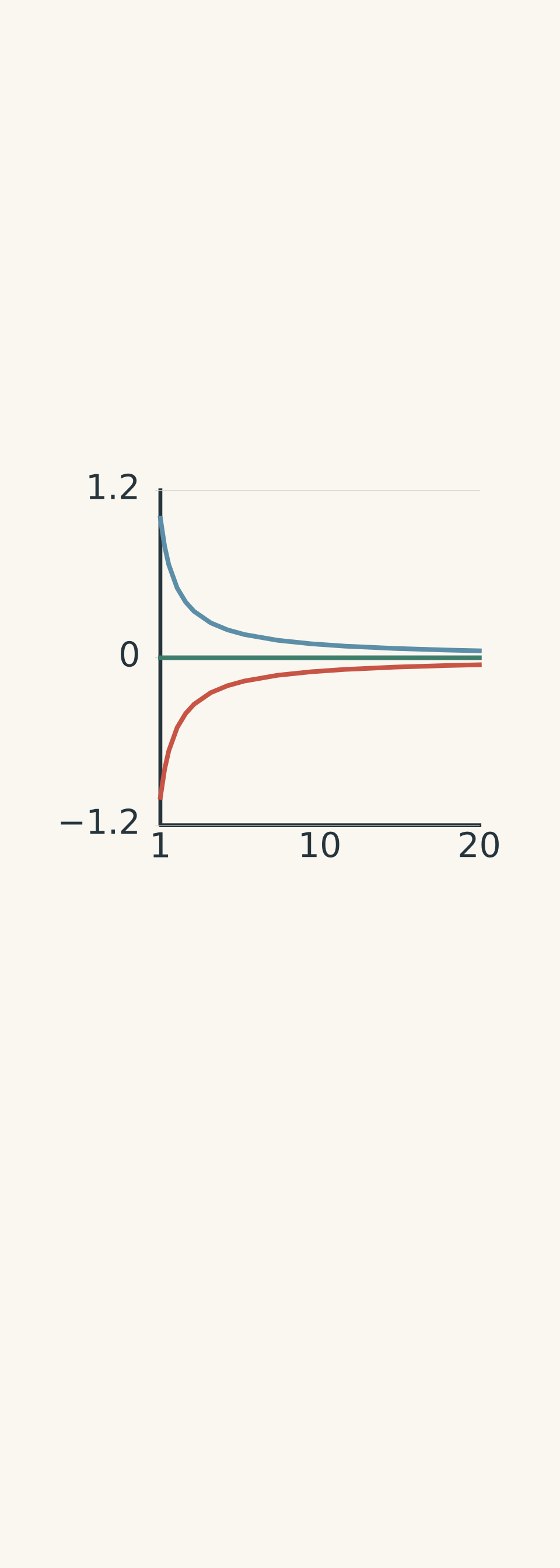
The curves are mirror images across the zero-energy line because their values are equal in magnitude and opposite in sign.
At every finite distance, the probe still has positive kinetic energy. It continues moving outwards, but more slowly.
As \\(r\\) approaches infinity, both \\(K\\) and \\(U\\) approach zero. The total energy remains zero throughout.
The key insight: escape speed is the boundary between escaping and remaining gravitationally bound. At exactly escape speed, the object has just enough energy to reach arbitrarily large distances, with its speed tending to zero at infinity.
Worked example: Reading an escape-speed graph
A planet has mass \\(4.0\times10^{24}\ \mathrm{kg}\\) and radius \\(5.0\times10^6\ \mathrm{m}\\). A \\(100\ \mathrm{kg}\\) probe is launched from its surface at exactly escape speed. Calculate the escape speed, then determine the probe’s kinetic energy, gravitational potential energy, and total mechanical energy at \\(r=2R\\).
Step 1: Calculate the escape speed.
Use the escape-speed equation:
\\[ v_{\mathrm{esc}}=\sqrt{\frac{2GM}{R}} \\]
Substituting the given values,
\\[ \begin{aligned} v_{\mathrm{esc}} &=\sqrt{ \frac{2(6.67\times10^{-11})(4.0\times10^{24})} {5.0\times10^6} }\\\\[5pt] &=1.03\times10^4\ \mathrm{m\,s^{-1}} \end{aligned} \\]
The escape speed is approximately \\(10.3\ \mathrm{km\,s^{-1}}\\).
Step 2: Find the gravitational potential energy at \\(r=2R\\).
First, calculate the magnitude of the gravitational potential energy at the surface:
\\[ \begin{aligned} A&=\frac{GMm}{R}\\ &=\frac{(6.67\times10^{-11}) (4.0\times10^{24})(100)} {5.0\times10^6}\\ &=5.34\times10^9\ \mathrm{J} \end{aligned} \\]
At twice the planet’s radius, the potential energy is
\\[ \begin{aligned} U&=-\frac{GMm}{2R}\\ &=-\frac{A}{2}\\ &=-2.67\times10^9\ \mathrm{J} \end{aligned} \\]
The negative sign tells us that the probe is still gravitationally bound to the planet’s potential well, even though it is escaping.
Step 3: Find the kinetic energy.
Because the probe is on an exact escape trajectory, \\(E=0\\). Therefore,
\\[ \begin{aligned} K&=E-U\\ &=0-(-2.67\times10^9)\\ &=2.67\times10^9\ \mathrm{J} \end{aligned} \\]
Step 4: State the total energy and interpret the result.
The three energy values at \\(r=2R\\) are
| Energy | Value |
|---|---|
| Kinetic energy, \\(K\\) | \\(+2.67\times10^9\ \mathrm{J}\\) |
| Potential energy, \\(U\\) | \\(-2.67\times10^9\ \mathrm{J}\\) |
| Total energy, \\(E\\) | \\(0\ \mathrm{J}\\) |
The probe is still moving. Its kinetic energy has halved compared with its value at the surface, but its speed has fallen only by a factor of \\(1/\sqrt{2}\\).
This is a useful distinction: kinetic energy is proportional to \\(v^2\\), not \\(v\\).
03Why kinetic energy decreases: work and signs
Suppose the probe moves outwards from a position \\(r_1\\) to a greater distance \\(r_2\\).
Its gravitational potential energy changes by
\\[ \Delta U=U_2-U_1 \\]
Because potential energy increases as the probe moves outwards, \\(\Delta U\\) is positive.
The work done by gravity is the negative of the change in gravitational potential energy:
\\[ W_g=-\Delta U \\]
Therefore, \\(W_g\\) is negative during outward motion.
Why? Gravity acts towards the planet, while the probe’s displacement is away from it. The force and displacement point in opposite directions, so gravity does negative work.
If gravity is the only force doing work, the work-energy theorem gives
\\[ \Delta K=W_g=-\Delta U \\]
So as potential energy increases, kinetic energy decreases by the same amount. Nothing has been lost from the total mechanical energy.

A common mistake is to say that gravity does positive work because the probe is moving away from the planet. The direction of motion alone does not determine the sign of work. You must compare the direction of the force with the displacement.
Use this quick rule:
- Moving outwards under gravity alone: \\(U\\) increases, \\(K\\) decreases, and \\(E\\) stays constant.
- Moving inwards under gravity alone: \\(U\\) decreases, \\(K\\) increases, and \\(E\\) stays constant.
These rules apply to the signs of the energy changes, not to whether the energies themselves are positive or negative.
04What changes when the probe is launched below escape speed?
Now imagine launching the same probe more slowly.
It still starts with kinetic energy, and gravity still converts some of that kinetic energy into gravitational potential energy as the probe climbs. But this time, the probe does not have enough total energy to reach infinity.
The total mechanical energy is
\\[ E=\frac12 mv_0^2-\frac{GMm}{R} \\]
where \\(v_0\\) is the launch speed.
If \\(v_0\\) is less than escape speed, then
\\[ E<0 \\]
This negative total energy changes the shape of the energy graph’s horizontal reference line. The gravitational potential energy curve itself does not change.
The total-energy line now sits below zero. The kinetic-energy curve is still given by
\\[ K=E-U \\]
As the probe moves outwards, its kinetic energy decreases until it reaches zero at a finite distance.
At that point,
\\[ K=0 \\]
and hence
\\[ E=U=-\frac{GMm}{r_{\max}} \\]
Here, \\(r_{\max}\\) is the maximum distance from the planet’s centre for a straight, radial launch. Rearranging gives
\\[ r_{\max}=\frac{GMm}{|E|} \\]
The probe momentarily comes to rest, then reverses direction and falls back towards the planet.
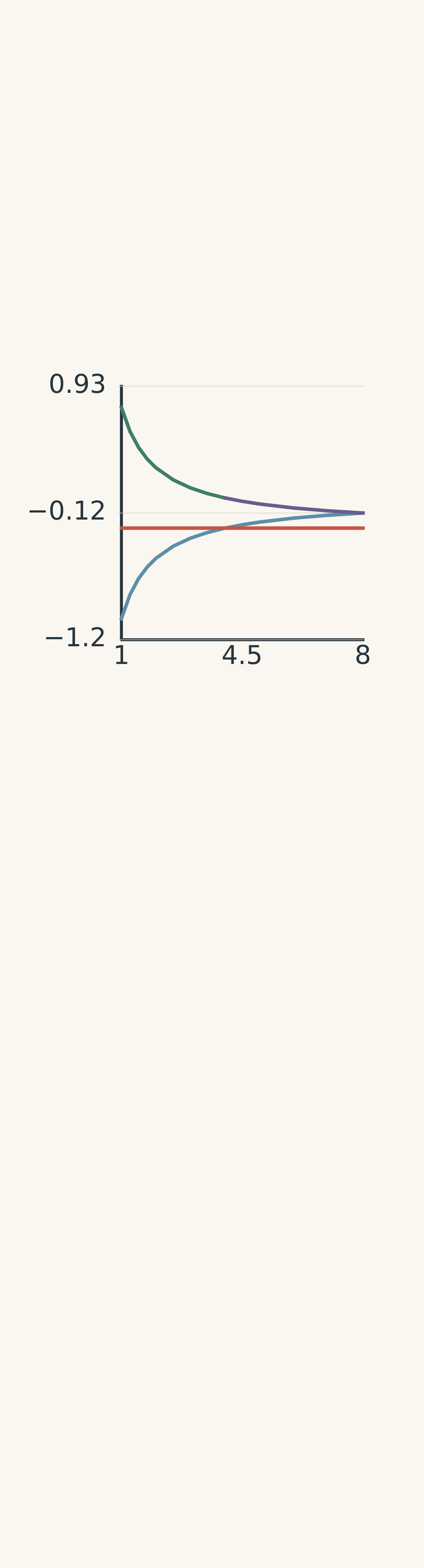
The graph gives a useful way to distinguish three cases:
| Total mechanical energy | What happens as the probe moves outwards? |
|---|---|
| \\(E<0\\) | It reaches a finite maximum radius and cannot escape. |
| \\(E=0\\) | It approaches infinity with its speed tending to zero. |
| \\(E>0\\) | It can escape with positive kinetic energy remaining at infinity. |
For the bound case, do not interpret a mathematical extension of the kinetic-energy curve below zero as real motion. Physical kinetic energy cannot be negative. The region where \\(K<0\\) is inaccessible for that total energy.
Worked example: Finding the maximum radius of a bound probe
Using the same planet and probe as in the previous example, suppose the probe is launched at \\(0.80v_{\mathrm{esc}}\\). Find its maximum distance from the planet’s centre.
Step 1: Calculate its kinetic energy at launch.
Let \\(A=GMm/R=5.34\times10^9\ \mathrm{J}\\), as calculated earlier.
Since kinetic energy is proportional to the square of speed,
\\[ \begin{aligned} K_0&=\frac12m(0.80v_{\mathrm{esc}})^2\\ &=(0.80)^2A\\ &=0.64A\\ &=3.42\times10^9\ \mathrm{J} \end{aligned} \\]
Step 2: Calculate the total mechanical energy.
At the surface, \\(U_0=-A\\). Therefore,
\\[ \begin{aligned} E&=K_0+U_0\\ &=0.64A-A\\ &=-0.36A\\ &=-1.92\times10^9\ \mathrm{J} \end{aligned} \\]
The total energy is negative, so the probe cannot escape.
Step 3: Use the turning-point condition.
At maximum radius, the probe’s kinetic energy is zero. Its total energy equals its gravitational potential energy:
\\[ \begin{aligned} E&=-\frac{GMm}{r_{\max}}\\\\[4pt] r_{\max}&=\frac{GMm}{|E|}\\\\[4pt] &=\frac{AR}{0.36A}\\\\[4pt] &=\frac{R}{0.36} \end{aligned} \\]
Substituting \\(R=5.0\times10^6\ \mathrm{m}\\),
\\[ r_{\max}=2.78R =1.39\times10^7\ \mathrm{m} \\]
The probe reaches a maximum centre-to-centre distance of approximately \\(1.39\times10^7\ \mathrm{m}\\), then falls back. The result is a distance from the centre, not a height above the surface.
Notice how close the launch speed is to escape speed. A launch at \\(80\%\\) of escape speed still gives a maximum radius of almost three times the planet’s radius. The relationship between launch speed and maximum distance is not linear.
05A reliable checklist for reading energy graphs
When you face an unfamiliar gravitational energy graph, work through these checks in order.
1. Check the axes and reference level.
The horizontal axis should give distance \\(r\\) from the planet’s centre. Check where \\(U=0\\) is defined. For the graphs in this guide, it is at infinity.
2. Identify the total-energy line.
If only gravity does work, \\(E=K+U\\) is constant, so the total-energy graph is horizontal. It lies at zero for exact escape speed and below zero for a bound radial launch.
3. Read kinetic energy from the energy balance.
Use \\(K=E-U\\). At a given distance, the vertical difference between the total-energy line and the potential-energy curve gives the kinetic energy. Only regions with \\(K\geq0\\) are physically allowed.
4. Find the turning point.
For a radial launch, the probe turns where \\(K=0\\), which means \\(E=U\\). A negative total energy produces a finite turning radius; zero total energy gives the escape limit at infinity.
5. Check work and signs.
During outward motion under gravity alone, \\(\Delta U>0\\), \\(W_g<0\\), and \\(\Delta K<0\\). The total mechanical energy stays constant.
One final qualification: these turning-point sketches assume a radial launch, with no sideways velocity. If an object has tangential motion, its distance from the planet can reach a maximum while it still has tangential kinetic energy. The escape criterion based on total mechanical energy remains valid, but finding that turning point requires accounting for the radial and tangential motion separately.
06Questions and solutions
Question 1
A probe follows an exact escape trajectory. At one point, its gravitational potential energy is \\(-4.8\times10^8\ \mathrm{J}\\).
Find its kinetic energy and total mechanical energy. If its distance from the planet’s centre doubles, find its new kinetic and potential energies. By what factor does its speed change?
Solution 1
The kinetic energy is \\(+4.8\times10^8\ \mathrm{J}\\), and the total mechanical energy is zero. When the distance doubles, both the magnitude of the potential energy and the kinetic energy halve, while the speed falls by a factor of \\(1/\sqrt{2}\\).
Because the probe is on an exact escape trajectory,
\\[ E=K+U=0 \\]
Therefore,
\\[ \begin{aligned} K&=-U\\ &=-(-4.8\times10^8)\\ &=4.8\times10^8\ \mathrm{J} \end{aligned} \\]
The total energy is
\\[ E=4.8\times10^8-4.8\times10^8 =0\ \mathrm{J} \\]
Since \\(U=-GMm/r\\), doubling \\(r\\) halves the magnitude of \\(U\\):
\\[ U_2=-2.4\times10^8\ \mathrm{J} \\]
The total energy remains zero, so
\\[ K_2=E-U_2=2.4\times10^8\ \mathrm{J} \\]
Finally, \\(K\propto v^2\\), giving
\\[ \frac{v_2}{v_1} =\sqrt{\frac{K_2}{K_1}} =\sqrt{\frac12} =\frac{1}{\sqrt2} \\]
The probe continues escaping. Its kinetic energy halves, but its speed does not halve.
Question 2
A probe is launched radially outwards and has total mechanical energy \\(-2.0\times10^9\ \mathrm{J}\\). At \\(r=3R\\), its gravitational potential energy is \\(-5.0\times10^9\ \mathrm{J}\\).
Calculate:
- its kinetic energy at \\(r=3R\\);
- its maximum distance from the planet’s centre;
- the work done by gravity between \\(r=3R\\) and the turning point.
Explain why having positive kinetic energy at \\(r=3R\\) does not mean the probe will escape.
Solution 2
The probe has \\(3.0\times10^9\ \mathrm{J}\\) of kinetic energy at \\(3R\\), turns at \\(7.5R\\), and gravity does \\(-3.0\times10^9\ \mathrm{J}\\) of work before the turn. Its positive kinetic energy at \\(3R\\) does not guarantee escape because its total mechanical energy is negative.
Step 1: Find the kinetic energy.
Use \\(E=K+U\\):
\\[ \begin{aligned} K&=E-U\\ &=-2.0\times10^9-(-5.0\times10^9)\\ &=3.0\times10^9\ \mathrm{J} \end{aligned} \\]
Step 2: Find the maximum radius.
At the turning point, \\(K=0\\), so \\(E=U\\). The gravitational potential energy is proportional to \\(-1/r\\).
At \\(3R\\), \\(U=-5.0\times10^9\ \mathrm{J}\\). At the turning point, \\(U=-2.0\times10^9\ \mathrm{J}\\). Thus,
\\[ \begin{aligned} \frac{r_{\max}}{3R} &=\frac{5.0}{2.0}\\\\[4pt] r_{\max}&=7.5R \end{aligned} \\]
The probe reaches \\(7.5R\\) from the planet’s centre, then reverses direction.
Step 3: Calculate the work done by gravity.
The potential energy increases from \\(-5.0\times10^9\ \mathrm{J}\\) to \\(-2.0\times10^9\ \mathrm{J}\\), so
\\[ \begin{aligned} \Delta U&=3.0\times10^9\ \mathrm{J}\\ W_g&=-\Delta U\\ &=-3.0\times10^9\ \mathrm{J} \end{aligned} \\]
This also agrees with the change in kinetic energy:
\\[ \Delta K=0-3.0\times10^9 =-3.0\times10^9\ \mathrm{J} \\]
The tempting mistake is to look only at the positive kinetic energy at \\(3R\\). But the probe must also have enough total energy to reach infinity, where \\(U=0\\). Its negative total energy makes that impossible.
Question 3
For a particular planet-probe system,
\\[ \frac{GMm}{R}=6.0\times10^9\ \mathrm{J} \\]
A probe is launched at exactly escape speed. A student chooses to define gravitational potential energy as zero at the planet’s surface instead of at infinity.
Using this new reference:
- calculate the potential energy and total mechanical energy at \\(r=R\\), \\(r=2R\\), and infinity;
- explain why a positive total energy does not mean the student has made an error;
- state the correct escape criterion using the new reference.
Solution 3
The student’s graph is valid, but its escape threshold is no longer \\(E=0\\). The total energy is \\(+6.0\times10^9\ \mathrm{J}\\), equal to the potential energy at infinity, so the probe is still on an exact escape trajectory.
Step 1: Write the new potential-energy expression.
Changing the reference adds a constant \\(GMm/R\\) to every potential-energy value:
\\[ U’=GMm\left(\frac1R-\frac1r\right) \\]
The total energy also shifts by the same constant. Since the original energy was zero,
\\[ E’=6.0\times10^9\ \mathrm{J} \\]
at every point on the trajectory.
Step 2: Evaluate the energies at each position.
At the surface, \\(r=R\\):
\\[ \begin{aligned} U’&=0\ \mathrm{J}\\ K&=6.0\times10^9\ \mathrm{J}\\ E’&=6.0\times10^9\ \mathrm{J} \end{aligned} \\]
At \\(r=2R\\), the original escape trajectory has \\(K=3.0\times10^9\ \mathrm{J}\\). The shifted potential energy is
\\[ \begin{aligned} U’&=6.0\times10^9 -\frac{GMm}{2R}\\ &=6.0\times10^9-3.0\times10^9\\ &=3.0\times10^9\ \mathrm{J} \end{aligned} \\]
Hence,
\\[ E’=K+U’=6.0\times10^9\ \mathrm{J} \\]
At infinity, \\(U’\\) approaches \\(+6.0\times10^9\ \mathrm{J}\\), while \\(K\\) approaches zero. The total energy remains \\(+6.0\times10^9\ \mathrm{J}\\).
Step 3: State the correct criterion.
The zero of potential energy is a convention. Changing it shifts \\(U\\) and \\(E\\) by the same amount without changing the motion.
With this reference, the escape threshold is
\\[ E’\geq U’_{\infty} \\]
where \\(U’_{\infty}=6.0\times10^9\ \mathrm{J}\\). Equality corresponds to exact escape speed. A positive energy is not automatically an escape condition unless the reference level is also specified.
Question 4
A probe is launched radially outwards from the surface of a planet. Its speed at \\(r=3R\\) is exactly half its launch speed.
Assuming gravity is the only force doing work, determine:
- the launch speed as a fraction of escape speed;
- the sign and magnitude of its total mechanical energy in terms of \\(A=GMm/R\\);
- the maximum distance it reaches from the planet’s centre.
Solution 4
The launch speed is \\(\frac{2\sqrt2}{3}v_{\mathrm{esc}}\\), the total energy is \\(-A/9\\), and the probe reaches a maximum radius of \\(9R\\). It is bound, despite still moving at \\(3R\\).
Step 1: Express the launch kinetic energy in terms of \\(A\\).
Since
\\[ A=\frac{GMm}{R} =\frac12 mv_{\mathrm{esc}}^2 \\]
define
\\[ x=\left(\frac{v_0}{v_{\mathrm{esc}}}\right)^2 \\]
Then the initial kinetic energy is \\(K_0=xA\\), while the initial potential energy is \\(-A\\).
Step 2: Apply conservation of mechanical energy at \\(r=3R\\).
The speed at \\(3R\\) is \\(v_0/2\\), so its kinetic energy there is \\(K_3=xA/4\\). Its potential energy is \\(-A/3\\).
Conservation of energy gives
\\[ xA-A=\frac{xA}{4}-\frac{A}{3} \\]
Dividing by \\(A\\) and rearranging,
\\[ \begin{aligned} x-1&=\frac{x}{4}-\frac13\\\\[4pt] \frac{3x}{4}&=\frac23\\\\[4pt] x&=\frac89 \end{aligned} \\]
Therefore,
\\[ \frac{v_0}{v_{\mathrm{esc}}} =\sqrt{\frac89} =\frac{2\sqrt2}{3} \approx0.943 \\]
The launch speed is approximately \\(94.3\%\\) of escape speed.
Step 3: Find the total mechanical energy.
At the surface,
\\[ \begin{aligned} E&=K_0+U_0\\ &=\frac89A-A\\ &=-\frac19A \end{aligned} \\]
The negative sign shows that the probe cannot escape.
Step 4: Find the maximum radius.
At the turning point, \\(K=0\\), so
\\[ \begin{aligned} -\frac{A}{9} &=-\frac{GMm}{r_{\max}}\\\\[4pt] -\frac{A}{9} &=-\frac{AR}{r_{\max}}\\\\[4pt] r_{\max}&=9R \end{aligned} \\]
The probe reaches nine times the planet’s radius measured from its centre before returning.
The subtle point is that knowing the speed has halved at \\(3R\\) does not tell you, by itself, whether the probe escapes. You must compare its kinetic energy with the gravitational potential energy to determine the total energy.
Question 5
Two identical probes are launched from the same planet at exactly escape speed. Let
\\[ A=\frac{GMm}{R} \\]
One probe receives an instantaneous radial braking pulse at \\(r=R\\), while the other receives its pulse at \\(r=2R\\). Both pulses leave the probe moving outwards, and no further thrust or drag acts afterwards.
Consider two different braking systems.
System I: Each pulse removes exactly \\(A/4\\) joules of kinetic energy.
System II: Each pulse reduces the probe’s instantaneous speed by \\(20\%\\).
For each system, calculate the maximum radius of both probes. Explain why the two braking systems do not necessarily produce the same outcome, even though the speed reduction sounds similar.
Solution 5
With System I, both probes turn at \\(4R\\). With System II, the probe braked at \\(R\\) turns at \\(25R/9\\), while the probe braked at \\(2R\\) turns at \\(50R/9\\). The difference is that removing a fixed amount of energy is not the same as reducing speed by a fixed percentage.
Step 1: Establish the initial energies.
Before either pulse, each probe has total energy zero.
At \\(r=R\\),
\\[ K=A,\qquad U=-A \\]
At \\(r=2R\\),
\\[ K=\frac{A}{2},\qquad U=-\frac{A}{2} \\]
These values are different, even though both probes are escaping.
Step 2: Analyse System I, which removes a fixed amount of energy.
Each pulse removes \\(A/4\\) joules, so the total mechanical energy of each probe becomes
\\[ E’=0-\frac{A}{4}=-\frac{A}{4} \\]
At the turning point, \\(K=0\\), so
\\[ \begin{aligned} -\frac{A}{4} &=-\frac{GMm}{r_{\max}}\\ -\frac{A}{4} &=-\frac{AR}{r_{\max}}\\ r_{\max}&=4R \end{aligned} \\]
Both probes turn at \\(4R\\).
The probe braked at \\(R\\) has \\(3A/4\\) of kinetic energy immediately after the pulse. The probe braked at \\(2R\\) has \\(A/4\\) remaining. Both continue moving outwards, but their new total energies are identical. With gravity alone acting afterwards, they must have the same turning radius.
Step 3: Analyse System II, which reduces speed by \\(20\%\\).
A speed reduction to \\(80\%\\) of the original speed leaves the kinetic energy at
\\[ K’= (0.80)^2K=0.64K \\]
The pulse removes \\(36\%\\) of the kinetic energy available immediately before braking.
For the probe braked at \\(R\\),
\\[ \begin{aligned} K’&=0.64A\\ E’&=0.64A-A\\ &=-0.36A \end{aligned} \\]
Its maximum radius is
\\[ \begin{aligned} -0.36A&=-\frac{AR}{r_{\max}}\\ r_{\max}&=\frac{R}{0.36}\\ &=\frac{25R}{9} \end{aligned} \\]
So this probe turns at approximately \\(2.78R\\).
For the probe braked at \\(2R\\),
\\[ \begin{aligned} K’&=0.64\left(\frac A2\right)\\ &=0.32A\\\\[4pt] E’&=0.32A-\frac A2\\ &=-0.18A \end{aligned} \\]
Its maximum radius is
\\[ \begin{aligned} -0.18A&=-\frac{AR}{r_{\max}}\\ r_{\max}&=\frac{R}{0.18}\\ &=\frac{50R}{9} \end{aligned} \\]
This probe turns at approximately \\(5.56R\\).
Step 4: Explain the difference.
The tempting prediction is that reducing speed by the same percentage should have the same effect on both probes. But kinetic energy depends on the square of speed, and the two probes have different kinetic energies before braking.
At \\(R\\), the \\(20\%\\) speed reduction removes \\(0.36A\\) of energy. At \\(2R\\), it removes only \\(0.18A\\). The second probe therefore ends up with a less negative total energy and reaches a greater maximum radius.
The governing principle is that the turning radius depends on the total energy after the pulse, not simply on the percentage change in speed or the position where the pulse occurs.
This is why energy graphs are useful beyond identifying escape speed. They let you compare different launch conditions, interpret the work done by forces, and predict what happens when a system’s mechanical energy changes. Once you can read the energy balance at each radius, you can move on to more complicated orbital motion, where kinetic energy includes both radial and tangential motion.