
When Can an Alkene Have Cis-Trans Isomers? The Structural Test
Learn why a C=C bond alone does not guarantee cis-trans isomerism. Compare but-2-ene, propene, and 2-methylbut-2-ene, then apply the structural test to more challenging examples.
But-2-ene, propene, and 2-methylbut-2-ene all contain a C=C bond. Which one can exist in two distinct arrangements that cannot be converted into each other by simply twisting around the double bond? Make a prediction before reading on. Having a double bond is necessary, but it isn’t enough.
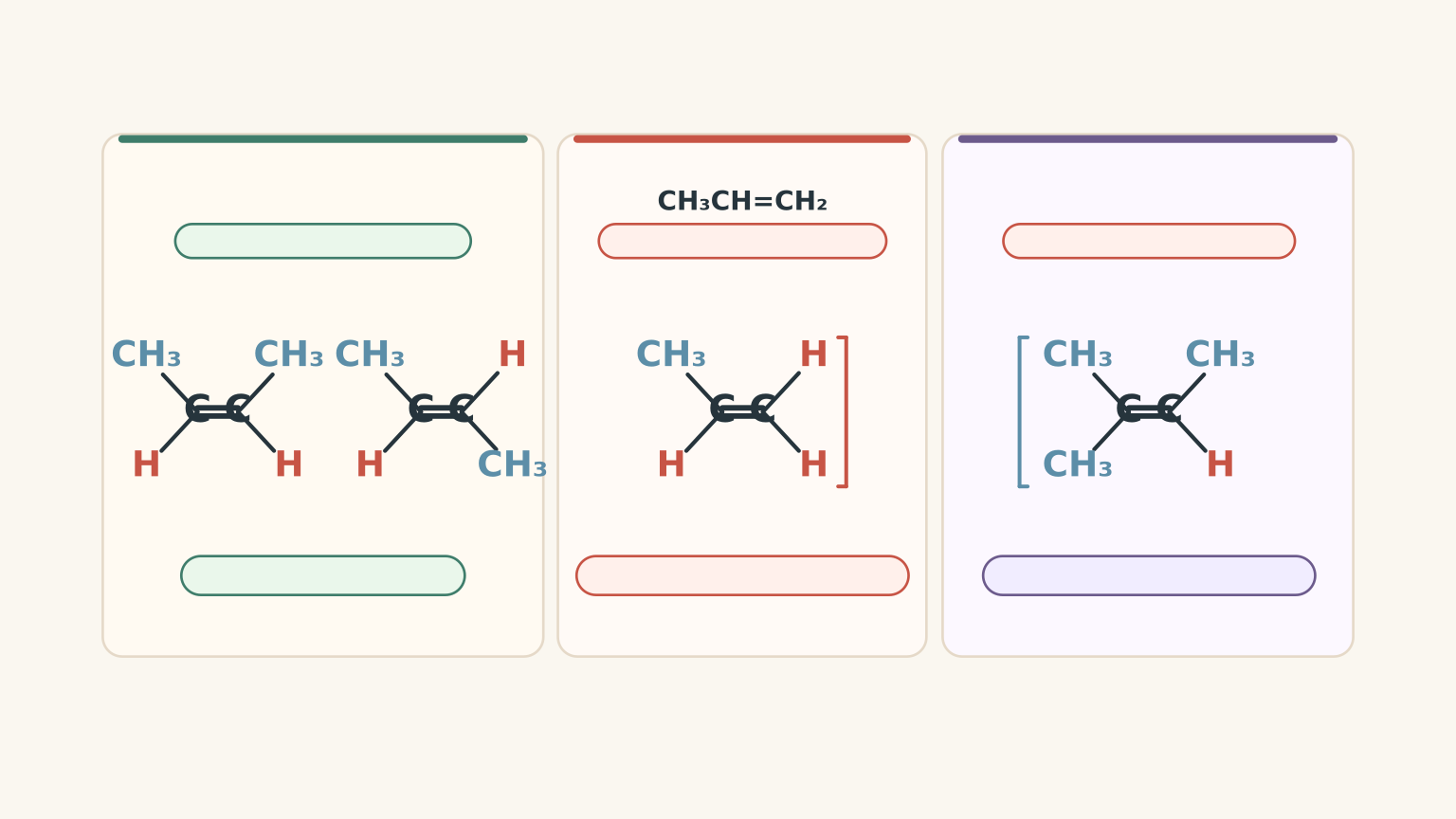
Only but-2-ene qualifies. The decisive check is surprisingly local: inspect the two carbon atoms of the C=C bond separately. Each carbon must be attached to two different groups.
01The two-carbon test
A group attached to an alkene carbon might be a hydrogen atom (H), a methyl group (\(\ce{CH3}\)), an ethyl group (\(\ce{CH2CH3}\)), or another atom or group.
For an alkene to exhibit geometric isomerism, two conditions must both be satisfied:
- The first carbon of the C=C bond must have two different groups attached to it.
- The second carbon of the C=C bond must also have two different groups attached to it.
Both conditions are essential. If either carbon has two identical groups, the alkene cannot exhibit geometric isomerism.
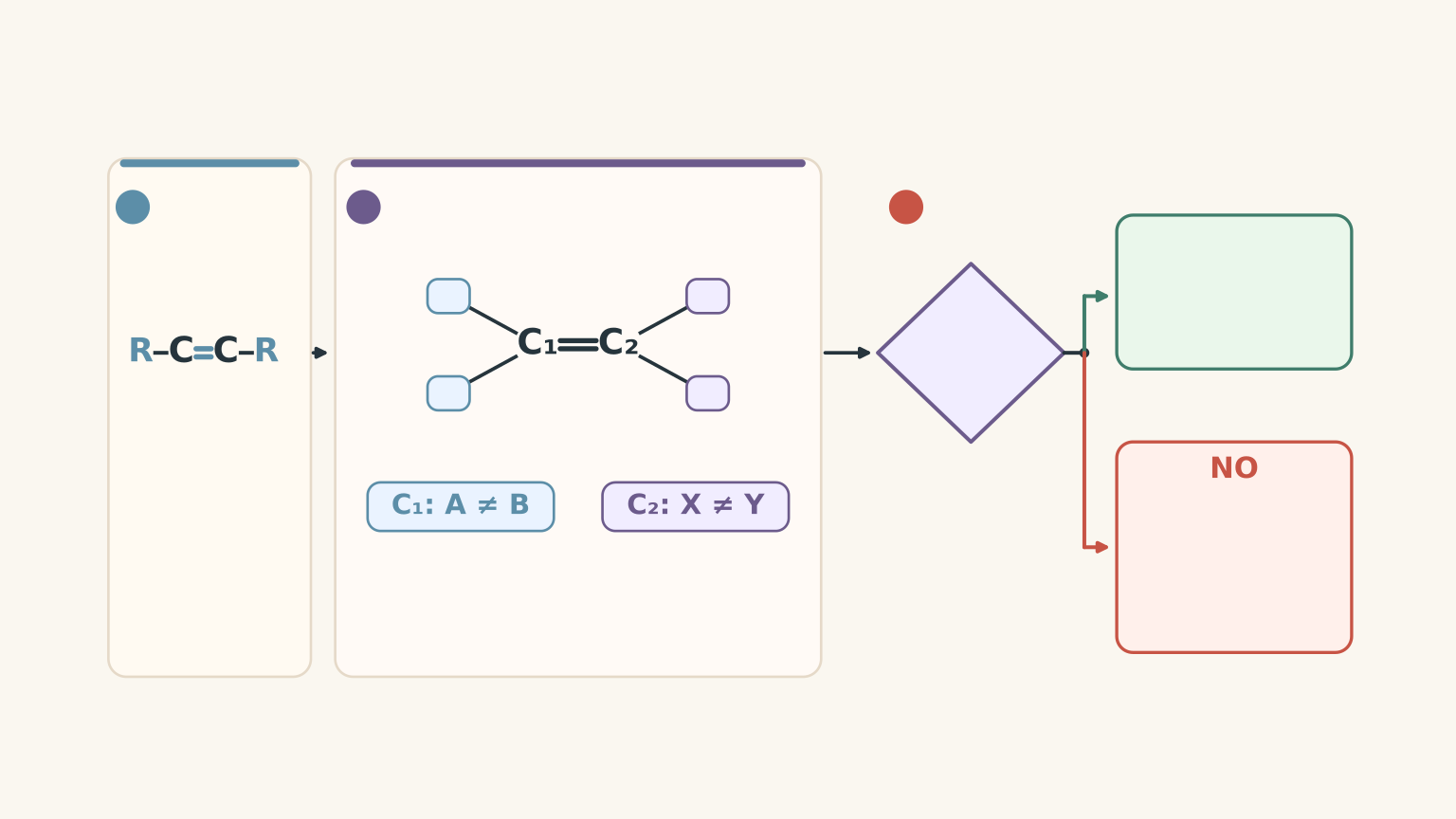
Why does this rule work? Geometric isomers have the same connections between atoms but differ in the relative positions of groups around a double bond. If two groups attached to one carbon are identical, swapping their positions produces no distinguishable arrangement.
Let’s apply the rule to the three molecules.
02Comparing three alkenes
1. But-2-ene: geometric isomerism is possible
The condensed structural formula is \(\ce{CH3CH=CHCH3}\).
Each carbon in the double bond has one H and one \(\ce{CH3}\) group. Both carbons pass the two-carbon test.
This gives two possible arrangements:
cis-but-2-ene                 trans-but-2-ene

   CH3      CH3                  CH3       H
     \      /                      \      /
      C = C                         C = C
     /      \                      /      \
    H        H                    H       CH3
In cis-but-2-ene, the two methyl groups are on the same side of the double bond. In trans-but-2-ene, they are on opposite sides.
These are distinct geometric isomers. The atoms are connected in exactly the same order, but the groups occupy different positions relative to the C=C bond.
2. Propene: geometric isomerism is not possible
The condensed structural formula is \(\ce{CH3CH=CH2}\).
The left carbon of the double bond is attached to \(\ce{CH3}\) and H. Those groups are different, so it passes.
The right carbon is attached to H and H. Those groups are identical, so it fails.
You might try to draw two arrangements by swapping the hydrogen atoms on the terminal carbon. But both hydrogen atoms are identical. Swapping them cannot produce a new geometric isomer.
3. 2-Methylbut-2-ene: geometric isomerism is not possible
The condensed structural formula is \(\ce{CH3C(CH3)=CHCH3}\).
The left carbon of the double bond is attached to two \(\ce{CH3}\) groups. Those groups are identical, so that carbon fails the test.
The right carbon has H and \(\ce{CH3}\), which are different. However, passing on one carbon is not enough. Both carbons must pass.
Notice that the problem isn’t the number of carbon atoms, the number of methyl groups in the whole molecule, or how complicated the structure looks. The only question is whether each individual carbon in the C=C bond has two different groups attached.
03Why can’t the double bond simply rotate?
Suppose you have cis-but-2-ene. Why can’t it twist around its C=C bond and become trans-but-2-ene?
A carbon-carbon single bond can usually rotate without breaking the bond itself. Think of it roughly like a swivel hinge: one end can change orientation while the connection remains intact. Rotation still has an energy cost, but it does not require breaking the bond.
A double bond is different.
A C=C double bond contains two types of bonding:
- A sigma (\(\sigma\)) bond, formed by overlap along the line between the two carbon nuclei.
- A pi (\(\pi\)) bond, formed by sideways overlap of p orbitals.
The sideways overlap that forms the pi bond depends on the p orbitals remaining parallel. Twisting one carbon relative to the other disrupts that overlap.
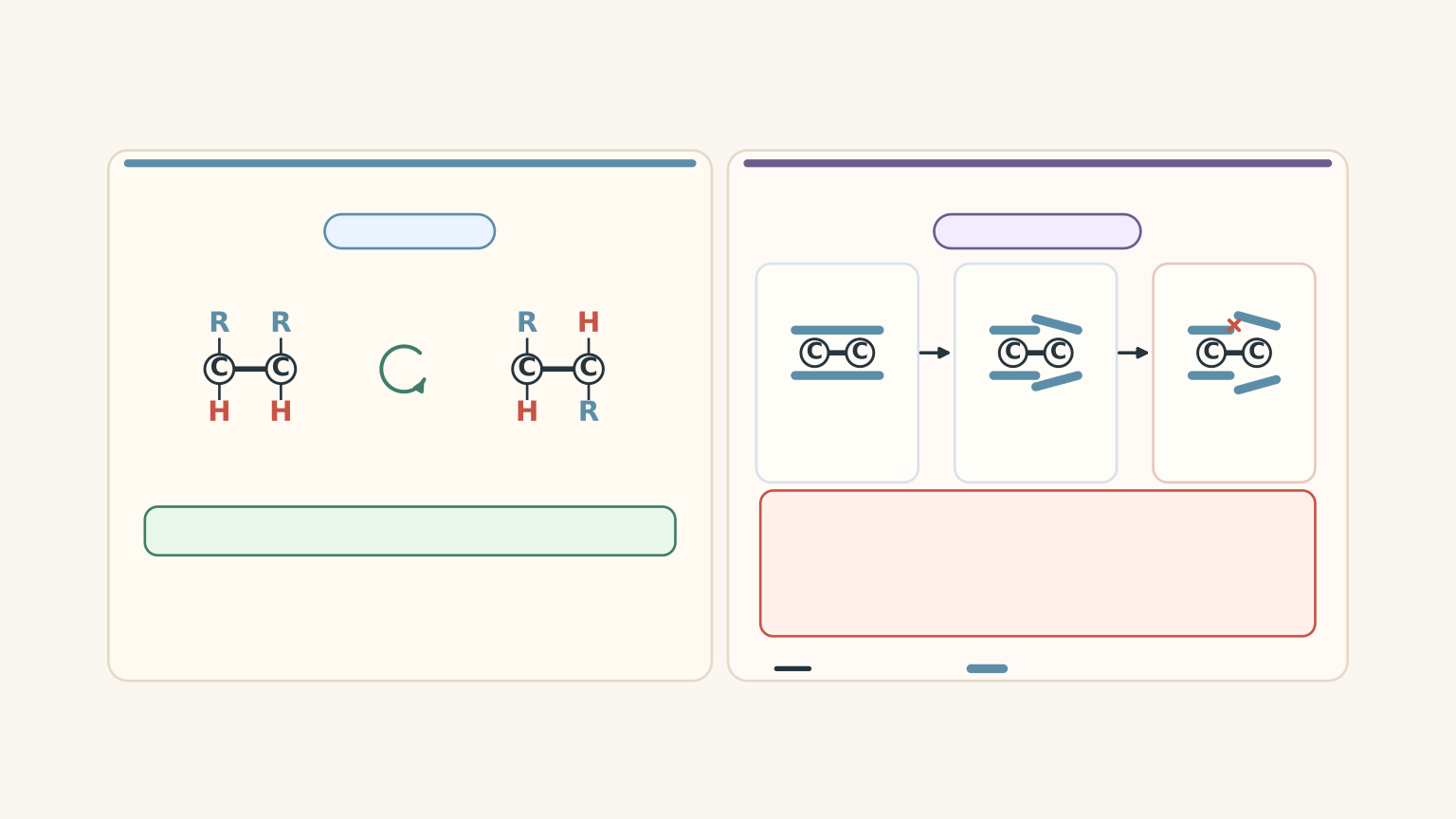
This is why rotation around a C=C bond is strongly restricted under ordinary conditions. Converting one geometric isomer into the other requires disrupting the pi bond and then restoring the bonding arrangement.
The hinge analogy has limits: chemical bonds aren’t literal hinges, and rotation around a double bond isn’t impossible under every condition. It simply isn’t free rotation.
Now return to the original puzzle. Restricted rotation allows different arrangements to remain distinct, but it does not guarantee that those arrangements exist. The two-carbon test determines whether the groups can form distinguishable geometric isomers in the first place.
04Worked example: Does hex-3-ene have geometric isomers?
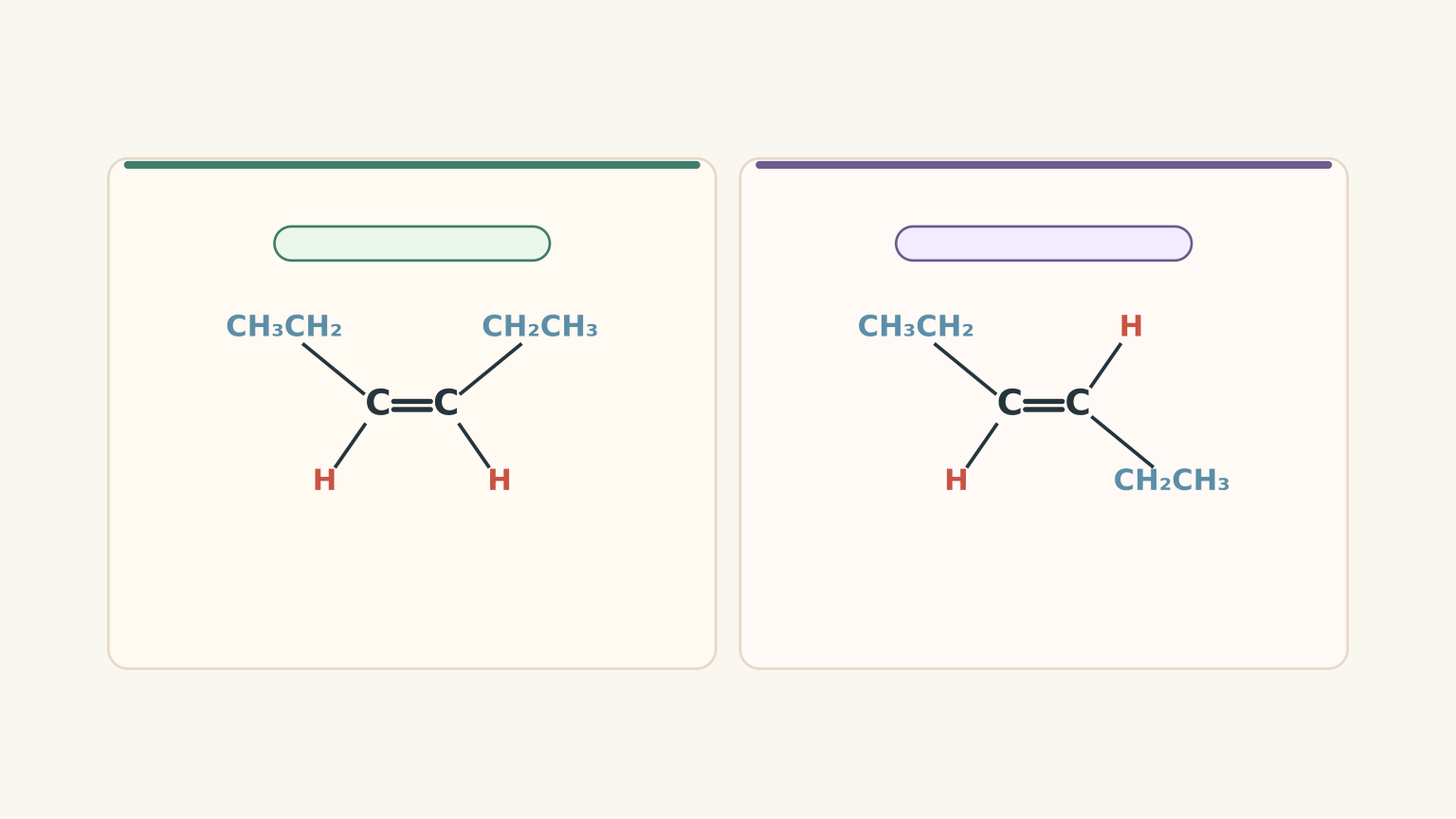
Question: Hex-3-ene has the condensed structural formula \(\ce{CH3CH2CH=CHCH2CH3}\). Determine whether geometric isomerism is possible, and describe the difference between its two forms.
Step 1
They are the third and fourth carbon atoms in the chain.
Step 2
Each alkene carbon has one H and one ethyl group, \(\ce{CH2CH3}\).
Both carbons therefore have two different groups attached.
Step 3
Both conditions are satisfied, so hex-3-ene can exhibit geometric isomerism.
In cis-hex-3-ene, the two ethyl groups are on the same side of the double bond. In trans-hex-3-ene, they are on opposite sides. The molecular formula and connectivity remain unchanged.
05Worked example: What if the groups on opposite sides differ?
Question: Consider the alkene \(\ce{CH3CH=C(CH3)CH2CH3}\). A student claims it cannot have geometric isomers because the groups attached across the double bond are not identical. Is the student correct?
Step 1
It is attached to H and \(\ce{CH3}\). These groups are different.
Step 2
It is attached to \(\ce{CH3}\) and \(\ce{CH2CH3}\). These groups are also different.
Step 3
The alkene can exhibit geometric isomerism. The student’s conclusion is incorrect.
The two sides of the double bond do not need to contain identical sets of groups. What matters is that the two groups attached to each individual alkene carbon are different.
For more complicated substitution patterns, E/Z nomenclature is often the clearest way to name the resulting geometric isomers.
06Why ordinary alkynes don’t have cis-trans isomers
Consider but-2-yne, \(\ce{CH3C\bond{#}CCH3}\).
It contains a carbon-carbon triple bond, and rotation around a triple bond is also restricted. So should it have cis-trans isomers?
No. Restricted rotation alone is not sufficient.
The two carbon atoms in a triple bond have a linear arrangement. Each triple-bonded carbon has only one additional group attached to it, and the bond angles around those carbons are \(180^\circ\).
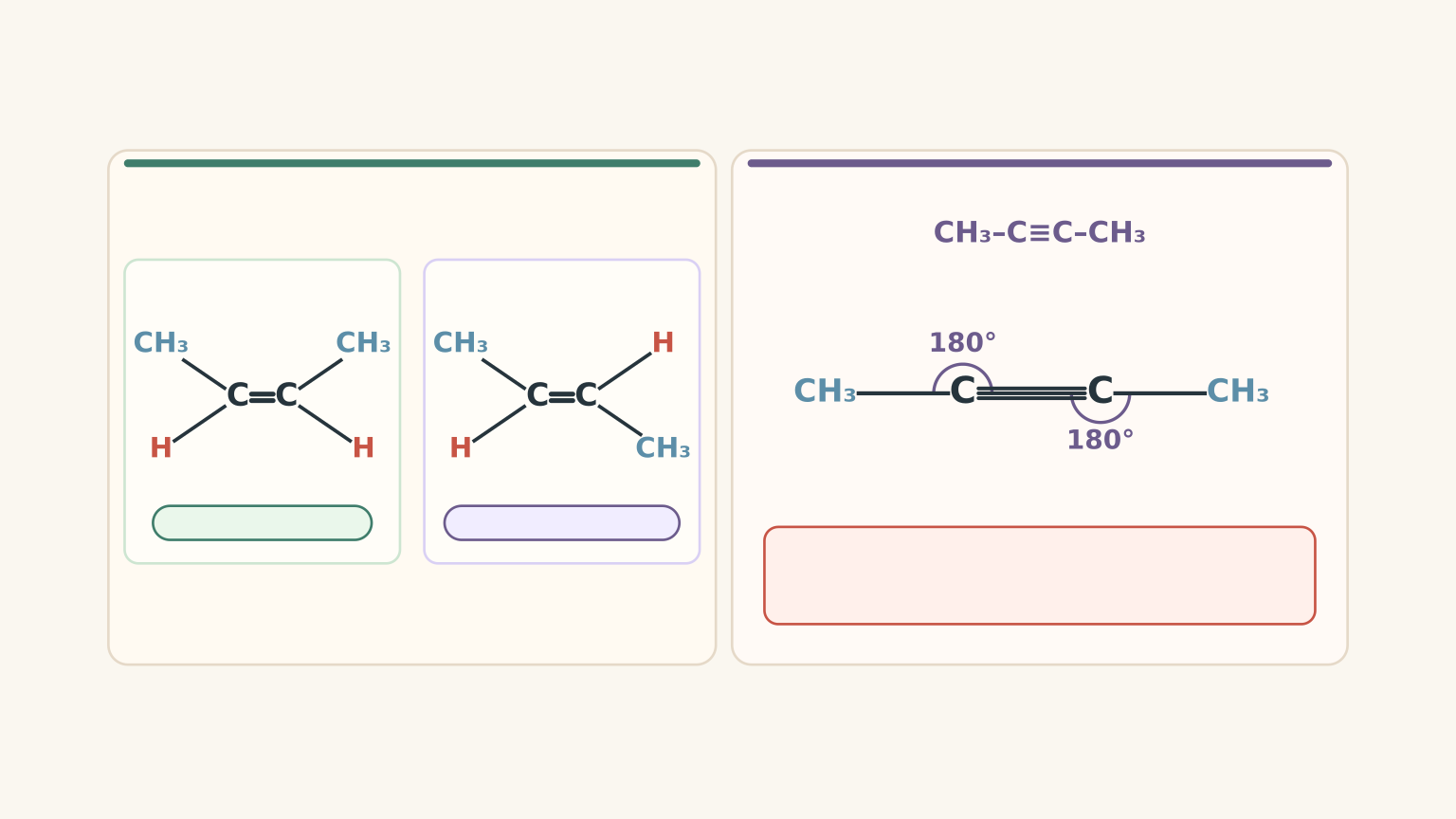
In an alkene such as but-2-ene, the groups attached to the double-bond carbons can occupy different positions on either side of the bond. In an ordinary alkyne, the groups attached to the triple-bond carbons lie along the same straight axis, at opposite ends of the triple bond.
There is no alternative arrangement corresponding to the cis and trans forms of an alkene. Ordinary alkynes therefore do not exhibit this type of geometric isomerism.
The key distinction is that a double bond can support different relative arrangements of substituents, provided the two-carbon test is satisfied. A triple bond has a different geometry, so the same cis-trans arrangement is unavailable.
07A reliable exam method
When asked whether an alkene can exhibit geometric isomerism, follow this sequence:
- Locate the C=C bond.
- List the two groups attached to the first carbon.
- Check that those groups are different.
- Repeat for the second carbon.
- If either carbon has two identical groups, geometric isomerism is not possible. If both pass, it is possible.
Avoid the tempting shortcut that any molecule with a double bond must have cis-trans isomers. A double bond restricts rotation, but the arrangement of its attached groups determines whether distinct geometric isomers can exist.
08Questions and solutions
Question 1
Classify the following molecules: but-2-ene, \(\ce{CH3CH=CHCH3}\); propene, \(\ce{CH3CH=CH2}\); and 2-methylbut-2-ene, \(\ce{CH3C(CH3)=CHCH3}\).
For each molecule, list the two groups attached to each carbon of the C=C bond and state whether geometric isomerism is possible.
Solution 1
Only but-2-ene can exhibit geometric isomerism.
- But-2-ene: Each alkene carbon has H and \(\ce{CH3}\). Both pairs contain different groups, so geometric isomerism is possible.
- Propene: One alkene carbon has H and H. Since these groups are identical, geometric isomerism is not possible.
- 2-Methylbut-2-ene: One alkene carbon has \(\ce{CH3}\) and \(\ce{CH3}\). This pair is identical, so geometric isomerism is not possible.
All three molecules contain a C=C bond, but only but-2-ene satisfies both parts of the structural condition.
Question 2
A sample contains \(0.250\ \mathrm{mol}\) of a mixture of cis-but-2-ene and trans-but-2-ene in a \(40:60\) mole ratio.
The mixture is completely hydrogenated according to the reaction
\[ \ce{CH3CH=CHCH3 + H2 -> CH3CH2CH2CH3} \]
(a) Calculate the amount of hydrogen required.
(b) If the reaction consumes \(0.250\ \mathrm{mol}\) of hydrogen, does this verify the original \(40:60\) ratio? Explain.
Solution 2
(a) The mixture requires \(0.250\ \mathrm{mol}\) of hydrogen.
First, calculate the amount of each geometric isomer.
\[ \begin{aligned} n(\text{cis}) &= 0.40 \times 0.250\\ &= 0.100\ \mathrm{mol}\\[6pt] n(\text{trans}) &= 0.60 \times 0.250\\ &= 0.150\ \mathrm{mol} \end{aligned} \]
Each molecule of but-2-ene contains one C=C bond, so each mole of alkene reacts with one mole of \(\ce{H2}\).
Therefore,
\[ \begin{aligned} n(\ce{H2}) &= 0.100 + 0.150\\ &= 0.250\ \mathrm{mol} \end{aligned} \]
(b) No. Hydrogen consumption cannot verify the cis:trans ratio.
Both geometric isomers consume hydrogen in the same \(1:1\) mole ratio because each has one C=C bond. Any mixture containing a total of \(0.250\ \mathrm{mol}\) of these isomers would consume \(0.250\ \mathrm{mol}\) of hydrogen under complete hydrogenation.
The measurement establishes the total amount of alkene, not the relative amounts of its geometric isomers. Additional evidence would be needed to establish the ratio.
Question 3
A student argues:
“But-2-yne must have cis-trans isomers because its triple bond restricts rotation even more strongly than a double bond.”
Evaluate this argument. Explain why restricted rotation is not enough to produce geometric isomerism, referring to the structure of an alkyne.
Solution 3
The argument is incorrect: but-2-yne does not have cis-trans isomers.
Restricted rotation helps preserve distinct arrangements, but it does not create those arrangements. For geometric isomerism, the groups attached to a double bond must be capable of occupying distinguishable relative positions.
In but-2-yne, \(\ce{CH3C\bond{#}CCH3}\), the triple-bonded carbons are linear, with bond angles of \(180^\circ\). Each has only one additional group attached, and the two methyl groups lie at opposite ends of the triple-bond axis.
There is no alternative arrangement in which the methyl groups switch between the same side and opposite sides of the triple bond. The linear geometry prevents the cis-trans arrangement found in suitable alkenes.
Question 4
Two structural isomers have the molecular formula \(\ce{C4H7Cl}\):
- Compound A: \(\ce{(CH3)2C=CHCl}\)
- Compound B: \(\ce{CH3CH=C(Cl)CH3}\)
Both contain a C=C bond. Determine which compound can exhibit geometric isomerism and explain why their shared molecular formula does not determine the answer.
Solution 4
Compound B can exhibit geometric isomerism; compound A cannot.
In compound A, one alkene carbon is attached to two \(\ce{CH3}\) groups. Those groups are identical, so A fails the two-carbon test.
In compound B, the first alkene carbon is attached to H and \(\ce{CH3}\), while the second is attached to Cl and \(\ce{CH3}\). Both pairs contain different groups, so B passes the test.
The molecular formula tells us how many atoms of each element are present. It does not specify how those atoms are connected. Because A and B have different connectivity, they have different substituent arrangements around their double bonds and different capacities for geometric isomerism.
Question 5
An open-chain alkene has the molecular formula \(\ce{C5H10}\), contains exactly one C=C bond, and undergoes complete catalytic hydrogenation to form 2-methylbutane.
Assume hydrogenation adds hydrogen across the double bond without rearranging the carbon skeleton. The original alkene shows no geometric isomerism.
A student claims that the alkene must be 2-methylbut-2-ene because its name resembles the name of the hydrogenation product.
Determine every distinct alkene structure consistent with the evidence. For each structure, explain why geometric isomerism is or is not possible.
Solution 5
The student’s conclusion is incorrect. Three distinct alkene structures satisfy all the evidence, and none exhibits geometric isomerism.
Hydrogenation converts the C=C bond into a C-C bond without changing the carbon skeleton. To find the possible starting structures, consider the distinct positions where a double bond can occur on the 2-methylbutane carbon skeleton.
Structure 1: 2-methylbut-1-ene
\[ \ce{CH2=C(CH3)CH2CH3} \]
The terminal alkene carbon is attached to two H atoms. It fails the two-carbon test, so geometric isomerism is not possible.
Structure 2: 2-methylbut-2-ene
\[ \ce{CH3C(CH3)=CHCH3} \]
One alkene carbon is attached to two \(\ce{CH3}\) groups. These are identical, so geometric isomerism is not possible.
Structure 3: 3-methylbut-1-ene
\[ \ce{CH2=CHCH(CH3)CH3} \]
Again, the terminal alkene carbon is attached to two H atoms. The structure fails the test, so geometric isomerism is not possible.
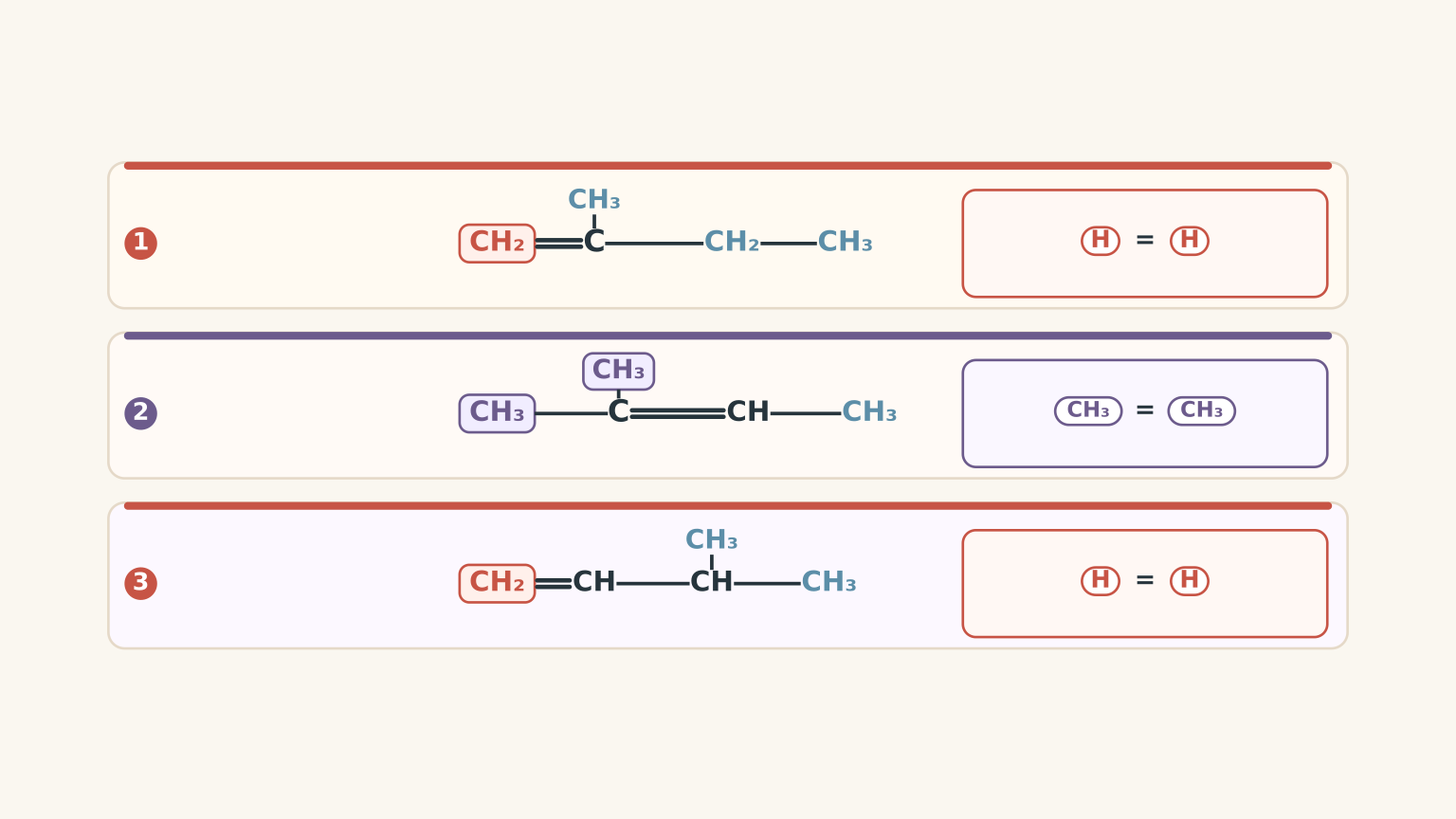
These are all the possibilities for this carbon skeleton. The two methyl groups attached to the central carbon of 2-methylbutane are equivalent, so placing the double bond at either of those equivalent positions gives the same alkene structure. The remaining distinct bond positions produce the other two structures.
The hydrogenation product cannot identify the original double-bond position because hydrogenation removes that double bond while preserving the carbon skeleton. The absence of geometric isomerism does not resolve the ambiguity either: all three structures fail the two-carbon test, but for different reasons.
The next useful step is learning how to name the two possible arrangements when an alkene passes the test. Cis-trans notation works for suitable structures, while E/Z nomenclature provides a more general method for identifying geometric isomers.