
Doppler Effect Sign Errors: How to Choose the Correct Signs
Learn how to choose the correct signs in the sound Doppler equation by separating observer motion from source motion. Worked examples and practice questions help you handle approaching, separating, and same-direction motion, then check whether your calculated frequency makes physical sense.
You have a siren ahead of you. You and the vehicle carrying the siren are both travelling east, but you’re moving faster and catching up. You substitute both speeds into the Doppler equation, get a frequency below the emitted frequency, and move on.
The calculation looks reasonable. The physics doesn’t: as you catch the source, the distance between you is shrinking, so the detected frequency should be higher.
This is one of the most common Doppler-effect sign errors. The problem isn’t usually the arithmetic. It’s choosing signs from the direction of travel instead of considering what each object does to the sound waves.
Before you calculate anything, predict whether the pitch rises or falls when an observer catches up to a source moving in the same direction. It rises. The trick is understanding why, so you can handle the signs correctly in every arrangement.
Observer motion versus source motion
| Stationary source | Equal wavefront spacing in still air. |
|---|---|
| Moving observer | Wavefront spacing stays unchanged; encounter rate rises when approaching and falls when receding. |
| Moving source | Wavefront spacing compresses ahead and stretches behind; emitted frequency stays constant. |
01Why the two signs are different
The key is that observer motion and source motion affect different parts of the Doppler equation.
- The observer’s motion changes how frequently they encounter the incoming wavefronts.
- The source’s motion changes the spacing between the wavefronts travelling towards the observer.
If you treat both motions as the same kind of correction, you’ll eventually choose the wrong sign.
1. Observer motion changes the encounter rate
Imagine walking into falling rain. The raindrops already have a particular spacing, but you encounter more of them each second when you walk towards them. Walk in the same direction as the falling rain, and you encounter fewer each second.
Sound behaves similarly in this respect. An observer moving towards the source meets incoming wavefronts more frequently. An observer moving away from the source meets them less frequently.
The spacing of the wavefronts in the air hasn’t changed just because the observer started moving.
The analogy has a limit: sound wavefronts are pressure variations travelling through air, not individual particles of rain. What matters is the rate at which the observer encounters successive wavefronts.
2. Source motion changes the wavefront spacing
Now imagine a metronome clicking at a constant rate while someone walks towards you. The person doesn’t need to click any faster. Each successive click simply comes from a position closer to you.
A moving sound source does something similar. It emits successive wavefronts from different positions.
- When the source moves towards the observer, successive wavefronts become closer together in front of it.
- When the source moves away from the observer, successive wavefronts become farther apart behind it.
The source’s emitted frequency remains unchanged. What changes is the wavelength reaching the observer.
Source motion changes wavelength, not emitted frequency
| Source approaching | fₛ unchanged; shorter λ ahead Ahead: wavefronts are closer together. |
|---|---|
| Source receding | fₛ unchanged; longer λ behind Behind: wavefronts are farther apart. |
02The equation, built from the two effects
For sound travelling through still air, the Doppler equation is
\[ f_o=f_s\frac{v\pm v_o}{v\mp v_s} \]
where:
- \(f_o\) is the observed frequency, measured in hertz (Hz).
- \(f_s\) is the frequency emitted by the source, measured in hertz (Hz).
- \(v\) is the speed of sound relative to the air, measured in metres per second (m/s).
- \(v_o\) is the observer’s speed relative to the air, measured in m/s.
- \(v_s\) is the source’s speed relative to the air, measured in m/s.
For the examples below, use \(v=340\text{ m/s}\). The speeds \(v_o\) and \(v_s\) are positive magnitudes; you choose the signs according to the physical situation.
The equation has two separate decisions to make.
The numerator: observer motion
The numerator describes the rate at which the observer encounters the wavefronts.
| Observer’s motion | Effect | Numerator |
|---|---|---|
| Towards the source | Encounters wavefronts more frequently | \(v+v_o\) |
| Away from the source | Encounters wavefronts less frequently | \(v-v_o\) |
| Stationary | No change in encounter rate | \(v\) |
Notice that the rule depends on the observer’s motion relative to the incoming sound, not their compass direction.
The denominator: source motion
The denominator accounts for the wavelength produced by the moving source.
| Source’s motion | Effect | Denominator |
|---|---|---|
| Towards the observer | Wavefronts are compressed | \(v-v_s\) |
| Away from the observer | Wavefronts are spread out | \(v+v_s\) |
| Stationary | No change in wavelength from source motion | \(v\) |
The source term works in the denominator because source motion changes the wavelength, and frequency is inversely proportional to wavelength when the wave speed is fixed.
You can see this from the basic wave equation:
\[ v=f\lambda \]
Here, \(\lambda\) is the wavelength in metres. Rearranging gives \(f=v/\lambda\). A smaller wavelength means a higher frequency, provided the relevant wave speed stays constant.
For example, if a source moves towards an observer, the denominator decreases from \(v\) to \(v-v_s\). This increases the observed frequency. If the source moves away, the denominator increases, reducing the observed frequency.
The two signs must be selected from their own rules. Do not assume that the numerator and denominator always receive the same sign just because the objects travel in the same direction.
03A dependable sign method for exams
Use this sequence every time. It is more reliable than memorising a formula for each possible arrangement.
A reliable five-step Doppler sign method
- Locate source and observer
Mark both positions and their motion.
- Mark sound direction
Draw an arrow from source to observer.
- Choose the numerator
v ± vₒ
Observer toward source: +; away: −.
- Choose the denominator
v ∓ vₛ
Source toward observer: −; away: +.
- Check the predicted pitch
Closing separation: higher pitch; opening separation: lower pitch.
Step 1: Locate the source and observer.
Draw a quick sketch if necessary. Establish who is in front and who is behind. This is particularly important when both objects travel in the same direction.
Step 2: Establish the direction of sound travel.
Sound travels from the source towards the observer. The direction can be opposite to the direction in which both objects are travelling.
Step 3: Choose the observer sign.
Ask: Is the observer moving towards the source, against the incoming wavefronts, or moving away with the incoming wavefronts?
- Towards the source: use \(v+v_o\).
- Away from the source: use \(v-v_o\).
Step 4: Choose the source sign.
Ask: Is the source moving towards the observer or away from the observer?
- Towards the observer: use \(v-v_s\).
- Away from the observer: use \(v+v_s\).
Step 5: Check whether the answer makes physical sense.
If the distance between source and observer is decreasing, the detected frequency should be higher than the emitted frequency. If the distance is increasing, it should be lower. If the distance remains constant, there should be no Doppler shift under the assumptions used here.
This last step catches many sign errors before they cost you marks.
04Worked examples
Worked example: Both source and observer approach each other
A siren emits a frequency of \(700\text{ Hz}\). The siren moves towards a stationary road user at \(20\text{ m/s}\), while the road user walks towards the siren at \(10\text{ m/s}\). Calculate the observed frequency. Take the speed of sound as \(340\text{ m/s}\).
Step 1
The observer moves towards the source, so they encounter wavefronts more frequently. Use \(v+v_o\) in the numerator.
Step 2
The source moves towards the observer, compressing the wavefronts. Use \(v-v_s\) in the denominator.
Step 3
\[ \begin{aligned} f_o&=f_s\frac{v+v_o}{v-v_s}\\[4pt] &=700\frac{340+10}{340-20}\\[4pt] &=700\frac{350}{320}\\[4pt] &=765.625\text{ Hz} \end{aligned} \]
Therefore,
\[ \boxed{f_o\approx766\text{ Hz}} \]
Step 4
The observed frequency is higher than \(700\text{ Hz}\), as expected. The observer encounters wavefronts faster, and the source compresses those wavefronts. Both effects raise the detected frequency.
Worked example: Source and observer separate
A source emits a tone of \(600\text{ Hz}\). The source moves away from an observer at \(18\text{ m/s}\), while the observer moves away from the source at \(12\text{ m/s}\). Calculate the observed frequency. Take \(v=340\text{ m/s}\).
Step 1
The observer moves away from the source, travelling in the same direction as the incoming wavefronts. They encounter fewer wavefronts each second, so use \(v-v_o\).
Step 2
The source moves away from the observer, spreading out the wavefronts. Use \(v+v_s\).
Step 3
\[ \begin{aligned} f_o&=f_s\frac{v-v_o}{v+v_s}\\[4pt] &=600\frac{340-12}{340+18}\\[4pt] &=600\frac{328}{358}\\[4pt] &\approx549.7\text{ Hz} \end{aligned} \]
Therefore,
\[ \boxed{f_o\approx550\text{ Hz}} \]
Step 4
The detected frequency is lower than \(600\text{ Hz}\). The observer encounters the waves less frequently, and the source produces a longer wavelength behind it. Both effects lower the detected frequency.
Worked example: Source and observer travel in the same direction
A siren emitting \(600\text{ Hz}\) is ahead of a listener. Both travel east. The siren travels at \(15\text{ m/s}\), while the listener travels at \(25\text{ m/s}\). The listener is catching up to the siren.
Calculate the observed frequency, taking \(v=340\text{ m/s}\).
Step 1
The siren is ahead of the listener, so the sound travelling from the siren to the listener moves west. Both vehicles move east, which means both move opposite to the incoming sound.
Step 2
The listener moves towards the source and into the incoming wavefronts. Use \(v+v_o\).
Step 3
The siren moves away from the listener, stretching the wavefronts behind it. Use \(v+v_s\) in the denominator.
Step 4
\[ \begin{aligned} f_o&=f_s\frac{v+v_o}{v+v_s}\\[4pt] &=600\frac{340+25}{340+15}\\[4pt] &=600\frac{365}{355}\\[4pt] &\approx616.9\text{ Hz} \end{aligned} \]
Therefore,
\[ \boxed{f_o\approx617\text{ Hz}} \]
Step 5
The listener is catching the siren, so the separation is decreasing. The observed frequency is consequently higher than the emitted frequency.
Now compare that with a tempting but incorrect approach.
The wrong approach is to see that both objects travel east and subtract both speeds:
\[ f_o=600\frac{340-25}{340-15} \]
This gives approximately \(582\text{ Hz}\), predicting a lower pitch.
The problem is not the arithmetic. Those signs describe a different arrangement: a source behind an observer, with both travelling east. In that arrangement, sound travels east, not west.
For the actual situation, the sound travels west. The listener moves against the incoming wavefronts, and the siren moves away from the listener. Those two facts determine the signs.
Same direction of motion, different Doppler signs
| Incorrect: sound assumed east | 600(340−25)/(340−15) ≈ 582 Hz Wrong direction; predicts lower pitch. |
|---|---|
| Correct: sound travels west | 600(340+25)/(340+15) ≈ 617 Hz Observer encounters waves faster; source stretches wavefronts behind it. |
05Edge cases that break memorised shortcuts
The phrase “same-direction motion” does not tell you which signs to use. You must also know which object is ahead.
| Arrangement | Direction of sound | Correct frequency ratio |
|---|---|---|
| Source ahead, observer behind; both travel east | West | \(\dfrac{v+v_o}{v+v_s}\) |
| Observer ahead, source behind; both travel east | East | \(\dfrac{v-v_o}{v-v_s}\) |
In the first arrangement, the source moves away from the observer, while the observer moves towards the source. Both move opposite to the incoming sound.
In the second arrangement, the source moves towards the observer, while the observer moves away from the source. Both move in the same direction as the incoming sound.
The signs reverse even though both arrangements involve two objects travelling east.
Relative position determines sound direction
| Source ahead of observer | (v + vₒ)/(v + vₛ) Both travel east; source is east of observer. Sound travels west, against both motions. |
|---|---|
| Source behind observer | (v − vₒ)/(v − vₛ) Both travel east; source is west of observer. Sound travels east, with both motions. |
There is another common trap: assuming that if the observer moves away from the source, the observed frequency must be lower.
That is not necessarily true when the source is also moving. In the second worked example, both objects separated, so the frequency fell. But suppose the source moves towards the observer at \(24\text{ m/s}\), while the observer retreats at \(9\text{ m/s}\). The source closes the gap faster than the observer opens it. The overall separation decreases, and the observed frequency is higher than the emitted frequency.
Always consider both motions before predicting the result.
06The physical plausibility check
Once you have calculated a frequency, check the direction of the change.
For a steady source in still air, with straight-line motion and speeds below the speed of sound:
- Separation decreases: \(f_o>f_s\). The detected pitch is higher.
- Separation increases: \(f_o<f_s\). The detected pitch is lower.
- Separation stays constant: \(f_o=f_s\). There is no Doppler shift.
This check is about the distance between the source and observer, not whether they travel in the same or opposite directions.
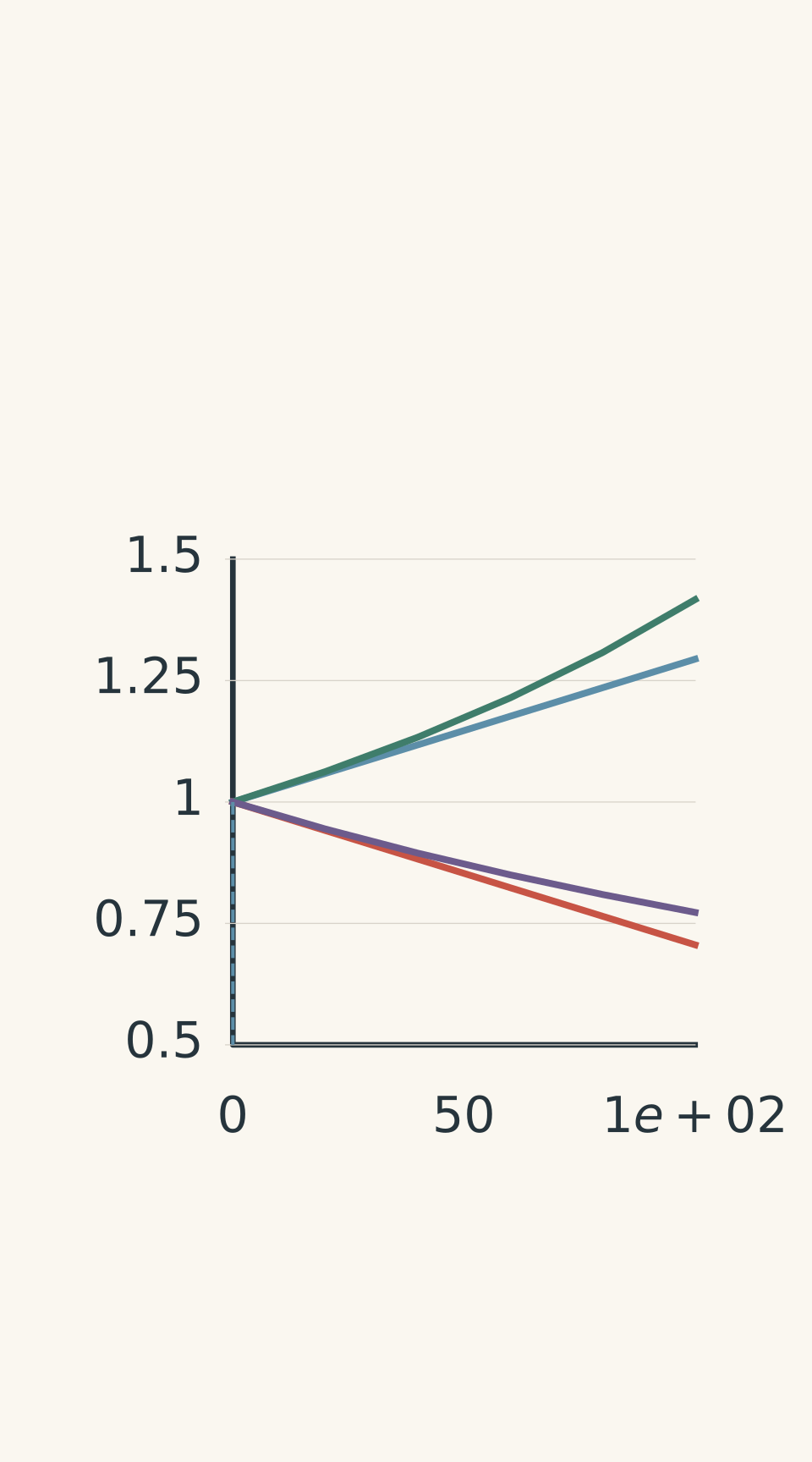
- Observer approaching
- Observer receding
- Source approaching
- Source receding
- No shift: fₒ/fₛ = 1
The graph also shows why the source and observer terms should not be treated as interchangeable. Observer motion changes the numerator, while source motion changes the denominator. Both can raise or lower the frequency, but they do so through different physical effects.
The plausibility check cannot tell you the exact frequency. It tells you whether your sign choices and final result agree with the motion of the system.
07A 10-second exam self-check
Before moving on from a Doppler calculation, run through these five points:
- Have I identified which object is ahead?
- Have I marked the direction the sound travels from source to observer?
- Have I chosen the numerator from the observer’s motion relative to the incoming waves?
- Have I chosen the denominator from whether the source approaches or recedes?
- Does the final frequency agree with whether the separation increases, decreases, or stays constant?
If the last check fails, revisit your signs before redoing the arithmetic.
08Questions and solutions
Question 1
A stationary buzzer emits a frequency of \(500\text{ Hz}\). An observer walks directly towards it at \(17\text{ m/s}\). Take the speed of sound as \(340\text{ m/s}\).
Calculate the observed frequency.
Solution 1
The observer hears \(525\text{ Hz}\), which is higher than the emitted frequency of \(500\text{ Hz}\).
The source is stationary, so there is no source-motion correction in the denominator. The observer moves towards the source, so the numerator is \(v+v_o\).
Using the Doppler equation,
\[ \begin{aligned} f_o&=f_s\frac{v+v_o}{v}\\[4pt] &=500\frac{340+17}{340}\\[4pt] &=500\frac{357}{340}\\[4pt] &=525\text{ Hz} \end{aligned} \]
The observer encounters the unchanged wavefront spacing more frequently because they are moving towards the incoming sound. This raises the observed frequency.
Question 2
A sound source emits a frequency of \(680\text{ Hz}\) and moves towards an observer at \(24\text{ m/s}\). The observer simultaneously moves directly away from the source at \(9\text{ m/s}\).
The speed of sound is \(340\text{ m/s}\).
Calculate the observed frequency. Explain why the result is above or below the emitted frequency, even though the observer is moving away from the source.
Solution 2
The observed frequency is approximately \(712\text{ Hz}\), which is higher than \(680\text{ Hz}\).
The observer’s motion alone would reduce the detected frequency. However, the source approaches at \(24\text{ m/s}\), faster than the observer retreats at \(9\text{ m/s}\). The gap therefore decreases, and the source’s wavefront compression outweighs the observer’s retreat.
The observer moves away from the source, so use \(v-v_o\) in the numerator. The source moves towards the observer, so use \(v-v_s\) in the denominator.
\[ \begin{aligned} f_o&=f_s\frac{v-v_o}{v-v_s}\\[4pt] &=680\frac{340-9}{340-24}\\[4pt] &=680\frac{331}{316}\\[4pt] &\approx712.3\text{ Hz} \end{aligned} \]
Therefore,
\[ \boxed{f_o\approx712\text{ Hz}} \]
The tempting mistake is to assume that an observer moving away must hear a lower frequency. That conclusion ignores the source’s motion. Here, the source closes the gap faster than the observer retreats, so the detected frequency rises.
Question 3
A siren is ahead of an observer, and both travel east through still air. The observer moves at \(12\text{ m/s}\). The siren emits a frequency of \(720\text{ Hz}\), but the observer detects approximately \(708\text{ Hz}\).
Take the speed of sound as \(340\text{ m/s}\).
Estimate the siren’s speed and determine whether the separation between the siren and observer is increasing or decreasing.
Solution 3
The siren travels at approximately \(18\text{ m/s}\), so the gap is increasing.
The siren is ahead of the observer. Sound therefore travels west from the siren to the observer, while both objects move east. The observer moves against the incoming wavefronts, and the source moves away from the observer.
Both terms therefore have plus signs:
\[ f_o=f_s\frac{v+v_o}{v+v_s} \]
Substitute the known values:
\[ 708\approx720\frac{340+12}{340+v_s} \]
Rearrange to isolate the denominator:
\[ 340+v_s\approx\frac{720(352)}{708} \]
\[ 340+v_s\approx357.97\text{ m/s} \]
Therefore,
\[ v_s\approx357.97-340 \]
\[ \boxed{v_s\approx18.0\text{ m/s}} \]
The siren moves faster than the observer, at approximately \(18\text{ m/s}\) compared with \(12\text{ m/s}\). Since the siren is ahead and moving faster, the separation increases.
This agrees with the observed frequency being below \(720\text{ Hz}\). The source stretches the wavefront spacing behind it more than the observer’s motion increases the rate of wavefront encounters.
The given detected frequency is rounded, so the inferred source speed is an estimate.
Question 4
A source emits a frequency of \(500\text{ Hz}\). The source and observer both travel east at \(30\text{ m/s}\), and the speed of sound is \(340\text{ m/s}\).
Consider two arrangements:
- Arrangement A: The source is ahead of the observer.
- Arrangement B: The observer is ahead of the source.
Calculate the observed frequency in each arrangement. Explain why the results do not justify the shortcut “same direction means no Doppler shift”.
Solution 4
The observed frequency is \(500\text{ Hz}\) in both arrangements, but the correct signs are different.
Arrangement A: Source ahead of observer
Sound travels west. The observer moves towards the source, against the incoming wavefronts, while the source moves away from the observer.
\[ \begin{aligned} f_o&=500\frac{340+30}{340+30}\\[4pt] &=500\frac{370}{370}\\[4pt] &=\boxed{500\text{ Hz}} \end{aligned} \]
Arrangement B: Observer ahead of source
Sound travels east. The observer moves away from the source, with the incoming wavefronts, while the source moves towards the observer.
\[ \begin{aligned} f_o&=500\frac{340-30}{340-30}\\[4pt] &=500\frac{310}{310}\\[4pt] &=\boxed{500\text{ Hz}} \end{aligned} \]
In each arrangement, the numerator and denominator cancel because the source and observer have the same velocity relative to the air. Their separation remains constant.
The tempting shortcut happens to produce the right result here, but for the wrong reason. Same-direction motion does not guarantee no Doppler shift. If the source and observer travel at different speeds, their separation changes and the detected frequency generally differs from the emitted frequency.
Question 5
Two vehicles travel east through still air. In each case, a siren is ahead of an observer, and the observer is catching up to the siren. The siren emits a constant frequency of \(600\text{ Hz}\), and the speed of sound is \(340\text{ m/s}\).
The two arrangements are:
- Case A: The siren travels at \(20\text{ m/s}\), and the observer travels at \(60\text{ m/s}\).
- Case B: The siren travels at \(60\text{ m/s}\), and the observer travels at \(100\text{ m/s}\).
In both cases, the observer closes the gap at \(40\text{ m/s}\).
A student argues that both arrangements must produce the same observed frequency because the separation decreases at the same rate.
Test this claim by calculating both frequencies. Then, letting \(\Delta=v_o-v_s\), derive an expression for \(f_o/f_s\) and explain why the two arrangements give different results.
Solution 5
The claim is false. Case A produces approximately \(666.7\text{ Hz}\), while Case B produces \(660\text{ Hz}\). The same rate of closing the gap does not guarantee the same Doppler shift.
In both cases, the source is ahead of the observer, so sound travels west while both objects move east. The observer moves against the incoming wavefronts, and the source moves away from the observer.
The correct equation is therefore
\[ f_o=f_s\frac{v+v_o}{v+v_s} \]
Case A
Substitute \(v_o=60\text{ m/s}\) and \(v_s=20\text{ m/s}\):
\[ \begin{aligned} f_o&=600\frac{340+60}{340+20}\\[4pt] &=600\frac{400}{360}\\[4pt] &\approx666.7\text{ Hz} \end{aligned} \]
Case B
Substitute \(v_o=100\text{ m/s}\) and \(v_s=60\text{ m/s}\):
\[ \begin{aligned} f_o&=600\frac{340+100}{340+60}\\[4pt] &=600\frac{440}{400}\\[4pt] &=\boxed{660\text{ Hz}} \end{aligned} \]
The gap closes at \(40\text{ m/s}\) in both cases because \(v_o-v_s=40\text{ m/s}\). But the Doppler equation depends on each object’s speed relative to the air, not just their relative speed.
We can see this directly by defining
\[ \Delta=v_o-v_s \]
so that
\[ v_o=v_s+\Delta \]
Substitute into the frequency ratio:
\[ \begin{aligned} \frac{f_o}{f_s} &=\frac{v+v_o}{v+v_s}\\[4pt] &=\frac{v+v_s+\Delta}{v+v_s}\\[4pt] &=1+\frac{\Delta}{v+v_s} \end{aligned} \]
Therefore,
\[ \boxed{\frac{f_o}{f_s}=1+\frac{\Delta}{v+v_s}} \]
For a fixed closing speed \(\Delta\), increasing the source’s speed increases the denominator \(v+v_s\), reducing the fractional increase in frequency.
In Case A, the ratio is
\[ \frac{f_o}{f_s}=1+\frac{40}{360} \]
which gives approximately \(1.1111\).
In Case B, the ratio is
\[ \frac{f_o}{f_s}=1+\frac{40}{400} \]
which gives \(1.10\).
Case A consequently has the higher observed frequency.
The crucial constraint is that sound travels through air. The observer’s speed determines how quickly they encounter wavefronts, while the source’s speed determines how far apart those wavefronts are. Knowing only the rate at which the gap closes does not determine both effects separately.
This is why replacing the two terms with a single relative-speed correction is not generally valid.
The next useful step is to recognise the reference frame in any Doppler problem. If a question introduces wind, you must account for the air’s motion and use velocities consistently relative to the air. The sign method still starts with the incoming wavefronts, but the speed of sound and the motion of the source and observer can no longer be treated as though the air were stationary.