
Einstein’s Train Thought Experiment: Relativity of Simultaneity
Why can two flashes occur simultaneously in one reference frame but not another? Reconstruct Einstein’s train-and-platform thought experiment, explore how light speed and synchronised clocks explain the difference, and practise with worked examples and challenging HSC-style questions.
Two flashes occur at the front and rear ends of a train just as it passes two platform marks. A person standing halfway between the marks receives both flashes at the same instant. Must the person riding in the train agree that the flashes happened together?
No. In Einstein’s train-and-embankment thought experiment, the platform frame assigns the two flashes the same time, while the train frame assigns the front flash an earlier time. Both frames measure the speed of light as \(c\). The disagreement comes from how each frame assigns times to events at different locations.
In the standard version, the flashes are lightning strikes at fixed platform marks that line up with the train’s ends at one instant. They are not lamps attached to the train. We will keep these same two events in view while comparing the observers, then reverse the setup to see what changes.
01Set up the thought experiment
The problem Einstein wanted to expose is simple: how do you decide whether two events at different locations happened at the same time?
You cannot put one clock at both ends of a train. Instead, you need clocks at different locations, synchronised according to a consistent procedure.
Picture the following arrangement:
- The train moves to the right at a constant speed \(v\) relative to the platform.
- At one instant according to platform clocks, a flash occurs at the rear end of the train and another at the front end.
- A stationary platform observer, P, is halfway between the two flash locations.
- A train observer, T, is also at the midpoint at the instant of the flashes, but moves with the train.
We will idealise the light as travelling through a vacuum and treat both observers as belonging to inertial frames. An inertial frame is a reference frame moving at constant velocity, without acceleration.
Call the platform frame \(S\) and the train frame \(S'\). Define the positive \(x\)-direction as the direction the train moves, so the front is at positive \(x\) relative to the rear.
Let \(L\) be the separation between the two platform marks at the instant of the flashes. Let \(L_0\) be the train’s length measured in its own rest frame.
Why the platform observer receives both flashes together
- Flash events
t = 0
Both platform marks flash simultaneously.
- Equal distances
d₁ = d₂ = L/2
Stationary observer P is midway between the marks.
- Light travel
t_travel = L/(2c)
Both signals travel equal distances at speed c.
- Reception events
t_arrival = L/(2c)
Both signals reach P together, after the flashes occur.
02What the platform observer can conclude
Start with P, the person standing on the platform.
The two flashes occur simultaneously according to the platform clocks. Both marks are a distance \(L/2\) from P, and light travels at speed \(c\).
The time taken for each signal to reach P is therefore
\[ t_{\text{travel}}=\frac{L}{2c}. \]
Both signals travel the same distance at the same speed, so they arrive together.
This matters because P is not simply guessing when the lightning strikes happened. P can use the equal travel times to infer that the two events were simultaneous in frame \(S\).
Now make a prediction.
If there were one universal time shared by every observer, what would the train observer conclude?
They would have to agree that the flashes occurred simultaneously. That is the prediction of the familiar Newtonian model of absolute time.
But the train observer does not assign the events the same time.
03What the train observer can conclude
In the platform frame, T moves to the right along with the train.
Consider the two light signals after the flashes occur.
- The light from the front travels towards the left, while T moves towards the front flash’s location. They approach each other.
- The light from the rear travels towards the right, in the same direction as T. It must catch up with the moving observer.
Consequently, T receives the front signal first.
That is a statement about when light reaches T. By itself, it is not a complete statement about when the flashes occurred.
Here is the crucial extra step.
In the train frame \(S'\), T is stationary at the train’s midpoint. Each flash event occurs at one of the train’s fixed endpoint coordinates, \(x' = \pm L_0/2\). The distance from either endpoint to T is therefore \(L_0/2\).
Because light has the same speed \(c\) in this frame, both signals take the same amount of time to travel to T.
So, in this particular setup, receiving the front signal first means that the front flash event occurred earlier in the train frame. The equal light-travel times let T work backwards from reception to event time.
The two observers therefore make different assignments for the same pair of flash events:
- In \(S\), the platform frame, the flashes are simultaneous.
- In \(S'\), the train frame, the front flash occurs first.
Same flashes, different event times
| Platform frame S | Same two flash events Event-time difference: Δt = 0; flashes are simultaneous. Travel time: L/(2c) for each signal. Reception order: both signals arrive together. |
|---|---|
| Train frame S′ | Same two flash events Event-time difference: Δt′ < 0; front flash occurs first. Travel time: L₀/(2c) for each signal. Reception order: front signal arrives first. |
Neither observer needs to be mistaken about what they measure. The difference appears when they assign times to events at separate locations.
04The missing step: synchronised clocks
There is a trap here that is worth fixing before we introduce the equation.
Receiving a flash at a particular time does not automatically tell you when the flash occurred. Light needs time to travel.
For a stationary receiver in a given frame, the relationship is
\[ t_{\text{arrival}} = t_{\text{event}}+\frac{d}{c}, \]
where \(d\) is the distance the light travels from the event to the receiver in that frame.
If the two signals travel different distances, their arrival-time difference includes the difference in travel times. A signal arriving first need not have been emitted first.
Think of two people sending messages from opposite ends of a school hall. If the messages reach you together, that does not prove they were sent together unless you account for how long each took to arrive. The analogy has a limit: in relativity, there is no universal master clock that automatically synchronises every distant clock for every observer.
Instead, each inertial frame uses its own network of synchronised clocks to assign times to events at different locations.
This is the revision that resolves the problem. Rather than treating a single observer’s reception times as universal event timestamps, we assign coordinates to the events in each frame.
Einstein’s 1905 formulation of special relativity made the synchronisation of distant clocks using light signals central to the definition of time. The train-and-embankment scenario is a thought experiment, not a claim that this exact lightning setup was physically performed.
05The equation behind the disagreement
Once each frame has its own synchronised clocks, the Lorentz transformation tells us how the time coordinates of the same events are related.
For a train moving in the positive \(x\)-direction at speed \(v\), the time-coordinate difference transforms according to
\[ \Delta t' = \gamma\left( \Delta t-\frac{v\Delta x}{c^2} \right), \]
where
\[ \gamma=\frac{1}{\sqrt{1-v^2/c^2}}. \]
Here:
- \(\Delta t=t_F-t_R\) is the front-event time minus the rear-event time in the platform frame.
- \(\Delta t'=t'_F-t'_R\) is the same time difference in the train frame.
- \(\Delta x=x_F-x_R\) is the front event’s position minus the rear event’s position in the platform frame.
- \(v\) is the train’s velocity relative to the platform.
- \(c\) is the speed of light in a vacuum.
- \(\gamma\) is the Lorentz factor, which accounts for the relative motion between the frames.
The equation contains the term that changes everything:
\[ -\frac{v\Delta x}{c^2}. \]
In the standard thought experiment, the platform clocks assign the same time to both flashes, so \(\Delta t=0\). The front event is at a greater \(x\)-coordinate than the rear event, so \(\Delta x=L>0\).
Substituting these conditions gives
\[ \Delta t'=-\frac{\gamma vL}{c^2}. \]
For a train moving to the right, \(v>0\), so \(\Delta t'<0\).
That negative sign has a physical meaning: the train frame assigns the front flash an earlier time than the rear flash.
This is the relativity of simultaneity. It is not caused by light travelling more slowly for the train observer. Both observers measure the same light speed, but their synchronised clocks assign different times to spatially separated events.
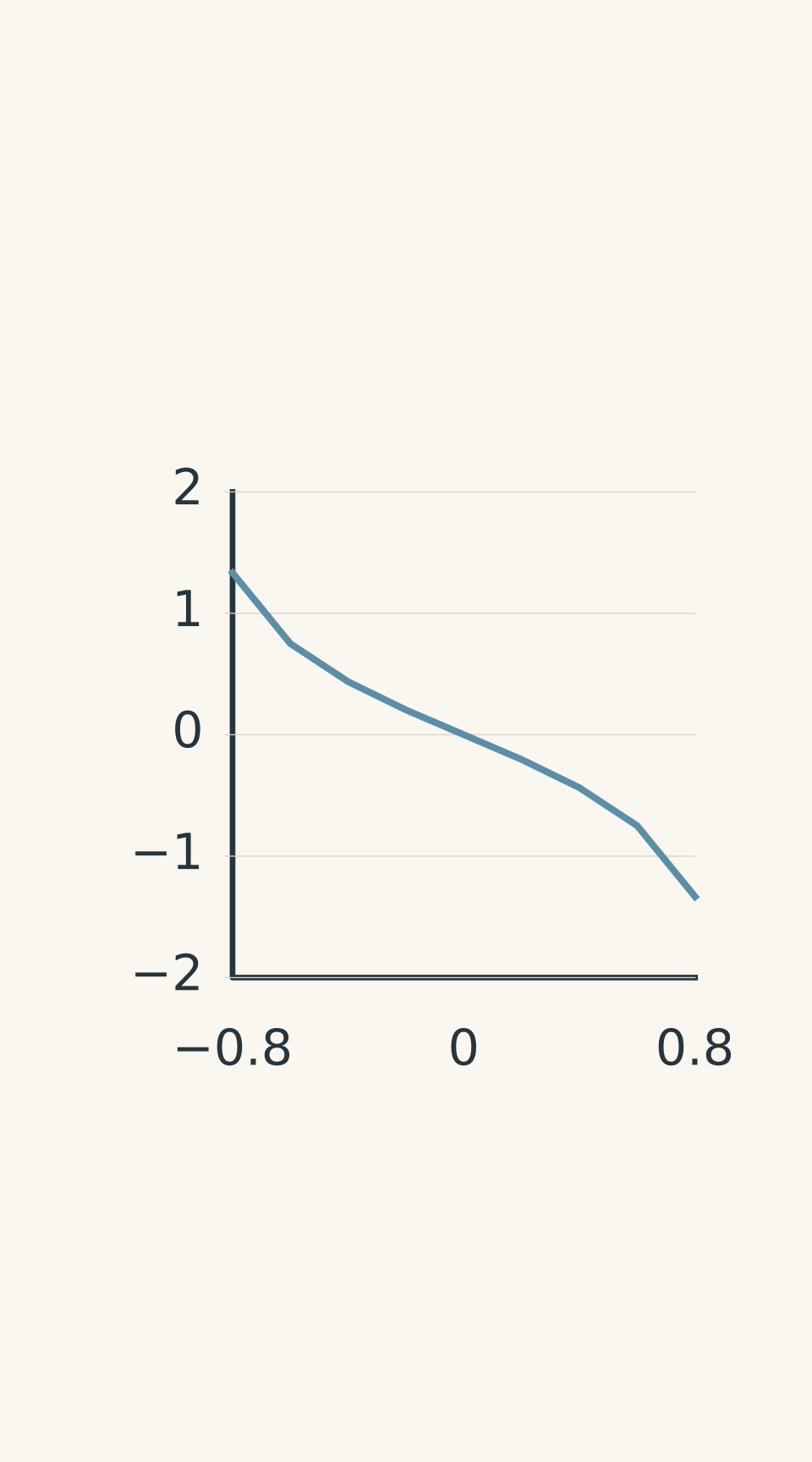
- −γβ
Worked example: Simultaneous platform strikes
A train has a rest length of \(500\text{ m}\) and moves to the right at \(0.60c\). Two platform marks flash simultaneously just as they line up with the train’s rear and front. Find the separation between the marks in the platform frame and the time difference \(\Delta t'=t'_F-t'_R\) assigned by the train frame.
Step 1
The train’s speed as a fraction of the speed of light is \(v/c=0.60\).
\[ \gamma=\frac{1}{\sqrt{1-0.60^2}}=1.25 \]
Step 2
The train’s length in the platform frame is contracted relative to its rest length:
\[ L=\frac{L_0}{\gamma} =\frac{500\text{ m}}{1.25} =400\text{ m}. \]
Because the flashes are simultaneous in the platform frame,
\[ \Delta t=0,\qquad \Delta x=400\text{ m}. \]
Step 3
\[ \begin{aligned} \Delta t' &=-\frac{\gamma vL}{c^2}\\ &=-\frac{(1.25)(0.60)(400\text{ m})}{c}\\ &=-\frac{300\text{ m}}{3.00\times10^8\text{ m s}^{-1}}\\ &=-1.00\,\mu\text{s}. \end{aligned} \]
Step 4
The train frame assigns the front flash an earlier time by \(1.00\,\mu\text{s}\). The platform frame assigns the same two events equal times.
Both results follow from the same Lorentz transformation. Neither observer has changed the speed of light or altered what happened at either flash location.
06Change the trigger: flashes simultaneous in the train frame
Now reverse the setup.
Imagine that lamps are attached to the front and rear of the train. They are triggered simultaneously according to clocks synchronised in the train frame.
This is a different arrangement from the platform lightning strikes. We have changed which pair of events we are considering by changing how the flashes are timed.
In the train frame, the flashes have equal event times:
\[ \Delta t'=0. \]
Their positions are separated by the train’s rest length, so
\[ \Delta x'=L_0. \]
To find the time difference in the platform frame, use the inverse Lorentz transformation:
\[ \Delta t = \gamma\left( \Delta t'+\frac{v\Delta x'}{c^2} \right). \]
Since \(\Delta t'=0\) and \(\Delta x'=L_0\),
\[ \Delta t=\frac{\gamma vL_0}{c^2}. \]
For a train moving to the right, this difference is positive. The platform frame assigns the rear flash an earlier time and the front flash a later time.
Simultaneity depends on the frame
| A — Platform-fixed marks | Platform: flashes simultaneous. Train: front flash earlier. |
|---|---|
| B — Train-mounted lamps | Train: flashes simultaneous. Platform: rear flash earlier. |
Worked example: Train-mounted lamps
A train has a rest length of \(500\text{ m}\) and moves to the right at \(0.75c\). Lamps at its front and rear flash simultaneously according to synchronised train clocks. Calculate the time difference assigned by the platform frame.
Step 1
The flashes are simultaneous in the train frame, and the separation between their locations is the rest length of the train.
\[ \Delta t'=0,\qquad \Delta x'=500\text{ m}. \]
Step 2
\[ \gamma =\frac{1}{\sqrt{1-0.75^2}} \approx1.512. \]
Step 3
\[ \begin{aligned} \Delta t &=\frac{\gamma vL_0}{c^2}\\ &=\frac{(1.512)(0.75)(500\text{ m})} {3.00\times10^8\text{ m s}^{-1}}\\ &=1.89\times10^{-6}\text{ s}\\ &=1.89\,\mu\text{s}. \end{aligned} \]
Step 4
The platform frame assigns the front flash an event time \(1.89\,\mu\text{s}\) later than the rear flash.
There is no contradiction with the first worked example. In the first experiment, the platform marks define the simultaneous events. In this experiment, the train clocks define them. We have not changed the frame used to describe one fixed pair of events; we have changed the physical timing of the flashes.
07Why neither frame is privileged
The key result is not that one observer sees the world correctly and the other gets confused. Both frames are valid inertial frames, and both measure light travelling at speed \(c\).
They agree on which events occur. They also agree on whether one event can causally influence another. What they do not always agree on is the time difference between events at separate locations.
That last point matters because not every pair of events can have its order reversed.
If two events are separated so that
\[ |\Delta x|>c|\Delta t|, \]
their separation is called spacelike. No signal travelling at or below the speed of light can travel from one event to the other. Different inertial frames can assign different time orders to such events.
By contrast, if events are separated by a possible causal connection, all inertial observers agree on their order. Relativity does not allow an effect to precede its cause merely because we change frames.
In the standard lightning thought experiment, the flashes are simultaneous in the platform frame but occur at different locations. They cannot influence each other. The train frame can therefore assign them a different order without creating a causal paradox.
The historical lesson is equally important. Einstein’s reasoning exposed an assumption hidden in the old model of time: that synchronised clocks in one frame must remain synchronised with clocks at different locations in every other frame. Special relativity replaces that assumption with a precise rule for relating space and time coordinates.
08Questions and solutions
Question 1
Two platform marks, separated by \(300\text{ m}\), flash simultaneously in the platform frame as a train moves to the right at \(0.80c\). Calculate the time difference \(\Delta t'=t'_F-t'_R\) in the train frame. Which flash occurs first according to the train?
Solution 1
The train frame assigns the front flash an earlier time by approximately \(1.33\,\mu\text{s}\).
Because the flashes are simultaneous in the platform frame, \(\Delta t=0\), and their position difference is \(\Delta x=+300\text{ m}\).
First, calculate the Lorentz factor:
\[ \gamma=\frac{1}{\sqrt{1-0.80^2}} =\frac{1}{0.60} \approx1.667. \]
Use the Lorentz transformation:
\[ \begin{aligned} \Delta t' &=-\frac{\gamma v\Delta x}{c^2}\\ &=-\frac{(1.667)(0.80)(300\text{ m})}{c}\\ &=-\frac{400\text{ m}}{3.00\times10^8\text{ m s}^{-1}}\\ &=-1.33\,\mu\text{s}. \end{aligned} \]
The result is negative because \(\Delta t'\) means front time minus rear time. Therefore, the front flash occurs first in the train frame.
Question 2
A train has a rest length of \(500\text{ m}\) and moves to the right at \(0.60c\). Two platform strikes occur simultaneously at \(t=0\), when they line up with the train’s ends.
A detector at the train’s midpoint has its clock set to \(t'=0\) at the instant the strikes occur in the platform frame. It records the front signal arriving at \(0.333\,\mu\text{s}\) and the rear signal arriving at \(1.333\,\mu\text{s}\).
Reconstruct the event times in the train frame. Explain why the difference between arrival times equals the difference between event times in this setup, but not necessarily in every setup.
Solution 2
The front strike occurred at \(t'_F=-0.500\,\mu\text{s}\), and the rear strike occurred at \(t'_R=+0.500\,\mu\text{s}\). Thus, the front event occurred \(1.00\,\mu\text{s}\) earlier in the train frame.
The detector is at the midpoint of the train, so each flash event is \(250\text{ m}\) from it in the train frame.
The light-travel time for either signal is
\[ \begin{aligned} t_{\text{travel}} &=\frac{250\text{ m}}{3.00\times10^8\text{ m s}^{-1}}\\ &=0.833\,\mu\text{s}. \end{aligned} \]
Subtract this travel time from each recorded arrival time:
\[ t'_F=0.333-0.833=-0.500\,\mu\text{s}, \]
\[ t'_R=1.333-0.833=+0.500\,\mu\text{s}. \]
The event-time difference is therefore
\[ \Delta t'=-0.500-(+0.500) =-1.00\,\mu\text{s}. \]
The arrival-time difference equals the event-time difference here because both signals travel the same distance at the same speed in the train frame. In a different arrangement, the distances might be unequal. You would then need to subtract each signal’s own travel time before comparing event times.
Question 3
A train has a rest length of \(400\text{ m}\). Lamps at its front and rear flash simultaneously according to synchronised clocks in the train frame.
Synchronized platform clocks assign the front flash an event time \(1.00\,\mu\text{s}\) later than the rear flash. Assuming the train moves to the right, determine its speed as a fraction of \(c\).
Solution 3
The train moves to the right at \(0.60c\).
Since the lamps flash simultaneously in the train frame, \(\Delta t'=0\) and \(\Delta x'=L_0=400\text{ m}\). The inverse Lorentz transformation gives
\[ \Delta t=\frac{\gamma vL_0}{c^2}. \]
Define \(\beta=v/c\). Then
\[ \frac{c\Delta t}{L_0}=\gamma\beta. \]
Substitute the given values:
\[ \gamma\beta =\frac{(3.00\times10^8)(1.00\times10^{-6})}{400} =0.75. \]
We need to solve \(\gamma\beta=0.75\), remembering that \(\gamma=1/\sqrt{1-\beta^2}\).
Squaring both sides gives
\[ \frac{\beta^2}{1-\beta^2}=0.75^2. \]
Rearranging,
\[ \begin{aligned} \beta^2 &=\frac{0.75^2}{1+0.75^2}\\ &=\frac{0.5625}{1.5625}\\ &=0.36. \end{aligned} \]
Therefore,
\[ \beta=0.60, \qquad v=0.60c. \]
The positive value follows from the stated direction of motion. A train moving in the opposite direction would produce the opposite sign for the platform-frame time difference.
Question 4
Two students make the following claims about Einstein’s thought experiment.
- Student A: “If light travels at \(c\) for both observers, they must agree on whether the flashes were simultaneous.”
- Student B: “Whichever flash an observer receives first must have occurred first.”
Evaluate both claims. Explain what each observer concludes in the standard setup and identify the reasoning trap in Student B’s claim.
Solution 4
Student A is incorrect, and Student B has stated a rule that is not generally valid.
The invariance of light speed does not mean that every frame assigns the same time coordinates to spatially separated events. Each inertial frame synchronises its own distant clocks, and the Lorentz transformation shows that the time difference depends on both the event-time difference and the spatial separation.
For Student B, reception time includes light-travel time. If two signals travel different distances, a signal from an earlier event could arrive after a signal from a later event.
However, Student B’s conclusion happens to be correct for the train observer in this particular setup. In the train frame, the front and rear flash events are equally far from the train’s midpoint. Both signals therefore take the same time to reach the observer, so the front signal’s earlier arrival means the front event occurred earlier.
The platform observer also has equal travel times to the two strikes, but the platform observer receives the signals together. These are different reception events along different observers’ paths through spacetime. There is no contradiction between the two frames’ conclusions.
Question 5
A train has a rest length of \(500\text{ m}\) and moves to the right at \(0.60c\). Assume that each flash occurs exactly at a train endpoint when it happens.
At \(t=0\) in the platform frame, the rear-end flash occurs. The front-end flash occurs \(0.80\,\mu\text{s}\) later according to synchronised platform clocks.
- Find the coordinate separation \(\Delta x=x_F-x_R\) between the two flash events in the platform frame.
- Calculate the time difference \(\Delta t'=t'_F-t'_R\) in the train frame.
- Determine whether either flash could have caused the other.
Solution 5
The train frame assigns the front flash an earlier time by \(0.36\,\mu\text{s}\), even though the platform frame assigns it a time \(0.80\,\mu\text{s}\) later. The order can reverse because the events are spacelike separated, so neither flash could have caused the other.
Step 1: Find the train’s length in the platform frame at a single instant.
The Lorentz factor is
\[ \gamma=\frac{1}{\sqrt{1-0.60^2}}=1.25. \]
The contracted length is
\[ L=\frac{L_0}{\gamma} =\frac{500\text{ m}}{1.25} =400\text{ m}. \]
Choose the rear-end event to occur at \(x_R=0\). At \(t=0\), the front end is at \(x=400\text{ m}\).
Step 2: Find the front event’s position when its flash occurs.
The time difference in the platform frame is
\[ \Delta t=+0.80\,\mu\text{s}. \]
During this interval, the train moves a distance
\[ \begin{aligned} v\Delta t &=(0.60c)(0.80\times10^{-6}\text{ s})\\ &=(0.60)(3.00\times10^8)(0.80\times10^{-6})\\ &=144\text{ m}. \end{aligned} \]
The front flash therefore occurs at
\[ x_F=400+144=544\text{ m}. \]
Hence, the separation between the event coordinates is
\[ \Delta x=544-0=544\text{ m}. \]
This is the important distinction: \(400\text{ m}\) is the train’s length at a single platform time. It is not the coordinate separation between two events that occur at different times.
Step 3: Transform the time difference.
Use the Lorentz transformation:
\[ \Delta t'=\gamma\left(\Delta t-\frac{v\Delta x}{c^2}\right). \]
The light-speed term is
\[ \begin{aligned} \frac{v\Delta x}{c^2} &=\frac{(0.60c)(544\text{ m})}{c^2}\\ &=\frac{326.4\text{ m}}{3.00\times10^8\text{ m s}^{-1}}\\ &=1.088\,\mu\text{s}. \end{aligned} \]
Substituting,
\[ \begin{aligned} \Delta t' &=1.25(0.80-1.088)\,\mu\text{s}\\ &=1.25(-0.288)\,\mu\text{s}\\ &=-0.36\,\mu\text{s}. \end{aligned} \]
The negative sign means the front flash occurs earlier in the train frame, despite occurring later in the platform frame.
A tempting but incorrect approach is to use \(400\text{ m}\) directly as \(\Delta x\). That would give
\[ \Delta t'=1.25(0.80-0.80)\,\mu\text{s}=0. \]
The result is wrong because the two flashes occur \(0.80\,\mu\text{s}\) apart. The train moves \(144\text{ m}\) between the events, so their coordinate separation is \(544\text{ m}\), not \(400\text{ m}\).
Step 4: Check whether the events can be causally connected.
Transform the spatial separation as well:
\[ \begin{aligned} \Delta x' &=\gamma(\Delta x-v\Delta t)\\ &=1.25(544-144)\text{ m}\\ &=500\text{ m}. \end{aligned} \]
The time separation in the train frame corresponds to a light-travel distance of
\[ c|\Delta t'| =(3.00\times10^8)(0.36\times10^{-6}) =108\text{ m}. \]
But the events are separated by \(500\text{ m}\) in the train frame. Light would need more time than the available \(0.36\,\mu\text{s}\) to travel between them.
The same conclusion holds in the platform frame: \(c\Delta t=240\text{ m}\), which is less than \(\Delta x=544\text{ m}\). Neither event can send a signal to the other at or below the speed of light.
The time order can therefore reverse without violating causality. This is the conceptual limit that makes relativity of simultaneity consistent: different inertial frames can disagree about the order of spacelike-separated events, but they cannot reverse the order of events connected by a causal signal.
The next useful step is to transform space and time coordinates together. The same Lorentz transformation leads to time dilation and length contraction, and helps explain how all inertial frames can agree on the laws of physics without sharing one universal clock. For the wider HSC sequence, continue with tutorgum’s Special Relativity for HSC Physics: A Clear, Worked Guide.