
Why Gravitational Potential Energy Is Negative Around a Planet
Why is gravitational potential energy negative, and what does that mean for a satellite escaping a planet? Learn how the zero-at-infinity convention leads to U = −GMm/r, how kinetic and potential energy change as an object moves away, and how to solve common HSC Physics exam questions without sign errors.
You write \(U=+GMm/r\) because gravitational potential energy should be positive. Or you remember the minus sign in \(U=-GMm/r\), but conclude that a satellite with negative potential energy cannot escape a planet. Then an exam question tells you that a satellite moves farther from the planet and its gravitational potential energy increases. Surely that is backwards? Gravity is attractive, so shouldn’t the energy decrease as the satellite gets farther away?
Before reading on, predict what happens to \(U\) as the distance \(r\) increases: does it become more negative, more positive, or stay the same?
It becomes more positive, approaching zero from below. If only gravity acts, the satellite loses kinetic energy by exactly the amount its gravitational potential energy increases. The minus sign is not a warning that the energy is unusable. It tells you where the system sits relative to a chosen zero-energy reference.
01What the minus sign is actually telling you
The most important decision is not which formula to memorise. It is deciding where potential energy is defined to be zero.
For gravitational potential energy around a planet, we commonly choose
\[ U(\infty)=0 \]
This means the gravitational potential energy is defined to approach zero when the planet and the object are infinitely far apart.
At any finite distance, gravity attracts the two masses towards each other. Separating them requires work against that attraction. Their potential energy is therefore lower than the chosen zero level when they are close together.
Strictly, gravitational potential energy belongs to the planet-object system, not to the satellite on its own.
Think of a clingy couple at a party. If you choose the state where they are infinitely far apart as your zero-energy reference, pulling them apart takes effort, so their closer-together state sits below that reference. As they separate, their potential energy rises. The analogy only explains the sign and the reference level; actual gravitational attraction follows a precise inverse-square law, not relationship drama.
The useful mental model is simple:
- At infinite separation, \(U=0\).
- At any finite separation, \(U<0\) under this convention.
- As the separation increases, \(U\) rises towards zero.
- Moving the masses apart requires energy to be supplied, unless the system already has enough kinetic energy to exchange for potential energy.
A negative potential energy does not mean the object has negative kinetic energy, nor does it automatically mean the object cannot escape.
02Where \(U=-GMm/r\) comes from
For an object outside a spherically symmetric planet, the gravitational potential energy is
\[ \boxed{U=-\frac{GMm}{r}} \]
Here:
- \(U\) is gravitational potential energy, measured in joules (J).
- \(G\) is the universal gravitational constant, approximately \(6.67\times10^{-11}\ \mathrm{N\,m^2\,kg^{-2}}\).
- \(M\) is the mass of the planet, in kilograms (kg).
- \(m\) is the mass of the object, in kilograms (kg).
- \(r\) is the distance between the centres of the two masses, in metres (m).
The formula is Newtonian and assumes the object is outside the planet. Notice that \(r\) is measured from the planet’s centre, not from its surface.
Follow the work, not just the sign
Imagine slowly moving an object from a distance \(r\) to infinity.
Gravity points towards the planet, but the object moves outwards. The force and displacement point in opposite directions, so gravity does negative work.
Because gravitational force changes with distance, we cannot calculate the entire journey using one constant force and \(W=Fd\). We must account for the changing force over the journey.
Taking outward as the positive direction, the radial gravitational force at a distance \(x\) is
\[ F_g=-\frac{GMm}{x^2} \]
The work done by gravity from \(r\) to infinity is
\[ \begin{aligned} W_g &=\int_r^\infty -\frac{GMm}{x^2}\,dx\\[4pt] &=-\frac{GMm}{r} \end{aligned} \]
The negative result makes physical sense: gravity opposes the outward movement.
The change in potential energy is the negative of the work done by gravity:
\[ \Delta U=-W_g \]
Therefore,
\[ \begin{aligned} U(\infty)-U(r)&=\frac{GMm}{r}\\[4pt] 0-U(r)&=\frac{GMm}{r}\\[4pt] \boxed{U(r)=-\frac{GMm}{r}} \end{aligned} \]
There is your minus sign. It comes from the work required to separate the masses, together with the choice \(U(\infty)=0\).
You do not need to repeat this derivation in every calculation. The result to use is \(U=-GMm/r\), provided the question uses zero potential energy at infinity.
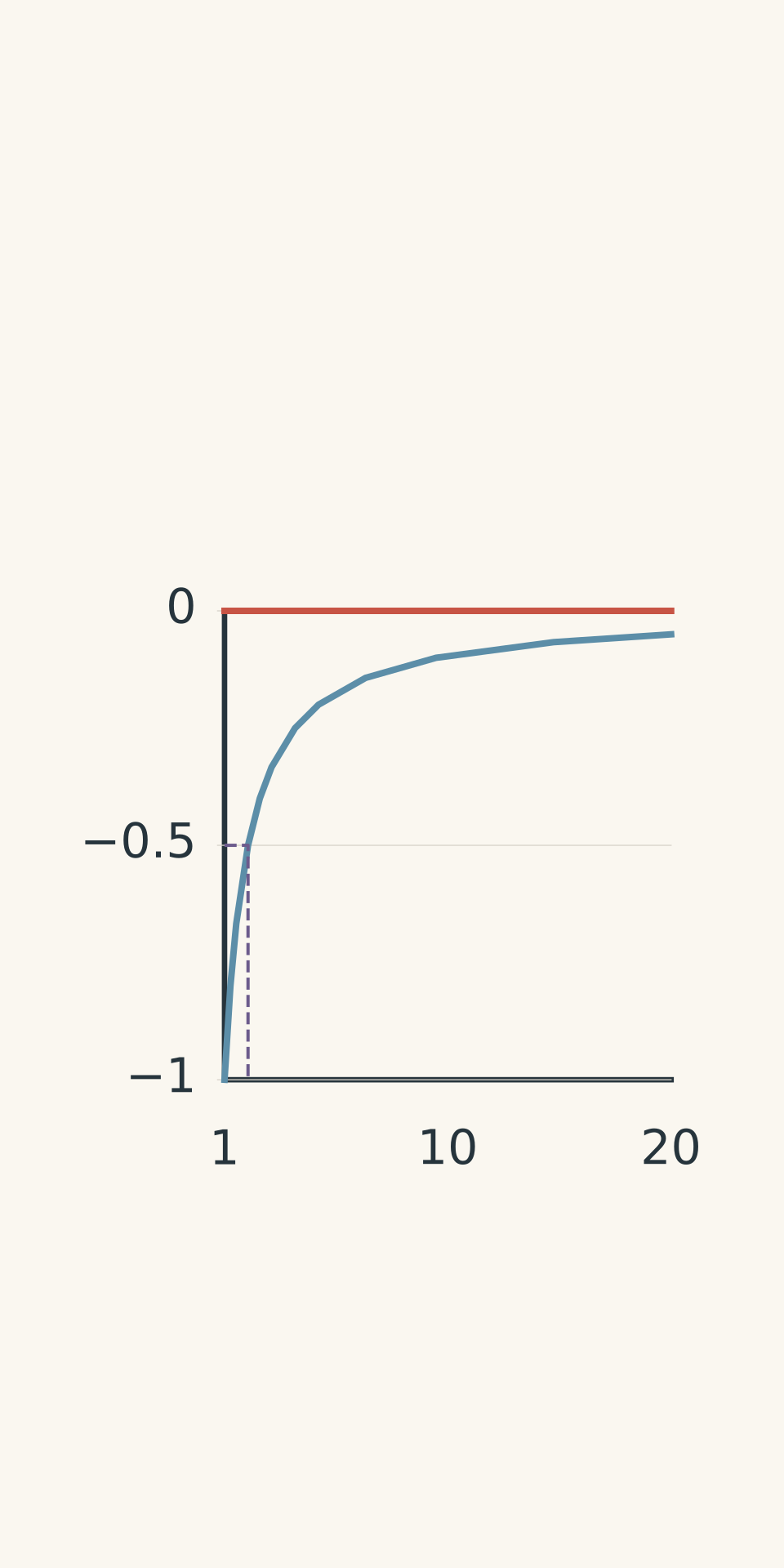
- U/(GMm/R) = −R/r
- Zero potential energy, U = 0
- Planet surface: r = R, U = −GMm/R
- At r = 2R: U = −GMm/(2R)
The graph gives you a quick sign check. At the surface, \(U=-GMm/R\). At twice the surface radius, \(U=-GMm/(2R)\), which is less negative. At very large distances, the curve approaches zero.
The gravitational force is still attractive at every finite distance. What changes is the energy of the configuration as the separation increases.
03Why potential energy increases when an object moves away
Suppose an object moves outwards from radius \(r_1\) to radius \(r_2\), where \(r_2>r_1\).
Its change in gravitational potential energy is
\[ \begin{aligned} \Delta U &=U_2-U_1\\[4pt] &=-\frac{GMm}{r_2} +\frac{GMm}{r_1}\\[4pt] &=GMm\left(\frac{1}{r_1} -\frac{1}{r_2}\right) \end{aligned} \]
Because \(r_2>r_1\), the bracket is positive. Therefore, \(\Delta U>0\).
The potential energy has increased, even though both the initial and final values may be negative.
For example, suppose the potential energy changes from \(-8{,}000\ \mathrm{J}\) to \(-3{,}000\ \mathrm{J}\).
\[ \Delta U=(-3{,}000)-(-8{,}000) =+5{,}000\ \mathrm{J} \]
The increase is \(5{,}000\ \mathrm{J}\). Do not subtract the magnitudes and then attach a negative sign just because both original values were negative.
Two different ways to move the object
The next distinction is important because exam questions often change one phrase and expect you to change your method.
Case 1: The object moves outwards under gravity alone.
Its total mechanical energy is conserved. As it moves outwards, its kinetic energy decreases while its gravitational potential energy increases.
\[ \Delta K=-\Delta U \]
Here, \(K\) is kinetic energy, measured in joules. The object is exchanging kinetic energy for potential energy.
Case 2: An engine or external force moves the object outwards slowly.
The external force does positive work against gravity. If the object’s kinetic energy remains approximately constant, the work supplied becomes an increase in potential energy.
\[ W_{\text{ext}}=\Delta U \]
This second equation assumes negligible change in kinetic energy and no energy losses. More generally, the net work done by external, non-gravitational forces changes the total mechanical energy \(K+U\).
Two ways to move away from a planet
| Free outward motion | ΔK = −ΔU; ΔE = 0 K decreases ↓; U increases ↑ Total energy E = K + U stays constant |
|---|---|
| Slow controlled lift | Wₑₓₜ ≈ ΔU; ΔK ≈ 0 External work added; U increases ↑ K stays approximately constant; E increases ↑ |
Do not mix these cases. If only gravity acts, you cannot claim that extra mechanical energy is being supplied by an engine.
04How the negative value connects to escape
A planet’s gravitational field does not have a sharp outer edge. To escape means to reach arbitrarily large distances without falling back.
The key quantity is the object’s total mechanical energy:
\[ E=K+U \]
Using the infinity-zero convention,
\[ E=K-\frac{GMm}{r} \]
This equation tells you whether the object has enough kinetic energy to escape.
The minimum energy needed to escape
Consider an object at radius \(r\). Its potential energy is
\[ U=-\frac{GMm}{r} \]
To reach infinity with zero final speed, its final kinetic energy must approach zero. Its final potential energy also approaches zero, so its total energy at that limiting state is zero.
By conservation of mechanical energy, the initial total energy must therefore be zero:
\[ \begin{aligned} E_i&=K_i+U_i=0\\[4pt] K_i-\frac{GMm}{r}&=0\\[4pt] \boxed{K_i=\frac{GMm}{r}} \end{aligned} \]
This is the minimum kinetic energy needed for escape under ideal conditions, with no further propulsion or energy losses. If the object starts at rest, the same amount of energy must be supplied externally to raise it to infinity with zero final speed.
At the planet’s surface, \(r=R\), where \(R\) is the planet’s radius. The minimum energy needed to escape from rest is therefore
\[ \boxed{W_{\min}=\frac{GMm}{R}} \]
This result connects the negative potential energy directly to the work required to escape. The magnitude of the surface potential energy is the energy needed to raise the object from rest at the surface to infinity with zero final speed.
What does the energy diagram show?
Imagine an object launched from the surface at exactly its escape speed.
Initially,
\[ U_i=-\frac{GMm}{R}, \qquad K_i=+\frac{GMm}{R} \]
The negative potential energy and positive kinetic energy cancel. The total mechanical energy is zero.
As the object moves away, its potential energy rises towards zero and its kinetic energy falls towards zero. At every finite distance, the two have equal magnitudes for this just-escaping object.
At infinity, in the limiting sense,
\[ U_\infty=0,\qquad K_\infty=0 \]
The total energy remains zero throughout.
Energy of a probe at escape speed
| At the surface (r = R) | E = K + U = 0 K = +GMm/R U = −GMm/R |
|---|---|
| At infinity (r → ∞) | E = K + U = 0 K → 0 U → 0 |
Now compare three possible launches from the same radius.
- Below escape speed: \(K<|U|\), so \(E<0\). The object moving outwards reaches a finite turning point, where its kinetic energy becomes zero, and then falls back.
- At escape speed: \(K=|U|\), so \(E=0\). The object escapes, with its speed approaching zero as the distance approaches infinity.
- Above escape speed: \(K>|U|\), so \(E>0\). The object escapes with positive kinetic energy remaining at infinity.
Total energy determines escape
| Below escape | U = −A; K = 0.6A E = K + U = −0.4A Turns back at finite radius |
|---|---|
| Just escaping | U = −A; K = A E = K + U = 0 Speed approaches zero at infinity |
| Above escape | U = −A; K = 1.4A E = K + U = +0.4A Escapes with kinetic energy remaining |
The trap is to use negative potential energy as the escape test. It is not. At any finite radius, \(U\) is negative under this convention. What determines escape is the total energy \(E=K+U\).
The escape speed follows from the same reasoning. If \(v_e\) is the minimum escape speed at radius \(r\), then
\[ \frac12 mv_e^2=\frac{GMm}{r} \]
Cancelling \(m\) gives
\[ \boxed{v_e=\sqrt{\frac{2GM}{r}}} \]
The ideal escape speed does not depend on the object’s mass, although the energy required to escape does.
05When the zero level changes
A common exam trap is to see two different answers for gravitational potential energy and assume one must be wrong.
Suppose one student chooses zero potential energy at infinity, while another chooses zero at the planet’s surface.
With zero at infinity,
\[ U=-\frac{GMm}{r} \]
With zero at the surface, we add a constant so that \(U=0\) at \(r=R\). Calling this alternative potential energy \(U_s\),
\[ \boxed{U_s=GMm\left(\frac1R-\frac1r\right)} \]
At the surface, \(U_s=0\). At infinity, \(U_s=GMm/R\).
The two expressions give different values for the same physical position, but they give the same change in potential energy between two positions. Adding a constant to every potential energy value does not change the work required to move between those positions.
Changing the zero reference changes values, not energy differences
| Zero at infinity | U = −GMm/r At R: U = −A; at 2R: U = −A/2 Increase: ΔU = +A/2 |
|---|---|
| Zero at the surface | Uₛ = GMm(1/R − 1/r) At R: Uₛ = 0; at 2R: Uₛ = +A/2 Increase: ΔUₛ = +A/2 |
For example, if \(GMm/R=3.0\times10^9\ \mathrm{J}\), the potential energy at \(2R\) is \(-1.5\times10^9\ \mathrm{J}\) with zero at infinity, or \(+1.5\times10^9\ \mathrm{J}\) with zero at the surface. Both conventions give an increase of \(1.5\times10^9\ \mathrm{J}\) from the surface to \(2R\).
So, if a question specifies a different reference level, do not blindly use \(U=-GMm/r\). First check the convention, then use it consistently.
There are two other wording changes to watch for:
- Altitude versus radius: If the object is at altitude \(h\) above the surface, use \(r=R+h\), not \(r=h\).
- Reaching infinity versus reaching infinity at rest: At infinity, \(U\) approaches zero, but \(K\) does not have to. An object with positive total energy can reach infinity with positive kinetic energy remaining.
06A dependable exam method
When a question involves negative gravitational potential energy, use this decision process.
- Identify the zero reference. If the question says zero at infinity, use \(U=-GMm/r\).
- Find the correct radius. Measure from the planet’s centre. Convert altitude to \(r=R+h\) if necessary.
- Decide whether you need a value or a change. For a value, use the specified potential energy formula. For movement from \(r_1\) to \(r_2\), use
\[ \Delta U=GMm\left(\frac1{r_1}-\frac1{r_2}\right) \]
- Check what forces act. If only gravity acts, conserve \(K+U\). If an engine supplies work, account for the change in total mechanical energy.
- Test escape using total energy. Calculate \(E=K+U\). Do not decide from the sign of \(U\) alone.
If your answer says that potential energy decreases as an object moves outwards, stop and check your subtraction. If your answer says that negative potential energy makes escape impossible, calculate the total energy before deciding.
07Worked example: Correct the sign and use the correct radius
A \(1.0\times10^3\ \mathrm{kg}\) satellite is at an altitude of \(4.0\times10^5\ \mathrm{m}\) above a planet with mass \(5.97\times10^{24}\ \mathrm{kg}\) and radius \(6.37\times10^6\ \mathrm{m}\). Calculate its gravitational potential energy relative to infinity. A student writes \(U=+GMm/r\). Identify the error and calculate the correct value.
Use \(G=6.67\times10^{-11}\ \mathrm{N\,m^2\,kg^{-2}}\).
Step 1
Step 2
\[ \begin{aligned} r&=R+h\\ &=6.37\times10^6+4.0\times10^5\\ &=6.77\times10^6\ \mathrm{m} \end{aligned} \]
Step 3
\[ \begin{aligned} U&=-\frac{GMm}{r}\\[4pt] &=-\frac{ (6.67\times10^{-11}) (5.97\times10^{24}) (1.0\times10^3)} {6.77\times10^6}\\[4pt] &=-5.88\times10^{10}\ \mathrm{J} \end{aligned} \]
Step 4
08Worked example: Track energy as an object moves outwards
A \(500\ \mathrm{kg}\) object moves outwards from \(r_1=2.0\times10^7\ \mathrm{m}\) to \(r_2=4.0\times10^7\ \mathrm{m}\) from a planet of mass \(6.0\times10^{24}\ \mathrm{kg}\). It reaches \(r_2\) while moving outwards, and only gravity acts. Calculate the change in gravitational potential energy and the change in kinetic energy.
Use \(G=6.67\times10^{-11}\ \mathrm{N\,m^2\,kg^{-2}}\).
Step 1
\[ \Delta U=GMm\left(\frac1{r_1}-\frac1{r_2}\right) \]
Step 2
\[ \begin{aligned} \Delta U ={}&(6.67\times10^{-11}) (6.0\times10^{24})(500)\\ &\times\left( \frac1{2.0\times10^7} -\frac1{4.0\times10^7} \right)\\[4pt] ={}&+5.0\times10^9\ \mathrm{J} \end{aligned} \]
The potential energy has increased by \(5.0\times10^9\ \mathrm{J}\).
Step 3
\[ \Delta K+\Delta U=0 \]
Therefore,
\[ \Delta K=-\Delta U =-5.0\times10^9\ \mathrm{J} \]
Step 4
09Worked example: Calculate the energy and speed needed to escape
A \(1.2\times10^3\ \mathrm{kg}\) probe starts at rest at the surface of a planet with mass \(5.97\times10^{24}\ \mathrm{kg}\) and radius \(6.37\times10^6\ \mathrm{m}\). Calculate the minimum energy needed to reach infinity with zero final speed, then calculate the escape speed.
Ignore atmospheric drag, planetary rotation, and other energy losses. Use \(G=6.67\times10^{-11}\ \mathrm{N\,m^2\,kg^{-2}}\).
Step 1
\[ \begin{aligned} W_{\min}&=\Delta U\\ &=0-\left(-\frac{GMm}{R}\right)\\ &=\frac{GMm}{R} \end{aligned} \]
Step 2
\[ \begin{aligned} W_{\min} &=\frac{ (6.67\times10^{-11}) (5.97\times10^{24}) (1.2\times10^3)} {6.37\times10^6}\\[4pt] &=7.5\times10^{10}\ \mathrm{J} \end{aligned} \]
The minimum energy input is \(7.5\times10^{10}\ \mathrm{J}\).
Step 3
\[ \frac12 mv_e^2=\frac{GMm}{R} \]
Rearranging gives
\[ v_e=\sqrt{\frac{2GM}{R}} \]
Substituting,
\[ \begin{aligned} v_e&=\sqrt{ \frac{2(6.67\times10^{-11})(5.97\times10^{24})} {6.37\times10^6} }\\[4pt] &=1.12\times10^4\ \mathrm{m\,s^{-1}}\\[4pt] &=11.2\ \mathrm{km\,s^{-1}} \end{aligned} \]
Step 4
10Five-second self-check
Before submitting an exam answer, run through these checks:
- [ ] Did I use the reference level specified in the question?
- [ ] Did I measure \(r\) from the planet’s centre?
- [ ] If the object moves outwards, does its potential energy increase?
- [ ] If only gravity acts, do my changes satisfy \(\Delta K=-\Delta U\)?
- [ ] Did I use total energy, rather than potential energy alone, to decide whether the object escapes?
11Questions and solutions
Question 1
A \(200\ \mathrm{kg}\) satellite is at a centre-to-centre distance of \(1.0\times10^7\ \mathrm{m}\) from a planet of mass \(4.0\times10^{24}\ \mathrm{kg}\).
Calculate its gravitational potential energy using zero potential energy at infinity. Explain the sign of your answer.
Use \(G=6.67\times10^{-11}\ \mathrm{N\,m^2\,kg^{-2}}\).
Solution 1
The satellite’s gravitational potential energy is \(-5.34\times10^9\ \mathrm{J}\). It is negative because the satellite is at a finite separation, where the potential energy is below the chosen zero level at infinity.
Use
\[ U=-\frac{GMm}{r} \]
Substituting,
\[ \begin{aligned} U&=-\frac{ (6.67\times10^{-11}) (4.0\times10^{24})(200)} {1.0\times10^7}\\[4pt] &=-5.336\times10^9\ \mathrm{J}\\[4pt] &\approx-5.34\times10^9\ \mathrm{J} \end{aligned} \]
The negative sign is part of the potential energy value under the specified convention. It does not tell you whether the satellite can escape. That requires its kinetic energy as well.
Question 2
At the surface of a planet, an object has gravitational potential energy \(U=-8.0\times10^9\ \mathrm{J}\) and kinetic energy \(K=7.0\times10^9\ \mathrm{J}\). It moves radially outwards under gravity alone.
Assume the potential energy follows \(U=-GMm/r\).
(a) Calculate its total mechanical energy.
(b) Calculate its kinetic energy when it reaches \(r=4R\), where \(R\) is the planet’s radius.
(c) Find the greatest distance from the planet’s centre that the object reaches, expressed in terms of \(R\).
Solution 2
The total mechanical energy is \(-1.0\times10^9\ \mathrm{J}\). The object reaches \(4R\) with \(1.0\times10^9\ \mathrm{J}\) of kinetic energy, then turns around at \(8R\). Its negative total energy means it cannot escape under the stated conditions.
(a) Total mechanical energy
\[ \begin{aligned} E&=K+U\\ &=7.0\times10^9-8.0\times10^9\\ &=-1.0\times10^9\ \mathrm{J} \end{aligned} \]
(b) Kinetic energy at \(4R\)
Since \(U\) is inversely proportional to \(r\),
\[ U(4R)=\frac{-8.0\times10^9}{4} =-2.0\times10^9\ \mathrm{J} \]
Total energy is conserved, so
\[ \begin{aligned} K&=E-U\\ &=-1.0\times10^9-(-2.0\times10^9)\\ &=+1.0\times10^9\ \mathrm{J} \end{aligned} \]
The object is still moving outwards at \(4R\).
(c) Greatest distance
At the turning point, the object momentarily has \(K=0\). Therefore,
\[ E=U_{\text{turn}}=-1.0\times10^9\ \mathrm{J} \]
Using the inverse-distance relationship,
\[ -1.0\times10^9 =-8.0\times10^9\frac{R}{r_{\text{turn}}} \]
Rearranging,
\[ r_{\text{turn}}=8R \]
The object reaches \(8R\) before falling back. Notice that the conclusion comes from its negative total energy, not merely from its negative potential energy.
Question 3
For a particular planet and probe, suppose
\[ \frac{GMm}{R}=3.0\times10^9\ \mathrm{J} \]
One student chooses zero potential energy at infinity. Another chooses zero potential energy at the planet’s surface.
(a) Calculate the potential energy at \(r=2R\) using each convention.
(b) Calculate the change in potential energy from the surface to \(2R\).
(c) Find the minimum work required to move the probe slowly from the surface to infinity, with negligible change in kinetic energy.
Explain why the two students can obtain different potential energy values without disagreeing about the physics.
Solution 3
Both students can be correct because potential energy depends on the chosen zero reference. They obtain the same change in potential energy, \(+1.5\times10^9\ \mathrm{J}\), and the same minimum work to reach infinity, \(3.0\times10^9\ \mathrm{J}\).
Let \(A=GMm/R=3.0\times10^9\ \mathrm{J}\).
(a) Potential energy at \(2R\)
With zero at infinity,
\[ U(2R)=-\frac{GMm}{2R} =-\frac{A}{2} \]
Therefore,
\[ U(2R)=-1.5\times10^9\ \mathrm{J} \]
With zero at the surface,
\[ U_s(r)=GMm\left(\frac1R-\frac1r\right) \]
At \(r=2R\),
\[ \begin{aligned} U_s(2R) &=GMm\left(\frac1R-\frac1{2R}\right)\\ &=\frac{A}{2}\\ &=+1.5\times10^9\ \mathrm{J} \end{aligned} \]
The values differ because the reference levels differ by \(3.0\times10^9\ \mathrm{J}\).
(b) Change in potential energy
Starting from the surface, the infinity-zero convention gives
\[ \begin{aligned} \Delta U &=U(2R)-U(R)\\ &=(-1.5\times10^9)-(-3.0\times10^9)\\ &=+1.5\times10^9\ \mathrm{J} \end{aligned} \]
The surface-zero convention gives the same change:
\[ \Delta U=(+1.5\times10^9)-0 =+1.5\times10^9\ \mathrm{J} \]
The reference level changes the individual values, not the difference.
(c) Work to reach infinity
The change from the surface to infinity is
\[ \begin{aligned} \Delta U &=0-(-3.0\times10^9)\\ &=+3.0\times10^9\ \mathrm{J} \end{aligned} \]
For a slow lift with negligible change in kinetic energy, the external work equals this increase in potential energy. The minimum work is \(3.0\times10^9\ \mathrm{J}\).
The common mistake is to treat potential energy values as absolute quantities. For work and energy changes, consistency of the reference convention is what matters.
Question 4
Two probes are at the same distance \(r\) from a planet of mass \(M\). Probe A has mass \(m\), while probe B has mass \(3m\). Each is launched radially outwards with the same kinetic energy,
\[ K=\frac{2GMm}{r} \]
After launch, only gravity acts.
(a) Which probe escapes?
(b) Find the greatest distance from the planet’s centre reached by the probe that does not escape, in terms of \(r\).
(c) Explain why your answer does not contradict the fact that escape speed is independent of the probe’s mass.
Solution 4
Probe A escapes, while probe B turns around at a distance \(3r\) from the planet’s centre. The probes have the same kinetic energy but different masses, so they do not have the same speed or the same total mechanical energy.
(a) Determine which probe escapes
For probe A,
\[ \begin{aligned} E_A&=K+U_A\\ &=\frac{2GMm}{r}-\frac{GMm}{r}\\ &=+\frac{GMm}{r} \end{aligned} \]
Its total energy is positive, so it escapes. At infinity, its potential energy approaches zero, leaving kinetic energy \(K_\infty=GMm/r\).
For probe B,
\[ \begin{aligned} E_B&=K+U_B\\ &=\frac{2GMm}{r}-\frac{3GMm}{r}\\ &=-\frac{GMm}{r} \end{aligned} \]
Its total energy is negative, so it cannot escape under the stated conditions.
(b) Find the turning distance
At the turning point, probe B has zero kinetic energy. Its total energy must still be \(-GMm/r\).
Therefore,
\[ -\frac{3GMm}{r_{\text{turn}}} =-\frac{GMm}{r} \]
Cancelling the common factors gives
\[ \boxed{r_{\text{turn}}=3r} \]
Probe B reaches three times its initial centre-to-centre distance before falling back.
(c) Explain the mass-independence of escape speed
The escape speed at radius \(r\) is
\[ v_e=\sqrt{\frac{2GM}{r}} \]
The probe’s mass cancels from the escape-speed equation. Both probes therefore have the same escape speed at the same radius.
However, equal kinetic energies do not mean equal speeds because \(K=\frac12 mv^2\). The heavier probe moves more slowly for the same kinetic energy, and its gravitational potential energy is also more negative. That is why the two probes have different escape outcomes.
Question 5
A probe leaves the surface of a planet with initial kinetic energy
\[ K_i=0.75A \]
where
\[ A=\frac{GMm}{R} \]
is the magnitude of its gravitational potential energy at the surface, using zero potential energy at infinity.
The probe moves radially outwards under gravity alone until it reaches its turning point. A short engine burn near that point then adds \(0.30A\) of mechanical energy. The engine switches off, and no further external work or energy losses occur.
(a) Find the turning radius before the engine burn.
(b) Determine whether the probe escapes after the burn.
(c) If it escapes, calculate its kinetic energy at infinity.
(d) A student argues that the probe cannot escape because the engine supplies less than \(A\), the magnitude of its original surface potential energy. Explain precisely why this reasoning fails.
Solution 5
The probe turns at \(4R\) before the burn. It then escapes with kinetic energy \(0.05A\) at infinity. The student’s argument fails because the required additional energy is determined by the probe’s total mechanical energy at the time of the burn, not by the magnitude of its original surface potential energy.
(a) Find the turning radius
At the surface, the potential energy is \(U_i=-A\). The initial total mechanical energy is
\[ \begin{aligned} E_i&=K_i+U_i\\ &=0.75A-A\\ &=-0.25A \end{aligned} \]
Before the burn, only gravity acts, so the total mechanical energy stays constant.
At the turning point, \(K=0\). Therefore,
\[ U_{\text{turn}}=-0.25A \]
Using \(U=-GMm/r\) and \(A=GMm/R\),
\[ -\frac{GMm}{r_{\text{turn}}} =-0.25\frac{GMm}{R} \]
Cancelling common factors gives
\[ \boxed{r_{\text{turn}}=4R} \]
(b) Determine whether the probe escapes
The engine adds \(0.30A\) of mechanical energy. The total energy after the burn is
\[ \begin{aligned} E_f&=E_i+W\\ &=-0.25A+0.30A\\ &=+0.05A \end{aligned} \]
The total energy is now positive. The probe escapes because it has more energy than the minimum required to reach infinity.
(c) Find the kinetic energy at infinity
At infinity, the potential energy approaches zero. By conservation of mechanical energy after the burn,
\[ \begin{aligned} K_\infty+U_\infty&=E_f\\ K_\infty+0&=0.05A \end{aligned} \]
Therefore,
\[ \boxed{K_\infty=0.05A} \]
The probe arrives at infinity with positive kinetic energy rather than approaching zero speed.
(d) Identify the student’s mistake
The tempting argument compares the engine’s energy input with the original potential energy magnitude \(A\). But that ignores the probe’s initial kinetic energy of \(0.75A\).
Before the burn, the probe’s total energy is already \(-0.25A\), not \(-A\). Its energy deficit relative to the escape threshold \(E=0\) is therefore only \(0.25A\).
The engine supplies \(0.30A\), which exceeds that deficit by \(0.05A\). That surplus becomes the probe’s kinetic energy at infinity.
The important decision is to track the probe’s total mechanical energy through every stage. This same bookkeeping is essential when analysing satellite transfers, orbital changes, and engine burns: gravity exchanges kinetic and potential energy, while external work changes their total.