
IUPAC Nomenclature of Hydrocarbons for HSC Chemistry
Learn how to name and write formulae for alkanes, alkenes, and alkynes to C8, including methyl and ethyl branches and bond locants.
Two names compete for the structure \(\ce{CH3-CH(CH3)-CH=CH-CH3}\): 2-methylpent-3-ene and 4-methylpent-2-ene.
Which would you choose?
It is tempting to start numbering from the left because the methyl branch then gets the nice low number 2. But the carbon-carbon double bond matters first. Numbering from the right gives the double bond locant 2 instead of 3, so the correct name is 4-methylpent-2-ene.
That one decision captures a big part of hydrocarbon nomenclature: an IUPAC name is not just a carbon count. It is a set of coordinates telling you exactly how the atoms are connected.
01What information does a hydrocarbon name contain?
Think of the name like an address. The parent chain is the street, and locants are the house numbers. Saying “methyl” without a locant would be like telling someone, “I live somewhere on Parramatta Road.” Technically information, but not enough to find anything.
The analogy has a limit. A carbon chain is not actually a straight street. It can bend, zigzag, and branch in any direction. When choosing a parent chain, follow connected carbon atoms rather than whichever line happens to look straight on the page.
For example, consider 4-methylhex-2-yne.
The pieces tell us:
hex-means the parent chain contains six carbon atoms-ynemeans it contains a carbon-carbon triple bond2-beforeynemeans the triple bond begins at carbon 2, so it lies between carbons 2 and 34-methyl-means a one-carbon branch is attached to carbon 4
You should be able to work in both directions: structure to name, and name back to structure.
02The carbon stems from C1 to C8
The first part of the parent name tells you how many carbons are in the parent chain.
| Carbon atoms in parent | Stem |
|---|---|
| 1 | meth- |
| 2 | eth- |
| 3 | prop- |
| 4 | but- |
| 5 | pent- |
| 6 | hex- |
| 7 | hept- |
| 8 | oct- |
Then the ending tells you what kind of carbon-carbon bonds are present.
| Hydrocarbon | Carbon-carbon bonding | Suffix | General molecular formula for an acyclic compound |
|---|---|---|---|
| Alkane | single bonds only | -ane | \(C_nH_{2n+2}\) |
| Alkene | one double bond | -ene | \(C_nH_{2n}\) |
| Alkyne | one triple bond | -yne | \(C_nH_{2n-2}\) |
Here, \(n\) is the total number of carbon atoms in the whole molecule, including branches.
That last point catches people. A five-carbon parent chain with one methyl branch contains six carbons altogether.
The formula patterns above assume an acyclic hydrocarbon with either no multiple bond, one double bond, or one triple bond. They do not tell you where the multiple bond or branches are.
For example, \(\ce{C6H12}\) tells you the composition of an acyclic alkene, but it does not distinguish between different structural isomers.
03How to name an alkane, alkene, or alkyne
The order matters. Trying to name branches before deciding on the parent chain is one of the fastest ways to create a perfectly tidy wrong answer.
Step 1: Choose the parent chain
For an alkane, choose the longest continuous chain of carbon atoms.
For an alkene or alkyne in this HSC scope, the parent chain must contain the \(\ce{C=C}\) or \(\ce{C#C}\) bond. Then choose the longest suitable chain containing that multiple bond.
Do not assume the horizontal line in a condensed formula is the parent chain.
For example, a structure may be written as
\[ \ce{CH3-CH(CH2CH2CH3)-CH2-CH3} \]
At first glance, you might see a four-carbon horizontal chain with a propyl branch. But trace continuously from the left end through the branch point and down the three-carbon arm. You can make a six-carbon chain.
The parent is therefore hexane, not butane.
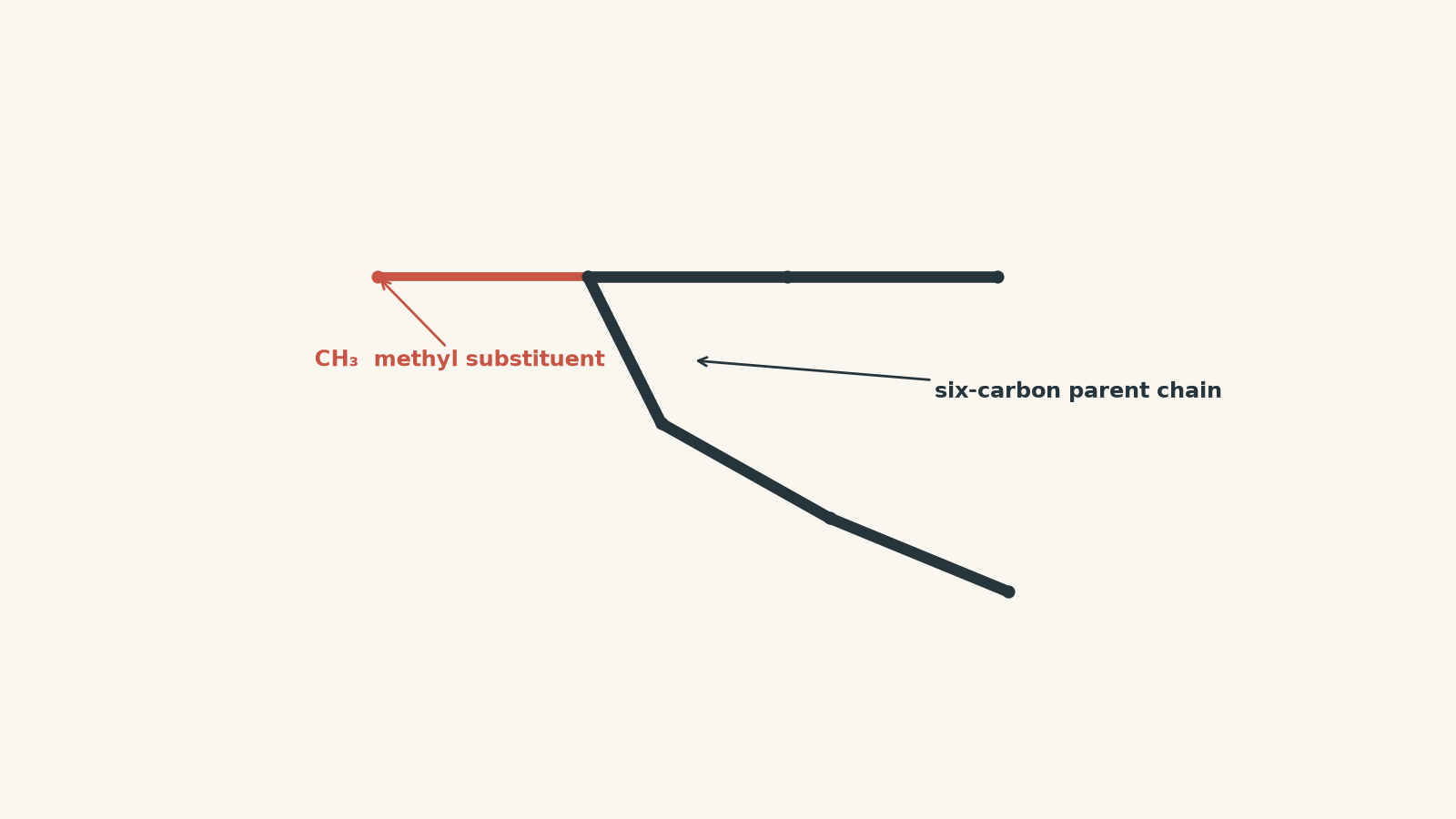
Step 2: Number the parent chain
For an alkane, number from the end that gives the substituents the lowest possible set of locants.
For an alkene or alkyne, first give the double or triple bond the lowest possible locant.
The bond locant is the number of the lower-numbered carbon in that bond.
So:
- hex-1-ene has its double bond between carbons 1 and 2
- pent-2-ene has its double bond between carbons 2 and 3
- hex-3-yne has its triple bond between carbons 3 and 4
If the multiple bond receives the same locant from either end, then use the substituent locants to break the tie.
This is why our opening structure was 4-methylpent-2-ene, not 2-methylpent-3-ene. The lower double-bond number wins before the lower methyl number.
Step 3: Identify the branches
A one-carbon branch is a methyl group, \(\ce{-CH3}\).
A two-carbon branch is an ethyl group, \(\ce{-CH2CH3}\).
Give each branch the number of the parent carbon to which it is attached.
If identical branches appear more than once, use prefixes such as di- or tri-:
- 2,3-dimethylpentane
- 2,2,4-trimethylpentane
Step 4: Assemble the name
List different substituents alphabetically. Ethyl therefore comes before methyl.
For example:
3-ethyl-2-methylhexane
Use:
- commas between two numbers
- hyphens between numbers and words
- no spaces inside the complete name
Prefixes such as di- do not change alphabetical ordering. You alphabetise according to the branch name itself.
If branched chains are the part you most often lose track of, the dedicated Naming Methyl and Ethyl Branched Chains for HSC Chemistry guide gives that decision more practice.
04How to write a formula from an IUPAC name
Going backwards is just as important.
Suppose you are given a name such as 3-methylpent-1-ene.
Do not try to imagine the whole molecule at once.
First write five connected carbons for pent-.
Then put the double bond between carbons 1 and 2.
Then attach a methyl group to carbon 3.
Finally, add enough hydrogens for every carbon atom to have a total of four bonds.
You obtain
\[ \ce{CH2=CH-CH(CH3)-CH2-CH3} \]
There are six carbon atoms altogether. Because it is an acyclic alkene with one double bond,
\[ C_nH_{2n}=C_6H_{12} \]
so its molecular formula is \(\ce{C6H12}\).
Notice the different jobs done by the two formulae:
- \(\ce{C6H12}\) is a molecular formula. It tells you how many atoms are present.
- \(\ce{CH2=CH-CH(CH3)-CH2-CH3}\) is a condensed structural formula. It also tells you how those atoms are connected.
You often need both.
05Worked example: Name a branched alkene
Name \(\ce{CH3-CH=C(CH3)-CH2-CH3}\), and determine its molecular formula.
Step 1
The longest suitable parent contains five carbon atoms, so the stem is pent-.
Step 2
From the left, the double bond is between carbons 2 and 3. From the right, it would begin at carbon 3.
We therefore number from the left and use pent-2-ene.
Step 3
There is a methyl group attached to carbon 3.
The complete name is therefore 3-methylpent-2-ene.
Step 4
The molecule contains six carbon atoms in total: five in the parent and one in the methyl branch.
An acyclic alkene containing one double bond follows \(C_nH_{2n}\).
\[ n=6 \]
\[ C_nH_{2n}=C_6H_{12} \]
The molecular formula is therefore \(\ce{C6H12}\).
The name tells us more than that formula does: the double bond is specifically between carbons 2 and 3, and the methyl branch is attached to carbon 3.
06Worked example: Build a branched alkyne from its name
Write the condensed structural formula and molecular formula of 3-ethylpent-1-yne.
Step 1
pent- means five carbons.
pent-1-yne means the triple bond lies between carbons 1 and 2.
Start with
\[ \ce{HC#C-CH2-CH2-CH3} \]
before adding the branch.
Step 2
An ethyl branch is \(\ce{-CH2CH3}\), so the structure becomes
\[ \ce{HC#C-CH(CH2CH3)-CH2-CH3} \]
Step 3
There are five carbons in the parent chain and two in the ethyl branch.
So \(n=7\).
Step 4
An acyclic alkyne with one triple bond follows \(C_nH_{2n-2}\).
\[ C_nH_{2n-2}=C_7H_{2(7)-2}=C_7H_{12} \]
The molecular formula is \(\ce{C7H12}\).
This check is useful, but it is not a substitute for constructing the structure. Many different alkynes can have the molecular formula \(\ce{C7H12}\).
07The mistakes that produce believable wrong names
Most nomenclature errors are not random. They come from applying a sensible rule at the wrong time.
| Tempting idea | What actually controls the decision |
|---|---|
| Start numbering from the branch nearest an end | For an alkene or alkyne, minimise the multiple-bond locant first |
| The straight-looking row must be the parent | Trace the longest valid connected carbon chain |
| An ethyl group written in brackets must stay an ethyl branch | It may become part of a longer parent chain |
| Two structures with the same molecular formula must be the same compound | Molecular formula does not specify connectivity |
| Once the carbon numbers are written, any branch can be attached there | Carbon still has to obey its valency of four |
The third mistake deserves a closer look.
Imagine a student names
\[ \ce{CH3-CH(CH2CH3)-CH2-CH2-CH3} \]
as 2-ethylpentane.
The name seems plausible. There is a five-carbon row, and an ethyl group is visibly attached to its second carbon.
But the drawing does not decide which carbons belong to the parent.
Trace from the end of that apparent ethyl group, through the branch point, and along the three-carbon section to the right. That path contains six carbon atoms.
The correct parent is therefore hexane. The one carbon left outside the parent is a methyl branch, giving 3-methylhexane.
This is a useful habit: before naming any branch, physically trace the parent chain from one end to the other.
08A fast decision routine under exam conditions
When you see a hydrocarbon structure, use this order:
- Find any \(\ce{C=C}\) or \(\ce{C#C}\) bond.
- Choose the longest suitable parent containing that bond. For an alkane, simply choose the longest carbon chain.
- Number the parent. Give a double or triple bond the lowest locant before worrying about branches.
- Identify methyl and ethyl substituents.
- Check whether your supposed branch could actually have been included in a longer parent.
- Assemble the name with correct alphabetical order and punctuation.
- If a molecular formula is required, count all carbon atoms, then use the appropriate hydrogen relationship.
- Check carbon valency. Every neutral carbon atom in these hydrocarbons must have a total bond order of four.
That final check can expose structures that look fine as names but cannot physically exist.
09Questions and solutions
Question 1
Name \(\ce{CH3-CH2-CH=CH-CH3}\) and give its molecular formula.
Solution 1
The compound is pent-2-ene, with molecular formula \(\ce{C5H10}\).
The parent chain contains five carbons, so the stem is pent-.
Numbering from the right places the double bond between carbons 2 and 3. Numbering from the left would give it locant 3, so the right-hand numbering is required.
The name is therefore pent-2-ene.
There are five carbons in an acyclic molecule containing one double bond, so
\[ C_nH_{2n}=C_5H_{2(5)}=C_5H_{10} \]
The formula is \(\ce{C5H10}\). The tempting mistake is to call it pent-3-ene by keeping the numbering shown in the written formula rather than renumbering from the nearer end.
Question 2
Name \(\ce{CH3-CH(CH3)-C#C-CH2-CH3}\), and determine its molecular formula. Explain how the numbering direction is chosen.
Solution 2
The correct name is 2-methylhex-3-yne, and its molecular formula is \(\ce{C7H12}\).
The longest chain containing the triple bond has six carbon atoms, so the parent is hex-yne.
The triple bond is in the middle of the chain. Numbering from either end gives the triple bond locant 3:
\[ \ce{C3#C4} \]
So the multiple bond does not break the tie.
Now consider the methyl branch. From one end it lies on carbon 2; from the other, it lies on carbon 5. The lower substituent locant is therefore 2.
Hence the name is 2-methylhex-3-yne.
There are seven carbon atoms altogether. For one acyclic triple bond,
\[ C_nH_{2n-2}=C_7H_{2(7)-2}=C_7H_{12} \]
so the molecular formula is \(\ce{C7H12}\).
A tempting route is to think that because the triple bond is equally placed from both ends, either numbering direction is acceptable. It is not. Once the multiple-bond locant ties, the substituent locants decide the direction.
Question 3
A student names the following hydrocarbon 2-ethylpentane:
\[ \ce{CH3-CH(CH2CH3)-CH2-CH2-CH3} \]
Determine the correct IUPAC name and molecular formula, and explain exactly why the student’s name fails.
Solution 3
The correct name is 3-methylhexane, and its molecular formula is \(\ce{C7H16}\).
The student’s mistake is treating the five-carbon horizontal section as the parent chain without checking whether a longer path exists.
Start at the terminal carbon of the apparent ethyl branch and trace continuously through the branch point and towards the right:
\[ \ce{CH3-CH2-CH-CH2-CH2-CH3} \]
That gives a six-carbon parent chain.
The carbon that had been drawn at the far left is now a one-carbon methyl substituent attached to carbon 3 when the chain is numbered from the nearer end.
The correct name is therefore 3-methylhexane.
There are seven carbons in total and only single carbon-carbon bonds, so
\[ C_nH_{2n+2}=C_7H_{2(7)+2}=C_7H_{16} \]
giving \(\ce{C7H16}\).
The tempting route is reasonable because the formula is written with an obvious five-carbon row. IUPAC naming does not care about the orientation chosen by whoever drew the molecule. Connectivity decides the parent chain.
Question 4
A student proposes 3,5-dimethylhex-2-yne as the name of a neutral hydrocarbon.
Can a molecule with that name exist?
If the methyl group supposedly attached to carbon 3 is moved to carbon 4 while the methyl group at carbon 5 remains in place, give the valid IUPAC name, condensed structural formula, and molecular formula of the new molecule.
Solution 4
No. 3,5-dimethylhex-2-yne cannot represent a valid neutral hydrocarbon. After moving the carbon-3 methyl group to carbon 4, the valid compound is 4,5-dimethylhex-2-yne, with condensed structural formula \(\ce{CH3-C#C-CH(CH3)-CH(CH3)-CH3}\) and molecular formula \(\ce{C8H14}\).
The key constraint is carbon’s valency.
In hex-2-yne, the triple bond lies between carbons 2 and 3:
\[ \ce{C1-C2#C3-C4-C5-C6} \]
Look specifically at carbon 3. It has a triple bond to carbon 2, contributing a bond order of 3, and a single bond to carbon 4, contributing another 1.
Its total bond order is already
\[ 3+1=4 \]
Carbon 3 therefore has no remaining bond available for a methyl group. Attaching another carbon there would require carbon 3 to exceed its normal valency of four.
Moving that methyl group to carbon 4 produces
\[ \ce{CH3-C#C-CH(CH3)-CH(CH3)-CH3} \]
The six-carbon parent still contains the triple bond. Numbering from the left gives the triple bond locant 2, compared with 4 from the other direction, so the correct name is 4,5-dimethylhex-2-yne.
The molecule contains eight carbons and one triple bond:
\[ C_nH_{2n-2}=C_8H_{2(8)-2}=C_8H_{14} \]
so its molecular formula is \(\ce{C8H14}\).
The tempting approach is to treat an IUPAC name as though any locant can simply be attached to any carbon. Locants still describe a physically possible structure. Bonding capacity is a separate constraint that must also be satisfied.
Question 5
Consider the three condensed structural formulae below.
A:
\[ \ce{CH2=CH-CH(CH2CH3)-CH2CH3} \]
B:
\[ \ce{CH3CH2-CH(CH=CH2)-CH2CH3} \]
C:
\[ \ce{CH2=C(CH3)-CH2-CH2-CH2-CH3} \]
All three have the molecular formula \(\ce{C7H14}\).
Without using the molecular formula alone, determine whether A, B, and C represent one, two, or three distinct hydrocarbons. Give the IUPAC name of each distinct compound and explain why the most visually obvious parent chain in B is misleading.
Solution 5
There are two distinct hydrocarbons. A and B are two different written representations of the same molecule, 3-ethylpent-1-ene. C is a different structural isomer, 2-methylhex-1-ene.
Start with A.
The parent chain must contain the double bond. A five-carbon chain can be traced from the terminal \(\ce{CH2}\) of the double bond through the central carbon and out along either of the two-carbon arms:
\[ \ce{CH2=CH-CH-CH2-CH3} \]
The remaining two-carbon arm is an ethyl substituent on carbon 3.
Numbering from the double-bond end gives the alkene locant 1, so A is 3-ethylpent-1-ene.
Now examine B. Its central \(\ce{CH}\) carbon is connected to three groups:
- \(\ce{CH=CH2}\)
- \(\ce{CH2CH3}\)
- another \(\ce{CH2CH3}\)
That is exactly the same connectivity as A.
The horizontal five-carbon path in B is tempting because it looks like a complete pentane chain:
\[ \ce{CH3CH2-CH-CH2CH3} \]
But that path excludes the double bond. It therefore cannot be used as the parent for this alkene when a suitable five-carbon parent containing the \(\ce{C=C}\) bond is available.
Tracing through the double bond again gives a five-carbon alkene parent and an ethyl branch at carbon 3. B is therefore also 3-ethylpent-1-ene.
C is different.
Its longest chain containing the double bond contains six carbons:
\[ \ce{CH2=C-CH2-CH2-CH2-CH3} \]
There is a methyl branch on carbon 2, so its name is 2-methylhex-1-ene.
Therefore:
| Formula shown | IUPAC name | Relationship |
|---|---|---|
| A | 3-ethylpent-1-ene | Same compound as B |
| B | 3-ethylpent-1-ene | Same compound as A |
| C | 2-methylhex-1-ene | Structural isomer of A and B |
All three representations have molecular formula \(\ce{C7H14}\), so the molecular formula cannot settle the question. The decisive information is connectivity.
That is the conceptual point of systematic nomenclature. A molecule can be drawn from a different direction, bent differently, or written with different groups inside brackets without becoming a new compound. If the connectivity is unchanged, a correct IUPAC naming process leads back to the same name.
10What this allows you to do next
Once you can choose the parent chain, place a multiple-bond locant correctly, and distinguish the parent from methyl and ethyl branches, you have the machinery needed to compare structural isomers rather than just recognise formula patterns.
It also gives you the foundation for naming hydrocarbons with other functional groups. The procedure becomes more detailed because functional groups can affect the suffix, numbering, and choice of parent, but the basic question stays the same: what exact structure does this name describe?
For that broader naming framework, continue with IUPAC Naming of Organic Compounds to C8 for HSC Chemistry.