
HSC Chemistry: Alkane, Alkene and Alkyne Formulae
Learn how to identify alkanes, alkenes and alkynes, construct models, and write structural and molecular formulae for hydrocarbons up to C8.
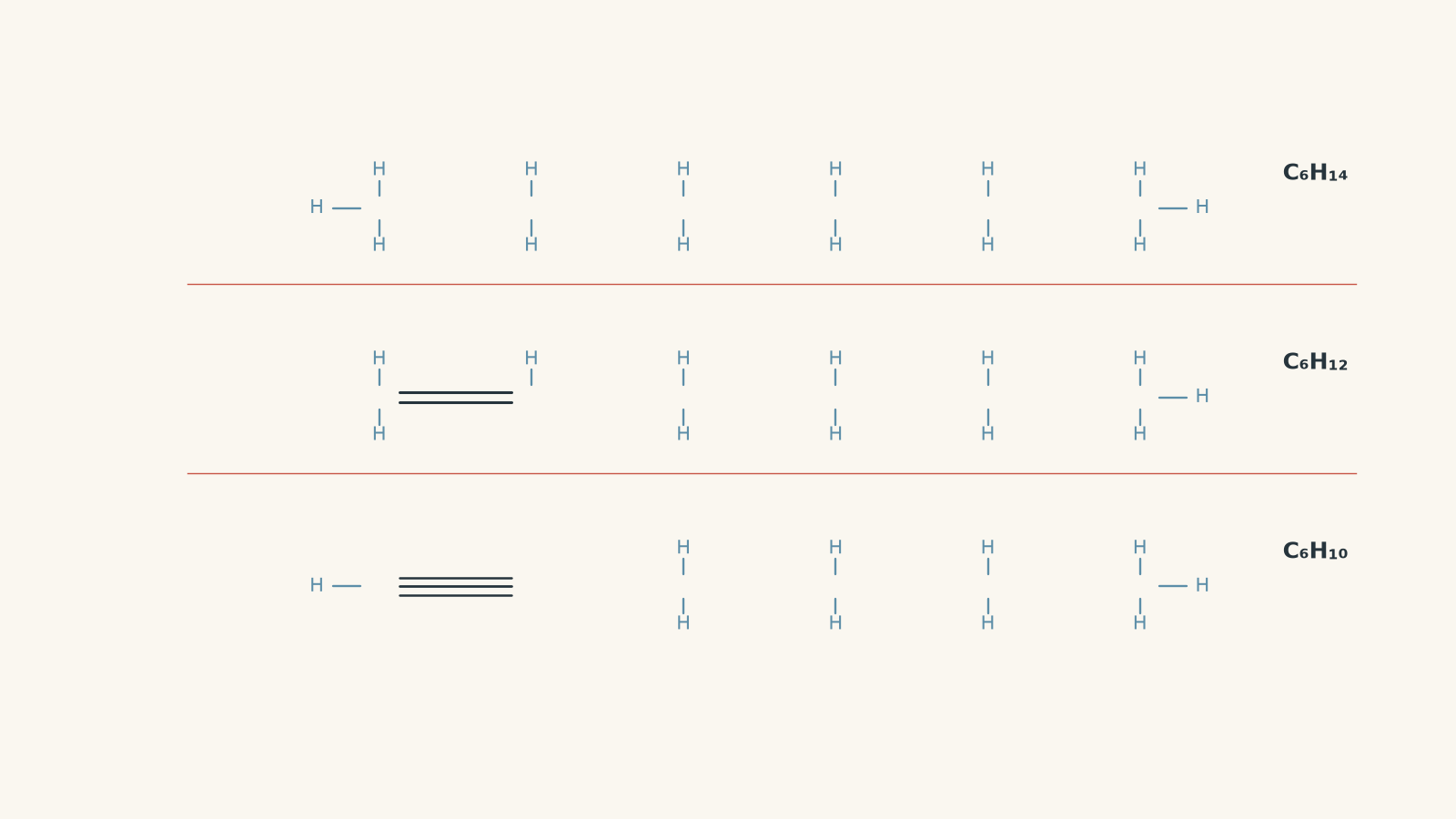
Imagine three molecular models. Each has six carbon atoms joined in one chain. The first has only single carbon-carbon bonds. The second has one double bond. The third has one triple bond.
Before counting anything, predict which model has the most hydrogen atoms.
It is the first one. The six-carbon alkane has formula \(\ce{C6H14}\). Change one carbon-carbon single bond into a double bond and the formula becomes \(\ce{C6H12}\). Make it a triple bond instead and it becomes \(\ce{C6H10}\).
The carbon count has not changed. What changed was how many of carbon’s bonding positions were used on other carbon atoms. That simple idea is the key to recognising alkanes, alkenes, and alkynes without memorising dozens of separate formulae.
01Start with carbon’s four-bond rule
When you build a hydrocarbon model, two facts do most of the work:
- carbon forms four bonds,
- hydrogen forms one bond.
A single bond counts as one bond between two atoms. A double bond counts as two, and a triple bond counts as three.
You can picture each carbon as having four bonding slots. Carbon is annoyingly strict about this. If it is using three slots on a triple bond to another carbon, it has only one slot left for anything else.
The analogy is useful for counting, but it is not an exact picture of chemical bonding. A double bond is not literally two separate little sticks, and a triple bond is not three independent bonds of identical type. For HSC model-building, however, counting bond order this way correctly tracks carbon’s valency.
Take ethane:
\[ \ce{CH3-CH3} \]
Each carbon has one C-C bond and three C-H bonds. That makes four bonds around each carbon.
Now compare ethene:
\[ \ce{CH2=CH2} \]
Each carbon is already using two bonding positions in the C=C double bond. Only two positions remain for hydrogen.
Then ethyne:
\[ \ce{HC#CH} \]
Each carbon uses three bonding positions in the C≡C triple bond, leaving room for only one hydrogen.
So increasing the carbon-carbon bond order reduces the number of hydrogen atoms the molecule can carry.
02The three homologous series
A homologous series is a family of compounds with a common structural feature and a common general formula. Neighbouring members differ by one \(\ce{CH2}\) unit.
For the three hydrocarbon series in this guide:
| Series | Defining carbon bonding | Functional group or feature | General formula | Smallest member |
|---|---|---|---|---|
| Alkane | C-C single bonds only | No characteristic functional group; all C-C bonds are single | \(\ce{C_nH_{2n+2}}\) | methane, \(\ce{CH4}\) |
| Alkene | Contains one C=C | C=C double bond | \(\ce{C_nH_{2n}}\) | ethene, \(\ce{C2H4}\) |
| Alkyne | Contains one C≡C | C≡C triple bond | \(\ce{C_nH_{2n-2}}\) | ethyne, \(\ce{C2H2}\) |
Here, \(n\) is the number of carbon atoms.
There is an important condition hiding in this table. These formulae describe the usual open-chain members containing:
- no multiple bonds for an alkane,
- one C=C bond for an alkene,
- one C≡C bond for an alkyne.
That condition matters. A molecular formula by itself does not always prove which bonds are present. We will return to that later.
Alkanes are saturated
An open-chain alkane contains the maximum possible number of hydrogen atoms for its carbon skeleton. It is therefore described as saturated.
For example, pentane has five carbon atoms:
\[ \ce{C5H12} \]
Using the alkane general formula:
\[ \ce{C_nH_{2n+2}} \]
with \(n=5\),
\[ \ce{H}=2(5)+2=12 \]
so the molecular formula is \(\ce{C5H12}\).
Alkenes and alkynes are unsaturated
An alkene has a C=C bond. An alkyne has a C≡C bond. Both therefore have fewer hydrogen atoms than the corresponding alkane.
For five carbons:
\[ \begin{aligned} \text{alkane: } &\ce{C5H12}\\ \text{alkene: } &\ce{C5H10}\\ \text{alkyne: } &\ce{C5H8} \end{aligned} \]
Notice the pattern. Moving from alkane to alkene removes two hydrogens from the formula. Moving from alkene to alkyne removes another two.
That is not a reaction equation. It is a comparison between structures with the same number of carbon atoms.
03Why the general formulae work
Start with an open-chain alkane:
\[ \ce{C_nH_{2n+2}} \]
Now imagine increasing one C-C single bond to a C=C double bond.
The two carbon atoms need to keep four bonds each. The extra carbon-carbon bond therefore replaces two C-H bonds overall: one on each carbon.
So an alkene has two fewer hydrogen atoms than the corresponding alkane:
\[ \ce{C_nH_{2n}} \]
Increase that same connection from a double bond to a triple bond. Another two C-H bonding positions disappear.
The result is:
\[ \ce{C_nH_{2n-2}} \]
This gives a useful comparison for compounds with the same number of carbon atoms:
| Series | Hydrogen count |
|---|---|
| Alkane | \(2n+2\) |
| Alkene | \(2n\) |
| Alkyne | \(2n-2\) |
If you forget one of the formulae in an exam, rebuild it from the four-bond rule rather than guessing.
04Carbon prefixes from C1 to C8
The start of a hydrocarbon name tells you how many carbon atoms are in its main chain.
| Carbon atoms | Prefix |
|---|---|
| 1 | meth- |
| 2 | eth- |
| 3 | prop- |
| 4 | but- |
| 5 | pent- |
| 6 | hex- |
| 7 | hept- |
| 8 | oct- |
The ending tells you the series:
-anemeans alkane,-enemeans alkene,-ynemeans alkyne.
For example, hex- means six carbons. Therefore:
- hexane is a six-carbon alkane,
- hexene is a six-carbon alkene,
- hexyne is a six-carbon alkyne.
For alkenes and alkynes, the name normally also tells you where the multiple bond begins. Hex-2-ene has its C=C bond between carbon 2 and carbon 3.
05Molecular formulae to C8
You do not need to memorise this whole table if you can use the general formulae. The table is more useful as a pattern check.
| Number of C atoms | Alkane | Alkene | Alkyne |
|---|---|---|---|
| 1 | \(\ce{CH4}\) | – | – |
| 2 | \(\ce{C2H6}\) | \(\ce{C2H4}\) | \(\ce{C2H2}\) |
| 3 | \(\ce{C3H8}\) | \(\ce{C3H6}\) | \(\ce{C3H4}\) |
| 4 | \(\ce{C4H10}\) | \(\ce{C4H8}\) | \(\ce{C4H6}\) |
| 5 | \(\ce{C5H12}\) | \(\ce{C5H10}\) | \(\ce{C5H8}\) |
| 6 | \(\ce{C6H14}\) | \(\ce{C6H12}\) | \(\ce{C6H10}\) |
| 7 | \(\ce{C7H16}\) | \(\ce{C7H14}\) | \(\ce{C7H12}\) |
| 8 | \(\ce{C8H18}\) | \(\ce{C8H16}\) | \(\ce{C8H14}\) |
There is no one-carbon alkene or alkyne. A double or triple carbon-carbon bond obviously needs two carbon atoms.
The vertical pattern matters too. Moving down one row within a homologous series adds \(\ce{CH2}\).
For example:
\[ \ce{C5H10 -> C6H12 -> C7H14 -> C8H16} \]
These are successive molecular formulae in the alkene series.
06Molecular formula versus structural formula
A molecular formula tells you how many atoms are present.
For example:
\[ \ce{C4H8} \]
tells you that the molecule contains four carbon atoms and eight hydrogen atoms.
It does not tell you how those atoms are connected.
A structural formula includes the bonding arrangement. A condensed structural formula for but-1-ene is:
\[ \ce{CH2=CH-CH2-CH3} \]
But-2-ene has the same molecular formula:
\[ \ce{CH3-CH=CH-CH3} \]
Both are \(\ce{C4H8}\), but the C=C bond is in a different position.
That is why you should not use the terms molecular formula and structural formula as though they mean the same thing.
07A reliable way to construct a hydrocarbon model
When you are given a name or asked to build a model, use the same order every time.
First, place the required number of carbon atoms. If you are building octane, you need eight.
Next, join the carbon skeleton.
Then insert the required multiple bond. For oct-3-yne, for example, the triple bond begins at carbon 3:
\[ \ce{C-C-C#C-C-C-C-C} \]
Only after the carbon skeleton is correct should you add hydrogen atoms.
For every carbon, ask:
How many more bonds does this carbon need to reach four?
That question is safer than trying to remember how many H atoms each carbon is “supposed” to have.
Worked example: Write the formulae for pent-2-ene
A hydrocarbon has five carbon atoms in a straight chain and a C=C bond between carbon 2 and carbon 3. Write its condensed structural formula and molecular formula.
Step 1
The prefix pent- tells us there are five carbon atoms.
Step 2
2-ene means the C=C bond begins at carbon 2:
\[ \ce{C-C=C-C-C} \]
Step 3
This gives:
\[ \ce{CH3-CH=CH-CH2-CH3} \]
Check the two double-bonded carbons. Each has one single C-C bond, one double C=C bond, and one C-H bond. Its total bond count is four.
Step 4
There are five carbon atoms and:
\[ 3+1+1+2+3=10 \]
hydrogen atoms.
So the molecular formula is:
\[ \ce{C5H10} \]
Step 5
For an alkene, \(\ce{C_nH_{2n}}\). With \(n=5\):
\[ \ce{H}=2(5)=10 \]
The count agrees. Pent-2-ene is therefore an alkene with molecular formula \(\ce{C5H10}\).
Worked example: Construct oct-3-yne
Construct a condensed structural formula for oct-3-yne, determine its molecular formula, and explain the hydrogen count on the triple-bonded carbons.
Step 1
Oct- means eight carbon atoms.
Step 2
3-yne means the triple bond begins at carbon 3. It therefore lies between carbon 3 and carbon 4:
\[ \ce{C-C-C#C-C-C-C-C} \]
Step 3
The condensed structural formula is:
\[ \ce{CH3-CH2-C#C-CH2-CH2-CH2-CH3} \]
Notice that carbon 3 and carbon 4 have no hydrogen atoms.
Each of those carbons already has a triple bond to the other carbon and a single bond to the next carbon in the chain:
\[ 3+1=4 \]
Its valency is already complete.
Step 4
\[ 3+2+0+0+2+2+2+3=14 \]
So the molecular formula is:
\[ \ce{C8H14} \]
Step 5
For an alkyne:
\[ \ce{C_nH_{2n-2}} \]
With \(n=8\):
\[ 2(8)-2=14 \]
so \(\ce{C8H14}\) is correct.
The important point is not just the answer. The triple bond uses three of carbon’s four bonding positions, so an internal triple-bonded carbon can have no hydrogen when its remaining bond connects it to another carbon.
08The most tempting mistakes
Mistake 1: A double bond means more hydrogen
It is easy to look at a double bond and think “more bonds, so perhaps more atoms”.
The opposite happens.
A double bond means the two carbon atoms are using more of their valency on each other. That leaves fewer bonding positions available for hydrogen.
For four carbons:
\[ \begin{aligned} \text{butane} &: \ce{C4H10}\\ \text{butene} &: \ce{C4H8}\\ \text{butyne} &: \ce{C4H6} \end{aligned} \]
More carbon-carbon bond order means fewer hydrogens.
Mistake 2: The general formula tells you the exact structure
Suppose you are given \(\ce{C6H12}\).
Within the restricted set of open-chain alkanes, alkenes, and alkynes used in a basic homologous-series question, it matches the alkene formula \(\ce{C_nH_{2n}}\).
But it does not tell you whether the structure is hex-1-ene, hex-2-ene, another alkene isomer, or, outside that restricted set, a different type of compound with the same molecular formula.
The general formula identifies a formula pattern. It does not draw the molecule for you.
Mistake 3: Counting carbon atoms from groups instead of atoms
Consider:
\[ \ce{CH3-CH2-CH=CH-CH3} \]
There are five carbon atoms, not four. Every C represents a carbon atom, including the carbon inside each \(\ce{CH3}\), \(\ce{CH2}\), or \(\ce{CH}\) group.
When in doubt, count the C symbols first.
Mistake 4: Giving every carbon four attached atoms
Carbon forms four bonds, not necessarily four bonds to four different atoms.
In a C=C bond, the other carbon accounts for two bond units.
In a C≡C bond, the other carbon accounts for three.
This is why a carbon in an alkyne can be correctly bonded to only two atoms while still having a valency of four.
09Questions and solutions
Question 1
Hexane is an unbranched alkane containing six carbon atoms.
Write:
a. its molecular formula,
b. its condensed structural formula,
c. the general formula you used to check your answer.
Solution 1
Hexane has molecular formula \(\ce{C6H14}\) and condensed structural formula \(\ce{CH3-CH2-CH2-CH2-CH2-CH3}\).
For an alkane, the general formula is:
\[ \ce{C_nH_{2n+2}} \]
For \(n=6\):
\[ 2(6)+2=14 \]
so the molecular formula is:
\[ \ce{C6H14} \]
The condensed structure contains two end carbons as \(\ce{CH3}\) groups and four internal carbons as \(\ce{CH2}\) groups:
\[ 3+2+2+2+2+3=14 \]
hydrogen atoms.
A common mistake is to use \(\ce{C_nH_{2n}}\), but that is the formula for an open-chain alkene containing one C=C bond. Hexane contains only single bonds, so it is saturated.
Question 2
A straight-chain hydrocarbon contains six carbon atoms. A model shows a double bond between carbon 3 and carbon 4, with no other multiple bonds.
Determine:
a. its name,
b. its condensed structural formula,
c. its molecular formula,
d. how its hydrogen count compares with hexane.
Solution 2
The compound is hex-3-ene, with condensed structural formula \(\ce{CH3-CH2-CH=CH-CH2-CH3}\) and molecular formula \(\ce{C6H12}\). It has two fewer hydrogen atoms than hexane.
The six-carbon chain gives the prefix hex-. The double bond begins at carbon 3, so the name is hex-3-ene.
Completing carbon’s valency gives:
\[ \ce{CH3-CH2-CH=CH-CH2-CH3} \]
The hydrogen count is:
\[ 3+2+1+1+2+3=12 \]
so:
\[ \ce{C6H12} \]
The alkene formula confirms this:
\[ \ce{C_nH_{2n}} \]
and with \(n=6\),
\[ 2(6)=12 \]
Hexane is \(\ce{C6H14}\). The C=C bond increases the bond order between two carbon atoms, so two fewer C-H bonds are possible overall.
The tempting error is to count six carbons correctly but still use the alkane formula. The double bond changes the allowable hydrogen count.
Question 3
An unknown open-chain hydrocarbon belongs to one of the three series in this guide. Its molecular formula is \(\ce{C7H12}\).
a. Identify its homologous series.
b. Write two different straight-chain condensed structural formulae that fit the molecular formula.
c. Explain why \(\ce{C7H12}\) alone cannot tell you which of your two structures is present.
Solution 3
Within the stated three-series model, the compound is an alkyne. Two possible straight-chain structures are hept-1-yne and hept-2-yne, and the molecular formula alone cannot distinguish their triple-bond positions.
For seven carbons, compare the predicted hydrogen counts:
\[ \begin{aligned} \text{alkane: } &2(7)+2=16\\ \text{alkene: } &2(7)=14\\ \text{alkyne: } &2(7)-2=12 \end{aligned} \]
The observed formula is \(\ce{C7H12}\), so it matches the alkyne series.
One possible structure is hept-1-yne:
\[ \ce{HC#C-CH2-CH2-CH2-CH2-CH3} \]
Another is hept-2-yne:
\[ \ce{CH3-C#C-CH2-CH2-CH2-CH3} \]
Both contain seven carbon atoms and twelve hydrogen atoms.
The tempting route is to think that once the homologous series has been identified, the structure has also been identified. It has not. The molecular formula tells us the numbers of atoms, while the structural formula tells us their connectivity.
Moving the triple bond changes the structure without changing the molecular formula.
Question 4
A student wants to turn the model of hex-1-ene,
\[ \ce{CH2=CH-CH2-CH2-CH2-CH3} \]
into a model of hex-1-yne.
They replace the C=C bond with C≡C but leave every hydrogen atom exactly where it was, giving the proposed structure
\[ \ce{CH2#CH-CH2-CH2-CH2-CH3} \]
Another student says, “It still has six carbon atoms, so it should be fine.”
Analyse the proposed model. Identify every valency problem, construct the correct hex-1-yne structure, determine its molecular formula, and explain exactly why the hydrogen count changes.
Solution 4
The proposed model is impossible because each of the first two carbon atoms would exceed carbon’s valency of four. Correct hex-1-yne is \(\ce{HC#C-CH2-CH2-CH2-CH3}\), with molecular formula \(\ce{C6H10}\).
Consider carbon 1 in the incorrect model:
\[ \ce{CH2#C} \]
The triple bond already contributes three bond units. Two C-H bonds would contribute another two:
\[ 3+2=5 \]
Carbon would have five bonds, which is not allowed in this model of ordinary hydrocarbons.
Carbon 2 has the same problem in a slightly different form. It has:
- a triple bond to carbon 1, contributing three,
- a single bond to carbon 3, contributing one,
- a C-H bond, contributing one.
That gives:
\[ 3+1+1=5 \]
Again, this exceeds four.
The correct structure is:
\[ \ce{HC#C-CH2-CH2-CH2-CH3} \]
Now carbon 1 has a triple bond plus one C-H bond:
\[ 3+1=4 \]
Carbon 2 has a triple bond plus one C-C single bond:
\[ 3+1=4 \]
and therefore carries no hydrogen.
Counting hydrogens gives:
\[ 1+0+2+2+2+3=10 \]
so the molecular formula is:
\[ \ce{C6H10} \]
This also agrees with the alkyne formula:
\[ 2(6)-2=10 \]
Hex-1-ene is \(\ce{C6H12}\), whereas hex-1-yne is \(\ce{C6H10}\). Increasing the C=C bond to a C≡C bond uses one additional bonding position on each of the two carbon atoms. Two C-H bonds must therefore be absent in the alkyne model.
The second student’s argument focuses only on the number of carbon atoms. That is not enough. A valid model must satisfy both the atom count and the bonding capacity of every carbon.
Question 5
An unknown hydrocarbon \(X\) has molecular formula \(\ce{C8H14}\).
A student argues:
Because \(\ce{C8H14}\) fits \(\ce{C_nH_{2n-2}}\), \(X\) must contain a carbon-carbon triple bond.
Work through the claim in two stages.
a. First assume \(X\) is known to belong to exactly one of the three open-chain homologous series studied in this guide: alkane, alkene with one C=C bond, or alkyne with one C≡C bond. Identify its series and give one possible condensed structural formula.
b. Now remove that restriction. Using carbon’s four-bond rule, construct an open-chain eight-carbon hydrocarbon with formula \(\ce{C8H14}\) that contains no triple bond.
c. Explain precisely what the molecular formula proves, what it does not prove, and what additional structural information would settle the student’s claim.
Solution 5
Under the restricted three-series assumption, \(X\) is an alkyne; without that assumption, \(\ce{C8H14}\) does not by itself prove that a triple bond is present.
For part a, test the three general formulae with \(n=8\):
\[ \begin{aligned} \text{alkane: }&2(8)+2=18\\ \text{alkene: }&2(8)=16\\ \text{alkyne: }&2(8)-2=14 \end{aligned} \]
Only the alkyne expression gives fourteen hydrogens. Within that restricted set, \(X\) must therefore be an alkyne.
One possible structure is oct-1-yne:
\[ \ce{HC#C-CH2-CH2-CH2-CH2-CH2-CH3} \]
Its hydrogen count is:
\[ 1+0+2+2+2+2+2+3=14 \]
so its molecular formula is \(\ce{C8H14}\).
For part b, however, we are no longer told that the molecule contains at most one multiple bond. Consider:
\[ \ce{CH2=CH-CH=CH-CH2-CH2-CH2-CH3} \]
This molecule contains two C=C bonds and no C≡C bond.
Count its hydrogens:
\[ 2+1+1+1+2+2+2+3=14 \]
so it also has molecular formula:
\[ \ce{C8H14} \]
Every carbon still obeys the four-bond rule.
This is the important hinge. The formula \(\ce{C_nH_{2n-2}}\) is the general formula of the open-chain alkyne homologous series containing one triple bond. But matching that atom count is not logically the same as proving that the molecule must be a member of that series when other bonding patterns are allowed.
The student’s conclusion was valid only because an unstated structural restriction had been assumed.
The molecular formula proves that the molecule contains eight carbon atoms and fourteen hydrogen atoms. It does not specify where the atoms are connected or whether the reduction in hydrogen count comes from one C≡C bond or some other bonding arrangement.
A structural formula, displayed formula, or molecular model showing the carbon-carbon connections would settle the question directly. If the structure showed one C≡C bond and no other multiple bonds, the compound could be classified as an alkyne.
That is why the best habit is not merely to recognise \(\ce{C_nH_{2n-2}}\). Always ask what assumptions make that formula useful.
10What this lets you do next
Once you can move reliably between a name, a molecular formula, and a structural model, the next step is to compare structures that share the same molecular formula.
That leads directly into structural isomerism. Two compounds may contain exactly the same numbers of carbon and hydrogen atoms while placing a double bond, triple bond, or carbon branch differently.
It also prepares you for hydrocarbon reactions. A molecular formula tells you the inventory of atoms, but the structural formula shows the part of the molecule where much of the chemistry happens. For alkenes and alkynes, that means paying particular attention to the C=C and C≡C bonds.