
How to Learn from Worked Solutions Without Copying Them
Learn how to turn worked solutions into genuine understanding instead of simply recognising familiar steps. This practical guide shows you how to identify gaps, reconstruct methods from memory, and test your skills on unfamiliar HSC questions.
You recognise the pattern: you read a worked solution, nod along, and think, “I would’ve done that.” Then you close the page, try the next question, and can’t decide what to write first. Change one condition, and the method suddenly falls apart.
The problem isn’t that you used a worked solution. It’s that recognising somebody else’s reasoning felt like producing your own.
Before reading on, predict which student is better prepared for an unfamiliar question. Student A can explain every line while the solution is visible. Student B struggles with one line, identifies what they can’t justify, then closes the solution and rebuilds the method from memory. Student B is doing the more useful work because they’re testing whether they can generate the reasoning themselves.
01Why reading a solution feels easier than solving a question
A worked solution gives you clues. It shows you which formula to use, which line to write next, and when to change direction. You don’t have to make those decisions yourself.
When you attempt the question independently, those clues disappear. You must decide what matters, choose a method, and justify each step.
This is the difference between recognition and retrieval. Recognition is familiarising yourself with a method when you see it. Retrieval is bringing that method back when the solution isn’t there to guide you.
Think of following a GPS route. You might recognise every turn while the directions are on your screen, but that doesn’t mean you could navigate if a road were closed. You need to understand enough about the route to make a new decision.
The analogy has limits: mathematical and scientific methods depend on rules and conditions, not just directions. But the key idea holds. Following a solution and choosing the next step independently are different skills.
Recognition vs independent reasoning
| Recognition | Solution visible; steps feel familiar. Follow the displayed sequence. |
|---|---|
| Independent reasoning | Solution hidden; reconstruct and justify steps from memory. Solve a changed question independently. |
The solution is still valuable. You just need to use it as a tool for finding and repairing gaps, rather than as something to read until it feels familiar.
02The five-pass method for learning from worked solutions
Use this process whenever you get stuck on an HSC Mathematics, Physics, or Chemistry question.
1. Attempt the question before opening the solution
Give the question a genuine attempt first. You don’t need to solve the entire thing to benefit from this step.
Write down what you know, what you need to find, and any relevant equation, principle, diagram, or prediction. If you cannot start, identify the decision you cannot make.
For example, you might know which quantities a physics question gives you but not know whether the acceleration is constant. Or you might recognise a quadratic expression but not know which technique will reveal its minimum.
That uncertainty is useful information. It tells you where to focus when you read the solution.
Don’t spend half an hour repeating the same unsuccessful approach, though. If you’ve reached a genuine block, move to the next pass.
2. Find the first step you cannot justify
Open the worked solution and compare it with your attempt.
Find the first line you cannot explain, or the first point where your reasoning stops making sense. This is more useful than writing “I didn’t understand the question” across the whole page.
Your gap will usually fit one of these categories:
- Concept: You don’t understand the principle behind the step.
- Method selection: You know several techniques but cannot decide which one applies.
- Condition: You have overlooked an assumption, restriction, or change in the situation.
- Execution: You know what to do but make an algebra, arithmetic, sign, or unit error.
- Interpretation: You can calculate a result but cannot explain what it means or whether it is reasonable.
These are different problems, so they need different fixes.
Also, don’t assume that the first line differing from your attempt is automatically wrong. Two methods can be valid. Find the first step you cannot justify, not simply the first step that looks different.
3. Study the reasoning, not just the sequence
Now read the solution one step at a time. For each major step, identify four things:
- The principle or rule that allows the step.
- The reason that principle applies to this question.
- Any condition that must be satisfied.
- What would change if that condition were different.
Suppose a mathematics solution divides both sides of an equation by an expression containing \(x\). Don’t just record the division. Check whether that expression could equal zero, because dividing by zero is undefined and dividing by an expression that might be zero can discard a valid solution.
In physics, if a solution uses an equation of motion, identify whether its assumptions hold over the entire time interval. In chemistry, if a solution uses a mole ratio, identify where that ratio comes from in the balanced equation.
You should be able to finish the sentence “This step is valid because…” without simply repeating the line itself.
4. Hide the solution and reconstruct it
Close the tab, cover the page, or turn your book over. Start again on a blank page.
Rebuild the method from the original question. Write down the important steps and briefly explain why each one follows from the previous step.
Don’t try to reproduce the original wording. Your working can look different if your reasoning is valid.
If you get stuck, reveal only the part you need to repair. Study it, hide it again, and continue. Avoid copying the remaining lines just because you’ve already looked at the answer.
This is the point where you discover whether the explanation has become something you can use independently.
5. Test the method on a slightly different question
Getting the original question right after studying its solution is encouraging, but it isn’t enough.
Try a new question that changes one meaningful feature. For example:
- Change the coefficient in a quadratic.
- Give a different quantity as the unknown.
- Reverse the direction of acceleration in a physics problem.
- Change the quantities in a chemical reaction so that a different reactant limits the product.
- Introduce a restriction on the allowed values of a variable.
Changing only the numbers tests whether you can execute the same method. Changing a condition tests whether you know when and how to adapt it.
Before calculating, state what remains the same and what must change. Then solve the new question without referring to the original solution.
Finally, revisit the method after a delay, such as the next day. If you can reconstruct it and apply it to a new question without prompts, you have much stronger evidence of learning than you get from rereading it immediately.
03Worked example: Learn the square, not the pattern
A worked solution finds the minimum value of \(f(x)=x^2-6x+13\) by rewriting it as \(f(x)=(x-3)^2+4\). Use the solution to understand why the rewrite works, then find the minimum value of \(g(x)=2x^2+8x+11\) without looking back.
Step 1
You might recognise that the expression contains \(x^2-6x\), but not know how the solution turns it into a squared bracket plus a constant. Mark that exact point.
Step 2
Expand the square:
\[ (x-3)^2=x^2-6x+9 \]
The original expression has \(+13\), not \(+9\). Therefore, write
\[ \begin{aligned} x^2-6x+13 &=x^2-6x+9+4\\ &=(x-3)^2+4 \end{aligned} \]
The \(9\) completes the square, and the \(4\) keeps the expression equal to the original.
Step 3
A real square cannot be negative, so
\[ (x-3)^2\geq 0 \]
The smallest possible value of this square is zero, which occurs when \(x=3\). Consequently,
\[ f(x)=(x-3)^2+4\geq 4 \]
The minimum value is \(4\), occurring at \(x=3\).
Step 4
A tempting shortcut is to write
\[ x^2-6x+13=(x-3)^2+13 \]
That looks plausible because the bracket contains the right square. But expanding the right-hand side gives \(x^2-6x+22\), not the original expression.
The mistake is forgetting to compensate for the \(9\) introduced when completing the square. The corrected expression is \((x-3)^2+4\).
Memorising “halve the coefficient of \(x\)” would not catch this error. Understanding why the constant changes will.
Step 5
Find the minimum of
\[ g(x)=2x^2+8x+11 \]
Factor out the coefficient of \(x^2\) before completing the square:
\[ \begin{aligned} g(x)&=2(x^2+4x)+11\\ &=2\big[(x+2)^2-4\big]+11\\ &=2(x+2)^2+3 \end{aligned} \]
Since \((x+2)^2\geq0\), the minimum occurs when \(x=-2\). The minimum value is \(3\).
This new question tests more than whether you remember the original answer. You must account for the leading coefficient and preserve the value of the expression while completing the square.
If you can explain why each transformation works, you have learnt the method. If you can only remember the shape of the final line, return to the step you couldn’t justify.
Completing the square while preserving equality
- Original expression
x² − 6x + 13
Keep the expression’s value unchanged.
- Split the constant
(x² − 6x + 9) + 4
Subtract the added 9 from 13: 13 − 9 = 4.
- Rewrite as a square
(x − 3)² + 4
Complete the square: x² − 6x + 9 = (x − 3)².
04Worked example: Notice when the physics model changes
A trolley starts from rest and accelerates uniformly at \(2.0\,\text{m s}^{-2}\) for \(4.0\,\text{s}\). It then moves at constant velocity for \(3.0\,\text{s}\). Find its total displacement.
Step 1
The important feature is that the motion changes after \(4.0\,\text{s}\). During the first stage, the acceleration is \(2.0\,\text{m s}^{-2}\). During the second, the acceleration is zero because the velocity is constant.
Don’t assume one equation describes the entire journey.
Step 2
Use
\[ v=u+at \]
where \(v\) is final velocity, \(u\) is initial velocity, \(a\) is acceleration, and \(t\) is elapsed time.
The trolley starts from rest, so \(u=0\,\text{m s}^{-1}\).
\[ \begin{aligned} v&=0+(2.0)(4.0)\\ &=8.0\,\text{m s}^{-1} \end{aligned} \]
The trolley enters the second stage at \(8.0\,\text{m s}^{-1}\).
Step 3
With constant acceleration, average velocity is the mean of the initial and final velocities. Therefore,
\[ s_1=\frac{u+v}{2}t \]
Substituting the values,
\[ \begin{aligned} s_1&=\frac{0+8.0}{2}\times4.0\\ &=16\,\text{m} \end{aligned} \]
The first stage contributes \(16\,\text{m}\) of displacement.
Step 4
The velocity is now constant at \(8.0\,\text{m s}^{-1}\). Use displacement = velocity × time:
\[ \begin{aligned} s_2&=vt\\ &=8.0\times3.0\\ &=24\,\text{m} \end{aligned} \]
Add the two displacements:
\[ s_{\text{total}}=16+24=40\,\text{m} \]
The total displacement is \(40\,\text{m}\).
Step 5
A student might apply
\[ s=ut+\frac12at^2 \]
over the full \(7.0\,\text{s}\), obtaining
\[ s=0+\frac12(2.0)(7.0)^2=49\,\text{m} \]
The formula is valid for uniformly accelerated motion, but the acceleration does not remain \(2.0\,\text{m s}^{-2}\) for the full \(7.0\,\text{s}\). It becomes zero after the first \(4.0\,\text{s}\).
The error is not necessarily a failure to remember the equation. It is a failure to track when the equation’s assumptions apply.
Step 6
Change the second stage so that the trolley brakes uniformly instead of travelling at constant velocity. Before doing any arithmetic, identify the new acceleration and decide which displacement relation applies.
That change tests whether you understand the motion, rather than whether you can repeat the original sequence of calculations.
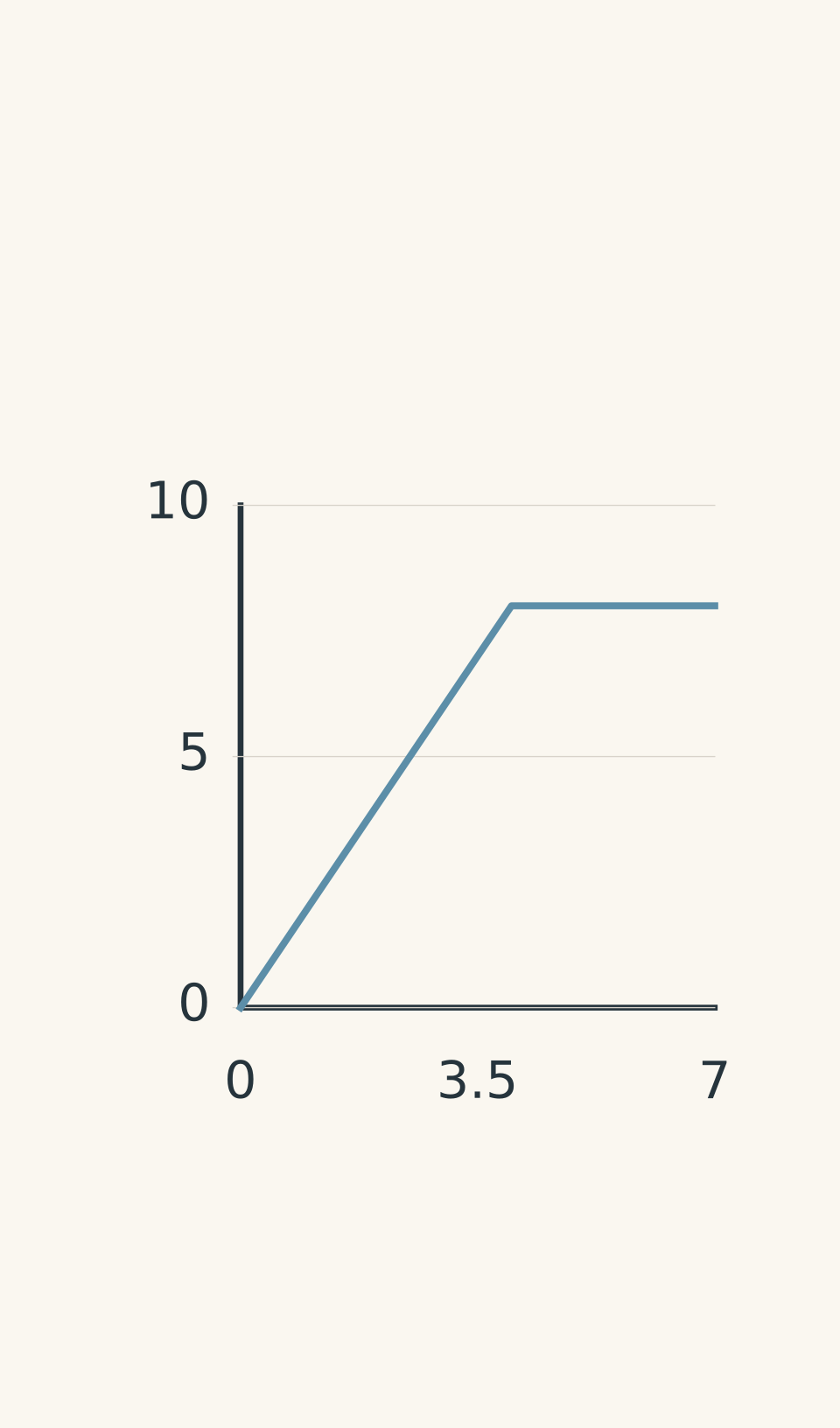
- Trolley velocity
05Diagnose the failure before repeating the question
When your reconstruction or transfer attempt goes wrong, use the result to decide what to do next.
| What happens | Likely gap | Best next move |
|---|---|---|
| The solution looks obvious when open, but you cannot start with it hidden. | Recognition without independent retrieval. | Rebuild from the given information and identify the first decision you cannot make. |
| You reach a particular line but cannot justify it. | Concept or condition gap. | Revisit that rule and explain why it applies here. |
| You reconstruct the original but fail when a condition changes. | Method selection or transfer. | Compare the two questions and identify the changed assumption before calculating. |
| Your method is correct, but you make an arithmetic, sign, or unit error. | Execution. | Correct that specific step and practise it again without rereading the whole solution. |
| You can solve the question now but fail after a delay. | The method is not reliably retrievable yet. | Repeat the reconstruction later, then try another related question. |
These are diagnoses to investigate, not automatic verdicts. One incorrect answer does not prove that you lack understanding. Find the first point where your reasoning breaks.
If the same mistake keeps recurring, record the specific cause in an HSC error log. Write “I assumed acceleration stayed constant after the first stage”, rather than simply “careless mistake”. The first entry tells you what to repair.
You can also turn recurring gaps into prompts for active revision. Instead of a card that asks you to state a formula, use one that asks when the formula is valid or what would make it inappropriate. The guide to making HSC flashcards that test understanding explains how to build these prompts.
06A quick self-check: Have you actually learnt the method?
Before marking a worked example as finished, check each statement.
- [ ] I attempted the question before reading the solution.
- [ ] I can identify the first step I couldn’t justify.
- [ ] I can explain why each major step is valid, including its assumptions and restrictions.
- [ ] I can reconstruct the method from a blank page without copying.
- [ ] I can solve a changed question and explain what stays the same and what changes.
- [ ] I can still retrieve the method after a delay.
The strongest evidence comes from being able to justify, reconstruct, and transfer the method. You don’t need to be perfect on the first attempt, but you do need to know what the attempt revealed.
07Questions and solutions
Question 1
You read a worked solution and understand every line while it is visible. What should you do next, and what would provide stronger evidence of learning than simply understanding the page?
Solution 1
Hide the solution, reconstruct the method from a blank page, and then test it on a changed question.
Following the visible lines does not require you to choose the next step independently. Reconstructing the solution tests whether you can retrieve the method and justify the reasoning. A changed question then tests whether you can apply that reasoning beyond the exact example you studied.
If you get stuck, identify the first step you cannot justify and return to that part of the solution.
Question 2
A worked solution solves
\[ (x-2)(x+3)=0 \]
by dividing both sides by \(x-2\), obtaining \(x+3=0\), and reporting \(x=-3\).
Explain the error, give the complete solution, and identify what you should learn from the mistake.
Solution 2
The solution is incomplete because dividing by \(x-2\) can discard the valid solution \(x=2\).
The original equation is already factorised. Since the product of two factors is zero, at least one factor must be zero:
\[ x-2=0 \quad \text{or} \quad x+3=0 \]
Therefore,
\[ x=2 \quad \text{or} \quad x=-3 \]
The tempting approach assumes \(x-2\ne0\), even though \(x=2\) is a solution of the original equation. The division is only valid if that restriction has been established, and it has not been.
The learning point is to check the conditions that make each algebraic step valid. A worked solution is something to reason through, not something to accept without checking.
Question 3
A student studies the equation
\[ \ln(x-1)+\ln(x+1)=\ln 8 \]
and learns to combine the logarithms before solving the resulting quadratic.
They then solve
\[ \ln(x-2)+\ln(x+2)=\ln 5 \]
and obtain \(x=\pm3\). They claim both values are valid because the algebra is correct.
Find the valid solution and identify the missing step in their reconstruction.
Solution 3
Only \(x=3\) is valid because the original logarithms require \(x>2\).
Before using logarithm laws, determine the domain:
\[ x-2>0 \implies x>2 \]
The second logarithm also requires \(x+2>0\), or \(x>-2\). Both conditions together give \(x>2\).
Now combine the logarithms:
\[ \begin{aligned} \ln[(x-2)(x+2)]&=\ln5\\ x^2-4&=5\\ x^2&=9\\ x&=\pm3 \end{aligned} \]
The algebra produces two candidates, but only \(x=3\) satisfies \(x>2\). The value \(x=-3\) makes the original logarithms undefined.
The missing step is checking the domain and rejecting candidates that are not allowed. The tempting approach treats solving the quadratic as the end of the problem. In fact, the quadratic is only an intermediate result.
To learn from this, practise recording the domain before combining logarithms and checking the final candidates against the original equation.
Question 4
You solve a quadratic-minimum question correctly by completing the square. The worked solution uses differentiation instead.
Consider these two question wordings:
- (i) “Find the minimum value of \(f(x)=x^2-6x+13\).”
- (ii) “Use differentiation to find the minimum value of \(f(x)=x^2-6x+13\).”
Does your method satisfy both prompts? Should you replace your notes with the worked solution?
Solution 4
Your method satisfies the first prompt, provided your reasoning is correct, but it does not satisfy the explicit method requirement in the second prompt.
For the first question, completing the square gives
\[ f(x)=(x-3)^2+4 \]
so the minimum value is \(4\), occurring at \(x=3\). This is a valid method because the question does not prescribe a particular technique.
The second question specifically requires differentiation. You must follow that instruction, even though another method reaches the correct answer.
You should not automatically discard your own valid method or memorise the worked solution word for word. Instead, check whether your method meets the question’s requirements, whether every step is justified, and whether another method offers a useful advantage. Learn the alternative when it is required or when it improves your understanding.
The important distinction is between a different valid method and a method that fails to satisfy the question.
Question 5
Ari studies a physics problem in which a trolley starts from rest, accelerates uniformly at \(+2.0\,\text{m s}^{-2}\) for \(4.0\,\text{s}\), and then travels at constant velocity for \(3.0\,\text{s}\).
Ari can reconstruct the worked solution immediately and correctly solve another question with different numbers but the same two stages.
Two days later, Ari faces a changed question. The trolley still accelerates at \(+2.0\,\text{m s}^{-2}\) for \(4.0\,\text{s}\), but then decelerates uniformly at \(-1.0\,\text{m s}^{-2}\) for \(3.0\,\text{s}\). Ari uses the original constant-velocity method for the second stage and obtains the wrong displacement. The arithmetic is internally consistent, but Ari claims the problem must be a calculation mistake because the original solution was understood.
(a) What does this evidence support, and what does it not prove?
(b) Give one brief diagnostic that distinguishes forgetting an equation from failing to update the motion model. Explain how different responses would change your diagnosis.
(c) Calculate the correct total displacement and check your result against the final velocity.
Solution 5
Ari’s clearest demonstrated gap is transferring the method when a condition changes, rather than basic arithmetic. The original reconstruction and the number-only variant show that Ari can reproduce the original structure, but they do not establish that Ari can recognise when that structure no longer applies.
(a) Interpret the evidence.
Ari has demonstrated immediate recall and the ability to execute a familiar method with different numbers. The delayed failure does not prove that Ari never understood the original solution. It shows that the understanding demonstrated so far was not sufficient to handle the changed condition independently.
The tempting conclusion is that Ari needs more arithmetic practice because the final answer is wrong. But the calculation is internally consistent with the wrong model. The important change is that the acceleration in the second stage is now negative, rather than zero.
(b) Run a two-minute diagnostic before doing any calculations.
Ask Ari to divide the motion into two intervals, write the acceleration for each, and select a valid displacement equation for each interval.
The responses distinguish the likely gaps:
- If Ari identifies the second-stage acceleration as zero, the main problem is tracking the physical conditions. Ari has carried the original model into a situation where it no longer applies.
- If Ari identifies the second-stage acceleration as \(-1.0\,\text{m s}^{-2}\) but cannot select a valid displacement equation, the gap is in retrieving or choosing the appropriate relationship.
- If Ari identifies both accelerations correctly and selects valid equations, but then makes a numerical error, the problem is more likely in execution.
This test is more useful than asking Ari to reread the entire solution. It isolates the first decision that needs repair.
(c) Calculate the correct displacement and check it.
During the first stage, the trolley starts from rest. Its velocity after \(4.0\,\text{s}\) is
\[ \begin{aligned} v_1&=u+at\\ &=0+(2.0)(4.0)\\ &=8.0\,\text{m s}^{-1} \end{aligned} \]
The displacement during this stage is
\[ \begin{aligned} s_1&=ut+\frac12at^2\\ &=0+\frac12(2.0)(4.0)^2\\ &=16\,\text{m} \end{aligned} \]
For the second stage, the initial velocity is \(8.0\,\text{m s}^{-1}\), the acceleration is \(-1.0\,\text{m s}^{-2}\), and the time is \(3.0\,\text{s}\).
\[ \begin{aligned} s_2&=ut+\frac12at^2\\ &=(8.0)(3.0)+\frac12(-1.0)(3.0)^2\\ &=24-4.5\\ &=19.5\,\text{m} \end{aligned} \]
The total displacement is
\[ \begin{aligned} s_{\text{total}}&=s_1+s_2\\ &=16+19.5\\ &=35.5\,\text{m} \end{aligned} \]
Check the final velocity:
\[ v_2=8.0+(-1.0)(3.0)=5.0\,\text{m s}^{-1} \]
The trolley is still moving forwards, but more slowly. Its second-stage average velocity is \((8.0+5.0)/2=6.5\,\text{m s}^{-1}\), giving a second-stage displacement of \(6.5\times3.0=19.5\,\text{m}\), which agrees with the calculation.
The correct total displacement is \(35.5\,\text{m}\).
The key learning decision is to repair the model-selection step, then reconstruct the solution and test another changed condition after a delay. Recopying a solution that you can already follow will not fix a condition you have learnt to overlook.