
Year 12 Physics: Nature of Light Mock Exam and Solutions
Test your understanding of the Year 12 Physics Nature of Light content with an original 90-mark tutorgum practice exam. Includes 110 minutes of timed questions, essential constants, calculations, data analysis, and fully worked solutions with marking guides.
This is an original tutorgum practice paper for Year 12 Physics: Nature of Light, covering the supplied 2025-syllabus content area. It combines calculations, data analysis, experimental evidence, and explanations across wave behaviour, quantum physics, electromagnetic waves, and special relativity. It is an original revision resource, not an official, endorsed, or predicted NESA examination paper.
01Exam instructions
- Total marks: 90
- Suggested working time: 110 minutes
- Reading time: 5 minutes
- Permitted equipment: Scientific calculator, ruler, and graph paper. No notes.
- Working: Show calculations, substitutions, units, and appropriate significant figures. Explain your reasoning in written responses.
This paper’s timing and conditions are suggested practice conditions, not claims about official examination rules.
Assessed scope
The paper assesses the supplied Year 12 Nature of Light content for the 2025 Physics syllabus edition, including wave and quantum models of light, electromagnetic-wave production and measurement, and special relativity. It does not assess content from other modules or combine material from different syllabus editions.
Constants and conversions
Use the following data where required.
| Quantity | Value |
|---|---|
| Permittivity of free space, \(\epsilon_0\) | \(8.85 \times 10^{-12}\ \mathrm{F\,m^{-1}}\) |
| Permeability of free space, \(\mu_0\) | \(4\pi \times 10^{-7}\ \mathrm{H\,m^{-1}}\) |
| Wien’s displacement constant, \(b\) | \(2.90 \times 10^{-3}\ \mathrm{m\,K}\) |
| Electronvolt conversion | \(1\ \mathrm{eV} = 1.60 \times 10^{-19}\ \mathrm{J}\) |
| Nanometre conversion | \(1\ \mathrm{nm} = 10^{-9}\ \mathrm{m}\) |
| Millimetre conversion | \(1\ \mathrm{mm} = 10^{-3}\ \mathrm{m}\) |
| Microsecond conversion | \(1\ \mathrm{\mu s} = 10^{-6}\ \mathrm{s}\) |
Unless a question specifies otherwise, assume light travels through air at approximately its speed in a vacuum, ideal polarising filters are used, and numerical answers should be rounded sensibly.
02Questions
Question 1 (8 marks)
(a) State Einstein’s two postulates of special relativity. For this question, an inertial frame is a reference frame that is not accelerating. (2 marks)
(b) Maxwell’s equations predict the speed of electromagnetic waves in a vacuum using
\[ c=\frac{1}{\sqrt{\mu_0\epsilon_0}} \]
where \(c\) is the wave speed, \(\mu_0\) is the permeability of free space, and \(\epsilon_0\) is the permittivity of free space.
Calculate the predicted wave speed. (2 marks)
(c) Describe how an accelerating electric charge can produce an electromagnetic wave. Include the orientation of the electric field, magnetic field, and direction of energy propagation. (2 marks)
(d) A Michelson-Morley-type experiment detects no measurable difference in the travel time of light along perpendicular directions as Earth moves. Explain what this result supported, and give one reason it was evidence relevant to special relativity rather than proof of the entire theory. (2 marks)
Question 2 (6 marks)
Heinrich Hertz used a spark-gap transmitter and a separate receiver loop containing a small gap. When the transmitter sparked, a spark could also be observed at the receiver, despite the absence of a conducting wire between them.
(a) Explain why this observation supported the existence of electromagnetic waves. (2 marks)
(b) A reflected electromagnetic wave produces a standing-wave pattern. Adjacent nodes are separated by \(0.30\ \mathrm{m}\). Calculate the wavelength of the wave. (1 mark)
(c) The transmitter’s oscillation frequency is \(5.0 \times 10^8\ \mathrm{Hz}\). Calculate the wave speed using your answer to part (b). (2 marks)
(d) State one assumption or limitation that should be considered when using this technique to estimate the speed of electromagnetic waves. (1 mark)
Question 3 (6 marks)
(a) A pulsed laser is directed towards a reflector \(1.50\ \mathrm{km}\) away. The measured time between sending a pulse and detecting its return is \(10.0\ \mathrm{\mu s}\).
Calculate the speed of light using these measurements. (2 marks)
(b) Outline how Fizeau’s toothed-wheel method used a returning beam of light and the rotation of a wheel to estimate the speed of light. (2 marks)
(c) Compare the modern pulsed-laser method with Fizeau’s historical method. State one advantage of the modern method and one limitation that still needs to be managed. (2 marks)
Question 4 (10 marks)
(a) An ideal blackbody emits a continuous spectrum of electromagnetic radiation. Describe how its observed spectrum differs from the prediction of classical physics at very short wavelengths, and explain how Planck’s quantisation of energy addressed this problem. (3 marks)
(b) The peak wavelength of a blackbody’s spectrum is \(580\ \mathrm{nm}\). Use Wien’s displacement law,
\[ \lambda_{\max}T=b \]
where \(\lambda_{\max}\) is the peak wavelength, \(T\) is the absolute temperature in kelvin, and \(b\) is the Wien displacement constant.
Calculate the blackbody’s temperature. (2 marks)
(c) A photon has a wavelength of \(400\ \mathrm{nm}\). Use
\[ E=\frac{hc}{\lambda} \]
where \(E\) is photon energy, \(h=6.63 \times 10^{-34}\ \mathrm{J\,s}\) is Planck’s constant, \(c=3.00 \times 10^8\ \mathrm{m\,s^{-1}}\) is the speed of light, and \(\lambda\) is wavelength.
Calculate the photon’s energy in joules and electronvolts. (3 marks)
(d) Explain how a photovoltaic cell converts light into electrical energy. Identify one other application that relies on the quantised energy of photons, and briefly describe its operation. (2 marks)
Question 5 (10 marks)
The photoelectric effect occurs when light incident on a metal causes electrons to be emitted. The work function, \(\phi\), is the minimum energy required to release an electron from the metal. The maximum kinetic energy of an emitted electron is \(K_{\max}\).
A student measures the maximum kinetic energy of photoelectrons emitted from one metal at different incident-light frequencies.
| Frequency, \(f\) (\(10^{14}\ \mathrm{Hz}\)) | \(K_{\max}\) (\(\mathrm{eV}\)) |
|---|---|
| 5.0 | 0.00 |
| 6.0 | 0.41 |
| 7.0 | 0.83 |
| 8.0 | 1.24 |
| 9.0 | 1.66 |
(a) Explain how the existence of a threshold frequency and the immediate emission of photoelectrons challenge the classical wave model of light. (2 marks)
(b) Plot \(K_{\max}\) against frequency using graph paper. Label the horizontal axis \(f/(10^{14}\ \mathrm{Hz})\), plot the data, and draw a suitable best-fit line.
Use your graph to estimate the threshold frequency and explain what it represents physically. (3 marks)
(c) Use the gradient of your graph to estimate Planck’s constant in \(\mathrm{J\,s}\). Convert the energy units correctly. (2 marks)
(d) Use the photoelectric equation
\[ K_{\max}=hf-\phi \]
to calculate:
- the work function of the metal in electronvolts;
- the maximum kinetic energy of emitted photoelectrons when the incident frequency is \(8.0 \times 10^{14}\ \mathrm{Hz}\).
Use your graph-derived value of Planck’s constant. (3 marks)
Question 6 (9 marks)
(a) Explain how thermionic emission occurs, why the emitting material is commonly placed in a vacuum, and one difference between thermionic emission and photoelectric emission. (3 marks)
(b) Unpolarised light of intensity \(I_0\) passes through an ideal polariser and then an ideal analyser. The angle between the transmission axes of the two filters is \(30^\circ\).
For plane-polarised light incident on the analyser, Malus’ law is
\[ I=I_{\max}\cos^2\theta \]
where \(I\) is the transmitted intensity, \(I_{\max}\) is the intensity incident on the analyser when its axis is aligned with the light’s polarisation direction, and \(\theta\) is the angle between the polarisation direction and the analyser’s transmission axis.
Calculate the final transmitted intensity in terms of \(I_0\). (3 marks)
(c) Explain why polarisation supports the transverse-wave model of light. Why can an ideal polariser not select a particular sideways oscillation direction for a longitudinal wave? (2 marks)
(d) State one condition required for Malus’ law to be applied correctly. (1 mark)
Question 7 (8 marks)
(a) Monochromatic light passes through a single narrow slit. The slit width is reduced from \(5\lambda\) to \(\lambda\), where \(\lambda\) is the wavelength of the light.
Describe how the diffraction pattern changes and explain why. (2 marks)
(b) In a double-slit experiment, the separation between the two slits is \(d=0.25\ \mathrm{mm}\). Light of wavelength \(\lambda=500\ \mathrm{nm}\) illuminates the slits.
The condition for a bright fringe is
\[ d\sin\theta=m\lambda \]
where \(\theta\) is the angle from the central axis and \(m\) is the integer order of the bright fringe.
Calculate the angle of the second-order bright fringe, \(m=2\). (3 marks)
(c) A screen is placed \(2.0\ \mathrm{m}\) from the slits. Use the small-angle approximation to calculate the displacement of the second-order bright fringe from the central maximum. (2 marks)
(d) Explain what the alternating bright and dark fringes demonstrate about the behaviour of light. (1 mark)
Question 8 (6 marks)
A diffraction grating has 600 lines per millimetre. It is illuminated normally by monochromatic light of wavelength \(500\ \mathrm{nm}\).
(a) Calculate the spacing \(d\) between adjacent grating lines and the angle of the second-order maximum. Use
\[ d\sin\theta=m\lambda \]
where \(m\) is the order of the maximum and \(\theta\) is its angle from the normal. (3 marks)
(b) Determine the highest possible diffraction order for this wavelength. (1 mark)
(c) Explain why a grating with many slits can distinguish two closely spaced wavelengths more effectively than a two-slit arrangement. (2 marks)
Question 9 (10 marks)
(a) Define an inertial frame and explain what is meant by the relativity of simultaneity. (2 marks)
(b) Two events, A and B, occur at positions \(x_A=0\) and \(x_B=+600\ \mathrm{m}\) in the platform frame. They are simultaneous in that frame, so \(\Delta t=t_B-t_A=0\).
A train frame moves in the \(+x\) direction at \(0.60c\) relative to the platform, where \(c=3.00 \times 10^8\ \mathrm{m\,s^{-1}}\).
Use the Lorentz transformation
\[ \Delta t'=\gamma\left(\Delta t-\frac{v\Delta x}{c^2}\right) \]
where \(\Delta t'=t'_B-t'_A\), \(\Delta x=x_B-x_A\), \(v\) is the relative speed, and
\[ \gamma=\frac{1}{\sqrt{1-v^2/c^2}} \]
is the Lorentz factor.
Calculate \(\Delta t'\) in the train frame and state which event occurs first in that frame. (3 marks)
(c) A clock at rest in a spacecraft records \(2.00\ \mathrm{\mu s}\) between two events that occur at the same point on the spacecraft. An Earth observer measures the spacecraft’s speed as \(0.80c\).
Calculate the time interval measured by the Earth observer. (3 marks)
(d) A spacecraft has a proper length of \(120\ \mathrm{m}\), measured in its own rest frame. Calculate the length measured by an Earth observer when the spacecraft moves at \(0.80c\). (2 marks)
Question 10 (5 marks)
(a) A particle has a rest mass of \(1.67 \times 10^{-27}\ \mathrm{kg}\) and moves at \(0.90c\), where \(c=3.00 \times 10^8\ \mathrm{m\,s^{-1}}\).
Use the relativistic momentum equation
\[ p=\gamma mv \]
where \(p\) is momentum, \(m\) is rest mass, \(v\) is speed, and \(\gamma\) is the Lorentz factor.
Calculate the particle’s relativistic momentum. (3 marks)
(b) Explain why a massive particle cannot be accelerated to the speed of light by supplying a finite amount of energy. (2 marks)
Question 11 (8 marks)
(a) Cosmic muons are produced in Earth’s upper atmosphere. A muon’s mean lifetime in its own rest frame is \(2.20\ \mathrm{\mu s}\), and it travels towards Earth’s surface at \(0.998c\).
Assume the muon travels vertically at constant speed, and neglect energy loss and other interactions. Its production altitude is \(10.0\ \mathrm{km}\).
Calculate:
- the Lorentz factor;
- the mean lifetime measured in Earth’s frame;
- the mean distance travelled before decay.
Use your results to explain why many muons can reach Earth’s surface. (5 marks)
(b) In a Hafele-Keating-style experiment, atomic clocks are flown eastward and westward around Earth. After the flights, their readings are compared with a reference clock kept on the ground.
Explain what is being tested, why the predicted clock offsets can depend on the direction and conditions of the flight, and what agreement between measured and predicted offsets would support. Consider both velocity-dependent and altitude-related effects. (3 marks)
Question 12 (4 marks)
A student makes the following claim:
“Diffraction and interference show that light is a wave, so the photoelectric effect cannot be explained by the same physical model of light.”
(a) State what diffraction or interference demonstrates about light’s behaviour, and why a purely classical particle model is insufficient to explain it. (1 mark)
(b) State what the threshold frequency and immediate emission observed in the photoelectric effect demonstrate about how light transfers energy. (1 mark)
(c) Evaluate the student’s claim using both sets of evidence. Explain how a modern model of light accommodates the observations. (2 marks)
03Worked solutions and marking guide
Equivalent methods and correctly rounded numerical answers should receive the same credit. In calculation questions, follow-through marks are appropriate when a student uses an earlier numerical result consistently, even if that result contains a minor error.
Solution 1
(a) Einstein’s postulates
- The laws of physics are the same in all inertial frames. No inertial frame is a preferred frame in which the laws of physics take a different form.
- The speed of light in a vacuum is the same for all inertial observers, independent of the motion of the source or observer.
Marking:
- 1 mark for each correctly stated postulate.
(b) Maxwell’s prediction
Substitute the supplied electromagnetic constants into the expression for wave speed.
\[ \begin{aligned} c&=\frac{1}{\sqrt{\mu_0\epsilon_0}}\\[4pt] &=\frac{1}{\sqrt{(4\pi\times10^{-7})(8.85\times10^{-12})}}\\[4pt] &\approx 3.00\times10^8\ \mathrm{m\,s^{-1}} \end{aligned} \]
The predicted electromagnetic-wave speed agrees with the accepted speed of light in a vacuum.
Marking:
- 1 mark for correct substitution.
- 1 mark for the correct speed and units.
(c) Production and propagation of electromagnetic waves
An accelerating electric charge produces changing electric and magnetic fields. These fields propagate away from the charge as an electromagnetic wave.
The electric field and magnetic field are perpendicular to each other, and both are perpendicular to the direction of propagation. The wave transports energy through space.
Marking:
- 1 mark for linking accelerating charges to changing electromagnetic fields.
- 1 mark for the transverse field arrangement and energy propagation.
(d) Michelson-Morley-type evidence
The null result supported the conclusion that there was no detectable change in light’s travel time caused by Earth’s motion through a hypothetical stationary ether. This helped undermine the ether model and supported the idea that the speed of light does not depend on the direction of measurement in the tested arrangement.
However, a null result is limited by the experiment’s sensitivity and setup. It does not, by itself, establish every consequence of special relativity or directly test every inertial frame.
Marking:
- 1 mark for correctly explaining what the null result supported.
- 1 mark for a valid limitation or reason it is not complete proof of the theory.
Solution 2
(a) Hertz’s evidence
The receiver produced a spark even though it was not connected to the transmitter by a conducting wire. This showed that energy could travel through space from the transmitter to the receiver, consistent with the propagation of electromagnetic waves.
The observation supported the electromagnetic-wave model, although the experimental arrangement also needed to distinguish propagating radiation from unwanted direct electromagnetic coupling.
Marking:
- 1 mark for identifying energy transfer without a conducting connection.
- 1 mark for linking the observation to electromagnetic waves.
(b) Wavelength from node spacing
Adjacent nodes in a standing wave are separated by half a wavelength.
\[ \begin{aligned} \frac{\lambda}{2}&=0.30\ \mathrm{m}\\ \lambda&=2(0.30)\\ &=0.60\ \mathrm{m} \end{aligned} \]
Marking:
- 1 mark for the correct wavelength.
(c) Wave speed
Wave speed \(v\) is the product of frequency \(f\) and wavelength \(\lambda\).
\[ \begin{aligned} v&=f\lambda\\ &=(5.0\times10^8)(0.60)\\ &=3.0\times10^8\ \mathrm{m\,s^{-1}} \end{aligned} \]
Marking:
- 1 mark for the correct relationship and substitution.
- 1 mark for the correct result with units.
(d) Assumption or limitation
One valid response is that the transmitter frequency must be known accurately. Another is that the locations of the standing-wave nodes must be measured accurately. Near-field coupling between the transmitter and receiver may also complicate the interpretation of the observation.
Marking:
- 1 mark for one relevant assumption or limitation.
Solution 3
(a) Modern laser time-of-flight measurement
The light travels to the reflector and back, so the total distance is twice the one-way distance.
\[ \begin{aligned} s&=2(1.50\times10^3)\\ &=3.00\times10^3\ \mathrm{m} \end{aligned} \]
The round-trip time is
\[ \Delta t=10.0\times10^{-6}\ \mathrm{s} \]
Therefore,
\[ \begin{aligned} c&=\frac{s}{\Delta t}\\ &=\frac{3.00\times10^3}{10.0\times10^{-6}}\\ &=3.00\times10^8\ \mathrm{m\,s^{-1}} \end{aligned} \]
Marking:
- 1 mark for using the round-trip distance correctly.
- 1 mark for the correct speed and units.
(b) Fizeau’s toothed-wheel method
Light passed through a gap in a rotating toothed wheel, travelled to a distant mirror, and returned. At a suitable wheel rotation speed, a tooth blocked the returning beam.
The wheel’s rotation rate and the known distance to the mirror allowed the light’s travel time to be estimated. Dividing the round-trip distance by this time gave the speed of light.
Marking:
- 1 mark for describing the wheel, outgoing beam, and returning beam.
- 1 mark for linking wheel rotation and round-trip distance to a travel-time estimate and hence the speed.
(c) Comparison
One advantage of a modern pulsed-laser method is that electronic timing can measure very short travel times with high precision, without a rotating toothed wheel.
One limitation is that the travel time may be extremely short, requiring precise timing electronics and detector calibration. Distance uncertainty, atmospheric effects, and reflector alignment can also affect the measurement.
Marking:
- 1 mark for a valid advantage.
- 1 mark for a valid limitation.
Solution 4
(a) Blackbody radiation and Planck’s quantisation
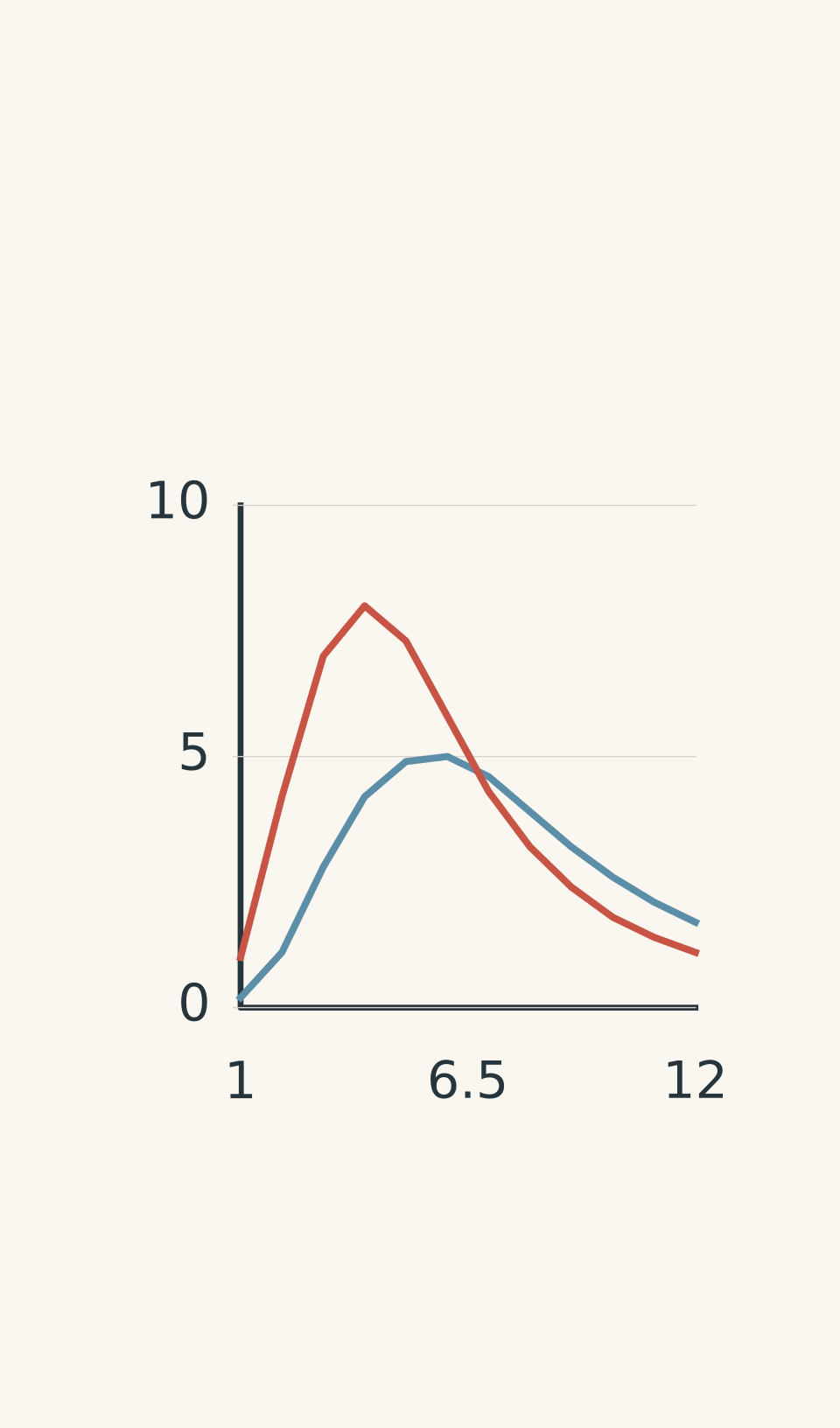
The observed blackbody spectrum rises to a peak and then falls at shorter wavelengths. Classical physics predicted an unlimited increase in emitted intensity at very short wavelengths, leading to the ultraviolet catastrophe.
Planck resolved the problem by proposing that energy could be exchanged in discrete packets, or quanta, rather than in arbitrary continuous amounts. The energy of a quantum is proportional to frequency:
\[ E=hf \]
where \(E\) is quantum energy, \(h\) is Planck’s constant, and \(f\) is frequency. This quantisation allowed the observed spectrum to be explained.
Marking:
- 1 mark for describing the observed spectrum.
- 1 mark for identifying the classical ultraviolet catastrophe.
- 1 mark for explaining the role of quantised energy.
- Cooler
- Hotter
(b) Wien’s displacement law
Convert the peak wavelength to metres:
\[ \lambda_{\max}=580\times10^{-9}\ \mathrm{m} \]
Rearrange Wien’s law to find temperature.
\[ \begin{aligned} T&=\frac{b}{\lambda_{\max}}\\[4pt] &=\frac{2.90\times10^{-3}}{580\times10^{-9}}\\[4pt] &=5.00\times10^3\ \mathrm{K} \end{aligned} \]
The blackbody temperature is approximately \(5000\ \mathrm{K}\).
Marking:
- 1 mark for correct conversion and substitution.
- 1 mark for the correct temperature and units.
(c) Photon energy
First calculate the energy in joules.
\[ \begin{aligned} E&=\frac{hc}{\lambda}\\[4pt] &=\frac{(6.63\times10^{-34})(3.00\times10^8)} {400\times10^{-9}}\\[4pt] &=4.97\times10^{-19}\ \mathrm{J} \end{aligned} \]
Convert to electronvolts by dividing by the energy equivalent of one electronvolt.
\[ \begin{aligned} E&=\frac{4.97\times10^{-19}}{1.60\times10^{-19}}\\[4pt] &=3.11\ \mathrm{eV} \end{aligned} \]
The photon energy is \(4.97\times10^{-19}\ \mathrm{J}\), or approximately \(3.11\ \mathrm{eV}\).
Marking:
- 1 mark for the correct equation and substitution.
- 1 mark for the energy in joules.
- 1 mark for the energy in electronvolts.
(d) Photovoltaics and another quantum application
In a photovoltaic cell, a photon with sufficient energy can promote an electron into a higher-energy state in a semiconductor, leaving behind a hole. The cell’s internal electric field separates these charges, allowing an electric current to flow through an external circuit.
One other example is an LED. When an electron recombines with a hole, energy can be released as a photon. The photon energy is related to the energy difference between the states.
Marking:
- 1 mark for correctly explaining photon absorption and charge separation in a photovoltaic cell.
- 1 mark for identifying another quantum application and explaining its operating principle.
Solution 5
(a) Threshold frequency and immediate emission
The threshold frequency \(f_0\) is the minimum incident-light frequency that allows photoelectrons to be emitted. Below this frequency, increasing the intensity does not cause emission because individual photons do not have enough energy to overcome the metal’s work function.
Above the threshold, emission occurs without a measurable delay. This challenges the classical wave prediction that electrons should gradually accumulate energy from the incident wave before escaping.
Marking:
- 1 mark for explaining the threshold frequency in terms of photon energy.
- 1 mark for explaining immediate emission and the conflict with the classical prediction.
(b) Graph and threshold frequency
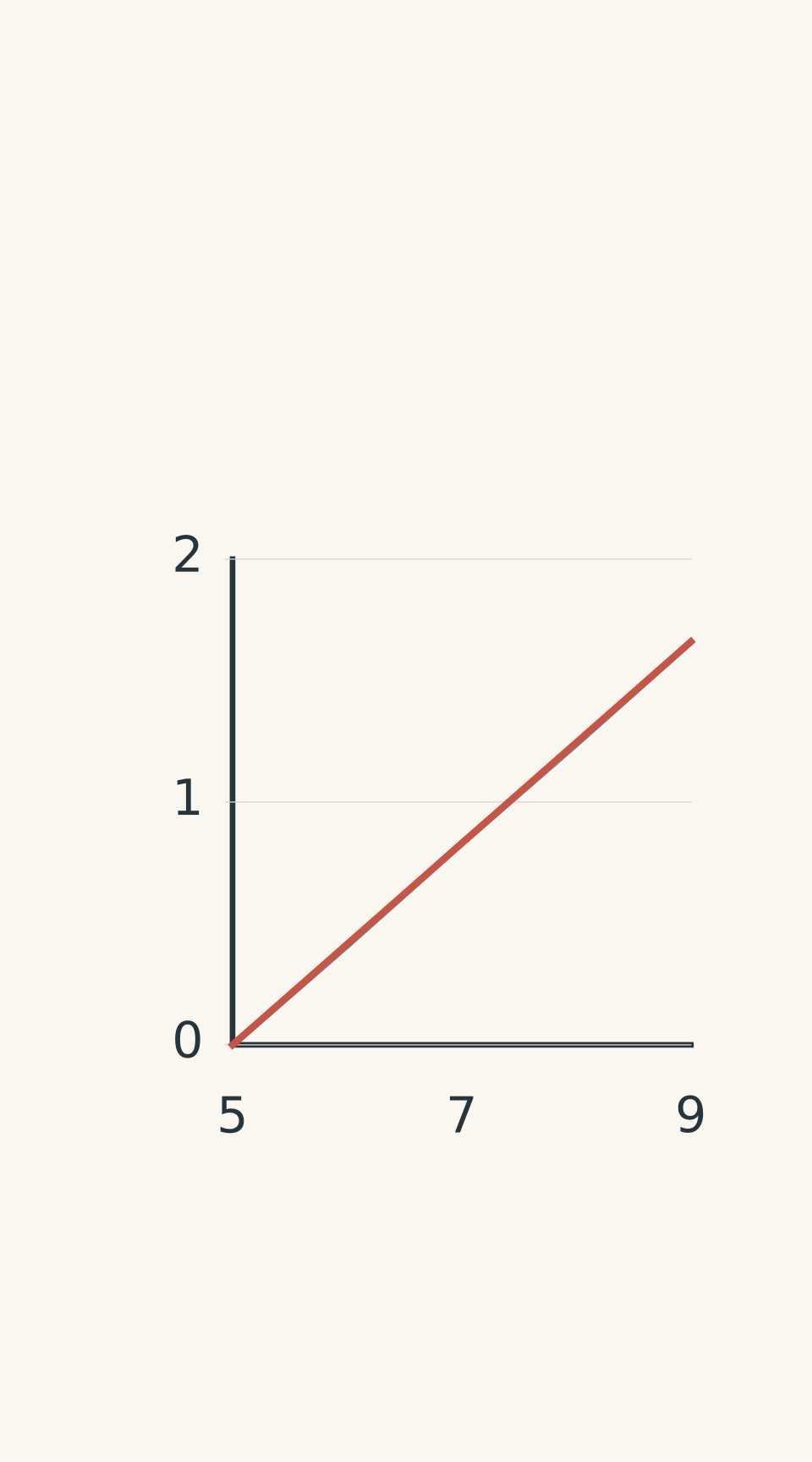
The graph should show the five data points lying close to a straight line.
The horizontal-axis intercept is approximately
\[ f_0=5.0\times10^{14}\ \mathrm{Hz} \]
At this frequency, the maximum kinetic energy is zero. The energy of an incident photon is just sufficient to overcome the work function, so
\[ hf_0=\phi \]
The threshold frequency therefore identifies the minimum frequency required to release electrons from this particular metal.
Marking:
- 1 mark for correctly plotting and labelling the data with a suitable best-fit line.
- 1 mark for estimating the horizontal-axis intercept.
- 1 mark for explaining the physical meaning of the threshold frequency.
- Measured data
- Best-fit line
- Threshold frequency: 5.0 × 10^14 Hz
(c) Planck’s constant from the gradient
Using the endpoints of the data, the gradient is approximately
\[ \begin{aligned} \text{gradient} &=\frac{\Delta K_{\max}}{\Delta f}\\[4pt] &=\frac{1.66-0.00}{(9.0-5.0)\times10^{14}}\\[4pt] &=4.15\times10^{-15}\ \mathrm{eV\,s} \end{aligned} \]
When kinetic energy is measured in electronvolts, this gradient represents Planck’s constant expressed in \(\mathrm{eV\,s}\). Convert it to \(\mathrm{J\,s}\):
\[ \begin{aligned} h&=(4.15\times10^{-15})(1.60\times10^{-19})\\ &=6.64\times10^{-34}\ \mathrm{J\,s} \end{aligned} \]
Marking:
- 1 mark for a correct gradient estimate with appropriate units.
- 1 mark for conversion to joules and the correct estimate of Planck’s constant.
(d) Work function and maximum kinetic energy
At the threshold frequency, the maximum kinetic energy is zero. Therefore,
\[ \phi=hf_0 \]
Using the graph-derived value of \(h\),
\[ \begin{aligned} \phi&=(6.64\times10^{-34})(5.0\times10^{14})\\ &=3.32\times10^{-19}\ \mathrm{J}\\[4pt] &=\frac{3.32\times10^{-19}}{1.60\times10^{-19}}\ \mathrm{eV}\\ &=2.08\ \mathrm{eV} \end{aligned} \]
For incident frequency \(f=8.0\times10^{14}\ \mathrm{Hz}\),
\[ K_{\max}=hf-\phi \]
\[ \begin{aligned} K_{\max} &=(6.64\times10^{-34})(8.0\times10^{14}) -3.32\times10^{-19}\\[4pt] &=1.99\times10^{-19}\ \mathrm{J}\\[4pt] &\approx1.24\ \mathrm{eV} \end{aligned} \]
The photon supplies energy \(hf\). Some of that energy is used to overcome the work function, and the remainder becomes the emitted electron’s kinetic energy. This is conservation of energy applied to the photoelectric effect.
Marking:
- 1 mark for calculating the work function.
- 1 mark for correctly substituting into the photoelectric equation for the specified frequency.
- 1 mark for the maximum kinetic energy with appropriate units.
Follow-through: accept calculations based on a slightly different but correctly obtained graph gradient.
Solution 6
(a) Thermionic emission
Thermionic emission occurs when heating gives electrons in a material enough energy to escape from its surface. The emitting material is commonly placed in a vacuum so that emitted electrons can travel with fewer collisions with gas molecules.
In photoelectric emission, photons supply energy to electrons, and the photon frequency determines whether the work function can be overcome. In thermionic emission, heating supplies the energy.
Marking:
- 1 mark for explaining how heating enables electrons to escape.
- 1 mark for explaining the purpose of a vacuum.
- 1 mark for distinguishing thermionic emission from photoelectric emission.
(b) Malus’ law
An ideal polariser transmits half the intensity of initially unpolarised light.
\[ I_1=\frac{I_0}{2} \]
This is the intensity incident on the analyser. Apply Malus’ law with \(\theta=30^\circ\):
\[ \begin{aligned} I&=I_1\cos^2 30^\circ\\[4pt] &=\frac{I_0}{2}\left(\frac{\sqrt{3}}{2}\right)^2\\[4pt] &=\frac{I_0}{2}\times\frac{3}{4}\\[4pt] &=\frac{3I_0}{8} \end{aligned} \]
The final transmitted intensity is \(3I_0/8\).
Marking:
- 1 mark for correctly determining the intensity after the first polariser.
- 1 mark for applying Malus’ law correctly.
- 1 mark for the final expression.
(c) Polarisation and transverse waves
A transverse wave oscillates perpendicular to its direction of propagation. A polariser selects a particular orientation of the electric field, demonstrating that light has a transverse oscillation direction.
A longitudinal wave oscillates parallel to its direction of propagation. It has no equivalent sideways oscillation orientation for a polariser to select.
Marking:
- 1 mark for linking polarisation to transverse oscillations.
- 1 mark for explaining why a longitudinal wave cannot be polarised in this way.
(d) Condition for Malus’ law
The light incident on the analyser must be plane-polarised. Malus’ law then relates transmitted intensity to the angle between the light’s polarisation direction and the analyser’s transmission axis.
Marking:
- 1 mark for stating a valid condition.
Solution 7
(a) Diffraction through a narrow slit
Diffraction is the spreading of a wave as it passes through an opening. For a fixed wavelength, the angular spread increases as the slit width becomes smaller relative to the wavelength.
Reducing the slit width from \(5\lambda\) to \(\lambda\) therefore produces greater spreading.
Marking:
- 1 mark for describing diffraction.
- 1 mark for linking the increased spread to the smaller slit width relative to the wavelength.
(b) Second-order bright fringe
Convert the slit separation and wavelength to metres:
\[ d=0.25\times10^{-3}=2.5\times10^{-4}\ \mathrm{m} \]
\[ \lambda=500\times10^{-9}=5.0\times10^{-7}\ \mathrm{m} \]
Using the bright-fringe condition,
\[ \begin{aligned} d\sin\theta&=m\lambda\\[4pt] \sin\theta&=\frac{m\lambda}{d}\\[4pt] &=\frac{2(5.0\times10^{-7})}{2.5\times10^{-4}}\\[4pt] &=0.0040 \end{aligned} \]
Therefore,
\[ \theta=\sin^{-1}(0.0040)\approx0.229^\circ \]
Marking:
- 1 mark for the correct relationship.
- 1 mark for correct substitution.
- 1 mark for the angle with appropriate units.
(c) Fringe displacement
For small angles measured in radians,
\[ \tan\theta\approx\sin\theta \]
The displacement \(y\) from the central maximum is approximately
\[ y=L\tan\theta\approx L\sin\theta \]
Substituting the screen distance \(L=2.0\ \mathrm{m}\),
\[ \begin{aligned} y&\approx2.0(0.0040)\\ &=0.0080\ \mathrm{m}\\ &=8.0\ \mathrm{mm} \end{aligned} \]
The second-order fringe is approximately \(8.0\ \mathrm{mm}\) from the central maximum.
Marking:
- 1 mark for the correct small-angle method.
- 1 mark for the displacement with units.
(d) Evidence for wave behaviour
The bright and dark fringes result from constructive and destructive interference, respectively. Their regular pattern provides evidence of the wave behaviour of light.
Marking:
- 1 mark for linking the fringe pattern to interference and wave behaviour.
Solution 8
(a) Grating spacing and second-order angle
The grating has 600 lines per millimetre. Convert this to lines per metre:
\[ 600\ \mathrm{lines\,mm^{-1}} =6.00\times10^5\ \mathrm{lines\,m^{-1}} \]
The spacing \(d\) is the reciprocal of the line density:
\[ \begin{aligned} d&=\frac{1}{6.00\times10^5}\\ &=1.67\times10^{-6}\ \mathrm{m} \end{aligned} \]
For the second-order maximum, \(m=2\):
\[ \begin{aligned} d\sin\theta&=m\lambda\\[4pt] \sin\theta&=\frac{2(500\times10^{-9})}{1.67\times10^{-6}}\\[4pt] &\approx0.600 \end{aligned} \]
Thus,
\[ \theta=\sin^{-1}(0.600)\approx36.9^\circ \]
Marking:
- 1 mark for the correct grating spacing.
- 1 mark for correct substitution into the grating equation.
- 1 mark for the angle with units.
(b) Highest possible order
A maximum can occur only if
\[ \sin\theta=\frac{m\lambda}{d}\leq1 \]
Therefore,
\[ m\leq\frac{d}{\lambda} =\frac{1.67\times10^{-6}}{5.00\times10^{-7}} \approx3.33 \]
The order must be an integer, so the highest possible order is
\[ m_{\max}=3 \]
Marking:
- 1 mark for the correct maximum order.
(c) Resolving power
A diffraction grating has many slits. Their interference produces narrower principal maxima than a two-slit arrangement.
When two wavelengths are close together, the narrower maxima make their separate angular positions easier to distinguish. This improves the grating’s wavelength resolution.
Marking:
- 1 mark for explaining that many slits produce narrower maxima.
- 1 mark for linking the narrower maxima to distinguishing closely spaced wavelengths.
Solution 9
(a) Inertial frames and simultaneity
An inertial frame is a reference frame that is not accelerating. It is either at rest or moving at constant velocity relative to another inertial frame.
The relativity of simultaneity means that two spatially separated events that are simultaneous in one inertial frame need not be simultaneous in another frame moving relative to it.
Marking:
- 1 mark for defining an inertial frame.
- 1 mark for explaining the relativity of simultaneity.
(b) Time difference between events
The events are simultaneous in the platform frame, so \(\Delta t=0\). Their spatial separation is
\[ \Delta x=x_B-x_A=600\ \mathrm{m} \]
At \(v=0.60c\), the Lorentz factor is
\[ \begin{aligned} \gamma&=\frac{1}{\sqrt{1-v^2/c^2}}\\[4pt] &=\frac{1}{\sqrt{1-0.60^2}}\\[4pt] &=1.25 \end{aligned} \]
Apply the supplied Lorentz transformation:
\[ \begin{aligned} \Delta t' &=\gamma\left(\Delta t-\frac{v\Delta x}{c^2}\right)\\[4pt] &=1.25\left(0-\frac{(0.60c)(600)}{c^2}\right)\\[4pt] &=-1.50\times10^{-6}\ \mathrm{s} \end{aligned} \]
The negative sign means \(t'_B-t'_A\) is negative. Event B occurs \(1.50\ \mathrm{\mu s}\) before event A in the train frame.
Marking:
- 1 mark for the correct Lorentz factor.
- 1 mark for correct substitution and calculation.
- 1 mark for interpreting the negative sign correctly.
(c) Time dilation
The clock measures the proper time because the two events occur at the same point in the spacecraft’s rest frame.
For a moving clock, the interval measured in the Earth frame is
\[ \Delta t=\gamma\Delta\tau \]
where \(\Delta\tau=2.00\ \mathrm{\mu s}\) is the proper time.
At \(v=0.80c\),
\[ \begin{aligned} \gamma&=\frac{1}{\sqrt{1-0.80^2}}\\[4pt] &=\frac{1}{\sqrt{0.36}}\\ &=1.667 \end{aligned} \]
Therefore,
\[ \begin{aligned} \Delta t&=1.667(2.00\ \mathrm{\mu s})\\ &=3.33\ \mathrm{\mu s} \end{aligned} \]
The Earth observer measures an interval of approximately \(3.33\ \mathrm{\mu s}\).
Marking:
- 1 mark for the correct Lorentz factor.
- 1 mark for the correct time-dilation relationship and substitution.
- 1 mark for the final interval with units.
(d) Length contraction
The proper length \(L_0=120\ \mathrm{m}\) is measured in the spacecraft’s rest frame. The Earth observer measures a shorter length along the direction of motion.
\[ L=\frac{L_0}{\gamma} \]
Using \(\gamma=1.667\),
\[ \begin{aligned} L&=\frac{120}{1.667}\\ &\approx72.0\ \mathrm{m} \end{aligned} \]
The contracted length is approximately \(72.0\ \mathrm{m}\).
Marking:
- 1 mark for the correct length-contraction relationship.
- 1 mark for the correct answer with units.
Solution 10
(a) Relativistic momentum
First calculate the Lorentz factor at \(v=0.90c\).
\[ \begin{aligned} \gamma&=\frac{1}{\sqrt{1-0.90^2}}\\[4pt] &=\frac{1}{\sqrt{0.19}}\\ &\approx2.294 \end{aligned} \]
The particle’s speed is
\[ v=0.90(3.00\times10^8) =2.70\times10^8\ \mathrm{m\,s^{-1}} \]
Using \(p=\gamma mv\),
\[ \begin{aligned} p&=(2.294)(1.67\times10^{-27})(2.70\times10^8)\\[4pt] &\approx1.03\times10^{-18}\ \mathrm{kg\,m\,s^{-1}} \end{aligned} \]
Marking:
- 1 mark for the correct Lorentz factor.
- 1 mark for correct substitution into the momentum equation.
- 1 mark for the correct momentum and units.
(b) Why a massive particle cannot reach the speed of light
As a massive particle’s speed approaches \(c\), the denominator in
\[ \gamma=\frac{1}{\sqrt{1-v^2/c^2}} \]
approaches zero. Consequently, the Lorentz factor increases without bound, and the energy required to accelerate the particle further becomes increasingly large.
Reaching the speed of light would require an infinite amount of energy in the limit. A massive particle therefore cannot reach \(c\) by receiving a finite amount of energy.
Marking:
- 1 mark for explaining the growth of the Lorentz factor or relativistic energy.
- 1 mark for linking this to the impossibility of reaching \(c\) with finite energy.
Solution 11
(a) Cosmic muons and time dilation
The muon’s proper mean lifetime is
\[ \tau_0=2.20\ \mathrm{\mu s} \]
Its speed is \(v=0.998c\).
First calculate the Lorentz factor:
\[ \begin{aligned} \gamma&=\frac{1}{\sqrt{1-0.998^2}}\\[4pt] &=\frac{1}{\sqrt{0.003996}}\\ &\approx15.8 \end{aligned} \]
The mean lifetime measured in Earth’s frame is longer because of time dilation:
\[ \begin{aligned} \Delta t&=\gamma\tau_0\\ &=(15.8)(2.20\ \mathrm{\mu s})\\ &\approx34.8\ \mathrm{\mu s} \end{aligned} \]
Calculate the mean travel distance:
\[ \begin{aligned} s&=v\Delta t\\ &=(0.998)(3.00\times10^8)(34.8\times10^{-6})\\ &\approx1.04\times10^4\ \mathrm{m}\\ &\approx10.4\ \mathrm{km} \end{aligned} \]
The mean travel distance is approximately \(10.4\ \mathrm{km}\), which is comparable to and slightly greater than the stated production altitude of \(10.0\ \mathrm{km}\). Time dilation therefore explains why many muons can reach Earth’s surface before decaying.
This is a mean-lifetime calculation, not a guarantee that every muon survives the journey. Individual decay times vary.
Marking:
- 1 mark for the correct Lorentz factor.
- 1 mark for the Earth-frame mean lifetime.
- 1 mark for the correct distance calculation method.
- 1 mark for the distance with units.
- 1 mark for linking the result to the observation of muons at Earth’s surface.
(b) Atomic-clock tests of relativity
The clocks are compared after the flights to measure differences in elapsed time. This tests whether clocks following different paths through space and time accumulate the amounts of time predicted by relativity.
The special-relativistic contribution depends on the clocks’ velocities relative to Earth, so eastward and westward flights can produce different results. Altitude also affects clock rates, contributing an additional relativistic effect that must be included in the predicted net offset.
Agreement between the measured offsets and the predictions supports the relativistic descriptions of elapsed time. The comparison is particularly useful because the predictions can be calculated before the clocks are reunited.
Marking:
- 1 mark for identifying the comparison of clock readings as the measured quantity.
- 1 mark for explaining the effects of velocity and altitude on the predicted offsets.
- 1 mark for explaining how agreement with predictions supports relativity.
Solution 12
(a) Wave evidence
Diffraction and interference demonstrate wave-like behaviour. A purely classical particle model does not account for the regular interference pattern produced by overlapping light waves.
Marking:
- 1 mark for correctly linking the evidence to wave behaviour and the limitation of a classical particle model.
(b) Photoelectric evidence
The threshold frequency shows that a photon must supply at least the work-function energy to release an electron. Immediate emission supports energy transfer in individual quantised amounts rather than gradual accumulation of energy from a continuous classical wave.
Marking:
- 1 mark for linking the observations to quantised photon energy.
(c) Evaluating the claim
The student’s conclusion is too strong. Diffraction and interference demonstrate wave-like behaviour, while the photoelectric effect provides evidence that light transfers energy in discrete quanta.
A modern quantum description accommodates both sets of observations. Light can display wave-like behaviour during propagation and interference, while its interactions with matter involve quantised energy transfer. The evidence cannot be explained fully by either a purely classical wave model or a purely classical particle model.
Marking:
- 1 mark for explaining how the two types of evidence are accommodated by a modern model.
- 1 mark for concluding that the classical wave and particle models alone are insufficient.