
Atomic Structure, Isotopes and Relative Mass: Practice Exam
Test your HSC Chemistry knowledge of atomic structure, isotopes, ionic particle counts, and relative atomic mass with this original 40-mark timed practice exam. Includes worked solutions and a detailed marking guide.
This original tutorgum practice paper tests your understanding of atomic structure, isotope notation, nuclear stability, and relative atomic mass. It includes particle-counting questions, weighted-average calculations, and problems where you must work backwards from an element’s relative atomic mass to find its isotopic composition.
01Exam instructions
- Course: Chemistry, 2017 syllabus edition.
- Scope: Atomic structure, isotopes, and relative atomic mass only.
- Suggested reading time: 5 minutes.
- Suggested working time: 50 minutes.
- Total marks: 40.
- Permitted equipment: Scientific calculator and periodic table.
- Working: Show calculations clearly, include units where appropriate, and give relative atomic masses to two decimal places unless instructed otherwise.
These timings and conditions are suggestions for this practice paper, not official examination rules.
This is an original tutorgum practice paper. It is not an official, endorsed, past, or predicted NESA examination paper.
Assessed content
The paper covers:
- Atomic number, mass number, and isotope notation.
- Numbers of protons, neutrons, and electrons in atoms and ions.
- Isotopes and their positions in the periodic table.
- Stable and unstable nuclei.
- Relative atomic mass calculated from isotopic masses and natural abundances.
- Unknown isotope abundances calculated from relative atomic mass.
Electron configurations, periodic trends, chemical bonding, stoichiometry, nuclear decay calculations, and other syllabus modules are excluded.
Use the isotope masses supplied in each question. Where isotope masses are given in unified atomic mass units (\(\mathrm{u}\)), use their numerical values in the weighted-average calculation. Relative atomic mass is dimensionless, so do not attach a unit to your final answer.
Attempt all questions before checking the worked solutions.
02Questions
Question 1 (5 marks)
Consider the neutral aluminium atom represented by the isotope symbol \(\ce{^{27}_{13}Al}\).
(a) State the atomic number and mass number of this atom. (2 marks)
(b) Determine the number of protons, neutrons, and electrons in this atom. (3 marks)
Question 2 (6 marks)
Consider the following two ions.
(a) For the chloride ion \(\ce{^{37}_{17}Cl^-}\), determine the number of protons, neutrons, and electrons. (3 marks)
(b) For the magnesium ion \(\ce{^{24}_{12}Mg^2+}\), determine the number of protons, neutrons, and electrons. (3 marks)
Question 3 (4 marks)
An ion contains 15 protons, 16 neutrons, and 18 electrons.
(a) Calculate the mass number of this ion. (1 mark)
(b) Write its isotope symbol, including the atomic number, mass number, and ionic charge. (2 marks)
(c) State whether the neutral atom formed this ion by gaining or losing electrons, and determine how many electrons were transferred. (1 mark)
Question 4 (7 marks)
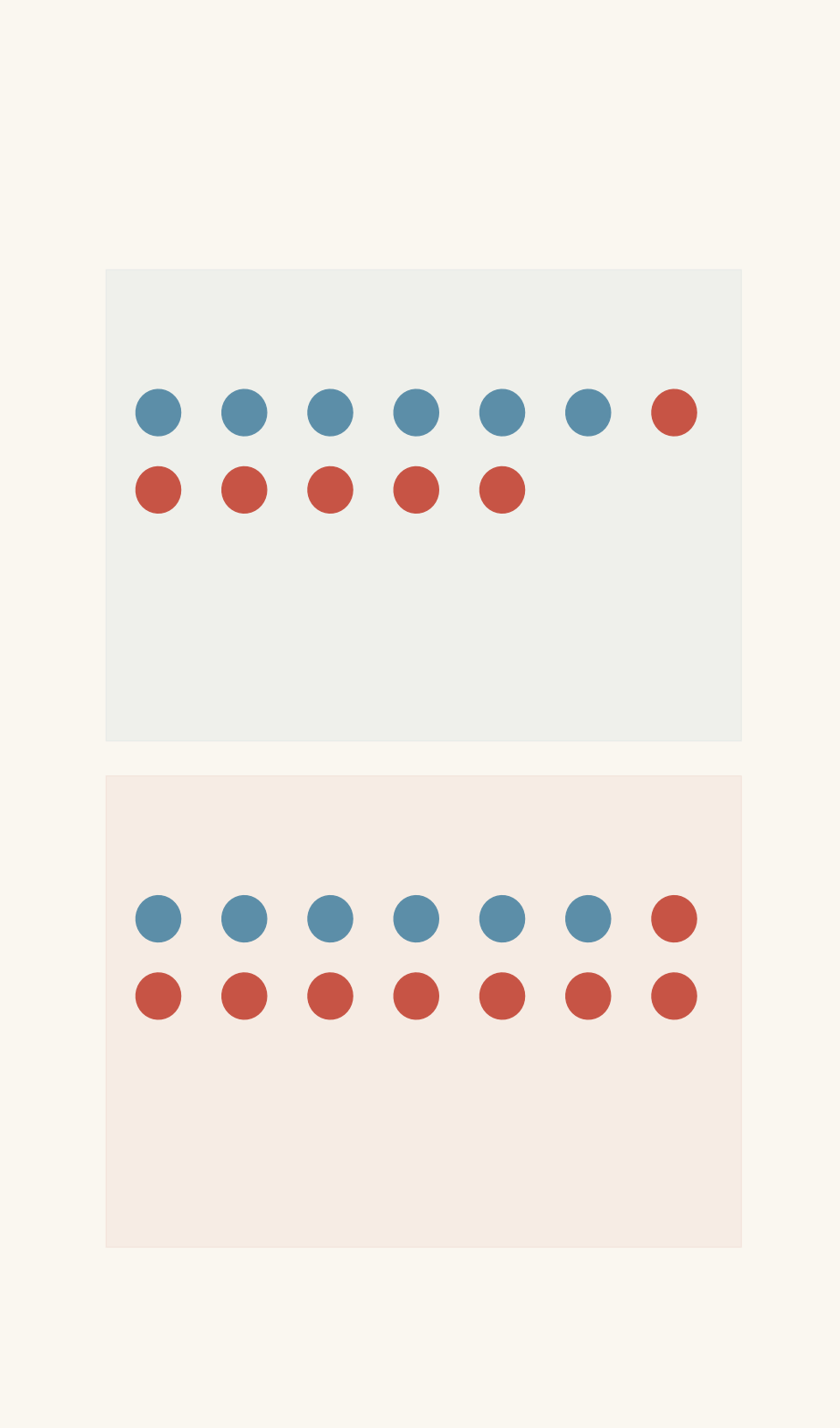
The schematic below compares two atomic nuclei, labelled A and B. Each circle represents one nucleon, and the key distinguishes protons from neutrons.
- Protons
- Neutrons
(a) State the number of protons and neutrons in each nucleus. (2 marks)
(b) Write the isotope symbol for each nucleus, including its atomic number and mass number. (2 marks)
(c) Explain why the atoms represented by A and B occupy the same position in the periodic table. (1 mark)
(d) For this question, take carbon-12 to have a stable nucleus and carbon-14 to have an unstable nucleus. Explain what the terms stable and unstable mean in terms of nuclear change. (2 marks)
Question 5 (5 marks)
Boron has two naturally occurring isotopes. Their isotope masses and natural abundances are shown below.
| Isotope | Isotope mass (u) | Natural abundance |
|---|---|---|
| \(\ce{^{10}_{5}B}\) | 10.01 | 19.9% |
| \(\ce{^{11}_{5}B}\) | 11.01 | 80.1% |
(a) Calculate the relative atomic mass of boron to two decimal places. Show your working. (4 marks)
(b) Explain why the calculated relative atomic mass is closer to 11.01 than to 10.01. (1 mark)
Question 6 (5 marks)
A hypothetical element T has exactly two isotopes, with masses of 62.0 u and 64.0 u. Its relative atomic mass is 63.4.
Assume these are the only two isotopes present and that the relative atomic mass is calculated from their weighted mean.
(a) Let \(x\) represent the fractional abundance of the isotope with mass 64.0 u. Write an equation relating \(x\) to the relative atomic mass. (2 marks)
(b) Calculate the percentage abundance of each isotope. (2 marks)
(c) A sample contains 200 atoms of T. Estimate the number of atoms with a mass of 64.0 u. (1 mark)
Question 7 (4 marks)
A sample of an element contains 200 atoms in total. Of these, 120 atoms belong to an isotope with a mass of 28.0 u, and 80 atoms belong to an isotope with a mass of 30.0 u.
(a) Calculate the percentage abundance of each isotope. (2 marks)
(b) Calculate the relative atomic mass of the element to two decimal places. (2 marks)
Question 8 (4 marks)
Two prepared samples contain only the chlorine isotopes \(\ce{^{35}_{17}Cl}\) and \(\ce{^{37}_{17}Cl}\). Their isotopic compositions are shown below.
For this question, use the rounded isotope masses of 35.0 u and 37.0 u.
| Sample | Chlorine-35 abundance | Chlorine-37 abundance |
|---|---|---|
| A | 75% | 25% |
| B | 60% | 40% |
(a) Calculate the weighted mean isotope mass for each sample to two decimal places. (2 marks)
(b) Explain why the samples have different weighted mean masses despite containing the same element. (2 marks)
03Worked solutions and marking guide
Solution 1
(a) Atomic number and mass number
For \(\ce{^{27}_{13}Al}\):
- Atomic number = 13.
- Mass number = 27.
The lower number gives the atomic number, which equals the number of protons. The upper number gives the mass number, which is the total number of protons and neutrons.
Marking guide (2 marks)
- Atomic number of 13. (1 mark)
- Mass number of 27. (1 mark)
(b) Number of protons, neutrons, and electrons
The atomic number gives the number of protons.
\[ \text{Protons}=13 \]
The mass number is the total number of protons and neutrons, so:
\[ \begin{aligned} \text{Neutrons} &= 27-13\\ &=14 \end{aligned} \]
Because the atom is neutral, it has equal numbers of protons and electrons.
\[ \text{Electrons}=13 \]
The final particle counts are 13 protons, 14 neutrons, and 13 electrons.
Marking guide (3 marks)
- Correct number of protons. (1 mark)
- Correct calculation and number of neutrons. (1 mark)
- Correct number of electrons for a neutral atom. (1 mark)
Solution 2
(a) Chloride ion, \(\ce{^{37}_{17}Cl^-}\)
The atomic number is 17, so the ion contains 17 protons.
The number of neutrons is the mass number minus the atomic number:
\[ \begin{aligned} \text{Neutrons} &= 37-17\\ &=20 \end{aligned} \]
The negative charge means the ion has gained one electron compared with the neutral chlorine atom.
\[ \text{Electrons}=17+1=18 \]
Therefore, the chloride ion contains 17 protons, 20 neutrons, and 18 electrons.
Marking guide (3 marks)
- 17 protons. (1 mark)
- 20 neutrons. (1 mark)
- 18 electrons. (1 mark)
(b) Magnesium ion, \(\ce{^{24}_{12}Mg^2+}\)
The atomic number is 12, so the ion contains 12 protons.
The number of neutrons is:
\[ \begin{aligned} \text{Neutrons} &= 24-12\\ &=12 \end{aligned} \]
The \(2+\) charge means the ion has lost two electrons. A neutral magnesium atom has 12 electrons, so the ion has:
\[ \text{Electrons}=12-2=10 \]
Therefore, the magnesium ion contains 12 protons, 12 neutrons, and 10 electrons.
Marking guide (3 marks)
- 12 protons. (1 mark)
- 12 neutrons. (1 mark)
- 10 electrons. (1 mark)
Solution 3
(a) Mass number
The mass number is the sum of the protons and neutrons.
\[ \begin{aligned} A &= 15+16\\ &=31 \end{aligned} \]
The mass number is 31.
Marking guide (1 mark)
- Correct calculation and answer of 31. (1 mark)
(b) Isotope symbol
The atomic number is 15. This identifies the element as phosphorus, \(\mathrm{P}\).
The mass number is 31, so the isotope is phosphorus-31.
There are 15 protons and 18 electrons. The ion has three more electrons than protons, giving it a \(3-\) charge.
The complete isotope symbol is:
\[ \boxed{\ce{^{31}_{15}P^3-}} \]
Marking guide (2 marks)
- Correct phosphorus isotope symbol with atomic number 15 and mass number 31. (1 mark)
- Correct ionic charge of \(3-\). (1 mark)
(c) Electron transfer
The ion has 18 electrons but only 15 protons. It therefore has three more electrons than the neutral atom.
The neutral phosphorus atom gained three electrons to form the ion.
Marking guide (1 mark)
- States that three electrons were gained. (1 mark)
Solution 4
(a) Proton and neutron numbers
From the counted-particle schematic:
- Nucleus A contains 6 protons and 6 neutrons.
- Nucleus B contains 6 protons and 8 neutrons.
Both nuclei have the same number of protons but different numbers of neutrons.
Marking guide (2 marks)
- Correct proton counts for both nuclei. (1 mark)
- Correct neutron counts for both nuclei. (1 mark)
(b) Isotope symbols
Both nuclei contain six protons. Their atomic number is therefore 6, which identifies the element as carbon.
For nucleus A:
\[ A=6+6=12 \]
Its isotope symbol is:
\[ \ce{^{12}_{6}C} \]
For nucleus B:
\[ A=6+8=14 \]
Its isotope symbol is:
\[ \ce{^{14}_{6}C} \]
Marking guide (2 marks)
- Correct symbol for nucleus A. (1 mark)
- Correct symbol for nucleus B. (1 mark)
(c) Position in the periodic table
Both atoms have six protons, so both have atomic number 6. An element’s identity, and therefore its position in the periodic table, is determined by its atomic number.
The atoms occupy the same periodic-table position because they are isotopes of the same element.
Marking guide (1 mark)
- Explains that both isotopes have the same atomic number because they have the same number of protons. (1 mark)
(d) Stable and unstable nuclei
A stable nucleus does not spontaneously undergo radioactive decay.
An unstable nucleus can spontaneously change through radioactive decay. This process may release particles or radiation as the nucleus changes.
For the isotopes in this question, carbon-12 is stable, whereas carbon-14 is unstable.
Marking guide (2 marks)
- Correctly describes a stable nucleus as one that does not spontaneously decay. (1 mark)
- Correctly describes an unstable nucleus as one that can undergo spontaneous radioactive decay. (1 mark)
Solution 5
(a) Relative atomic mass of boron
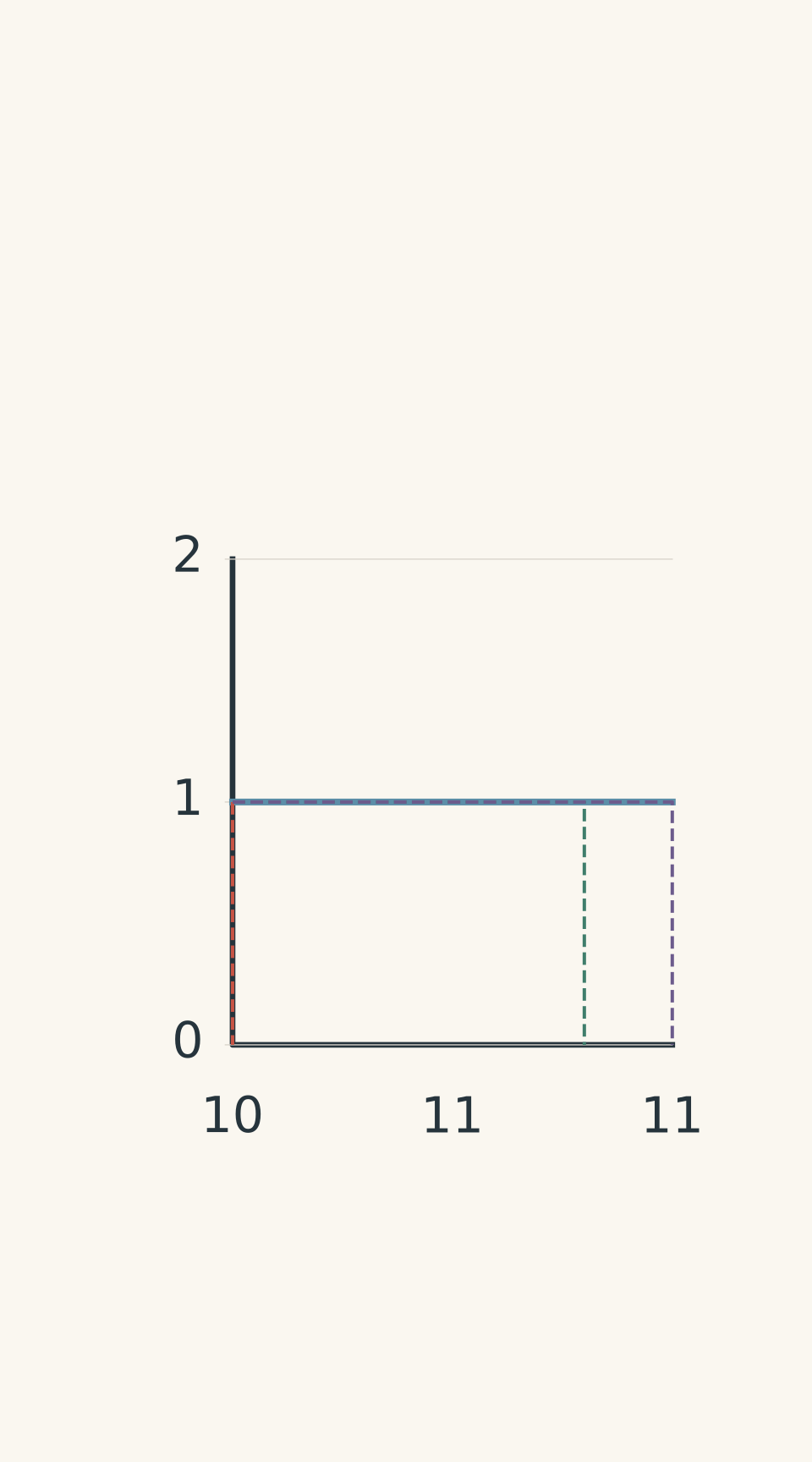
Relative atomic mass, \(A_r\), is the weighted mean of the isotope masses. Each isotope’s mass is multiplied by its fractional abundance, and the products are added.
First, convert the percentages to fractions:
- Boron-10: \(19.9\% = 0.199\).
- Boron-11: \(80.1\% = 0.801\).
Then calculate the weighted mean:
\[ \begin{aligned} A_r &= 10.01(0.199)+11.01(0.801)\\ &=1.99199+8.81901\\ &=10.811\\ &\approx 10.81 \end{aligned} \]
The relative atomic mass of boron is 10.81 to two decimal places.
Notice that you must use the isotope masses, not simply average the two mass numbers. The more abundant isotope contributes more to the final value.
- Mass number line
- Boron-10: 10.01 u; 19.9%
- Weighted mean: 10.81
- Boron-11: 11.01 u; 80.1%
Marking guide (4 marks)
- Converts both percentage abundances to correct fractions. (1 mark)
- Sets up the weighted-average expression using both isotope masses and abundances. (1 mark)
- Calculates the unrounded result of 10.811. (1 mark)
- Reports 10.81 to two decimal places. (1 mark)
(b) Why the result is closer to 11.01
Boron-11 makes up 80.1% of the atoms, so it is much more abundant than boron-10. Its mass therefore contributes more strongly to the weighted mean, pulling the relative atomic mass closer to 11.01.
Marking guide (1 mark)
- Explains that the greater abundance of boron-11 pulls the weighted mean towards its isotope mass. (1 mark)
Solution 6
(a) Constructing the equation
Let \(x\) be the fractional abundance of the isotope with mass 64.0 u.
The two isotope abundances must add to 1. Therefore, the fractional abundance of the isotope with mass 62.0 u is \(1-x\).
The weighted mean is 63.4, so:
\[ 62.0(1-x)+64.0x=63.4 \]
This equation includes both isotopes and their respective fractional abundances.
Marking guide (2 marks)
- Represents the abundance of the lighter isotope as \(1-x\). (1 mark)
- Writes the correct weighted-average equation. (1 mark)
(b) Calculating both isotope abundances
Start with the equation:
\[ 62.0(1-x)+64.0x=63.4 \]
Expand the brackets and collect the \(x\) terms:
\[ \begin{aligned} 62.0-62.0x+64.0x&=63.4\\ 62.0+2.0x&=63.4\\ 2.0x&=1.4\\ x&=0.70 \end{aligned} \]
Since \(x\) represents the fractional abundance of the heavier isotope, its percentage abundance is:
\[ 0.70\times100\%=70\% \]
The lighter isotope makes up the remainder:
\[ 100\%-70\%=30\% \]
Therefore:
- Isotope with mass 62.0 u: 30%.
- Isotope with mass 64.0 u: 70%.
Marking guide (2 marks)
- Correctly solves for \(x=0.70\). (1 mark)
- Gives both isotope abundances as 30% and 70%, respectively. (1 mark)
(c) Number of heavier isotope atoms
The heavier isotope accounts for 70% of the 200 atoms.
\[ \begin{aligned} N &= 0.70\times200\\ &=140 \end{aligned} \]
The sample contains 140 atoms of the isotope with mass 64.0 u.
Marking guide (1 mark)
- Correctly calculates 140 atoms. (1 mark)
Solution 7
(a) Percentage abundance of each isotope
First, check the total number of atoms:
\[ 120+80=200 \]
The percentage abundance of each isotope is its number of atoms divided by the total number of atoms, multiplied by 100%.
For the isotope with mass 28.0 u:
\[ \frac{120}{200}\times100\%=60\% \]
For the isotope with mass 30.0 u:
\[ \frac{80}{200}\times100\%=40\% \]
The percentage abundances are 60% and 40%.
Marking guide (2 marks)
- Correctly calculates 60% for the isotope with mass 28.0 u. (1 mark)
- Correctly calculates 40% for the isotope with mass 30.0 u. (1 mark)
(b) Relative atomic mass
Convert the percentage abundances to fractions: 60% becomes 0.60, and 40% becomes 0.40.
Multiply each isotope mass by its fractional abundance, then add the results:
\[ \begin{aligned} A_r &= 0.60(28.0)+0.40(30.0)\\ &=16.8+12.0\\ &=28.80 \end{aligned} \]
The relative atomic mass is 28.80.
Marking guide (2 marks)
- Uses a correct weighted-average calculation. (1 mark)
- Obtains the final answer of 28.80 to two decimal places. (1 mark)
Solution 8
(a) Weighted mean isotope mass for each sample
Use the fractional abundance of each isotope to calculate the weighted mean.
For Sample A, the abundances are 75% and 25%, giving fractions of 0.75 and 0.25.
\[ \begin{aligned} A_{r,A} &= 0.75(35.0)+0.25(37.0)\\ &=26.25+9.25\\ &=35.50 \end{aligned} \]
For Sample B, the abundances are 60% and 40%, giving fractions of 0.60 and 0.40.
\[ \begin{aligned} A_{r,B} &= 0.60(35.0)+0.40(37.0)\\ &=21.00+14.80\\ &=35.80 \end{aligned} \]
The weighted mean isotope masses are:
- Sample A: 35.50 u.
- Sample B: 35.80 u.
The corresponding relative mass values are 35.50 and 35.80, without units.
Marking guide (2 marks)
- Correct weighted mean for Sample A. (1 mark)
- Correct weighted mean for Sample B. (1 mark)
(b) Why the samples have different weighted mean masses
Both samples contain chlorine-35 and chlorine-37. These isotopes have the same atomic number, 17, so they contain the same number of protons and belong to the same element.
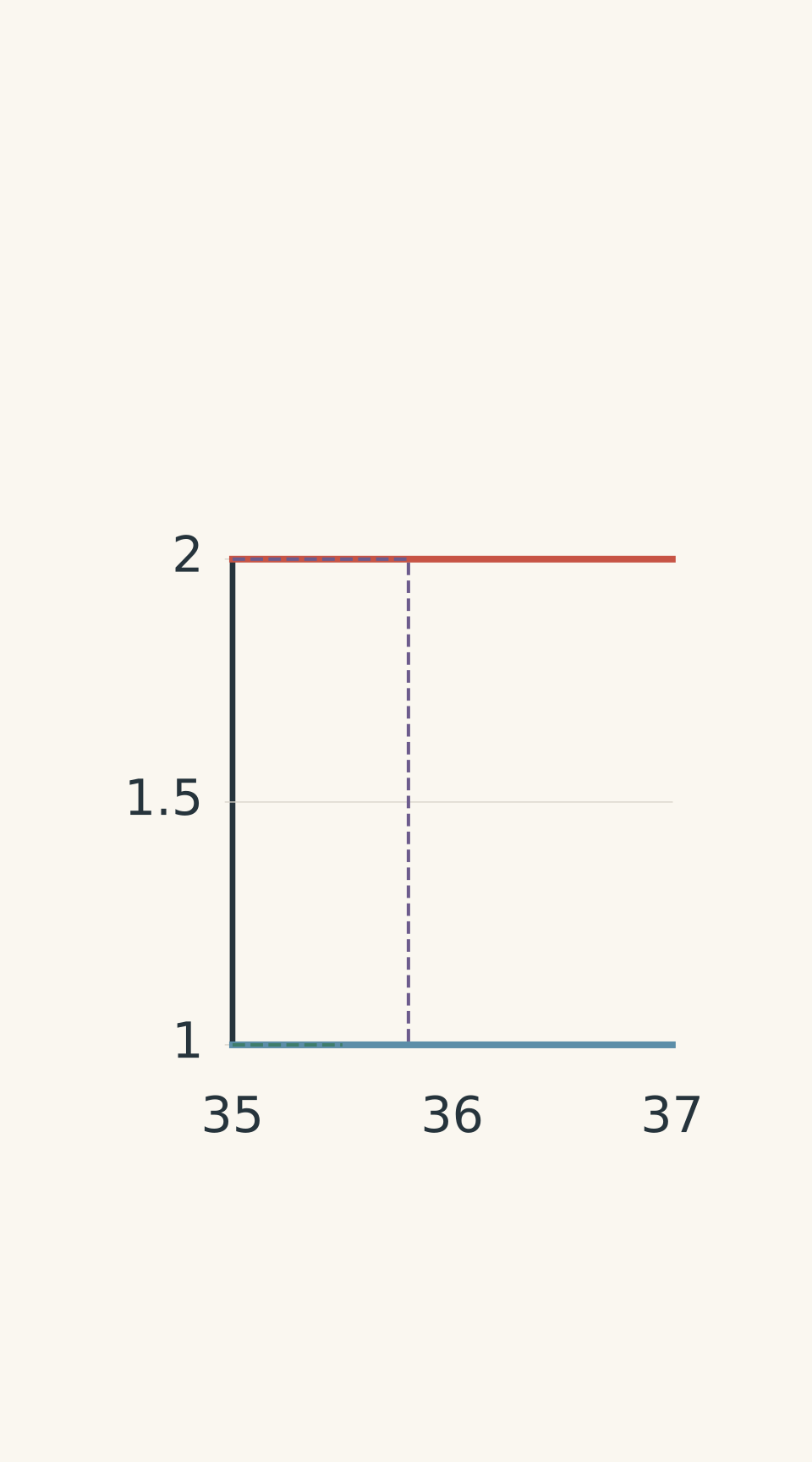
However, the samples have different proportions of the two isotopes. Sample B contains a greater percentage of the heavier chlorine-37 isotope than Sample A does. This shifts Sample B’s weighted mean towards the heavier isotope, giving it a higher average mass.
- Sample A: chlorine-35 75%, chlorine-37 25%
- Sample B: chlorine-35 60%, chlorine-37 40%
- Sample A mean: 35.50 u
- Sample B mean: 35.80 u
Marking guide (2 marks)
- Explains that both isotopes have the same number of protons and therefore represent the same element. (1 mark)
- Explains that different isotope abundances produce different weighted mean masses. (1 mark)
End of paper – 40 marks
When checking your work, pay particular attention to three things: subtract the atomic number from the mass number to find neutrons, adjust electron counts according to ionic charge, and use fractional abundances rather than whole-number percentages in weighted-average calculations.