
Angular Velocity, Speed, Period and Frequency: Practice Exam
Test your understanding of uniform circular motion with this original 36-mark Physics revision exam for the NSW HSC Physics 2017-edition scope. Includes timed exam instructions, seven questions, complete worked solutions, and a detailed marking guide.
This is an original tutorgum practice paper on the linked angular and linear descriptions of uniform circular motion. It assesses the supplied Physics 2017-edition scope for angular velocity, speed, period, and frequency. It is a focused topic paper, not a full-course mock exam and not an official, endorsed, past, or predicted NESA paper.
01Exam instructions
- Suggested working time: 50 minutes.
- Reading time: 5 minutes.
- Total marks: 36.
- Permitted equipment: Scientific calculator, pen, and pencil. No notes.
- Conditions: These are practice-paper conditions, not claims about official NESA examination rules.
Assessed scope
This paper covers:
- Converting between revolutions, radians, frequency, and period.
- Calculating angular velocity from angular displacement and elapsed time.
- Connecting angular velocity with frequency, period, and linear speed.
- Comparing points at different radii on the same rotating object.
- Distinguishing equal angular velocities from equal linear speeds.
- Interpreting numerical data for uniform circular motion.
The paper excludes centripetal acceleration and force, torque, angular acceleration, non-uniform circular motion, and material from other syllabus editions.
Notation and units
Use the following notation throughout the paper.
- Angular displacement, \(\Delta\theta\), is the change in angular position, measured in radians (rad).
- Angular velocity, \(\omega\), describes the rate of change of angular displacement, measured in radians per second (\(\text{rad s}^{-1}\)).
- Radius, \(r\), is measured in metres (m).
- Linear speed, \(v\), is measured in metres per second (\(\text{m s}^{-1}\)).
- Elapsed time, \(t\), is measured in seconds (s).
- Period, \(T\), is the time taken for one complete revolution, measured in seconds (s).
- Frequency, \(f\), is the number of revolutions per second, measured in hertz (Hz).
Assume uniform circular motion wherever rotation is described as uniform. Use \(\pi\) or your calculator’s value, include units, and give answers to three significant figures unless the supplied data supports fewer.
All questions appear before the worked solutions. Attempt the paper under timed conditions before consulting the marking guide.
02Questions
Question 1 (4 marks)
A turntable completes 15 revolutions in 10.0 s.
(a) Determine its frequency and period. (2 marks)
(b) Determine the angular displacement of the turntable over the 10.0 s interval, in radians. (1 mark)
(c) Calculate the average angular velocity over this interval. (1 mark)
Question 2 (5 marks)
A drive shaft rotates uniformly at 120.0 revolutions per minute (rpm).
(a) Convert this rotation rate to frequency in hertz. (1 mark)
(b) Calculate the angular velocity of the shaft in radians per second. (2 marks)
(c) Calculate the angular displacement of the shaft over a time interval of 3.50 s. (2 marks)
Question 3 (5 marks)
A marker on a rotating platform moves in uniform circular motion along a path of radius 0.400 m. It completes one revolution every 1.60 s.
(a) Calculate the linear speed of the marker. (2 marks)
(b) Calculate the angular velocity of the marker. (1 mark)
(c) Calculate the distance travelled by the marker in 12.0 s. (2 marks)
Question 4 (5 marks)
A rigid turntable rotates at a constant angular velocity of \(0.80\ \text{rad s}^{-1}\).
Point A is located 0.10 m from the centre, while point B is located 0.30 m from the centre.
(a) Compare the angular velocities of points A and B. Explain your answer. (2 marks)
(b) Calculate the linear speed of each point. (2 marks)
(c) Determine the ratio of the linear speed of point B to the linear speed of point A. (1 mark)
Question 5 (6 marks)
Two objects, X and Y, move in uniform circular motion. Object X moves in a circle of radius 0.200 m and completes one revolution every 0.500 s. Object Y moves in a circle of radius 0.350 m.
Both objects have the same linear speed.
(a) Calculate the linear speed of object X. (2 marks)
(b) Determine the period of object Y. (2 marks)
(c) Which object has the greater angular velocity? Justify your answer using the relationship between linear speed, radius, and angular velocity. (2 marks)
Question 6 (5 marks)
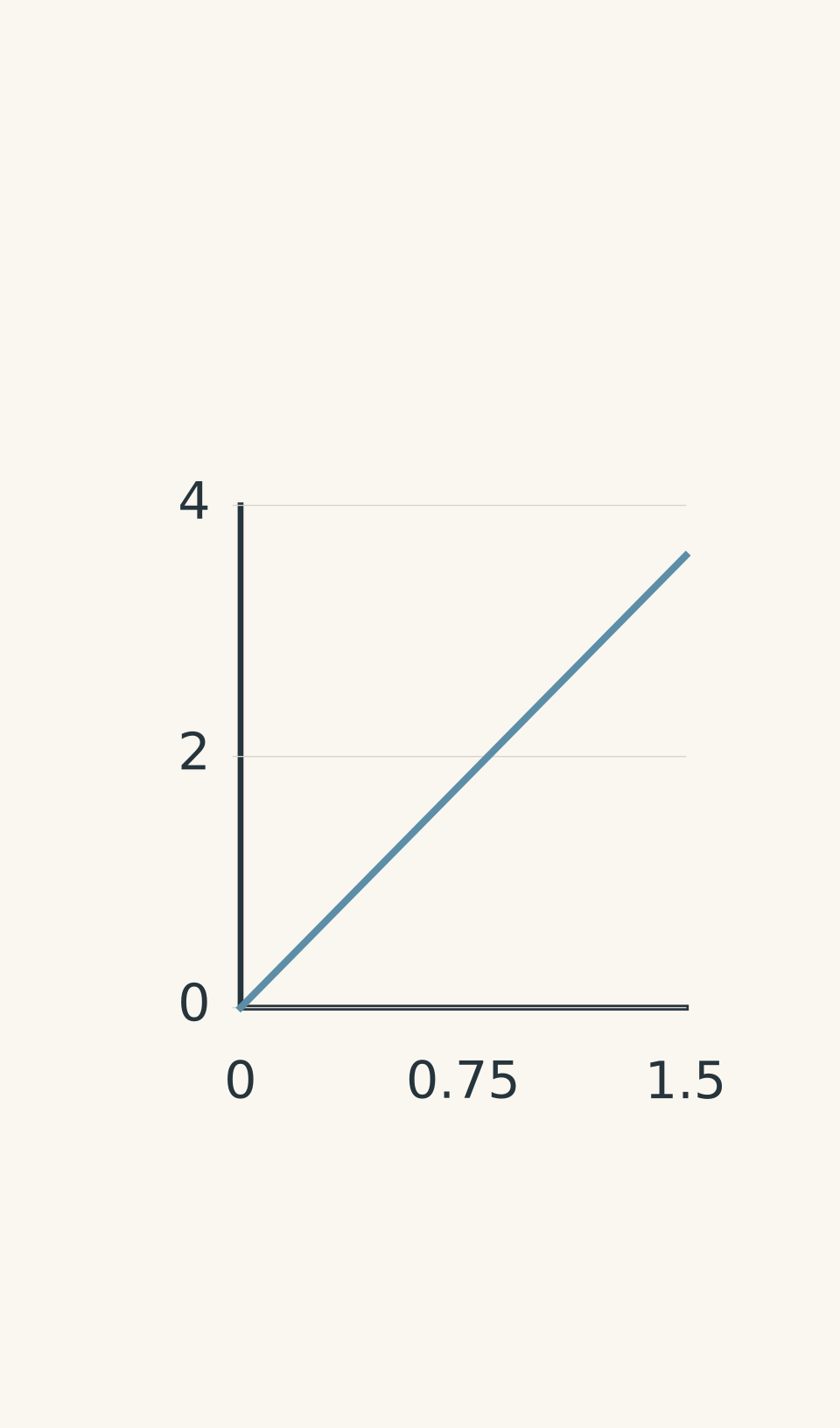
A rotating sensor records its angular displacement from its starting position at several times. The rotation remains uniform throughout the measurement.
| Time, \(t\) (s) | Angular displacement, \(\Delta\theta\) (rad) |
|---|---|
| 0.00 | 0.00 |
| 0.50 | 1.20 |
| 1.00 | 2.40 |
| 1.50 | 3.60 |
(a) Calculate the angular velocity using the measurements from 0.00 s to 1.50 s. (2 marks)
(b) Calculate the angular displacement after 6.0 s. Express this displacement as a number of revolutions. (2 marks)
(c) A point on the sensor is located 0.250 m from the axis of rotation. Calculate its linear speed. (1 mark)
Question 7 (6 marks)
A rotating inspection platform operates at 45.0 rpm. Sensor A is mounted 0.120 m from the centre, and sensor B is mounted 0.280 m from the centre.
(a) Convert the platform’s rotation rate to angular velocity in radians per second. (2 marks)
(b) Calculate the linear speed of each sensor. (2 marks)
(c) Sensor B is moved to a radius of 0.200 m. The platform’s rotation rate is adjusted so that the sensor’s linear speed remains equal to its original value. Calculate the new angular velocity in radians per second and express the new rotation rate in rpm. (2 marks)
03Worked solutions and marking guide
Award marks for the demonstrated steps listed below. Accept mathematically equivalent methods and appropriate rounding. Follow-through marks should be awarded where a student correctly uses an earlier numerical result, even if that result contains an earlier error.
Solution 1
(a) Determine the frequency and period. (2 marks)
Frequency is the number of revolutions completed per second. The turntable completes 15 revolutions in 10.0 s, so
\[ f=\frac{15}{10.0}=1.50\ \text{Hz} \]
The period is the time for one revolution. It is the reciprocal of frequency:
\[ T=\frac{1}{f}=\frac{1}{1.50}=0.667\ \text{s} \]
Answers: \(f=1.50\ \text{Hz}\) and \(T=0.667\ \text{s}\).
Marking guide:
- 1 mark for the correct frequency.
- 1 mark for the correct period.
(b) Determine the angular displacement. (1 mark)
One complete revolution corresponds to \(2\pi\) radians. Therefore, 15 revolutions correspond to
\[ \Delta\theta=15(2\pi)=30\pi \]
\[ \Delta\theta=94.2\ \text{rad} \]
Marking guide:
- 1 mark for the correct angular displacement in radians.
(c) Calculate the average angular velocity. (1 mark)
Angular velocity is the angular displacement divided by the elapsed time:
\[ \begin{aligned} \omega&=\frac{\Delta\theta}{\Delta t}\\ &=\frac{30\pi}{10.0}\\ &=9.42\ \text{rad s}^{-1} \end{aligned} \]
Marking guide:
- 1 mark for the correct angular velocity with units.
Total: 4 marks.
Solution 2
(a) Convert rpm to frequency. (1 mark)
There are 60 seconds in one minute. Divide the rotation rate by 60 to obtain revolutions per second:
\[ f=\frac{120.0}{60}=2.00\ \text{Hz} \]
Marking guide:
- 1 mark for the correct frequency in hertz.
(b) Calculate angular velocity. (2 marks)
Each revolution represents an angular displacement of \(2\pi\) radians. Since the shaft completes \(f\) revolutions per second, its angular velocity is
\[ \omega=2\pi f \]
Substituting the frequency:
\[ \begin{aligned} \omega&=2\pi(2.00)\\ &=4\pi\\ &=12.6\ \text{rad s}^{-1} \end{aligned} \]
Marking guide:
- 1 mark for the correct relationship between angular velocity and frequency.
- 1 mark for the correct numerical answer with units.
(c) Calculate angular displacement in 3.50 s. (2 marks)
For uniform rotation, angular displacement equals angular velocity multiplied by elapsed time:
\[ \begin{aligned} \Delta\theta&=\omega t\\ &=(4\pi)(3.50)\\ &=14\pi\\ &=44.0\ \text{rad} \end{aligned} \]
Marking guide:
- 1 mark for using the correct angular displacement relationship.
- 1 mark for the correct numerical answer with units.
Total: 5 marks.
From revolutions to angular velocity
- Convert revolutions to radians
1 revolution = 2π rad
Multiply revolutions by 2π to find angular displacement.
- Find frequency
f = revolutions ÷ time
Frequency f is measured in hertz (Hz); 1 Hz = 1 revolution per second.
- Calculate angular velocity
ω = 2πf
Angular velocity ω is measured in rad s⁻¹.
Solution 3
(a) Calculate linear speed. (2 marks)
The marker travels one circumference, \(2\pi r\), during each period \(T\). Linear speed is distance travelled divided by time, giving
\[ v=\frac{2\pi r}{T} \]
Substituting \(r=0.400\ \text{m}\) and \(T=1.60\ \text{s}\):
\[ \begin{aligned} v&=\frac{2\pi(0.400)}{1.60}\\ &=1.57\ \text{m s}^{-1} \end{aligned} \]
Answer: \(1.57\ \text{m s}^{-1}\).
Marking guide:
- 1 mark for the correct formula.
- 1 mark for the correct numerical answer with units.
(b) Calculate angular velocity. (1 mark)
One revolution corresponds to \(2\pi\) radians, so the angular velocity is
\[ \begin{aligned} \omega&=\frac{2\pi}{T}\\ &=\frac{2\pi}{1.60}\\ &=3.93\ \text{rad s}^{-1} \end{aligned} \]
Marking guide:
- 1 mark for the correct angular velocity with units.
(c) Calculate distance travelled in 12.0 s. (2 marks)
The marker travels at a constant linear speed. Distance is therefore linear speed multiplied by elapsed time:
\[ \begin{aligned} d&=vt\\ &=(1.5708)(12.0)\\ &=18.8\ \text{m} \end{aligned} \]
Answer: \(18.8\ \text{m}\).
Marking guide:
- 1 mark for using \(d=vt\).
- 1 mark for the correct distance with units.
Total: 5 marks.
Solution 4
(a) Compare angular velocities. (2 marks)
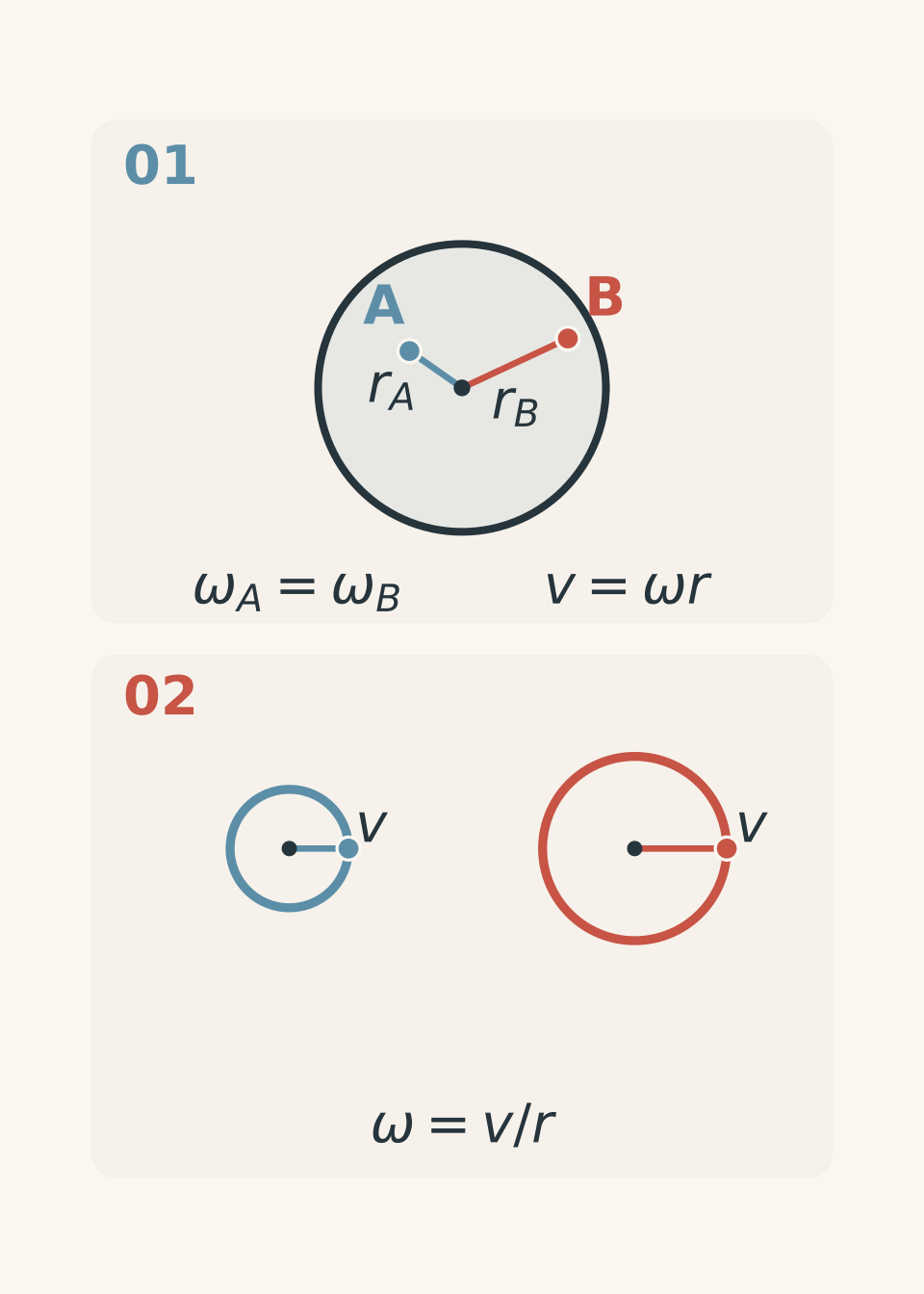
Both points belong to the same rigid turntable. During any given time interval, the turntable rotates through the same angular displacement at every point.
Therefore,
\[ \omega_A=\omega_B=0.80\ \text{rad s}^{-1} \]
The points have equal angular velocities even though they are located at different radii.
Marking guide:
- 1 mark for stating that the angular velocities are equal.
- 1 mark for explaining that both points undergo the same angular displacement in the same time.
(b) Calculate the linear speeds. (2 marks)
Angular velocity and linear speed are related by
\[ v=\omega r \]
For point A:
\[ \begin{aligned} v_A&=(0.80)(0.10)\\ &=0.080\ \text{m s}^{-1} \end{aligned} \]
For point B:
\[ \begin{aligned} v_B&=(0.80)(0.30)\\ &=0.24\ \text{m s}^{-1} \end{aligned} \]
Point B travels faster because it is farther from the axis of rotation. In the same time, it travels a longer arc while completing the same angular displacement.
Marking guide:
- 1 mark for the correct linear speed of point A.
- 1 mark for the correct linear speed of point B.
(c) Determine the speed ratio. (1 mark)
\[ \frac{v_B}{v_A}=\frac{0.24}{0.080}=3.0 \]
Therefore,
\[ v_B:v_A=3:1 \]
Marking guide:
- 1 mark for the correct ratio.
Total: 5 marks.
Solution 5
(a) Calculate the linear speed of object X. (2 marks)
Object X has radius \(r_X=0.200\ \text{m}\) and period \(T_X=0.500\ \text{s}\).
Using the circumference travelled in one revolution,
\[ v_X=\frac{2\pi r_X}{T_X} \]
Substituting the values:
\[ \begin{aligned} v_X&=\frac{2\pi(0.200)}{0.500}\\ &=2.51\ \text{m s}^{-1} \end{aligned} \]
Marking guide:
- 1 mark for the correct formula and substitution.
- 1 mark for the correct linear speed with units.
(b) Determine the period of object Y. (2 marks)
The two objects have equal linear speeds, so
\[ v_Y=v_X=2.513\ \text{m s}^{-1} \]
The linear speed of object Y is its circumference divided by its period:
\[ v_Y=\frac{2\pi r_Y}{T_Y} \]
Rearranging to make the period the subject,
\[ T_Y=\frac{2\pi r_Y}{v_Y} \]
Substituting the values:
\[ \begin{aligned} T_Y&=\frac{2\pi(0.350)}{2.513}\\ &=0.875\ \text{s} \end{aligned} \]
Answer: \(T_Y=0.875\ \text{s}\).
Marking guide:
- 1 mark for the correct rearrangement and substitution.
- 1 mark for the correct period with units.
(c) Compare angular velocities. (2 marks)
The relationship between linear speed and angular velocity is
\[ \omega=\frac{v}{r} \]
For object X:
\[ \omega_X=\frac{2.513}{0.200}=12.6\ \text{rad s}^{-1} \]
For object Y:
\[ \omega_Y=\frac{2.513}{0.350}=7.18\ \text{rad s}^{-1} \]
Object X has the greater angular velocity. Both objects have the same linear speed, but X has the smaller radius. It must therefore have a greater angular velocity to produce the same linear speed.
Marking guide:
- 1 mark for correctly applying the relationship between linear speed, radius, and angular velocity.
- 1 mark for identifying object X as having the greater angular velocity.
Total: 6 marks.
Solution 6
(a) Calculate angular velocity from the measurements. (2 marks)
Angular velocity is the change in angular displacement divided by the elapsed time:
\[ \omega=\frac{\Delta\theta}{\Delta t} \]
Using the measurements at 0.00 s and 1.50 s,
\[ \begin{aligned} \omega&=\frac{3.60-0.00}{1.50-0.00}\\ &=2.40\ \text{rad s}^{-1} \end{aligned} \]
Answer: \(2.40\ \text{rad s}^{-1}\).
Marking guide:
- 1 mark for the correct relationship and use of the data.
- 1 mark for the correct angular velocity with units.
(b) Calculate angular displacement and convert to revolutions. (2 marks)
The rotation is uniform, so the angular displacement after 6.0 s is
\[ \begin{aligned} \Delta\theta&=\omega t\\ &=(2.40)(6.0)\\ &=14.4\ \text{rad} \end{aligned} \]
One revolution is \(2\pi\) radians. Therefore, the number of revolutions is
\[ \begin{aligned} N&=\frac{\Delta\theta}{2\pi}\\ &=\frac{14.4}{2\pi}\\ &=2.29\ \text{revolutions} \end{aligned} \]
Here, \(N\) represents the number of revolutions.
Answers: \(14.4\ \text{rad}\), or \(2.29\) revolutions.
Marking guide:
- 1 mark for the correct angular displacement.
- 1 mark for the correct conversion to revolutions.
(c) Calculate linear speed. (1 mark)
The point is located \(0.250\ \text{m}\) from the axis of rotation. Using \(v=\omega r\),
\[ \begin{aligned} v&=(2.40)(0.250)\\ &=0.600\ \text{m s}^{-1} \end{aligned} \]
Marking guide:
- 1 mark for the correct linear speed with units.
Total: 5 marks.
- Slope = ω = 2.40 rad s⁻¹
Solution 7
(a) Convert the rotation rate to angular velocity. (2 marks)
The platform rotates at \(45.0\) revolutions per minute. Converting to revolutions per second gives
\[ f=\frac{45.0}{60}=0.750\ \text{Hz} \]
Since each revolution corresponds to \(2\pi\) radians,
\[ \begin{aligned} \omega&=2\pi f\\ &=2\pi(0.750)\\ &=4.71\ \text{rad s}^{-1} \end{aligned} \]
Answer: \(4.71\ \text{rad s}^{-1}\).
Marking guide:
- 1 mark for correctly converting rpm to frequency.
- 1 mark for the correct angular velocity with units.
(b) Calculate the linear speeds of both sensors. (2 marks)
The linear speed of a point on a rotating object is
\[ v=\omega r \]
For sensor A:
\[ \begin{aligned} v_A&=(4.712)(0.120)\\ &=0.565\ \text{m s}^{-1} \end{aligned} \]
For sensor B:
\[ \begin{aligned} v_B&=(4.712)(0.280)\\ &=1.32\ \text{m s}^{-1} \end{aligned} \]
Sensor B has the greater linear speed because it is farther from the axis of rotation. Both sensors have the same angular velocity while mounted on the same rigid platform.
Marking guide:
- 1 mark for the correct linear speed of sensor A.
- 1 mark for the correct linear speed of sensor B.
(c) Calculate the new angular velocity and rotation rate. (2 marks)
Sensor B must retain its original linear speed of approximately \(1.319\ \text{m s}^{-1}\). Its new radius is \(0.200\ \text{m}\).
Rearranging \(v=\omega r\),
\[ \begin{aligned} \omega_{\text{new}}&=\frac{v}{r_{\text{new}}}\\ &=\frac{1.319}{0.200}\\ &=6.60\ \text{rad s}^{-1} \end{aligned} \]
To convert the new angular velocity to revolutions per minute, first convert radians per second to revolutions per second, then multiply by 60:
\[ \begin{aligned} f_{\text{new}}&=\frac{\omega_{\text{new}}}{2\pi}\\ &=\frac{6.596}{2\pi}\\ &=1.05\ \text{Hz} \end{aligned} \]
\[ \text{Rotation rate}=1.05(60)=63.0\ \text{rpm} \]
Answers: \(\omega_{\text{new}}=6.60\ \text{rad s}^{-1}\) and a rotation rate of \(63.0\ \text{rpm}\).
The new rotation rate is higher because the sensor is closer to the axis. To maintain the same linear speed at a smaller radius, the platform must rotate faster.
Marking guide:
- 1 mark for correctly calculating the new angular velocity using the unchanged linear speed.
- 1 mark for correctly converting the angular velocity to rpm.
Total: 6 marks.
Final mark check
| Question | Marks |
|---|---|
| Question 1 | 4 |
| Question 2 | 5 |
| Question 3 | 5 |
| Question 4 | 5 |
| Question 5 | 6 |
| Question 6 | 5 |
| Question 7 | 6 |
| Total | 36 |
The central relationship across this paper is that angular velocity describes how quickly angular position changes, while linear speed describes how quickly distance along the circular path changes. For uniform circular motion, they are connected by
\[ v=\omega r=\frac{2\pi r}{T} \]
Points on the same rigid rotating object share the same angular velocity, but their linear speeds depend on their distances from the axis. When two objects have the same linear speed instead, the one with the smaller radius has the greater angular velocity.