
Alcohol Structures and Properties: HSC Chemistry Practice Exam
Test your understanding of alcohol nomenclature, positional isomers, alcohol classification, boiling points, and water solubility with this original 50-mark practice paper. Includes complete worked solutions and a question-by-question marking guide.
This original tutorgum practice paper assesses alcohol structures and properties for NSW HSC Chemistry, using the supplied Chemistry 2025 edition scope. It tests your ability to name and classify alcohols, identify positional isomers, and explain how molecular structure affects boiling point and water solubility.
01Exam instructions
Practice-paper conditions
- Suggested reading time: 5 minutes.
- Suggested working time: 60 minutes.
- Total marks: 50.
- Permitted equipment: Pen, pencil, ruler, and scientific calculator.
- Resources: No notes or internet access.
This is an original tutorgum practice paper. It is not an official, endorsed, past, or predicted NESA examination paper. The conditions above apply to this practice paper and are not a statement of official NESA examination rules.
Assessed topics
- IUPAC nomenclature of simple alcohols.
- Primary, secondary, and tertiary alcohols.
- Structural formulae and alcohol positional isomers.
- Intramolecular covalent bonds and intermolecular forces, including hydrogen bonding, dipole-dipole attractions, and London dispersion forces.
- Boiling-point trends in alcohol homologous series and isomers.
- Water solubility and the relationship between the hydroxyl group and the hydrocarbon chain.
Exclusions: Alcohol reactions, preparation, combustion, oxidation, spectroscopy, and unrelated syllabus content are not assessed.
Assumptions and conventions
- All compounds are acyclic alcohols containing one hydroxyl group, \(\ce{-OH}\).
- Boiling-point data refer to normal boiling points at approximately 101.3 kPa.
- Water-solubility observations are at room temperature.
- Use the data provided in each question.
- Show working for calculations, include units, and use IUPAC names with appropriate locants.
- Where a structural formula is requested, a correct condensed or displayed formula is acceptable unless the question specifies otherwise.
02Questions
Question 1 (6 marks)
(a) Classify each alcohol as primary, secondary, or tertiary. (4 marks)
(i) \(\ce{CH3CH2OH}\) (1 mark)
(ii) \(\ce{CH3CH(OH)CH3}\) (1 mark)
(iii) \(\ce{CH3C(OH)(CH3)CH2CH3}\) (1 mark)
(iv) \(\ce{CH3CH(OH)CH2CH2CH2CH3}\) (1 mark)
(b) Draw a structural formula for each of the following alcohols. Both must have the molecular formula \(\ce{C4H10O}\). (2 marks)
(i) One primary alcohol. (1 mark)
(ii) One secondary alcohol. (1 mark)
Question 2 (8 marks)
(a) Give the IUPAC name of each alcohol, A-D. (4 marks)
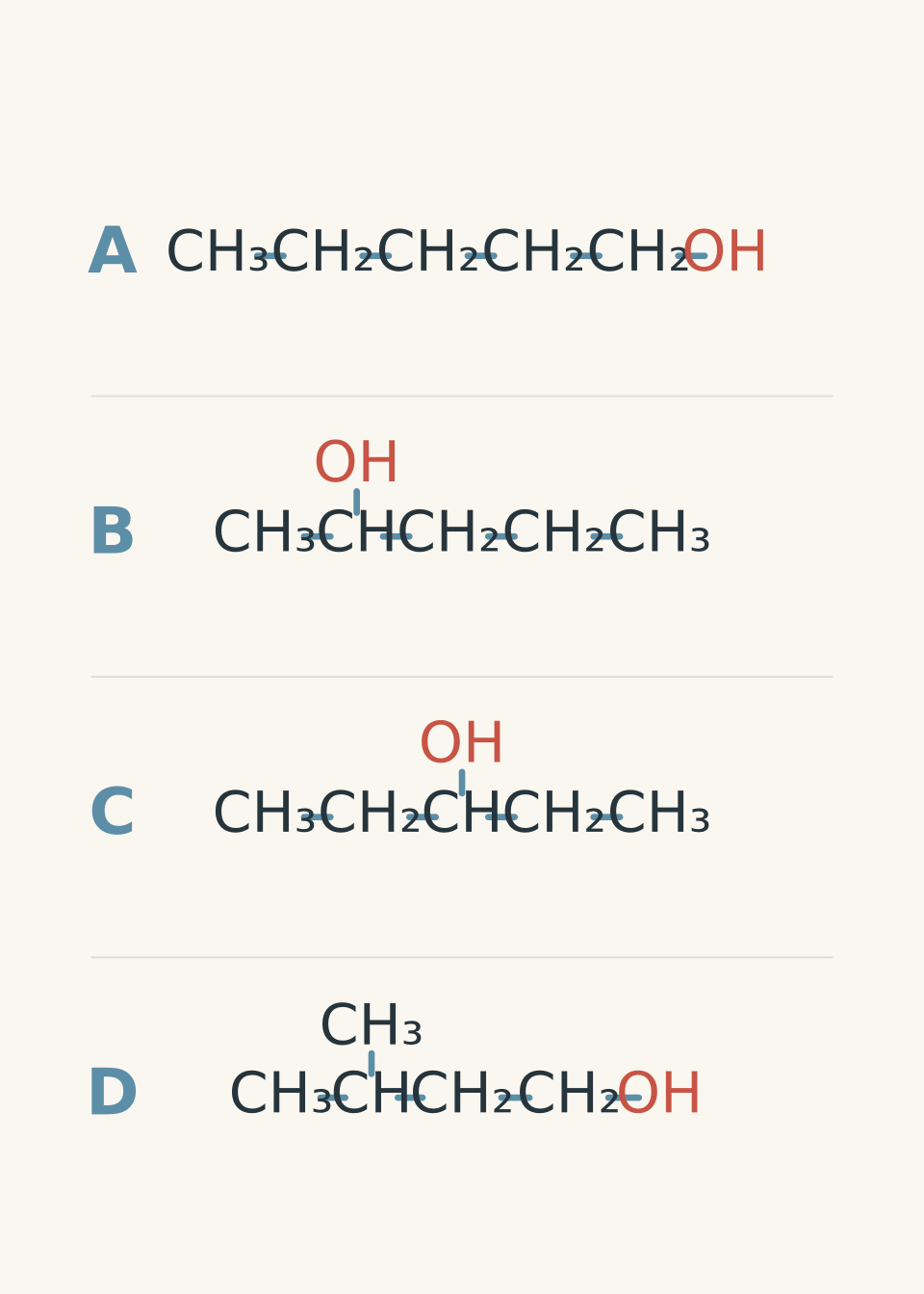
The condensed structural formulae are also provided below.
- A: \(\ce{CH3CH2CH2CH2CH2OH}\)
- B: \(\ce{CH3CH(OH)CH2CH2CH3}\)
- C: \(\ce{CH3CH2CH(OH)CH2CH3}\)
- D: \(\ce{CH3CH(CH3)CH2CH2OH}\)
(b) Draw the condensed structural formula of 3-methylbutan-2-ol. (2 marks)
(c) A student gives the name butan-3-ol to the compound \(\ce{CH3CH(OH)CH2CH3}\).
Give the correct IUPAC name and explain the numbering rule that the student has overlooked. (2 marks)
Question 3 (6 marks)
Two alcohols, A and B, have an unbranched four-carbon skeleton and one hydroxyl group. Their structures are shown below.
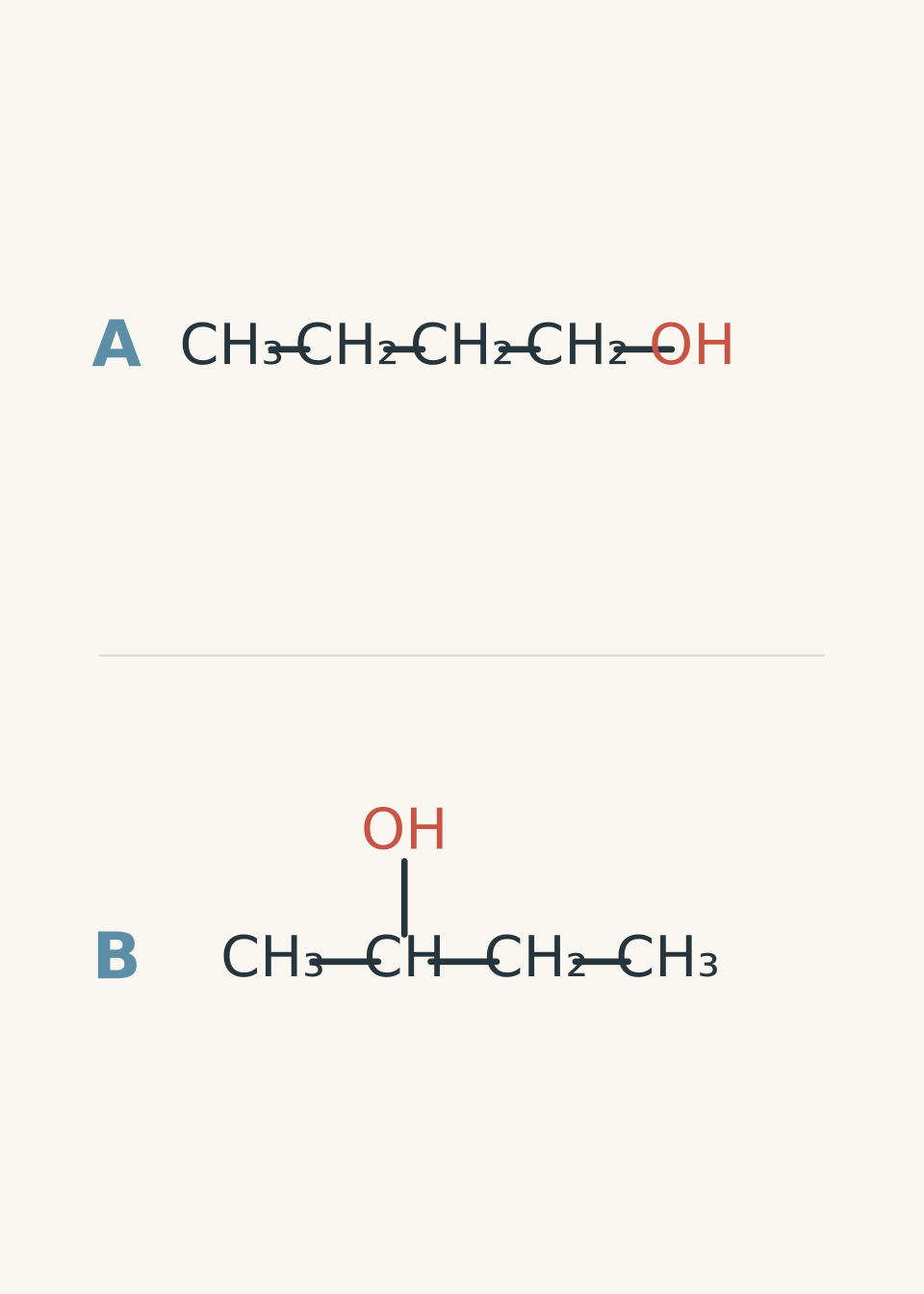
For reference:
- A: \(\ce{CH3CH2CH2CH2OH}\)
- B: \(\ce{CH3CH(OH)CH2CH3}\)
(a) Give the IUPAC name of A and B. (2 marks)
(b) Explain why A and B are positional isomers. (2 marks)
(c) The alcohol 2-methylpropan-1-ol has the same molecular formula as A. Explain why it is a chain isomer of A rather than a positional isomer. (2 marks)
Question 4 (8 marks)
The following table gives the normal boiling points of four alcohols.
| Alcohol | Molecular formula | Boiling point (°C) |
|---|---|---|
| Ethanol | \(\ce{C2H6O}\) | 78.4 |
| Propan-1-ol | \(\ce{C3H8O}\) | 97.2 |
| Butan-1-ol | \(\ce{C4H10O}\) | 117.7 |
| Pentan-1-ol | \(\ce{C5H12O}\) | 137.9 |
(a) Describe the trend in boiling point as the carbon chain increases from ethanol to pentan-1-ol. Calculate the total change in boiling point across the series. (2 marks)
(b) Explain the trend using the intermolecular forces present in alcohols. Your answer should distinguish the role of the hydroxyl group from the effect of increasing carbon chain length. (4 marks)
(c) When ethanol boils, explain which attractions must be overcome and which bonds within each ethanol molecule remain intact. (2 marks)
Question 5 (6 marks)
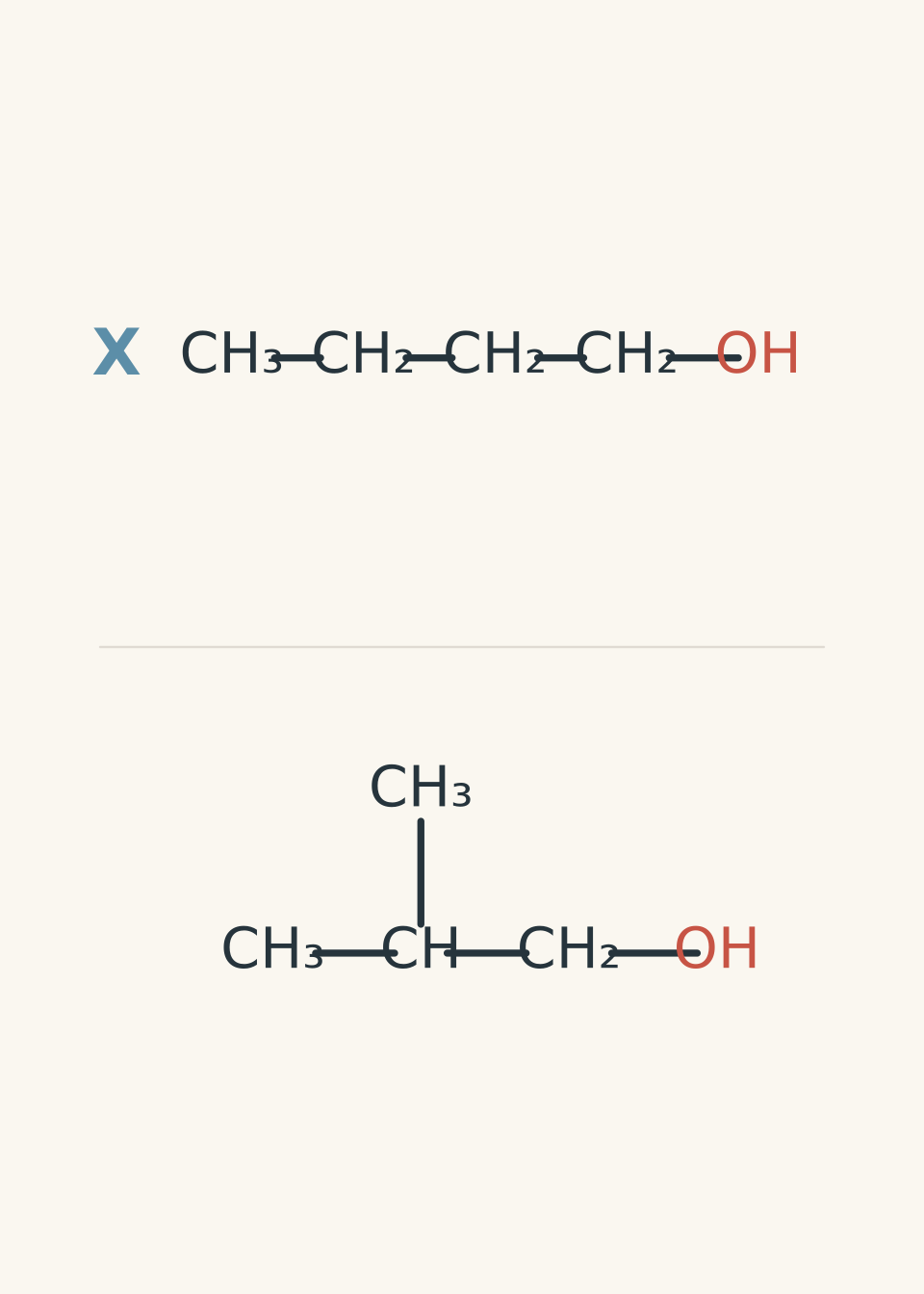
Two alcohols, X and Y, have the molecular formula \(\ce{C4H10O}\). Their structures and boiling points are shown below.
| Alcohol | Boiling point (°C) |
|---|---|
| X | 117.7 |
| Y | 108.0 |
(a) Calculate the difference between the boiling points of X and Y. (1 mark)
(b) Explain why X has a higher boiling point than Y. In your answer, consider molecular shape, London dispersion forces, and hydrogen bonding. (4 marks)
(c) Explain why comparing X and Y provides a more controlled investigation of the effect of branching than comparing ethanol with pentan-1-ol. (1 mark)
Question 6 (8 marks)
The following qualitative observations describe the solubility of four alcohols in water at room temperature.
| Alcohol | Water solubility |
|---|---|
| Ethanol | Miscible |
| Propan-1-ol | Miscible |
| Butan-1-ol | Limited solubility |
| Pentan-1-ol | Low solubility |
Miscible means that two liquids mix in all proportions.
(a) Describe the trend in water solubility as the carbon chain increases from two to five carbon atoms. Refer to the supplied observations. (2 marks)
(b) Explain this trend in terms of the hydroxyl group and the hydrocarbon chain. (2 marks)
(c) A student claims:
“Pentan-1-ol has low solubility in water because its hydroxyl group cannot form hydrogen bonds with water.”
Evaluate this claim. (2 marks)
(d) Draw a labelled molecular-level sketch showing one ethanol molecule and one water molecule joined by an intermolecular hydrogen bond. Clearly distinguish the covalent bonds within each molecule from the intermolecular attraction between the molecules. (2 marks)
Question 7 (8 marks)
A student makes the following statements while revising alcohol structures and properties.
(a) “The O-H covalent bond breaks when an alcohol boils.”
Correct the statement and explain what happens at the molecular level during boiling. (2 marks)
(b) “Any two alcohols with the molecular formula \(\ce{C4H10O}\) must be positional isomers.”
Explain why this statement is incorrect. Use one example of a positional-isomer pair and one example of a chain-isomer pair. (2 marks)
(c) “Pentan-1-ol has a higher boiling point than ethanol because its O-H covalent bond is stronger.”
Correct the explanation using the relevant intermolecular forces. (2 marks)
(d) Draw the structural formula of a tertiary alcohol with the molecular formula \(\ce{C4H10O}\), and give its IUPAC name. (2 marks)
03Worked solutions and marking guide
Solution 1
(a) Classifying alcohols (4 marks)
The classification depends on the number of carbon atoms directly attached to the carbon that carries the hydroxyl group.
- (i) \(\ce{CH3CH2OH}\): primary alcohol. The carbon carrying \(\ce{-OH}\) is attached to one other carbon.
- (ii) \(\ce{CH3CH(OH)CH3}\): secondary alcohol. The carbon carrying \(\ce{-OH}\) is attached to two other carbons.
- (iii) \(\ce{CH3C(OH)(CH3)CH2CH3}\): tertiary alcohol. The carbon carrying \(\ce{-OH}\) is attached to three other carbons.
- (iv) \(\ce{CH3CH(OH)CH2CH2CH2CH3}\): secondary alcohol. The carbon carrying \(\ce{-OH}\) is attached to two other carbons.
Marking guide
- (i) Correct classification: 1 mark.
- (ii) Correct classification: 1 mark.
- (iii) Correct classification: 1 mark.
- (iv) Correct classification: 1 mark.
(b) Drawing alcohols with formula \(\ce{C4H10O}\) (2 marks)
One valid primary alcohol is butan-1-ol:
\[ \ce{CH3CH2CH2CH2OH} \]
One valid secondary alcohol is butan-2-ol:
\[ \ce{CH3CH(OH)CH2CH3} \]
Other valid primary alcohol structures, such as 2-methylpropan-1-ol, are also acceptable.
Marking guide
- One correct primary alcohol with formula \(\ce{C4H10O}\): 1 mark.
- One correct secondary alcohol with formula \(\ce{C4H10O}\): 1 mark.
Solution 2
(a) IUPAC nomenclature (4 marks)
- A: pentan-1-ol.
- B: pentan-2-ol.
- C: pentan-3-ol.
- D: 3-methylbutan-1-ol.
To name an alcohol, choose the longest carbon chain containing the carbon attached to the hydroxyl group. Number the chain from the end that gives the hydroxyl group the lowest possible locant, then use the suffix -ol.
For D, numbering starts at the end containing the hydroxyl group. The main chain has four carbon atoms, and the methyl branch is on carbon 3. This gives 3-methylbutan-1-ol.
Marking guide
- A correctly named: 1 mark.
- B correctly named: 1 mark.
- C correctly named: 1 mark.
- D correctly named: 1 mark.
(b) Structural formula of 3-methylbutan-2-ol (2 marks)
\[ \ce{CH3CH(OH)CH(CH3)CH3} \]
The main chain contains four carbon atoms. The hydroxyl group is attached to carbon 2, and a methyl group is attached to carbon 3.
Marking guide
- Correct four-carbon chain with the hydroxyl group at carbon 2: 1 mark.
- Correct methyl branch at carbon 3, with the correct connectivity: 1 mark.
(c) Correcting butan-3-ol (2 marks)
The correct name is butan-2-ol.
The four-carbon chain can be numbered from either end, but IUPAC nomenclature requires the hydroxyl group to receive the lowest possible locant. Numbering from the opposite end changes the hydroxyl position from 3 to 2.
Marking guide
- Correct name, butan-2-ol: 1 mark.
- Explains that numbering must give the hydroxyl group the lowest possible locant: 1 mark.
Solution 3
(a) Naming A and B (2 marks)
- A: butan-1-ol.
- B: butan-2-ol.
Each molecule has an unbranched chain of four carbon atoms. The number in the name identifies the carbon carrying the hydroxyl group.
Marking guide
- A correctly named: 1 mark.
- B correctly named: 1 mark.
(b) Explaining positional isomerism (2 marks)
A and B are positional isomers because they have the same molecular formula, \(\ce{C4H10O}\), and the same unbranched carbon skeleton, but the hydroxyl group occupies a different position.
In A, the hydroxyl group is attached to carbon 1. In B, it is attached to carbon 2.
Marking guide
- Identifies the same molecular formula and carbon skeleton: 1 mark.
- Identifies the different positions of the hydroxyl group: 1 mark.
(c) Distinguishing chain isomers (2 marks)
Butan-1-ol and 2-methylpropan-1-ol have the same molecular formula, \(\ce{C4H10O}\), but their carbon skeletons differ.
Butan-1-ol has an unbranched carbon chain, while 2-methylpropan-1-ol has a branched carbon skeleton. They are therefore chain isomers, not positional isomers.
Positional isomers differ in the position of a functional group on the same carbon skeleton. Chain isomers differ in the arrangement of the carbon skeleton itself.
Marking guide
- Identifies the difference between the unbranched and branched carbon skeletons: 1 mark.
- Correctly explains why they are chain isomers rather than positional isomers: 1 mark.
Solution 4
(a) Boiling-point trend (2 marks)
The boiling point increases as the carbon chain becomes longer.
The total change from ethanol to pentan-1-ol is:
\[ \begin{aligned} \Delta T_b &= 137.9 - 78.4\\ &= 59.5\,^\circ\mathrm{C} \end{aligned} \]
The boiling point increases by \(59.5\,^\circ\mathrm{C}\) across the supplied series.
Marking guide
- Identifies the increasing boiling-point trend: 1 mark.
- Correct subtraction and answer with units: 1 mark.
(b) Explaining the trend using intermolecular forces (4 marks)
Alcohol molecules experience several types of intermolecular attraction.
First, the hydroxyl group contains polar O-H and C-O bonds. Alcohol molecules are polar and can form hydrogen bonds with neighbouring alcohol molecules. They also experience dipole-dipole attractions.
Second, all molecules experience London dispersion forces. These arise from temporary fluctuations in electron distribution, which produce temporary dipoles and induce dipoles in neighbouring molecules.
As the carbon chain becomes longer, the molecule has more electrons and a larger electron cloud. Its London dispersion forces generally become stronger.
The number of hydroxyl groups remains one per molecule throughout this series. Hydrogen bonding is therefore present in every alcohol listed, but the increase in London dispersion forces as molecular size increases helps explain the rising boiling points. More energy is required to separate the molecules.
Marking guide
- Identifies hydrogen bonding between alcohol molecules: 1 mark.
- Identifies dipole-dipole attractions associated with molecular polarity: 1 mark.
- Explains that a longer carbon chain increases the electron cloud and strengthens London dispersion forces: 1 mark.
- Connects stronger overall intermolecular attractions with greater energy required to separate molecules and a higher boiling point: 1 mark.
(c) Intermolecular versus intramolecular bonds (2 marks)
When ethanol boils, sufficient energy is supplied to overcome the intermolecular attractions holding neighbouring ethanol molecules together. These include hydrogen bonding, dipole-dipole attractions, and London dispersion forces.
The covalent bonds within each ethanol molecule, including the O-H, C-O, C-C, and C-H bonds, remain intact. Boiling is a physical change, not the chemical decomposition of ethanol.
Marking guide
- Identifies the intermolecular attractions that must be overcome: 1 mark.
- States that the intramolecular covalent bonds remain intact: 1 mark.
Solution 5
(a) Difference in boiling points (1 mark)
\[ \begin{aligned} \Delta T_b &= 117.7 - 108.0\\ &= 9.7\,^\circ\mathrm{C} \end{aligned} \]
X has a boiling point \(9.7\,^\circ\mathrm{C}\) higher than Y.
Marking guide
- Correct difference with units: 1 mark.
(b) Effect of branching on boiling point (4 marks)
X is butan-1-ol, which has a straight carbon chain. Y is 2-methylpropan-1-ol, which has a branched carbon skeleton.
Both molecules contain one hydroxyl group, so both can form hydrogen bonds with neighbouring alcohol molecules. Branching does not remove the ability to hydrogen-bond.
However, X has a more extended shape and generally allows greater surface contact between neighbouring molecules. Y has a more compact shape, which reduces effective contact between its molecules.
This difference affects London dispersion forces. The intermolecular attractions between X molecules are stronger overall under these conditions, so more energy is needed to separate them. X consequently has the higher boiling point.
Marking guide
- States that both alcohols can form hydrogen bonds because both contain a hydroxyl group: 1 mark.
- Identifies the greater surface contact or less compact shape of X: 1 mark.
- Links the more compact shape of Y with weaker London dispersion attractions: 1 mark.
- Explains that stronger overall attractions require more energy to overcome, giving X the higher boiling point: 1 mark.
(c) Controlled comparison (1 mark)
X and Y have the same molecular formula, the same number of carbon atoms, and one hydroxyl group each. Both are primary alcohols.
Their comparison therefore reduces the effect of differences in molecular mass and hydroxyl-group count, making the effect of carbon-chain branching easier to examine.
Marking guide
- Identifies that the molecular formula and hydroxyl-group count are held constant, so branching and molecular shape can be compared more directly: 1 mark.
Solution 6
(a) Solubility trend (2 marks)
Ethanol and propan-1-ol are miscible with water. Butan-1-ol has limited solubility, while pentan-1-ol has low solubility.
The general trend is that water solubility decreases as the carbon chain becomes longer.
Marking guide
- Identifies the general decrease in water solubility with increasing chain length: 1 mark.
- Correctly refers to the supplied observations, including the lower solubility of butan-1-ol and pentan-1-ol: 1 mark.
(b) Explaining the trend (2 marks)
The hydroxyl group is polar and can form hydrogen bonds with water molecules. This helps alcohol molecules interact with water.
The hydrocarbon chain is largely non-polar and does not form hydrogen bonds with water. As the chain gets longer, the non-polar part becomes larger relative to the single hydroxyl group, making the molecule less compatible with water overall. Its solubility therefore decreases.
Marking guide
- Explains that the polar hydroxyl group can hydrogen-bond with water: 1 mark.
- Explains that the growing non-polar hydrocarbon chain reduces overall water solubility: 1 mark.
(c) Evaluating the student’s claim (2 marks)
The claim is incorrect. Pentan-1-ol can form hydrogen bonds with water through its hydroxyl group, just as ethanol can.
Its lower solubility is mainly due to its longer non-polar hydrocarbon chain, which limits the favourable interactions between the alcohol and water.
Marking guide
- States that pentan-1-ol can hydrogen-bond with water: 1 mark.
- Attributes its lower solubility to the longer non-polar chain rather than an inability to hydrogen-bond: 1 mark.
(d) Drawing a hydrogen-bonding arrangement (2 marks)
A valid sketch could show ethanol as \(\ce{CH3CH2-O-H}\) and water as \(\ce{H-O-H}\). Draw a dotted line from the hydrogen attached to ethanol’s oxygen to the oxygen atom of the water molecule.
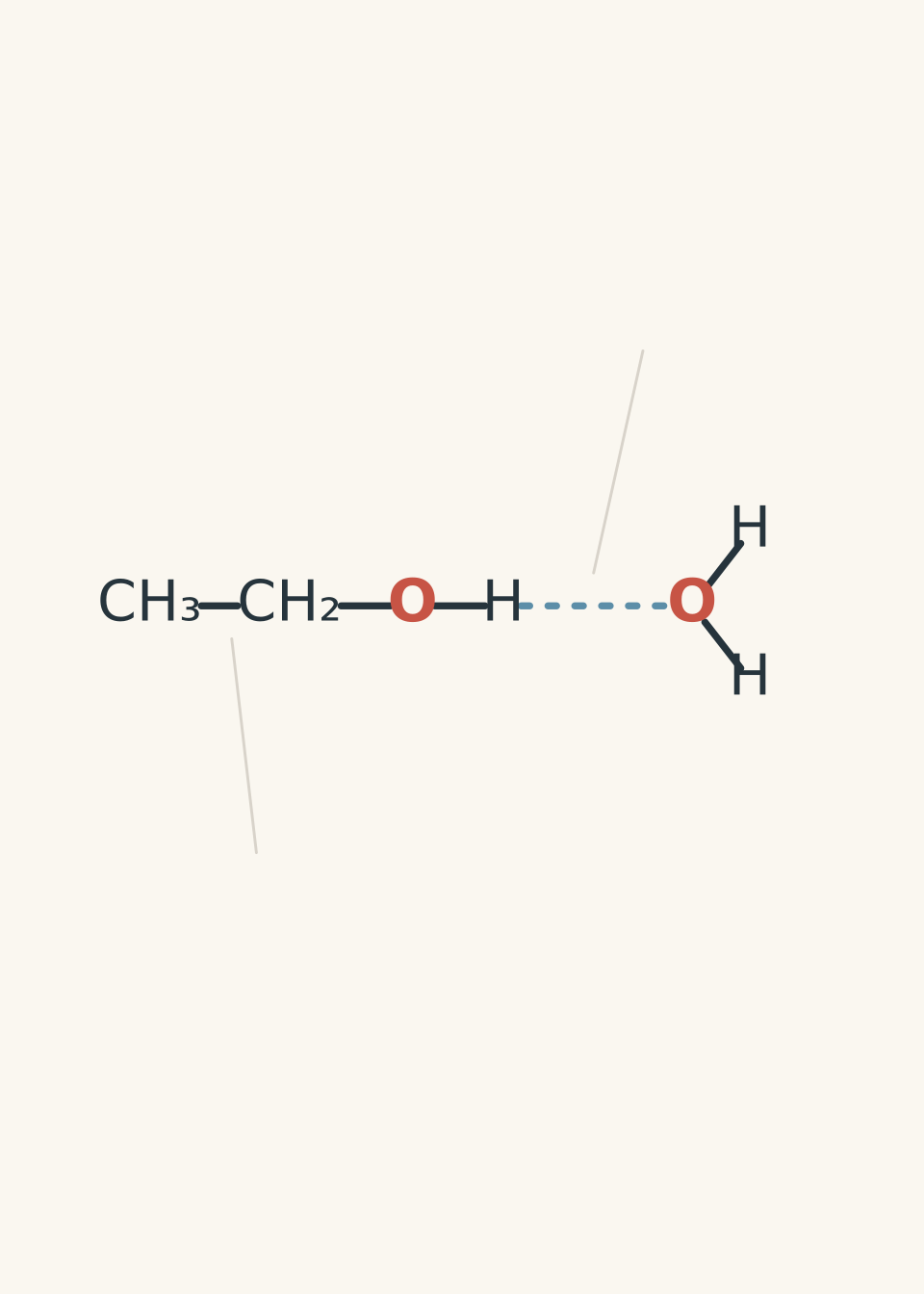
The solid lines represent covalent bonds within each molecule. The dotted line represents a hydrogen bond between the molecules; it is an intermolecular attraction, not a new covalent bond.
Marking guide
- Correctly represents the ethanol and water molecules with their covalent bonds intact: 1 mark.
- Shows and labels a correctly placed intermolecular hydrogen bond: 1 mark.
Solution 7
(a) Boiling and covalent bonds (2 marks)
The statement is incorrect. When an alcohol boils, intermolecular attractions between neighbouring molecules are overcome so that the molecules can separate into the gas phase.
The O-H covalent bond within each alcohol molecule remains intact. The same applies to the other covalent bonds within the molecule.
Marking guide
- Identifies that boiling overcomes intermolecular attractions rather than breaking the O-H covalent bond: 1 mark.
- Explains that the molecules separate while their intramolecular covalent bonds remain intact: 1 mark.
(b) Positional isomers and chain isomers (2 marks)
The statement is incorrect because having the same molecular formula does not automatically make two alcohols positional isomers.
Butan-1-ol and butan-2-ol are positional isomers because they have the same unbranched carbon skeleton but different hydroxyl-group positions.
Butan-1-ol and 2-methylpropan-1-ol are chain isomers because their carbon skeletons differ: one is unbranched, and the other is branched.
Marking guide
- Correctly distinguishes positional isomers from chain isomers: 1 mark.
- Gives a valid positional-isomer pair and a valid chain-isomer pair: 1 mark.
(c) Explaining the boiling-point difference (2 marks)
The O-H covalent bond does not become stronger simply because the carbon chain is longer. Ethanol and pentan-1-ol both contain one hydroxyl group and can form hydrogen bonds.
Pentan-1-ol has a larger electron cloud and more electrons than ethanol. Its stronger London dispersion forces increase the overall intermolecular attractions, so more energy is required to separate the molecules. This helps explain its higher boiling point.
Marking guide
- Rejects the claim that the longer chain raises boiling point by strengthening the O-H covalent bond: 1 mark.
- Explains the role of stronger London dispersion forces and the greater energy needed to separate molecules: 1 mark.
(d) Drawing and naming a tertiary alcohol (2 marks)
A correct structure is:
\[ \ce{(CH3)3COH} \]
Its IUPAC name is 2-methylpropan-2-ol.
The carbon carrying the hydroxyl group is attached to three other carbon atoms, so the alcohol is tertiary.
Marking guide
- Correct structural formula for a tertiary alcohol with molecular formula \(\ce{C4H10O}\): 1 mark.
- Correct IUPAC name, 2-methylpropan-2-ol: 1 mark.
End of paper: 50 marks