
Banked Tracks with Friction: HSC Physics Practice Exam
Prepare for NSW HSC Physics with this original 40-mark tutorgum practice paper on banked bends with friction. Test your understanding with six timed questions, then check your working against complete worked solutions and a detailed marking guide.
This original tutorgum practice paper focuses on banked bends with friction in NSW HSC Physics. It tests how to determine the direction of friction, resolve normal-force and friction components, and calculate the minimum and maximum speeds a vehicle can maintain without sliding.
The paper covers the supplied Physics 2017-edition scope for banked tracks with friction. It is a focused revision assessment, not a full-course exam or an official, endorsed, or predicted NESA paper.
01Exam instructions
- Suggested reading time: 5 minutes.
- Suggested working time: 60 minutes.
- Total marks: 40.
- Permitted equipment: Scientific calculator, ruler, and writing equipment. No notes or formula sheet.
- Working: Show all relevant equations, substitutions, and units. Unsupported numerical answers may not receive full marks.
- Precision: Give numerical answers to three significant figures unless otherwise stated.
- Gravity: Use \(g=9.8\ \text{m s}^{-2}\) throughout.
Assumptions and scope
For every question, assume the vehicle travels at constant speed around a horizontal circular path of radius \(r\). The road is banked at an angle \(\theta\) to the horizontal, with its outer edge higher than its inner edge.
Model the vehicle as a particle. Neglect air resistance, assume the tyres remain in contact with the road, and consider static friction between the tyres and road. The coefficient of static friction is denoted by \(\mu_s\).
The assessment covers banked tracks, normal-force components, friction direction, frictionless design speed, limiting friction, minimum and maximum speeds, and the coefficient of friction required for a specified speed. It excludes other circular-motion applications and material from other syllabus editions.
These are suggested conditions for this tutorgum practice paper, not claims about current official NESA examination rules.
02Questions
Question 1 (5 marks)
A banked bend is designed so that a car can travel around it at \(18.0\ \text{m s}^{-1}\) without relying on friction.
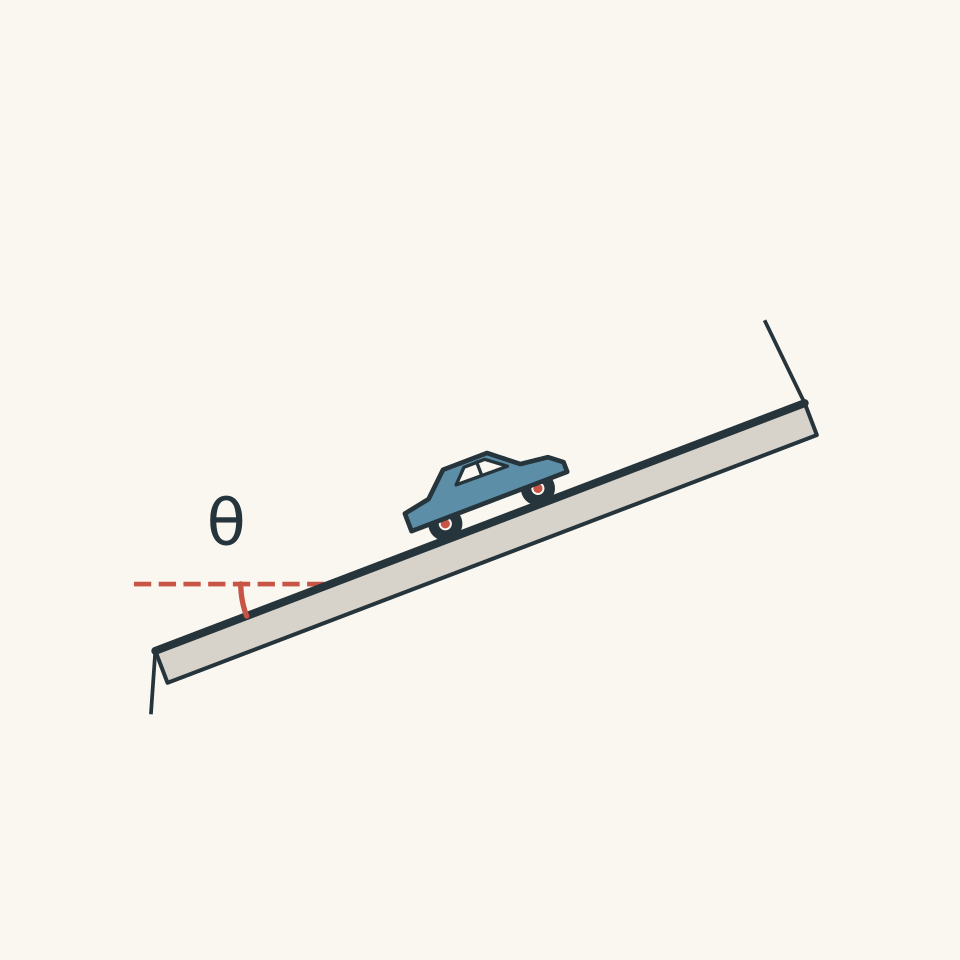
(a) For each speed below, state whether static friction must act up the bank, down the bank, or is not required to maintain the circular path. (3 marks)
(i) \(12.0\ \text{m s}^{-1}\)
(ii) \(18.0\ \text{m s}^{-1}\)
(iii) \(24.0\ \text{m s}^{-1}\)
(b) Explain why the direction of friction changes when the car’s speed moves from below the design speed to above it. Refer to the required centripetal force. (2 marks)
Question 2 (6 marks)
A \(1000\ \text{kg}\) car travels at \(20.0\ \text{m s}^{-1}\) around a banked bend of radius \(120\ \text{m}\). The bank angle is \(25.0^\circ\).
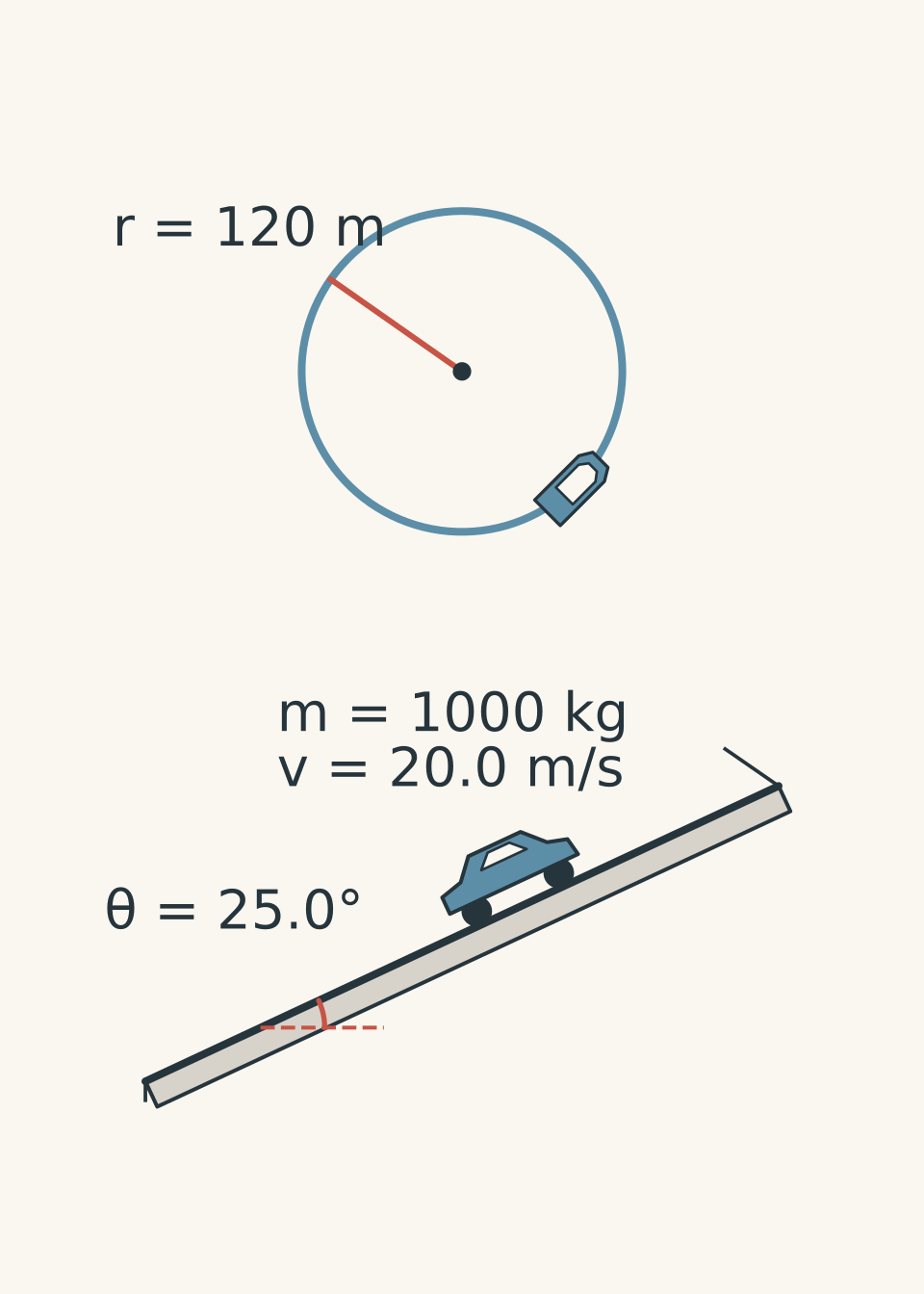
(a) Calculate the frictionless design speed for this bend. Use your result to determine the direction in which friction must act at \(20.0\ \text{m s}^{-1}\). (2 marks)
(b) Resolve the forces acting on the car to calculate the normal force and the magnitude of the friction force at \(20.0\ \text{m s}^{-1}\). (3 marks)
(c) Determine the minimum coefficient of static friction required for the car to maintain this speed. (1 mark)
Question 3 (7 marks)
A car travels around a banked bend with radius \(75.0\ \text{m}\) and bank angle \(18.0^\circ\). The coefficient of static friction between the tyres and road is \(0.350\).
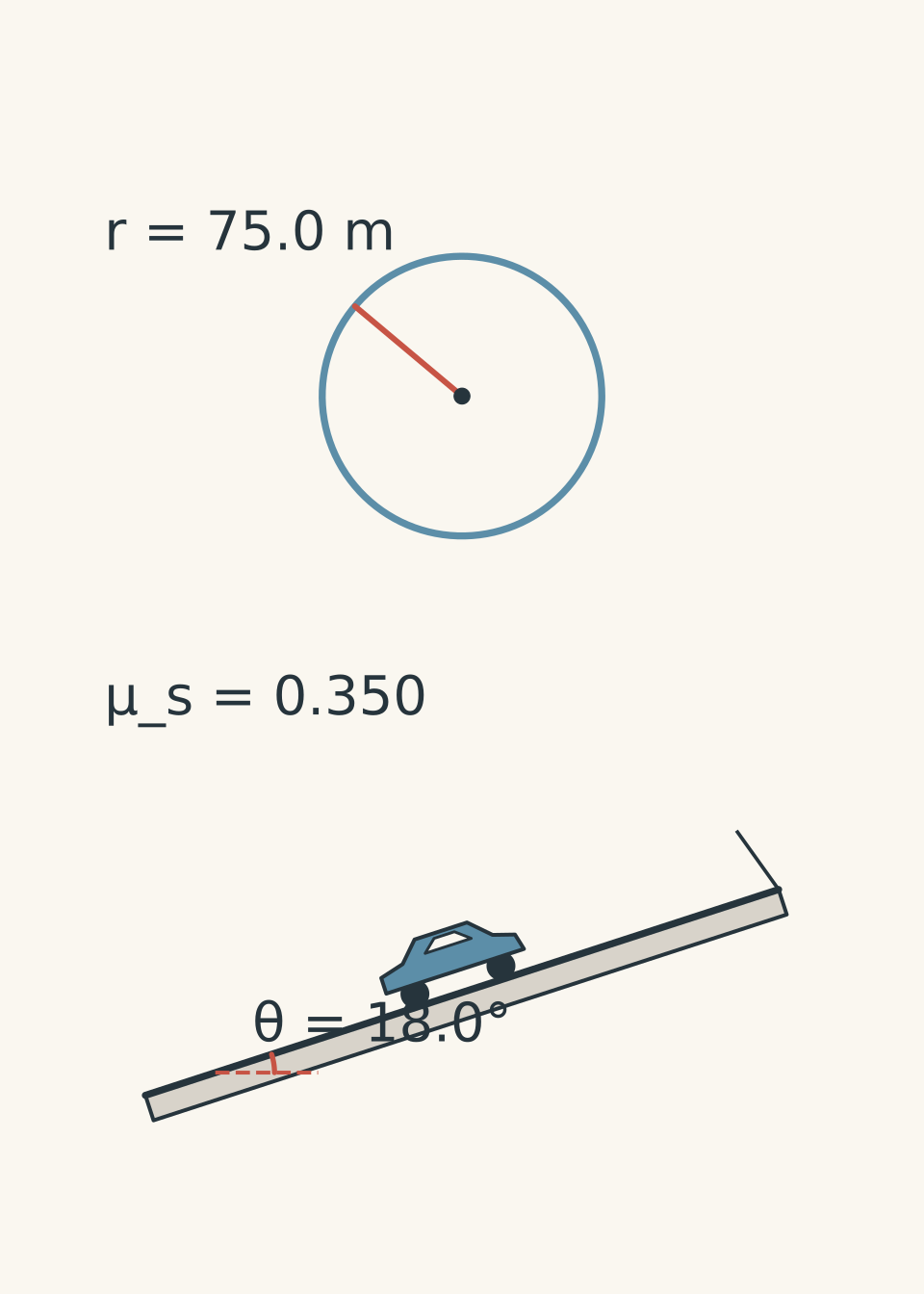
(a) At the maximum speed before the car begins to slide up the bank, state the direction of friction and express its limiting magnitude in terms of the normal force \(N\). (2 marks)
(b) Using resolved force components, calculate the maximum speed before the car begins to slide up the bank. Show your equations and working. (5 marks)
Question 4 (6 marks)
A banked bend has radius \(90.0\ \text{m}\) and bank angle \(28.0^\circ\). Initially, the coefficient of static friction is \(0.300\).
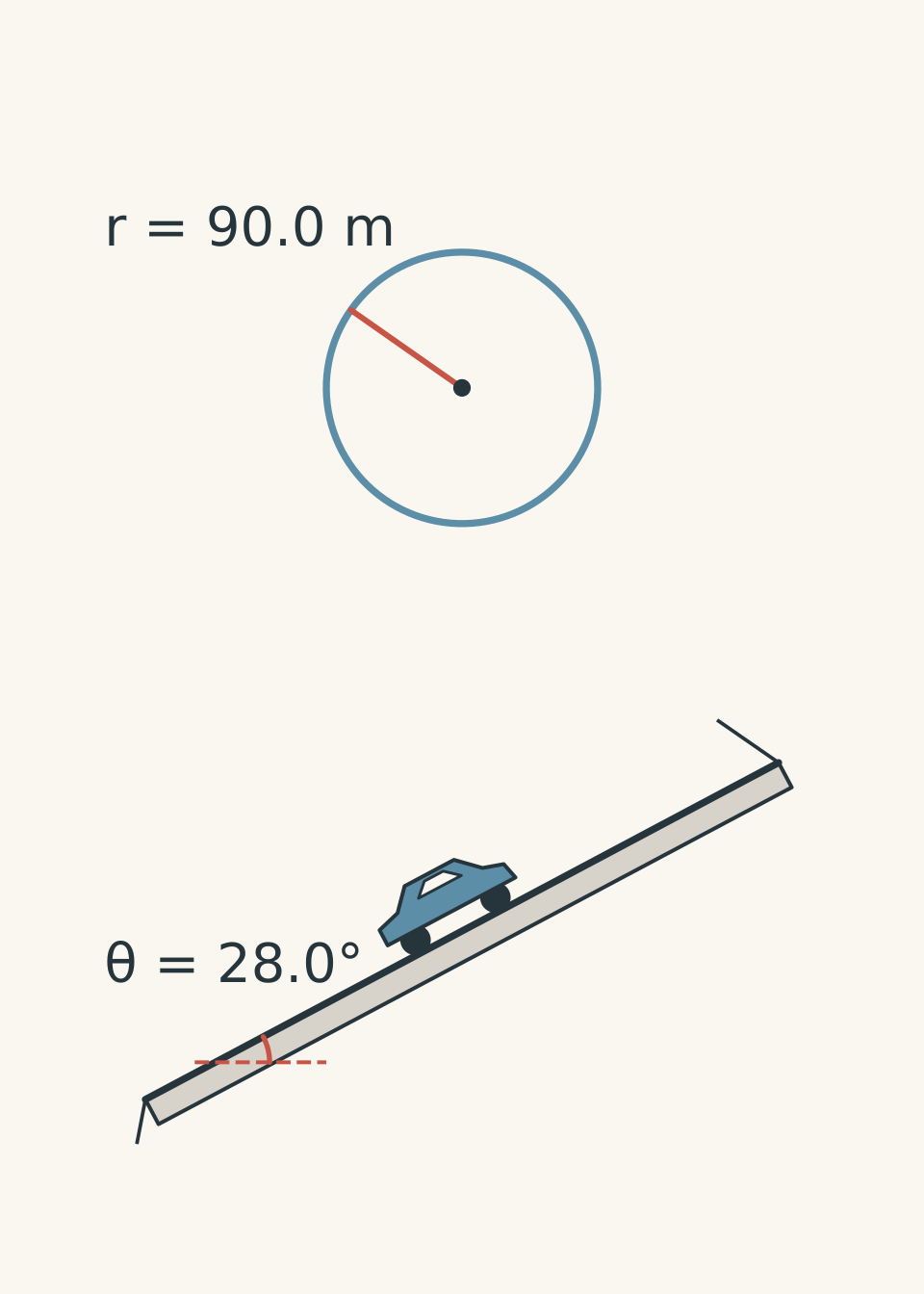
(a) At the minimum speed before the car begins to slide down the bank, state the direction of friction. (1 mark)
(b) Calculate the minimum speed before the car begins to slide down the bank. (3 marks)
(c) The bend is then considered with a coefficient of static friction of \(0.600\), while the radius and bank angle remain unchanged. Determine whether a positive minimum-speed threshold is required. Justify your answer quantitatively. (2 marks)
Question 5 (8 marks)
A banked bend has radius \(100\ \text{m}\), bank angle \(15.0^\circ\), and coefficient of static friction \(0.200\).
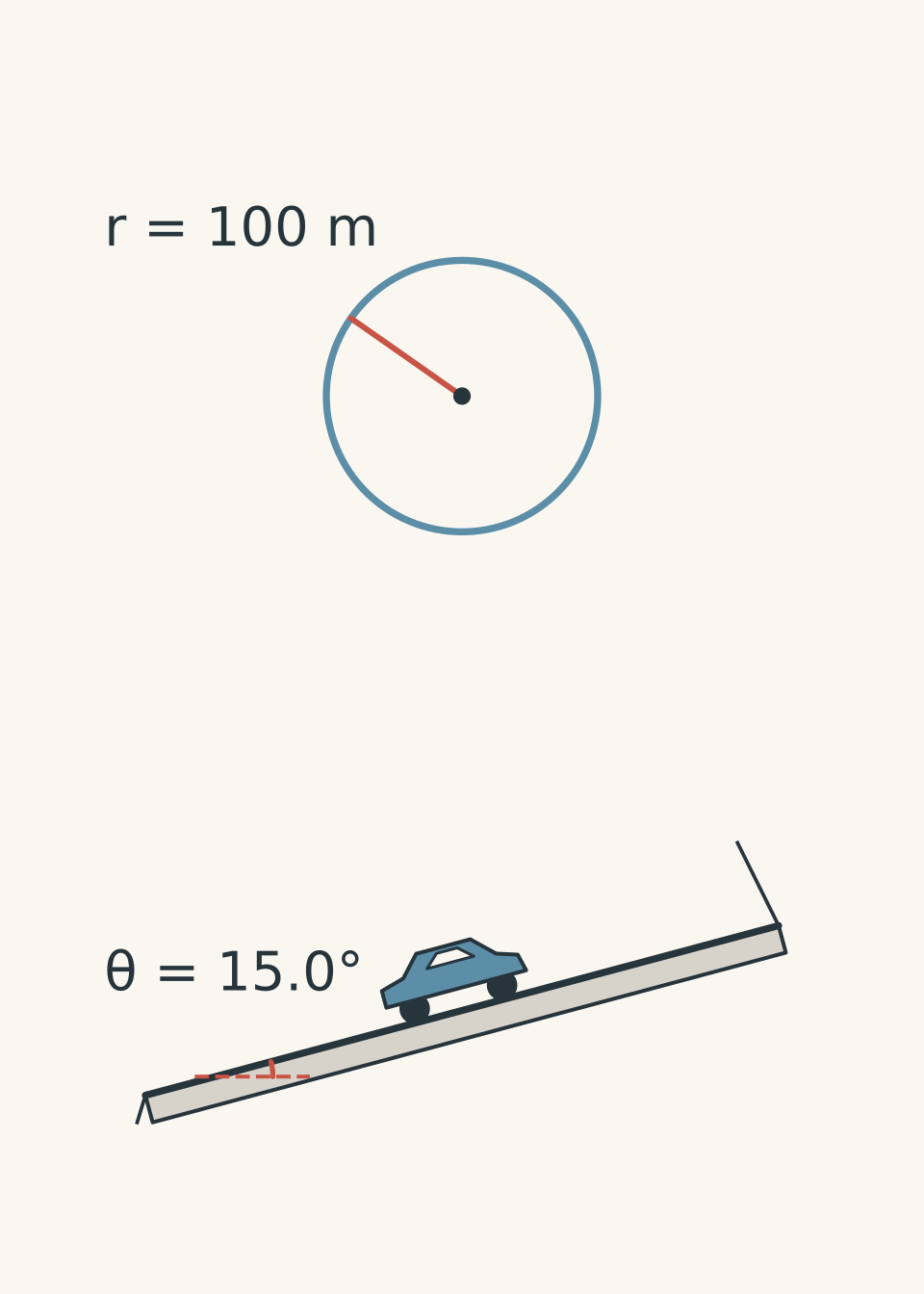
(a) Calculate the frictionless design speed. (1 mark)
(b) Calculate the minimum speed before the car begins to slide down the bank. (2 marks)
(c) Calculate the maximum speed before the car begins to slide up the bank. (2 marks)
(d) State the allowed speed range for the car. Check whether your frictionless design speed lies within this range. (2 marks)
(e) State the direction of friction at each limiting speed. (1 mark)
Question 6 (8 marks)
A \(1200\ \text{kg}\) car travels at \(18.0\ \text{m s}^{-1}\) around a banked bend of radius \(65.0\ \text{m}\) and bank angle \(22.0^\circ\). The coefficient of static friction available between the tyres and road is \(0.150\).
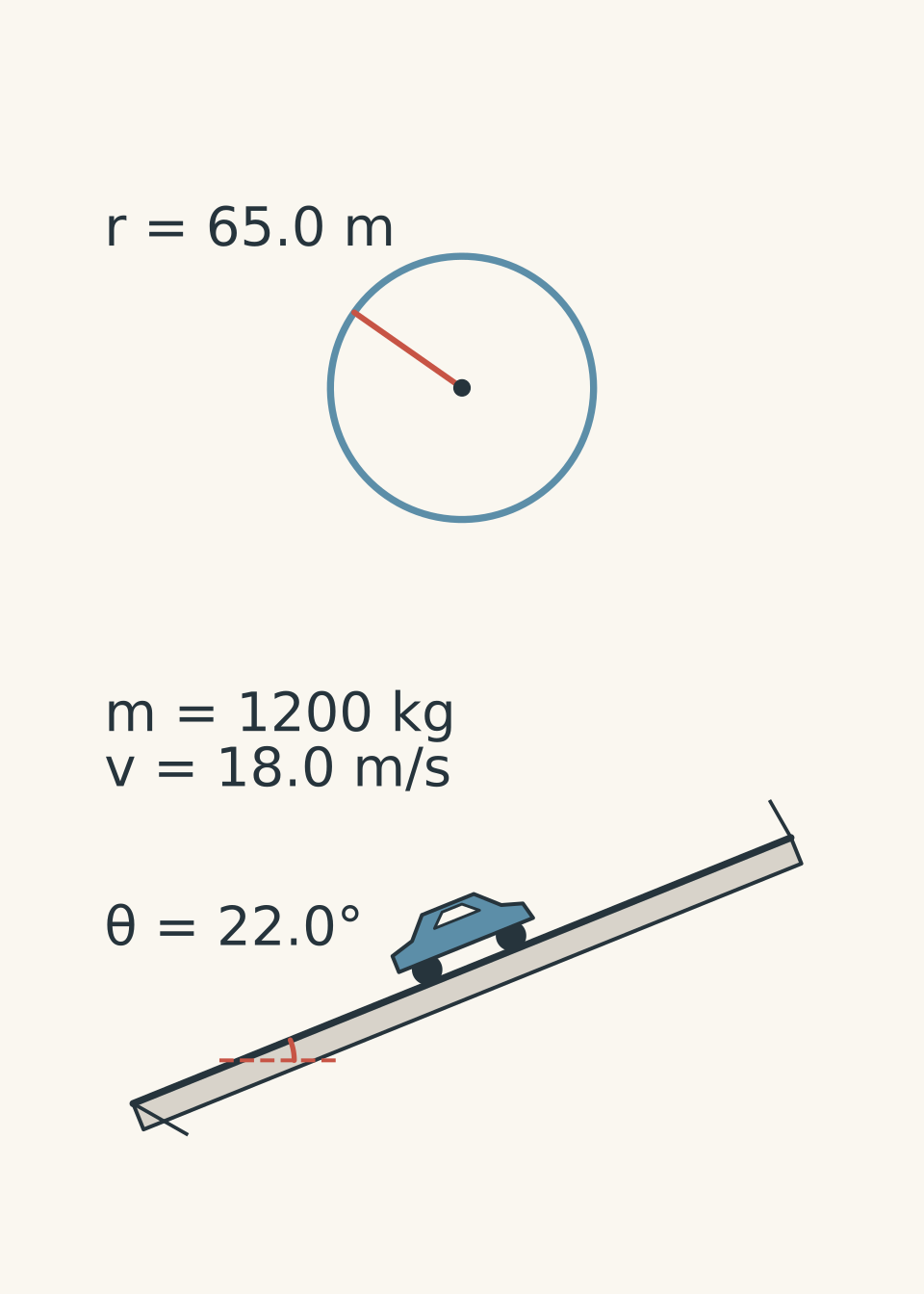
(a) Calculate the frictionless design speed and use it to determine the direction in which friction must act at \(18.0\ \text{m s}^{-1}\). (2 marks)
(b) Calculate the normal force acting on the car at this speed. (2 marks)
(c) Calculate the magnitude of the actual friction force required to maintain this motion. (2 marks)
(d) Calculate the minimum coefficient of static friction required at this speed. (1 mark)
(e) Determine whether the available coefficient of \(0.150\) is sufficient to maintain the car’s speed. State whether friction is limiting, supporting your conclusion with a numerical comparison. (1 mark)
03Worked solutions and marking guide
Solution 1
(a) Friction direction (3 marks)
(i) At \(12.0\ \text{m s}^{-1}\), friction acts up the bank.
(ii) At \(18.0\ \text{m s}^{-1}\), friction is not required. This is the frictionless design speed.
(iii) At \(24.0\ \text{m s}^{-1}\), friction acts down the bank.
Marking:
- (i) Correct direction: 1 mark.
- (ii) Correctly identifies that friction is not required: 1 mark.
- (iii) Correct direction: 1 mark.
(b) Explanation (2 marks)
At the frictionless design speed, the normal force supplies the required centripetal force through its horizontal inward component, while its vertical component balances the car’s weight.
Below the design speed, the required centripetal force is smaller relative to the frictionless condition. Friction acts up the bank, giving an outward horizontal component that helps reduce the net inward force.
Above the design speed, more centripetal force is required. Friction acts down the bank, adding an inward horizontal component.
Marking:
- Explains why friction acts up the bank below the design speed: 1 mark.
- Explains why friction acts down the bank above the design speed: 1 mark.
For the calculation questions, use the following sign convention: take the horizontal direction towards the centre of the bend as positive, and the vertical direction upwards as positive. Define the signed friction force \(f\) as positive down the bank and negative up the bank.
For a bank angle \(\theta\), the resolved force equations are
\[ N\sin\theta+f\cos\theta=\frac{mv^2}{r} \]
\[ N\cos\theta-f\sin\theta=mg \]
Here, \(N\) is the normal force, \(m\) is the vehicle’s mass, \(v\) is its speed, and \(r\) is the radius of its circular path.
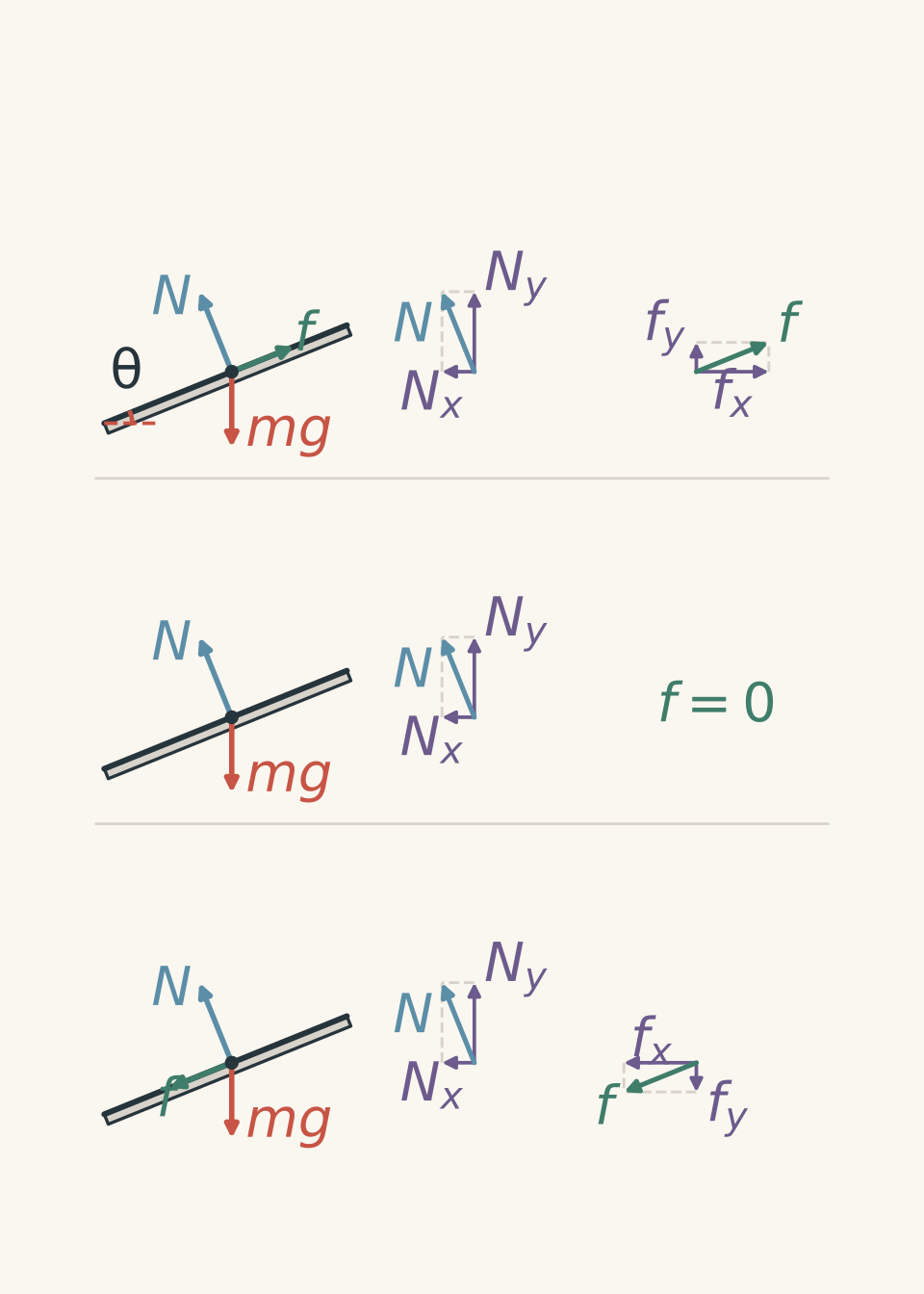
Solving the two force equations gives
\[ N=m\left(g\cos\theta+ \frac{v^2}{r}\sin\theta\right) \]
and
\[ f=m\left(\frac{v^2}{r}\cos\theta- g\sin\theta\right). \]
The frictionless design speed occurs when \(f=0\). Therefore,
\[ \frac{v_0^2}{r}\cos\theta=g\sin\theta \]
so
\[ v_0=\sqrt{rg\tan\theta}. \]
This relationship is useful for checking the direction of friction before calculating its magnitude.
Solution 2
(a) Design speed and friction direction (2 marks)
The frictionless design speed is
\[ v_0=\sqrt{rg\tan\theta}. \]
Substituting \(r=120\ \text{m}\), \(g=9.8\ \text{m s}^{-2}\), and \(\theta=25.0^\circ\),
\[ \begin{aligned} v_0&=\sqrt{120(9.8)\tan25.0^\circ}\\ &=23.4\ \text{m s}^{-1}. \end{aligned} \]
The car travels at \(20.0\ \text{m s}^{-1}\), which is below the design speed. Therefore, friction acts up the bank.
Marking:
- Correct design-speed calculation: 1 mark.
- Correct friction direction based on the speed comparison: 1 mark.
(b) Normal force and friction force (3 marks)
First calculate the centripetal acceleration:
\[ a_c=\frac{v^2}{r} =\frac{20.0^2}{120} =3.33\ \text{m s}^{-2}. \]
From the resolved force equations,
\[ N=m(g\cos\theta+a_c\sin\theta). \]
Substitute the values:
\[ \begin{aligned} N&=1000(9.8\cos25.0^\circ\\ &\qquad+3.33\sin25.0^\circ)\\ &=1.03\times10^4\ \text{N}. \end{aligned} \]
The signed friction force is
\[ f=m(a_c\cos\theta-g\sin\theta). \]
Therefore,
\[ \begin{aligned} f&=1000(3.33\cos25.0^\circ\\ &\qquad-9.8\sin25.0^\circ)\\ &=-1.12\times10^3\ \text{N}. \end{aligned} \]
The negative sign confirms that friction acts up the bank. Its magnitude is \(1.12\times10^3\ \text{N}\).
Marking:
- Correct acceleration and resolved force method: 1 mark.
- Correct normal force with units: 1 mark.
- Correct friction magnitude and direction: 1 mark.
(c) Minimum coefficient of static friction (1 mark)
The minimum coefficient is the ratio of the required friction magnitude to the normal force:
\[ \begin{aligned} \mu_{\min}&=\frac{|f|}{N}\\ &=\frac{1.12\times10^3}{1.03\times10^4}\\ &=0.109. \end{aligned} \]
Answer: \(\boxed{\mu_{\min}=0.109}\).
Marking:
- Correct ratio and numerical answer: 1 mark.
Solution 3
(a) Friction direction and limiting magnitude (2 marks)
At maximum speed, the car is on the verge of sliding up the bank. Static friction opposes this impending motion, so it acts down the bank.
At the limiting condition, the magnitude of friction reaches its maximum available value:
\[ f=\mu_sN. \]
Here, \(f\) is positive under the sign convention used above.
Marking:
- Correct friction direction: 1 mark.
- Correct limiting-friction relationship: 1 mark.
(b) Maximum speed (5 marks)
The resolved force equations are
\[ N\sin\theta+f\cos\theta=\frac{mv^2}{r} \]
and
\[ N\cos\theta-f\sin\theta=mg. \]
At the upper speed limit, \(f=\mu_sN\). Substituting gives
\[ N(\sin\theta+\mu_s\cos\theta) =\frac{mv^2}{r} \]
and
\[ N(\cos\theta-\mu_s\sin\theta)=mg. \]
Divide the first equation by the second to eliminate \(N\) and \(m\):
\[ \frac{v_{\max}^2}{r} =g\frac{\sin\theta+\mu_s\cos\theta} {\cos\theta-\mu_s\sin\theta}. \]
Therefore,
\[ v_{\max}^2 =rg\frac{\sin\theta+\mu_s\cos\theta} {\cos\theta-\mu_s\sin\theta}. \]
Substitute \(r=75.0\ \text{m}\), \(\theta=18.0^\circ\), and \(\mu_s=0.350\):
\[ \begin{aligned} v_{\max}^2 &=75.0(9.8)\\ &\quad\times \frac{\sin18.0^\circ+0.350\cos18.0^\circ} {\cos18.0^\circ-0.350\sin18.0^\circ}. \end{aligned} \]
The ratio evaluates to approximately \(0.7615\), giving
\[ \begin{aligned} v_{\max}^2&=559.7\ \text{m}^2\text{s}^{-2}\\ v_{\max}&=23.7\ \text{m s}^{-1}. \end{aligned} \]
Answer: \(\boxed{v_{\max}=23.7\ \text{m s}^{-1}}\).
Marking:
- Both resolved force equations: 2 marks.
- Correct elimination of \(N\) to obtain the maximum-speed relationship: 1 mark.
- Correct substitution and evaluation: 1 mark.
- Final speed with units: 1 mark.
Solution 4
(a) Friction direction (1 mark)
At the minimum speed, the car is on the verge of sliding down the bank. Friction opposes this impending motion and therefore acts up the bank.
Marking:
- Correct direction: 1 mark.
(b) Minimum speed (3 marks)
At the lower speed limit, friction acts up the bank, so its signed value is \(f=-\mu_sN\).
The resolved equations become
\[ N\sin\theta-\mu_sN\cos\theta =\frac{mv^2}{r} \]
and
\[ N\cos\theta+\mu_sN\sin\theta=mg. \]
Eliminating \(N\) gives
\[ v_{\min}^2 =rg\frac{\sin\theta-\mu_s\cos\theta} {\cos\theta+\mu_s\sin\theta}. \]
Substitute \(r=90.0\ \text{m}\), \(\theta=28.0^\circ\), and \(\mu_s=0.300\):
\[ \begin{aligned} v_{\min}^2 &=90.0(9.8)\\ &\quad\times \frac{\sin28.0^\circ-0.300\cos28.0^\circ} {\cos28.0^\circ+0.300\sin28.0^\circ}\\ &=176.2\ \text{m}^2\text{s}^{-2}. \end{aligned} \]
Thus,
\[ v_{\min}=\sqrt{176.2} =13.3\ \text{m s}^{-1}. \]
Answer: \(\boxed{v_{\min}=13.3\ \text{m s}^{-1}}\).
Marking:
- Correct lower-speed relationship: 1 mark.
- Correct substitution and calculation: 1 mark.
- Final speed with units: 1 mark.
(c) No positive minimum-speed threshold (2 marks)
At zero speed, the car would need friction to prevent it from sliding down the bank. In this case, the required friction-to-normal-force ratio is
\[ \frac{|f|}{N}=\tan\theta. \]
For the \(28.0^\circ\) bank,
\[ \tan28.0^\circ=0.532. \]
The available coefficient is \(0.600\), which is greater than \(0.532\). Static friction is therefore sufficient to hold the car without sliding even at zero speed.
There is no positive minimum-speed threshold. The lower limit is \(0\ \text{m s}^{-1}\).
Marking:
- Correct comparison of \(0.600\) with \(\tan28.0^\circ\): 1 mark.
- Correct conclusion, with an explanation based on the friction required at zero speed: 1 mark.
Solution 5
(a) Frictionless design speed (1 mark)
Use
\[ v_0=\sqrt{rg\tan\theta}. \]
Substituting the given values,
\[ \begin{aligned} v_0&=\sqrt{100(9.8)\tan15.0^\circ}\\ &=16.2\ \text{m s}^{-1}. \end{aligned} \]
Answer: \(\boxed{v_0=16.2\ \text{m s}^{-1}}\).
Marking:
- Correct design-speed calculation: 1 mark.
(b) Minimum speed (2 marks)
The minimum speed is
\[ v_{\min}^2 =rg\frac{\sin\theta-\mu_s\cos\theta} {\cos\theta+\mu_s\sin\theta}. \]
Substitute \(r=100\ \text{m}\), \(\theta=15.0^\circ\), and \(\mu_s=0.200\):
\[ \begin{aligned} v_{\min}^2 &=100(9.8)\\ &\quad\times \frac{\sin15.0^\circ-0.200\cos15.0^\circ} {\cos15.0^\circ+0.200\sin15.0^\circ}\\ &=63.2\ \text{m}^2\text{s}^{-2}. \end{aligned} \]
Therefore,
\[ \boxed{v_{\min}=7.95\ \text{m s}^{-1}}. \]
Marking:
- Correct relationship and substitution: 1 mark.
- Correct numerical answer with units: 1 mark.
(c) Maximum speed (2 marks)
The maximum speed is
\[ v_{\max}^2 =rg\frac{\sin\theta+\mu_s\cos\theta} {\cos\theta-\mu_s\sin\theta}. \]
Substituting the same radius, angle, and coefficient,
\[ \begin{aligned} v_{\max}^2 &=100(9.8)\\ &\quad\times \frac{\sin15.0^\circ+0.200\cos15.0^\circ} {\cos15.0^\circ-0.200\sin15.0^\circ}\\ &=484.6\ \text{m}^2\text{s}^{-2}. \end{aligned} \]
Therefore,
\[ \boxed{v_{\max}=22.0\ \text{m s}^{-1}}. \]
Marking:
- Correct relationship and substitution: 1 mark.
- Correct numerical answer with units: 1 mark.
(d) Allowed speed range and design-speed check (2 marks)
The car can maintain its circular path without exceeding the available static friction when its speed lies between the two limiting values:
\[ \boxed{7.95\leq v\leq22.0\ \text{m s}^{-1}}. \]
The frictionless design speed is \(16.2\ \text{m s}^{-1}\), which lies inside this interval. This is consistent: at the design speed, friction is not required, so that speed should be permitted.
Marking:
- Correct allowed speed interval: 1 mark.
- Correct check that the design speed lies within the interval: 1 mark.
(e) Friction direction at the limits (1 mark)
- At \(v_{\min}=7.95\ \text{m s}^{-1}\), friction acts up the bank.
- At \(v_{\max}=22.0\ \text{m s}^{-1}\), friction acts down the bank.
Marking:
- Correct directions at both limits: 1 mark.
Solution 6
(a) Design speed and friction direction (2 marks)
The frictionless design speed is
\[ v_0=\sqrt{rg\tan\theta}. \]
Substituting \(r=65.0\ \text{m}\) and \(\theta=22.0^\circ\),
\[ \begin{aligned} v_0&=\sqrt{65.0(9.8)\tan22.0^\circ}\\ &=16.0\ \text{m s}^{-1}. \end{aligned} \]
The actual speed, \(18.0\ \text{m s}^{-1}\), is greater than the design speed. Friction must therefore act down the bank.
Marking:
- Correct design speed: 1 mark.
- Correct friction direction: 1 mark.
(b) Normal force (2 marks)
First calculate the centripetal acceleration:
\[ a_c=\frac{v^2}{r} =\frac{18.0^2}{65.0} =4.98\ \text{m s}^{-2}. \]
The normal force is
\[ N=m(g\cos\theta+a_c\sin\theta). \]
Substituting,
\[ \begin{aligned} N&=1200(9.8\cos22.0^\circ\\ &\qquad+4.98\sin22.0^\circ)\\ &=1.31\times10^4\ \text{N}. \end{aligned} \]
Answer: \(\boxed{N=1.31\times10^4\ \text{N}}\).
Marking:
- Correct resolved normal-force equation: 1 mark.
- Correct normal force with units: 1 mark.
(c) Actual friction force (2 marks)
Using the signed friction equation,
\[ f=m(a_c\cos\theta-g\sin\theta). \]
Substitute the values:
\[ \begin{aligned} f&=1200(4.98\cos22.0^\circ\\ &\qquad-9.8\sin22.0^\circ)\\ &=1.14\times10^3\ \text{N}. \end{aligned} \]
The result is positive, so friction acts down the bank.
Answer: \(\boxed{|f|=1.14\times10^3\ \text{N}}\), down the bank.
Marking:
- Correct friction equation and substitution: 1 mark.
- Correct magnitude and direction: 1 mark.
(d) Minimum coefficient of static friction (1 mark)
The minimum coefficient is
\[ \begin{aligned} \mu_{\min}&=\frac{|f|}{N}\\ &=\frac{1.14\times10^3}{1.31\times10^4}\\ &=0.0868. \end{aligned} \]
Answer: \(\boxed{\mu_{\min}=0.0868}\).
Marking:
- Correct ratio and numerical answer: 1 mark.
(e) Is the available friction sufficient? (1 mark)
The maximum available static-friction magnitude is
\[ f_{\max}=\mu_sN. \]
Using the available coefficient,
\[ \begin{aligned} f_{\max} &=0.150(1.31\times10^4)\\ &=1.97\times10^3\ \text{N}. \end{aligned} \]
The required friction is approximately \(1.14\times10^3\ \text{N}\), which is less than the available maximum of \(1.97\times10^3\ \text{N}\).
The car can maintain its speed, and friction is not limiting. The actual friction is the amount required by the car’s motion, not automatically the maximum value \(\mu_sN\).
Marking:
- Correct comparison and conclusion that the available friction is sufficient and not limiting: 1 mark.
Marking notes: Accept mathematically equivalent methods and correctly resolved force equations. Award follow-through marks when a student uses an earlier numerical result consistently in a valid method, even if that earlier result contains an arithmetic error. Do not award follow-through where the method is physically inconsistent.