
Buffers and Acid-Base Equilibria: HSC Chemistry Practice Exam
Test your understanding of buffers and acid-base equilibria with this original 50-mark tutorgum practice paper. Includes timed exam instructions, calculation and explanation questions, worked solutions, and a detailed marking guide.
This original tutorgum practice paper focuses on buffers and acid-base equilibria within the supplied Chemistry 2017 syllabus scope. It tests your ability to use \(K_a\) and \(pK_a\), represent neutralisation, interpret pH data, and explain how buffers work in natural systems and laboratory solutions.
01Exam instructions
This is an original tutorgum practice paper. It is not an official, endorsed, past, or predicted NESA paper.
- Suggested reading time: 5 minutes.
- Suggested working time: 60 minutes.
- Total marks: 50.
- Permitted equipment: scientific calculator, ruler, graph paper, and writing equipment. Do not use notes or external resources.
- Assessed scope: buffers in natural systems; \(K_a\), \(pK_a\), and acid strength; neutralisation involving strong and weak acids and bases; and the preparation and testing of buffers.
- Exclusions: other Chemistry 2017 syllabus topics and content from other syllabus editions. This is a focused topic paper, not a full-course examination.
Use the following assumptions and data throughout the paper:
- Unless stated otherwise, the temperature is \(25^\circ\text{C}\).
- Treat strong acids and bases as fully ionised in aqueous solution.
- Assume neutralisation reactions proceed to completion when calculating final particle counts.
- Assume solution volumes are additive for buffer-preparation calculations.
- Treat all supplied pH values as given data. Do not recalculate the pH values in Question 3 or Question 5.
- Use appropriate units and significant figures. Show your working for calculations.
Useful relationships:
For a weak monoprotic acid, \(\ce{HA}\),
\[ \ce{HA + H2O <=> H3O+ + A^-} \]
\[ K_a=\frac{[\ce{H3O+}][\mathrm{A}^{-}]}{[\ce{HA}]} \]
\[ pK_a=-\log_{10}(K_a) \]
Here, \(K_a\) is the acid dissociation constant, \(pK_a\) is its negative base-10 logarithm, and the square brackets represent equilibrium concentrations in \(\text{mol L}^{-1}\).
At \(25^\circ\text{C}\), the ionic product of water is \(K_w=1.0\times10^{-14}\).
02Questions
Question 1 (9 marks)
Acid dissociation and acid strength
(a) (2 marks)
A monoprotic weak acid, HX, has an acid dissociation constant of
\[ K_a=2.5\times10^{-5} \]
Calculate its \(pK_a\), giving your answer to two decimal places.
(b) (2 marks)
A second weak acid, HY, has a \(pK_a\) of 3.80.
Calculate its \(K_a\), giving your answer to two significant figures.
(c) (2 marks)
Three weak acids have the following acid dissociation constants.
| Acid | \(K_a\) |
|---|---|
| P | \(1.8\times10^{-4}\) |
| Q | \(6.3\times10^{-6}\) |
| R | \(4.0\times10^{-9}\) |
Rank the acids from strongest to weakest. Justify your ranking using the relationship between \(K_a\) and acid strength.
(d) (3 marks)
A solution of weak acid HA reaches equilibrium with the following concentrations:
| Species | Equilibrium concentration (\(\text{mol L}^{-1}\)) |
|---|---|
| \(\ce{H3O+}\) | \(1.20\times10^{-3}\) |
| \(\mathrm{A}^{-}\) | \(1.20\times10^{-3}\) |
| \(\ce{HA}\) | \(9.88\times10^{-2}\) |
Calculate:
- the acid dissociation constant, \(K_a\);
- the \(pK_a\) of the acid.
Give both answers to three significant figures where appropriate.
Question 2 (12 marks)
Neutralisation: symbolic and particle representations
(a) (2 marks)
Hydrochloric acid reacts with sodium hydroxide in aqueous solution.
Write the balanced net ionic equation for the neutralisation reaction using hydronium ions.
(b) (3 marks)
Ethanoic acid, \(\ce{CH3COOH}\), reacts with hydroxide ions.
- Write the balanced net ionic equation for this reaction. (2 marks)
- Explain why ethanoic acid is represented as \(\ce{CH3COOH}\), rather than as fully dissociated ions, in this equation. (1 mark)
(c) (2 marks)
Ammonia, \(\ce{NH3}\), reacts with hydronium ions.
Write the balanced net ionic equation and identify ammonia as either a weak acid or a weak base.
(d) (5 marks)
The following simplified particle models represent two separate mixtures before neutralisation.
Counted-particle diagram unsupported
| Mixture A | Six each of H₃O⁺, Cl⁻, Na⁺, and OH⁻. |
|---|---|
| Mixture B | Six each of CH₃COOH molecules, Na⁺, and OH⁻. |
Each particle represents one particle. The acid and base are present in equal stoichiometric amounts in each mixture.
Assume neutralisation is complete. For both mixtures, draw the final particle model, omitting water molecules but including all remaining ions.
Also identify the spectator ions in mixture A.
Question 3 (8 marks)
Neutralisation and pH graphs
Two separate \(25.0\text{ mL}\) samples of \(0.100\text{ mol L}^{-1}\) acid are titrated with \(0.100\text{ mol L}^{-1}\) sodium hydroxide.
One sample contains hydrochloric acid, \(\ce{HCl}\). The other contains ethanoic acid, \(\ce{CH3COOH}\).
The following pH values are recorded.
| Volume of NaOH added (mL) | pH: HCl | pH: \(\ce{CH3COOH}\) |
|---|---|---|
| 0.0 | 1.00 | 2.88 |
| 10.0 | 1.37 | 4.56 |
| 20.0 | 1.95 | 5.35 |
| 24.0 | 2.69 | 6.12 |
| 25.0 | 7.00 | 8.72 |
| 26.0 | 11.29 | 11.29 |
| 30.0 | 11.96 | 11.96 |
| 40.0 | 12.36 | 12.36 |
(a) (4 marks)
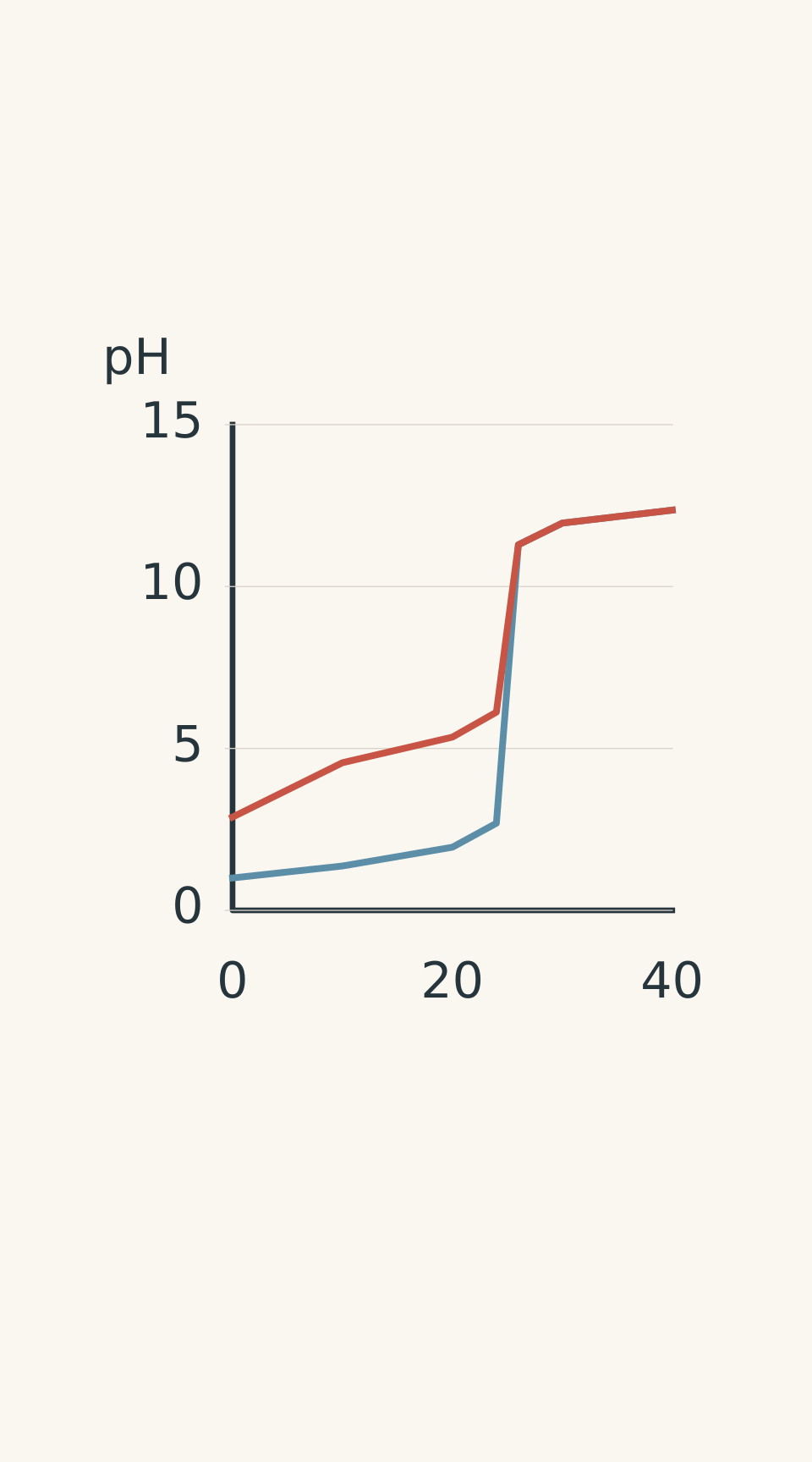
Plot both sets of data on the same set of axes.
Label both axes, include units where appropriate, use a suitable scale, and draw smooth curves through the plotted points. Clearly identify each curve.
(b) (1 mark)
State the equivalence volume for each titration.
(c) (2 marks)
The two titrations have different pH values at the equivalence point.
Explain why the hydrochloric acid titration has a pH of approximately 7.00 at equivalence, while the ethanoic acid titration has a pH above 7.00.
(d) (1 mark)
Identify which titration displays a buffer region before the equivalence point. Give an approximate volume range over which this region is evident in the supplied data.
Question 4 (8 marks)
Buffers in natural systems
(a) (3 marks)
Explain why buffers are important in natural systems. Name one natural buffer system and explain why maintaining a relatively stable pH is important in that system.
(b) (4 marks)
A buffer contains a weak acid, HA, and its conjugate base, \(\mathrm{A}^{-}\).
Write a balanced equation showing how this buffer responds to each of the following additions:
- a small amount of hydronium ions, \(\ce{H3O+}\); (2 marks)
- a small amount of hydroxide ions, \(\mathrm{OH}^{-}\). (2 marks)
For each equation, identify the buffer component that reacts with the added species.
(c) (1 mark)
Explain why adding a small amount of hydrochloric acid to a buffer generally produces a smaller pH change than adding the same amount to pure water.
Question 5 (13 marks)
Preparing and testing a buffer
A student wants to prepare \(100.0\text{ mL}\) of a buffer containing \(0.0500\text{ mol L}^{-1}\) ethanoic acid and \(0.0500\text{ mol L}^{-1}\) ethanoate ions.
The student has access to separate \(0.100\text{ mol L}^{-1}\) stock solutions of ethanoic acid, \(\ce{CH3COOH}\), and sodium ethanoate, \(\ce{CH3COONa}\).
Assume the stock solutions are prepared accurately and their volumes are additive.
(a) (2 marks)
Calculate the volume of each stock solution required to prepare the buffer.
(b) (4 marks)
Describe a practical method to prepare the buffer and test its resistance to pH change when small amounts of acid or base are added.
Your method must include suitable controls and measurements that allow the buffer’s performance to be compared with that of distilled water.
(c) (5 marks)
The student uses separate \(10.0\text{ mL}\) aliquots of the buffer and distilled water. Each aliquot receives either \(0.50\text{ mL}\) of \(0.100\text{ mol L}^{-1}\) hydrochloric acid or \(0.50\text{ mL}\) of \(0.100\text{ mol L}^{-1}\) sodium hydroxide.
The pH readings are shown below. The acid and base tests use separate aliquots.
| Sample | Initial pH | After HCl addition | After NaOH addition |
|---|---|---|---|
| Buffer | 4.74 | 4.65 | 4.83 |
| Distilled water | 7.00 | 2.32 | 11.68 |
Calculate the magnitude of the pH change for each of the four tests:
- buffer after HCl addition;
- buffer after NaOH addition;
- distilled water after HCl addition;
- distilled water after NaOH addition.
Use the results to compare the buffer’s resistance to pH change with that of distilled water.
(d) (2 marks)
Explain why a buffer cannot maintain a nearly constant pH if sufficiently large amounts of acid or base are added.
03Worked solutions and marking guide
Solution 1
(a) Calculate \(pK_a\)
Use the relationship:
\[ pK_a=-\log_{10}(K_a) \]
Substitute the given value:
\[ \begin{aligned} pK_a&=-\log_{10}(2.5\times10^{-5})\\ &=4.602\ldots\\ &=\boxed{4.60} \end{aligned} \]
The \(pK_a\) is dimensionless.
Marking (2 marks):
- Correct logarithmic relationship and substitution: 1 mark.
- Correct answer of \(4.60\): 1 mark.
(b) Calculate \(K_a\)
Rearrange the \(pK_a\) relationship:
\[ K_a=10^{-pK_a} \]
Substitute \(pK_a=3.80\):
\[ \begin{aligned} K_a&=10^{-3.80}\\ &=1.5849\ldots\times10^{-4}\\ &=\boxed{1.6\times10^{-4}} \end{aligned} \]
Marking (2 marks):
- Correct rearrangement and substitution: 1 mark.
- Correct answer to two significant figures: 1 mark.
(c) Rank the acids
The order from strongest to weakest is:
\[ \boxed{\text{P}>\text{Q}>\text{R}} \]
A larger \(K_a\) means a greater extent of acid dissociation at equilibrium. Therefore, acid P is the strongest because it has the largest \(K_a\), while acid R is the weakest because it has the smallest \(K_a\).
Marking (2 marks):
- Correct ranking: 1 mark.
- Explanation linking larger \(K_a\) to greater dissociation and stronger acid behaviour: 1 mark.
(d) Calculate \(K_a\) and \(pK_a\)
For the equilibrium
\[ \ce{HA + H2O <=> H3O+ + A^-} \]
the expression is
\[ K_a=\frac{[\ce{H3O+}][\mathrm{A}^{-}]}{[\ce{HA}]} \]
Substitute the equilibrium concentrations:
\[ \begin{aligned} K_a&=\frac{(1.20\times10^{-3})(1.20\times10^{-3})} {9.88\times10^{-2}}\\[4pt] &=\frac{1.44\times10^{-6}}{9.88\times10^{-2}}\\[4pt] &=\boxed{1.46\times10^{-5}} \end{aligned} \]
Now calculate \(pK_a\):
\[ \begin{aligned} pK_a&=-\log_{10}(1.46\times10^{-5})\\ &=\boxed{4.84} \end{aligned} \]
Marking (3 marks):
- Correct expression and substitution: 1 mark.
- Correct \(K_a\): 1 mark.
- Correct \(pK_a\): 1 mark.
Solution 2
(a) Strong acid-strong base neutralisation
The balanced net ionic equation is
\[ \boxed{\ce{H3O+ + OH^- -> 2H2O}} \]
Hydronium ions react with hydroxide ions to form water. Sodium and chloride ions are omitted because they do not participate in the net ionic reaction.
Marking (2 marks):
- Correct reacting ions and product: 1 mark.
- Correctly balanced equation: 1 mark.
(b) Ethanoic acid neutralisation
The balanced net ionic equation is
\[ \boxed{\ce{CH3COOH + OH^- -> CH3COO^- + H2O}} \]
Ethanoic acid is a weak acid, so it only partially ionises in water. Most of the acid remains as \(\ce{CH3COOH}\) molecules rather than existing as fully dissociated ions.
When hydroxide ions are added, they react with the acid molecules, removing a proton and producing ethanoate ions and water.
Marking (3 marks):
- Correct reactants and products: 1 mark.
- Correctly balanced equation: 1 mark.
- Explanation that ethanoic acid is only partially ionised and is represented mainly as molecules: 1 mark.
(c) Ammonia neutralisation
The balanced net ionic equation is
\[ \boxed{\ce{NH3 + H3O+ -> NH4+ + H2O}} \]
Ammonia is a weak base because it accepts a proton from hydronium ions to form ammonium ions.
Marking (2 marks):
- Correct balanced net ionic equation: 1 mark.
- Correctly identifies ammonia as a weak base: 1 mark.
(d) Final particle models
Mixture A contains equal amounts of hydronium and hydroxide ions. They react completely to form water. With water omitted from the drawing, the final mixture contains:
- Six \(\mathrm{Na}^{+}\) ions.
- Six \(\mathrm{Cl}^{-}\) ions.
There are no remaining hydronium or hydroxide ions under the stated assumptions. Both sodium and chloride ions are spectator ions in this mixture.
Mixture B contains equal amounts of ethanoic acid and hydroxide ions. They react to form ethanoate ions and water. With water omitted, the final mixture contains:
- Six \(\mathrm{Na}^{+}\) ions.
- Six \(\mathrm{CH_{3}COO}^{-}\) ions.
The ethanoate ions are products of the reaction, not spectator ions. Sodium ions remain unchanged throughout the reaction.
Marking (5 marks):
- Mixture A: correct identities and counts of six \(\mathrm{Na}^{+}\) and six \(\mathrm{Cl}^{-}\) ions: 2 marks.
- Mixture B: correct identities and counts of six \(\mathrm{Na}^{+}\) and six \(\mathrm{CH_{3}COO}^{-}\) ions: 2 marks.
- Correctly identifies \(\mathrm{Na}^{+}\) and \(\mathrm{Cl}^{-}\) as spectator ions in mixture A: 1 mark.
Award the particle-model marks for equivalent, clearly labelled drawings that show the correct species and particle counts.
Solution 3
(a) Plot the titration curves
The graph should show pH on the vertical axis and the volume of sodium hydroxide added, in mL, on the horizontal axis. Both data sets should appear on the same axes.
- HCl
- CH₃COOH
The hydrochloric acid curve begins at pH 1.00. The ethanoic acid curve begins at pH 2.88. Both curves rise sharply near \(25.0\text{ mL}\), after which the pH values become similar as excess hydroxide ions dominate the solution.
Marking (4 marks):
- Correctly labelled axes, units, and sensible scales: 1 mark.
- Accurate plotting of the supplied points: 1 mark.
- Appropriate smooth curves following the data: 1 mark.
- Both curves clearly identified: 1 mark.
(b) Equivalence volume
Both titrations have an equivalence volume of
\[ \boxed{25.0\text{ mL}} \]
Each sample initially contains
\[ \begin{aligned} n(\text{acid})&=cV\\ &=0.100\times0.0250\\ &=2.50\times10^{-3}\text{ mol} \end{aligned} \]
Because the sodium hydroxide concentration is also \(0.100\text{ mol L}^{-1}\), \(25.0\text{ mL}\) of sodium hydroxide supplies the same number of moles.
Marking (1 mark):
- Correct equivalence volume of \(25.0\text{ mL}\) for both titrations: 1 mark.
(c) Different pH values at equivalence
For the hydrochloric acid titration, the acid and base have reacted in equal amounts. The remaining dissolved salt is sodium chloride. Its ions do not appreciably react with water, so the solution has a pH of approximately 7.00 at \(25^\circ\text{C}\).
For the ethanoic acid titration, the solution contains ethanoate ions. These ions react with water in a hydrolysis equilibrium:
\[ \ce{CH3COO^- + H2O <=> CH3COOH + OH^-} \]
The production of hydroxide ions makes the solution basic, so its pH is above 7.00 at equivalence.
Marking (2 marks):
- Explains why the strong acid-strong base equivalence solution is approximately neutral: 1 mark.
- Explains that ethanoate ions react with water to produce hydroxide ions: 1 mark.
(d) Buffer region
The ethanoic acid titration shows a buffer region, approximately from \(10\text{ mL}\) to \(24\text{ mL}\) of sodium hydroxide added.
During this region, both ethanoic acid and ethanoate ions are present in appreciable amounts.
Marking (1 mark):
- Identifies the ethanoic acid curve and a reasonable pre-equivalence range: 1 mark.
Solution 4
(a) Buffers in natural systems
Buffers reduce the size of pH changes when small amounts of acid or base enter a system. They do not prevent all change, but they help maintain pH within a relatively narrow range.
One example is the carbonic acid-hydrogencarbonate buffer system in blood. Maintaining a stable pH supports normal enzyme activity and helps preserve the structure and function of proteins.
Marking (3 marks):
- Explains that buffers resist pH changes: 1 mark.
- Names a valid natural buffer system: 1 mark.
- Connects stable pH with biological function: 1 mark.
(b) How a buffer responds to added acid or base
For a buffer containing HA and \(\mathrm{A}^{-}\), the response to added hydronium ions is
\[ \boxed{\ce{A^- + H3O+ -> HA + H2O}} \]
The conjugate base, \(\mathrm{A}^{-}\), reacts with the added hydronium ions, converting them into the weak acid HA.
When hydroxide ions are added, the reaction is
\[ \boxed{\ce{HA + OH^- -> A^- + H2O}} \]
The weak acid HA reacts with the added hydroxide ions, forming its conjugate base and water.
These reactions remove much of the added acid or base before it can cause a large pH change.
How a buffer resists pH change
| Added acid | H₃O⁺ + HCO₃⁻ → H₂CO₃ + H₂O HCO₃⁻ consumes added H₃O⁺. |
|---|---|
| Added base | OH⁻ + H₂CO₃ → HCO₃⁻ + H₂O H₂CO₃ consumes added OH⁻. |
Marking (4 marks):
- Correct equation for added hydronium ions: 1 mark.
- Identifies \(\mathrm{A}^{-}\) as the component that consumes the added acid: 1 mark.
- Correct equation for added hydroxide ions: 1 mark.
- Identifies HA as the component that consumes the added base: 1 mark.
(c) Buffer compared with pure water
A buffer contains a conjugate acid-base pair that can react with added acid. Pure water does not contain comparable amounts of these buffer components, so the added hydronium ions cause a much larger pH change.
Marking (1 mark):
- Correctly explains that the buffer consumes added acid and therefore limits the pH change: 1 mark.
Solution 5
(a) Calculate the volumes of stock solutions
The target concentration of each buffer component is \(0.0500\text{ mol L}^{-1}\), and the final solution volume is \(100.0\text{ mL}\).
Use the dilution relationship
\[ C_1V_1=C_2V_2 \]
For ethanoic acid:
\[ \begin{aligned} V_1&=\frac{C_2V_2}{C_1}\\ &=\frac{0.0500\times100.0}{0.100}\\ &=\boxed{50.0\text{ mL}} \end{aligned} \]
The sodium ethanoate stock has the same concentration and the target ethanoate concentration is also \(0.0500\text{ mol L}^{-1}\). Therefore, the required volume is also \(50.0\text{ mL}\).
The student should combine \(50.0\text{ mL}\) of each stock solution to prepare \(100.0\text{ mL}\) of buffer.
Marking (2 marks):
- Correctly calculates the ethanoic acid volume: 1 mark.
- Correctly calculates the sodium ethanoate volume: 1 mark.
(b) Prepare and test the buffer
A suitable method is:
- Measure \(50.0\text{ mL}\) of the ethanoic acid stock and \(50.0\text{ mL}\) of the sodium ethanoate stock. Mix them thoroughly to prepare the buffer.
- Prepare separate \(10.0\text{ mL}\) aliquots of the buffer for the acid and base tests. Prepare matching \(10.0\text{ mL}\) distilled-water controls.
- Measure and record the initial pH of each sample using a calibrated pH probe. Add \(0.50\text{ mL}\) of \(0.100\text{ mol L}^{-1}\) HCl to the acid-test samples and \(0.50\text{ mL}\) of \(0.100\text{ mol L}^{-1}\) NaOH to the separate base-test samples. Mix each sample and measure its final pH.
- Keep the sample volumes, titrant concentrations, and temperature consistent. Rinse the probe between samples, then compare the magnitude of the pH changes for the buffer and distilled water.
Using separate aliquots prevents the acid addition from affecting the subsequent base test, or vice versa. The distilled-water samples provide a control for comparison.
Marking (4 marks):
- Correct preparation using the calculated stock volumes: 1 mark.
- Uses separate buffer aliquots and matching distilled-water controls: 1 mark.
- Measures initial and final pH after measured acid or base additions: 1 mark.
- Controls relevant conditions and compares pH changes fairly: 1 mark.
(c) Calculate the pH changes
Calculate the magnitude of each change using
\[ |\Delta pH|=|pH_{\text{final}}-pH_{\text{initial}}| \]
For the buffer after HCl addition:
\[ |\Delta pH|=|4.65-4.74|=\boxed{0.09} \]
For the buffer after NaOH addition:
\[ |\Delta pH|=|4.83-4.74|=\boxed{0.09} \]
For distilled water after HCl addition:
\[ |\Delta pH|=|2.32-7.00|=\boxed{4.68} \]
For distilled water after NaOH addition:
\[ |\Delta pH|=|11.68-7.00|=\boxed{4.68} \]
The buffer experiences a pH change of only 0.09 in each test, compared with a change of 4.68 in distilled water. The buffer therefore resists pH changes much more effectively under these conditions.
Marking (5 marks):
- Correct buffer pH change after HCl addition: 1 mark.
- Correct buffer pH change after NaOH addition: 1 mark.
- Correct distilled-water pH change after HCl addition: 1 mark.
- Correct distilled-water pH change after NaOH addition: 1 mark.
- Correct comparison concluding that the buffer resists pH change much more effectively: 1 mark.
(d) Why buffer capacity is limited
A buffer contains finite amounts of its weak acid and conjugate base. Added acid consumes the conjugate base, while added base consumes the weak acid.
If enough acid or base is added, one of these components becomes largely depleted. Further additions can no longer be neutralised effectively, so the pH begins to change much more sharply.
Marking (2 marks):
- Identifies the finite amounts of the weak acid and conjugate base: 1 mark.
- Explains that depletion limits neutralisation and allows larger pH changes: 1 mark.
General marking guidance: Accept mathematically equivalent methods, correctly balanced equivalent equations, and particle models that preserve the correct species, charges, and particle counts. Allow reasonable rounding differences in logarithmic calculations. Award follow-through marks where a student carries an earlier numerical error consistently and the subsequent method is correct.