
Atomic Models and Particle Discovery: Focused Physics Practice Exam
Test your understanding of atomic-model and particle-discovery experiments with this original 40-mark tutorgum practice paper. Includes timed exam conditions, original questions, fully worked solutions, and a detailed marking guide.
This original tutorgum practice paper tests four connected areas of the Physics 2017 syllabus scope: the Geiger-Marsden alpha-scattering experiment, Rutherford’s nuclear atomic model, Millikan’s oil-drop experiment, and Chadwick’s discovery of the neutron. It focuses on interpreting experimental evidence, using conservation arguments, and evaluating what scientific models explain and what they leave unresolved.
This is a focused topic paper, not a full-course examination. It is an original tutorgum practice resource, not an official, endorsed, past, or predicted NESA paper.
01Exam instructions
Suggested reading time: 5 minutes
Working time: 50 minutes
Total marks: 40
Permitted equipment: Scientific calculator, ruler, and writing materials. Complete the paper without notes or internet access.
These are suggested practice conditions, not official NESA examination rules.
Assessed scope
The paper assesses:
- Geiger-Marsden experiment: interpreting alpha-particle scattering evidence.
- Rutherford’s nuclear model: its structure, successes, and unresolved problems.
- Millikan’s oil-drop experiment: determining elementary charge and explaining how electron mass was calculated.
- Chadwick’s neutron discovery: interpreting evidence for neutral nuclear particles using conservation of energy and momentum.
Later quantum atomic models, radioactivity, and material from other syllabus editions are excluded. Nuclear reaction details appear only where needed to understand Chadwick’s experiment.
How to answer
- Attempt every question.
- Show your working for calculations, including substitutions and units.
- Give explanations that connect an observation to the conclusion it supports.
- Distinguish what an experiment directly measures from what scientists infer from the results.
- Give numerical answers to three significant figures unless otherwise indicated.
- The numerical datasets are original illustrative data for this practice paper, not historical experimental measurements.
02Questions
Question 1 (10 marks)
A beam of alpha particles is directed at a very thin sheet of gold foil. A detector records the magnitude of each particle’s deflection from its original direction.
The following illustrative data show the number of detected particles in each angular interval.
| Deflection angle | Number of particles |
|---|---|
| \(0^\circ\) to \(1^\circ\) | 99,700 |
| Greater than \(1^\circ\) to \(10^\circ\) | 290 |
| Greater than \(10^\circ\) to \(90^\circ\) | 9 |
| Greater than \(90^\circ\) | 1 |
| Total | 100,000 |
(a) State two patterns evident in the scattering data. (2 marks)
(b) Explain what the dominant scattering pattern suggests about the internal structure of an atom. (2 marks)
(c) Explain what the rare large-angle deflections, including the single deflection greater than \(90^\circ\), suggest about the distribution of positive charge and mass within an atom. (3 marks)
(d) A student argues that the nucleus must occupy most of the atom because one alpha particle was deflected through an angle greater than \(90^\circ\). Evaluate this conclusion using the experimental data. (3 marks)
Question 2 (10 marks)
Millikan’s oil-drop experiment allowed scientists to determine the charge carried by individual oil droplets. Repeated measurements produced the following charge magnitudes.
| Oil droplet | Measured charge magnitude |
|---|---|
| A | \(1.60 \times 10^{-19}\ \mathrm{C}\) |
| B | \(3.20 \times 10^{-19}\ \mathrm{C}\) |
| C | \(4.80 \times 10^{-19}\ \mathrm{C}\) |
| D | \(6.40 \times 10^{-19}\ \mathrm{C}\) |
| E | \(8.00 \times 10^{-19}\ \mathrm{C}\) |
(a) Identify the common charge increment indicated by the data. Express each droplet’s charge magnitude as a multiple of this increment. (2 marks)
(b) Describe how Millikan could determine the charge on an individual oil droplet. Explain how measurements across many droplets provide evidence that electric charge is quantised. (3 marks)
(c) A separate cathode-ray experiment measured the magnitude of the electron’s charge-to-mass ratio as
\[ \frac{|e|}{m_e} =1.76\times10^{11}\ \mathrm{C\,kg^{-1}}. \]
Using your answer to part (a), calculate the electron’s mass, \(m_e\), to three significant figures. (3 marks)
(d) A report states that Millikan directly measured the mass of a single electron using his oil-drop experiment. Explain why this statement is inaccurate. (2 marks)
Question 3 (10 marks)
James Chadwick investigated the neutral radiation produced when alpha particles struck a beryllium target. The radiation showed no measurable deflection in electric or magnetic fields. When it struck paraffin, which contains many hydrogen nuclei, energetic protons were ejected.
In one simplified set of observations, the ejected protons had kinetic energies of up to \(5.0\ \mathrm{MeV}\).
A proposed explanation was that the radiation consisted of gamma-ray photons. For this question, assume that the energy available to a hypothetical photon is no greater than \(11\ \mathrm{MeV}\).
For a photon striking a stationary proton, the maximum possible proton recoil kinetic energy is given by
\[ K_{\max} =\frac{2E_\gamma^2} {m_pc^2+2E_\gamma}, \]
where:
- \(K_{\max}\) is the maximum proton recoil kinetic energy, in MeV.
- \(E_\gamma\) is the photon energy, in MeV.
- \(m_pc^2=938\ \mathrm{MeV}\) is the proton’s rest energy.
(a) Explain what the absence of deflection in electric and magnetic fields supports about the radiation. State one conclusion that cannot be established from this observation alone. (2 marks)
(b) Calculate the maximum proton recoil kinetic energy possible if the radiation consisted of photons with energy no greater than \(11\ \mathrm{MeV}\). (3 marks)
(c) Use your result and the principle of conservation of energy to evaluate the gamma-ray explanation for the observed proton recoil. (2 marks)
(d) Explain how the neutron hypothesis accounts for the observations. Include the relevant properties of the neutron and the significance of the proton recoil. (3 marks)
Question 4 (10 marks)
Rutherford’s nuclear atomic model developed from the evidence gathered by Geiger and Marsden. Although the model explained important experimental observations, it did not resolve every problem concerning atomic structure.
(a) State three key features of Rutherford’s nuclear atomic model. (3 marks)
(b) Explain why Rutherford’s model accounts for the Geiger-Marsden scattering evidence better than Thomson’s plum-pudding model. (3 marks)
(c) According to classical physics, explain why Rutherford’s model struggles to account for the stability of atoms. (2 marks)
(d) Identify another important observation about atoms that Rutherford’s model could not adequately explain. Explain the limitation. (2 marks)
03Worked solutions and marking guide
Solution 1
(a) Two patterns in the scattering data (2 marks)
Almost all alpha particles experienced very little deflection: \(99{,}700\) out of \(100{,}000\) were deflected by no more than \(1^\circ\).
Large-angle deflections were rare. Only 10 particles were deflected through more than \(10^\circ\), and just one was deflected through more than \(90^\circ\).
Marking guide:
- 1 mark for identifying that almost all particles experienced very small deflections.
- 1 mark for identifying the rarity of large-angle deflections or backscattering.
(b) What the dominant pattern suggests (2 marks)
Most alpha particles passed through the gold foil with almost no change in direction. This suggests that most of an atom’s volume is empty space, with relatively little concentrated matter or charge encountered by a typical alpha particle.
Marking guide:
- 1 mark for stating that most of the atom is empty space.
- 1 mark for linking this conclusion to the predominance of particles passing through with little deflection.
(c) What rare large-angle deflections suggest (3 marks)
Alpha particles are positively charged. A large deflection occurs when an alpha particle passes close to a concentrated region of positive charge and experiences strong electrostatic repulsion.
The rarity of these events indicates that this region occupies a very small part of the atom. The possibility of an alpha particle reversing direction also supports the existence of a dense, massive nucleus that can exert a strong repulsive force without being displaced substantially.
Marking guide:
- 1 mark for identifying a small, concentrated region.
- 1 mark for explaining the strong repulsion between positive charges.
- 1 mark for linking backscattering to a dense nucleus containing most of the atom’s mass.
(d) Evaluating the student’s conclusion (3 marks)
The conclusion is not supported by the data. Only one particle out of \(100{,}000\) was deflected through more than \(90^\circ\). If the nucleus occupied most of the atom, close interactions with it would not be expected to be so rare.
The evidence instead supports a nucleus that is very small but capable of exerting a strong force when an alpha particle passes close to it. The strength of an interaction does not tell us that the interacting region occupies a large volume.
Marking guide:
- 1 mark for using the rarity of backscattering as evidence.
- 1 mark for explaining that a small nucleus can still produce strong deflections.
- 1 mark for rejecting the claim that the nucleus occupies most of the atom.
Solution 2
(a) Common charge increment (2 marks)
The common increment is
\[ |e|=1.60\times10^{-19}\ \mathrm{C}. \]
The measured charge magnitudes are consistent with the following multiples:
| Oil droplet | Multiple of the common increment |
|---|---|
| A | \(1|e|\) |
| B | \(2|e|\) |
| C | \(3|e|\) |
| D | \(4|e|\) |
| E | \(5|e|\) |
The data support a smallest common unit of charge of \(1.60\times10^{-19}\ \mathrm{C}\), assuming the droplets carry integer multiples of the elementary charge.
Marking guide:
- 1 mark for identifying the common increment as \(1.60\times10^{-19}\ \mathrm{C}\).
- 1 mark for expressing the measured charges as the integer multiples \(1, 2, 3, 4,\) and \(5\).
(b) How the oil-drop experiment worked (3 marks)
Millikan measured the motion of charged oil droplets under gravity and in an applied electric field. By adjusting the electric field until a droplet was suspended, he could balance the electric force against the droplet’s effective weight, accounting for buoyancy.
For a suspended droplet, the simplified force balance is
\[ |q|E=W_{\mathrm{eff}}, \]
where \(|q|\) is the magnitude of the droplet’s charge, \(E\) is the electric field strength, and \(W_{\mathrm{eff}}\) is its effective weight. If the voltage across the plates is \(V\) and their separation is \(d\), the field strength is \(E=V/d\). These measurements allow the droplet’s charge magnitude to be calculated.
Repeating the measurements for many droplets showed that their charges were consistent with integer multiples of a common unit. This is evidence that electric charge is quantised: it occurs in discrete units rather than arbitrary continuous amounts.
How the oil-drop experiment reveals quantised charge
- Measure droplet motion
Track a charged oil drop as it moves under gravity.
Use its motion to determine the information needed to calculate its effective weight.
- Apply an electric field
Apply a voltage and adjust the field acting on the drop.
Field strength: E = V/d
- Balance forces and calculate charge
Adjust the field until the drop is suspended.
Electric force balances effective weight: |q|E = W_eff
Calculate the charge magnitude: |q| = W_eff/E
- Compare many droplets
Calculate the charge magnitude for each drop.
The charges are consistent with integer multiples of a common unit, revealing charge quantisation.
Marking guide:
- 1 mark for describing the use of an electric field and force balance to determine droplet charge.
- 1 mark for explaining how field strength and effective weight allow the charge to be calculated.
- 1 mark for linking repeated integer multiples to quantisation and the elementary charge.
(c) Calculating the electron’s mass (3 marks)
The electron’s mass is calculated by dividing the magnitude of its charge by the magnitude of its charge-to-mass ratio.
\[ \begin{aligned} m_e &=\frac{|e|}{|e|/m_e}\\[4pt] &=\frac{1.60\times10^{-19}\ \mathrm{C}} {1.76\times10^{11}\ \mathrm{C\,kg^{-1}}}\\[4pt] &=9.09\times10^{-31}\ \mathrm{kg}. \end{aligned} \]
The electron’s mass is therefore \(9.09\times10^{-31}\ \mathrm{kg}\), to three significant figures.
Notice that the coulomb units cancel, leaving kilograms.
Marking guide:
- 1 mark for rearranging the charge-to-mass relationship correctly.
- 1 mark for correct substitution and calculation.
- 1 mark for the correct mass, units, and three significant figures.
Follow-through marks should be awarded for a correct method using a student’s earlier numerical answer, provided the method is otherwise valid.
(d) What Millikan actually measured (2 marks)
Millikan’s oil-drop experiment determined the charge carried by individual oil droplets and provided a value for the elementary charge. It did not directly measure the mass of an electron.
The electron’s mass was calculated by combining the elementary charge obtained from Millikan’s work with an independently measured electron charge-to-mass ratio from cathode-ray experiments.
Marking guide:
- 1 mark for distinguishing the measured droplet charges from a direct measurement of electron mass.
- 1 mark for explaining that electron mass was calculated using the charge and an independently measured charge-to-mass ratio.
Solution 3
(a) Evidence from the field tests (2 marks)
The absence of measurable deflection in electric and magnetic fields supports the conclusion that the radiation carries no detectable electric charge.
However, this observation alone cannot establish that the radiation consists of neutrons. Gamma-ray photons are also electrically neutral, so further evidence is needed to distinguish the two explanations.
Marking guide:
- 1 mark for identifying the evidence for neutral radiation.
- 1 mark for explaining that neutrality alone does not establish the particle’s identity or mass.
(b) Maximum proton recoil energy (3 marks)
The maximum permitted photon energy is \(11\ \mathrm{MeV}\). Substituting this value into the supplied relationship gives
\[ \begin{aligned} K_{\max} &=\frac{2E_\gamma^2}{m_pc^2+2E_\gamma}\\[4pt] &=\frac{2(11)^2}{938+2(11)}\ \mathrm{MeV}\\[4pt] &=\frac{242}{960}\ \mathrm{MeV}\\[4pt] &=0.252\ \mathrm{MeV}. \end{aligned} \]
The maximum possible proton recoil kinetic energy under the photon hypothesis is therefore \(0.252\ \mathrm{MeV}\), to three significant figures.
Marking guide:
- 1 mark for correct substitution of the photon energy and proton rest energy.
- 1 mark for correct arithmetic.
- 1 mark for the answer with appropriate units and precision.
(c) Evaluating the gamma-ray explanation (2 marks)
The observed proton recoil energy reaches \(5.0\ \mathrm{MeV}\), whereas the photon model permits a maximum of only \(0.252\ \mathrm{MeV}\) under the stated conditions.
The photon explanation cannot account for the observed recoil while respecting the available energy and conservation laws. The discrepancy supports the rejection of the proposed gamma-ray explanation.
Marking guide:
- 1 mark for comparing the calculated maximum with the observed \(5.0\ \mathrm{MeV}\).
- 1 mark for explaining that the photon hypothesis is inconsistent with the energy available and conservation requirements.
(d) How the neutron hypothesis explains the evidence (3 marks)
A neutron has no electric charge, so it is not deflected by electric or magnetic fields in the way a charged particle would be.
It also has a mass close to that of a proton. A neutron colliding with a proton can therefore transfer substantial momentum and kinetic energy to it. This explains why energetic protons are ejected from paraffin without requiring an impossibly energetic gamma ray.
The recoil evidence supports the existence of a neutral particle with a mass comparable to the proton’s mass. Chadwick interpreted the observations as evidence for the neutron, a neutral nuclear particle.
Chadwick’s neutron discovery: testing the photon model
- 01 · Bombard beryllium
Alpha particles strike a beryllium target.
Neutral, penetrating radiation is produced.
- 02 · Detect neutral radiation
The radiation travels onward without behaving like a stream of charged particles.
Its identity is investigated through collisions with matter.
- 03 · Observe proton recoil
The radiation strikes hydrogen-rich paraffin.
Protons recoil with substantial kinetic energy.
- 04 · Test the photon model
Observed proton recoil: 5.0 MeV
Photon-model maximum: 0.252 MeV
The observed energy greatly exceeds the photon prediction, supporting the neutron hypothesis.
Marking guide:
- 1 mark for identifying the neutron’s lack of electric charge.
- 1 mark for identifying its mass as comparable to the proton’s mass.
- 1 mark for explaining how collisions transfer energy and momentum to the recoiling protons.
Solution 4
(a) Features of Rutherford’s nuclear model (3 marks)
Rutherford’s nuclear model proposed that:
- The atom contains a very small, positively charged nucleus.
- Most of the atom’s mass is concentrated in this nucleus.
- Electrons occupy the region outside the nucleus, meaning most of the atom’s volume is empty space.
Marking guide:
- 1 mark for identifying the small, positively charged nucleus.
- 1 mark for locating most of the atom’s mass in the nucleus.
- 1 mark for identifying electrons outside the nucleus and the predominantly empty volume of the atom.
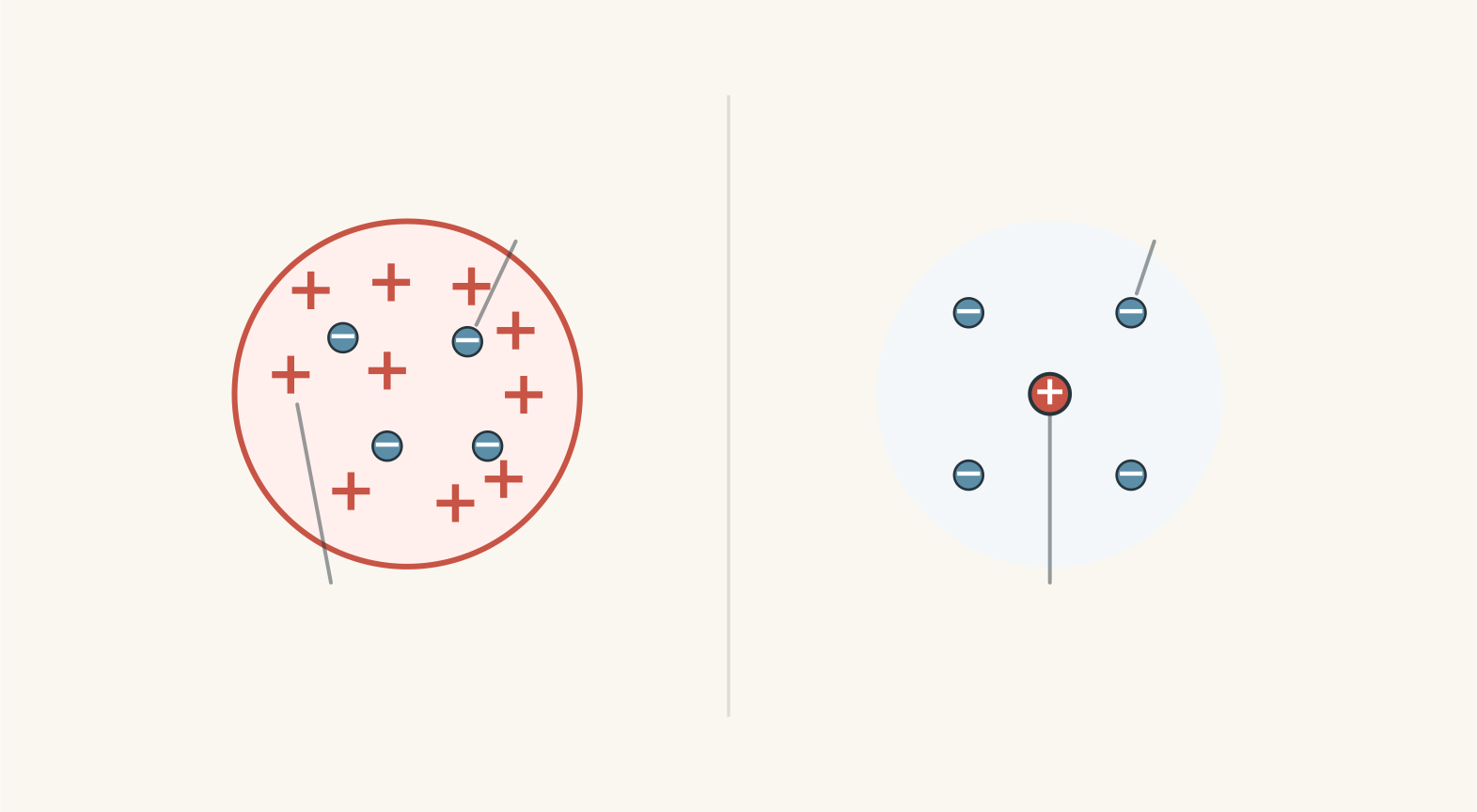
(b) Why Rutherford’s model fits the scattering evidence better (3 marks)
Rutherford’s model explains why most alpha particles passed through the foil with little deflection: most of the atom is empty space.
It also explains the rare large-angle deflections. A positively charged alpha particle approaching the small, positively charged nucleus experiences strong electrostatic repulsion, which can change its direction substantially.
Thomson’s plum-pudding model distributed positive charge throughout the atom, with electrons embedded in it. This model did not adequately explain the rare, very large deflections or backscattering. Rutherford’s model accounted for those observations by proposing a concentrated nucleus.
Marking guide:
- 1 mark for linking the predominance of small deflections to the atom’s mostly empty volume.
- 1 mark for linking large-angle scattering to strong repulsion from the concentrated positive nucleus.
- 1 mark for explaining why the evidence favoured Rutherford’s model over Thomson’s model.
(c) The stability problem (2 marks)
According to classical electrodynamics, an electron moving in an orbit is accelerating because its direction of motion continually changes. An accelerating electric charge should emit electromagnetic radiation and lose energy.
The electron would consequently lose orbital energy and spiral towards the nucleus. Rutherford’s model therefore struggled to explain why atoms are stable.
Marking guide:
- 1 mark for explaining that an accelerating electron should radiate energy.
- 1 mark for explaining that the resulting energy loss would cause the electron to spiral into the nucleus, contradicting atomic stability.
(d) The problem of atomic line spectra (2 marks)
Atoms emit and absorb light at particular discrete frequencies, producing characteristic line spectra. Rutherford’s model did not explain why only certain frequencies occur.
The model provided no satisfactory account of quantised electron energies or why electrons could occupy only particular allowed energy states. This was an important unresolved problem for the nuclear model.
Marking guide:
- 1 mark for identifying the discrete frequencies observed in atomic line spectra.
- 1 mark for explaining that Rutherford’s model could not account for the allowed energy states responsible for those discrete frequencies.