
Year 11 Chemistry Quantitative Chemistry: 100-Mark Practice Exam
Revise the Year 11 Chemistry quantitative chemistry module with this original 100-mark tutorgum practice exam. Test your calculations, chemical reasoning, and problem-solving across the supplied 2025-syllabus content, then check your work with complete worked solutions and a marking guide.
This is an original tutorgum practice paper for Year 11 Chemistry, covering the supplied 2025-syllabus quantitative chemistry content. It is a focused module revision exam, not a full-course examination, and it is not an official, endorsed, past, or predicted NESA paper.
01Exam instructions
- Suggested working time: 120 minutes.
- Suggested reading time: 5 minutes.
- Total marks: 100.
- Permitted equipment: Scientific calculator, pen, pencil, and ruler. You may use a periodic table, although the relative atomic masses needed for this paper are provided below.
- Show your working, include units, and give numerical answers to three significant figures unless an exact ratio or formula is required.
- Use the smallest whole-number coefficients when balancing chemical equations.
- These are the conditions for this practice paper, not claims about official examination rules.
Assessed content
This paper covers the supplied quantitative chemistry scope: the mole and Avogadro constant; molar mass and mass-mole calculations; balancing equations and interpreting mole ratios; percentage composition and empirical formulae; limiting reagents and theoretical yields; conservation of mass and open and closed systems; mass relationships in reactions; solution concentration units, molarity, standard solutions, and dilution; plant extraction and chemical delivery; the Ideal Gas Law and other gas-law relationships; and gas stoichiometry and gas-volume ratios.
Content from other syllabus editions, other Chemistry modules, and topics outside the supplied scope is excluded. This paper does not assess the entire Year 11 Chemistry course.
Data and constants
Use the following relative atomic masses, \(A_r\):
| Element | \(A_r\) | Element | \(A_r\) |
|---|---|---|---|
| H | 1.01 | C | 12.0 |
| N | 14.0 | O | 16.0 |
| Na | 23.0 | Mg | 24.3 |
| Al | 27.0 | S | 32.1 |
| Cl | 35.5 | Ca | 40.1 |
Avogadro constant:
\[ N_A = 6.022 \times 10^{23}\ \mathrm{mol^{-1}} \]
Ideal gas constant:
\[ R = 8.31\ \mathrm{kPa\,L\,mol^{-1}\,K^{-1}} \]
Useful symbols:
- \(n\): amount of substance, in mol
- \(m\): mass, in g
- \(M\): molar mass, in \(\mathrm{g\,mol^{-1}}\)
- \(c\): amount concentration, in \(\mathrm{mol\,L^{-1}}\)
- \(V\): volume
- \(P\): pressure
- \(T\): absolute temperature, in K
For gas calculations using the supplied \(R\), express volume in litres, pressure in kilopascals, and temperature in kelvin. Assume ideal gas behaviour unless stated otherwise.
02Questions
Question 1 (10 marks)
Moles, molar mass, and particles
Aluminium sulfate has the formula \(\ce{Al2(SO4)3}\).
(a) Calculate its molar mass. (2 marks)
(b) Calculate the amount of aluminium sulfate in an \(8.56\ \mathrm{g}\) sample. (2 marks)
(c) Calculate the number of formula units in this sample. (2 marks)
(d) Calculate the amount, in moles, of oxygen atoms present in the sample. (2 marks)
(e) Calculate the mass of aluminium present in the sample. (2 marks)
Question 2 (10 marks)
Chemical equations and composition
(a) Balance the following equation using the smallest whole-number coefficients:
\[ \ce{C3H8 + O2 -> CO2 + H2O} \]
(2 marks)
(b) A compound contains \(40.0\%\) carbon, \(6.70\%\) hydrogen, and \(53.3\%\) oxygen by mass.
Determine its empirical formula. Show your mole calculations and the simplest whole-number ratio. (4 marks)
(c) Calculate the percentage by mass of oxygen in magnesium nitrate, \(\ce{Mg(NO3)2}\). (2 marks)
(d) Using your balanced equation from part (a), state the mole ratio of propane to carbon dioxide. Explain what this ratio means in terms of the amounts of substances reacting and forming. (2 marks)
Question 3 (12 marks)
Limiting reagents and reaction masses
Aluminium reacts with chlorine according to the balanced equation:
\[ \ce{2Al(s) + 3Cl2(g) -> 2AlCl3(s)} \]
A reaction mixture contains \(5.40\ \mathrm{g}\) of aluminium and \(10.65\ \mathrm{g}\) of chlorine gas.
(a) Calculate the amount, in moles, of each reactant initially present. (3 marks)
(b) Identify the limiting reagent. Justify your answer using the mole ratio in the balanced equation. (2 marks)
(c) Calculate the theoretical mass of aluminium chloride that can form. (3 marks)
(d) Calculate the mass of aluminium remaining after the reaction is complete. (2 marks)
(e) Check the law of conservation of mass by comparing the total initial mass of the reactants with the total final mass of the products and any excess reactant. (2 marks)
Question 4 (10 marks)
Open and closed systems
Sodium hydrogen carbonate reacts with ethanoic acid to produce carbon dioxide:
\[ \ce{NaHCO3(aq) + CH3COOH(aq) -> CH3COONa(aq) + H2O(l) + CO2(g)} \]
The same reaction is performed in two different setups, X and Y. The total mass of each reaction container and its contents is measured immediately before and after the reaction.
Assume that carbon dioxide is the only substance that can leave either setup. No liquid splashes out, and no solvent evaporates.
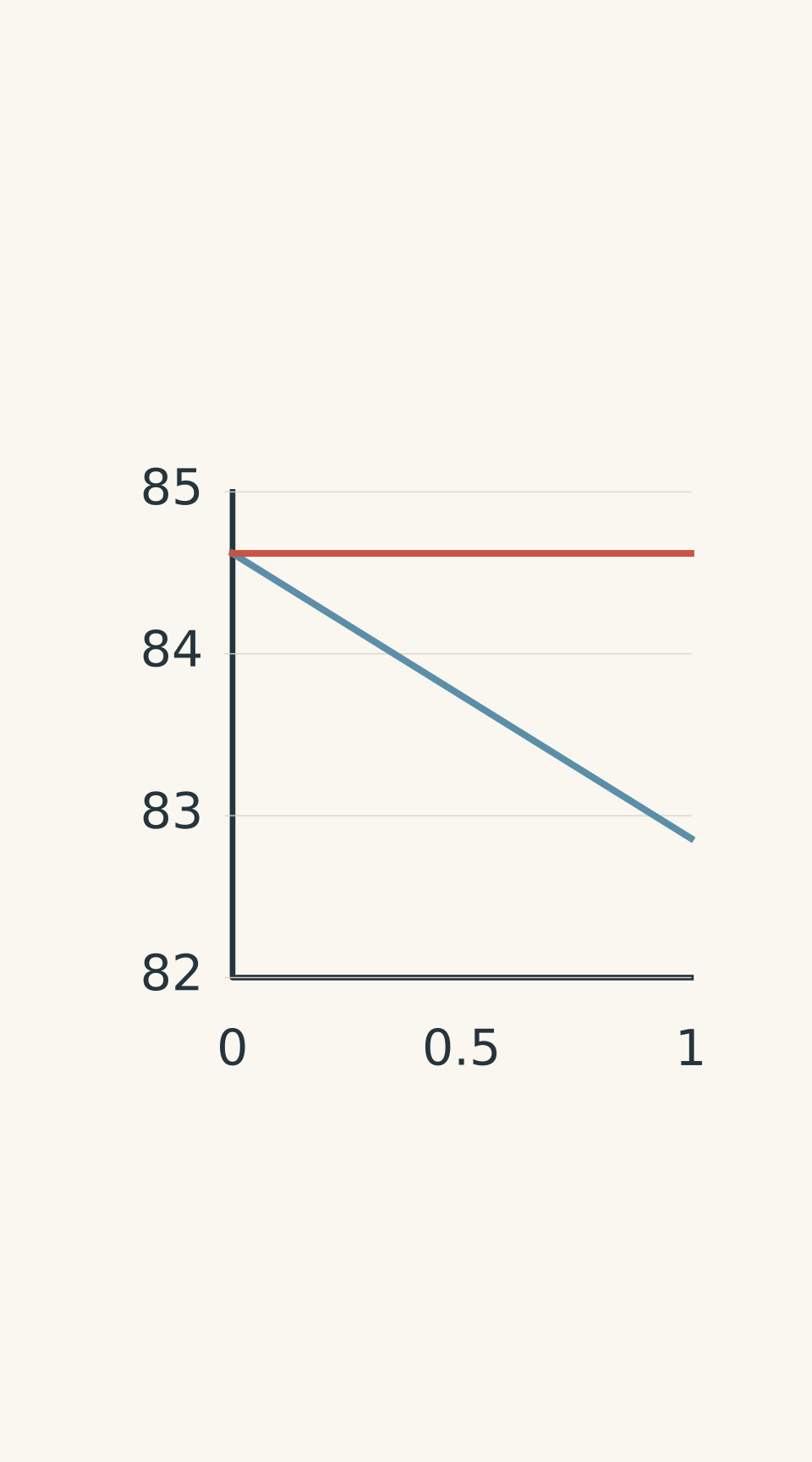
| Setup | Mass before reaction (g) | Mass after reaction (g) |
|---|---|---|
| X | 84.62 | 82.86 |
| Y | 84.62 | 84.62 |
- Setup X
- Setup Y
(a) Classify setups X and Y as open or closed systems with respect to matter. Justify each classification using the measurements. (2 marks)
(b) Calculate the mass change in setup X. State what this change represents under the assumptions given. (2 marks)
(c) Calculate the amount, in moles, of carbon dioxide that escaped from setup X. Use a molar mass of \(44.0\ \mathrm{g\,mol^{-1}}\) for carbon dioxide. (2 marks)
(d) Calculate the mass of sodium hydrogen carbonate consumed in setup X. (2 marks)
(e) A student claims that the decrease in mass in setup X proves that matter was destroyed during the reaction. Evaluate this claim using the law of conservation of mass. (2 marks)
Question 5 (12 marks)
Solution concentration and dilution calculations
(a) Convert a mass concentration of \(2.40\ \mathrm{g\,L^{-1}}\) into \(\mathrm{mg\,mL^{-1}}\). (1 mark)
(b) A sodium chloride solution has an amount concentration of \(0.750\ \mathrm{mol\,L^{-1}}\).
Calculate its mass concentration in \(\mathrm{g\,L^{-1}}\). (2 marks)
(c) A student dissolves \(2.92\ \mathrm{g}\) of sodium chloride and adds water until the final solution volume is \(250.0\ \mathrm{mL}\).
Calculate the amount concentration of the solution. (3 marks)
(d) A glucose solution is labelled \(5.00\%\) (m/V).
Explain what this concentration means, then calculate the mass of glucose present in \(35.0\ \mathrm{mL}\) of the solution. (2 marks)
(e) A student transfers \(25.0\ \mathrm{mL}\) of a \(0.400\ \mathrm{mol\,L^{-1}}\) copper sulfate solution into a volumetric flask and dilutes it to a final volume of \(200.0\ \mathrm{mL}\).
Calculate the final amount concentration. (2 marks)
(f) Distinguish between mass concentration and amount concentration. Give an appropriate unit for each. (2 marks)
Question 6 (10 marks)
Preparing standard solutions and performing dilutions
A student needs to prepare \(250.0\ \mathrm{mL}\) of a \(0.100\ \mathrm{mol\,L^{-1}}\) sodium carbonate solution using anhydrous sodium carbonate, \(\ce{Na2CO3}\).
(a) Calculate the mass of sodium carbonate required. (3 marks)
(b) Describe a suitable procedure for preparing this standard solution from the accurately measured solid. Include the steps needed to transfer the solute quantitatively and obtain the correct final volume. (3 marks)
(c) A student also needs to prepare a diluted solution by transferring \(10.00\ \mathrm{mL}\) of a \(0.250\ \mathrm{mol\,L^{-1}}\) stock solution into a \(100.0\ \mathrm{mL}\) volumetric flask.
Calculate the final amount concentration and describe the glassware and procedure needed to perform the dilution accurately. (3 marks)
(d) During the preparation of the sodium carbonate standard solution, a student fails to rinse the beaker after transferring the dissolved solute into the volumetric flask. State the effect this would have on the final concentration and explain why. (1 mark)
Question 7 (12 marks)
Gas laws and the Ideal Gas Law
(a) A gas occupies \(2.40\ \mathrm{L}\) at a pressure of \(100\ \mathrm{kPa}\). Its temperature and amount remain constant while its volume is reduced to \(1.60\ \mathrm{L}\).
Calculate its final pressure. (2 marks)
(b) A gas occupies \(250\ \mathrm{mL}\) at \(27^\circ\mathrm{C}\). It is heated at constant pressure until its temperature reaches \(127^\circ\mathrm{C}\).
Calculate its final volume. (3 marks)
(c) A gas is held in a rigid container at \(95.0\ \mathrm{kPa}\) and \(20^\circ\mathrm{C}\). The gas is heated to \(80^\circ\mathrm{C}\).
Calculate its final pressure. (2 marks)
(d) A sample of gas contains \(0.500\ \mathrm{mol}\) and occupies \(12.2\ \mathrm{L}\) at \(298\ \mathrm{K}\).
Calculate its pressure using the Ideal Gas Law. (3 marks)
(e) A gas occupies \(12.2\ \mathrm{L}\) when its amount is \(0.500\ \mathrm{mol}\). At the same temperature and pressure, calculate the volume occupied by \(0.750\ \mathrm{mol}\) of the gas. (2 marks)
Question 8 (10 marks)
Gas volumes and combined stoichiometric calculations
(a) Nitrogen and hydrogen react to form ammonia according to the balanced equation:
\[ \ce{N2(g) + 3H2(g) -> 2NH3(g)} \]
A mixture contains \(30.0\ \mathrm{mL}\) of nitrogen and \(60.0\ \mathrm{mL}\) of hydrogen at the same temperature and pressure.
Assume the reaction goes to completion and all products remain gaseous.
Determine:
- the limiting reactant;
- the volume of ammonia formed; and
- the volume of any unreacted gas remaining.
(4 marks)
(b) Calcium carbonate reacts with hydrochloric acid according to the balanced equation:
\[ \ce{CaCO3(s) + 2HCl(aq) -> CaCl2(aq) + H2O(l) + CO2(g)} \]
A student reacts \(5.00\ \mathrm{g}\) of calcium carbonate with \(100.0\ \mathrm{mL}\) of \(0.200\ \mathrm{mol\,L^{-1}}\) hydrochloric acid.
The carbon dioxide is collected at \(298\ \mathrm{K}\) and \(100.0\ \mathrm{kPa}\). Assume ideal gas behaviour, complete reaction of the limiting reagent, and no loss or dissolution of carbon dioxide.
Calculate the volume of carbon dioxide produced. Show how you determine the limiting reagent. (6 marks)
Question 9 (7 marks)
Plant extraction and chemical delivery
A plant pigment is extracted from \(12.0\ \mathrm{g}\) of dried leaf material using a suitable solvent. The mixture is filtered, and the extract is made up to a final volume of \(150.0\ \mathrm{mL}\).
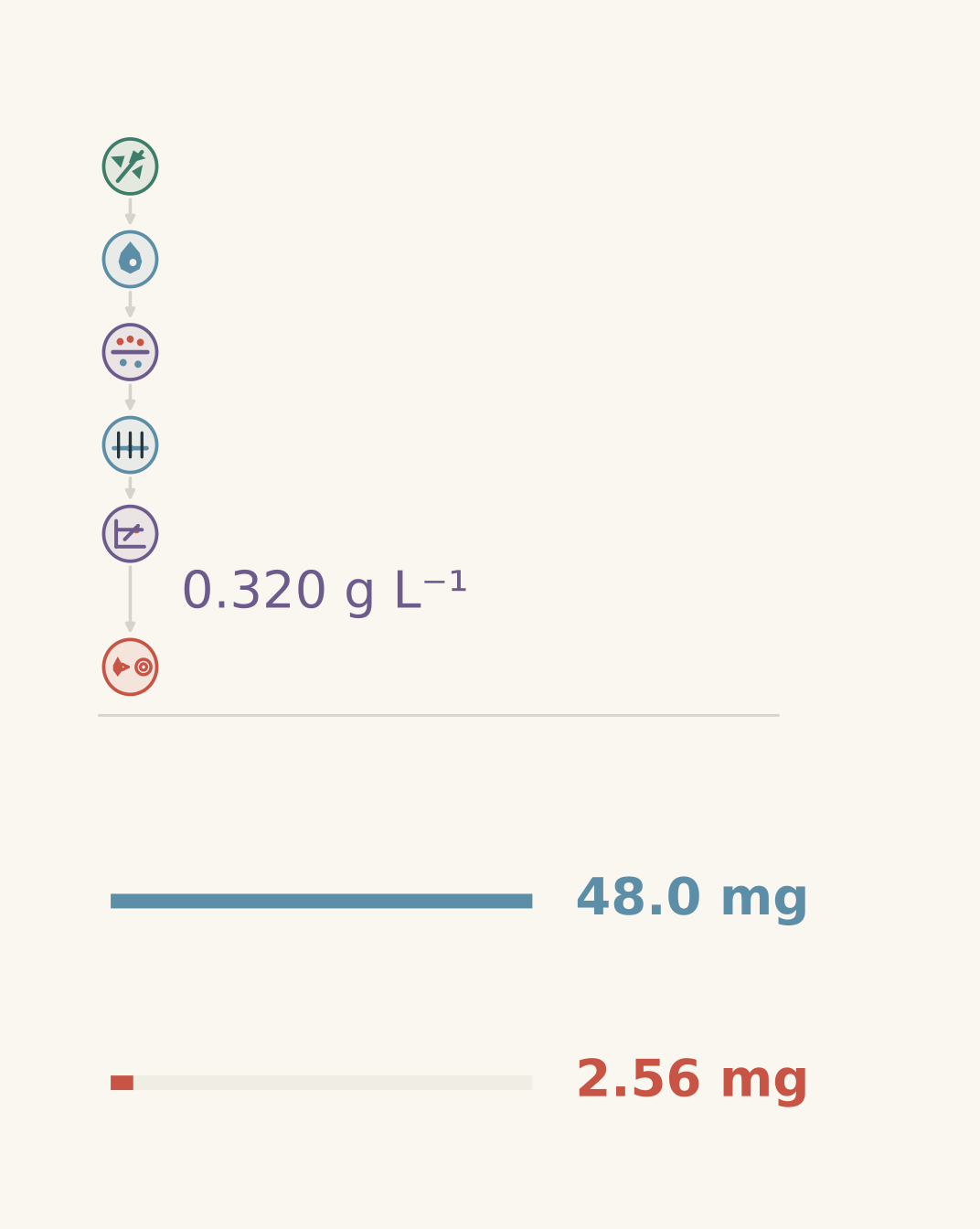
An analysis gives a pigment mass concentration of \(0.320\ \mathrm{g\,L^{-1}}\). An \(8.00\ \mathrm{mL}\) aliquot of this extract is then delivered to a test sample.
Assume the stated concentration refers to the extracted pigment only.
(a) Calculate the mass of pigment recovered in the full extract. (2 marks)
(b) Calculate the mass of pigment delivered to the test sample in the \(8.00\ \mathrm{mL}\) aliquot. Give your answer in milligrams. (2 marks)
(c) Convert the pigment mass concentration into \(\mathrm{mg\,mL^{-1}}\). (1 mark)
(d) Calculate the recovered pigment mass as a percentage of the initial dry leaf mass. (1 mark)
(e) Explain why the percentage calculated in part (d) is not necessarily the extraction efficiency of the process. (1 mark)
Question 10 (7 marks)
Experimental evidence for whole-number mole ratios
Magnesium reacts with oxygen to form magnesium oxide:
\[ \ce{Mg(s) + O2(g) -> MgO(s)} \]
Two trials are performed. The mass gain is attributed entirely to oxygen incorporated into the solid.
| Trial | Mass of magnesium heated (g) | Measured mass gain (g) |
|---|---|---|
| 1 | 0.243 | 0.160 |
| 2 | 0.486 | 0.320 |
For the calculations, assume each sample reacts completely.
(a) For Trial 1, calculate the amount of magnesium atoms and the amount of oxygen atoms incorporated into the solid. (3 marks)
(b) Use the results from Trial 1 to determine the simplest whole-number mole ratio of magnesium to oxygen, and state the empirical formula of the oxide. (2 marks)
(c) Check whether Trial 2 supports the same mole ratio. Then identify one realistic experimental error that could cause an experimentally measured ratio to differ from the expected ratio. (2 marks)
03Worked solutions and marking guide
Award method marks for equivalent correct approaches. Follow-through credit is appropriate where a student uses an earlier result correctly in a later calculation. Numerical answers may differ slightly because of rounding.
Solution 1
(a) Molar mass (2 marks)
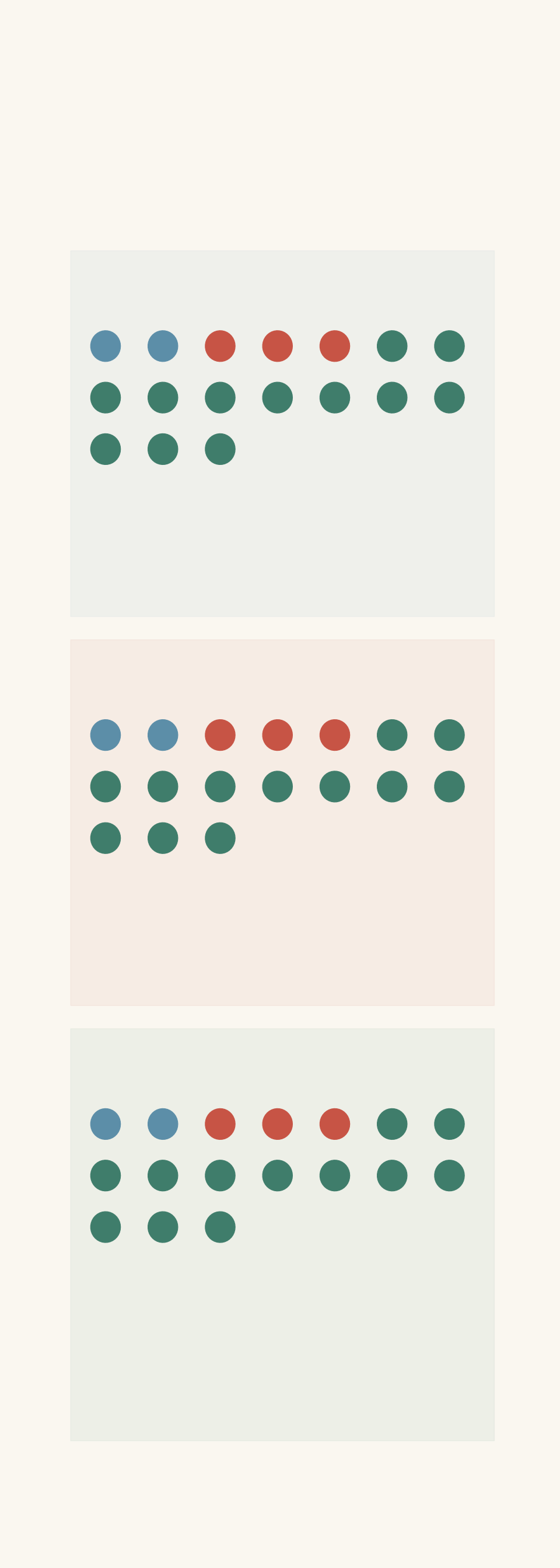
One formula unit of \(\ce{Al2(SO4)3}\) contains two aluminium atoms, three sulfur atoms, and twelve oxygen atoms.
\[ \begin{aligned} M &= 2(27.0)+3(32.1)+12(16.0)\\ &=54.0+96.3+192.0\\ &=342.3\ \mathrm{g\,mol^{-1}} \end{aligned} \]
Answer: \(342.3\ \mathrm{g\,mol^{-1}}\).
Marking:
- 1 mark for correctly counting the atoms and substituting their relative atomic masses.
- 1 mark for the correct molar mass with units.
(b) Amount of aluminium sulfate (2 marks)
Use \(n=m/M\), where \(n\) is amount, \(m\) is mass, and \(M\) is molar mass.
\[ \begin{aligned} n&=\frac{8.56}{342.3}\\ &=0.0250\ \mathrm{mol} \end{aligned} \]
Answer: \(0.0250\ \mathrm{mol}\).
Marking:
- 1 mark for the correct relationship and substitution.
- 1 mark for the correct amount with units.
(c) Number of formula units (2 marks)
Multiply the amount by Avogadro’s constant.
\[ \begin{aligned} N&=nN_A\\ &=0.0250(6.022\times10^{23})\\ &=1.51\times10^{22} \end{aligned} \]
Answer: \(1.51\times10^{22}\) formula units.
Marking:
- 1 mark for using \(N=nN_A\).
- 1 mark for the correct number of formula units.
(d) Amount of oxygen atoms (2 marks)
Each formula unit contains twelve oxygen atoms. Therefore, the amount of oxygen atoms is twelve times the amount of aluminium sulfate.
\[ \begin{aligned} n(\mathrm O)&=12(0.0250)\\ &=0.300\ \mathrm{mol} \end{aligned} \]
Answer: \(0.300\ \mathrm{mol}\) of oxygen atoms.
Marking:
- 1 mark for recognising the factor of twelve.
- 1 mark for the correct amount.
- Al atoms
- S atoms
- O atoms
(e) Mass of aluminium (2 marks)
Each formula unit contains two aluminium atoms, so the amount of aluminium atoms is:
\[ n(\mathrm{Al})=2(0.0250)=0.0500\ \mathrm{mol} \]
Using \(m=nM\):
\[ m(\mathrm{Al})=0.0500(27.0)=1.35\ \mathrm{g} \]
Answer: \(1.35\ \mathrm{g}\) of aluminium.
Marking:
- 1 mark for calculating the amount of aluminium.
- 1 mark for the correct mass with units.
Solution 2
(a) Balancing the equation (2 marks)
Start with:
\[ \ce{C3H8 + O2 -> CO2 + H2O} \]
Three carbon atoms require three carbon dioxide molecules. Eight hydrogen atoms require four water molecules.
\[ \ce{C3H8 + O2 -> 3CO2 + 4H2O} \]
The products now contain ten oxygen atoms: six in carbon dioxide and four in water. Five oxygen molecules supply ten oxygen atoms.
The balanced equation is:
\[ \boxed{\ce{C3H8 + 5O2 -> 3CO2 + 4H2O}} \]
Marking:
- 1 mark for correctly balancing carbon and hydrogen.
- 1 mark for balancing oxygen and giving the complete balanced equation.
(b) Empirical formula (4 marks)
An empirical formula gives the simplest whole-number ratio of atoms in a compound.
Assume a \(100.0\ \mathrm{g}\) sample. The masses of the elements are then numerically equal to their percentages:
- Carbon: \(40.0\ \mathrm{g}\)
- Hydrogen: \(6.70\ \mathrm{g}\)
- Oxygen: \(53.3\ \mathrm{g}\)
Convert each mass to an amount using \(n=m/M\).
\[ \begin{aligned} n(\mathrm C)&=\frac{40.0}{12.0}=3.33\ \mathrm{mol}\\ n(\mathrm H)&=\frac{6.70}{1.01}=6.63\ \mathrm{mol}\\ n(\mathrm O)&=\frac{53.3}{16.0}=3.33\ \mathrm{mol} \end{aligned} \]
Divide each amount by the smallest amount, approximately \(3.33\ \mathrm{mol}\).
\[ \mathrm C:\mathrm H:\mathrm O \approx 1:1.99:1 \]
Rounding to the simplest whole-number ratio gives \(1:2:1\).
Answer: \(\boxed{\ce{CH2O}}\).
Marking:
- 1 mark for establishing a suitable sample mass and converting mass percentages to masses.
- 1 mark for calculating the amounts of the three elements.
- 1 mark for obtaining and simplifying the mole ratio.
- 1 mark for the correct empirical formula.
(c) Percentage composition of magnesium nitrate (2 marks)
First calculate the molar mass of \(\ce{Mg(NO3)2}\).
\[ \begin{aligned} M&=24.3+2(14.0)+6(16.0)\\ &=148.3\ \mathrm{g\,mol^{-1}} \end{aligned} \]
The oxygen contributes \(6(16.0)=96.0\ \mathrm{g\,mol^{-1}}\).
\[ \begin{aligned} \%\mathrm O&=\frac{96.0}{148.3}\times100\\ &=64.7\% \end{aligned} \]
Answer: \(64.7\%\) oxygen by mass.
Marking:
- 1 mark for the correct molar mass and oxygen contribution.
- 1 mark for the correct percentage.
(d) Mole ratio in propane combustion (2 marks)
The balanced equation is:
\[ \ce{C3H8 + 5O2 -> 3CO2 + 4H2O} \]
The coefficients give the mole ratio:
\[ \ce{C3H8 : CO2}=1:3 \]
This means that complete reaction of \(1\ \mathrm{mol}\) of propane produces \(3\ \mathrm{mol}\) of carbon dioxide.
Marking:
- 1 mark for the correct \(1:3\) ratio.
- 1 mark for correctly interpreting the ratio in terms of amounts.
Solution 3
(a) Amounts of reactants (3 marks)
For aluminium:
\[ n(\mathrm{Al})=\frac{5.40}{27.0}=0.200\ \mathrm{mol} \]
For chlorine gas, \(\ce{Cl2}\):
\[ M(\ce{Cl2})=2(35.5)=71.0\ \mathrm{g\,mol^{-1}} \]
\[ n(\ce{Cl2})=\frac{10.65}{71.0}=0.150\ \mathrm{mol} \]
Answers: \(0.200\ \mathrm{mol}\) Al and \(0.150\ \mathrm{mol}\) \(\ce{Cl2}\).
Marking:
- 1 mark for the amount of aluminium.
- 1 mark for the molar mass and amount of chlorine gas.
- 1 mark for correct units and working.
(b) Limiting reagent (2 marks)
The balanced equation requires two moles of aluminium for every three moles of chlorine gas.
For \(0.200\ \mathrm{mol}\) of aluminium, the required amount of chlorine is:
\[ n(\ce{Cl2})_{\mathrm{required}} =0.200\times\frac{3}{2} =0.300\ \mathrm{mol} \]
Only \(0.150\ \mathrm{mol}\) is available. Chlorine gas runs out first.
Answer: \(\ce{Cl2}\) is the limiting reagent.
Marking:
- 1 mark for comparing the required and available amounts using the mole ratio.
- 1 mark for identifying chlorine as the limiting reagent.
(c) Theoretical mass of aluminium chloride (3 marks)
The equation shows that three moles of \(\ce{Cl2}\) produce two moles of \(\ce{AlCl3}\).
\[ \begin{aligned} n(\ce{AlCl3})&=0.150\times\frac{2}{3}\\ &=0.100\ \mathrm{mol} \end{aligned} \]
Calculate the molar mass:
\[ M(\ce{AlCl3})=27.0+3(35.5)=133.5\ \mathrm{g\,mol^{-1}} \]
Therefore:
\[ \begin{aligned} m(\ce{AlCl3})&=nM\\ &=0.100(133.5)\\ &=13.35\ \mathrm{g} \end{aligned} \]
Answer: \(13.4\ \mathrm{g}\) of \(\ce{AlCl3}\), to three significant figures.
Marking:
- 1 mark for the correct product amount.
- 1 mark for the correct molar mass and mass calculation.
- 1 mark for the final mass with units and suitable precision.
(d) Excess aluminium (2 marks)
The reaction consumes \(0.100\ \mathrm{mol}\) of aluminium because the mole ratio of Al to \(\ce{Cl2}\) is \(2:3\).
\[ \begin{aligned} m(\mathrm{Al\ consumed})&=0.100(27.0)\\ &=2.70\ \mathrm{g} \end{aligned} \]
Subtract this from the initial aluminium mass:
\[ m(\mathrm{Al\ remaining})=5.40-2.70=2.70\ \mathrm{g} \]
Answer: \(2.70\ \mathrm{g}\) of aluminium remains.
Marking:
- 1 mark for calculating the mass of aluminium consumed.
- 1 mark for subtracting from the initial mass.
(e) Conservation of mass (2 marks)
The initial total mass is:
\[ m_{\mathrm{initial}}=5.40+10.65=16.05\ \mathrm{g} \]
The final total mass includes both the aluminium chloride and the unreacted aluminium:
\[ m_{\mathrm{final}}=13.35+2.70=16.05\ \mathrm{g} \]
The totals are equal. The reaction conserves mass when all products and excess reactants are included.
Answer: Both totals are \(16.05\ \mathrm{g}\).
Marking:
- 1 mark for the correct initial total.
- 1 mark for the correct final total and interpretation.
Solution 4
(a) Classifying the systems (2 marks)
Setup X is open with respect to matter because its measured mass decreases as carbon dioxide escapes.
Setup Y is closed with respect to matter because its measured total mass remains constant during the reaction.
Marking:
- 1 mark for correctly classifying both setups.
- 1 mark for explaining the classifications using matter transfer and the measured masses.
(b) Mass change in setup X (2 marks)
Calculate the decrease:
\[ \begin{aligned} \Delta m&=84.62-82.86\\ &=1.76\ \mathrm{g} \end{aligned} \]
Under the stated assumptions, the \(1.76\ \mathrm{g}\) decrease is the mass of carbon dioxide that escaped.
Answer: A mass decrease of \(1.76\ \mathrm{g}\).
Marking:
- 1 mark for the correct mass change.
- 1 mark for identifying the lost mass as escaped carbon dioxide.
(c) Amount of carbon dioxide (2 marks)
The molar mass of carbon dioxide is:
\[ M(\ce{CO2})=12.0+2(16.0)=44.0\ \mathrm{g\,mol^{-1}} \]
Therefore:
\[ \begin{aligned} n(\ce{CO2})&=\frac{m}{M}\\ &=\frac{1.76}{44.0}\\ &=0.0400\ \mathrm{mol} \end{aligned} \]
Answer: \(0.0400\ \mathrm{mol}\) of carbon dioxide escaped.
Marking:
- 1 mark for using \(n=m/M\) correctly.
- 1 mark for the correct amount with units.
(d) Mass of sodium hydrogen carbonate consumed (2 marks)
The balanced equation gives a \(1:1\) mole ratio between \(\ce{NaHCO3}\) and \(\ce{CO2}\).
Therefore:
\[ n(\ce{NaHCO3})=0.0400\ \mathrm{mol} \]
The molar mass of sodium hydrogen carbonate is:
\[ M(\ce{NaHCO3})=23.0+1.01+12.0+3(16.0) \approx84.0\ \mathrm{g\,mol^{-1}} \]
Thus:
\[ \begin{aligned} m(\ce{NaHCO3})&=0.0400(84.0)\\ &=3.36\ \mathrm{g} \end{aligned} \]
Answer: \(3.36\ \mathrm{g}\) of sodium hydrogen carbonate was consumed.
Marking:
- 1 mark for using the \(1:1\) mole ratio.
- 1 mark for calculating the mass correctly.
(e) Evaluating the conservation claim (2 marks)
The student’s claim is incorrect. Matter has not been destroyed.
In setup X, carbon dioxide crosses the boundary of the measured system and is no longer included in the final mass measurement. If the escaped gas were included in the total mass, the mass would be conserved.
Marking:
- 1 mark for rejecting the claim that matter was destroyed.
- 1 mark for explaining the role of escaping carbon dioxide and the system boundary.
Solution 5
(a) Converting mass concentration (1 mark)
Convert grams to milligrams and litres to millilitres:
\[ 2.40\ \mathrm{g\,L^{-1}} =\frac{2400\ \mathrm{mg}}{1000\ \mathrm{mL}} \]
Answer: \(2.40\ \mathrm{mg\,mL^{-1}}\).
Marking:
- 1 mark for the correct conversion and units.
(b) Mass concentration of sodium chloride (2 marks)
First calculate the molar mass:
\[ M(\ce{NaCl})=23.0+35.5=58.5\ \mathrm{g\,mol^{-1}} \]
Each litre contains \(0.750\ \mathrm{mol}\) of sodium chloride. Therefore:
\[ \begin{aligned} \text{Mass concentration} &=cM\\ &=0.750(58.5)\\ &=43.875\ \mathrm{g\,L^{-1}} \end{aligned} \]
Answer: \(43.9\ \mathrm{g\,L^{-1}}\).
Marking:
- 1 mark for the molar mass and correct relationship.
- 1 mark for the final mass concentration.
(c) Amount concentration from mass (3 marks)
The amount of sodium chloride is:
\[ \begin{aligned} n&=\frac{m}{M}\\ &=\frac{2.92}{58.5}\\ &=0.0499\ \mathrm{mol} \end{aligned} \]
Convert the solution volume to litres:
\[ 250.0\ \mathrm{mL}=0.2500\ \mathrm{L} \]
Use \(c=n/V\):
\[ \begin{aligned} c&=\frac{0.0499}{0.2500}\\ &=0.200\ \mathrm{mol\,L^{-1}} \end{aligned} \]
Answer: \(0.200\ \mathrm{mol\,L^{-1}}\).
Marking:
- 1 mark for calculating the amount of sodium chloride.
- 1 mark for converting the volume and applying \(c=n/V\).
- 1 mark for the correct concentration with units.
(d) Percentage concentration (2 marks)
A \(5.00\%\) (m/V) glucose solution contains \(5.00\ \mathrm{g}\) of glucose per \(100\ \mathrm{mL}\) of final solution.
The glucose mass in \(35.0\ \mathrm{mL}\) is:
\[ m=\frac{5.00}{100}\times35.0=1.75\ \mathrm{g} \]
Answer: \(1.75\ \mathrm{g}\) of glucose.
Marking:
- 1 mark for correctly interpreting the percentage concentration.
- 1 mark for the correct mass calculation.
(e) Dilution calculation (2 marks)
Dilution adds solvent without changing the amount of dissolved solute.
Use:
\[ c_1V_1=c_2V_2 \]
Rearrange to calculate the final concentration:
\[ \begin{aligned} c_2&=\frac{c_1V_1}{V_2}\\ &=\frac{0.400(25.0)}{200.0}\\ &=0.0500\ \mathrm{mol\,L^{-1}} \end{aligned} \]
Answer: \(0.0500\ \mathrm{mol\,L^{-1}}\).
Marking:
- 1 mark for the correct dilution relationship and substitution.
- 1 mark for the final concentration.
(f) Comparing concentration measures (2 marks)
Mass concentration describes the mass of solute per volume of solution, commonly expressed in \(\mathrm{g\,L^{-1}}\).
Amount concentration describes the amount of solute in moles per volume of solution, commonly expressed in \(\mathrm{mol\,L^{-1}}\).
Marking:
- 1 mark for correctly defining mass concentration and giving a suitable unit.
- 1 mark for correctly defining amount concentration and giving a suitable unit.
Solution 6
(a) Mass required for the standard solution (3 marks)
The target concentration is \(0.100\ \mathrm{mol\,L^{-1}}\), and the final volume is \(0.2500\ \mathrm{L}\).
Calculate the required amount:
\[ \begin{aligned} n&=cV\\ &=0.100(0.2500)\\ &=0.0250\ \mathrm{mol} \end{aligned} \]
The molar mass of sodium carbonate is:
\[ M(\ce{Na2CO3})=2(23.0)+12.0+3(16.0) =106.0\ \mathrm{g\,mol^{-1}} \]
Calculate the mass:
\[ \begin{aligned} m&=nM\\ &=0.0250(106.0)\\ &=2.65\ \mathrm{g} \end{aligned} \]
Answer: \(2.65\ \mathrm{g}\) of anhydrous sodium carbonate.
Marking:
- 1 mark for calculating the required amount.
- 1 mark for the correct molar mass.
- 1 mark for the correct mass.
(b) Preparing the standard solution (3 marks)
A suitable procedure is:
- Accurately weigh \(2.65\ \mathrm{g}\) of anhydrous sodium carbonate.
- Dissolve the solid in a small volume of deionised water in a beaker.
- Transfer the solution into a \(250.0\ \mathrm{mL}\) volumetric flask. Rinse the beaker and stirring rod, adding the rinsings to the flask so that the dissolved solute is transferred quantitatively.
- Add deionised water until the bottom of the meniscus reaches the calibration mark at eye level. Stopper the flask and invert it several times to mix thoroughly.
The final volume must be \(250.0\ \mathrm{mL}\), not \(250.0\ \mathrm{mL}\) of water added to the solid.
Marking:
- 1 mark for dissolving the accurately measured solid.
- 1 mark for quantitative transfer, including rinsing the original container.
- 1 mark for making the solution to the calibration mark and mixing thoroughly.
Prepare a standard solution accurately
- Dissolve
Dissolve the weighed solid in a small volume of deionised water.
- Transfer
Transfer the solution into a volumetric flask.
- Rinse
Rinse the original container and stirring rod with deionised water.
Add all rinsings to the flask to transfer the remaining solute.
- Make to the mark
Add deionised water until the bottom of the meniscus meets the calibration mark.
Read the meniscus at eye level.
- Stopper and mix
Stopper the flask securely and invert it several times to mix thoroughly.
(c) Performing the dilution (3 marks)
The initial concentration is \(0.250\ \mathrm{mol\,L^{-1}}\), the aliquot volume is \(10.00\ \mathrm{mL}\), and the final volume is \(100.0\ \mathrm{mL}\).
Using the dilution relationship:
\[ \begin{aligned} c_2&=\frac{c_1V_1}{V_2}\\ &=\frac{0.250(10.00)}{100.0}\\ &=0.0250\ \mathrm{mol\,L^{-1}} \end{aligned} \]
The dilution factor is \(100.0/10.00=10.0\).
For accurate preparation, use a \(10.00\ \mathrm{mL}\) volumetric pipette to transfer the stock solution into a \(100.0\ \mathrm{mL}\) volumetric flask. Add deionised water to the calibration mark, stopper, and invert several times to mix.
Answer: \(0.0250\ \mathrm{mol\,L^{-1}}\).
Marking:
- 1 mark for the correct final concentration.
- 1 mark for identifying suitable volumetric glassware.
- 1 mark for describing accurate dilution to the final mark and mixing.
(d) Failure to rinse the beaker (1 mark)
The final concentration would be lower than intended. Some solute would remain in the beaker, so fewer moles would reach the volumetric flask even though the solution is still made up to the same final volume.
Marking:
- 1 mark for identifying the lower concentration and explaining the loss of solute.
Solution 7
(a) Pressure-volume relationship (2 marks)
At constant temperature and amount of gas:
\[ P_1V_1=P_2V_2 \]
Rearranging:
\[ \begin{aligned} P_2&=\frac{P_1V_1}{V_2}\\ &=\frac{100(2.40)}{1.60}\\ &=150\ \mathrm{kPa} \end{aligned} \]
Answer: \(150\ \mathrm{kPa}\).
Marking:
- 1 mark for the correct relationship and substitution.
- 1 mark for the final pressure.
(b) Temperature-volume relationship (3 marks)
Convert both temperatures to kelvin:
\[ T_1=27+273=300\ \mathrm{K} \]
\[ T_2=127+273=400\ \mathrm{K} \]
At constant pressure and amount of gas, volume is proportional to absolute temperature.
\[ \begin{aligned} \frac{V_1}{T_1}&=\frac{V_2}{T_2}\\ V_2&=\frac{250(400)}{300}\\ &=333\ \mathrm{mL} \end{aligned} \]
Answer: \(333\ \mathrm{mL}\).
Marking:
- 1 mark for converting both temperatures to kelvin.
- 1 mark for the correct relationship and substitution.
- 1 mark for the final volume.
(c) Pressure-temperature relationship (2 marks)
Convert the temperatures:
\[ T_1=20+273=293\ \mathrm{K} \]
\[ T_2=80+273=353\ \mathrm{K} \]
Because the container is rigid, volume remains constant. The pressure is proportional to absolute temperature.
\[ \begin{aligned} P_2&=P_1\frac{T_2}{T_1}\\ &=95.0\frac{353}{293}\\ &=114\ \mathrm{kPa} \end{aligned} \]
Answer: \(114\ \mathrm{kPa}\).
Marking:
- 1 mark for the correct temperature conversion and relationship.
- 1 mark for the final pressure.
(d) Ideal Gas Law (3 marks)
The Ideal Gas Law is:
\[ PV=nRT \]
Rearrange to make pressure the subject:
\[ P=\frac{nRT}{V} \]
Substitute the values:
\[ \begin{aligned} P&=\frac{0.500(8.31)(298)}{12.2}\\ &=101.5\ \mathrm{kPa} \end{aligned} \]
Answer: \(101\ \mathrm{kPa}\), to three significant figures.
Marking:
- 1 mark for the correct rearrangement of the Ideal Gas Law.
- 1 mark for correct substitution using consistent units.
- 1 mark for the final pressure with units and suitable precision.
(e) Amount-volume relationship (2 marks)
At constant temperature and pressure, gas volume is proportional to the amount of gas.
\[ \begin{aligned} V_2&=V_1\frac{n_2}{n_1}\\ &=12.2\frac{0.750}{0.500}\\ &=18.3\ \mathrm{L} \end{aligned} \]
Answer: \(18.3\ \mathrm{L}\).
Marking:
- 1 mark for the correct proportional relationship.
- 1 mark for the correct final volume.
Solution 8
(a) Gas-volume stoichiometry (4 marks)
The balanced equation is:
\[ \ce{N2(g) + 3H2(g) -> 2NH3(g)} \]
At the same temperature and pressure, reacting gas volumes follow the coefficient ratio in the balanced equation.
The reaction requires one volume of nitrogen for every three volumes of hydrogen. Therefore, \(60.0\ \mathrm{mL}\) of hydrogen requires:
\[ V(\ce{N2})_{\mathrm{required}}=\frac{60.0}{3}=20.0\ \mathrm{mL} \]
There are \(30.0\ \mathrm{mL}\) of nitrogen available, so hydrogen is the limiting reactant.
The equation shows that three volumes of hydrogen produce two volumes of ammonia:
\[ V(\ce{NH3})=60.0\frac{2}{3}=40.0\ \mathrm{mL} \]
Nitrogen remaining:
\[ V(\ce{N2})_{\mathrm{remaining}}=30.0-20.0=10.0\ \mathrm{mL} \]
Answers:
- Limiting reactant: hydrogen.
- Ammonia produced: \(40.0\ \mathrm{mL}\).
- Unreacted nitrogen: \(10.0\ \mathrm{mL}\).
Marking:
- 1 mark for correctly comparing the reactant volumes using the coefficient ratio.
- 1 mark for identifying hydrogen as the limiting reactant.
- 1 mark for calculating the ammonia volume.
- 1 mark for calculating the remaining nitrogen volume.
(b) Combined stoichiometry and gas volume (6 marks)
First calculate the amount of hydrochloric acid:
\[ \begin{aligned} n(\ce{HCl})&=cV\\ &=0.200(0.1000)\\ &=0.0200\ \mathrm{mol} \end{aligned} \]
The volume has been converted to litres.
Next calculate the amount of calcium carbonate:
\[ M(\ce{CaCO3})=40.1+12.0+3(16.0) =100.1\ \mathrm{g\,mol^{-1}} \]
\[ \begin{aligned} n(\ce{CaCO3})&=\frac{5.00}{100.1}\\ &=0.04995\ \mathrm{mol} \end{aligned} \]
The balanced equation requires two moles of hydrochloric acid for every mole of calcium carbonate.
The available \(0.0200\ \mathrm{mol}\) of hydrochloric acid can react with only:
\[ n(\ce{CaCO3})_{\mathrm{required}} =\frac{0.0200}{2} =0.0100\ \mathrm{mol} \]
Since \(0.04995\ \mathrm{mol}\) of calcium carbonate is available, hydrochloric acid is the limiting reagent.
The equation gives a \(2:1\) mole ratio of hydrochloric acid to carbon dioxide. Therefore:
\[ n(\ce{CO2})=\frac{0.0200}{2}=0.0100\ \mathrm{mol} \]
Now apply the Ideal Gas Law:
\[ PV=nRT \]
Rearrange for volume:
\[ V=\frac{nRT}{P} \]
Substitute:
\[ \begin{aligned} V&=\frac{0.0100(8.31)(298)}{100.0}\\ &=0.2476\ \mathrm{L} \end{aligned} \]
Answer: \(\boxed{0.248\ \mathrm{L}}\) of carbon dioxide.
Marking:
- (i) Amounts of reactants (2 marks):
- 1 mark for calculating the amount of hydrochloric acid.
- 1 mark for calculating the amount of calcium carbonate.
- (ii) Limiting reagent and carbon dioxide amount (2 marks):
- 1 mark for identifying hydrochloric acid as the limiting reagent with a valid comparison.
- 1 mark for calculating \(0.0100\ \mathrm{mol}\) of carbon dioxide.
- (iii) Gas volume (2 marks):
- 1 mark for using the Ideal Gas Law with consistent units.
- 1 mark for the correct volume with units and suitable precision.
Solution 9
(a) Mass of pigment in the full extract (2 marks)
The mass concentration is \(0.320\ \mathrm{g\,L^{-1}}\), and the final extract volume is:
\[ 150.0\ \mathrm{mL}=0.1500\ \mathrm{L} \]
Using mass concentration \(=\) mass divided by solution volume:
\[ \begin{aligned} m&=c_mV\\ &=0.320(0.1500)\\ &=0.0480\ \mathrm{g} \end{aligned} \]
Here, \(c_m\) represents mass concentration.
Answer: \(0.0480\ \mathrm{g}\), or \(48.0\ \mathrm{mg}\), of pigment.
Marking:
- 1 mark for converting the volume to litres and using the correct relationship.
- 1 mark for the correct mass.
(b) Mass delivered in the aliquot (2 marks)
Convert the aliquot volume to litres:
\[ 8.00\ \mathrm{mL}=0.00800\ \mathrm{L} \]
Calculate the pigment mass delivered:
\[ \begin{aligned} m&=c_mV\\ &=0.320(0.00800)\\ &=0.00256\ \mathrm{g} \end{aligned} \]
Convert grams to milligrams:
\[ 0.00256\ \mathrm{g}=2.56\ \mathrm{mg} \]
Answer: \(2.56\ \mathrm{mg}\) of pigment is delivered.
Marking:
- 1 mark for using the aliquot volume correctly.
- 1 mark for the correct delivered mass in milligrams.
(c) Converting mass concentration (1 mark)
Since \(1\ \mathrm{g}=1000\ \mathrm{mg}\) and \(1\ \mathrm{L}=1000\ \mathrm{mL}\), the numerical value of a concentration in \(\mathrm{g\,L^{-1}}\) is unchanged when expressed in \(\mathrm{mg\,mL^{-1}}\).
Answer: \(0.320\ \mathrm{mg\,mL^{-1}}\).
Marking:
- 1 mark for the correct conversion.
(d) Recovered pigment as a percentage of leaf mass (1 mark)
\[ \begin{aligned} \text{Percentage} &=\frac{\text{recovered pigment mass}} {\text{initial dry leaf mass}}\times100\\ &=\frac{0.0480}{12.0}\times100\\ &=0.400\% \end{aligned} \]
Answer: \(0.400\%\).
Marking:
- 1 mark for the correct percentage.
(e) Limitation of the percentage (1 mark)
The percentage compares recovered pigment mass with total starting leaf mass. It does not tell us what fraction of the pigment originally present in the leaves was extracted. The initial pigment content of the leaves would need to be known to calculate extraction efficiency.
Marking:
- 1 mark for explaining that the initial amount of pigment in the leaves is unknown.
Solution 10
(a) Amounts of magnesium and oxygen atoms (3 marks)
For Trial 1, the mass of magnesium is \(0.243\ \mathrm{g}\).
\[ \begin{aligned} n(\mathrm{Mg})&=\frac{0.243}{24.3}\\ &=0.0100\ \mathrm{mol} \end{aligned} \]
The measured mass gain is attributed to oxygen. The amount of oxygen atoms incorporated is:
\[ \begin{aligned} n(\mathrm O)&=\frac{0.160}{16.0}\\ &=0.0100\ \mathrm{mol} \end{aligned} \]
Answer: \(0.0100\ \mathrm{mol}\) of magnesium atoms and \(0.0100\ \mathrm{mol}\) of oxygen atoms.
Marking:
- 1 mark for the amount of magnesium.
- 1 mark for the amount of oxygen atoms.
- 1 mark for correctly using the oxygen mass gain and the molar mass of oxygen atoms.
(b) Mole ratio and empirical formula (2 marks)
The ratio of magnesium atoms to oxygen atoms is:
\[ \mathrm{Mg}:\mathrm O=0.0100:0.0100=1:1 \]
The simplest whole-number ratio is \(1:1\).
Answer: The empirical formula is \(\boxed{\ce{MgO}}\).
Marking:
- 1 mark for the simplest whole-number ratio.
- 1 mark for the correct empirical formula.
(c) Checking Trial 2 and experimental error (2 marks)
For Trial 2:
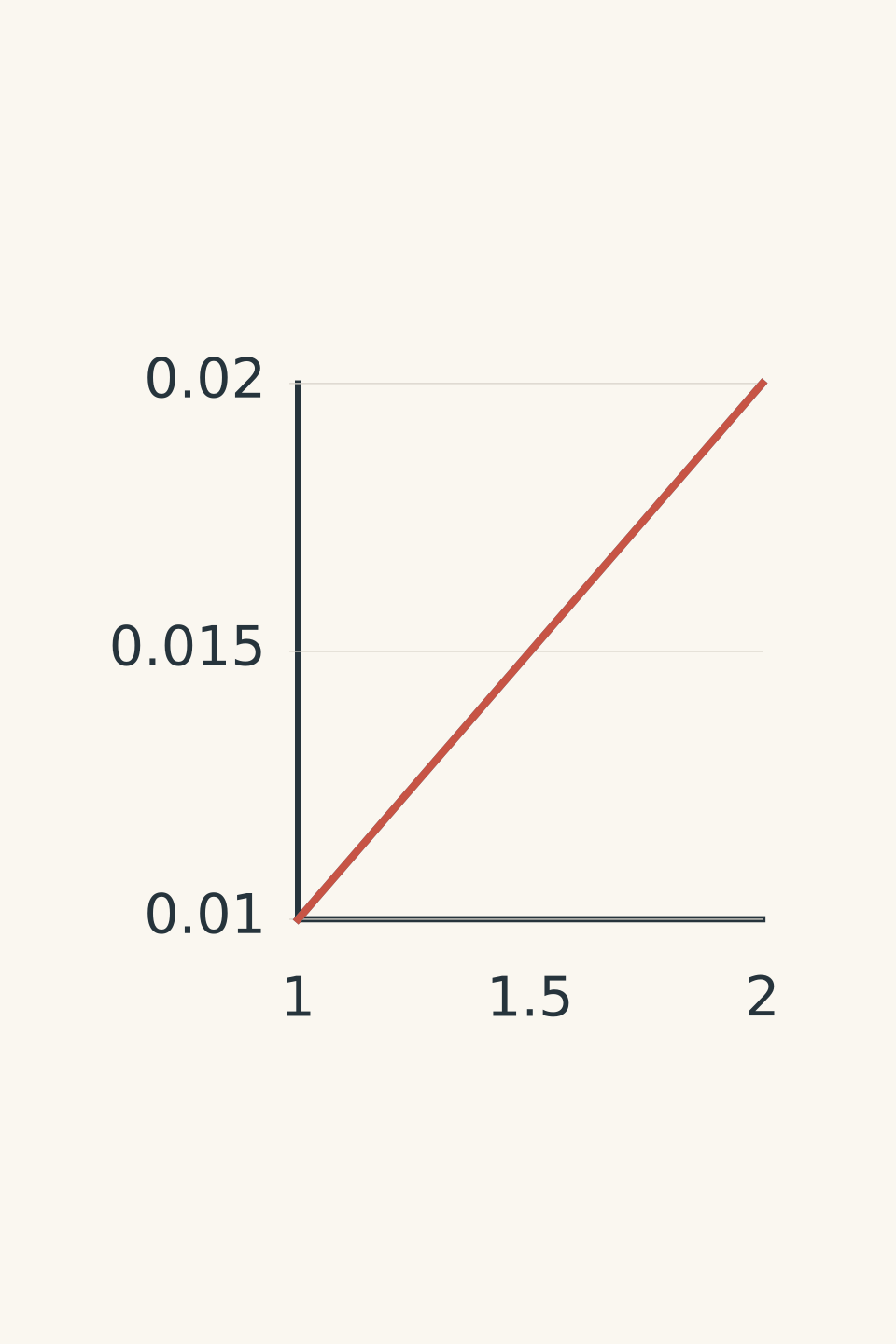
\[ \begin{aligned} n(\mathrm{Mg})&=\frac{0.486}{24.3}\\ &=0.0200\ \mathrm{mol} \end{aligned} \]
\[ \begin{aligned} n(\mathrm O)&=\frac{0.320}{16.0}\\ &=0.0200\ \mathrm{mol} \end{aligned} \]
The mole ratio is again \(1:1\). Trial 2 supports the same empirical formula, \(\ce{MgO}\).
One possible experimental error is incomplete oxidation of magnesium. If some magnesium does not react, the measured oxygen gain may be lower than expected, producing an inaccurate mole ratio.
- Magnesium atoms (Mg)
- Oxygen atoms (O)
Marking:
- 1 mark for confirming that Trial 2 gives the same \(1:1\) ratio.
- 1 mark for identifying a realistic experimental error that could affect the measured ratio.