
ICE Tables for Equilibrium: Calculate Concentrations and Use Kc
Learn how to build an ICE table from a balanced equation, calculate equilibrium concentrations using Kc, and check your answers for physically impossible results. Discover how Qc predicts reaction direction and when an equilibrium mixture will shift.
A flask starts with \(0.50\ \mathrm{M}\) hydrogen gas and \(0.50\ \mathrm{M}\) iodine gas, but no hydrogen iodide. At this temperature, the equilibrium constant is \(K_c=64\).
Does that mean all the hydrogen and iodine will react? Not necessarily. A large \(K_c\) tells you that products are favoured at equilibrium, but it doesn’t tell you the exact concentrations left in the flask. To find those, you need to track how the concentrations change as the reaction proceeds.
An initial-change-equilibrium table, usually called an ICE table, gives you a systematic way to do this.
01Build the ICE table from the balanced equation
We’ll use one reaction throughout this guide:
\[ \ce{H2(g) + I2(g) <=> 2HI(g)} \]
All three substances are gases, so this is a homogeneous equilibrium: the reactants and products occupy the same phase.
Before making a table, look at the balanced equation. The coefficients tell you the relative amounts of each substance consumed or formed.
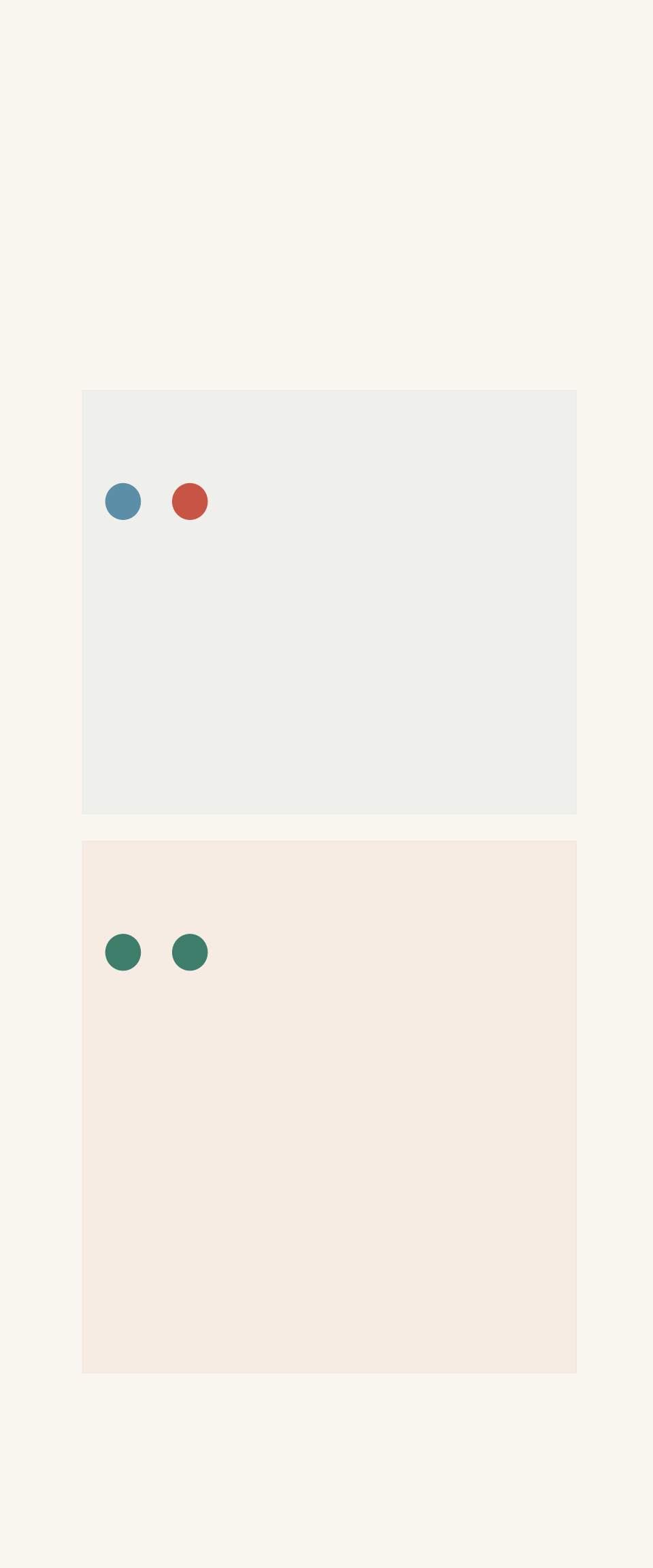
Predict what happens if \(0.10\ \mathrm{M}\) of hydrogen reacts in the forward direction. How much iodine is consumed, and how much hydrogen iodide forms?
The equation gives a ratio of \(1:1:2\). Therefore, \(0.10\ \mathrm{M}\) of iodine is consumed, and \(0.20\ \mathrm{M}\) of hydrogen iodide forms.
- H₂ molecules
- I₂ molecules
- HI molecules
That coefficient ratio determines the change row of your ICE table.
ICE stands for:
- I – Initial: the concentrations before the reaction shifts towards equilibrium.
- C – Change: how each concentration changes as the reaction proceeds.
- E – Equilibrium: the final concentrations once equilibrium is established.
For our starting mixture, the table is:
| \(\ce{H2}\) | \(\ce{I2}\) | \(\ce{HI}\) | |
|---|---|---|---|
| Initial (M) | \(0.50\) | \(0.50\) | \(0\) |
| Change (M) | \(-x\) | \(-x\) | \(+2x\) |
| Equilibrium (M) | \(0.50-x\) | \(0.50-x\) | \(2x\) |
Here, \(x\) is the concentration of hydrogen consumed in the forward reaction, measured in \(\mathrm{mol\,L^{-1}}\), or M.
Notice that the product changes by \(+2x\), not \(+x\). The coefficient of 2 in the balanced equation means that twice as much hydrogen iodide forms as hydrogen is consumed.
The equilibrium row is simply the initial concentration plus the change for each substance.
For example:
\[ [\ce{H2}]_{\mathrm{eq}}=0.50-x \]
The subscript \(\mathrm{eq}\) means equilibrium. Square brackets denote molar concentration.
You don’t yet know \(x\), so you can’t calculate the final concentrations. That’s where \(K_c\) comes in.
02Turn the equilibrium row into a \(K_c\) equation
The equilibrium constant connects the equilibrium concentrations of the reactants and products.
For our reaction,
\[ \ce{H2(g) + I2(g) <=> 2HI(g)} \]
the equilibrium expression is
\[ K_c=\frac{[\ce{HI}]^2} {[\ce{H2}][\ce{I2}]} \]
The coefficient of each substance becomes its exponent in the equilibrium expression. Hydrogen iodide has a coefficient of 2, so its concentration is squared. Hydrogen and iodine each have a coefficient of 1, so their concentrations appear to the first power.
From balanced equation to Kc expression
| Product: hydrogen iodide | 2HI → [HI]² Coefficient 2 becomes exponent 2. HI concentration is squared in the numerator. |
|---|---|
| Reactant: hydrogen | H₂ → [H₂]¹ Coefficient 1 becomes exponent 1. H₂ concentration appears in the denominator. |
| Reactant: iodine | I₂ → [I₂]¹ Coefficient 1 becomes exponent 1. I₂ concentration appears in the denominator. |
There are two important rules here.
First, use equilibrium concentrations in the \(K_c\) expression. Initial concentrations belong in the initial row, not automatically in the equilibrium expression.
Second, \(K_c\) is fixed at a given temperature. If you change the initial amounts, you can change the equilibrium concentrations, but \(K_c\) remains the same as long as the temperature stays constant.
Now we can solve the original problem.
Worked example: Calculate the equilibrium concentrations
A flask contains \(0.50\ \mathrm{M}\) hydrogen gas and \(0.50\ \mathrm{M}\) iodine gas, with no hydrogen iodide initially. At a particular temperature, \(K_c=64\). Calculate the equilibrium concentration of each gas.
Step 1
For the forward reaction, the changes are \(-x\), \(-x\), and \(+2x\).
| \(\ce{H2}\) | \(\ce{I2}\) | \(\ce{HI}\) | |
|---|---|---|---|
| Initial (M) | \(0.50\) | \(0.50\) | \(0\) |
| Change (M) | \(-x\) | \(-x\) | \(+2x\) |
| Equilibrium (M) | \(0.50-x\) | \(0.50-x\) | \(2x\) |
Step 2
\[ K_c=\frac{[\ce{HI}]^2} {[\ce{H2}][\ce{I2}]} \]
Substitute the equilibrium row, not the initial row:
\[ 64=\frac{(2x)^2}{(0.50-x)^2} \]
Step 3
The physically possible range is \(0\leq x<0.50\ \mathrm{M}\). Both reactant concentrations must remain non-negative, and a finite equilibrium constant rules out zero reactant concentrations in this expression.
Taking the positive square root gives
\[ 8=\frac{2x}{0.50-x} \]
Rearrange:
\[ \begin{aligned} 8(0.50-x)&=2x\\ 4-8x&=2x\\ 4&=10x\\ x&=0.40\ \mathrm{M} \end{aligned} \]
Step 4
For hydrogen:
\[ [\ce{H2}]_{\mathrm{eq}} =0.50-0.40 =0.10\ \mathrm{M} \]
For iodine:
\[ [\ce{I2}]_{\mathrm{eq}} =0.50-0.40 =0.10\ \mathrm{M} \]
For hydrogen iodide:
\[ [\ce{HI}]_{\mathrm{eq}} =2(0.40) =0.80\ \mathrm{M} \]
The equilibrium mixture contains \(0.10\ \mathrm{M}\) hydrogen, \(0.10\ \mathrm{M}\) iodine, and \(0.80\ \mathrm{M}\) hydrogen iodide.
Step 5
Substitute the calculated concentrations back into the equilibrium expression:
\[ \begin{aligned} K_c&=\frac{(0.80)^2}{(0.10)(0.10)}\\ &=\frac{0.64}{0.01}\\ &=64 \end{aligned} \]
The result agrees with the given \(K_c\).
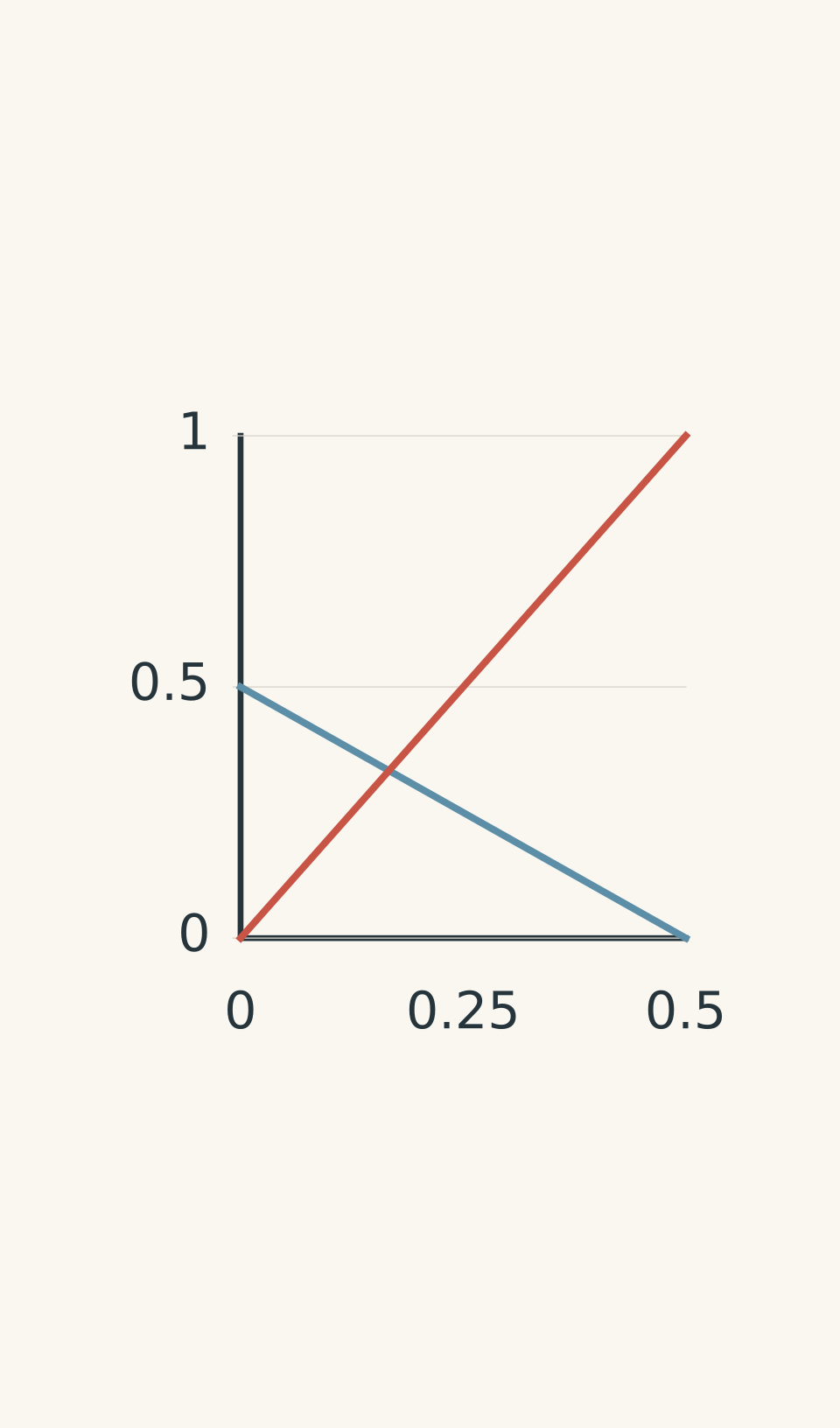
- H₂ and I₂ (equilibrium: 0.10 M; limit: x = 0.50 M)
- HI (equilibrium: 0.80 M)
Why you must check for negative concentrations
Algebra can produce a mathematically valid root that is chemically impossible.
In the example above, taking both square-root signs would also give the equation
\[ -8=\frac{2x}{0.50-x} \]
Solving it gives \(x=\frac{2}{3}\ \mathrm{M}\). But this would make the hydrogen concentration
\[ [\ce{H2}]=0.50-\frac{2}{3} =-0.167\ \mathrm{M} \]
A negative concentration is physically impossible. Reject that root.
The general rule is simple: check every calculated equilibrium concentration, not just the value of \(K_c\). If any concentration is negative, that root cannot describe the chemical system.
03Use \(Q\) to choose the reaction direction
So far, the initial mixture contained only reactants, which made the forward direction a natural starting point. But what if the flask already contains products?
You shouldn’t automatically assume the reaction moves forwards. First, compare the reaction quotient, \(Q_c\), with \(K_c\).
The expression for \(Q_c\) is identical to the expression for \(K_c\):
\[ Q_c=\frac{[\ce{HI}]^2} {[\ce{H2}][\ce{I2}]} \]
The difference is which concentrations you use.
- \(Q_c\) uses the concentrations at the current moment, whether or not the system is at equilibrium.
- \(K_c\) describes the required concentration ratio at equilibrium for that temperature.
Compare the two values:
| Comparison | Net reaction direction | Change row |
|---|---|---|
| \(Q_cK_c\) | Reverse, towards reactants | \(+x,\ +x,\ -2x\) |
| \(Q_c=K_c\) | No net shift | No net concentration change |
If \(Q_cK_c\), the mixture has too much product relative to that ratio. The reverse reaction decreases \(Q_c\) until equilibrium is restored.
If \(Q_c=K_c\), the mixture is already at equilibrium, so there is no net shift. The forward and reverse reactions can still occur, but at equal rates.
Unsupported: branching Qc and Kc decision flowchart
- Required decision
Calculate Qc and compare it with Kc.
Qc < Kc: forward shift.
Qc > Kc: reverse shift.
Qc = Kc: equilibrium, with no net shift.
This distinction is essential: \(Q_c\) predicts the direction of change; \(K_c\), together with the ICE table, lets you calculate the equilibrium concentrations.
Worked example: Start with products already present
A flask contains \(0.20\ \mathrm{M}\) hydrogen, \(0.20\ \mathrm{M}\) iodine, and \(0.60\ \mathrm{M}\) hydrogen iodide. At the same temperature, \(K_c=4\). Calculate the equilibrium concentrations.
Step 1
\[ \begin{aligned} Q_c&=\frac{[\ce{HI}]^2} {[\ce{H2}][\ce{I2}]}\\ &=\frac{(0.60)^2}{(0.20)(0.20)}\\ &=\frac{0.36}{0.04}\\ &=9 \end{aligned} \]
Since \(Q_c=9>K_c=4\), the reaction shifts in the reverse direction. Hydrogen iodide decomposes to form hydrogen and iodine.
Step 2
For the reverse reaction, hydrogen and iodine increase, while hydrogen iodide decreases.
| \(\ce{H2}\) | \(\ce{I2}\) | \(\ce{HI}\) | |
|---|---|---|---|
| Initial (M) | \(0.20\) | \(0.20\) | \(0.60\) |
| Change (M) | \(+x\) | \(+x\) | \(-2x\) |
| Equilibrium (M) | \(0.20+x\) | \(0.20+x\) | \(0.60-2x\) |
Hydrogen iodide cannot become negative, so \(0\leq x\leq0.30\ \mathrm{M}\).
Step 3
\[ 4=\frac{(0.60-2x)^2}{(0.20+x)^2} \]
Because the concentrations must be non-negative, take the positive square root:
\[ \begin{aligned} 2&=\frac{0.60-2x}{0.20+x}\\ 0.60-2x&=0.40+2x\\ 0.20&=4x\\ x&=0.05\ \mathrm{M} \end{aligned} \]
Step 4
\[ [\ce{H2}]_{\mathrm{eq}} =0.20+0.05 =0.25\ \mathrm{M} \]
\[ [\ce{I2}]_{\mathrm{eq}} =0.20+0.05 =0.25\ \mathrm{M} \]
\[ [\ce{HI}]_{\mathrm{eq}} =0.60-2(0.05) =0.50\ \mathrm{M} \]
Check:
\[ K_c=\frac{(0.50)^2}{(0.25)(0.25)} =\frac{0.25}{0.0625} =4 \]
The equilibrium concentrations are \(0.25\ \mathrm{M}\) hydrogen, \(0.25\ \mathrm{M}\) iodine, and \(0.50\ \mathrm{M}\) hydrogen iodide.
Notice that hydrogen iodide decreases, even though the product is still present in a substantial concentration. Equilibrium does not mean that products disappear or that reactants are completely consumed. It means the concentrations satisfy the equilibrium expression.
04A reliable method for any ICE table
When you face an equilibrium calculation in an HSC Chemistry question, work through these steps in order.
- Balance the equation. The coefficients determine the relative changes.
- Write the initial row. Include the given concentrations and any zero concentrations.
- Compare \(Q_c\) with \(K_c\) if the initial mixture contains products or its direction is uncertain.
- Write the change row. Choose the correct signs and multiply each change by its stoichiometric coefficient.
- Build the equilibrium row. Add the initial concentration and change for every species.
- Substitute into \(K_c\) and solve. Check for negative concentrations and reject physically impossible roots.
- Verify the answer. Substituting your equilibrium concentrations into the expression should reproduce the given \(K_c\).
The most tempting mistakes are usually bookkeeping errors rather than difficult mathematics.
- Writing \(+x\) for hydrogen iodide when it should be \(+2x\).
- Substituting initial concentrations directly into \(K_c\).
- Assuming the limiting reactant must be completely consumed.
- Accepting an algebraic root that gives a negative concentration.
- Choosing the ICE change signs before checking the reaction direction.
Keep the roles separate. The balanced equation determines the ratios of the changes, \(Q_c\) determines the direction, and \(K_c\) determines the equilibrium condition.
05Questions and solutions
Question 1
At a fixed temperature, \(K_c=4\). A mixture currently contains \([\ce{H2}]=0.20\ \mathrm{M}\), \([\ce{I2}]=0.10\ \mathrm{M}\), and \([\ce{HI}]=0.40\ \mathrm{M}\).
Calculate \(Q_c\) and predict the net reaction direction.
Solution 1
The reaction shifts in the reverse direction. The current reaction quotient is greater than the equilibrium constant.
\[ \begin{aligned} Q_c&=\frac{[\ce{HI}]^2} {[\ce{H2}][\ce{I2}]}\\ &=\frac{(0.40)^2}{(0.20)(0.10)}\\ &=\frac{0.16}{0.02}\\ &=8 \end{aligned} \]
Since \(Q_c=8>K_c=4\), the mixture contains too much product relative to the equilibrium ratio. The net reaction proceeds towards hydrogen and iodine.
If you were to write an ICE table for this shift, the change row would be \(+x,\ +x,\ -2x\), in the order \(\ce{H2}\), \(\ce{I2}\), and \(\ce{HI}\).
The trap is to assume that a mixture containing all three gases must already be at equilibrium. Only the comparison between \(Q_c\) and \(K_c\) tells you that.
Question 2
A mixture is at equilibrium with \([\ce{H2}]=0.10\ \mathrm{M}\), \([\ce{I2}]=0.10\ \mathrm{M}\), and \([\ce{HI}]=0.80\ \mathrm{M}\), where \(K_c=64\).
At constant volume and temperature, additional hydrogen iodide is introduced, increasing its concentration immediately to \(0.90\ \mathrm{M}\). The hydrogen and iodine concentrations remain unchanged at that instant.
Calculate the new \(Q_c\), predict the net direction of reaction, and write the correct ICE change row.
Solution 2
The reaction shifts in reverse, with a change row of \(+x,\ +x,\ -2x\). Adding hydrogen iodide increases \(Q_c\) above \(K_c\).
Immediately after the addition,
\[ \begin{aligned} Q_c&=\frac{(0.90)^2}{(0.10)(0.10)}\\ &=\frac{0.81}{0.01}\\ &=81 \end{aligned} \]
Since \(81>64\), the reaction proceeds towards the reactants.
The correct change row is:
| \(\ce{H2}\) | \(\ce{I2}\) | \(\ce{HI}\) | |
|---|---|---|---|
| Change (M) | \(+x\) | \(+x\) | \(-2x\) |
The added hydrogen iodide does not change \(K_c\), because the temperature remains constant. Instead, it changes the current reaction quotient. The reaction then adjusts the concentrations until \(Q_c=K_c\) again.
Question 3
At equilibrium, a mixture has \([\ce{H2}]=[\ce{I2}]=0.10\ \mathrm{M}\) and \([\ce{HI}]=0.80\ \mathrm{M}\), with \(K_c=64\).
The vessel is compressed to half its original volume at constant temperature. Assume the concentrations double immediately, before any reaction occurs.
Calculate the immediate concentrations and \(Q_c\). Will the reaction subsequently shift forwards or backwards? Explain why.
Solution 3
There is no net shift; the mixture remains at equilibrium. Halving the volume doubles every reacting gas concentration, but \(Q_c\) remains equal to \(K_c\).
Immediately after compression:
\[ \begin{aligned} [\ce{H2}]&=0.20\ \mathrm{M}\\ [\ce{I2}]&=0.20\ \mathrm{M}\\ [\ce{HI}]&=1.60\ \mathrm{M} \end{aligned} \]
Calculate the new reaction quotient:
\[ \begin{aligned} Q_c&=\frac{(1.60)^2}{(0.20)(0.20)}\\ &=\frac{2.56}{0.04}\\ &=64 \end{aligned} \]
Since \(Q_c=K_c\), there is no net reaction shift.
Here’s the subtle point. Compression often favours the side with fewer moles of gas, but this reaction has two moles of gaseous reactants for every two moles of gaseous products. Neither side has fewer gaseous moles.
Mathematically, doubling the concentrations multiplies the numerator of \(Q_c\) by \(2^2=4\). It also multiplies the denominator by \(2\times2=4\). The factors cancel.
The tempting prediction is that higher pressure must force a shift. It doesn’t: the stoichiometry of the balanced equation determines whether the pressure change alters the reaction quotient.
Question 4
A closed flask initially contains \([\ce{H2}]=0.40\ \mathrm{M}\), \([\ce{I2}]=0.20\ \mathrm{M}\), and \([\ce{HI}]=0.20\ \mathrm{M}\).
At this temperature, \(K_c=4\). A report claims that the equilibrium concentrations are \([\ce{H2}]=0.25\ \mathrm{M}\) and \([\ce{HI}]=0.50\ \mathrm{M}\), but the iodine concentration is missing.
Assuming the initial concentrations and reported hydrogen and hydrogen iodide concentrations are correct, determine the iodine concentration required by stoichiometry. Then test whether the report is consistent with \(K_c=4\).
Solution 4
The report is inconsistent with \(K_c=4\). Stoichiometry requires an equilibrium iodine concentration of \(0.05\ \mathrm{M}\), but that concentration gives \(K_c=20\), not 4.
First, determine how much hydrogen has reacted.
\[ x=0.40-0.25=0.15\ \mathrm{M} \]
The reaction consumes hydrogen and iodine in a \(1:1\) ratio. Therefore,
\[ [\ce{I2}]_{\mathrm{eq}} =0.20-0.15 =0.05\ \mathrm{M} \]
The hydrogen iodide concentration also agrees with the change:
\[ [\ce{HI}]_{\mathrm{eq}} =0.20+2(0.15) =0.50\ \mathrm{M} \]
So the three reported concentrations are consistent with the stoichiometry and the stated initial mixture.
Now test the equilibrium constant:
\[ \begin{aligned} K_c&=\frac{(0.50)^2}{(0.25)(0.05)}\\ &=\frac{0.25}{0.0125}\\ &=20 \end{aligned} \]
This does not match the stated \(K_c=4\).
In fact, if \([\ce{H2}]=0.25\ \mathrm{M}\) and \([\ce{HI}]=0.50\ \mathrm{M}\) really were equilibrium concentrations for \(K_c=4\), the equilibrium expression would require
\[ [\ce{I2}] =\frac{(0.50)^2}{4(0.25)} =0.25\ \mathrm{M} \]
But stoichiometry requires \(0.05\ \mathrm{M}\). Both conditions cannot be satisfied at once.
This is why a convincing ICE-table calculation needs two checks: the concentrations must obey the balanced equation, and they must reproduce the correct \(K_c\). If the data are exact, the reported state is not the equilibrium state for the stated temperature.
Question 5
At the same temperature, \(K_c=64\) for the reaction
\[ \ce{H2(g) + I2(g) <=> 2HI(g)} \]
Two separate flasks have equal volumes, and both are at equilibrium.
- Flask A contains \([\ce{H2}]=0.10\ \mathrm{M}\), \([\ce{I2}]=0.10\ \mathrm{M}\), and \([\ce{HI}]=0.80\ \mathrm{M}\).
- Flask B contains \([\ce{H2}]=0.40\ \mathrm{M}\), \([\ce{I2}]=0.025\ \mathrm{M}\), and \([\ce{HI}]=0.80\ \mathrm{M}\).
The contents of both flasks are poured into one vessel. Its volume equals the sum of the original flask volumes. Assume the mixture forms instantly at constant temperature, before any further reaction occurs.
Are the combined contents at equilibrium simply because both original flasks were at equilibrium? Calculate the new concentrations and \(Q_c\), then predict the net direction of reaction.
Flask-mixing schematic: unsupported construction
| Flask A | H₂ + I₂ ⇌ 2HI [H₂] = 0.10 M; [I₂] = 0.10 M [HI] = 0.80 M; Qc = Kc = 64 |
|---|---|
| Flask B | H₂ + I₂ ⇌ 2HI [H₂] = 0.40 M; [I₂] = 0.025 M [HI] = 0.80 M; Qc = Kc = 64 |
| Combined mixture | Qc = [HI]² / ([H₂][I₂]) Equal volumes: [H₂] = 0.25 M; [I₂] = 0.0625 M; [HI] = 0.80 M Qc = 40.96 < Kc = 64; net forward shift |
Solution 5
The combined mixture is not at equilibrium; the reaction shifts forwards. Even though both original flasks were at equilibrium, mixing them changes the concentration ratio so that \(Q_c<K_c\).
First, verify that both original flasks were at equilibrium.
For flask A:
\[ Q_{c,A} =\frac{(0.80)^2}{(0.10)(0.10)} =64 \]
For flask B:
\[ Q_{c,B} =\frac{(0.80)^2}{(0.40)(0.025)} =64 \]
Both satisfy \(Q_c=K_c\).
However, concentrations do not combine by averaging the original \(Q_c\) values. They combine according to the amounts of each substance and the final volume.
Because the flasks have equal volumes, each final concentration is the arithmetic mean of the two original concentrations.
For hydrogen:
\[ [\ce{H2}]_{\mathrm{mix}} =\frac{0.10+0.40}{2} =0.25\ \mathrm{M} \]
For iodine:
\[ [\ce{I2}]_{\mathrm{mix}} =\frac{0.10+0.025}{2} =0.0625\ \mathrm{M} \]
For hydrogen iodide:
\[ [\ce{HI}]_{\mathrm{mix}} =\frac{0.80+0.80}{2} =0.80\ \mathrm{M} \]
Now calculate the reaction quotient of the combined mixture:
\[ \begin{aligned} Q_c&=\frac{(0.80)^2}{(0.25)(0.0625)}\\ &=\frac{0.64}{0.015625}\\ &=40.96 \end{aligned} \]
Since \(Q_c=40.96<K_c=64\), the net reaction proceeds forwards, forming more hydrogen iodide.
Why doesn’t the fact that both flasks were at equilibrium guarantee that their mixture is at equilibrium?
The key is that the equilibrium expression is nonlinear. Each original flask had
\[ [\ce{H2}][\ce{I2}]=0.010 \]
but after mixing, the product of the average concentrations is
\[ (0.25)(0.0625)=0.015625 \]
That denominator is larger, while the hydrogen iodide concentration remains unchanged. As a result, \(Q_c\) falls below \(K_c\).
The tempting assumption is that equilibrium is a property that survives mixing. It isn’t. Equilibrium depends on the actual concentrations in the system you’re considering, not on the history of the mixtures used to make it.
06What to learn next
An ICE table lets you calculate the equilibrium composition of a reaction, while \(Q_c\) tells you whether the current mixture needs to shift to reach that composition.
Together, they make Le Châtelier’s principle easier to understand: you can analyse how a change in concentration or volume affects the reaction quotient, then predict the direction in which the system responds. Temperature is a special case because changing the temperature can change \(K_c\) itself.
For the broader HSC treatment of equilibrium, continue with tutorgum’s HSC Chemistry Module 5 Equilibrium: Complete Topic Summary.