
Black-Body Radiation and Photons: 40-Mark Physics Practice Exam
Prepare for HSC Physics with this original 40-mark practice paper on black-body radiation and photons. Test your understanding with timed exam-style questions, then check your working against complete solutions and a detailed marking guide.
This original tutorgum practice paper tests black-body radiation and photons, with questions on observed radiation spectra, the classical ultraviolet catastrophe, Planck’s quantisation of energy, photon energy and wavelength, Wien’s displacement law, and the relationship between photon number and total intensity. It is a focused topic paper, not a full-course Physics exam. It is not an official, endorsed, past, or predicted NESA paper.
01Exam instructions
- Suggested reading time: 5 minutes.
- Suggested working time: 45 minutes.
- Total marks: 40.
- Permitted equipment: Scientific calculator, pen, and pencil. Do not use notes or the internet.
- Scope: The supplied Physics 2025 scope for black-body radiation and photons only. Other modules, including photoelectric-effect calculations and unrelated quantum topics, are excluded.
- Working: Show your method for every calculation. Include units and give numerical answers to three significant figures unless otherwise stated.
- Assumptions: Treat black bodies as ideal where specified. Use the constants and equations below.
Constants and equations
| Quantity | Symbol | Value |
|---|---|---|
| Planck constant | \(h\) | \(6.63 \times 10^{-34}\ \mathrm{J\,s}\) |
| Speed of light in a vacuum | \(c\) | \(3.00 \times 10^8\ \mathrm{m\,s^{-1}}\) |
| Wien displacement constant | \(b\) | \(2.90 \times 10^{-3}\ \mathrm{m\,K}\) |
You may use:
\[ E=hf \]
\[ c=f\lambda \]
\[ E=\frac{hc}{\lambda} \]
\[ \lambda_{\max}=\frac{b}{T} \]
Here, \(E\) is photon energy in joules, \(f\) is frequency in hertz, \(\lambda\) is wavelength in metres, \(\lambda_{\max}\) is the wavelength of maximum spectral intensity, and \(T\) is absolute temperature in kelvin.
For this paper, intensity means energy delivered per unit time per unit area. Spectral intensity describes how that emission is distributed across wavelength.
02Questions
Question 1 (8 marks)
(a) State what an ideal black body does to incident electromagnetic radiation. Describe the shape of its emitted spectrum at a fixed temperature. (2 marks)
(b) Explain what is meant by the classical ultraviolet catastrophe. Include the classical prediction and the conflict between that prediction and observed black-body spectra. (3 marks)
(c) Explain how Planck’s quantisation of energy changed the classical model and helped account for the observed spectrum at short wavelengths. (3 marks)
Question 2 (8 marks)
Three ideal black bodies, A, B, and C, have equal emitting areas and are observed under identical conditions.
The following table gives information about their radiation spectra. The peak spectral intensity and area under the spectrum are each normalised independently, with source A assigned a value of 1.0 in each column. The values are approximate relative measurements.
| Source | Peak wavelength, \(\lambda_{\max}\) (nm) | Peak spectral intensity (relative units) | Area under spectrum (relative units) |
|---|---|---|---|
| A | 900 | 1.0 | 1.0 |
| B | 600 | 7.6 | 5.1 |
| C | 450 | 32.0 | 16.0 |
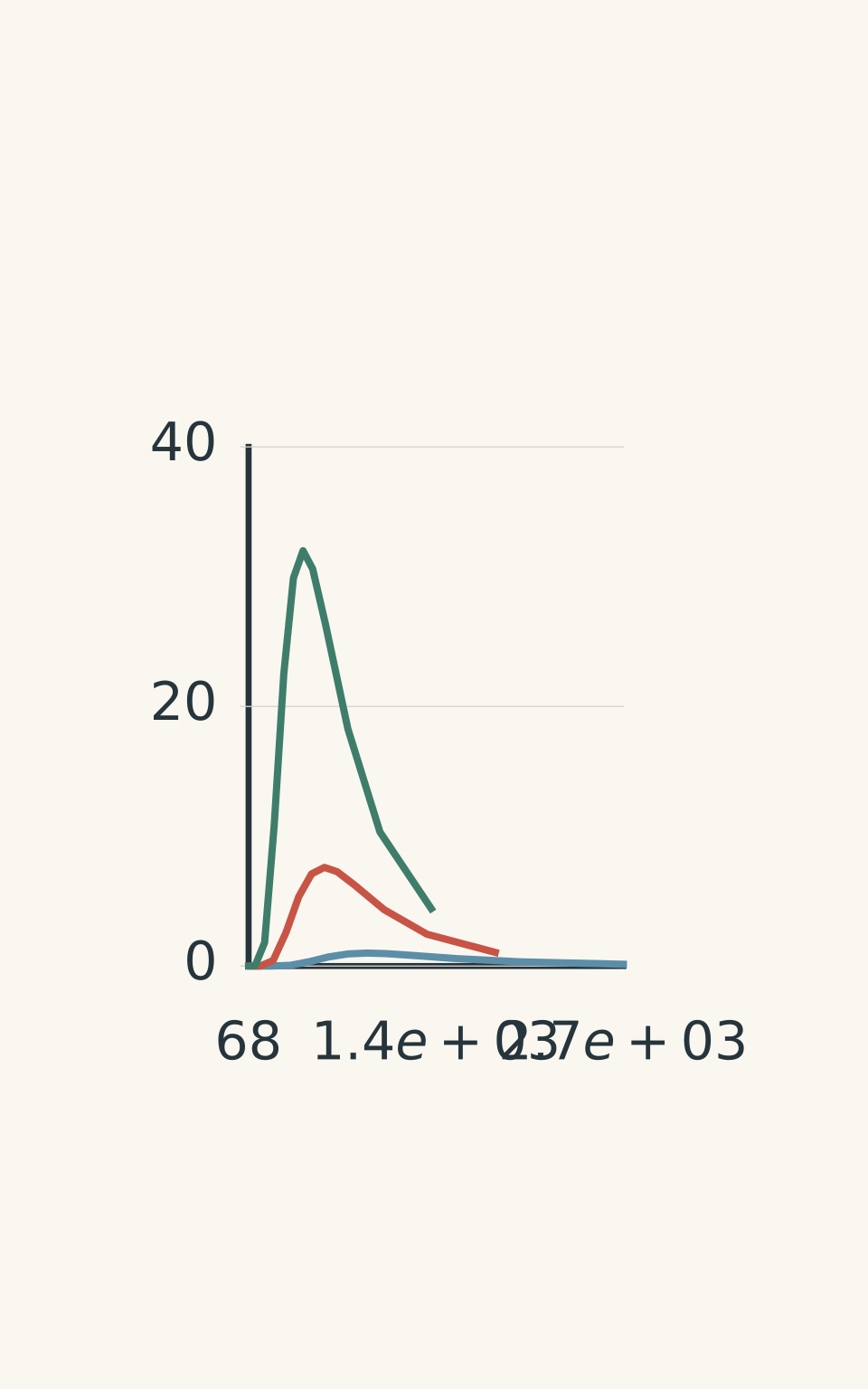
- A (peak 900 nm)
- B (peak 600 nm)
- C (peak 450 nm)
(a) Rank the sources in increasing order of temperature. Justify your answer using Wien’s displacement law. (2 marks)
(b) Calculate the temperature of source B. (2 marks)
(c) By what factor is the peak spectral intensity of source C greater than that of source A? (1 mark)
(d) Which source emits the greatest total energy per unit area per second across all wavelengths? Use the data to justify your answer, and distinguish the area under a spectrum from its peak height. (3 marks)
Question 3 (8 marks)
(a) Calculate the energy of a photon with frequency \(6.00 \times 10^{14}\ \mathrm{Hz}\). (2 marks)
(b) Calculate the wavelength of a photon with energy \(4.42 \times 10^{-19}\ \mathrm{J}\). Give your answer in metres and nanometres. (3 marks)
(c) Compare photons with wavelengths of 450 nm and 900 nm. Calculate the ratio
\[ \frac{E_{900}}{E_{450}} \]
and explain which photon has the greater energy. (3 marks)
Question 4 (8 marks)
Two monochromatic light beams, X and Y, consist entirely of photons with wavelengths of 450 nm and 900 nm, respectively.
Each beam delivers \(2.00 \times 10^{-3}\ \mathrm{J}\) of energy to the same area of \(1.00\ \mathrm{cm^2}\) over a period of \(1.00\ \mathrm{s}\).
(a) Calculate the energy of a single photon in each beam. (2 marks)
(b) Calculate the number of photons delivered by each beam during the one-second interval. (4 marks)
(c) Explain why the two beams have the same intensity despite containing different numbers of photons. (2 marks)
Question 5 (8 marks)
An ideal black body has a peak wavelength of 520 nm.
(a) Calculate the temperature of the black body. (3 marks)
(b) A second ideal black body has twice the temperature of the first. Calculate its peak wavelength. (2 marks)
(c) A student claims:
A shorter peak wavelength automatically means an object emits more photons per second.
Evaluate this statement. Explain what can be determined from the peak wavelength and identify the additional information needed to compare the total photon emission rates of two objects of unknown size. (3 marks)
03Worked solutions and marking guide
Use the itemised marking breakdowns below to check your work. Equivalent methods are acceptable, and consistent follow-through from an earlier numerical error should receive credit where appropriate.
Solution 1
(a) Ideal black body and its spectrum (2 marks)
An ideal black body absorbs all incident electromagnetic radiation, regardless of wavelength. It also emits thermal radiation whose spectrum depends on its temperature.
At a fixed temperature, its spectrum is continuous. The spectral intensity rises to a maximum at \(\lambda_{\max}\), then decreases towards zero at both very short and very long wavelengths.
Marking guide:
- 1 mark – States that an ideal black body absorbs all incident radiation.
- 1 mark – Describes a continuous spectrum with a peak and decreasing intensity towards both ends of the wavelength range.
(b) Classical ultraviolet catastrophe (3 marks)
Classical physics predicted that spectral intensity would increase without limit at high frequencies, corresponding to very short wavelengths.
This prediction implied that the total energy emitted across all frequencies would be infinite. Observed black-body spectra do not behave this way: their intensity falls sharply at high frequencies, giving a finite total emission.
The classical model therefore failed to reproduce the observed short-wavelength part of the spectrum.
Marking guide:
- 1 mark – Identifies the classical prediction of unbounded intensity at high frequencies or short wavelengths.
- 1 mark – Explains that this leads to an infinite predicted total emitted energy.
- 1 mark – Contrasts the prediction with the observed fall in intensity at short wavelengths.
(c) Planck’s quantisation of energy (3 marks)
Planck proposed that energy exchange between matter and radiation occurs in discrete amounts rather than varying continuously.
For an oscillator of frequency \(f\), the allowed energy levels are separated by amounts related to \(hf\). In the photon description, each photon carries energy
\[ E=hf \]
A higher-frequency photon has more energy. At a fixed temperature, high-frequency energy quanta are less readily populated, so the predicted intensity falls at short wavelengths instead of increasing without limit.
This quantised model reproduced the observed black-body spectrum and resolved the ultraviolet catastrophe.
Marking guide:
- 1 mark – Explains that energy exchange occurs in discrete quanta related to \(hf\).
- 1 mark – Connects higher frequency with greater photon energy and the reduced population of high-frequency modes at a fixed temperature.
- 1 mark – Explains that quantisation accounts for the observed short-wavelength fall-off and avoids the classical divergence.
Solution 2
(a) Ranking the temperatures (2 marks)
Wien’s displacement law is
\[ \lambda_{\max}=\frac{b}{T} \]
Rearranging gives
\[ T=\frac{b}{\lambda_{\max}} \]
Temperature is inversely proportional to peak wavelength. A shorter peak wavelength means a higher temperature.
The increasing order of temperature is therefore
\[ \boxed{T_A<T_B<T_C} \]
Source A has the longest peak wavelength, while source C has the shortest.
Marking guide:
- 1 mark – Correctly ranks the sources as A, B, C in increasing temperature.
- 1 mark – Uses the inverse relationship between peak wavelength and temperature to justify the ranking.
(b) Temperature of source B (2 marks)
The peak wavelength of source B is
\[ \lambda_{\max}=600\ \mathrm{nm} =6.00\times10^{-7}\ \mathrm{m} \]
Using Wien’s displacement law,
\[ \begin{aligned} T&=\frac{b}{\lambda_{\max}}\\[4pt] &=\frac{2.90\times10^{-3}} {6.00\times10^{-7}}\\[4pt] &=4.83\times10^3\ \mathrm{K} \end{aligned} \]
Therefore,
\[ \boxed{T_B=4.83\times10^3\ \mathrm{K}} \]
Marking guide:
- 1 mark – Correctly converts the wavelength and substitutes into the rearranged law.
- 1 mark – Obtains the correct temperature with units.
(c) Ratio of peak spectral intensities (1 mark)
Source A has a peak spectral intensity of 1.0 relative unit. Source C has a peak spectral intensity of 32.0 relative units.
\[ \frac{I_{\mathrm{peak},C}} {I_{\mathrm{peak},A}} =\frac{32.0}{1.0} \]
\[ \boxed{32.0} \]
Source C’s peak spectral intensity is 32 times that of source A.
Marking guide:
- 1 mark – Correctly calculates the factor of 32.
(d) Total energy emission (3 marks)
Source C emits the greatest total energy per unit area per second across all wavelengths.
Its area under the spectrum is 16.0 relative units, compared with 5.1 for source B and 1.0 for source A.
The area under a spectral-intensity-versus-wavelength curve represents the accumulated emission across the wavelength range. It therefore relates to the total energy emitted per unit area per unit time. Peak height, by contrast, gives the spectral intensity at just one wavelength.
A curve can have a high peak without that peak alone telling us the total emission. The area accounts for the whole spectrum.
Marking guide:
- 1 mark – Identifies source C.
- 1 mark – Uses its largest area under the spectrum, 16.0 relative units, as evidence.
- 1 mark – Distinguishes total emission across wavelengths from spectral intensity at the peak.
Solution 3
(a) Energy of a photon at \(6.00\times10^{14}\ \mathrm{Hz}\) (2 marks)
Use
\[ E=hf \]
Substitute the values:
\[ \begin{aligned} E&=(6.63\times10^{-34}) (6.00\times10^{14})\\[4pt] &=3.978\times10^{-19}\ \mathrm{J} \end{aligned} \]
To three significant figures,
\[ \boxed{E=3.98\times10^{-19}\ \mathrm{J}} \]
Marking guide:
- 1 mark – Uses \(E=hf\) with the correct substitution.
- 1 mark – Gives the correct energy with units.
(b) Wavelength of a photon with energy \(4.42\times10^{-19}\ \mathrm{J}\) (3 marks)
Start with
\[ E=\frac{hc}{\lambda} \]
Rearrange for wavelength:
\[ \lambda=\frac{hc}{E} \]
Substitute:
\[ \begin{aligned} \lambda&= \frac{(6.63\times10^{-34}) (3.00\times10^8)} {4.42\times10^{-19}}\\[6pt] &=4.50\times10^{-7}\ \mathrm{m} \end{aligned} \]
Since \(1\ \mathrm{nm}=10^{-9}\ \mathrm{m}\),
\[ \boxed{\lambda=4.50\times10^{-7}\ \mathrm{m} =450\ \mathrm{nm}} \]
Marking guide:
- 1 mark – Correctly rearranges the photon-energy equation.
- 1 mark – Substitutes the constants and energy using consistent SI units.
- 1 mark – Obtains the correct wavelength in metres and nanometres.
(c) Comparing 450 nm and 900 nm photons (3 marks)
Photon energy is inversely proportional to wavelength:
\[ E=\frac{hc}{\lambda} \]
Therefore,
\[ \begin{aligned} \frac{E_{900}}{E_{450}} &=\frac{hc/900}{hc/450}\\[4pt] &=\frac{450}{900}\\[4pt] &=0.500 \end{aligned} \]
Thus,
\[ \boxed{\frac{E_{900}}{E_{450}}=0.500} \]
The 900 nm photon has half the energy of the 450 nm photon. Equivalently, the 450 nm photon carries twice as much energy as the 900 nm photon.
Marking guide:
- 1 mark – Identifies the inverse relationship between energy and wavelength.
- 1 mark – Calculates the ratio as 0.500.
- 1 mark – Correctly identifies which photon has greater energy and explains the comparison.
Solution 4
(a) Energy per photon (2 marks)
Use
\[ E=\frac{hc}{\lambda} \]
For beam X, with wavelength 450 nm:
\[ \begin{aligned} E_X&=\frac{(6.63\times10^{-34}) (3.00\times10^8)} {450\times10^{-9}}\\[4pt] &=4.42\times10^{-19}\ \mathrm{J} \end{aligned} \]
For beam Y, with wavelength 900 nm:
\[ \begin{aligned} E_Y&=\frac{(6.63\times10^{-34}) (3.00\times10^8)} {900\times10^{-9}}\\[4pt] &=2.21\times10^{-19}\ \mathrm{J} \end{aligned} \]
Therefore,
\[ \boxed{E_X=4.42\times10^{-19}\ \mathrm{J}} \]
\[ \boxed{E_Y=2.21\times10^{-19}\ \mathrm{J}} \]
The 450 nm photons have twice the energy of the 900 nm photons.
Marking guide:
- 1 mark – Correct energy for the 450 nm photon.
- 1 mark – Correct energy for the 900 nm photon.
(b) Number of photons in each beam (4 marks)
The total energy in each beam is \(2.00\times10^{-3}\ \mathrm{J}\).
If each photon carries energy \(E_{\mathrm{photon}}\), the number of photons is
\[ N=\frac{E_{\mathrm{beam}}}{E_{\mathrm{photon}}} \]
For beam X:
\[ \begin{aligned} N_X&=\frac{2.00\times10^{-3}} {4.42\times10^{-19}}\\[4pt] &=4.52\times10^{15} \end{aligned} \]
For beam Y:
\[ \begin{aligned} N_Y&=\frac{2.00\times10^{-3}} {2.21\times10^{-19}}\\[4pt] &=9.05\times10^{15} \end{aligned} \]
The numbers of photons delivered are
\[ \boxed{N_X=4.52\times10^{15}} \]
\[ \boxed{N_Y=9.05\times10^{15}} \]
Beam Y delivers approximately twice as many photons as beam X.
Marking guide:
- 1 mark – Correctly applies \(N=E_{\mathrm{beam}}/E_{\mathrm{photon}}\) to beam X.
- 1 mark – Correct number of photons for beam X.
- 1 mark – Correctly applies the relationship to beam Y.
- 1 mark – Correct number of photons for beam Y.
(c) Equal intensity, different photon numbers (2 marks)
Intensity is energy delivered per unit time per unit area.
Both beams deliver the same total energy over the same time to the same area. Their intensities are therefore equal.
However, each 900 nm photon carries half the energy of each 450 nm photon. Beam Y needs twice as many photons to deliver the same total energy.
This illustrates an important distinction: photon number and total intensity are not the same quantity.
Marking guide:
- 1 mark – Explains that equal energy delivered over equal time to equal area gives equal intensity.
- 1 mark – Explains that the lower energy per photon in beam Y requires more photons to deliver that energy.
Solution 5
(a) Temperature of the first black body (3 marks)
The peak wavelength is
\[ \lambda_{\max}=520\ \mathrm{nm} =5.20\times10^{-7}\ \mathrm{m} \]
Rearrange Wien’s displacement law:
\[ T=\frac{b}{\lambda_{\max}} \]
Substitute:
\[ \begin{aligned} T&=\frac{2.90\times10^{-3}} {5.20\times10^{-7}}\\[4pt] &=5.58\times10^3\ \mathrm{K} \end{aligned} \]
Therefore,
\[ \boxed{T=5.58\times10^3\ \mathrm{K}} \]
Marking guide:
- 1 mark – Converts the peak wavelength into metres and rearranges the law correctly.
- 1 mark – Substitutes the values correctly.
- 1 mark – Obtains the correct temperature with units.
(b) Peak wavelength of the second black body (2 marks)
The second black body has twice the temperature:
\[ T_2=2T_1 \]
Wien’s displacement law gives
\[ \lambda_{\max,2} =\frac{b}{T_2} =\frac{b}{2T_1} \]
Therefore, its peak wavelength is half that of the first source:
\[ \begin{aligned} \lambda_{\max,2} &=\frac{520}{2}\ \mathrm{nm}\\[4pt] &=260\ \mathrm{nm} \end{aligned} \]
\[ \boxed{\lambda_{\max,2}=260\ \mathrm{nm}} \]
Doubling the absolute temperature halves the peak wavelength.
Marking guide:
- 1 mark – Uses the inverse relationship between peak wavelength and temperature.
- 1 mark – Obtains \(260\ \mathrm{nm}\).
(c) Does a shorter peak wavelength guarantee a greater photon emission rate? (3 marks)
The claim is not necessarily correct.
For an ideal black body, a shorter peak wavelength indicates a higher temperature. However, the peak wavelength alone does not determine the total number of photons emitted per second by an object whose size is unknown.
The emitting area matters because a larger object can emit more total radiation than a smaller object at the same temperature. The full spectrum also matters: the number of photons depends on how much energy is emitted across different wavelengths and on the energy carried by each photon.
To compare total photon emission rates, we need the emitting areas and sufficient information about the spectral output. We can then relate the energy emitted at each wavelength to the energy per photon, \(E=hc/\lambda\), to estimate the photon numbers.
Marking guide:
- 1 mark – Rejects the claim as stated, recognising that peak wavelength alone does not establish total photon emission rate.
- 1 mark – Explains that peak wavelength determines temperature for an ideal black body, but not the object’s emitting area or absolute emission rate.
- 1 mark – Identifies the need for information about the full spectrum and photon energies to compare photon emission rates.