
M5 Advanced Mechanics: Original HSC Physics Practice Exam
Test your understanding of the legacy NSW HSC Physics M5 Advanced Mechanics unit with this original 100-mark practice paper. Includes timed exam conditions, questions across the supplied syllabus scope, and complete worked solutions with marking guides.
This is an original tutorgum practice paper for mixed revision of the legacy NSW HSC Physics M5: Advanced Mechanics unit, using only the supplied physics-2017-compatible scope. It is a focused unit assessment, not a full-course examination, and it is not an official, endorsed, past, or predicted NESA paper.
01Exam instructions
Suggested working time: 150 minutes
Suggested reading time: 5 minutes
Total marks: 100
Equipment and conditions
- Use a scientific calculator and a ruler.
- Do not use notes, textbooks, or internet resources.
- Show your working for all calculations. A correct numerical answer without working may not earn full marks.
- Give numerical answers to three significant figures unless a different precision is appropriate.
- Include units and state directions where requested.
- Assume air resistance is negligible unless a question states otherwise.
- Use \(g = 9.80\ \mathrm{m\,s^{-2}}\) for projectile motion and near-Earth surface calculations.
- Use the universal gravitational constant \(G = 6.67 \times 10^{-11}\ \mathrm{N\,m^2\,kg^{-2}}\).
- For gravitational calculations, \(r\) denotes the distance from the centre of the relevant planet or other central body, unless a question defines it differently.
These conditions are for this practice paper. They are not claims about current official NESA examination rules.
Assessed scope
This paper covers the supplied legacy Advanced Mechanics content:
- Uniform circular motion, angular velocity, centripetal acceleration, and centripetal force.
- Tension, friction, normal forces, banked curves, and torque.
- Projectile motion, including velocity components, range, maximum height, flight time, non-level landing, launch angle, and experimental validation.
- Newton’s law of universal gravitation, gravitational field strength, and gravitational potential energy.
- Circular orbital velocity, orbital period, orbital energy, satellite transfers, and escape velocity.
- Kepler’s three laws and geostationary orbits.
- Work and energy in uniform circular motion.
The paper does not assess material from other syllabus editions or unrelated modules. Air-resistance calculations and quantitative energy calculations for elliptical orbits are excluded. Elliptical orbits are assessed qualitatively through Kepler’s laws.
02Questions
Question 1 (5 marks)
A rotating platform completes 18 revolutions in 9.0 s at constant angular velocity. A small marker is attached to the platform at a radius of \(0.40\ \mathrm{m}\) from its centre.
(a) Calculate the angular velocity of the platform in radians per second. (2 marks)
(b) Calculate the linear speed of the marker. (1 mark)
(c) Calculate the centripetal acceleration of the marker and state its direction. (2 marks)
Question 2 (6 marks)
A \(0.30\ \mathrm{kg}\) bob is attached to a light, inextensible string of length \(1.20\ \mathrm{m}\). The bob moves at constant speed in a horizontal circle, with the string held at an angle of \(25^\circ\) to the vertical.
Ignore air resistance and use \(g = 9.80\ \mathrm{m\,s^{-2}}\).
(a) Resolve the forces acting on the bob vertically and calculate the tension in the string. (2 marks)
(b) Calculate the radius of the horizontal circle. (1 mark)
(c) Calculate the speed of the bob and identify the force component that supplies its centripetal force. (3 marks)
Question 3 (4 marks)
A \(1200\ \mathrm{kg}\) car travels at \(14.0\ \mathrm{m\,s^{-1}}\) around a flat, level bend of radius \(55.0\ \mathrm{m}\).
Assume friction is the only horizontal force acting on the car.
(a) Calculate the required centripetal force and state its direction. (2 marks)
(b) Calculate the minimum coefficient of static friction required to prevent the car from skidding. (2 marks)
Question 4 (5 marks)
A vehicle travels around a frictionless banked track. The track has a radius of \(90.0\ \mathrm{m}\) and is banked at \(18.0^\circ\) to the horizontal.
The normal force is the contact force exerted by the track, perpendicular to its surface.
(a) Resolve the normal force into vertical and horizontal components. Write the equations relating these components to the weight and the required centripetal force. (2 marks)
(b) Calculate the design speed at which the vehicle can negotiate the curve without friction. (2 marks)
(c) Identify the component of the normal force that supplies the centripetal force. (1 mark)
Question 5 (4 marks)
A mechanic uses a spanner of length \(0.28\ \mathrm{m}\) to loosen a nut. A force of \(65\ \mathrm{N}\) is applied at an angle of \(40^\circ\) to the spanner.
(a) Calculate the magnitude of the torque about the nut. (2 marks)
(b) Explain why applying the same force perpendicular to the spanner produces a greater torque. Include the meaning of the moment arm in your explanation. (2 marks)
Question 6 (6 marks)
A ball is launched from level ground at an initial speed of \(22.0\ \mathrm{m\,s^{-1}}\), at an angle of \(35.0^\circ\) above the horizontal. It lands at the same height from which it was launched.
Ignore air resistance.
(a) Calculate the initial horizontal and vertical velocity components. (2 marks)
(b) Calculate the maximum height reached above the launch point. (2 marks)
(c) Calculate the total time of flight and the horizontal range. (2 marks)
Question 7 (8 marks)
A ball is launched from a ledge \(12.0\ \mathrm{m}\) above level ground. Its initial speed is \(16.0\ \mathrm{m\,s^{-1}}\), at an angle of \(30.0^\circ\) above the horizontal.
Ignore air resistance and take the ground as \(y=0\), with upward displacement positive.
(a) Calculate the initial horizontal and vertical velocity components. (2 marks)
(b) Calculate the time taken for the ball to reach the ground. (2 marks)
(c) Calculate the horizontal distance travelled before impact. (1 mark)
(d) Calculate the magnitude and direction of the ball’s final velocity immediately before impact. (3 marks)
Question 8 (8 marks)
A student investigates projectile motion by recording the position of a launched ball at regular time intervals. The origin is the launch point, horizontal displacement \(x\) is positive forwards, and vertical displacement \(y\) is positive upwards.
The measured data are shown below.
| Time, \(t\) (s) | Horizontal displacement, \(x\) (m) | Vertical displacement, \(y\) (m) |
|---|---|---|
| 0.00 | 0.00 | 0.00 |
| 0.10 | 0.50 | 0.45 |
| 0.20 | 1.01 | 0.80 |
| 0.30 | 1.49 | 1.06 |
| 0.40 | 2.00 | 1.22 |
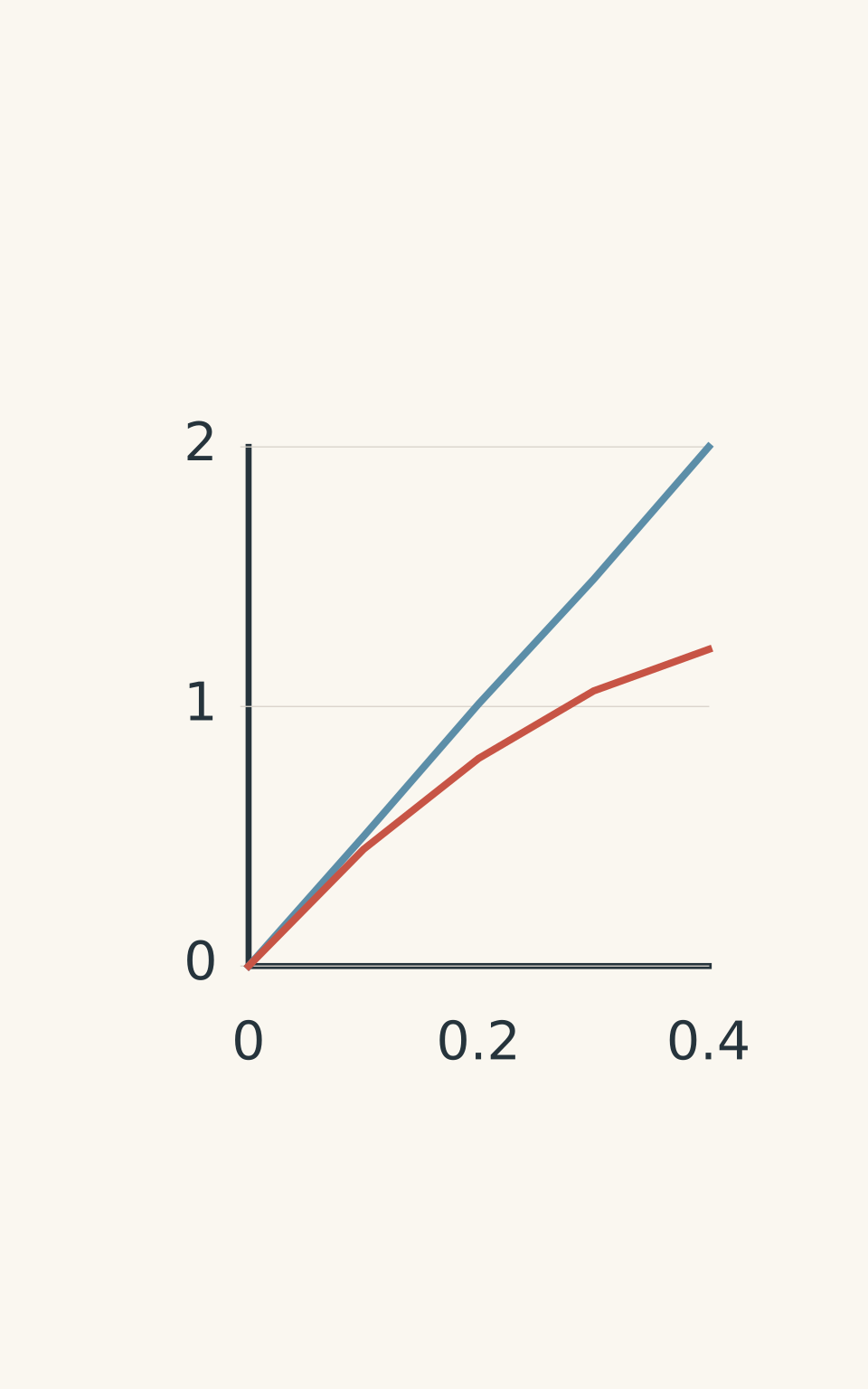
- Horizontal displacement, x(t)
- Vertical displacement, y(t)
(a) Calculate the average horizontal velocity over the recorded interval. Use the data to assess whether the horizontal motion is approximately uniform. (2 marks)
(b) Estimate the vertical acceleration at \(t=0.20\ \mathrm{s}\) using the centred second-difference method. For equally spaced times, you may use
\[ a_y \approx \frac{y(t+\Delta t)-2y(t)+y(t-\Delta t)} {(\Delta t)^2} \]
where \(\Delta t\) is the time interval between measurements. (2 marks)
(c) Describe a practical method for collecting data to test the projectile-motion model. Identify how you would measure the ball’s position and how you would improve the reliability of the results. (2 marks)
(d) State one assumption of the ideal projectile-motion model and describe one situation in which that assumption may fail. (2 marks)
Question 9 (6 marks)
(a) Two small spherical masses of \(8.0\ \mathrm{kg}\) and \(12.0\ \mathrm{kg}\) have a centre-to-centre separation of \(0.50\ \mathrm{m}\). Calculate the magnitude of the gravitational force between them. (2 marks)
(b) A hypothetical spherical planet has a mass of \(4.8 \times 10^{24}\ \mathrm{kg}\) and a radius of \(6.0 \times 10^6\ \mathrm{m}\).
Calculate the gravitational field strength at its surface. (2 marks)
(c) Explain the difference between gravitational field strength and gravitational force. Include their units and the relationship between them. (2 marks)
Question 10 (6 marks)
A satellite of mass \(500\ \mathrm{kg}\) is located \(8.0 \times 10^6\ \mathrm{m}\) from the centre of a planet with mass \(6.0 \times 10^{24}\ \mathrm{kg}\).
Use the universal gravitational constant given in the exam instructions.
(a) Calculate the gravitational field strength at the satellite’s location. (2 marks)
(b) Calculate the magnitude of the gravitational force acting on the satellite. (1 mark)
(c) Calculate the satellite’s gravitational potential energy, taking the potential energy to be zero at infinity. (2 marks)
(d) Explain what the negative value of the gravitational potential energy means in this reference system. (1 mark)
Question 11 (7 marks)
A satellite moves in a circular orbit around Earth. Its orbital radius, measured from Earth’s centre, is \(7.0 \times 10^6\ \mathrm{m}\).
Take Earth’s mass as \(5.97 \times 10^{24}\ \mathrm{kg}\).
(a) Starting from Newton’s law of universal gravitation and the expression for centripetal force, derive an expression for the satellite’s orbital speed in terms of \(G\), Earth’s mass \(M\), and orbital radius \(r\). (2 marks)
(b) Calculate the satellite’s orbital speed. (2 marks)
(c) Calculate its orbital period in seconds and convert your answer to minutes. (3 marks)
Question 12 (6 marks)
A satellite of mass \(800\ \mathrm{kg}\) is transferred from a circular orbit of radius \(7.0 \times 10^6\ \mathrm{m}\) to a circular orbit of radius \(1.4 \times 10^7\ \mathrm{m}\) around Earth.
Take Earth’s mass as \(5.97 \times 10^{24}\ \mathrm{kg}\).
For a satellite in a circular orbit, its total mechanical energy is
\[ E=-\frac{GMm}{2r} \]
where \(E\) is total mechanical energy, \(M\) is Earth’s mass, \(m\) is the satellite’s mass, and \(r\) is the orbital radius.
(a) Calculate the satellite’s total mechanical energy in each orbit. (3 marks)
(b) Calculate the change in total mechanical energy during the transfer. (1 mark)
(c) Explain how the satellite’s kinetic energy and gravitational potential energy change as it moves to the higher orbit. (2 marks)
Question 13 (4 marks)
Escape velocity is the minimum launch speed required for an object to reach infinitely far from a planet, with zero final speed, in the ideal model without air resistance.
A planet has a mass of \(5.0 \times 10^{24}\ \mathrm{kg}\). An object begins at a distance of \(7.0 \times 10^6\ \mathrm{m}\) from the planet’s centre.
(a) Use conservation of mechanical energy to derive the expression
\[ v_{\mathrm{esc}}=\sqrt{\frac{2GM}{r}} \]
where \(v_{\mathrm{esc}}\) is escape velocity, \(M\) is the planet’s mass, and \(r\) is the starting distance from its centre. (2 marks)
(b) Calculate the escape velocity for this planet and starting position. (2 marks)
Question 14 (5 marks)
A communications company wants to place a satellite in a geostationary orbit around Earth.
(a) State four orbital conditions required for the satellite to remain above the same point on Earth’s surface. (4 marks)
(b) Describe one practical use of a geostationary satellite and explain why this orbit is suitable for that use. (1 mark)
Question 15 (6 marks)
(a) State Kepler’s three laws of planetary motion. (3 marks)
(b) Two objects orbit the same central body. Object B has an orbital semi-major axis twice that of object A.
Use Kepler’s third law to calculate the ratio of their orbital periods, \(T_B/T_A\). (2 marks)
(c) Write the Newtonian form of Kepler’s third law for an object orbiting a central mass \(M\). (1 mark)
Question 16 (2 marks)
An object moves at constant speed in a circle under the action of a centripetal force.
(a) Explain why the centripetal force does no work on the object in ideal uniform circular motion. (1 mark)
(b) State the consequence for the object’s kinetic energy and speed. (1 mark)
Question 17 (5 marks)
A ball is launched from a low platform at \(14.0\ \mathrm{m\,s^{-1}}\), at an angle of \(40.0^\circ\) above the horizontal. A landing platform is \(2.0\ \mathrm{m}\) above the launch point.
The ball is caught as it passes the landing platform on its descending path. Ignore air resistance.
(a) Calculate the initial horizontal and vertical velocity components. (2 marks)
(b) Calculate the time taken to reach the landing platform on the descending path. (2 marks)
(c) Calculate the horizontal distance travelled before the ball reaches the landing platform. (1 mark)
Question 18 (7 marks)
A ball is launched from level ground and lands at the same height. Its initial speed is \(20.0\ \mathrm{m\,s^{-1}}\).
Compare two launches: one at \(30.0^\circ\) above the horizontal and one at \(60.0^\circ\). Ignore air resistance.
(a) Calculate the total time of flight for each launch. (2 marks)
(b) Calculate the maximum height for each launch and explain why the two heights differ. (2 marks)
(c) Calculate the horizontal range for each launch and explain why the ranges are equal. (2 marks)
(d) State the launch angle that produces the maximum horizontal range for a fixed initial speed when launch and landing heights are equal. (1 mark)
03Worked solutions and marking guide
Solution 1
(a) Angular velocity
Angular velocity, \(\omega\), is the angular displacement in radians divided by the time taken.
Each revolution corresponds to \(2\pi\) radians, so 18 revolutions correspond to
\[ \Delta\theta=18(2\pi)=36\pi\ \mathrm{rad} \]
Using \(\omega=\Delta\theta/\Delta t\),
\[ \omega=\frac{36\pi}{9.0} =4\pi =12.6\ \mathrm{rad\,s^{-1}} \]
Answer: \(12.6\ \mathrm{rad\,s^{-1}}\).
(b) Linear speed
The linear speed \(v\) of a point rotating at radius \(r\) is
\[ v=\omega r \]
Substituting \(r=0.40\ \mathrm{m}\),
\[ v=(4\pi)(0.40)=5.03\ \mathrm{m\,s^{-1}} \]
Answer: \(5.03\ \mathrm{m\,s^{-1}}\).
(c) Centripetal acceleration
Centripetal acceleration is the acceleration required to continually change the direction of the marker’s velocity.
Its magnitude is
\[ a_c=\frac{v^2}{r} \]
Therefore,
\[ a_c=\frac{(5.0265)^2}{0.40} =63.2\ \mathrm{m\,s^{-2}} \]
The acceleration points towards the centre of the circular path.
Answer: \(63.2\ \mathrm{m\,s^{-2}}\), directed inwards.
Marking guide:
- (a) Correct angular displacement in radians: 1 mark; correct angular velocity: 1 mark.
- (b) Correct use of \(v=\omega r\) and numerical result: 1 mark.
- (c) Correct acceleration magnitude: 1 mark; inward direction: 1 mark.
Total: 5 marks.
Solution 2
(a) Tension
The bob has no vertical acceleration, so its vertical forces balance.
The tension \(T\) acts along the string. Its vertical component is \(T\cos25^\circ\), while the weight is \(mg\) downwards.
\[ T\cos25^\circ=mg \]
Rearranging,
\[ T=\frac{mg}{\cos25^\circ} \]
\[ T=\frac{(0.30)(9.80)}{\cos25^\circ} =3.24\ \mathrm{N} \]
Answer: \(3.24\ \mathrm{N}\).
(b) Radius of the circle
The radius is the horizontal component of the string length:
\[ r=L\sin25^\circ \]
\[ r=1.20\sin25^\circ =0.507\ \mathrm{m} \]
Answer: \(0.507\ \mathrm{m}\).
(c) Speed and centripetal force
The horizontal component of tension supplies the centripetal force. The weight and vertical component of tension balance, so weight does not provide a net horizontal force.
\[ T\sin25^\circ=\frac{mv^2}{r} \]
Rearranging for speed,
\[ v=\sqrt{\frac{T r\sin25^\circ}{m}} \]
Substituting,
\[ v=\sqrt{\frac{(3.24)(0.507)\sin25^\circ}{0.30}} \]
\[ v=1.52\ \mathrm{m\,s^{-1}} \]
Answer: \(1.52\ \mathrm{m\,s^{-1}}\). The horizontal component \(T\sin25^\circ\) supplies the centripetal force.
Marking guide:
- (a) Correct vertical force balance: 1 mark; correct tension: 1 mark.
- (b) Correct radius calculation: 1 mark.
- (c) Correct horizontal force equation: 1 mark; correct speed: 1 mark; identifies the horizontal tension component as the centripetal force: 1 mark.
Total: 6 marks.
Solution 3
(a) Required centripetal force
The centripetal force is the net inward force required to maintain circular motion.
\[ F_c=\frac{mv^2}{r} \]
Substituting the car’s mass, speed, and bend radius,
\[ F_c=\frac{(1200)(14.0)^2}{55.0} \]
\[ F_c=4.28\times10^3\ \mathrm{N} \]
The force acts towards the centre of the bend.
Answer: \(4.28\times10^3\ \mathrm{N}\), towards the centre.
(b) Minimum coefficient of static friction
On a flat bend, static friction supplies the required centripetal force. At the limiting condition,
\[ F_f=\mu_s N=\mu_s mg \]
Setting this equal to the centripetal force,
\[ \mu_s mg=\frac{mv^2}{r} \]
The mass cancels, giving
\[ \mu_{s,\min}=\frac{v^2}{rg} \]
\[ \mu_{s,\min}=\frac{(14.0)^2}{(55.0)(9.80)} =0.364 \]
Answer: The minimum coefficient of static friction is \(0.364\).
Marking guide:
- (a) Correct centripetal-force calculation: 1 mark; correct magnitude and direction: 1 mark.
- (b) Correct limiting-friction relationship and coefficient: 2 marks.
Total: 4 marks.
Solution 4
(a) Resolving the normal force
Let \(N\) be the normal force and \(\theta=18.0^\circ\) be the banking angle.
Because the normal force is perpendicular to the track, its vertical component is \(N\cos\theta\), and its horizontal component is \(N\sin\theta\).
There is no vertical acceleration, so
\[ N\cos\theta=mg \]
The horizontal component provides the centripetal force:
\[ N\sin\theta=\frac{mv^2}{r} \]
(b) Design speed
Divide the horizontal equation by the vertical equation:
\[ \tan\theta=\frac{v^2}{rg} \]
Rearranging,
\[ v=\sqrt{rg\tan\theta} \]
Substituting the radius and banking angle,
\[ v=\sqrt{(90.0)(9.80)\tan18.0^\circ} \]
\[ v=16.9\ \mathrm{m\,s^{-1}} \]
Answer: \(16.9\ \mathrm{m\,s^{-1}}\).
(c) Force supplying centripetal force
The horizontal component of the normal force, \(N\sin\theta\), supplies the centripetal force.
Marking guide:
- (a) Correct vertical component equation: 1 mark; correct horizontal component equation: 1 mark.
- (b) Correct design-speed relationship: 1 mark; correct numerical result: 1 mark.
- (c) Correctly identifies \(N\sin\theta\): 1 mark.
Total: 5 marks.
Solution 5
(a) Torque
Torque, \(\tau\), measures the turning effect of a force about a pivot. Its magnitude is
\[ \tau=rF\sin\theta \]
where \(r\) is the distance from the pivot to the point of application of the force, \(F\) is the force magnitude, and \(\theta\) is the angle between the force and the spanner.
Substituting,
\[ \tau=(0.28)(65)\sin40^\circ \]
\[ \tau=11.7\ \mathrm{N\,m} \]
Answer: \(11.7\ \mathrm{N\,m}\).
(b) Moment arm
The moment arm is the perpendicular distance from the pivot to the line of action of the force.
The torque can therefore be written as
\[ \tau=F d_\perp \]
where \(d_\perp\) is the moment arm.
When the force is perpendicular to the spanner, the moment arm equals the full spanner length. This produces the maximum torque for a fixed force and spanner length. At \(40^\circ\), the moment arm is shorter, so the torque is smaller.
Marking guide:
- (a) Correct torque relationship and substitution: 1 mark; correct result with unit: 1 mark.
- (b) Correct definition of moment arm: 1 mark; explains why perpendicular application maximises torque: 1 mark.
Total: 4 marks.
Solution 6
(a) Initial velocity components
The initial speed is \(v_0=22.0\ \mathrm{m\,s^{-1}}\), and the launch angle is \(\theta=35.0^\circ\).
Resolve the velocity into horizontal and vertical components:
\[ v_x=v_0\cos\theta \]
\[ v_{y0}=v_0\sin\theta \]
Therefore,
\[ v_x=22.0\cos35.0^\circ =18.0\ \mathrm{m\,s^{-1}} \]
\[ v_{y0}=22.0\sin35.0^\circ =12.6\ \mathrm{m\,s^{-1}} \]
Answer: \(v_x=18.0\ \mathrm{m\,s^{-1}}\) and \(v_{y0}=12.6\ \mathrm{m\,s^{-1}}\).
(b) Maximum height
At maximum height, the vertical velocity is zero. Using the vertical-motion equation
\[ v_y^2=v_{y0}^2-2gh \]
and setting \(v_y=0\),
\[ h=\frac{v_{y0}^2}{2g} \]
Substituting,
\[ h=\frac{(12.6187)^2}{2(9.80)} =8.12\ \mathrm{m} \]
Answer: \(8.12\ \mathrm{m}\) above the launch point.
(c) Flight time and horizontal range
Because the ball lands at its launch height, the time spent rising equals the time spent falling.
The total flight time is
\[ T=\frac{2v_{y0}}{g} \]
\[ T=\frac{2(12.6187)}{9.80} =2.58\ \mathrm{s} \]
Horizontal velocity remains constant, so the range \(R\) is
\[ R=v_xT \]
\[ R=(18.0213)(2.5752) =46.4\ \mathrm{m} \]
Answers: \(2.58\ \mathrm{s}\) and \(46.4\ \mathrm{m}\).
Marking guide:
- (a) Correct horizontal component: 1 mark; correct vertical component: 1 mark.
- (b) Correct maximum-height relationship: 1 mark; correct height: 1 mark.
- (c) Correct flight time: 1 mark; correct range: 1 mark.
Total: 6 marks.
Solution 7
(a) Initial velocity components
The initial speed is \(16.0\ \mathrm{m\,s^{-1}}\), and the launch angle is \(30.0^\circ\).
\[ v_x=16.0\cos30.0^\circ =13.9\ \mathrm{m\,s^{-1}} \]
\[ v_{y0}=16.0\sin30.0^\circ =8.00\ \mathrm{m\,s^{-1}} \]
Answer: \(v_x=13.9\ \mathrm{m\,s^{-1}}\) and \(v_{y0}=8.00\ \mathrm{m\,s^{-1}}\).
(b) Time to reach the ground
Choose upward as the positive vertical direction. The initial height is \(12.0\ \mathrm{m}\), and the ground is at \(y=0\).
The vertical displacement equation is
\[ y=y_0+v_{y0}t-\frac12gt^2 \]
At impact,
\[ 0=12.0+8.00t-4.90t^2 \]
Rearranging and solving the quadratic,
\[ 4.90t^2-8.00t-12.0=0 \]
\[ t=\frac{8.00\pm\sqrt{64.0+235.2}}{9.80} \]
The positive root gives
\[ t=2.58\ \mathrm{s} \]
The negative root is not physically relevant because it represents a time before launch.
Answer: \(2.58\ \mathrm{s}\).
(c) Horizontal distance
Horizontal velocity remains constant throughout the flight.
\[ R=v_xt \]
\[ R=(13.8564)(2.5814) =35.8\ \mathrm{m} \]
Answer: \(35.8\ \mathrm{m}\).
(d) Final velocity
The horizontal component remains
\[ v_x=13.9\ \mathrm{m\,s^{-1}} \]
The final vertical velocity is
\[ v_{yf}=v_{y0}-gt \]
\[ v_{yf}=8.00-(9.80)(2.5814) =-17.3\ \mathrm{m\,s^{-1}} \]
The negative sign indicates downward motion.
Recombine the perpendicular velocity components to find the speed:
\[ v_f=\sqrt{v_x^2+v_{yf}^2} \]
\[ v_f=\sqrt{(13.8564)^2+(17.2974)^2} =22.2\ \mathrm{m\,s^{-1}} \]
The direction relative to the horizontal is
\[ \alpha=\tan^{-1}\left(\frac{|v_{yf}|}{v_x}\right) \]
\[ \alpha=\tan^{-1}\left(\frac{17.2974}{13.8564}\right) =51.3^\circ \]
Answer: \(22.2\ \mathrm{m\,s^{-1}}\), at \(51.3^\circ\) below the horizontal.
Marking guide:
- (a) Correct horizontal component: 1 mark; correct vertical component: 1 mark.
- (b) Correct vertical displacement equation: 1 mark; correct positive time: 1 mark.
- (c) Correct horizontal distance: 1 mark.
- (d) Correct final vertical velocity: 1 mark; correct speed: 1 mark; correct angle and direction: 1 mark.
Total: 8 marks.
Solution 8
(a) Average horizontal velocity
Average horizontal velocity is the change in horizontal displacement divided by the elapsed time.
\[ v_{x,\mathrm{avg}}=\frac{\Delta x}{\Delta t} \]
Using the first and last measurements,
\[ v_{x,\mathrm{avg}} =\frac{2.00-0.00}{0.40-0.00} =5.00\ \mathrm{m\,s^{-1}} \]
The horizontal displacement increases by approximately \(0.50\ \mathrm{m}\) in each \(0.10\ \mathrm{s}\) interval. This supports the conclusion that horizontal velocity is approximately constant.
Answer: \(5.00\ \mathrm{m\,s^{-1}}\), with approximately uniform horizontal motion.
(b) Vertical acceleration
Use the measurements at \(0.10\), \(0.20\), and \(0.30\ \mathrm{s}\).
The time interval is \(\Delta t=0.10\ \mathrm{s}\).
\[ a_y\approx \frac{1.06-2(0.80)+0.45}{(0.10)^2} \]
\[ a_y\approx\frac{-0.09}{0.01} =-9.0\ \mathrm{m\,s^{-2}} \]
Answer: Approximately \(-9.0\ \mathrm{m\,s^{-2}}\).
This estimate is reasonably close to the expected \(-9.80\ \mathrm{m\,s^{-2}}\). The difference can be explained by measurement uncertainty and rounding in the recorded positions.
(c) Experimental method
One suitable method is to record the projectile using high-speed video. Place a calibrated length scale in the plane of motion, record the frame rate, and track the centre of the ball in successive frames.
Keep the launch conditions consistent, including the launch speed, angle, and height. Repeat the trial and compare the results. Plotting \(x\) against \(t\) and \(y\) against \(t\) allows the student to test whether horizontal motion is approximately uniform and vertical motion is consistent with constant acceleration.
(d) Assumptions and limitations
One assumption is that air resistance is negligible. This may fail for a light object travelling quickly through air, where drag can noticeably change its velocity.
Another assumption is that gravitational acceleration remains constant. This is a good approximation for ordinary projectile experiments near Earth’s surface, but it becomes less accurate over very large vertical distances.
Marking guide:
- (a) Correct average horizontal velocity: 1 mark; sensible interpretation of the data: 1 mark.
- (b) Correct second-difference method and substitution: 1 mark; correct estimate with interpretation: 1 mark.
- (c) Suitable measurement method: 1 mark; appropriate controls, repeats, or data analysis: 1 mark.
- (d) Correct model assumption: 1 mark; valid circumstance in which it may fail: 1 mark.
Total: 8 marks.
Solution 9
(a) Gravitational force between two masses
Newton’s law of universal gravitation gives
\[ F=\frac{Gm_1m_2}{d^2} \]
where \(m_1\) and \(m_2\) are the two masses, and \(d\) is their centre-to-centre separation.
Substituting,
\[ F=\frac{(6.67\times10^{-11})(8.0)(12.0)} {(0.50)^2} \]
\[ F=2.56\times10^{-8}\ \mathrm{N} \]
Answer: \(2.56\times10^{-8}\ \mathrm{N}\).
Each mass attracts the other along the line joining their centres.
(b) Surface gravitational field strength
For a spherical planet, the gravitational field strength at its surface is
\[ g=\frac{GM}{R^2} \]
where \(M\) is the planet’s mass and \(R\) is its radius.
\[ g=\frac{(6.67\times10^{-11})(4.8\times10^{24})} {(6.0\times10^6)^2} \]
\[ g=8.89\ \mathrm{N\,kg^{-1}} \]
Answer: \(8.89\ \mathrm{N\,kg^{-1}}\), equivalent to \(8.89\ \mathrm{m\,s^{-2}}\).
(c) Field strength versus force
Gravitational field strength describes the gravitational force per unit mass at a location:
\[ g=\frac{F}{m} \]
Its unit is \(\mathrm{N\,kg^{-1}}\), equivalent to \(\mathrm{m\,s^{-2}}\).
Gravitational force is the actual force acting on an object and is measured in newtons. For an object in a gravitational field,
\[ F=mg \]
The field strength at a particular location does not depend on the mass of a small test object, but the force on that object does.
Marking guide:
- (a) Correct gravitational-force relationship and substitution: 1 mark; correct result and direction of attraction: 1 mark.
- (b) Correct field-strength relationship: 1 mark; correct numerical result: 1 mark.
- (c) Correct definition and unit of field strength: 1 mark; explains the mass dependence of force: 1 mark.
Total: 6 marks.
Solution 10
(a) Gravitational field strength
The satellite is \(r=8.0\times10^6\ \mathrm{m}\) from the planet’s centre.
\[ g=\frac{GM}{r^2} \]
\[ g=\frac{(6.67\times10^{-11})(6.0\times10^{24})} {(8.0\times10^6)^2} \]
\[ g=6.25\ \mathrm{N\,kg^{-1}} \]
Answer: \(6.25\ \mathrm{N\,kg^{-1}}\).
(b) Gravitational force
The force magnitude is the satellite’s mass multiplied by the field strength:
\[ F=mg \]
\[ F=(500)(6.25)=3.13\times10^3\ \mathrm{N} \]
Answer: \(3.13\times10^3\ \mathrm{N}\), directed towards the planet’s centre.
(c) Gravitational potential energy
For two bodies separated by a distance \(r\), with gravitational potential energy defined as zero at infinity,
\[ U=-\frac{GMm}{r} \]
Substituting,
\[ U=-\frac{(6.67\times10^{-11})(6.0\times10^{24})(500)} {8.0\times10^6} \]
\[ U=-2.50\times10^{10}\ \mathrm{J} \]
Answer: \(-2.50\times10^{10}\ \mathrm{J}\).
(d) Meaning of the negative value
Zero potential energy is defined at infinite separation. A negative value means the satellite is gravitationally bound relative to that reference level. Energy must be supplied to move it to infinity with zero final kinetic energy.
Marking guide:
- (a) Correct relationship and substitution: 1 mark; correct field strength: 1 mark.
- (b) Correct force calculation: 1 mark.
- (c) Correct potential-energy relationship and substitution: 1 mark; correct result and sign: 1 mark.
- (d) Correct interpretation of the zero reference and negative energy: 1 mark.
Total: 6 marks.
Solution 11
(a) Deriving orbital speed
A satellite in a circular orbit is accelerated towards the centre of its orbit. Gravity supplies the centripetal force.
Newton’s law of universal gravitation gives
\[ F_g=\frac{GMm}{r^2} \]
The required centripetal force is
\[ F_c=\frac{mv^2}{r} \]
Equating the two forces,
\[ \frac{GMm}{r^2}=\frac{mv^2}{r} \]
Cancel the satellite mass \(m\) and one factor of \(r\):
\[ v^2=\frac{GM}{r} \]
Therefore,
\[ \boxed{v=\sqrt{\frac{GM}{r}}} \]
(b) Orbital speed
Substitute Earth’s mass and the orbital radius:
\[ v=\sqrt{\frac{(6.67\times10^{-11})(5.97\times10^{24})} {7.0\times10^6}} \]
\[ v=7.54\times10^3\ \mathrm{m\,s^{-1}} \]
Answer: \(7.54\ \mathrm{km\,s^{-1}}\).
(c) Orbital period
The orbital period \(T\) is the time taken to complete one revolution. The satellite travels a circumference of \(2\pi r\) in this time.
\[ v=\frac{2\pi r}{T} \]
Rearranging,
\[ T=\frac{2\pi r}{v} \]
\[ T=\frac{2\pi(7.0\times10^6)} {7.54\times10^3} \]
\[ T\approx5.83\times10^3\ \mathrm{s} \]
Converting to minutes,
\[ T=\frac{5.83\times10^3}{60} \approx97.2\ \mathrm{min} \]
Answer: \(5.83\times10^3\ \mathrm{s}\), or \(97.2\ \mathrm{min}\).
Marking guide:
- (a) Correctly equates gravitational and centripetal forces: 1 mark; correct derived expression: 1 mark.
- (b) Correct substitution: 1 mark; correct orbital speed: 1 mark.
- (c) Correct period relationship: 1 mark; correct period in seconds: 1 mark; correct conversion to minutes: 1 mark.
Total: 7 marks.
Solution 12
(a) Total energy in each orbit
The total mechanical energy of a satellite in a circular orbit is
\[ E=-\frac{GMm}{2r} \]
The common numerator is
\[ GMm=(6.67\times10^{-11})(5.97\times10^{24})(800) \]
\[ GMm=3.185592\times10^{17} \]
For the lower orbit, \(r_1=7.0\times10^6\ \mathrm{m}\):
\[ E_1=-\frac{3.185592\times10^{17}}{2(7.0\times10^6)} \]
\[ E_1=-2.28\times10^{10}\ \mathrm{J} \]
For the higher orbit, \(r_2=1.4\times10^7\ \mathrm{m}\):
\[ E_2=-\frac{3.185592\times10^{17}}{2(1.4\times10^7)} \]
\[ E_2=-1.14\times10^{10}\ \mathrm{J} \]
Answers: \(E_1=-2.28\times10^{10}\ \mathrm{J}\) and \(E_2=-1.14\times10^{10}\ \mathrm{J}\).
(b) Change in total energy
The change is final energy minus initial energy:
\[ \Delta E=E_2-E_1 \]
\[ \Delta E=(-1.14\times10^{10}) -(-2.28\times10^{10}) \]
\[ \Delta E=+1.14\times10^{10}\ \mathrm{J} \]
Answer: The satellite’s total mechanical energy increases by \(1.14\times10^{10}\ \mathrm{J}\).
(c) Changes in kinetic and potential energy
For a circular orbit, the kinetic energy \(K\) and gravitational potential energy \(U\) are
\[ K=\frac{GMm}{2r} \]
\[ U=-\frac{GMm}{r} \]
As the orbital radius increases, kinetic energy decreases because the satellite’s circular orbital speed decreases.
Gravitational potential energy increases because it becomes less negative. The increase in potential energy is greater than the decrease in kinetic energy, so the total mechanical energy increases. Energy must be supplied during the transfer.
The relationship between the two energy quantities can be seen by comparing their normalised values at different orbital radii.
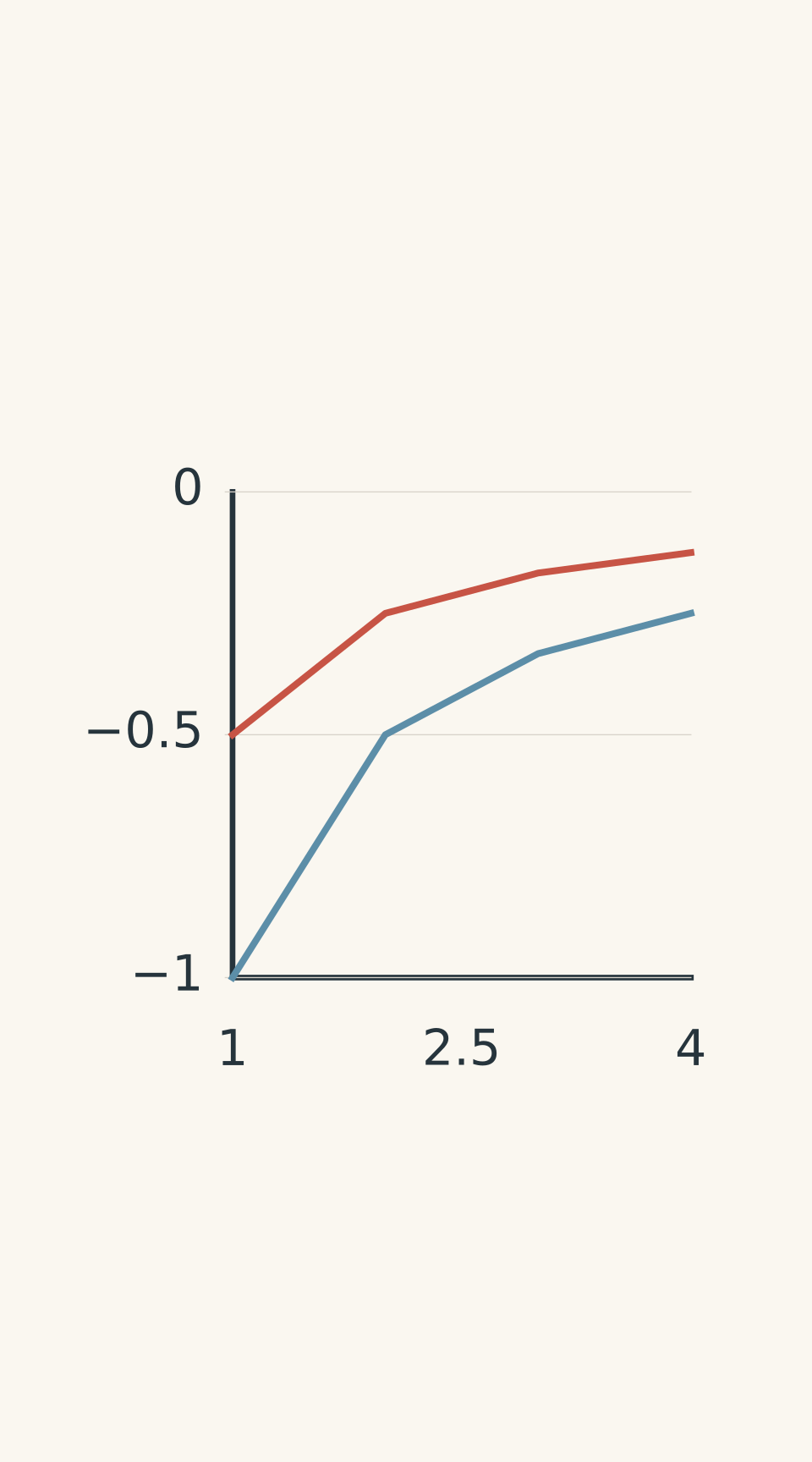
- Gravitational potential energy, U
- Total mechanical energy, E
Marking guide:
- (a) Correct total-energy relationship: 1 mark; correct lower-orbit energy: 1 mark; correct higher-orbit energy: 1 mark.
- (b) Correct subtraction and energy change: 1 mark.
- (c) Correct kinetic-energy trend: 1 mark; correct potential-energy trend and explanation of the increase in total energy: 1 mark.
Total: 6 marks.
Solution 13
(a) Deriving escape velocity
At the minimum escape speed, the object reaches infinity with zero final speed in the ideal model.
Gravitational potential energy is defined as zero at infinity. Therefore, the total mechanical energy at infinity is zero.
At the starting position, the total energy is
\[ E=\frac12 mv_{\mathrm{esc}}^2-\frac{GMm}{r} \]
Setting the initial total energy equal to zero gives
\[ \frac12 mv_{\mathrm{esc}}^2-\frac{GMm}{r}=0 \]
Rearranging,
\[ \frac12 mv_{\mathrm{esc}}^2=\frac{GMm}{r} \]
Cancel the object mass \(m\):
\[ v_{\mathrm{esc}}^2=\frac{2GM}{r} \]
Therefore,
\[ \boxed{v_{\mathrm{esc}}=\sqrt{\frac{2GM}{r}}} \]
(b) Calculating escape velocity
Substitute the planet’s mass and the starting radius:
\[ v_{\mathrm{esc}}= \sqrt{\frac{2(6.67\times10^{-11})(5.0\times10^{24})} {7.0\times10^6}} \]
\[ v_{\mathrm{esc}}=9.76\times10^3\ \mathrm{m\,s^{-1}} \]
Answer: \(9.76\ \mathrm{km\,s^{-1}}\).
Marking guide:
- (a) Correct conservation-of-energy setup: 1 mark; correct derivation: 1 mark.
- (b) Correct substitution: 1 mark; correct escape velocity: 1 mark.
Total: 4 marks.
Solution 14
(a) Conditions for a geostationary orbit
A geostationary satellite must have all four of the following properties:
- A circular orbit.
- An orbital period equal to Earth’s rotation period, approximately 23 hours and 56 minutes. A value of 24 hours is a common approximation.
- An orbit in the plane of Earth’s equator.
- Motion in the same direction as Earth’s rotation, from west to east.
These conditions allow the satellite to remain above the same point on Earth’s surface.
(b) Practical use
A geostationary satellite can relay telecommunications signals. Because it remains above approximately the same location, ground stations can maintain a continuous link without tracking a satellite moving across the sky.
Marking guide:
- (a) One mark for each of the four orbital conditions.
- (b) Identifies a valid practical use and links it to the satellite’s fixed position relative to Earth: 1 mark.
Total: 5 marks.
Solution 15
(a) Kepler’s three laws
Kepler’s first law: Each planet follows an elliptical orbit with the Sun at one focus of the ellipse.
Kepler’s second law: A line joining a planet to the Sun sweeps out equal areas in equal time intervals. Consequently, a planet moves faster when it is closer to the Sun and slower when it is farther away.
Kepler’s third law: The square of a planet’s orbital period is proportional to the cube of the semi-major axis of its orbit:
\[ T^2\propto a^3 \]
Here, \(T\) is the orbital period and \(a\) is the semi-major axis, which describes the size of the ellipse.
(b) Comparing orbital periods
For two objects orbiting the same central body,
\[ \frac{T_B^2}{T_A^2} =\frac{a_B^3}{a_A^3} \]
Since \(a_B=2a_A\),
\[ \frac{T_B^2}{T_A^2} =\frac{(2a_A)^3}{a_A^3}=8 \]
Taking the square root,
\[ \frac{T_B}{T_A}=\sqrt{8}=2.83 \]
Answer: Object B’s orbital period is approximately \(2.83\) times that of object A.
(c) Newtonian form of Kepler’s third law
Newtonian gravitation gives the more specific relationship
\[ \boxed{T^2=\frac{4\pi^2a^3}{GM}} \]
where \(G\) is the universal gravitational constant and \(M\) is the central body’s mass. The period depends on the central mass as well as the orbital size.
For a circular orbit, the semi-major axis \(a\) is equal to the orbital radius \(r\).
Marking guide:
- (a) Correct first law: 1 mark; correct second law: 1 mark; correct third law: 1 mark.
- (b) Correct use of the period-radius relationship: 1 mark; correct period ratio: 1 mark.
- (c) Correct Newtonian form of Kepler’s third law: 1 mark.
Total: 6 marks.
Solution 16
(a) Work done by centripetal force
Work depends on the component of force acting along a displacement. In uniform circular motion, the centripetal force points towards the centre, while the instantaneous velocity and displacement are tangential to the circle.
The force is perpendicular to the instantaneous motion, so its work is zero.
(b) Effect on kinetic energy and speed
Because the centripetal force does no work, it does not change the object’s kinetic energy or speed. It changes the direction of the velocity instead.
Marking guide:
- (a) Correctly explains the perpendicular relationship and zero work: 1 mark.
- (b) States that kinetic energy and speed remain constant: 1 mark.
Total: 2 marks.
Solution 17
(a) Initial velocity components
The launch speed is \(14.0\ \mathrm{m\,s^{-1}}\), and the launch angle is \(40.0^\circ\).
\[ v_x=14.0\cos40.0^\circ =10.7\ \mathrm{m\,s^{-1}} \]
\[ v_{y0}=14.0\sin40.0^\circ =9.00\ \mathrm{m\,s^{-1}} \]
Answer: \(v_x=10.7\ \mathrm{m\,s^{-1}}\) and \(v_{y0}=9.00\ \mathrm{m\,s^{-1}}\).
(b) Time to reach the landing platform
The landing platform is \(2.0\ \mathrm{m}\) above the launch point, so
\[ y=v_{y0}t-\frac12gt^2 \]
Substituting the known values,
\[ 2.0=9.00t-4.90t^2 \]
Rearranging,
\[ 4.90t^2-9.00t+2.0=0 \]
The quadratic formula gives
\[ t=\frac{9.00\pm\sqrt{81.0-39.2}}{9.80} \]
The two solutions are approximately
\[ t=0.259\ \mathrm{s} \quad\text{or}\quad t=1.58\ \mathrm{s} \]
The earlier time corresponds to the ball passing the platform on its way up. The later time corresponds to the descending path specified in the question.
Answer: \(1.58\ \mathrm{s}\).
(c) Horizontal distance
The horizontal velocity remains constant:
\[ x=v_xt \]
\[ x=(10.7246)(1.578) =16.9\ \mathrm{m} \]
Answer: \(16.9\ \mathrm{m}\).
Marking guide:
- (a) Correct horizontal component: 1 mark; correct vertical component: 1 mark.
- (b) Correct vertical displacement equation: 1 mark; selects the descending root: 1 mark.
- (c) Correct horizontal distance: 1 mark.
Total: 5 marks.
Solution 18
(a) Time of flight
For a projectile that lands at its launch height, the total flight time is
\[ T=\frac{2v_0\sin\theta}{g} \]
For the \(30.0^\circ\) launch,
\[ T_{30}=\frac{2(20.0)\sin30.0^\circ}{9.80} =2.04\ \mathrm{s} \]
For the \(60.0^\circ\) launch,
\[ T_{60}=\frac{2(20.0)\sin60.0^\circ}{9.80} =3.53\ \mathrm{s} \]
Answers: \(2.04\ \mathrm{s}\) at \(30.0^\circ\) and \(3.53\ \mathrm{s}\) at \(60.0^\circ\).
(b) Maximum height
The maximum height above the launch point is
\[ h_{\max}=\frac{(v_0\sin\theta)^2}{2g} \]
For the \(30.0^\circ\) launch,
\[ h_{30}=\frac{(20.0\sin30.0^\circ)^2}{19.6} =5.10\ \mathrm{m} \]
For the \(60.0^\circ\) launch,
\[ h_{60}=\frac{(20.0\sin60.0^\circ)^2}{19.6} =15.3\ \mathrm{m} \]
Answer: \(5.10\ \mathrm{m}\) at \(30.0^\circ\) and \(15.3\ \mathrm{m}\) at \(60.0^\circ\).
The \(60.0^\circ\) launch has a larger initial vertical velocity component. It therefore takes longer to reach the point where vertical velocity is zero and reaches a greater maximum height.
(c) Horizontal range
For a projectile that lands at its launch height, the horizontal range is
\[ R=\frac{v_0^2\sin2\theta}{g} \]
For the \(30.0^\circ\) launch,
\[ R_{30}=\frac{(20.0)^2\sin60.0^\circ}{9.80} =35.3\ \mathrm{m} \]
For the \(60.0^\circ\) launch,
\[ R_{60}=\frac{(20.0)^2\sin120.0^\circ}{9.80} =35.3\ \mathrm{m} \]
The ranges are equal because \(\sin60.0^\circ=\sin120.0^\circ\).
Answer: Both launches have a horizontal range of \(35.3\ \mathrm{m}\).
(d) Maximum-range angle
For fixed initial speed and equal launch and landing heights, the maximum range occurs at a launch angle of \(45.0^\circ\), provided air resistance is negligible.
This follows because the range depends on \(\sin2\theta\), which reaches its maximum value of 1 when \(2\theta=90^\circ\).
Marking guide:
- (a) Correct time of flight at \(30.0^\circ\): 1 mark; correct time at \(60.0^\circ\): 1 mark.
- (b) Correct maximum-height values: 1 mark; explains the difference using the vertical velocity component: 1 mark.
- (c) Correct range calculation: 1 mark; explains why the ranges are equal: 1 mark.
- (d) Correct maximum-range angle: 1 mark.
Total: 7 marks.