
Buffers and Acid-Base Equilibria: HSC Chemistry Practice Exam
Test your understanding with an original 50-mark, 60-minute tutorgum practice paper on buffers, weak-acid equilibria, and acid-base neutralisation. Includes exam-style questions, complete worked solutions, and a detailed marking guide.
This original tutorgum practice paper assesses buffers, weak-acid and weak-base equilibria, and the neutralisation of strong and weak acids and bases. You will work with particle models, symbolic equations, pH data, and equilibrium calculations. This is a focused topic paper, not a full-course mock exam. It is an original tutorgum resource, not an official NESA paper, an endorsed resource, a past paper, or a prediction of an HSC exam.
01Exam instructions
Suggested reading time: 5 minutes
Suggested working time: 60 minutes
Total marks: 50
Permitted equipment: Scientific calculator, ruler, and writing materials. No notes or internet access.
Assessed scope
- Particle, symbolic, and graphical models of neutralisation involving strong and weak acids and bases.
- Acid-base equilibria, including the ionisation of weak acids and bases.
- Buffer composition, pH calculations, buffer action, and buffer capacity.
- The effects of dilution, added common ions, and small additions of strong acid or base on equilibrium systems.
This paper excludes other Chemistry topics, including redox chemistry, organic reaction pathways, electrochemistry, and solubility equilibria.
Conditions and conventions
- Assume a temperature of \(25^\circ\mathrm{C}\) unless stated otherwise.
- Use \(K_w=1.0\times10^{-14}\) and \(pH+pOH=14.00\) at \(25^\circ\mathrm{C}\).
- Assume ideal dilute solutions. Treat strong acids, strong bases, and soluble ionic salts as fully dissociated.
- Assume volumes are additive unless a question states that volume changes are negligible.
- For buffer calculations, assume the equilibrium concentrations of the conjugate acid-base pair remain close to their concentrations after any stated neutralisation reaction.
- Check the validity of any approximation used in a weak-acid or weak-base equilibrium calculation.
- Report pH to two decimal places and other numerical answers to three significant figures unless stated otherwise.
- Show working, include units where appropriate, and write chemical equations with correct formulas, charges, and equilibrium arrows.
These are the conditions for this practice paper, not claims about official examination rules.
02Questions
Question 1 (8 marks)
Two monoprotic acids, HA and HX, are dissolved separately. Both samples have the same formal concentration and volume. Their equilibrium particle models are shown below.
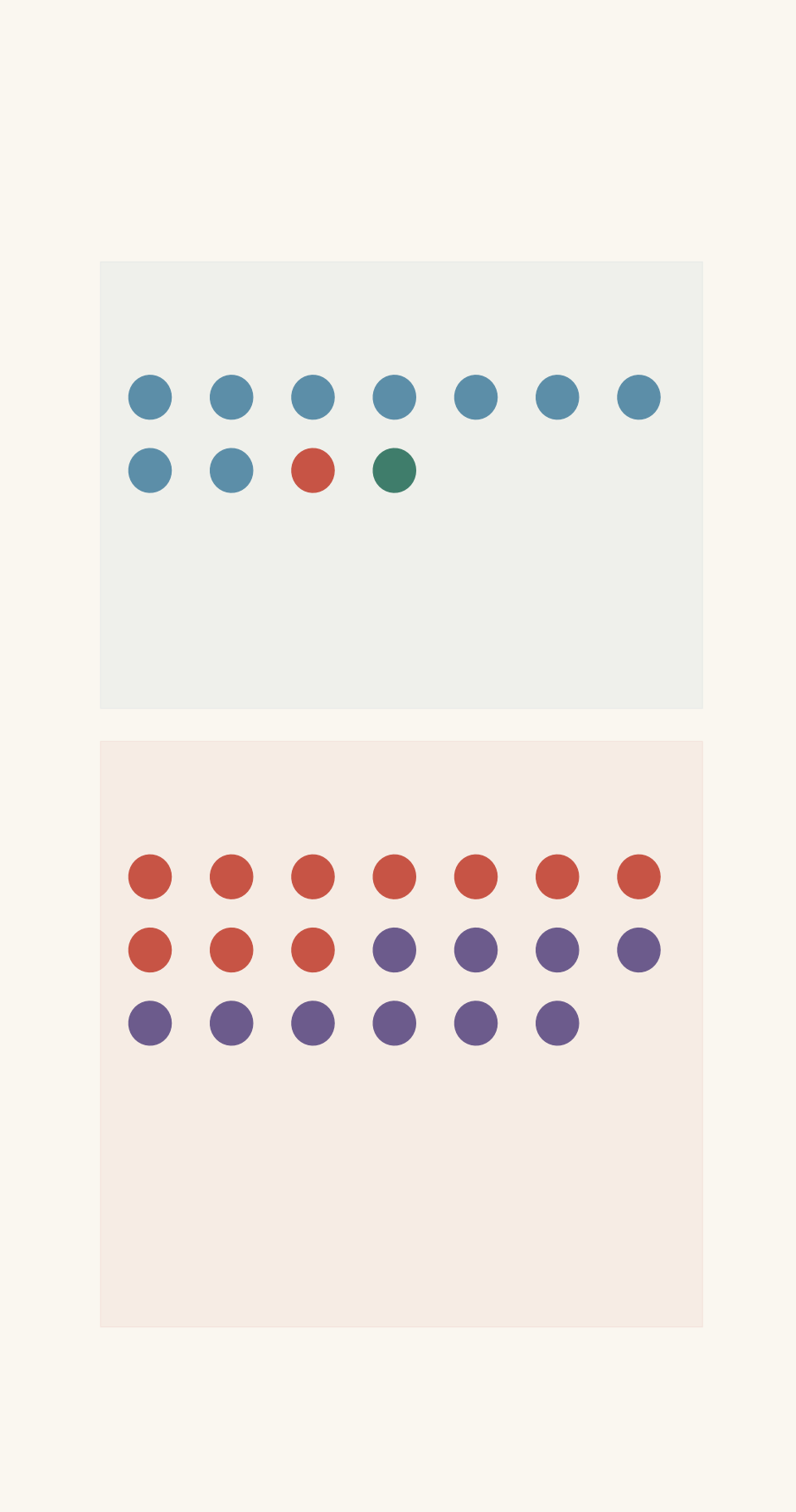
- HA molecules
- H₃O⁺ ions
- A⁻ ions
- X⁻ ions
(a) Identify which sample represents a strong acid. Justify your choice using the particle model. (2 marks)
(b) Write the ionisation equation for each acid in water. Use an appropriate arrow for each acid. (2 marks)
(c) Write the net ionic equation for the neutralisation of each acid by hydroxide ions, \(\mathrm{OH}^{-}\). (2 marks)
(d) Calculate the volume of \(0.100\ \mathrm{mol\,L^{-1}}\) NaOH required to neutralise \(25.0\ \mathrm{mL}\) of either \(0.100\ \mathrm{mol\,L^{-1}}\) acid. Explain why the required volume is the same for both acids. (2 marks)
Question 2 (10 marks)
Two \(25.0\ \mathrm{mL}\) samples of monoprotic acids are titrated separately with \(0.100\ \mathrm{mol\,L^{-1}}\) NaOH. The pH is recorded as the volume of NaOH added increases.
The measured data are shown below.
| Volume of NaOH added (mL) | Curve P: pH | Curve Q: pH |
|---|---|---|
| 0 | 1.00 | 2.88 |
| 10 | 1.37 | 4.57 |
| 24 | 2.69 | 6.12 |
| 25 | 7.00 | 8.72 |
| 26 | 11.29 | 11.29 |
| 40 | 12.36 | 12.36 |
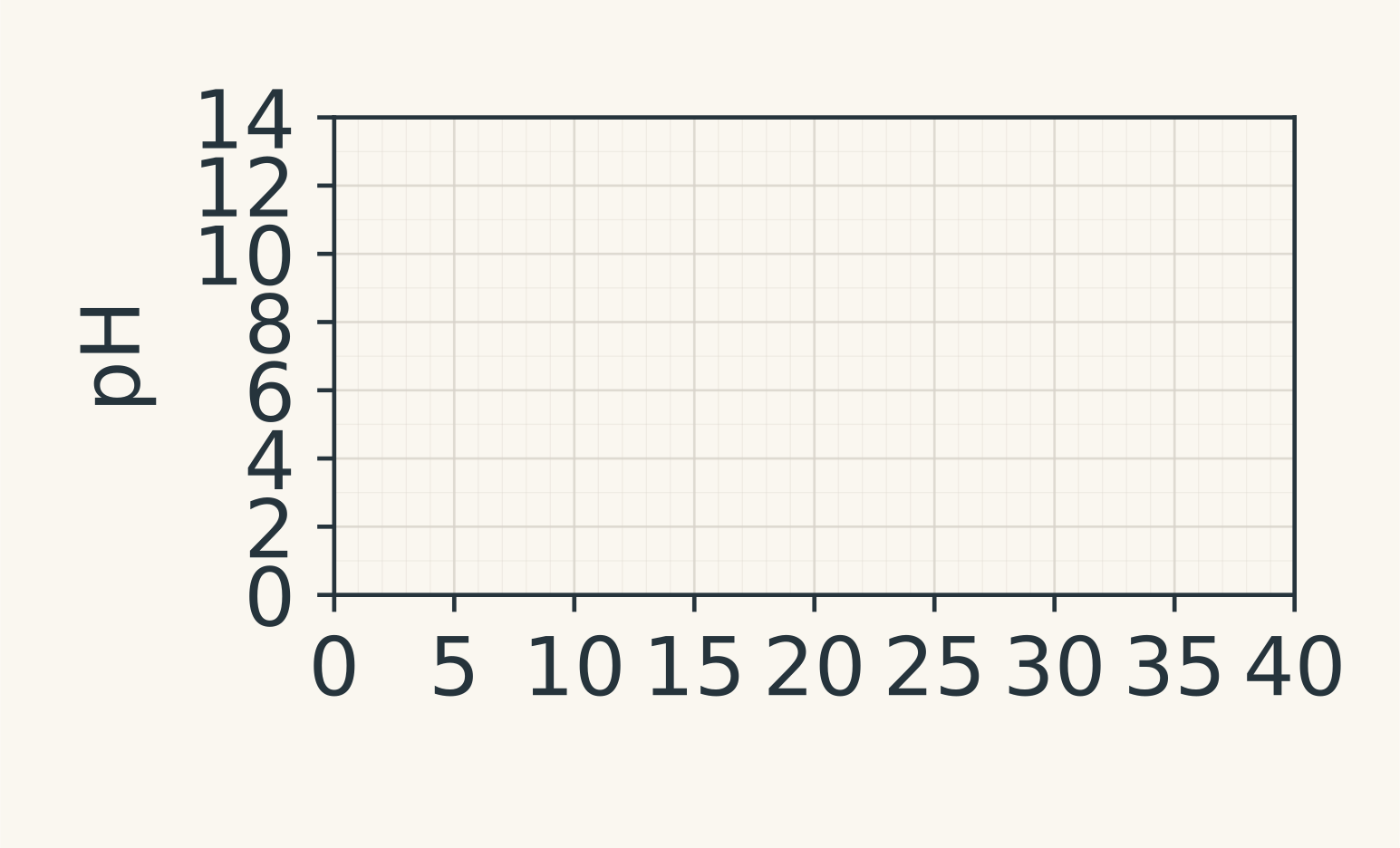
(a) Plot both data sets on the supplied axes. Join the points with smooth curves and label each curve P or Q. (3 marks)
(b) Identify which curve represents the strong acid and which represents the weak acid. Support your answer using features of the data. (2 marks)
(c) Calculate the initial amount, in moles, of acid in each sample using the equivalence volume and the NaOH concentration. (2 marks)
(d) Explain why the equivalence point for the weak-acid titration has a pH above 7. Include a relevant equilibrium equation. (2 marks)
(e) Explain why both curves have the same pH at \(26\ \mathrm{mL}\) of added NaOH. (1 mark)
Question 3 (10 marks)
A buffer is prepared by dissolving \(0.200\ \mathrm{mol}\) of ethanoic acid, \(\ce{CH3COOH}\), and \(0.150\ \mathrm{mol}\) of sodium ethanoate, \(\ce{CH3COONa}\), to make \(1.00\ \mathrm{L}\) of solution.
At \(25^\circ\mathrm{C}\), the acid dissociation constant is
\[ K_a=1.8\times10^{-5} \]
Treat sodium ethanoate as fully dissociated. Assume volume changes are negligible when strong acid is added.
(a) Write the equilibrium equation for ethanoic acid ionising in water and the corresponding expression for \(K_a\). (2 marks)
(b) Calculate the initial pH of the buffer. Show how you use the equilibrium expression and state the approximation made. (3 marks)
(c) A small amount of hydrochloric acid is added. The addition supplies \(0.0100\ \mathrm{mol}\) of HCl. Calculate the new amounts of ethanoic acid and ethanoate ions, then determine the new pH. (3 marks)
(d) Explain why the buffer’s pH changes only slightly after this addition. Identify one condition under which the buffer would lose its effectiveness. (2 marks)
Question 4 (8 marks)
An aqueous buffer contains \(0.100\ \mathrm{mol\,L^{-1}}\) ammonia, \(\ce{NH3}\), and \(0.0500\ \mathrm{mol\,L^{-1}}\) ammonium chloride, \(\ce{NH4Cl}\).
At \(25^\circ\mathrm{C}\),
\[ K_b(\ce{NH3})=1.8\times10^{-5} \]
Treat ammonium chloride as fully dissociated. Assume the equilibrium concentrations of ammonia and ammonium ions remain close to their stated concentrations when calculating the initial pH.
(a) Write the equilibrium equation for ammonia reacting with water and the corresponding expression for \(K_b\). (2 marks)
(b) Calculate the initial pH of the buffer. Show your calculation of hydroxide ion concentration, pOH, and pH. (3 marks)
(c) A small amount of ammonium chloride is added, with negligible change in volume. Predict the effect on pH and explain your answer using equilibrium principles. (2 marks)
(d) Write a net ionic equation showing how ammonia reacts with added hydronium ions. (1 mark)
Question 5 (14 marks)
A weak monoprotic acid, HA, is dissolved in water to produce a solution with a formal concentration of \(0.100\ \mathrm{mol\,L^{-1}}\).
At \(25^\circ\mathrm{C}\),
\[ K_a=2.0\times10^{-5} \]
Assume ideal dilute-solution behaviour and neglect the contribution of water autoionisation to the hydronium ion concentration.
(a) Use an equilibrium calculation to determine the pH of the original solution. Assess whether the small-\(x\) approximation is justified. (5 marks)
(b) A \(5.00\ \mathrm{mL}\) portion of the original solution is diluted to a final volume of \(25.0\ \mathrm{mL}\).
Calculate the new pH using an appropriate equilibrium method. State how the hydronium ion concentration and percentage ionisation compare with those in the original solution. (5 marks)
(c) Sodium salt \(\ce{NaA}\) is added to a fresh portion of the original acid solution. Assume negligible volume change. Predict the direction of the equilibrium shift and explain how the hydronium ion concentration changes. (2 marks)
(d) Compare the pH of the original weak-acid solution with that of a \(0.100\ \mathrm{mol\,L^{-1}}\) solution of a strong monoprotic acid. Explain the difference. (2 marks)
03Worked solutions and marking guide
Award follow-through marks where a student uses a correct method consistently with an earlier numerical result. Accept mathematically equivalent methods, appropriate significant figures, and sensible rounding.
Solution 1
(a) Sample B represents the strong acid. All ten acid formula units are represented by hydronium ions and conjugate-base ions, with no undissociated HX molecules. Sample A contains mostly undissociated HA molecules, indicating partial ionisation.
Marking: 1 mark for identifying Sample B; 1 mark for explaining the complete ionisation shown by its particles.
(b) The strong acid ionises essentially completely:
\[ \ce{HX + H2O -> H3O+ + X^-} \]
The weak acid establishes an equilibrium:
\[ \ce{HA + H2O <=> H3O+ + A^-} \]
The single forward arrow represents the essentially complete ionisation of the strong acid. The reversible arrow represents the partial ionisation of the weak acid.
Marking: 1 mark for each correctly written equation with an appropriate arrow.
(c) For the strong acid, neutralisation is represented by:
\[ \ce{H3O+ + OH^- -> 2H2O} \]
For the weak acid, hydroxide reacts directly with the acid molecules:
\[ \ce{HA + OH^- -> A^- + H2O} \]
As hydroxide removes acid from the weak-acid equilibrium, further HA ionises to replace some of the hydronium ions consumed.
Marking: 1 mark for each correct net ionic equation.
(d) Calculate the amount of acid initially present:
\[ \begin{aligned} n&=cV\\ &=(0.100)(0.0250)\\ &=2.50\times10^{-3}\ \mathrm{mol} \end{aligned} \]
Both acids are monoprotic, so one mole of acid requires one mole of NaOH for complete neutralisation.
Therefore,
\[ \begin{aligned} V(\ce{NaOH})&=\frac{n}{c}\\ &=\frac{2.50\times10^{-3}}{0.100}\\ &=0.0250\ \mathrm{L}\\ &=25.0\ \mathrm{mL} \end{aligned} \]
The required volume is the same because both samples contain the same amount of monoprotic acid. Their different degrees of ionisation do not change the overall neutralisation stoichiometry.
Marking: 1 mark for the correct stoichiometric calculation and volume; 1 mark for explaining why the volume is the same.
Solution 2
(a) The two curves should pass through the supplied points.
- Curve P must begin at pH 1.00, rise sharply near \(25\ \mathrm{mL}\), and pass through pH 7.00 at equivalence.
- Curve Q must begin at pH 2.88, rise through the buffer region, and pass through pH 8.72 at equivalence.
- Both curves approach the same pH after equivalence.
Marking: 1 mark for accurately plotting curve P; 1 mark for accurately plotting curve Q; 1 mark for smooth, correctly labelled curves.
(b) Curve P represents the strong acid, while curve Q represents the weak acid.
Curve P starts at the lower pH, consistent with a greater initial hydronium ion concentration. Its equivalence point is at pH 7.00. Curve Q starts at a higher pH and has an equivalence point above 7, which is characteristic of a weak acid titrated with a strong base.
Marking: 1 mark for correctly identifying both curves; 1 mark for supporting the identification with the graph’s features.
(c) Both titrations reach equivalence at \(25.0\ \mathrm{mL}\) of NaOH added.
The amount of NaOH added is
\[ \begin{aligned} n(\mathrm{OH}^{-})&=cV\\ &=(0.100)(0.0250)\\ &=2.50\times10^{-3}\ \mathrm{mol} \end{aligned} \]
Each acid is monoprotic, so the acid and hydroxide react in a 1:1 mole ratio.
Therefore, the initial amount of acid in each sample is
\[ \boxed{n(\text{acid})=2.50\times10^{-3}\ \mathrm{mol}} \]
Marking: 1 mark for using the equivalence volume and 1:1 stoichiometry; 1 mark for the correct amount of acid.
(d) At the weak acid’s equivalence point, most of the original HA has been converted into its conjugate base, \(\mathrm{A}^{-}\).
The conjugate base reacts with water:
\[ \ce{A^- + H2O <=> HA + OH^-} \]
This reaction produces hydroxide ions, making the solution basic. Therefore, the equivalence-point pH is above 7.
Marking: 1 mark for the correct hydrolysis equation; 1 mark for linking hydroxide production to a pH above 7.
(e) After equivalence, excess NaOH determines the hydronium and hydroxide balance. Since both titrations have the same initial acid amount and use the same NaOH concentration, the excess hydroxide concentration is the same at the same added volume.
Marking: 1 mark for identifying excess hydroxide from NaOH as the dominant factor.
Solution 3
(a) Ethanoic acid ionises according to
\[ \ce{CH3COOH + H2O <=> H3O+ + CH3COO^-} \]
The acid dissociation constant is
\[ K_a= \frac{[\ce{H3O+}][\mathrm{CH_{3}COO}^{-}]} {[\ce{CH3COOH}]} \]
Water is omitted from the expression because its concentration is effectively constant.
Marking: 1 mark for the correct equilibrium equation; 1 mark for the correct \(K_a\) expression.
(b) The solution volume is \(1.00\ \mathrm{L}\), so the initial concentrations are
\[ [\ce{CH3COOH}]=0.200\ \mathrm{mol\,L^{-1}} \]
\[ [\mathrm{CH_{3}COO}^{-}]=0.150\ \mathrm{mol\,L^{-1}} \]
In a buffer, the hydronium ion concentration is small compared with the concentrations of both buffer components. We can therefore approximate their equilibrium concentrations by their stated concentrations.
Rearranging the \(K_a\) expression gives
\[ \begin{aligned} [\ce{H3O+}]&\approx K_a\frac{[\ce{CH3COOH}]}{[\mathrm{CH_{3}COO}^{-}]}\\ &=(1.8\times10^{-5})\frac{0.200}{0.150}\\ &=2.40\times10^{-5}\ \mathrm{mol\,L^{-1}} \end{aligned} \]
Hence,
\[ \begin{aligned} pH&=-\log_{10}[\ce{H3O+}]\\ &=-\log_{10}(2.40\times10^{-5})\\ &=\boxed{4.62} \end{aligned} \]
Marking: 1 mark for rearranging and applying the equilibrium expression; 1 mark for the hydronium ion concentration; 1 mark for the pH.
(c) Added HCl supplies hydronium ions, which react with ethanoate ions:
\[ \ce{CH3COO^- + H3O+ -> CH3COOH + H2O} \]
The reaction consumes \(0.0100\ \mathrm{mol}\) of ethanoate and produces the same amount of ethanoic acid.
The new amounts are
\[ \begin{aligned} n(\mathrm{CH_{3}COO}^{-})&=0.150-0.0100\\ &=0.140\ \mathrm{mol} \end{aligned} \]
\[ \begin{aligned} n(\ce{CH3COOH})&=0.200+0.0100\\ &=0.210\ \mathrm{mol} \end{aligned} \]
Since the final volume is still approximately \(1.00\ \mathrm{L}\), the numerical values of the concentrations are \(0.140\ \mathrm{mol\,L^{-1}}\) and \(0.210\ \mathrm{mol\,L^{-1}}\), respectively.
Using the same buffer approximation,
\[ \begin{aligned} [\ce{H3O+}]&\approx(1.8\times10^{-5})\frac{0.210}{0.140}\\ &=2.70\times10^{-5}\ \mathrm{mol\,L^{-1}} \end{aligned} \]
Therefore,
\[ pH=-\log_{10}(2.70\times10^{-5}) =\boxed{4.57} \]
The pH decreases from 4.62 to 4.57.
Marking: 1 mark for the correct reaction and updated amounts; 1 mark for the correct new pH calculation, including the equilibrium ratio; 1 mark for the final pH and comparison with the initial value.
(d) The buffer’s ethanoate ions react with most of the added hydronium ions, converting them into ethanoic acid. This changes the ratio of conjugate base to weak acid only slightly, so the pH changes only slightly.
The buffer has limited capacity. If enough strong acid is added to consume most of the ethanoate ions, the solution can no longer remove added hydronium ions effectively.
Marking: 1 mark for explaining how the conjugate base consumes added acid; 1 mark for identifying depletion of the relevant buffer component as a limit.
Solution 4
(a) Ammonia reacts with water according to
\[ \ce{NH3 + H2O <=> NH4+ + OH^-} \]
The base dissociation constant is
\[ K_b=\frac{[\ce{NH4+}][\mathrm{OH}^{-}]}{[\ce{NH3}]} \]
Marking: 1 mark for the correct equilibrium equation; 1 mark for the correct \(K_b\) expression.
(b) Rearrange the equilibrium expression to calculate hydroxide ion concentration:
\[ \begin{aligned} [\mathrm{OH}^{-}]&\approx K_b\frac{[\ce{NH3}]}{[\ce{NH4+}]}\\ &=(1.8\times10^{-5})\frac{0.100}{0.0500}\\ &=3.60\times10^{-5}\ \mathrm{mol\,L^{-1}} \end{aligned} \]
Calculate pOH:
\[ pOH=-\log_{10}(3.60\times10^{-5})=4.44 \]
At \(25^\circ\mathrm{C}\),
\[ \begin{aligned} pH&=14.00-pOH\\ &=14.00-4.44\\ &=\boxed{9.56} \end{aligned} \]
The pH is above 7 because ammonia is a weak base and the buffer contains ammonia and its conjugate acid, ammonium.
Marking: 1 mark for the hydroxide ion concentration; 1 mark for pOH; 1 mark for the correct pH.
(c) Adding \(\ce{NH4Cl}\) increases the concentration of \(\ce{NH4+}\), a product of the ammonia equilibrium.
The equilibrium shifts to the left, suppressing ammonia’s ionisation and reducing the hydroxide ion concentration. The pH therefore decreases.
Marking: 1 mark for identifying the common-ion effect and equilibrium shift; 1 mark for predicting and explaining the decrease in pH.
(d) Ammonia reacts with added hydronium ions according to
\[ \ce{NH3 + H3O+ -> NH4+ + H2O} \]
Marking: 1 mark for the correct net ionic equation.
Solution 5
(a) The weak acid establishes the equilibrium
\[ \ce{HA + H2O <=> H3O+ + A^-} \]
Let \(x\) be the equilibrium concentration of hydronium ions, in \(\mathrm{mol\,L^{-1}}\).
Ignoring water autoionisation, an equilibrium table is
| \(\ce{HA}\) | \(\ce{H3O+}\) | \(\mathrm{A}^{-}\) | |
|---|---|---|---|
| Initial | 0.100 | 0 | 0 |
| Change | \(-x\) | \(+x\) | \(+x\) |
| Equilibrium | \(0.100-x\) | \(x\) | \(x\) |
The acid dissociation expression becomes
\[ K_a=\frac{x^2}{0.100-x}=2.0\times10^{-5} \]
Since the acid is weak, we can test the approximation \(x\ll0.100\). Taking \(0.100-x\approx0.100\) gives
\[ \begin{aligned} x&\approx\sqrt{K_aC}\\ &=\sqrt{(2.0\times10^{-5})(0.100)}\\ &=1.41\times10^{-3}\ \mathrm{mol\,L^{-1}} \end{aligned} \]
Thus,
\[ pH=-\log_{10}(1.41\times10^{-3}) =\boxed{2.85} \]
Check the percentage ionisation:
\[ \begin{aligned} \%\text{ ionisation} &\approx\frac{x}{C}\times100\\ &=\frac{1.41\times10^{-3}}{0.100}\times100\\ &=1.41\% \end{aligned} \]
Only about \(1.41\%\) of the acid is ionised, so the small-\(x\) approximation is justified.
Marking: 1 mark for the equilibrium equation and correct \(K_a\) expression; 1 mark for setting up the equilibrium calculation; 1 mark for the hydronium ion concentration; 1 mark for the pH; 1 mark for checking percentage ionisation and validating the approximation.
(b) The original solution is diluted fivefold because \(5.00\ \mathrm{mL}\) becomes \(25.0\ \mathrm{mL}\).
The new formal concentration is
\[ \begin{aligned} C_2&=C_1\frac{V_1}{V_2}\\ &=0.100\frac{5.00}{25.0}\\ &=0.0200\ \mathrm{mol\,L^{-1}} \end{aligned} \]
Using the same small-\(x\) approximation,
\[ \begin{aligned} [\ce{H3O+}]&\approx\sqrt{K_aC_2}\\ &=\sqrt{(2.0\times10^{-5})(0.0200)}\\ &=6.32\times10^{-4}\ \mathrm{mol\,L^{-1}} \end{aligned} \]
The new pH is
\[ pH=-\log_{10}(6.32\times10^{-4}) =\boxed{3.20} \]
The hydronium ion concentration decreases from approximately \(1.41\times10^{-3}\) to \(6.32\times10^{-4}\ \mathrm{mol\,L^{-1}}\), so the pH rises from 2.85 to 3.20.
However, the percentage ionisation increases:
\[ \begin{aligned} \%\text{ ionisation} &\approx\frac{6.32\times10^{-4}}{0.0200}\times100\\ &=3.16\% \end{aligned} \]
Dilution lowers the hydronium ion concentration but increases the fraction of acid molecules that ionise. The percentage ionisation is still below 5%, so the approximation remains reasonable.
Solving the full quadratic instead gives a pH of approximately 3.21 and a percentage ionisation of \(3.11\%\). Both approaches are acceptable when the method and approximation are justified.
Marking: 1 mark for the new formal concentration; 1 mark for the equilibrium calculation; 1 mark for the new pH; 1 mark for correctly comparing hydronium ion concentrations and pH values; 1 mark for showing that percentage ionisation increases.
(c) Adding \(\ce{NaA}\) increases the concentration of \(\mathrm{A}^{-}\), a product of the weak-acid equilibrium:
\[ \ce{HA + H2O <=> H3O+ + A^-} \]
The equilibrium shifts to the left, consuming hydronium ions and forming more HA. Therefore, the hydronium ion concentration decreases and the pH rises.
Marking: 1 mark for identifying the leftward equilibrium shift; 1 mark for explaining that the hydronium ion concentration decreases.
(d) A \(0.100\ \mathrm{mol\,L^{-1}}\) strong monoprotic acid ionises essentially completely. Its hydronium ion concentration is approximately \(0.100\ \mathrm{mol\,L^{-1}}\), giving
\[ pH=-\log_{10}(0.100)=1.00 \]
The weak acid has a pH of approximately 2.85, which is higher. This is because only a small fraction of its acid molecules ionise, producing a much lower hydronium ion concentration than the strong acid.
Marking: 1 mark for the strong acid pH and complete-ionisation reasoning; 1 mark for comparing it with the weak acid and explaining the difference.