
Year 12 Physics Advanced Mechanics: 80-Mark Practice Exam
Prepare for Year 12 Physics with this original 80-mark Advanced Mechanics practice exam. Complete 10 mixed-topic questions under timed conditions, then check your working against detailed solutions and a question-by-question marking guide.
This is an original tutorgum practice paper for Year 12 Physics, covering the Advanced Mechanics content area of the 2025 syllabus edition specified in this brief. It combines projectile motion, circular motion, gravitation, and orbital mechanics in a timed assessment, with all questions presented before the worked solutions and marking guide.
01Exam instructions
Practice paper conditions
- Suggested reading time: 5 minutes.
- Suggested working time: 120 minutes.
- Total marks: 80.
- Permitted equipment: scientific calculator, ruler, and blank graph paper.
- Show your working, include units, and give numerical answers to three significant figures unless otherwise appropriate.
- Use degree mode for angles. Assume all projectile launch angles are measured above the horizontal.
- These are conditions for this original tutorgum practice paper, not claims about official NESA examination requirements.
Assessed syllabus scope
This paper assesses the supplied 2025-edition Year 12 Advanced Mechanics content:
- Projectile motion: velocity components, flight time, maximum height, horizontal range, launch height, launch-angle effects, assumptions, and experimental validation.
- Projectile technologies of Aboriginal and Torres Strait Islander Peoples, considered through an appropriate physical model and its limitations.
- Circular motion: centripetal acceleration and force, tension and weight, friction on flat bends, speed, radius, period, and motion after the centripetal force is removed.
- Gravitation: Newton’s law of universal gravitation, gravitational field strength, surface gravity, and gravitational potential energy.
- Orbital mechanics: circular orbital speed, orbital period, Kepler’s three laws, geostationary orbits, total orbital energy, energy changes between circular orbits, and escape velocity.
Exclusions: Content from other syllabus editions or unrelated modules, quantitative air-resistance modelling, detailed numerical calculations for elliptical orbits, and detailed burn-by-burn orbital transfer manoeuvres. Qualitative elliptical-orbit behaviour and energy changes between circular orbits are included.
Constants and assumptions
Use the following values unless a question provides different information:
\[ G=6.67\times10^{-11} \ \mathrm{N\,m^2\,kg^{-2}} \]
\[ g=9.80\ \mathrm{m\,s^{-2}} \]
Here, \(G\) is the universal gravitational constant, and \(g\) is the gravitational acceleration used for projectile calculations near Earth’s surface.
Assume negligible air resistance for projectile calculations unless discussing model limitations. For gravitational calculations, treat planets as spherical and use distances measured from their centres. For satellite calculations, assume the satellite’s mass is negligible compared with the central body’s mass unless stated otherwise.
02Questions
Question 1 (8 marks)
A ball is launched from level ground at a speed of \(24.0\ \mathrm{m\,s^{-1}}\), at an angle of \(35.0^\circ\) above the horizontal. It lands at the same height from which it was launched.
Assume that air resistance is negligible and that gravitational acceleration is constant.
(a) Resolve the initial velocity into its horizontal and vertical components. (2 marks)
(b) Calculate the total time of flight. (2 marks)
(c) Calculate the horizontal range of the ball. (2 marks)
(d) Calculate the speed and direction of the ball immediately before it lands. (2 marks)
Question 2 (10 marks)
A ball is launched from a platform \(12.0\ \mathrm{m}\) above level ground with an initial speed of \(18.0\ \mathrm{m\,s^{-1}}\), at an angle of \(40.0^\circ\) above the horizontal.
Assume that the ball lands on the ground below the platform and that air resistance is negligible.
(a) Calculate the initial horizontal and vertical velocity components. (2 marks)
(b) Calculate the time between launch and landing. (2 marks)
(c) Calculate the horizontal distance travelled from the point directly below the launch position to the landing point. (2 marks)
(d) Calculate the maximum height of the ball above the ground. (2 marks)
(e) For a fixed launch speed and equal launch and landing heights, explain how increasing the launch angle from \(20^\circ\) to \(45^\circ\) affects maximum height, flight time, and horizontal range. What happens to the range when the angle increases beyond \(45^\circ\)? (2 marks)
Question 3 (8 marks)
A mass of \(0.400\ \mathrm{kg}\) is attached to a string of length \(0.800\ \mathrm{m}\). It moves at constant speed in a horizontal circle, with the string held at an angle of \(25.0^\circ\) to the vertical.
Assume that the string remains taut and that the mass moves in a horizontal plane.
(a) Resolve the tension into vertical and horizontal components, and calculate the tension in the string. (2 marks)
(b) Calculate the radius of the horizontal circle. (1 mark)
(c) Calculate the speed of the mass. (2 marks)
(d) A car travels around a flat circular bend of radius \(55.0\ \mathrm{m}\). The coefficient of static friction between the tyres and the road is \(0.550\).
Calculate the maximum speed at which the car can travel around the bend without slipping. Determine whether a speed of \(15.0\ \mathrm{m\,s^{-1}}\) is possible. (3 marks)
Question 4 (6 marks)
A \(0.250\ \mathrm{kg}\) puck moves at a constant speed of \(4.00\ \mathrm{m\,s^{-1}}\) in a horizontal circle of radius \(0.500\ \mathrm{m}\) on a nearly frictionless table. A string attached to the puck is fixed at the centre of the circle.
(a) Calculate the centripetal acceleration of the puck. (1 mark)
(b) Calculate the net centripetal force and identify the real force supplying it. (2 marks)
(c) Calculate the period of the circular motion. (1 mark)
(d) The string suddenly breaks. Describe the puck’s immediate motion and explain why it follows this path. (2 marks)
Question 5 (8 marks)
A spherical planet has a mass of \(6.40\times10^{23}\ \mathrm{kg}\) and a radius of \(3.40\times10^6\ \mathrm{m}\).
(a) Calculate the gravitational field strength at the planet’s surface. (2 marks)
(b) Calculate the gravitational force acting on a \(72.0\ \mathrm{kg}\) astronaut standing on the surface. (2 marks)
(c) A \(1.20\times10^3\ \mathrm{kg}\) probe is located \(400\ \mathrm{km}\) above the planet’s surface. Calculate the gravitational force acting on the probe. (3 marks)
(d) Explain the difference between gravitational field strength and gravitational force. (1 mark)
Question 6 (11 marks)
A satellite of mass \(m\) orbits a planet of mass \(M=5.97\times10^{24}\ \mathrm{kg}\) in a circular orbit of radius \(r=7.20\times10^6\ \mathrm{m}\).
Assume that the satellite’s mass is negligible compared with the planet’s mass.
(a) Starting with Newton’s law of universal gravitation and the centripetal force relationship, derive an expression for the orbital speed. Calculate the satellite’s speed. (3 marks)
(b) Calculate the satellite’s orbital period in seconds and minutes. (2 marks)
(c) Use the relationship between orbital speed, radius, and period to derive the Newtonian form of Kepler’s third law for this satellite. State how the relationship generalises when both orbiting masses must be considered. (3 marks)
(d) A second satellite orbits the same planet at four times the original orbital radius. Determine the factor by which its orbital period changes. (1 mark)
(e) State Kepler’s first and second laws of planetary motion. (2 marks)
Question 7 (12 marks)
A satellite of mass \(900\ \mathrm{kg}\) moves between two circular orbits around a planet of mass \(M=5.97\times10^{24}\ \mathrm{kg}\).
Its initial orbital radius is
\[ r_1=7.00\times10^6\ \mathrm{m} \]
and its final orbital radius is
\[ r_2=1.40\times10^7\ \mathrm{m}. \]
Use the gravitational constant given in the exam instructions.
(a) For the initial circular orbit, calculate the satellite’s gravitational potential energy, kinetic energy, and total mechanical energy. (3 marks)
(b) Calculate the total mechanical energy in the final circular orbit. Hence, calculate the change in total orbital energy and explain whether energy must be supplied to or removed from the satellite to reach the higher orbit. (3 marks)
(c) Starting with conservation of energy, derive an expression for the escape velocity of an object launched from a distance \(r\) from the centre of a planet of mass \(M\). Assume that the object reaches infinity with zero final speed. (3 marks)
(d) Calculate the escape velocity from the surface of a planet with mass \(5.97\times10^{24}\ \mathrm{kg}\) and radius \(6.40\times10^6\ \mathrm{m}\). (2 marks)
(e) Explain the meaning of choosing gravitational potential energy to be zero at infinity. (1 mark)
Question 8 (6 marks)
Projectile technologies are diverse across Aboriginal and Torres Strait Islander Peoples and communities, and are connected to particular materials, purposes, and knowledge traditions. A woomera is one example of a spear-thrower associated with some Aboriginal Peoples; it does not represent all traditions.
Consider a hypothetical, community-authorised demonstration involving a practice spear. The following launch speeds are invented for this assessment and are not measurements of any community’s practice.
| Trial | Launch speed | Launch angle |
|---|---|---|
| Without a spear-thrower | \(17.0\ \mathrm{m\,s^{-1}}\) | \(35.0^\circ\) |
| With a spear-thrower | \(25.0\ \mathrm{m\,s^{-1}}\) | \(35.0^\circ\) |
Assume that both projectiles land at their launch height and that air resistance is negligible.
(a) Calculate the theoretical horizontal range without the spear-thrower. (2 marks)
(b) Calculate the theoretical horizontal range with the spear-thrower. (2 marks)
(c) Identify one conclusion that the physics model permits and one conclusion that it does not permit. Refer to a model assumption and the diversity of Aboriginal and Torres Strait Islander knowledge and technologies. (2 marks)
Question 9 (6 marks)
A group of students investigates how launch angle affects the horizontal range of a projectile.
The launcher is set to the same launch speed of \(10.0\ \mathrm{m\,s^{-1}}\) for every angle. The projectile lands at the same vertical height from which it was launched. Each reported range is the mean of five trials, and the estimated uncertainty in each mean is \(\pm0.2\ \mathrm{m}\).
| Launch angle | Mean horizontal range |
|---|---|
| \(20^\circ\) | \(6.5\ \mathrm{m}\) |
| \(30^\circ\) | \(8.9\ \mathrm{m}\) |
| \(40^\circ\) | \(10.0\ \mathrm{m}\) |
| \(50^\circ\) | \(9.9\ \mathrm{m}\) |
| \(60^\circ\) | \(8.8\ \mathrm{m}\) |
(a) Identify the independent and dependent variables. (1 mark)
(b) State two variables that should be controlled during the experiment. (1 mark)
(c) Calculate the theoretical horizontal range at a launch angle of \(30^\circ\). (2 marks)
(d) Evaluate whether the experimental results support the ideal projectile model. Refer to the data and its uncertainty. (1 mark)
(e) Suggest one improvement that would strengthen the validity or reliability of the experiment. (1 mark)
Question 10 (5 marks)
A satellite is intended to remain above the same longitude on Earth so that a ground station can maintain a continuous connection with it.
(a) State the required orbital shape and plane, direction of motion, and orbital period for a geostationary satellite. (3 marks)
(b) Explain why a satellite in this orbit appears stationary relative to an observer on Earth’s surface. (1 mark)
(c) Give one practical use of a geostationary satellite. (1 mark)
03Worked solutions and marking guide
Accept mathematically equivalent methods throughout. Where a later calculation correctly uses an earlier numerical result, award appropriate follow-through marks if the method remains consistent with the physical model.
Solution 1
(a) Initial velocity components
The horizontal component is \(v_x=v_0\cos\theta\), and the vertical component is \(v_y=v_0\sin\theta\).
\[ \begin{aligned} v_x&=24.0\cos35.0^\circ\\ &=19.7\ \mathrm{m\,s^{-1}}\\[4pt] v_y&=24.0\sin35.0^\circ\\ &=13.8\ \mathrm{m\,s^{-1}} \end{aligned} \]
Marking: 1 mark for each correctly calculated component.
(b) Time of flight
The ball lands at its launch height, so its net vertical displacement is zero. Using vertical motion,
\[ 0=v_yt-\frac12gt^2. \]
Ignoring the launch instant \(t=0\), the flight time is
\[ \begin{aligned} t&=\frac{2v_y}{g}\\ &=\frac{2(13.7658)}{9.80}\\ &=2.81\ \mathrm{s}. \end{aligned} \]
Marking: 1 mark for the correct vertical-motion relationship; 1 mark for the time.
(c) Horizontal range
Horizontal velocity remains constant because air resistance is neglected.
\[ \begin{aligned} R&=v_xt\\ &=(19.6596)(2.80935)\\ &=55.2\ \mathrm{m}. \end{aligned} \]
Marking: 1 mark for the horizontal displacement relationship and substitution; 1 mark for the range.
(d) Final speed and direction
The horizontal velocity is unchanged. Since the ball returns to its original height, its final vertical velocity has the same magnitude as its initial vertical velocity, but the opposite direction.
\[ v_{xf}=19.7\ \mathrm{m\,s^{-1}}, \qquad v_{yf}=-13.8\ \mathrm{m\,s^{-1}}. \]
The final speed is
\[ \begin{aligned} v_f&=\sqrt{v_{xf}^2+v_{yf}^2}\\ &=24.0\ \mathrm{m\,s^{-1}}. \end{aligned} \]
The direction is \(35.0^\circ\) below the horizontal.
Marking: 1 mark for the correct final velocity components or equivalent reasoning; 1 mark for the speed and direction.
Solution 2
(a) Initial velocity components
\[ \begin{aligned} v_x&=18.0\cos40.0^\circ\\ &=13.8\ \mathrm{m\,s^{-1}}\\[4pt] v_y&=18.0\sin40.0^\circ\\ &=11.6\ \mathrm{m\,s^{-1}} \end{aligned} \]
Marking: 1 mark for each component.
(b) Time of flight
Take upward as the positive vertical direction. The initial height is \(12.0\ \mathrm{m}\), and the final height is zero.
The vertical displacement equation is
\[ 0=12.0+11.5702t-4.90t^2. \]
Solving the quadratic and choosing the positive root gives
\[ t=3.14\ \mathrm{s}. \]
The negative root is not physically relevant because it corresponds to a time before launch.
Marking: 1 mark for the correct vertical-motion equation; 1 mark for the positive flight time.
(c) Horizontal distance
The horizontal velocity is constant throughout the flight.
\[ \begin{aligned} R&=v_xt\\ &=(13.7888)(3.14099)\\ &=43.3\ \mathrm{m}. \end{aligned} \]
Marking: 1 mark for the horizontal displacement calculation; 1 mark for the result.
(d) Maximum height
At the maximum height, the vertical velocity is zero. Using the vertical-motion relationship,
\[ v_y^2=u_y^2+2a_y\Delta y, \]
where \(u_y\) is the initial vertical velocity, \(v_y=0\) at the maximum height, and \(a_y=-g\).
The rise above the platform is
\[ \begin{aligned} \Delta y_{\max} &=\frac{u_y^2}{2g}\\ &=\frac{(11.5702)^2}{2(9.80)}\\ &=6.83\ \mathrm{m}. \end{aligned} \]
The platform is already \(12.0\ \mathrm{m}\) above the ground, so
\[ H_{\max}=12.0+6.83 =18.8\ \mathrm{m}. \]
Marking: 1 mark for the rise above the launch point; 1 mark for adding the launch height.
(e) Effect of launch angle
At fixed launch speed, increasing the angle from \(20^\circ\) to \(45^\circ\) increases the vertical velocity component. This increases both the maximum height and the time of flight.
For equal launch and landing heights, the range is described by
\[ R=\frac{v_0^2\sin2\theta}{g}. \]
The range is greatest at \(45^\circ\). Above \(45^\circ\), the range decreases because the projectile spends longer moving vertically while its horizontal velocity component becomes smaller.
Marking: 1 mark for the effects on maximum height and flight time; 1 mark for the maximum range at \(45^\circ\) and the decrease beyond it.
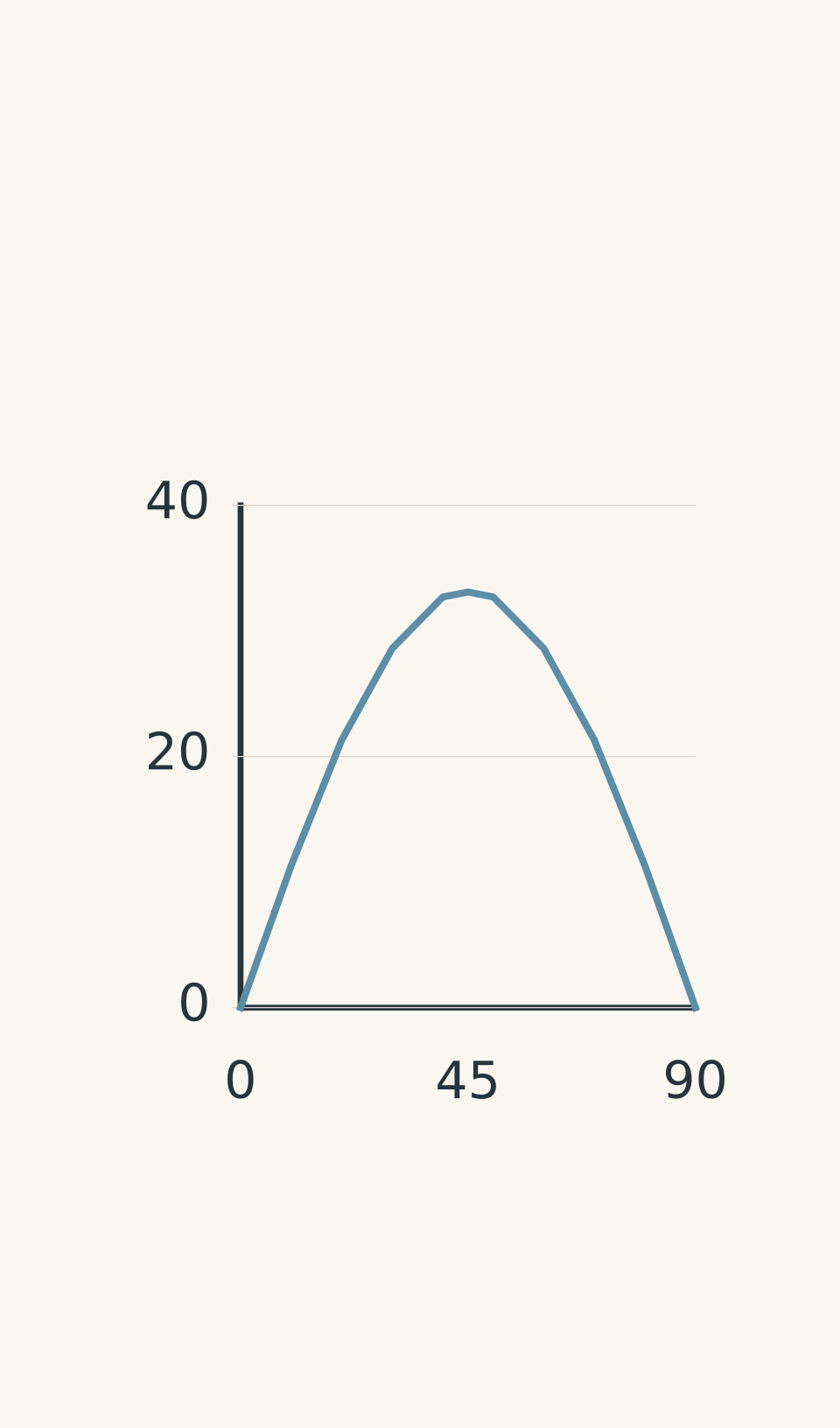
- Ideal range
Solution 3
(a) Tension in the string
The mass has no vertical acceleration. Therefore, the vertical component of tension balances its weight.
\[ T\cos\theta=mg. \]
Substituting the mass and angle,
\[ \begin{aligned} T&=\frac{mg}{\cos\theta}\\ &=\frac{0.400(9.80)}{\cos25.0^\circ}\\ &=4.33\ \mathrm{N}. \end{aligned} \]
The horizontal component, \(T\sin\theta\), points towards the centre of the circle and supplies the centripetal force.
Marking: 1 mark for resolving tension and applying the vertical force balance; 1 mark for the tension.
(b) Radius of the circle
The string length is the hypotenuse of the right triangle formed by the string and its vertical projection.
\[ \begin{aligned} r&=L\sin\theta\\ &=0.800\sin25.0^\circ\\ &=0.338\ \mathrm{m}. \end{aligned} \]
Marking: 1 mark for the correct radius.
(c) Speed of the mass
The horizontal component of tension supplies the centripetal force.
\[ T\sin\theta=\frac{mv^2}{r}. \]
Combining this with \(T\cos\theta=mg\) gives
\[ v=\sqrt{rg\tan\theta}. \]
Substitution gives
\[ \begin{aligned} v&=\sqrt{(0.338)(9.80)\tan25.0^\circ}\\ &=1.24\ \mathrm{m\,s^{-1}}. \end{aligned} \]
Marking: 1 mark for the correct horizontal force relationship or equivalent derivation; 1 mark for the speed.
(d) Maximum speed on the flat bend
On a flat bend, static friction supplies the centripetal force. The maximum available friction is
\[ F_{\mathrm{friction,max}}=\mu_s mg, \]
where \(\mu_s\) is the coefficient of static friction.
At the limiting speed,
\[ \frac{mv_{\max}^2}{r}=\mu_s mg. \]
The mass cancels, leaving
\[ \begin{aligned} v_{\max}&=\sqrt{\mu_sgr}\\ &=\sqrt{(0.550)(9.80)(55.0)}\\ &=17.2\ \mathrm{m\,s^{-1}}. \end{aligned} \]
Since \(15.0\ \mathrm{m\,s^{-1}}\) is less than the maximum speed, the car can maintain the turn without slipping under the stated conditions.
Marking: 1 mark for the friction and centripetal-force relationship; 1 mark for the maximum speed; 1 mark for the conclusion. An equivalent method that compares the required friction with the maximum available friction is acceptable.
Solution 4
(a) Centripetal acceleration
For uniform circular motion,
\[ \begin{aligned} a_c&=\frac{v^2}{r}\\ &=\frac{(4.00)^2}{0.500}\\ &=32.0\ \mathrm{m\,s^{-2}}. \end{aligned} \]
Marking: 1 mark for the correct calculation.
(b) Centripetal force
The net centripetal force is
\[ \begin{aligned} F_c&=ma_c\\ &=(0.250)(32.0)\\ &=8.00\ \mathrm{N}. \end{aligned} \]
The string tension supplies this inward horizontal force. The puck’s weight and the table’s normal force balance vertically.
Marking: 1 mark for the force calculation; 1 mark for identifying string tension as the real force supplying the centripetal force.
(c) Period
The period is the time required for one complete revolution. If \(T_p\) denotes the period,
\[ \begin{aligned} T_p&=\frac{2\pi r}{v}\\ &=\frac{2\pi(0.500)}{4.00}\\ &=0.785\ \mathrm{s}. \end{aligned} \]
Marking: 1 mark for the correct period.
(d) Motion after the string breaks
The string tension disappears, so the horizontal centripetal force is removed. The puck continues initially in the direction of its instantaneous velocity, which is tangent to the circle.
On the nearly frictionless table, it then moves in a straight line at approximately its instantaneous speed of \(4.00\ \mathrm{m\,s^{-1}}\). It does not move radially outwards: a centripetal force is needed to continually change the direction of its velocity, not to create its existing forward velocity.
Marking: 1 mark for identifying the tangential direction; 1 mark for explaining the loss of centripetal force and the resulting motion.
Solution 5
(a) Surface gravitational field strength
The gravitational field strength at distance \(R\) from a spherical planet’s centre is
\[ g_{\mathrm{surface}}=\frac{GM}{R^2}. \]
Substituting the planet’s mass and radius,
\[ \begin{aligned} g_{\mathrm{surface}} &=\frac{(6.67\times10^{-11})(6.40\times10^{23})} {(3.40\times10^6)^2}\\ &=3.69\ \mathrm{m\,s^{-2}}. \end{aligned} \]
This is also \(3.69\ \mathrm{N\,kg^{-1}}\).
Marking: 1 mark for the correct relationship; 1 mark for the numerical result.
(b) Force on the astronaut
The gravitational force on an object of mass \(m\) is \(F=mg_{\mathrm{surface}}\).
\[ \begin{aligned} F&=(72.0)(3.6927)\\ &=266\ \mathrm{N}. \end{aligned} \]
Marking: 1 mark for the force relationship; 1 mark for the result.
(c) Force on the probe
Gravitational force depends on the distance between the centres of the two bodies. The probe is \(400\ \mathrm{km}=4.00\times10^5\ \mathrm{m}\) above the surface, so its distance from the planet’s centre is
\[ \begin{aligned} r&=R+h\\ &=3.40\times10^6+4.00\times10^5\\ &=3.80\times10^6\ \mathrm{m}. \end{aligned} \]
Newton’s law of universal gravitation gives
\[ F=\frac{GMm}{r^2}. \]
Substituting the values,
\[ \begin{aligned} F&=\frac{(6.67\times10^{-11}) (6.40\times10^{23})(1.20\times10^3)} {(3.80\times10^6)^2}\\ &=3.55\times10^3\ \mathrm{N}. \end{aligned} \]
Marking: 1 mark for the correct centre-to-centre distance; 1 mark for the gravitational-force equation and substitution; 1 mark for the result.
(d) Field strength versus force
Gravitational field strength is the gravitational force per unit mass at a location. Its unit is \(\mathrm{N\,kg^{-1}}\).
Gravitational force is the actual force acting on a particular mass. At a given location, a larger mass experiences a proportionally larger gravitational force.
Marking: 1 mark for clearly distinguishing the field property from the force on an object.
Solution 6
(a) Orbital speed
Gravity supplies the centripetal force required to keep the satellite in circular motion.
\[ \frac{GMm}{r^2}=\frac{mv^2}{r}. \]
Cancelling the satellite mass \(m\) and rearranging,
\[ v^2=\frac{GM}{r}, \qquad v=\sqrt{\frac{GM}{r}}. \]
Substituting the planet’s mass and orbital radius,
\[ \begin{aligned} v&=\sqrt{\frac{(6.67\times10^{-11})(5.97\times10^{24})} {7.20\times10^6}}\\ &=7.44\times10^3\ \mathrm{m\,s^{-1}}. \end{aligned} \]
The orbital speed is \(7.44\ \mathrm{km\,s^{-1}}\).
Marking: 1 mark for equating gravitational and centripetal forces; 1 mark for deriving the speed expression; 1 mark for the calculated speed.
(b) Orbital period
One complete circular orbit has circumference \(2\pi r\). Therefore, the orbital period is
\[ T=\frac{2\pi r}{v}. \]
Substituting the orbital radius and speed,
\[ \begin{aligned} T&=\frac{2\pi(7.20\times10^6)} {7.4368\times10^3}\\ &=6.08\times10^3\ \mathrm{s}. \end{aligned} \]
Converting to minutes,
\[ T=\frac{6.08\times10^3}{60} =101\ \mathrm{min}. \]
Marking: 1 mark for the period relationship; 1 mark for the result with appropriate units.
(c) Newtonian form of Kepler’s third law
The orbital speed can also be expressed in terms of the circumference and period:
\[ v=\frac{2\pi r}{T}. \]
Substitute this expression into \(v^2=GM/r\):
\[ \left(\frac{2\pi r}{T}\right)^2 =\frac{GM}{r}. \]
Rearranging gives
\[ \frac{4\pi^2r^2}{T^2}=\frac{GM}{r}, \]
so
\[ T^2=\frac{4\pi^2r^3}{GM}. \]
For a circular orbit, the orbital radius is also the semi-major axis of the orbit. This result shows that \(T^2\) is proportional to \(r^3\) when the central mass is fixed.
For a general two-body system with masses \(M\) and \(m\), the Newtonian relationship is
\[ T^2=\frac{4\pi^2a^3}{G(M+m)}, \]
where \(a\) is the semi-major axis of the relative orbit. When \(m\ll M\), this reduces to the expression derived above.
Marking: 1 mark for substituting the orbital-speed relationship; 1 mark for correct rearrangement; 1 mark for the general two-body relationship.
(d) Change in orbital period
From Kepler’s third law,
\[ T^2\propto r^3 \quad\Rightarrow\quad T\propto r^{3/2}. \]
If the radius increases by a factor of four,
\[ \frac{T_2}{T_1}=4^{3/2}=8. \]
The new orbital period is eight times the original period.
Marking: 1 mark for the correct period factor.
(e) Kepler’s first and second laws
- First law: A planet follows an elliptical orbit with the Sun at one focus.
- Second law: The line joining a planet to the Sun sweeps out equal areas in equal time intervals.
The second law means that a planet moves faster when it is closer to the Sun and slower when it is farther away.
Marking: 1 mark for each law.
Solution 7
(a) Initial orbital energies
The gravitational potential energy of a satellite at orbital radius \(r\), with zero potential energy defined at infinity, is
\[ U=-\frac{GMm}{r}. \]
For the initial orbit,
\[ \begin{aligned} U_1&=-\frac{(6.67\times10^{-11}) (5.97\times10^{24})(900)} {7.00\times10^6}\\ &=-5.12\times10^{10}\ \mathrm{J}. \end{aligned} \]
For a circular orbit, the kinetic energy is
\[ K=\frac{GMm}{2r}. \]
Therefore,
\[ K_1=+2.56\times10^{10}\ \mathrm{J}. \]
The total mechanical energy is the sum of kinetic and gravitational potential energy:
\[ E_1=K_1+U_1. \]
Hence,
\[ E_1=-2.56\times10^{10}\ \mathrm{J}. \]
This agrees with the circular-orbit expression
\[ E=-\frac{GMm}{2r}. \]
Marking: 1 mark for the potential energy; 1 mark for the kinetic energy; 1 mark for the total energy.
(b) Change in orbital energy
For the final circular orbit,
\[ \begin{aligned} E_2&=-\frac{GMm}{2r_2}\\ &=-\frac{(6.67\times10^{-11}) (5.97\times10^{24})(900)} {2(1.40\times10^7)}\\ &=-1.28\times10^{10}\ \mathrm{J}. \end{aligned} \]
The change in total orbital energy is
\[ \begin{aligned} \Delta E&=E_2-E_1\\ &=(-1.28\times10^{10}) -(-2.56\times10^{10})\\ &=+1.28\times10^{10}\ \mathrm{J}. \end{aligned} \]
The energy change is positive. Energy must be supplied to move the satellite from the initial circular orbit to the higher circular orbit. The total orbital energy becomes less negative, approaching zero as the orbital radius increases.
Marking: 1 mark for the final orbital energy; 1 mark for the energy change; 1 mark for explaining the positive energy transfer.
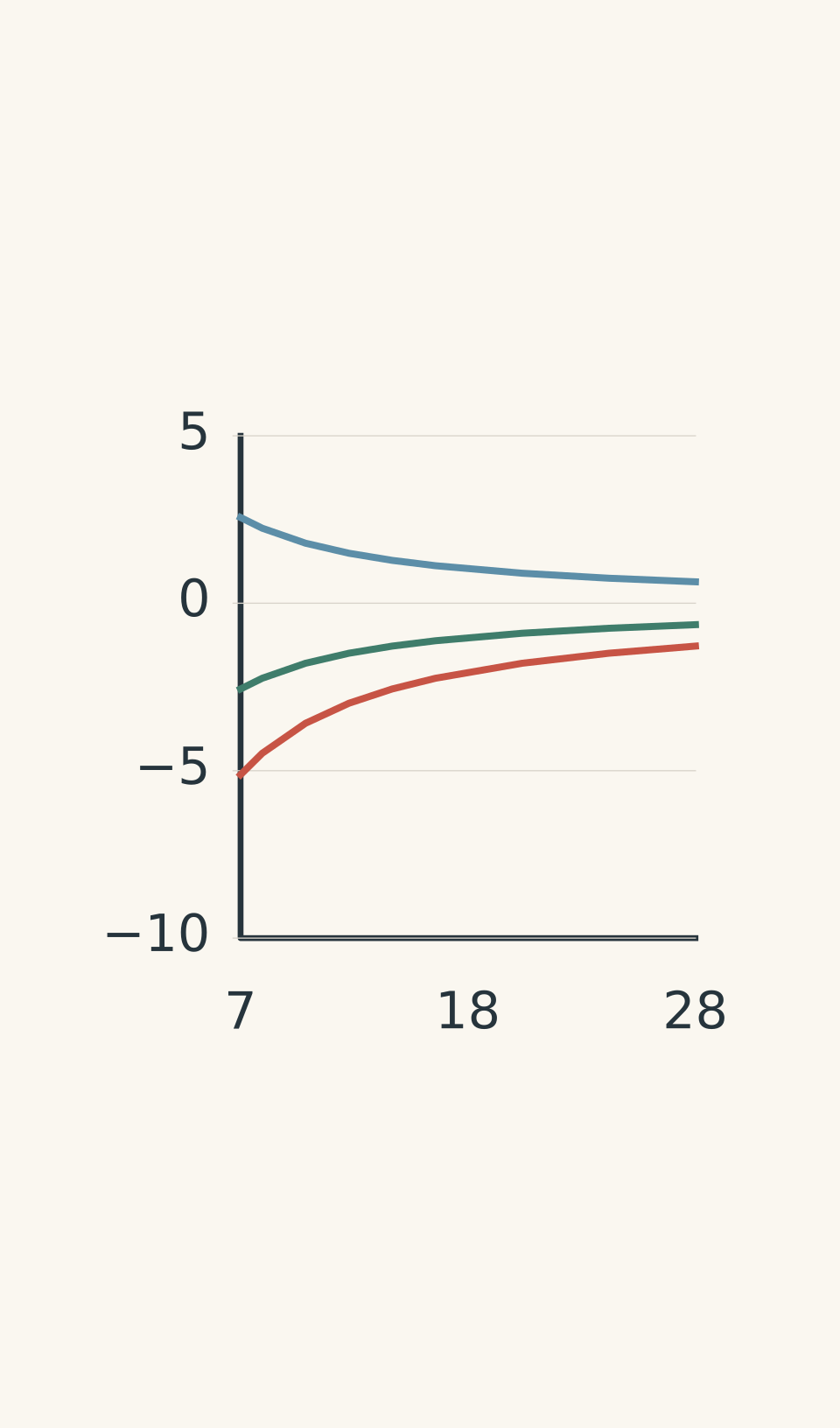
- Kinetic energy K
- Potential energy U
- Total energy E
(c) Derivation of escape velocity
Escape velocity is the minimum launch speed needed to reach infinity with zero final speed, assuming no air resistance or other energy transfers.
At an initial distance \(r\), the object’s total mechanical energy is
\[ E_i=\frac12mv_{\mathrm{esc}}^2-\frac{GMm}{r}. \]
At infinity, the gravitational potential energy is zero. For the minimum escape speed, the final kinetic energy is also zero, so \(E_f=0\).
Conservation of energy gives
\[ \frac12mv_{\mathrm{esc}}^2-\frac{GMm}{r}=0. \]
Rearranging,
\[ \frac12mv_{\mathrm{esc}}^2=\frac{GMm}{r}. \]
The object’s mass cancels, leaving
\[ v_{\mathrm{esc}}^2=\frac{2GM}{r}. \]
Therefore,
\[ \boxed{v_{\mathrm{esc}}=\sqrt{\frac{2GM}{r}}} \]
Marking: 1 mark for the initial energy expression and conservation of energy; 1 mark for correctly setting the final energy to zero and rearranging; 1 mark for the derived escape-velocity expression.
(d) Escape speed from the surface
Use the planet’s radius as the distance from its centre:
\[ \begin{aligned} v_{\mathrm{esc}} &=\sqrt{\frac{2GM}{R}}\\ &=\sqrt{\frac{2(6.67\times10^{-11}) (5.97\times10^{24})}{6.40\times10^6}}\\ &=1.12\times10^4\ \mathrm{m\,s^{-1}}. \end{aligned} \]
The escape speed is approximately \(11.2\ \mathrm{km\,s^{-1}}\).
Marking: 1 mark for correct substitution; 1 mark for the numerical result with units.
(e) Potential energy at infinity
Setting gravitational potential energy to zero at infinity is a choice of reference level. At a finite distance from the planet, gravitational potential energy is negative because energy must be supplied to separate the object from the planet and take it to infinity.
Marking: 1 mark for explaining the reference level and the meaning of negative gravitational potential energy.
Solution 8
(a) Range without a spear-thrower
For a projectile launched and landing at the same height, the theoretical range is
\[ R=\frac{v_0^2\sin2\theta}{g}. \]
Using \(v_0=17.0\ \mathrm{m\,s^{-1}}\) and \(\theta=35.0^\circ\),
\[ \begin{aligned} R&=\frac{(17.0)^2\sin70.0^\circ}{9.80}\\ &=27.7\ \mathrm{m}. \end{aligned} \]
Marking: 1 mark for the correct relationship and substitution; 1 mark for the range.
(b) Range with a spear-thrower
Using the hypothetical launch speed of \(25.0\ \mathrm{m\,s^{-1}}\),
\[ \begin{aligned} R&=\frac{(25.0)^2\sin70.0^\circ}{9.80}\\ &=59.9\ \mathrm{m}. \end{aligned} \]
Marking: 1 mark for the correct relationship and substitution; 1 mark for the range.
(c) What the model can and cannot establish
The model permits a comparison of ideal projectile ranges when launch speed, launch angle, and landing height are specified. For this hypothetical dataset, the higher launch speed produces a greater predicted range because range depends on the square of launch speed when the angle and gravitational acceleration remain fixed.
However, the calculation assumes negligible air resistance and equal launch and landing heights. It does not establish real-world accuracy, effectiveness in every situation, or the cultural purposes and knowledge associated with a technology. The example must not be generalised to all Aboriginal and Torres Strait Islander projectile technologies or traditions.
Marking: 1 mark for a valid physical conclusion; 1 mark for a valid model limitation and an appropriately contextualised conclusion.
Solution 9
(a) Variables
The independent variable is the launch angle, measured in degrees.
The dependent variable is the mean horizontal range, measured in metres.
Marking: 0.5 marks for each variable.
(b) Controlled variables
Suitable controls include:
- Launch speed.
- Projectile type and mass.
- Launch and landing heights.
- Release point and measurement method.
Any two valid controlled variables earn full marks.
Marking: 0.5 marks for each of two suitable controls.
(c) Theoretical range at \(30^\circ\)
For equal launch and landing heights,
\[ R=\frac{v_0^2\sin2\theta}{g}. \]
Substituting the launch speed and angle,
\[ \begin{aligned} R&=\frac{(10.0)^2\sin60^\circ}{9.80}\\ &=8.84\ \mathrm{m}. \end{aligned} \]
Marking: 1 mark for the correct relationship and substitution; 1 mark for the predicted range.
(d) Agreement with the model
The measured range at \(30^\circ\) is \(8.9\ \mathrm{m}\), compared with a predicted value of \(8.84\ \mathrm{m}\). The difference is only \(0.06\ \mathrm{m}\), which is smaller than the stated uncertainty of \(0.2\ \mathrm{m}\).
The data therefore support the ideal model within the stated uncertainty. The measured range is also greatest near \(40^\circ\)-\(50^\circ\), consistent with the predicted maximum near \(45^\circ\).
Marking: 1 mark for a justified conclusion based on the measurements and uncertainty.
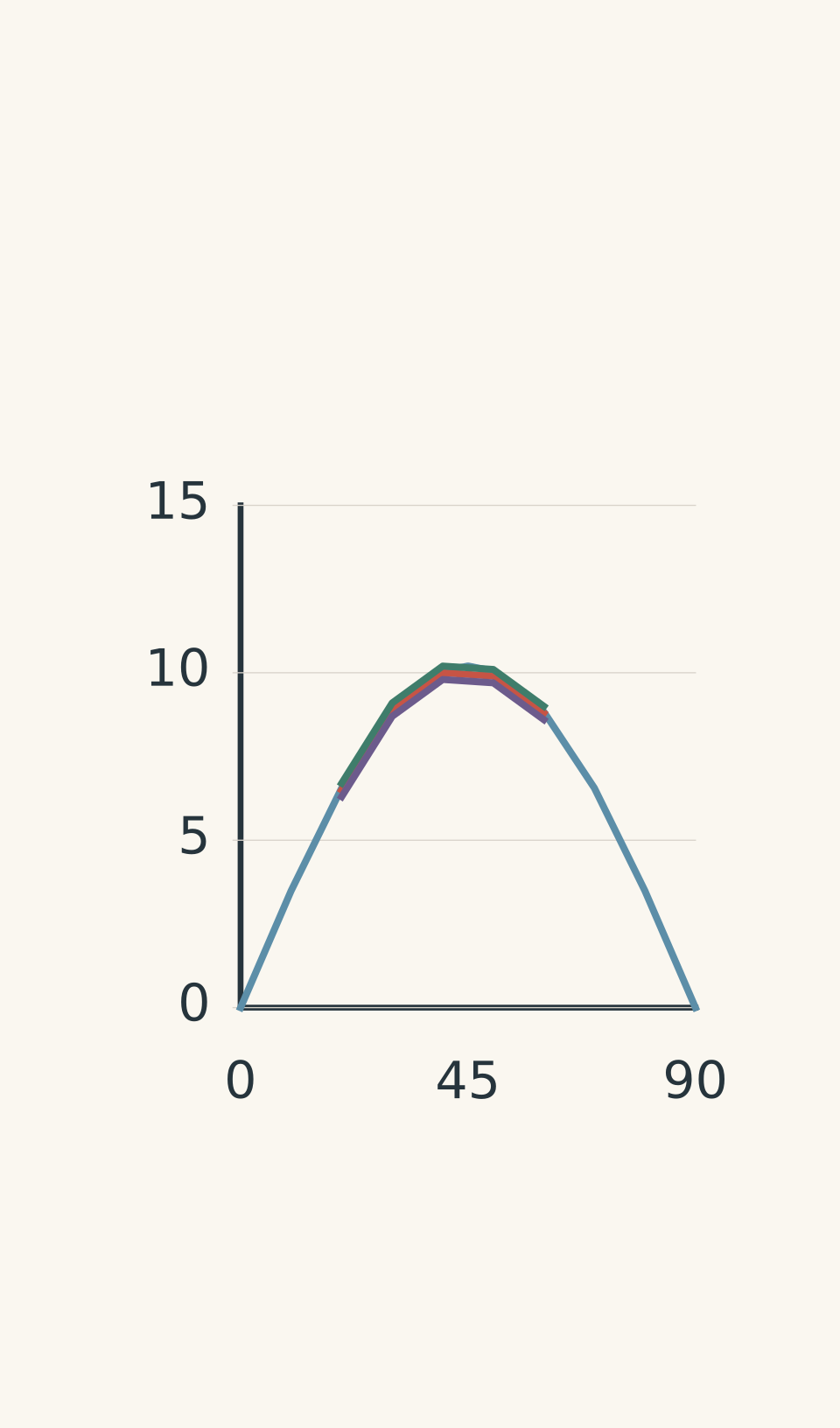
- Ideal model
- Measured mean
- Upper uncertainty limit
- Lower uncertainty limit
(e) Improvement
One improvement would be to use photogates or calibrated high-speed video to measure the launch speed for every trial. This would help identify variations in launch speed that could otherwise affect the range and weaken the comparison with the model.
Other valid improvements include increasing the number of trials, improving angle calibration, and reducing systematic errors in range measurements.
Marking: 1 mark for one specific, relevant improvement.
Solution 10
(a) Conditions for a geostationary orbit
A geostationary satellite must:
- Follow a circular orbit in Earth’s equatorial plane.
- Move eastwards, in the same direction as Earth’s rotation.
- Have an orbital period equal to one sidereal rotation of Earth, approximately \(23\ \mathrm{h}\ 56\ \mathrm{min}\).
Marking: 1 mark for the circular equatorial orbit; 1 mark for the direction of motion; 1 mark for the orbital period.
(b) Why it appears stationary
The satellite completes an orbit in the same time that Earth completes one rotation relative to the stars. Because it moves in the same direction and in the equatorial plane, it remains above approximately the same longitude and appears stationary relative to an observer on Earth’s surface.
Marking: 1 mark for explaining the matching rotation period and direction.
(c) Practical use
One use is satellite communications, including television broadcasting. A geostationary satellite can maintain a continuous link with a ground station without appearing to move across the sky.
Weather monitoring is another valid example.
Marking: 1 mark for a valid practical use.