
M2 Dynamics: Physics Revision Practice Exam and Solutions
Test your understanding of the Physics 2017 legacy Dynamics scope with this original 60-mark tutorgum practice exam. Includes timed exam conditions, mixed-difficulty questions, complete worked solutions, and a detailed marking guide.
This is an original tutorgum practice paper for mixed revision across the supplied Physics 2017 legacy Dynamics scope. It assesses forces and Newton’s laws, friction on inclined planes, constant-acceleration motion, work and energy, power, impulse, and collisions in one and two dimensions. It is a focused topic paper, not a full-course HSC exam, and it is not an official, endorsed, past, or predicted NESA paper.
01Exam instructions
- Suggested reading time: 5 minutes.
- Suggested working time: 60 minutes.
- Total marks: 60.
- Permitted equipment: Scientific calculator, ruler, pencil, and blank paper. No notes or formula sheet are assumed.
- Constants: Use \(g=9.8\ \text{m s}^{-2}\), where \(g\) is the gravitational field strength near Earth’s surface.
- Working: Show your calculations, include units, and give directions for vector quantities. Use three significant figures unless a different precision is appropriate.
- Assumptions: Neglect air resistance unless stated otherwise. Treat momentum as conserved in a collision only when the external impulse on the chosen system is negligible.
This paper assesses only the supplied Physics 2017 legacy Dynamics revision scope. It does not combine different syllabus editions or include topics outside the supplied scope. The timing, equipment, and marking conditions are suggested conditions for this practice paper, not official exam rules.
02Questions
Question 1 (9 marks)
A \(4.0\ \text{kg}\) cart moves on a horizontal track. Friction from the track is negligible. A rope pulls the cart to the right with a force of \(18\ \text{N}\), while a hand pushes it to the left with a force of \(6.0\ \text{N}\). The cart has no vertical acceleration.
(a) List the forces that belong on a correct free-body diagram of the cart. For each force, state its direction and whether it is a contact force or a field force. (2 marks)
(b) Calculate the net horizontal force on the cart and its acceleration. (2 marks)
(c) The rope exerts a force on the cart. Identify the Newton’s third-law partner of this force and explain why the two forces do not cancel on the cart. (2 marks)
(d) An object experiences a \(30\ \text{N}\) force east and a \(40\ \text{N}\) force north. Calculate the magnitude and direction of the third force required to place the object in equilibrium. (2 marks)
(e) An object experiences zero net force. Does this mean the object must be stationary? Name the Newton’s law that supports your answer. (1 mark)
Question 2 (7 marks)
A \(5.0\ \text{kg}\) block is released from rest on a slope inclined at \(30^\circ\) to the horizontal. The coefficient of static friction is \(\mu_s=0.50\), and the coefficient of kinetic friction is \(\mu_k=0.30\). Here, \(\mu_s\) and \(\mu_k\) are the coefficients used to model static and kinetic friction, respectively.
Assume the block remains in contact with the slope.
(a) Resolve the block’s weight into components parallel and perpendicular to the slope. Calculate the normal force on the block. (2 marks)
(b) Calculate the maximum possible static friction. Use this value to decide whether the block remains at rest, and explain what the maximum-static-friction model represents. (3 marks)
(c) Once the block is sliding, calculate the kinetic friction and the block’s acceleration. State the direction of the acceleration. (2 marks)
Question 3 (5 marks)
A \(1.5\ \text{kg}\) trolley initially moves to the right at \(2.0\ \text{m s}^{-1}\). It experiences a constant net force of \(3.0\ \text{N}\) to the right for \(4.0\ \text{s}\).
Take right as the positive direction.
(a) Calculate the trolley’s acceleration. (1 mark)
(b) Calculate its velocity after \(4.0\ \text{s}\). (1 mark)
(c) Calculate its displacement during the \(4.0\ \text{s}\) interval. (2 marks)
(d) Draw a velocity-time graph for the interval. Label both axes with units and show the correct endpoints. (1 mark)
Question 4 (6 marks)
A \(2.0\ \text{kg}\) trolley is released from rest at a height of \(1.8\ \text{m}\) above the bottom of a track. It reaches the bottom with a speed of \(5.0\ \text{m s}^{-1}\).
Take gravitational potential energy to be zero at the bottom. Assume that the relevant energy stores are kinetic, gravitational potential, and thermal/sound energy.
(a) Calculate the decrease in gravitational potential energy as the trolley descends. (1 mark)
(b) Calculate the increase in the trolley’s kinetic energy. (1 mark)
(c) Calculate the energy transferred to thermal/sound energy by resistive forces. (1 mark)
(d) If resistance were absent, calculate the trolley’s speed at the bottom. Then use the work-energy theorem to explain why the actual speed is lower. (3 marks)
Question 5 (5 marks)
A worker pulls a \(10.0\ \text{kg}\) crate \(10.0\ \text{m}\) along a horizontal floor. The worker applies a constant force of \(50\ \text{N}\) at an angle of \(37^\circ\) above the horizontal. Kinetic friction acts opposite to the crate’s motion with a constant magnitude of \(20\ \text{N}\).
The crate’s displacement is horizontal.
(a) Resolve the applied force into horizontal and vertical components. (2 marks)
(b) Calculate the work done by the applied force over the displacement. (1 mark)
(c) Calculate the work done by friction and the net work done on the crate by all forces. (2 marks)
Question 6 (6 marks)
A \(0.20\ \text{kg}\) ball initially moves to the right at \(12\ \text{m s}^{-1}\). During contact with another object, the horizontal force on the ball varies linearly through the following points.
| Time, \(t\) (ms) | 0 | 5.0 | 15.0 |
|---|---|---|---|
| Horizontal force, \(F\) (N) | 0 | −400 | 0 |
The force acts horizontally, and right is the positive direction.
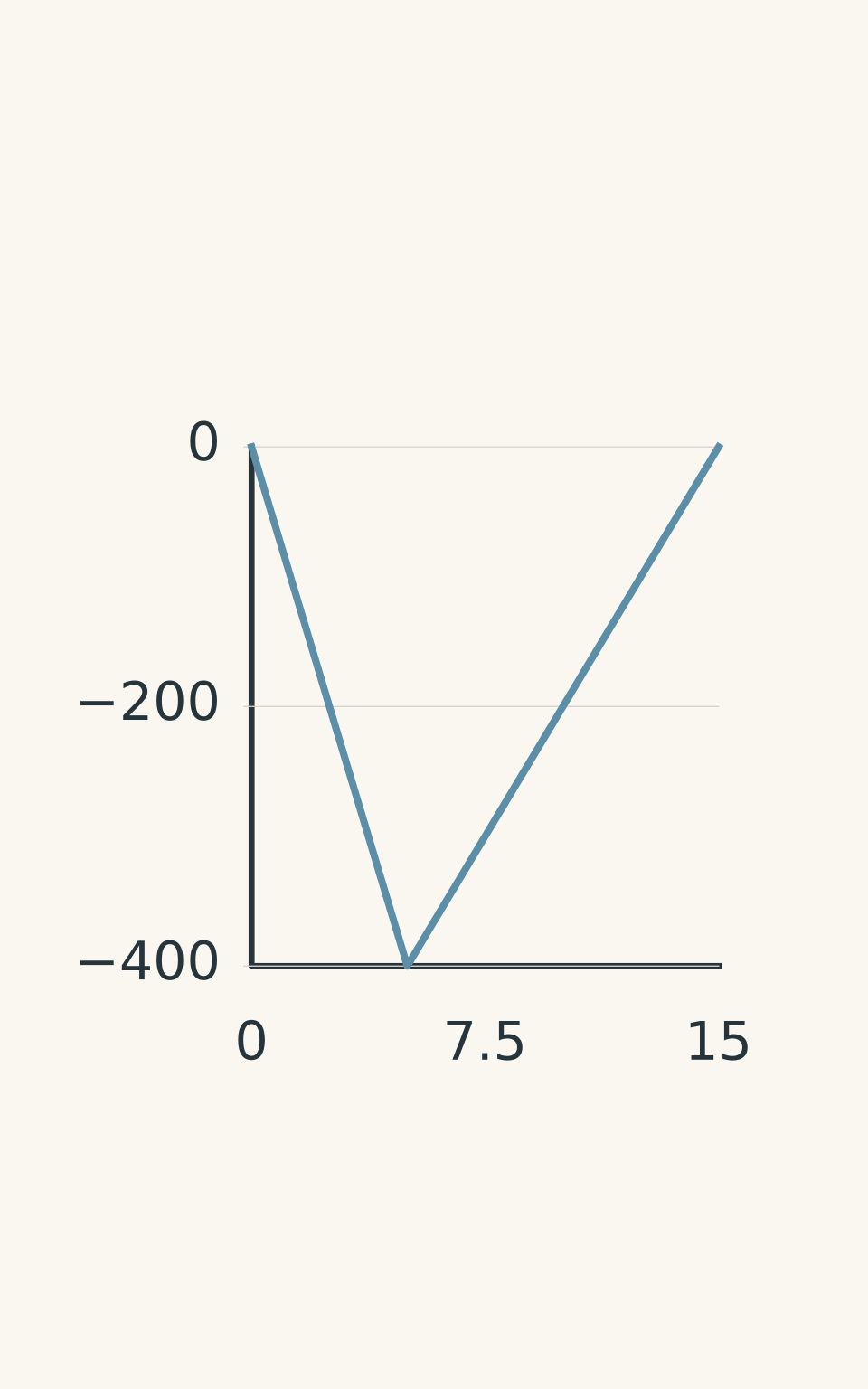
- Horizontal force
(a) Calculate the impulse delivered to the ball during contact. (2 marks)
(b) Calculate the ball’s velocity immediately after contact. (2 marks)
(c) Calculate the average horizontal force acting on the ball during contact. (1 mark)
(d) Explain what the sign of the impulse tells you about the ball’s change in momentum. (1 mark)
Question 7 (7 marks)
Cart A has a mass of \(2.0\ \text{kg}\) and moves to the right at \(5.0\ \text{m s}^{-1}\). Cart B has a mass of \(3.0\ \text{kg}\) and is initially stationary. The carts collide on a low-friction track and latch together.
During the brief collision, the external horizontal impulse on the two-cart system is negligible. Take right as the positive direction.
(a) Define the system used to analyse the collision and state the condition that allows momentum to be conserved. (2 marks)
(b) Calculate the common velocity of the carts immediately after the collision. (2 marks)
(c) Calculate the total kinetic energy before and after the collision. (2 marks)
(d) Classify the collision and justify your classification using the energy results. (1 mark)
Question 8 (4 marks)
A \(1.0\ \text{kg}\) cart moves to the right at \(4.0\ \text{m s}^{-1}\) and collides elastically in one dimension with a stationary \(3.0\ \text{kg}\) cart. The external impulse during the collision is negligible.
Take right as the positive direction.
(a) Write the equation expressing conservation of momentum for the collision. (1 mark)
(b) Write the equation expressing conservation of kinetic energy for the collision. (1 mark)
(c) Use both equations to determine the final velocity of each cart, including the direction of motion. (2 marks)
Question 9 (5 marks)
Two pucks collide on a horizontal surface. Puck A has a mass of \(0.15\ \text{kg}\) and initially travels east at \(8.0\ \text{m s}^{-1}\). Puck B has a mass of \(0.10\ \text{kg}\) and is initially stationary.
After the collision, puck A travels north at \(3.0\ \text{m s}^{-1}\). Assume the external impulse in the horizontal plane is negligible during impact.
Take east as the positive \(x\)-direction and north as the positive \(y\)-direction.
(a) Write the momentum conservation equation for the east-west direction. (1 mark)
(b) Write the momentum conservation equation for the north-south direction. (1 mark)
(c) Use the equations to determine the east-west and north-south components of puck B’s final velocity. (1 mark)
(d) Calculate the magnitude of puck B’s final velocity. (1 mark)
(e) Determine the direction of puck B’s final velocity, measured relative to east. (1 mark)
Question 10 (6 marks)
(a) A cable pulls a sled horizontally along a surface. The sled moves at \(3.0\ \text{m s}^{-1}\), and the cable exerts a constant force of \(200\ \text{N}\) at \(25^\circ\) above the horizontal. Calculate the instantaneous power transferred to the sled by the cable. (2 marks)
(b) A winch raises a \(12\ \text{kg}\) load vertically through \(6.0\ \text{m}\) in \(8.0\ \text{s}\) at constant speed.
Calculate the load’s increase in gravitational potential energy and the average power delivered to it. A second motor transfers \(900\ \text{J}\) of mechanical energy in the same \(8.0\ \text{s}\). Calculate the second motor’s average power and compare the two power values. (4 marks)
03Worked solutions and marking guide
Award marks for the demonstrated physics and method, not just the final answer. Accept mathematically equivalent methods, appropriate rounding, and equivalent direction descriptions. Apply follow-through marks when a student uses an earlier result incorrectly but then applies a valid method consistently, unless the error invalidates the later reasoning.
Solution 1
(a) Forces on the cart (2 marks)
The free-body diagram must contain only forces acting on the cart.
- Rope’s pull: \(18\ \text{N}\) to the right; contact force.
- Hand’s push: \(6.0\ \text{N}\) to the left; contact force.
- Normal force, \(N\): vertically upwards; contact force.
- Weight, \(F_g=mg\): vertically downwards; field force due to gravity.
Because the cart has no vertical acceleration, the normal force and weight have equal magnitudes:
\[ N=mg=4.0\times9.8=39.2\ \text{N} \]
The normal force is not an additional horizontal force. It acts perpendicular to the track.
Marking:
- 1 mark for identifying all four forces and their directions.
- 1 mark for correctly classifying contact and field forces.
(b) Net force and acceleration (2 marks)
Take right as positive. The net horizontal force is the sum of the horizontal forces, including their signs.
\[ \begin{aligned} F_{\text{net}}&=18-6.0\\ &=12\ \text{N to the right} \end{aligned} \]
Newton’s second law gives \(F_{\text{net}}=ma\), where \(m\) is mass and \(a\) is acceleration.
\[ \begin{aligned} a&=\frac{F_{\text{net}}}{m}\\ &=\frac{12}{4.0}\\ &=3.0\ \text{m s}^{-2} \end{aligned} \]
The cart accelerates to the right.
Marking:
- 1 mark for the correct net force.
- 1 mark for the correct acceleration and direction.
(c) Newton’s third law (2 marks)
The rope exerts an \(18\ \text{N}\) force to the right on the cart. The cart exerts an equal \(18\ \text{N}\) force to the left on the rope.
These forces form a Newton’s third-law pair. They are equal and opposite, but they act on different objects. The rope’s force acts on the cart, while the cart’s force acts on the rope. Therefore, they do not cancel on the cart’s free-body diagram.
Marking:
- 1 mark for identifying the equal and opposite force on the rope.
- 1 mark for explaining that the forces act on different objects.
(d) Equilibrium in two dimensions (2 marks)
The two existing forces are perpendicular. Their resultant magnitude is:
\[ \begin{aligned} F_R&=\sqrt{30^2+40^2}\\ &=50\ \text{N} \end{aligned} \]
The resultant points northeast. The third force must be equal in magnitude and opposite in direction to produce zero net force.
The required force is \(50\ \text{N}\), directed \(53.1^\circ\) south of west.
The angle is found using:
\[ \theta=\tan^{-1}\left(\frac{40}{30}\right) \]
Marking:
- 1 mark for the correct magnitude.
- 1 mark for the correct direction.
(e) Newton’s first law (1 mark)
No. Zero net force does not require an object to be stationary. Newton’s first law states that an object remains at rest or continues moving at constant velocity when the net force is zero.
Marking:
- 1 mark for identifying Newton’s first law and recognising that non-zero constant velocity is possible.
Solution 2
(a) Resolving weight and finding the normal force (2 marks)
The block’s weight is the gravitational force:
\[ F_g=mg=5.0\times9.8=49\ \text{N} \]
For an incline at angle \(\theta=30^\circ\), the components of weight are:
\[ \begin{aligned} F_{g,\parallel}&=mg\sin\theta\\ &=49\sin30^\circ\\ &=24.5\ \text{N} \end{aligned} \]
This component acts down the slope.
The perpendicular component is:
\[ \begin{aligned} F_{g,\perp}&=mg\cos\theta\\ &=49\cos30^\circ\\ &=42.4\ \text{N} \end{aligned} \]
There is no acceleration perpendicular to the slope, so the normal force balances the perpendicular component of weight:
\[ N=42.4\ \text{N} \]
Marking:
- 1 mark for the correct weight components.
- 1 mark for the normal force.
(b) Static friction and whether the block slides (3 marks)
The maximum static friction is modelled by:
\[ f_{s,\max}=\mu_sN \]
Substituting the coefficient of static friction, \(\mu_s=0.50\):
\[ \begin{aligned} f_{s,\max}&=0.50\times42.4\\ &=21.2\ \text{N} \end{aligned} \]
The component of weight pulling the block down the slope is \(24.5\ \text{N}\). This exceeds the maximum static friction of \(21.2\ \text{N}\), so static friction cannot hold the block in place. The block slides down the slope.
The important modelling detail is that \(\mu_sN\) represents the maximum possible static friction. Static friction adjusts to the force needed to prevent motion, up to that maximum. It does not always equal \(\mu_sN\).
Marking:
- 1 mark for calculating the maximum static friction.
- 1 mark for comparing the forces and concluding that the block slides.
- 1 mark for explaining that static friction adjusts up to a maximum.
(c) Kinetic friction and acceleration (2 marks)
Once the block slides, use the coefficient of kinetic friction, \(\mu_k=0.30\).
\[ \begin{aligned} f_k&=\mu_kN\\ &=0.30\times42.4\\ &=12.7\ \text{N} \end{aligned} \]
Kinetic friction acts up the slope, opposing the sliding motion. Taking down the slope as positive:
\[ \begin{aligned} F_{\text{net}}&=24.5-12.7\\ &=11.8\ \text{N}\\ a&=\frac{11.8}{5.0}\\ &=2.36\ \text{m s}^{-2} \end{aligned} \]
The block accelerates down the slope at \(2.36\ \text{m s}^{-2}\).
Marking:
- 1 mark for the kinetic friction force.
- 1 mark for the net force, acceleration, and direction.
Solution 3
(a) Acceleration (1 mark)
Newton’s second law relates the net force \(F_{\text{net}}\), mass \(m\), and acceleration \(a\):
\[ \begin{aligned} a&=\frac{F_{\text{net}}}{m}\\ &=\frac{3.0}{1.5}\\ &=2.0\ \text{m s}^{-2} \end{aligned} \]
Marking:
- 1 mark for the correct acceleration.
(b) Final velocity (1 mark)
For constant acceleration, use \(v=u+at\), where \(u\) is initial velocity, \(v\) is final velocity, and \(t\) is elapsed time.
\[ \begin{aligned} v&=2.0+(2.0)(4.0)\\ &=10\ \text{m s}^{-1} \end{aligned} \]
The final velocity is \(10\ \text{m s}^{-1}\) to the right.
Marking:
- 1 mark for the correct final velocity and direction.
(c) Displacement (2 marks)
For constant acceleration, displacement \(s\) is:
\[ s=ut+\frac12at^2 \]
Substitute the initial velocity, acceleration, and time:
\[ \begin{aligned} s&=(2.0)(4.0)+\frac12(2.0)(4.0)^2\\ &=8.0+16\\ &=24\ \text{m} \end{aligned} \]
The displacement is \(24\ \text{m}\) to the right.
Marking:
- 1 mark for selecting and applying an appropriate kinematics equation.
- 1 mark for the correct displacement with units.
(d) Velocity-time graph (1 mark)
The graph must be a straight line because acceleration is constant. It starts at \(2.0\ \text{m s}^{-1}\) when \(t=0\) and ends at \(10\ \text{m s}^{-1}\) when \(t=4.0\ \text{s}\).
The horizontal axis is time in seconds, and the vertical axis is velocity in metres per second. The gradient of the line is the acceleration, \(2.0\ \text{m s}^{-2}\).
Marking:
- 1 mark for correctly labelled axes and a straight line through the required endpoints.
Solution 4
(a) Decrease in gravitational potential energy (1 mark)
Gravitational potential energy near Earth’s surface changes according to \(\Delta U_g=mg\Delta h\), where \(m\) is mass and \(\Delta h\) is the change in height.
The decrease in gravitational potential energy is:
\[ \begin{aligned} E_{\text{decrease}}&=mgh\\ &=2.0\times9.8\times1.8\\ &=35.28\ \text{J} \end{aligned} \]
The decrease is \(35.3\ \text{J}\). Equivalently, the signed change in gravitational potential energy is \(\Delta U_g=-35.3\ \text{J}\).
Marking:
- 1 mark for the correct energy decrease.
(b) Increase in kinetic energy (1 mark)
Kinetic energy is the energy associated with motion:
\[ K=\frac12mv^2 \]
The trolley starts from rest, so its initial kinetic energy is zero.
\[ \begin{aligned} \Delta K&=\frac12mv^2\\ &=\frac12(2.0)(5.0)^2\\ &=25\ \text{J} \end{aligned} \]
The increase in kinetic energy is \(25\ \text{J}\).
Marking:
- 1 mark for the correct kinetic energy increase.
(c) Energy transferred by resistance (1 mark)
The decrease in gravitational potential energy is greater than the increase in kinetic energy. The difference is transferred to other energy stores, mainly thermal energy and sound in this model.
\[ \begin{aligned} E_{\text{transferred}}&=35.28-25\\ &=10.28\ \text{J} \end{aligned} \]
Approximately \(10.3\ \text{J}\) is transferred to thermal/sound energy.
Marking:
- 1 mark for the correct energy transferred.
(d) Ideal speed and the work-energy theorem (3 marks)
If resistance were absent, mechanical energy would be conserved. The decrease in gravitational potential energy would equal the increase in kinetic energy.
\[ \begin{aligned} mgh&=\frac12mv^2\\ v&=\sqrt{2gh}\\ &=\sqrt{2(9.8)(1.8)}\\ &=5.94\ \text{m s}^{-1} \end{aligned} \]
Without resistance, the trolley would reach the bottom at approximately \(5.94\ \text{m s}^{-1}\).
The work-energy theorem states that the net work done on an object equals its change in kinetic energy:
\[ W_{\text{net}}=\Delta K=25\ \text{J} \]
Gravity does positive work of approximately \(35.3\ \text{J}\), while resistive forces do negative work of approximately \(10.3\ \text{J}\). Their combined work is \(25.0\ \text{J}\), matching the increase in kinetic energy.
The actual mechanical energy is not conserved because resistive forces transfer some mechanical energy to thermal/sound energy. Total energy is conserved, but the trolley gains less kinetic energy than it would in the ideal case. That is why its actual speed is lower.
Marking:
- 1 mark for the correct ideal speed.
- 1 mark for applying the work-energy theorem correctly, including the net work.
- 1 mark for explaining the energy transfer caused by resistance and the lower actual speed.
Solution 5
(a) Resolving the applied force (2 marks)
The applied force has magnitude \(F=50\ \text{N}\) and acts at an angle of \(37^\circ\) above the horizontal.
The horizontal component is:
\[ \begin{aligned} F_x&=F\cos\theta\\ &=50\cos37^\circ\\ &=39.9\ \text{N} \end{aligned} \]
The vertical component is:
\[ \begin{aligned} F_y&=F\sin\theta\\ &=50\sin37^\circ\\ &=30.1\ \text{N} \end{aligned} \]
The applied force has a horizontal component of \(39.9\ \text{N}\) and an upward component of \(30.1\ \text{N}\).
Marking:
- 1 mark for the correct horizontal component.
- 1 mark for the correct vertical component.
(b) Work done by the applied force (1 mark)
Work done by a constant force is \(W=Fs\cos\theta\), where \(s\) is displacement and \(\theta\) is the angle between the force and displacement.
The displacement is horizontal, so the angle between the applied force and displacement is \(37^\circ\).
\[ \begin{aligned} W_{\text{applied}}&=50(10.0)\cos37^\circ\\ &=399\ \text{J} \end{aligned} \]
The applied force does approximately \(399\ \text{J}\) of positive work.
Marking:
- 1 mark for the correct work and units.
(c) Work by friction and net work (2 marks)
Friction acts opposite to the displacement, so the angle between friction and displacement is \(180^\circ\).
\[ \begin{aligned} W_{\text{friction}}&=fs\cos180^\circ\\ &=-20(10.0)\\ &=-200\ \text{J} \end{aligned} \]
The weight and normal force do zero work because they act vertically, perpendicular to the horizontal displacement.
Therefore, the net work is:
\[ \begin{aligned} W_{\text{net}}&=399-200\\ &=199\ \text{J} \end{aligned} \]
The net work done on the crate is approximately \(199\ \text{J}\).
Marking:
- 1 mark for the work done by friction.
- 1 mark for the correct net work, accounting for the forces that do zero work.
Solution 6
(a) Impulse from the force-time graph (2 marks)
Impulse is the signed area under a force-time graph. It equals the change in momentum.
The force is negative because it acts to the left. Convert milliseconds to seconds before calculating the areas.
From \(0\) to \(5.0\ \text{ms}\), the triangular area is:
\[ J_1=-\frac12(0.005)(400)=-1.0\ \text{N s} \]
From \(5.0\) to \(15.0\ \text{ms}\), the second triangular area is:
\[ J_2=-\frac12(0.010)(400)=-2.0\ \text{N s} \]
The total impulse is:
\[ \begin{aligned} J&=J_1+J_2\\ &=-1.0-2.0\\ &=-3.0\ \text{N s} \end{aligned} \]
Marking:
- 1 mark for calculating the areas correctly.
- 1 mark for the correct signed total impulse.
(b) Final velocity (2 marks)
Impulse equals the change in momentum:
\[ J=\Delta p=p_f-p_i \]
Momentum \(p\) is mass multiplied by velocity. The initial momentum is:
\[ p_i=mv_i=(0.20)(12)=2.4\ \text{kg m s}^{-1} \]
The final momentum is:
\[ \begin{aligned} p_f&=p_i+J\\ &=2.4-3.0\\ &=-0.60\ \text{kg m s}^{-1} \end{aligned} \]
Therefore, the final velocity is:
\[ \begin{aligned} v_f&=\frac{p_f}{m}\\ &=\frac{-0.60}{0.20}\\ &=-3.0\ \text{m s}^{-1} \end{aligned} \]
The ball moves to the left at \(3.0\ \text{m s}^{-1}\).
Marking:
- 1 mark for the correct final momentum.
- 1 mark for the correct final velocity and direction.
(c) Average force (1 mark)
Average force is impulse divided by the duration of contact.
\[ \begin{aligned} F_{\text{avg}}&=\frac{J}{\Delta t}\\ &=\frac{-3.0}{0.015}\\ &=-200\ \text{N} \end{aligned} \]
The average force is \(200\ \text{N}\) to the left.
Marking:
- 1 mark for the correct average force, including its direction.
(d) Meaning of the sign (1 mark)
The negative impulse means the change in momentum is to the left. The force reduces the ball’s initial rightward momentum and is large enough in impulse to reverse its direction of motion.
Marking:
- 1 mark for correctly interpreting the sign as a leftward change in momentum.
Solution 7
(a) System boundary and momentum conservation (2 marks)
Choose both carts together as the system. During the brief collision, the external horizontal impulse on this system is negligible, so the total horizontal momentum is conserved.
Momentum conservation applies to the chosen system, not automatically to every individual object within it. The carts exert forces on each other during the collision, but those forces are internal to the two-cart system.
Marking:
- 1 mark for defining the system as both carts.
- 1 mark for stating that negligible external impulse allows momentum conservation.
(b) Common final velocity (2 marks)
Because the carts latch together, they have the same final velocity \(v_f\).
Conservation of momentum gives:
\[ m_Au_A+m_Bu_B=(m_A+m_B)v_f \]
Substituting the masses and initial velocities:
\[ \begin{aligned} v_f&=\frac{(2.0)(5.0)+(3.0)(0)}{2.0+3.0}\\ &=\frac{10}{5.0}\\ &=2.0\ \text{m s}^{-1} \end{aligned} \]
The joined carts move to the right at \(2.0\ \text{m s}^{-1}\).
Marking:
- 1 mark for applying conservation of momentum.
- 1 mark for the correct final velocity and direction.
(c) Kinetic energy before and after (2 marks)
Before the collision, only cart A has kinetic energy.
\[ \begin{aligned} K_i&=\frac12m_Au_A^2\\ &=\frac12(2.0)(5.0)^2\\ &=25\ \text{J} \end{aligned} \]
After the collision, the joined carts have a total mass of \(5.0\ \text{kg}\).
\[ \begin{aligned} K_f&=\frac12(m_A+m_B)v_f^2\\ &=\frac12(5.0)(2.0)^2\\ &=10\ \text{J} \end{aligned} \]
The kinetic energy decreases by \(15\ \text{J}\).
Marking:
- 1 mark for the correct initial kinetic energy.
- 1 mark for the correct final kinetic energy and energy difference.
(d) Collision classification (1 mark)
This is a perfectly inelastic collision because the carts stick together. Momentum is conserved, but kinetic energy decreases from \(25\ \text{J}\) to \(10\ \text{J}\). The difference is transferred to other energy stores, such as deformation, thermal energy, and sound.
Marking:
- 1 mark for correctly classifying the collision and linking the classification to the energy results.
Solution 8
(a) Conservation of momentum (1 mark)
Let \(v_{1f}\) be the final velocity of the \(1.0\ \text{kg}\) cart and \(v_{2f}\) the final velocity of the \(3.0\ \text{kg}\) cart. Right is positive.
\[ \begin{aligned} m_1u_1+m_2u_2&=m_1v_{1f}+m_2v_{2f}\\ (1.0)(4.0)+(3.0)(0)&=v_{1f}+3v_{2f} \end{aligned} \]
Therefore,
\[ 4.0=v_{1f}+3v_{2f} \]
Marking:
- 1 mark for the correct momentum equation.
(b) Conservation of kinetic energy (1 mark)
An elastic collision conserves total kinetic energy.
\[ \frac12(1.0)(4.0)^2 = \frac12(1.0)v_{1f}^2 +\frac12(3.0)v_{2f}^2 \]
Simplifying gives:
\[ v_{1f}^2+3v_{2f}^2=16 \]
Marking:
- 1 mark for the correct kinetic energy equation.
(c) Final velocities (2 marks)
From momentum conservation:
\[ v_{1f}=4.0-3v_{2f} \]
Substitute this into the kinetic energy equation:
\[ (4.0-3v_{2f})^2+3v_{2f}^2=16 \]
Expanding and simplifying:
\[ 12v_{2f}(v_{2f}-2.0)=0 \]
The mathematical solutions are \(v_{2f}=0\) and \(v_{2f}=2.0\ \text{m s}^{-1}\). The zero solution corresponds to the unchanged state before the collision, rather than the post-collision state. Therefore,
\[ v_{2f}=+2.0\ \text{m s}^{-1} \]
Using the momentum equation:
\[ \begin{aligned} v_{1f}&=4.0-3(2.0)\\ &=-2.0\ \text{m s}^{-1} \end{aligned} \]
The \(1.0\ \text{kg}\) cart moves left at \(2.0\ \text{m s}^{-1}\), and the \(3.0\ \text{kg}\) cart moves right at \(2.0\ \text{m s}^{-1}\).
Marking:
- 1 mark for correctly solving the conservation equations and selecting the post-collision solution.
- 1 mark for both final velocities with correct directions.
Solution 9
(a) East-west momentum equation (1 mark)
Momentum is conserved separately in the east-west direction.
Initially, puck A has eastward momentum:
\[ p_{x,i}=(0.15)(8.0)=1.20\ \text{kg m s}^{-1} \]
After the collision, puck A travels north, so it has no east-west momentum. Puck B must carry all the eastward momentum:
\[ 1.20=0.10v_{Bx} \]
Marking:
- 1 mark for the correct east-west momentum equation.
(b) North-south momentum equation (1 mark)
Initially, both pucks have zero north-south momentum. After the collision, puck A has northward momentum, so puck B must have an equal amount of southward momentum.
\[ 0=(0.15)(3.0)+0.10v_{By} \]
Marking:
- 1 mark for the correct north-south momentum equation.
(c) Velocity components (1 mark)
Solving the east-west equation:
\[ v_{Bx}=\frac{1.20}{0.10}=12\ \text{m s}^{-1} \]
Solving the north-south equation:
\[ v_{By}=\frac{-0.45}{0.10}=-4.5\ \text{m s}^{-1} \]
Puck B’s velocity components are \(12\ \text{m s}^{-1}\) east and \(4.5\ \text{m s}^{-1}\) south.
Marking:
- 1 mark for both correct components, including their signs or directions.
(d) Speed (1 mark)
The components are perpendicular, so use Pythagoras’ theorem to find the magnitude of the velocity.
\[ \begin{aligned} v_B&=\sqrt{v_{Bx}^2+v_{By}^2}\\ &=\sqrt{12^2+(-4.5)^2}\\ &=12.8\ \text{m s}^{-1} \end{aligned} \]
Marking:
- 1 mark for the correct speed.
(e) Direction (1 mark)
The angle south of east is:
\[ \begin{aligned} \theta&=\tan^{-1}\left(\frac{4.5}{12}\right)\\ &=20.6^\circ \end{aligned} \]
Puck B moves at \(20.6^\circ\) south of east.
Marking:
- 1 mark for the correct direction and angle.
Solution 10
(a) Power delivered to the sled (2 marks)
Mechanical power is the rate at which a force transfers energy. For a force acting at an angle to the velocity,
\[ P=Fv\cos\theta \]
Here, \(F=200\ \text{N}\) is the cable force, \(v=3.0\ \text{m s}^{-1}\) is the sled’s speed, and \(\theta=25^\circ\) is the angle between the force and the direction of motion.
\[ \begin{aligned} P&=200(3.0)\cos25^\circ\\ &=544\ \text{W} \end{aligned} \]
The cable transfers energy to the sled at an instantaneous rate of approximately \(544\ \text{W}\).
Only the component of the force along the direction of motion contributes to this power.
Marking:
- 1 mark for using the correct power relationship and angle.
- 1 mark for the correct numerical answer with units.
(b) Gravitational potential energy and average power (4 marks)
The increase in gravitational potential energy of the load is:
\[ \begin{aligned} \Delta U_g&=mg\Delta h\\ &=12\times9.8\times6.0\\ &=705.6\ \text{J} \end{aligned} \]
The load gains approximately \(706\ \text{J}\) of gravitational potential energy.
Average power is the change in energy divided by the time taken:
\[ P_{\text{avg}}=\frac{\Delta E}{\Delta t} \]
For the winch:
\[ \begin{aligned} P_{\text{winch}}&=\frac{705.6}{8.0}\\ &=88.2\ \text{W} \end{aligned} \]
The second motor transfers \(900\ \text{J}\) in \(8.0\ \text{s}\), so its average power is:
\[ \begin{aligned} P_{\text{second}}&=\frac{900}{8.0}\\ &=112.5\ \text{W} \end{aligned} \]
The difference between the two average powers is:
\[ \begin{aligned} \Delta P&=112.5-88.2\\ &=24.3\ \text{W} \end{aligned} \]
The second motor has the greater average power, by \(24.3\ \text{W}\).
Marking:
- 1 mark for the correct increase in gravitational potential energy.
- 1 mark for the winch’s average power.
- 1 mark for the second motor’s average power.
- 1 mark for correctly comparing the two power values.
Total available: 60 marks.