
Year 12 Chemistry: Applying Chemical Ideas Practice Exam
Prepare for Year 12 Chemistry with an original 100-mark timed practice exam covering the Applying Chemical Ideas content. Test your understanding with mixed revision questions, then check your work against detailed worked solutions and marking guides.
This original tutorgum practice paper provides mixed revision across the supplied Year 12 Chemistry: Applying chemical ideas content for the 2025 syllabus edition. It assesses redox chemistry, electrochemical cells, spectroscopy, quantitative analysis, petroleum chemistry, polymers, and metal extraction. All questions and data are original to this practice paper. It is not an official, endorsed, past, or predicted NESA examination.
01Exam instructions
- Suggested reading time: 5 minutes.
- Suggested working time: 120 minutes.
- Total marks: 100.
- Permitted equipment: a scientific calculator, writing materials, and a periodic table.
- Show your working for all calculations. Include units, appropriate significant figures, and chemical states where relevant.
- Unless stated otherwise, assume standard conditions when using standard reduction potentials.
- Use the numerical data supplied in each question. For molar mass calculations, use \(A_\mathrm{r}(\mathrm{C})=12.0\), \(A_\mathrm{r}(\mathrm{H})=1.0\), \(A_\mathrm{r}(\mathrm{O})=16.0\), and \(A_\mathrm{r}(\mathrm{Cl})=35.5\) where needed.
Assessed scope
This paper covers the supplied content on oxidation and reduction by electron transfer, redox half-equations, standard reduction potentials, cell potentials, redox spontaneity, and battery technology; flame tests, atomic absorption spectroscopy, atomic emission spectroscopy, and gravimetric analysis; mass spectrometry of organic compounds and environmental pollutants; infrared spectroscopy, proton NMR, carbon-13 NMR, combined spectral structure determination, and evidence for medicinal and agricultural molecular structures; petroleum fractional distillation and petrochemical pathways; Aboriginal resins, addition polymers, and polymer environmental and health impacts; and base-metal ore extraction, processing, and environmental and economic evaluation.
All other syllabus content is excluded. This is a focused revision assessment, not a full-course Chemistry examination. The suggested timing and conditions are for this tutorgum practice paper and do not claim to reproduce an official NESA examination format.
02Questions
Question 1 (10 marks)
Consider the following unbalanced ionic equation for a reaction between aluminium metal and copper(II) ions.
\[ \ce{Al(s) + Cu^2+(aq) -> Al^3+(aq) + Cu(s)} \]
(a) (4 marks) Identify the species that is oxidised and the species that is reduced. Identify the oxidising agent and the reducing agent.
(b) (4 marks) Write a balanced oxidation half-equation and a balanced reduction half-equation. Include electrons and state symbols.
(c) (2 marks) Combine the half-equations to obtain the balanced overall ionic equation. Show how the electrons cancel.
Question 2 (5 marks)
The following table gives standard reduction potentials at 25°C.
| Reduction half-equation | \(E^\circ\) (V) |
|---|---|
| \(\ce{Ag+(aq) + e- -> Ag(s)}\) | +0.80 |
| \(\ce{Cu^2+(aq) + 2e- -> Cu(s)}\) | +0.34 |
| \(\ce{Zn^2+(aq) + 2e- -> Zn(s)}\) | −0.76 |
(a) (3 marks) A clean copper strip is placed in aqueous silver nitrate. Predict whether a spontaneous reaction occurs under standard conditions. Write the balanced net ionic equation and justify your prediction using the table.
(b) (2 marks) A clean silver strip is placed in a solution containing \(\ce{Cu^2+(aq)}\). Predict whether a spontaneous reaction occurs under standard conditions. Justify your answer using the relative standard reduction potentials.
Question 3 (5 marks)
A galvanic cell is constructed from iron and copper half-cells. The relevant standard reduction potentials are:
| Reduction half-equation | \(E^\circ\) (V) |
|---|---|
| \(\ce{Fe^2+(aq) + 2e- -> Fe(s)}\) | −0.44 |
| \(\ce{Cu^2+(aq) + 2e- -> Cu(s)}\) | +0.34 |
(a) (3 marks) Calculate the standard cell potential, \(E^\circ_{\text{cell}}\). Identify the anode and cathode, and state the direction of electron flow through the external circuit.
(b) (2 marks) Predict whether the overall cell reaction is spontaneous under standard conditions. Explain how the sign of the calculated cell potential supports your conclusion.
Question 4 (8 marks)
A lead-acid battery is a rechargeable electrochemical cell. During discharge, its overall reaction is:
\[ \ce{Pb(s) + PbO2(s) + 2H2SO4(aq) ->} \]
\[ \ce{2PbSO4(s) + 2H2O(l)} \]
For this question, use the following simplified comparison. The energy-density values are illustrative data supplied for the assessment; actual batteries vary by design.
| Feature | Lead-acid battery | Lithium-ion battery |
|---|---|---|
| Energy density | 35 Wh kg\(^{-1}\) | 180 Wh kg\(^{-1}\) |
| Relative upfront cost | Lower | Higher |
| Selected concerns | Toxic lead and corrosive acid | Thermal runaway risk and impacts from mineral extraction |
| Recycling | Established recycling processes | Recycling and recovery processes vary by chemistry and facility |
(a) (3 marks) Describe the energy conversion that occurs during discharge. Explain why a lead-acid battery is classified as a secondary cell, and how charging changes the direction of the reaction.
(b) (2 marks) Determine the oxidation state change of lead in each of the following reactants: \(\ce{Pb(s)}\) and \(\ce{PbO2(s)}\). Identify which reactant is oxidised and which is reduced during discharge.
(c) (3 marks) A design team needs a battery for a lightweight portable device. Recommend one of the two technologies using the supplied data. Justify your choice with one benefit and one limitation.
Question 5 (14 marks)
An unknown organic compound, X, has the molecular formula \(\ce{C4H8O2}\). The following spectral data were collected.
Mass spectrometry
- Molecular ion peak: \(m/z=88\)
- Prominent fragment peak: \(m/z=43\)
Infrared spectroscopy
| Observation | Wavenumber (cm\(^{-1}\)) |
|---|---|
| Strong, sharp absorption | 1740 |
| Strong absorption region | 1050-1300 |
| Broad absorption in the 2500-3600 region | Absent |
Proton NMR spectroscopy
| Chemical shift, \(\delta\) (ppm) | Relative integration | Splitting pattern |
|---|---|---|
| 4.1 | 2H | Quartet |
| 2.0 | 3H | Singlet |
| 1.25 | 3H | Triplet |
Carbon-13 NMR spectroscopy
Four signals occur at the following chemical shifts:
\[ 170,\quad 60,\quad 21,\quad 14\ \text{ppm} \]
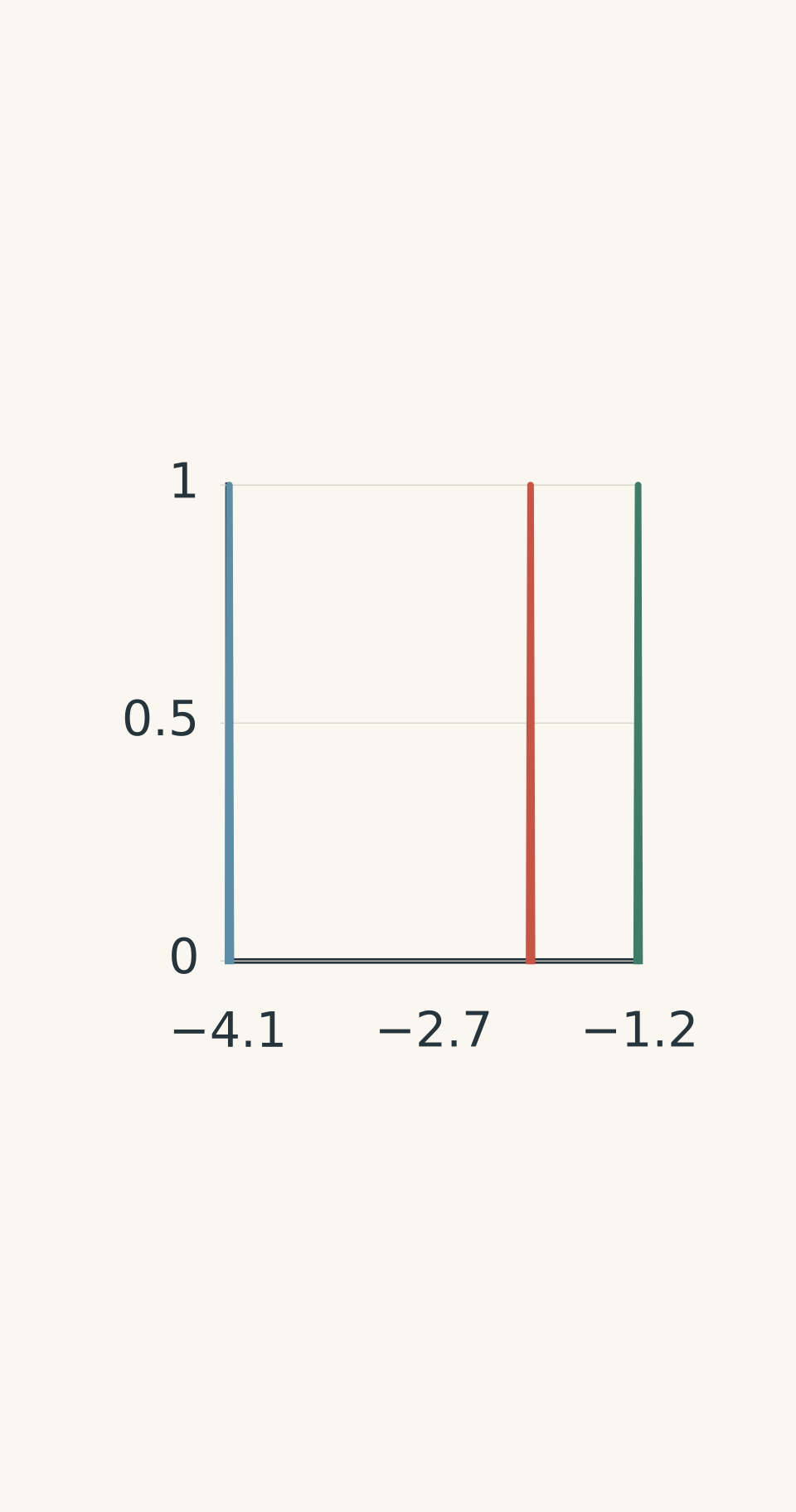
- 4.1 ppm · 2H · quartet
- 2.0 ppm · 3H · singlet
- 1.25 ppm · 3H · triplet
(a) (2 marks) Calculate the molar mass of X using its molecular formula. Explain how the molecular ion peak supports this value.
(b) (3 marks) Use the infrared data to identify the most likely functional group in X. Explain how the absorption data support your conclusion.
(c) (4 marks) Interpret the proton NMR data. State the number of distinct proton environments and explain what the integration and splitting patterns indicate about the groups present.
(d) (3 marks) Interpret the carbon-13 NMR data. State how many distinct carbon environments are present and use the chemical shifts to assign the four signals to plausible carbon environments.
(e) (2 marks) Propose a structural formula for X. Explain how the combined spectral evidence supports your proposal.
Question 6 (6 marks)
A laboratory investigates a chlorinated environmental pollutant using mass spectrometry. Its molecular-ion cluster has the following peaks:
| \(m/z\) | Relative intensity |
|---|---|
| 130 | 100 |
| 132 | 96 |
| 134 | 31 |
| 136 | 3 |
Natural chlorine contains approximately 75.8% chlorine-35 and 24.2% chlorine-37. A chlorine-37 isotope has a nominal mass two units greater than chlorine-35.
(a) (2 marks) Use the spacing and relative intensities of the molecular-ion peaks to estimate the number of chlorine atoms in the pollutant. Justify your answer.
(b) (2 marks) State the nominal mass indicated by the lowest-mass molecular-ion peak. Explain why this peak alone cannot uniquely establish the pollutant’s molecular formula, and identify one additional type of evidence that could help.
(c) (2 marks) Explain one limitation of mass spectrometry alone when assessing the environmental risk of a pollutant. Identify one complementary type of measurement or investigation that would help address this limitation.
Question 7 (10 marks)
(a) Flame tests (2 marks)
An aqueous sample produces a lilac flame during a flame test.
Identify the most likely metal cation responsible. State one limitation of using flame tests to identify an unknown aqueous cation.
(b) Atomic absorption spectroscopy (5 marks)
Aqueous samples containing a metal ion are analysed using atomic absorption spectroscopy (AAS). A set of calibration standards produces the following results.
| Metal-ion concentration (mg L\(^{-1}\)) | Absorbance |
|---|---|
| 0.0 | 0.00 |
| 2.0 | 0.16 |
| 4.0 | 0.32 |
| 6.0 | 0.48 |
An unknown sample is prepared by pipetting 10.0 mL of the original solution into a volumetric flask and diluting to a final volume of 50.0 mL. The diluted sample has an absorbance of 0.40.
Assume the calibration relationship is linear through the origin over the stated range.
- Explain how AAS can be used to determine the concentration of a metal ion in an aqueous sample. (2 marks)
- Calculate the metal-ion concentration in the original sample, in mg L\(^{-1}\). (3 marks)
(c) Atomic emission spectroscopy (3 marks)
Describe the basic measurement principle of atomic emission spectroscopy (AES). State one important difference between AES and AAS.
Question 8 (6 marks)
A 25.00 mL sample containing sulfate ions is treated with excess aqueous barium chloride. A precipitate of barium sulfate forms.
The net ionic equation is:
\[ \ce{Ba^2+(aq) + SO4^2-(aq) -> BaSO4(s)} \]
After filtration, washing, and drying to constant mass, the precipitate has a mass of 0.4668 g.
Use the molar mass:
\[ M(\ce{BaSO4})=233.39\ \text{g mol}^{-1} \]
(a) (4 marks) Calculate the sulfate-ion concentration in the original sample, in mol L\(^{-1}\).
(b) (2 marks) Explain why the precipitate is washed. Predict the effect on the calculated sulfate-ion concentration if the precipitate is not fully dry when weighed.
Question 9 (8 marks)
Petroleum contains hydrocarbons with a range of molecular sizes and boiling points. The following data describe two approximate fractions.
| Fraction | Typical carbon-number range | Approximate boiling range |
|---|---|---|
| A | C\(_5\)-C\(_{10}\) | 40-180°C |
| B | C\(_{15}\)-C\(_{20}\) | 250-350°C |
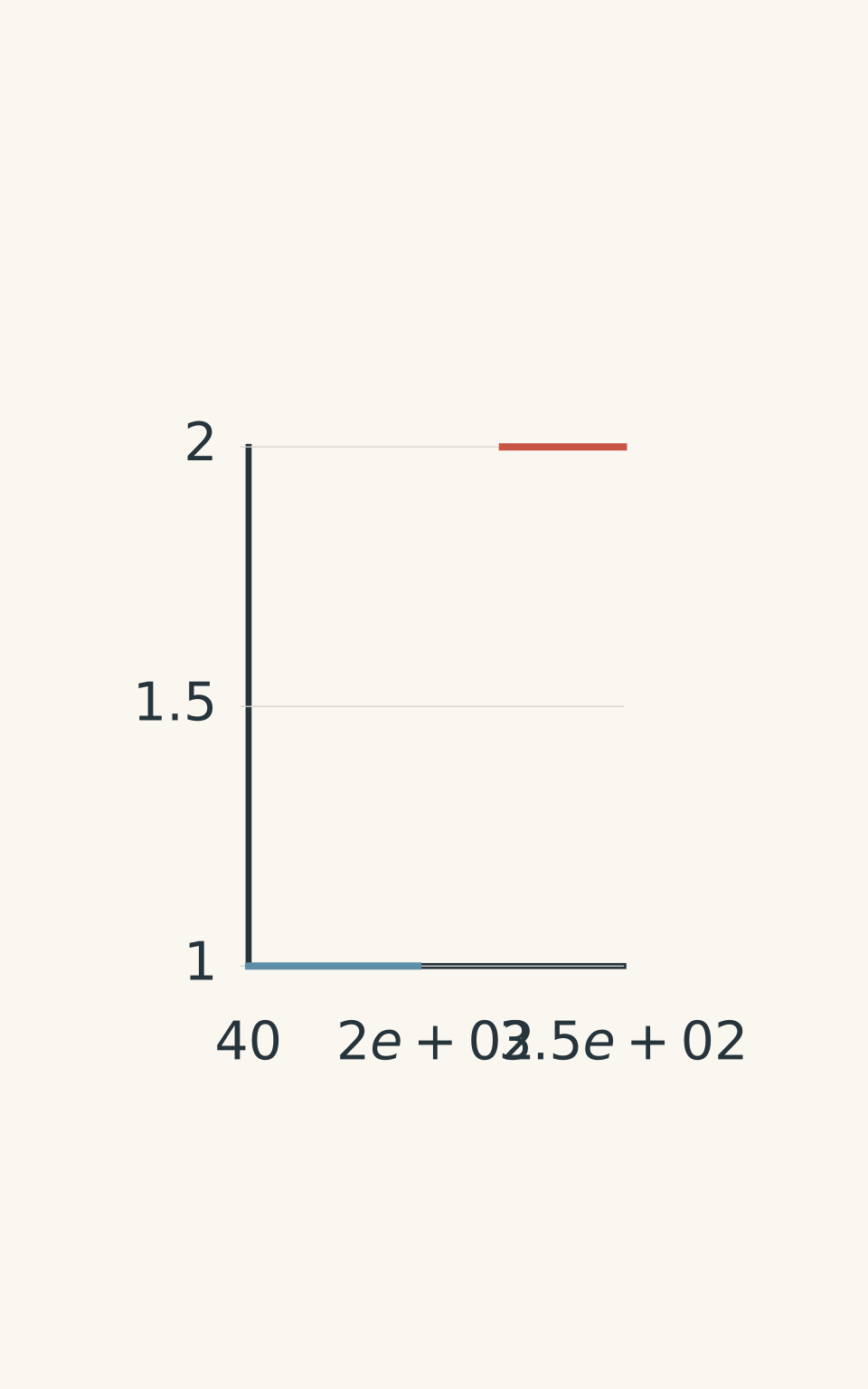
- Fraction A: 40–180 °C
- Fraction B: 250–350 °C
(a) (2 marks) Identify which fraction is more volatile. Explain how hydrocarbon chain length and intermolecular forces influence the boiling points of the two fractions.
(b) (2 marks) Explain how fractional distillation separates hydrocarbons in petroleum. Identify the physical property on which the separation depends.
(c) (2 marks) Decane can undergo cracking to form ethene and octane.
Write a balanced chemical equation for this reaction and explain one reason why cracking is useful in the petroleum industry.
(d) (2 marks) Ethene can be converted to ethanol by hydration. Write a balanced equation for this reaction and identify the type of reaction taking place.
Question 10 (10 marks)
Aboriginal Australian technologies have included the use of plant resins as adhesives for hafting or attaching components of tools. The plants, preparation methods, and recipes used vary between Countries and communities.
The following monomers are used to produce four common addition polymers.
| Monomer | Condensed structural formula |
|---|---|
| 1 | \(\ce{CH2=CH2}\) |
| 2 | \(\ce{CH2=CHCl}\) |
| 3 | \(\ce{CF2=CF2}\) |
| 4 | \(\ce{CH2=CHCH3}\) |
The polymers are polyethylene (PE), polyvinyl chloride (PVC), polytetrafluoroethylene (PTFE), and polypropylene (PP).
(a) (2 marks) State one material property that can make plant resin useful as an adhesive. Explain why a particular resin recipe or practice should not be generalised to all Aboriginal Australian communities.
(b) (2 marks) Match each of the four monomers in the table to its corresponding polymer. Use each polymer name once.
(c) (2 marks) Write the repeat unit of polypropylene. Explain why the formation of polypropylene from propene is classified as addition polymerisation.
(d) (4 marks) Compare the environmental and health impacts of at least two of PE, PVC, PTFE, and PP. Include an environmental concern, a health-related or manufacturing/disposal concern, and one practical mitigation strategy. Explain why the impacts depend on how the material is manufactured, used, or discarded.
Question 11 (10 marks)
Copper is a base metal commonly extracted from ores. Processing can involve crushing and grinding, concentration, extraction, and refining.
(a) (2 marks) A processing plant treats 2.00 tonnes of copper ore containing 1.20% copper by mass. The plant recovers 85% of the copper originally present.
Calculate the mass of copper recovered, in kilograms.
(b) (2 marks) For a copper sulfide ore, identify one concentration stage and one later extraction or refining stage. State the purpose of each stage.
(c) (4 marks) Two hypothetical mining sites are being evaluated. The table gives the supplied operating data.
| Property | Site A | Site B |
|---|---|---|
| Copper grade by mass | 1.50% | 0.90% |
| Copper recovery | 80% | 92% |
| Processing cost per tonne of ore | $180 | $100 |
| Energy use per tonne of ore | 8 GJ | 5 GJ |
| Tailings | Potentially acid-generating | Not classified as acid-generating |
For one tonne of ore feed, calculate the recovered copper mass and the processing cost per kilogram of recovered copper for each site.
(d) (2 marks) Recommend one site based on the supplied data. Refer to an economic factor and an environmental factor. Identify one additional factor that a real mining assessment should investigate.
Question 12 (8 marks)
A laboratory is verifying the identity of an organic intermediate used in the synthesis of a medicinal or agricultural product. Two candidate structures are being considered:
- Candidate A: butanal, \(\ce{CH3CH2CH2CHO}\)
- Candidate B: butan-2-one, \(\ce{CH3COCH2CH3}\)
Both candidates have the molecular formula \(\ce{C4H8O}\).
The following data are obtained for the unknown intermediate.
Mass spectrometry
- Molecular ion peak: \(m/z=72\)
Infrared spectroscopy
- Strong absorption at 1725 cm\(^{-1}\)
- Weak absorption bands near 2720-2820 cm\(^{-1}\)
Proton NMR spectroscopy
| Chemical shift, \(\delta\) (ppm) | Integration | Splitting pattern |
|---|---|---|
| 9.8 | 1H | Triplet |
| 2.4 | 2H | Triplet |
| 1.6 | 2H | Sextet |
| 0.95 | 3H | Triplet |
Carbon-13 NMR spectroscopy
Four signals occur at 202, 44, 19, and 14 ppm.
(a) (2 marks) Calculate the nominal molar mass of the candidate formula. Explain what the molecular ion peak establishes and whether it distinguishes the two candidate structures.
(b) (3 marks) Identify the candidate best supported by the spectral data. Justify your choice using at least two observations from the supplied spectra.
(c) (3 marks) Explain why the molecular-ion peak alone is insufficient to confirm the identity of a compound intended for medicinal or agricultural use. Name one independent confirmation method and explain one important property of the product that cannot be established by structural identification alone.
03Worked solutions and marking guide
Solution 1
(a) Oxidation, reduction, and the reacting agents
Aluminium loses electrons as it forms aluminium ions. Losing electrons is oxidation, so aluminium is oxidised and acts as the reducing agent.
Copper(II) ions gain electrons as they form copper metal. Gaining electrons is reduction, so \(\mathrm{Cu}^{2+}\) is reduced and acts as the oxidising agent.
Marking (4 marks):
- 1 mark: identifies aluminium as oxidised.
- 1 mark: identifies \(\mathrm{Cu}^{2+}\) as reduced.
- 1 mark: identifies aluminium as the reducing agent.
- 1 mark: identifies \(\mathrm{Cu}^{2+}\) as the oxidising agent.
(b) Half-equations
Oxidation:
\[ \ce{Al(s) -> Al^3+(aq) + 3e-} \]
Reduction:
\[ \ce{Cu^2+(aq) + 2e- -> Cu(s)} \]
The oxidation half-equation releases three electrons per aluminium atom. The reduction half-equation consumes two electrons per copper(II) ion.
Marking (4 marks):
- 2 marks: correct balanced oxidation half-equation, including electrons and states.
- 2 marks: correct balanced reduction half-equation, including electrons and states.
(c) Overall ionic equation
The smallest common multiple of three and two is six. Multiply the oxidation half-equation by two and the reduction half-equation by three.
\[ \ce{2Al -> 2Al^3+ + 6e-} \]
\[ \ce{3Cu^2+ + 6e- -> 3Cu} \]
Cancel the six electrons on both sides:
\[ \ce{2Al(s) + 3Cu^2+(aq) ->} \]
\[ \ce{2Al^3+(aq) + 3Cu(s)} \]
Marking (2 marks):
- 1 mark: scales the half-equations so that six electrons are transferred.
- 1 mark: gives the correct balanced overall ionic equation with electrons cancelled.
Solution 2
(a) Copper in silver nitrate
A spontaneous reaction occurs. Silver ions have a higher standard reduction potential than copper(II) ions, so \(\mathrm{Ag}^{+}\) is more readily reduced under standard conditions. Copper metal is oxidised while silver ions are reduced.
The balanced net ionic equation is:
\[ \ce{Cu(s) + 2Ag+(aq) -> Cu^2+(aq) + 2Ag(s)} \]
Marking (3 marks):
- 1 mark: predicts that a spontaneous reaction occurs.
- 1 mark: writes the correctly balanced net ionic equation.
- 1 mark: uses the relative reduction potentials to justify the reaction direction.
(b) Silver in copper(II) solution
No spontaneous reaction is predicted under standard conditions.
The \(\ce{Ag+/Ag}\) couple has the higher reduction potential. The proposed reaction would require copper(II) ions to oxidise silver metal, but the potential difference for that direction is negative:
\[ E^\circ_{\text{cell}}=+0.34-(+0.80)=-0.46\ \text{V} \]
Marking (2 marks):
- 1 mark: predicts no spontaneous reaction.
- 1 mark: justifies the prediction using the relative potentials or the negative cell potential.
Solution 3
(a) Cell potential and electrode roles
Copper has the higher reduction potential, so copper(II) ions are reduced at the cathode. Iron is oxidised at the anode.
Use the reduction potential of the cathode minus the reduction potential of the anode:
\[ \begin{aligned} E^\circ_{\text{cell}} &=E^\circ_{\text{cathode}}-E^\circ_{\text{anode}}\\ &=+0.34-(-0.44)\\ &=+0.78\ \text{V} \end{aligned} \]
The anode is the iron electrode. The cathode is the copper electrode. Electrons flow through the external circuit from iron to copper.
Marking (3 marks):
- 1 mark: calculates \(E^\circ_{\text{cell}}=+0.78\ \text{V}\).
- 1 mark: identifies iron as the anode and copper as the cathode.
- 1 mark: states that electrons flow from iron to copper through the external circuit.
(b) Spontaneity
The overall reaction is spontaneous under standard conditions because the calculated cell potential is positive.
For a galvanic cell under standard conditions, a positive \(E^\circ_{\text{cell}}\) corresponds to a negative standard Gibbs energy change, so the forward reaction is thermodynamically favourable.
Marking (2 marks):
- 1 mark: correctly predicts a spontaneous reaction.
- 1 mark: explains the significance of a positive cell potential.
Solution 4
(a) Energy conversion and recharging
During discharge, chemical energy is converted into electrical energy as the overall redox reaction proceeds.
A lead-acid battery is a secondary cell because it can be recharged. Applying an external electrical supply drives the overall reaction in the reverse direction, restoring the reactants needed for discharge.
Marking (3 marks):
- 1 mark: identifies conversion from chemical energy to electrical energy during discharge.
- 1 mark: identifies the battery as a rechargeable secondary cell.
- 1 mark: explains that an external electrical supply drives the reverse reaction during charging.
(b) Oxidation states
In \(\ce{Pb(s)}\), lead has oxidation state 0. In \(\ce{PbSO4}\), lead has oxidation state +2 because the sulfate ion has a charge of −2.
Lead therefore changes from 0 to +2 in the metal reactant. It loses electrons and is oxidised.
In \(\ce{PbO2}\), lead has oxidation state +4 because each oxygen has oxidation state −2. In \(\ce{PbSO4}\), lead is +2.
Lead therefore changes from +4 to +2 in lead dioxide. It gains electrons overall and is reduced.
Marking (2 marks):
- 1 mark: identifies \(\ce{Pb(s)}\) as oxidised, with the change \(0\rightarrow+2\).
- 1 mark: identifies lead in \(\ce{PbO2}\) as reduced, with the change \(+4\rightarrow+2\).
(c) Choosing a battery
For a lightweight portable device, the lithium-ion battery is the stronger choice on the supplied data. Its energy density is 180 Wh kg\(^{-1}\), compared with 35 Wh kg\(^{-1}\) for lead-acid. It can therefore store more energy for a given battery mass.
One limitation is its higher upfront cost. Thermal runaway risk and the environmental impacts of mineral extraction also need to be considered when selecting and managing a battery.
Marking (3 marks):
- 1 mark: recommends lithium-ion for the specified lightweight application.
- 1 mark: supports the recommendation with the supplied energy-density data.
- 1 mark: identifies and explains one relevant limitation or trade-off.
Solution 5
(a) Molar mass
Using the molecular formula \(\ce{C4H8O2}\):
\[ \begin{aligned} M&=4(12.0)+8(1.0)+2(16.0)\\ &=48.0+8.0+32.0\\ &=88.0\ \text{g mol}^{-1} \end{aligned} \]
The molecular ion peak at \(m/z=88\) is consistent with a molecular mass of approximately 88 Da for a singly charged molecular ion.
Marking (2 marks):
- 1 mark: correctly calculates the molar mass as \(88.0\ \text{g mol}^{-1}\).
- 1 mark: explains the agreement with the molecular ion peak.
(b) Infrared spectroscopy
The strong absorption at 1740 cm\(^{-1}\) is consistent with a carbonyl group, \(\ce{C=O}\). The strong absorption in the 1050-1300 cm\(^{-1}\) region supports the presence of a carbon-oxygen single bond.
Together, these features are consistent with an ester. The absence of a broad absorption in the 2500-3600 cm\(^{-1}\) region also supports the absence of a carboxylic acid or alcohol O-H group.
Marking (3 marks):
- 1 mark: identifies an ester as the most likely functional group.
- 1 mark: links the absorption near 1740 cm\(^{-1}\) to a carbonyl group.
- 1 mark: uses the C-O absorption or the absence of a broad O-H absorption as supporting evidence.
(c) Proton NMR spectroscopy
There are three distinct proton environments because the spectrum contains three signals.
The integrations total eight hydrogen atoms:
\[ 2+3+3=8 \]
This agrees with the molecular formula.
- At 4.1 ppm, the quartet integrates to 2H. This is consistent with a \(\ce{-O-CH2-CH3}\) group. The hydrogen atoms on the adjacent methyl group split the signal into a quartet.
- At 2.0 ppm, the singlet integrates to 3H. This is consistent with a methyl group adjacent to a carbonyl, \(\ce{CH3-C(=O)-}\), with no neighbouring carbon-bound hydrogen atoms producing the usual splitting.
- At 1.25 ppm, the triplet integrates to 3H. This is consistent with the terminal methyl group in \(\ce{-CH2-CH3}\). Its two neighbouring hydrogen atoms split the signal into a triplet.
Marking (4 marks):
- 1 mark: identifies three proton environments and recognises the total integration of eight hydrogen atoms.
- 1 mark: correctly assigns the 4.1 ppm quartet to an oxygen-adjacent \(\ce{CH2}\) group.
- 1 mark: correctly assigns the 2.0 ppm singlet to a methyl group adjacent to a carbonyl.
- 1 mark: correctly assigns the 1.25 ppm triplet to a terminal methyl group adjacent to \(\ce{CH2}\).
(d) Carbon-13 NMR spectroscopy
There are four signals, indicating four distinct carbon environments. This is consistent with the four carbon atoms in the molecular formula.
| Chemical shift (ppm) | Plausible assignment |
|---|---|
| 170 | Ester carbonyl carbon |
| 60 | Carbon in \(\ce{-O-CH2-}\) |
| 21 | Methyl carbon adjacent to the carbonyl |
| 14 | Terminal methyl carbon in the ethyl group |
The carbonyl carbon is strongly deshielded, giving a relatively high chemical shift. The carbon bonded directly to oxygen is also shifted downfield compared with an ordinary alkyl carbon.
Marking (3 marks):
- 1 mark: identifies four distinct carbon environments.
- 1 mark: correctly assigns the signals at 170 and 60 ppm.
- 1 mark: correctly assigns the signals at 21 and 14 ppm.
(e) Proposed structure
The proposed structure is ethyl ethanoate:
\[ \ce{CH3COOCH2CH3} \]
The ester carbonyl and C-O absorptions support the functional group. The proton NMR data fit the three proton environments, while the carbon-13 NMR data fit four distinct carbon environments. The molecular ion peak is also consistent with the proposed molecular mass.
Marking (2 marks):
- 1 mark: proposes the correct structural formula.
- 1 mark: explains how multiple independent spectral observations support the structure.
Solution 6
(a) Number of chlorine atoms
The pattern is consistent with three chlorine atoms.
The peaks are separated by two mass units because replacing chlorine-35 with chlorine-37 increases the nominal mass by two. A molecule containing three chlorine atoms produces a characteristic cluster from zero, one, two, or three chlorine-37 substitutions.
The approximate relative intensities expected for three chlorine atoms are close to \(100:96:31:3\), matching the supplied data.
Marking (2 marks):
- 1 mark: identifies three chlorine atoms.
- 1 mark: explains the two-unit spacing and the characteristic relative-intensity pattern.
(b) Molecular-ion mass and formula
The lowest-mass molecular-ion peak is at \(m/z=130\). For a singly charged molecular ion, this indicates a nominal molecular mass of approximately 130 Da.
That value does not uniquely determine a molecular formula. Different combinations of elements can produce the same nominal mass. High-resolution mass spectrometry can provide a more precise mass, while elemental analysis can help constrain the possible formula.
Marking (2 marks):
- 1 mark: identifies the nominal molecular mass as 130 Da.
- 1 mark: explains that nominal mass is not unique to one formula and names a suitable additional source of evidence.
(c) Environmental risk
Mass spectrometry can help identify a pollutant and, with suitable methods and calibration, measure its concentration. However, a mass spectrum alone does not establish its environmental persistence, distribution, toxicity, or effects on organisms.
A complementary investigation could measure pollutant concentrations in environmental samples or investigate toxicity and environmental fate under relevant conditions.
Marking (2 marks):
- 1 mark: identifies a valid limitation of mass spectrometry for assessing environmental risk.
- 1 mark: proposes a relevant complementary measurement or investigation.
Solution 7
(a) Flame tests
The most likely cation is potassium, \(\mathrm{K}^{+}\), which produces a lilac flame.
A flame test is qualitative rather than a reliable quantitative measurement. Contamination by sodium, for example, can produce a strong yellow emission that masks other colours.
Marking (2 marks):
- 1 mark: identifies \(\mathrm{K}^{+}\).
- 1 mark: states a valid limitation of flame tests.
(b) Atomic absorption spectroscopy
AAS measures the absorption of element-specific light by free atoms in the ground state. The aqueous sample is atomised, and the absorbance is compared with calibration standards to determine the concentration of the metal.
Marking for the principle (2 marks):
- 1 mark: explains that the sample is atomised and free atoms absorb characteristic radiation.
- 1 mark: explains that absorbance is compared with calibration data to determine concentration.
From the standards, the absorbance increases by 0.16 for every 2.0 mg L\(^{-1}\). The calibration gradient is therefore:
\[ \frac{0.16}{2.0} =0.080\ \text{L mg}^{-1} \]
For the diluted unknown, the concentration is:
\[ \begin{aligned} c_{\text{diluted}} &=\frac{0.40}{0.080}\\ &=5.0\ \text{mg L}^{-1} \end{aligned} \]
The original sample was diluted from 10.0 mL to 50.0 mL, giving a dilution factor of:
\[ \frac{50.0}{10.0}=5.00 \]
Therefore:
\[ \begin{aligned} c_{\text{original}} &=5.0\times5.00\\ &=25\ \text{mg L}^{-1} \end{aligned} \]
The metal-ion concentration in the original sample is \(25\ \text{mg L}^{-1}\).
Marking for the calculation (3 marks):
- 1 mark: determines the diluted sample concentration as \(5.0\ \text{mg L}^{-1}\).
- 1 mark: correctly calculates the dilution factor of 5.00.
- 1 mark: obtains \(25\ \text{mg L}^{-1}\) for the original sample, with units.
(c) Atomic emission spectroscopy
In AES, atoms or ions are supplied with energy and become excited. When they return to lower-energy states, they emit light at characteristic wavelengths.
The wavelengths help identify the elements present, while emission intensity can be used to determine concentration with appropriate calibration.
The key distinction is that AAS measures absorption of characteristic light, whereas AES measures emitted light from excited species.
Marking (3 marks):
- 1 mark: describes excitation of atoms or ions.
- 1 mark: describes emission at characteristic wavelengths and the use of intensity for analysis.
- 1 mark: distinguishes emission in AES from absorption in AAS.
Solution 8
(a) Sulfate-ion concentration
The precipitation reaction has a 1:1 mole ratio between sulfate ions and barium sulfate.
First, calculate the amount of precipitate:
\[ \begin{aligned} n(\ce{BaSO4}) &=\frac{m}{M}\\ &=\frac{0.4668}{233.39}\\ &=0.002000\ \text{mol} \end{aligned} \]
To four significant figures, the amount is \(0.002000\) mol.
From the reaction stoichiometry:
\[ n(\mathrm{SO_{4}}^{2-})=0.002000\ \text{mol} \]
Convert the original sample volume to litres:
\[ 25.00\ \text{mL}=0.02500\ \text{L} \]
Then calculate the concentration:
\[ \begin{aligned} c&=\frac{n}{V}\\ &=\frac{0.002000}{0.02500}\\ &=0.08000\ \text{mol L}^{-1} \end{aligned} \]
The sulfate-ion concentration is \(0.08000\ \text{mol L}^{-1}\).
Marking (4 marks):
- 1 mark: calculates the amount of \(\ce{BaSO4}\) from its mass and molar mass.
- 1 mark: uses the 1:1 mole ratio to determine the amount of sulfate ions.
- 1 mark: converts the sample volume to litres correctly.
- 1 mark: calculates the concentration with appropriate units and precision.
(b) Washing and drying
Washing removes soluble impurities that may otherwise remain with the precipitate and increase its measured mass.
If the precipitate is not fully dry, residual water increases the measured mass. The calculated amount of \(\ce{BaSO4}\), and therefore the calculated sulfate-ion concentration, would be too high.
Marking (2 marks):
- 1 mark: explains that washing removes soluble impurities.
- 1 mark: predicts that residual water causes an overestimate of sulfate-ion concentration.
Solution 9
(a) Volatility and boiling points
Fraction A is more volatile because it has the lower boiling range.
Its hydrocarbons generally have shorter chains and lower molar masses than those in fraction B. Longer hydrocarbon chains usually have stronger London dispersion forces between molecules, so more energy is required to separate the molecules during boiling.
Marking (2 marks):
- 1 mark: identifies fraction A as more volatile.
- 1 mark: explains the relationship between chain length, intermolecular forces, and boiling point.
(b) Fractional distillation
Fractional distillation separates hydrocarbons according to differences in boiling point.
The petroleum mixture is heated so that components vaporise. As vapours move through a temperature gradient, different hydrocarbons condense over different temperature ranges. This allows fractions with different boiling ranges to be collected separately.
The process is a physical separation, not a chemical reaction.
Marking (2 marks):
- 1 mark: identifies boiling-point differences as the basis of separation.
- 1 mark: explains vaporisation and condensation at different temperatures.
(c) Cracking
A balanced equation is:
\[ \ce{C10H22 -> C2H4 + C8H18} \]
The equation is balanced because there are ten carbon atoms and twenty-two hydrogen atoms on each side.
Cracking converts larger hydrocarbons into smaller, more useful molecules. It can increase the supply of shorter-chain fuels and produce alkenes used as chemical feedstocks.
Marking (2 marks):
- 1 mark: writes the balanced cracking equation.
- 1 mark: explains one valid industrial benefit of cracking.
(d) Hydration of ethene
The balanced equation is:
\[ \ce{C2H4(g) + H2O(g) -> C2H5OH(l)} \]
This is a hydration reaction because water is added across the carbon-carbon double bond in ethene to form ethanol.
Marking (2 marks):
- 1 mark: writes the balanced equation.
- 1 mark: identifies hydration and explains the addition of water across the double bond.
Solution 10
(a) Aboriginal resins
Plant resins can be useful as adhesives because they may be sticky or soften when warmed, allowing them to contact and bind surfaces. On cooling, a resin may harden and help hold components together.
It is important not to generalise one recipe or practice to all Aboriginal Australian communities. Plant sources, material preparation, intended uses, and knowledge differ between Countries and communities.
Marking (2 marks):
- 1 mark: identifies a relevant adhesive property of plant resin.
- 1 mark: explains why a specific practice cannot be assumed to represent all Aboriginal Australian communities.
(b) Matching monomers and polymers
| Monomer | Polymer |
|---|---|
| 1: \(\ce{CH2=CH2}\) | PE |
| 2: \(\ce{CH2=CHCl}\) | PVC |
| 3: \(\ce{CF2=CF2}\) | PTFE |
| 4: \(\ce{CH2=CHCH3}\) | PP |
Marking (2 marks):
- 0.5 mark for each correct match.
(c) Polypropylene
The repeat unit of polypropylene is:
\[ \ce{[-CH2-CH(CH3)-]_{n}} \]
During addition polymerisation, the carbon-carbon double bond in propene opens, allowing monomers to join into a long chain. No small molecule, such as water, is eliminated as a by-product of the addition reaction.
Marking (2 marks):
- 1 mark: gives the correct repeat unit, including the methyl side group.
- 1 mark: explains that monomers join through opening of the double bond without a small-molecule by-product.
Repeat units of four addition polymers
| PE — polyethylene | [–CH₂–CH₂–]ₙ No side groups |
|---|---|
| PVC — polyvinyl chloride | [–CH₂–CH(Cl)–]ₙ Chlorine side group |
| PTFE — polytetrafluoroethylene | [–CF₂–CF₂–]ₙ Fluorine atoms |
| PP — polypropylene | [–CH₂–CH(CH₃)–]ₙ Methyl side group |
(d) Environmental and health impacts
PE and PP are durable materials, which is useful for many products. However, discarded material can persist in the environment and fragment into smaller particles, including microplastics. Recycling can reduce waste when suitable collection and sorting systems are available.
PVC contains chlorine and may contain additives such as plasticisers, depending on its formulation. Some additives raise health concerns under particular exposure conditions, and uncontrolled burning of PVC can release hydrogen chloride and other hazardous combustion products.
PTFE has high thermal and chemical stability during normal use, but severe overheating can cause hazardous decomposition fumes. Environmental concerns can also arise from the fluorinated chemicals used in some manufacturing processes.
Practical mitigation includes reducing unnecessary single-use products, using appropriate collection and recycling systems, avoiding uncontrolled burning, and managing additives and manufacturing emissions. No polymer is automatically the best choice for every application: durability, exposure, manufacturing, and end-of-life options all matter.
Marking (4 marks):
- 1 mark: identifies a valid environmental concern for one named polymer.
- 1 mark: identifies a valid health-related, manufacturing, or disposal concern for a polymer.
- 1 mark: explains how a material property, formulation, or end-of-life pathway contributes to the concern.
- 1 mark: proposes a relevant mitigation strategy or explains a reasonable trade-off.
Accept other chemically accurate comparisons involving at least two of the named polymers.
Solution 11
(a) Mass of copper recovered
First convert the ore mass into kilograms:
\[ 2.00\ \text{tonnes}=2000\ \text{kg} \]
The mass of copper initially present is:
\[ \begin{aligned} m(\ce{Cu})_{\text{initial}} &=2000\times\frac{1.20}{100}\\ &=24.0\ \text{kg} \end{aligned} \]
The plant recovers 85% of this copper:
\[ \begin{aligned} m(\ce{Cu})_{\text{recovered}} &=24.0\times0.85\\ &=20.4\ \text{kg} \end{aligned} \]
The mass of copper recovered is \(20.4\ \text{kg}\).
Marking (2 marks):
- 1 mark: calculates 24.0 kg of copper initially present.
- 1 mark: calculates 20.4 kg recovered.
(b) Processing stages
One concentration stage is froth flotation. The ore is crushed and ground, then treated so that copper sulfide minerals can be separated from much of the unwanted rock, known as gangue.
A later stage is electrorefining. Copper from an earlier extraction stage is refined using an electrolytic cell to produce high-purity copper.
Other valid extraction or refining stages include smelting and converting, provided their purpose is correctly explained.
Marking (2 marks):
- 1 mark: identifies a valid concentration stage and its purpose.
- 1 mark: identifies a valid later extraction or refining stage and its purpose.
(c) Cost per kilogram of recovered copper
For each site, calculate the copper recovered from one tonne of ore before dividing the processing cost by the recovered copper mass.
For Site A:
\[ \begin{aligned} m(\ce{Cu})_{\text{initial}}&=1000\times0.0150\\ &=15.0\ \text{kg}\\[4pt] m(\ce{Cu})_{\text{recovered}}&=15.0\times0.80\\ &=12.0\ \text{kg} \end{aligned} \]
The processing cost per kilogram recovered is:
\[ \frac{\$180}{12.0\ \text{kg}} =\$15.00\ \text{kg}^{-1} \]
For Site B:
\[ \begin{aligned} m(\ce{Cu})_{\text{initial}}&=1000\times0.0090\\ &=9.0\ \text{kg}\\[4pt] m(\ce{Cu})_{\text{recovered}}&=9.0\times0.92\\ &=8.28\ \text{kg} \end{aligned} \]
The processing cost per kilogram recovered is:
\[ \frac{\$100}{8.28\ \text{kg}} =\$12.08\ \text{kg}^{-1} \]
| Result | Site A | Site B |
|---|---|---|
| Copper recovered per tonne of ore | 12.0 kg | 8.28 kg |
| Processing cost per kilogram recovered | $15.00 kg\(^{-1}\) | $12.08 kg\(^{-1}\) |
Marking (4 marks):
- 1 mark: calculates 12.0 kg of recovered copper for Site A.
- 1 mark: calculates the Site A processing cost as $15.00 per kilogram recovered.
- 1 mark: calculates 8.28 kg of recovered copper for Site B.
- 1 mark: calculates the Site B processing cost as approximately $12.08 per kilogram recovered.
(d) Evaluating the sites
On the supplied data, Site B is the stronger choice. Its processing cost per kilogram of recovered copper is lower, and its energy use per tonne is also lower. Its tailings are not classified as acid-generating, which reduces one identified environmental concern.
A real decision should also investigate factors such as water consumption, habitat disturbance, transport, tailings management, rehabilitation, and impacts on nearby communities. The supplied figures do not cover every cost or environmental consequence.
Marking (2 marks):
- 1 mark: gives a justified recommendation using the economic and environmental data.
- 1 mark: identifies one relevant additional factor for a real assessment.
Solution 12
(a) Molecular mass
Using the formula \(\ce{C4H8O}\):
\[ \begin{aligned} M&=4(12.0)+8(1.0)+16.0\\ &=48.0+8.0+16.0\\ &=72.0\ \text{g mol}^{-1} \end{aligned} \]
The molecular ion at \(m/z=72\) is consistent with a nominal molecular mass of 72 Da for a singly charged ion.
However, butanal and butan-2-one are structural isomers. They have the same molecular formula and nominal molecular mass, so the molecular ion alone cannot distinguish them.
Marking (2 marks):
- 1 mark: calculates the nominal molar mass as \(72.0\ \text{g mol}^{-1}\).
- 1 mark: explains that the molecular ion supports the mass but does not distinguish the two isomers.
(b) Identifying the candidate
Candidate A, butanal, is best supported by the data.
The proton NMR signal at 9.8 ppm is characteristic of an aldehyde proton. Butan-2-one has a ketone group and does not contain an aldehyde proton.
The weak infrared absorption bands near 2720-2820 cm\(^{-1}\) are also consistent with aldehyde C-H absorption. The carbon-13 NMR signal at 202 ppm supports an aldehyde carbonyl environment. The remaining carbon signals at 44, 19, and 14 ppm are consistent with the three carbon atoms in the straight-chain alkyl portion of butanal.
Marking (3 marks):
- 1 mark: identifies butanal as the best-supported candidate.
- 1 mark: uses the aldehyde proton signal or aldehyde C-H absorption as evidence.
- 1 mark: uses the carbon-13 NMR data or another valid independent spectral observation as supporting evidence.
(c) Confirming identity and assessing suitability
The molecular-ion peak alone provides mass information, not a unique structure. Isomers can have the same molecular formula and molecular mass but different arrangements of atoms.
An independent confirmation could involve comparing the unknown’s infrared and NMR spectra with those of an authenticated reference compound. Agreement across multiple techniques gives stronger evidence than a single peak.
Structural identification does not establish purity or biological effectiveness. Purity requires suitable analytical testing, such as chromatography, while biological effectiveness and safety require separate investigations appropriate to the intended use.
Marking (3 marks):
- 1 mark: explains why the molecular-ion peak alone cannot establish a unique structure.
- 1 mark: identifies a valid independent confirmation method, such as comparison with an authenticated reference.
- 1 mark: distinguishes structural identity from purity, safety, or biological effectiveness.