
M6 Acid/Base Reactions: Original Chemistry Revision Exam
Test your understanding of the Chemistry 2017 M6 Acid/Base Reactions unit with this original 80-mark practice exam. Work through 14 questions under timed conditions, then check your answers against detailed worked solutions and a marking guide.
This is an original tutorgum practice paper for the legacy Chemistry 2017 M6: Acid/Base Reactions unit. It tests your ability to apply acid-base theory, calculate pH, interpret titration data, explain chemical behaviour, and evaluate practical methods. It is a topic-based revision exam, not a full-course Chemistry examination or an official, endorsed, past, or predicted NESA paper.
01Exam instructions
Working time: 120 minutes
Reading time: 5 minutes
Total marks: 80
Equipment and conditions
- Use a scientific calculator, a ruler, and a periodic table.
- No notes are permitted under these suggested practice conditions.
- Show your working for calculations, include units where appropriate, and give answers to a sensible number of significant figures.
- Assume ideal dilute solutions at \(25^\circ\mathrm{C}\), additive solution volumes, and complete ionisation of strong acids and bases unless stated otherwise.
- These are suggested conditions for this practice paper, not claims about current official examination rules.
Assessed syllabus scope
This paper covers mixed revision across the supplied Chemistry 2017 legacy M6 Acid/Base Reactions unit, including acid-base theories, chemical equations, nomenclature, conjugate pairs, amphiprotic ions, indicators, pH and ion concentrations, acid strength, \(K_a\) and \(pK_a\), dilution and mixing, titration curves, conductivity, buffers, enthalpy of neutralisation, household and industrial analysis, and culturally respectful community-led environmental investigations.
It does not assess other chemistry modules, redox chemistry, organic reaction mechanisms, or content from other syllabus editions. It should not be interpreted as an exact match to any official NESA examination format.
Useful data
- The ionic product of water at \(25^\circ\mathrm{C}\) is \(K_w = 1.00\times10^{-14}\), where \(K_w=[\ce{H3O+}][\ce{OH-}]\).
- Calculate pH using \(pH=-\log_{10}[\ce{H3O+}]\).
- Calculate pOH using \(pOH=-\log_{10}[\ce{OH-}]\).
- At \(25^\circ\mathrm{C}\), \(pH+pOH=14.00\).
- \(pK_a=-\log_{10}K_a\).
- For calorimetry, use a solution density of \(1.00\ \mathrm{g\,mL^{-1}}\) and a specific heat capacity of \(4.18\ \mathrm{J\,g^{-1}\,K^{-1}}\). In \(q=mc\Delta T\), \(q\) is heat transferred to the solution, \(m\) is solution mass, \(c\) is specific heat capacity, and \(\Delta T\) is the temperature change.
- For buffer calculations, you may use \(pH=pK_a+\log_{10}([A^-]/[HA])\), where \([A^-]\) is the conjugate-base concentration and \([HA]\) is the weak-acid concentration.
02Questions
Question 1 (7 marks)
Acid-base theories, nomenclature, and dissociation
(a) Give the chemical formula of sulfuric acid and the correct name of \(\ce{NaOH}\). (2 marks)
(b) Write balanced equations, including state symbols, for:
(i) the ionisation of hydrochloric acid in water; (1 mark)
(ii) the dissociation of solid sodium hydroxide in water. (1 mark)
(c) Consider the reaction:
\[ \ce{NH3(aq) + H2O(l) <=> NH4+(aq) + OH-(aq)} \]
Identify the Brønsted-Lowry acid, the Brønsted-Lowry base, and the two conjugate acid-base pairs. (2 marks)
(d) State one limitation of Arrhenius acid-base theory that Brønsted-Lowry theory can address. (1 mark)
Question 2 (7 marks)
Balanced equations and amphiprotic ions
(a) Complete and balance each chemical equation. (3 marks)
(i) \(\ce{Mg + HCl ->}\)
(ii) \(\ce{CaCO3 + HNO3 ->}\)
(iii) \(\ce{H2SO4 + KOH ->}\)
(b) Sodium hydrogen carbonate and potassium dihydrogen phosphate contain the ions \(\mathrm{HCO_{3}}^{-}\) and \(\mathrm{H_{2}PO_{4}}^{-}\), respectively.
For each ion, write two ionic equations involving water: one in which the ion donates a proton and one in which it accepts a proton. Use reversible arrows where appropriate. (4 marks)
Question 3 (6 marks)
pH, pOH, and ion concentrations
Assume all solutions are at \(25^\circ\mathrm{C}\).
(a) A hydrochloric acid solution has a concentration of \(3.20\times10^{-3}\ \mathrm{mol\,L^{-1}}\).
Calculate:
(i) its pH; (1 mark)
(ii) its pOH; (1 mark)
(iii) its hydroxide ion concentration, \([\ce{OH-}]\). (1 mark)
(b) A solution has a measured pH of 10.40. Calculate its hydronium ion concentration, \([\ce{H3O+}]\), and its hydroxide ion concentration, \([\ce{OH-}]\). (2 marks)
(c) Compare solutions with pH values of 2.00 and 3.00. State how their hydronium ion concentrations compare. (1 mark)
Question 4 (6 marks)
Acid strength, \(K_a\), and \(pK_a\)
A monoprotic weak acid, \(\ce{HA}\), has an initial concentration of \(0.100\ \mathrm{mol\,L^{-1}}\) and a measured pH of 2.87. Assume that the acid dissociates according to:
\[ \ce{HA(aq) + H2O(l) <=> H3O+(aq) + A-(aq)} \]
(a) Calculate the acid dissociation constant, \(K_a\). Show how you obtain the equilibrium concentrations used in your calculation. (3 marks)
(b) Calculate the \(pK_a\) of the acid. (1 mark)
(c) A second acid, \(\ce{HB}\), has \(K_a=6.3\times10^{-4}\). Identify which acid is stronger and justify your answer using the dissociation constants. (1 mark)
(d) Explain how a concentrated weak acid can have a lower pH than a very dilute strong acid without being intrinsically stronger. (1 mark)
Question 5 (6 marks)
pH after dilution and mixing
Assume both acids and bases are strong and react completely.
(a) A student takes \(20.0\ \mathrm{mL}\) of \(0.100\ \mathrm{mol\,L^{-1}}\) sodium hydroxide and dilutes it to a final volume of \(250.0\ \mathrm{mL}\).
Calculate the final hydroxide ion concentration and the pH of the diluted solution. (3 marks)
(b) A student mixes \(25.00\ \mathrm{mL}\) of \(0.1200\ \mathrm{mol\,L^{-1}}\) hydrochloric acid with \(35.00\ \mathrm{mL}\) of \(0.0500\ \mathrm{mol\,L^{-1}}\) sodium hydroxide.
Assuming the volumes are additive, calculate the pH of the resulting solution. (3 marks)
Question 6 (5 marks)
Indicators and digital pH measurement
The following indicator information is available.
| Indicator | Transition range | Colour change |
|---|---|---|
| Methyl orange | pH 3.1-4.4 | Red to yellow |
| Bromothymol blue | pH 6.0-7.6 | Yellow to blue |
| Phenolphthalein | pH 8.2-10.0 | Colourless to pink |
(a) A student titrates a weak acid, \(\ce{CH3COOH}\), with a strong base, \(\ce{NaOH}\). The equivalence point is expected to occur at approximately pH 8.7.
Select the most suitable indicator from the table and justify your choice. (2 marks)
(b) An indicator has two differently coloured forms represented by:
\[ \ce{HIn(aq) + H2O(l) <=> H3O+(aq) + In-(aq)} \]
Explain why adding acid and then adding base can produce reversible colour changes. (1 mark)
(c) State two good practices when using a digital pH probe to compare the pH of several solutions. (2 marks)
Question 7 (7 marks)
Titration of an unknown acid
A student titrates \(25.00\ \mathrm{mL}\) aliquots of an unknown monoprotic acid, \(\ce{HA}\), using standardised \(0.1000\ \mathrm{mol\,L^{-1}}\) sodium hydroxide.
Three concordant titres are recorded:
| Trial | Titre of sodium hydroxide (mL) |
|---|---|
| 1 | 18.55 |
| 2 | 18.60 |
| 3 | 18.65 |
(a) Calculate the mean titre. (1 mark)
(b) Write the net ionic equation for the neutralisation of \(\ce{HA}\) by hydroxide ions. (1 mark)
(c) Calculate the concentration of the unknown acid. (3 marks)
(d) Explain one way acid-base titration can be used in industrial quality control. Also give one reason why standardising the titrant or obtaining concordant titres is important. (2 marks)
Question 8 (8 marks)
Titration curves and strong and weak acid-base models
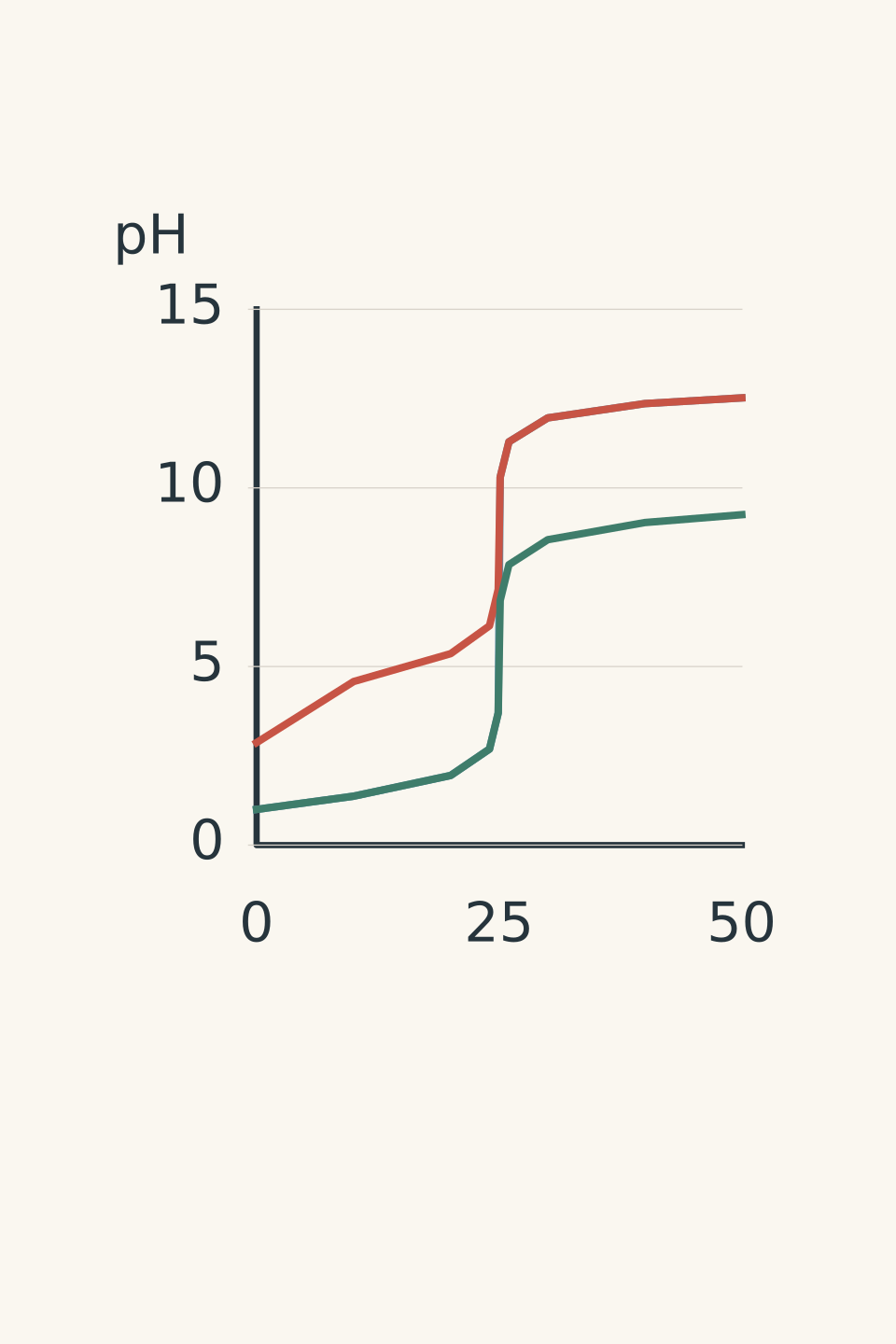
The graph represents three titrations. Each begins with \(25.0\ \mathrm{mL}\) of a \(0.100\ \mathrm{mol\,L^{-1}}\) acid, and the titrant is a \(0.100\ \mathrm{mol\,L^{-1}}\) base. The approximate equivalence-point pH values are A: 7.0, B: 8.7, and C: 5.3.
- A
- B
- C
(a) Match each curve to one of the following acid-base pairs. (3 marks)
- Hydrochloric acid and sodium hydroxide
- Ethanoic acid and sodium hydroxide
- Hydrochloric acid and ammonia
(b) Two particle models represent equal-volume solutions of the same monoprotic acid, \(\ce{HA}\), at the same initial concentration.
Acid ionisation models
| P | HA → H⁺ + A⁻ 20 H⁺ ions and 20 A⁻ ions 0 intact HA units |
|---|---|
| Q | HA ⇌ H⁺ + A⁻ 2 H⁺ ions, 2 A⁻ ions, 18 intact HA units |
Identify which model represents a strong acid and which represents a weak acid. Write a suitable symbolic dissociation equation for each, using the appropriate arrow. (2 marks)
(c) Explain why the equivalence-point solution for curve B is basic, while the equivalence-point solution for curve C is acidic. (2 marks)
(d) Identify which curve contains a buffer region and name the two main acid-base species responsible for that region. (1 mark)
Question 9 (4 marks)
Conductivity during titration
A student titrates \(20.0\ \mathrm{mL}\) of \(0.100\ \mathrm{mol\,L^{-1}}\) hydrochloric acid with \(0.100\ \mathrm{mol\,L^{-1}}\) sodium hydroxide. The conductivity is measured after each addition.
| Volume of NaOH added (mL) | Conductivity (\(\mathrm{mS\,cm^{-1}}\)) |
|---|---|
| 0 | 35.0 |
| 5 | 27.0 |
| 10 | 22.0 |
| 15 | 17.0 |
| 20 | 13.0 |
| 25 | 18.0 |
| 30 | 23.0 |
(a) Estimate the equivalence-point volume. (1 mark)
(b) Explain why the conductivity decreases before the equivalence point and increases afterwards. Refer to the ions present in the solution. (2 marks)
(c) Suggest one way to improve the precision of the equivalence-point estimate. (1 mark)
Question 10 (7 marks)
Buffers in natural systems and the laboratory
(a) Define a buffer solution and identify one natural system in which buffering is important. Explain why maintaining a relatively stable pH matters in that system. (2 marks)
(b) A student prepares a \(100.0\ \mathrm{mL}\) buffer by mixing \(50.0\ \mathrm{mL}\) of \(0.100\ \mathrm{mol\,L^{-1}}\) ethanoic acid with \(50.0\ \mathrm{mL}\) of \(0.100\ \mathrm{mol\,L^{-1}}\) sodium ethanoate.
The \(pK_a\) of ethanoic acid is 4.76.
Calculate the pH of the buffer. Assume the volumes are additive. (2 marks)
(c) Write net ionic equations showing how the ethanoic acid/ethanoate buffer responds to:
(i) the addition of hydronium ions; (1 mark)
(ii) the addition of hydroxide ions. (1 mark)
(d) Describe one controlled experiment using a digital pH probe to test whether this buffer resists pH change more effectively than distilled water. (1 mark)
Question 11 (7 marks)
Enthalpy of neutralisation
A student mixes \(50.0\ \mathrm{mL}\) of \(1.00\ \mathrm{mol\,L^{-1}}\) hydrochloric acid with \(50.0\ \mathrm{mL}\) of \(1.00\ \mathrm{mol\,L^{-1}}\) sodium hydroxide in an insulated cup.
The initial temperature of both solutions is \(22.4^\circ\mathrm{C}\). The maximum temperature reached is \(29.0^\circ\mathrm{C}\).
Assume that the total solution mass is \(100.0\ \mathrm{g}\), the solution absorbs all the heat released by the reaction, and the cup absorbs negligible heat.
(a) Calculate the heat absorbed by the solution. (2 marks)
(b) Calculate the molar enthalpy of neutralisation in \(\mathrm{kJ\,mol^{-1}}\), per mole of water formed. Include the sign of your answer. (3 marks)
(c) Identify one likely source of error in a real cup-calorimetry experiment and describe a specific improvement that would reduce it. (2 marks)
Question 12 (4 marks)
Community-led environmental analysis
An Aboriginal community-controlled organisation partners with environmental scientists to investigate seasonal changes in a waterway on Country. Local knowledge holders guide the choice of sampling sites and timing, and the community determines which information may be shared publicly.
The scientists use contemporary digital pH and conductivity probes alongside the place-specific knowledge provided by community members. The project does not assume that one practice or body of knowledge applies to all Aboriginal and Torres Strait Islander communities.
(a) State what each instrument measures and identify one conclusion about water quality that these measurements cannot establish on their own. (2 marks)
(b) Identify two practices that would help ensure the investigation respects community authority, knowledge, and cultural context. (2 marks)
Question 13 (3 marks)
Household acidity analysis
A student analyses a degassed soft drink by titration with standardised \(0.0100\ \mathrm{mol\,L^{-1}}\) sodium hydroxide.
A \(10.00\ \mathrm{mL}\) sample requires a mean titre of \(12.40\ \mathrm{mL}\) to reach the selected endpoint.
For this simplified calculation, assume all the titratable acidity is due to a single monoprotic acid, \(\ce{HA}\), which reacts with hydroxide ions in a 1:1 mole ratio.
(a) Calculate the apparent concentration of \(\ce{HA}\) in the original sample. (2 marks)
(b) Explain why measuring a drink’s pH alone does not determine its total titratable acidity. (1 mark)
Question 14 (3 marks)
Neutralisation in everyday life and industry
(a) Write the net ionic equation for the reaction between hydronium ions and hydroxide ions. (1 mark)
(b) An industrial wastewater treatment plant adds a base to acidic wastewater before discharge. Explain why the base should be added in a controlled manner while pH is monitored. (1 mark)
(c) Name one everyday application of neutralisation and identify the acid or base being neutralised. (1 mark)
03Worked solutions and marking guide
Solution 1
(a) Chemical formula and name
- Sulfuric acid: \(\ce{H2SO4}\).
- \(\ce{NaOH}\): sodium hydroxide.
Marking: 1 mark for each correct answer.
(b) Dissociation and ionisation
Hydrochloric acid transfers a proton to water:
\[ \ce{HCl(aq) + H2O(l) -> H3O+(aq) + Cl-(aq)} \]
Solid sodium hydroxide dissociates into aqueous ions:
\[ \ce{NaOH(s) -> Na+(aq) + OH-(aq)} \]
Marking: 1 mark for each correct equation, including appropriate formulas and balancing.
(c) Brønsted-Lowry theory
A Brønsted-Lowry acid donates a proton, while a Brønsted-Lowry base accepts a proton.
In the given reaction:
- \(\ce{H2O}\) is the acid because it donates a proton.
- \(\ce{NH3}\) is the base because it accepts a proton.
- The conjugate pairs are \(\ce{H2O/OH-}\) and \(\ce{NH4+/NH3}\).
Marking:
- 1 mark for identifying the acid and base correctly.
- 1 mark for identifying both conjugate pairs.
(d) Limitation of Arrhenius theory
Arrhenius theory describes acids and bases in aqueous solution through their effects on hydronium and hydroxide ion concentrations. It does not provide a general description of proton-transfer reactions that occur outside aqueous solution.
For example, gaseous hydrogen chloride transfers a proton to ammonia:
\[ \ce{HCl(g) + NH3(g) -> NH4Cl(s)} \]
Brønsted-Lowry theory explains this reaction directly by identifying the proton donor and proton acceptor.
Marking: 1 mark for a valid limitation and an explanation of how the broader proton-transfer model addresses it.
Solution 2
(a) Balanced equations
(i) Magnesium reacting with hydrochloric acid:
\[ \ce{Mg + 2HCl -> MgCl2 + H2} \]
(ii) Calcium carbonate reacting with nitric acid:
\[ \ce{CaCO3 + 2HNO3 -> Ca(NO3)2 + CO2 + H2O} \]
(iii) Sulfuric acid reacting with potassium hydroxide:
\[ \ce{H2SO4 + 2KOH -> K2SO4 + 2H2O} \]
Marking: 1 mark for each correctly balanced equation.
(b) Amphiprotic ions
An amphiprotic species can both donate and accept a proton.
For hydrogen carbonate, \(\mathrm{HCO_{3}}^{-}\):
As a proton donor:
\[ \ce{HCO3^- + H2O <=> CO3^2- + H3O+} \]
As a proton acceptor:
\[ \ce{HCO3^- + H2O <=> H2CO3 + OH-} \]
For dihydrogen phosphate, \(\mathrm{H_{2}PO_{4}}^{-}\):
As a proton donor:
\[ \ce{H2PO4^- + H2O <=> HPO4^2- + H3O+} \]
As a proton acceptor:
\[ \ce{H2PO4^- + H2O <=> H3PO4 + OH-} \]
In each equation, the hydrogen-containing ion changes its protonation state. The accompanying sodium and potassium ions are spectators and do not participate in these proton-transfer reactions.
Marking: 1 mark for each correct ionic equation, including balanced atoms and charge.
Solution 3
(a) Hydrochloric acid solution
Hydrochloric acid is a strong acid, so its concentration is taken to equal the hydronium ion concentration:
\[ [\ce{H3O+}]=3.20\times10^{-3}\ \mathrm{mol\,L^{-1}} \]
(i) Calculate pH:
\[ \begin{aligned} pH&=-\log_{10}(3.20\times10^{-3})\\ &=2.495 \end{aligned} \]
(ii) Calculate pOH:
\[ \begin{aligned} pOH&=14.00-pH\\ &=14.00-2.495\\ &=11.505 \end{aligned} \]
(iii) Calculate hydroxide ion concentration using \(K_w=[\ce{H3O+}][\ce{OH-}]\):
\[ \begin{aligned} [\ce{OH-}]&=\frac{K_w}{[\ce{H3O+}]}\\ &=\frac{1.00\times10^{-14}}{3.20\times10^{-3}}\\ &=3.13\times10^{-12}\ \mathrm{mol\,L^{-1}} \end{aligned} \]
Marking:
- 1 mark for pH.
- 1 mark for pOH.
- 1 mark for hydroxide ion concentration.
(b) Solution with pH 10.40
First calculate pOH:
\[ pOH=14.00-10.40=3.60 \]
Then calculate the concentrations:
\[ \begin{aligned} [\ce{OH-}]&=10^{-3.60}\\ &=2.51\times10^{-4}\ \mathrm{mol\,L^{-1}} \end{aligned} \]
\[ \begin{aligned} [\ce{H3O+}]&=10^{-10.40}\\ &=3.98\times10^{-11}\ \mathrm{mol\,L^{-1}} \end{aligned} \]
Marking: 1 mark for each correct concentration.
(c) Comparing pH 2 and pH 3
The solution at pH 2.00 has ten times the hydronium ion concentration of the solution at pH 3.00.
A one-unit decrease in pH corresponds to a tenfold increase in hydronium ion concentration.
Marking: 1 mark for the correct tenfold relationship.
Solution 4
(a) Calculate \(K_a\)
The measured pH gives the equilibrium hydronium ion concentration:
\[ \begin{aligned} [\ce{H3O+}]&=10^{-2.87}\\ &=1.35\times10^{-3}\ \mathrm{mol\,L^{-1}} \end{aligned} \]
For the reaction of a monoprotic acid, each mole of acid that dissociates produces one mole of hydronium ions and one mole of \(\mathrm{A}^{-}\).
Therefore:
\[ [\mathrm{A}^{-}]=1.35\times10^{-3}\ \mathrm{mol\,L^{-1}} \]
The remaining undissociated acid concentration is:
\[ \begin{aligned} [\ce{HA}]&=0.100-0.00135\\ &=0.09865\ \mathrm{mol\,L^{-1}} \end{aligned} \]
Using the acid dissociation expression:
\[ K_a=\frac{[\ce{H3O+}][\mathrm{A}^{-}]}{[\ce{HA}]} \]
Substituting the equilibrium concentrations:
\[ \begin{aligned} K_a&=\frac{(1.35\times10^{-3})^2}{0.09865}\\ &=1.84\times10^{-5} \end{aligned} \]
Marking:
- 1 mark for the hydronium concentration.
- 1 mark for the equilibrium concentrations and correct expression.
- 1 mark for the calculated \(K_a\).
(b) Calculate \(pK_a\)
\[ \begin{aligned} pK_a&=-\log_{10}(K_a)\\ &=-\log_{10}(1.84\times10^{-5})\\ &=4.73 \end{aligned} \]
Marking: 1 mark for the correct value.
(c) Compare acid strength
Acid \(\ce{HB}\) is stronger because its \(K_a\), \(6.3\times10^{-4}\), is greater than the \(K_a\) of \(\ce{HA}\), \(1.84\times10^{-5}\).
A larger \(K_a\) indicates a greater tendency to dissociate under comparable conditions.
Marking: 1 mark for identifying \(\ce{HB}\) and correctly linking strength to \(K_a\).
(d) Strength versus concentration
Acid strength describes the extent to which an acid ionises. Concentration describes how much acid is present per unit volume.
A concentrated weak acid can produce more hydronium ions per litre than a very dilute strong acid. Therefore, pH depends on both the amount of acid present and its ionisation behaviour; pH alone does not establish intrinsic acid strength.
Marking: 1 mark for distinguishing concentration from strength and linking this distinction to pH.
Solution 5
(a) Dilution of sodium hydroxide
The amount of sodium hydroxide remains constant during dilution.
\[ \begin{aligned} n(\ce{OH-})&=CV\\ &=0.100\times0.0200\\ &=0.00200\ \mathrm{mol} \end{aligned} \]
The final volume is \(0.2500\ \mathrm{L}\), so:
\[ \begin{aligned} [\ce{OH-}]&=\frac{0.00200}{0.2500}\\ &=0.00800\ \mathrm{mol\,L^{-1}} \end{aligned} \]
Calculate pOH:
\[ pOH=-\log_{10}(0.00800)=2.097 \]
Then calculate pH:
\[ pH=14.00-2.097=11.903 \]
Marking:
- 1 mark for the final hydroxide concentration.
- 1 mark for pOH.
- 1 mark for pH.
(b) Mixing hydrochloric acid and sodium hydroxide
First calculate the initial amounts in moles.
For hydrochloric acid:
\[ \begin{aligned} n(\ce{H3O+})&=0.1200\times0.02500\\ &=0.003000\ \mathrm{mol} \end{aligned} \]
For sodium hydroxide:
\[ \begin{aligned} n(\ce{OH-})&=0.0500\times0.03500\\ &=0.001750\ \mathrm{mol} \end{aligned} \]
Hydronium ions are in excess:
\[ \begin{aligned} n_{\mathrm{excess}}(\ce{H3O+}) &=0.003000-0.001750\\ &=0.001250\ \mathrm{mol} \end{aligned} \]
The total volume is:
\[ V_{\mathrm{total}}=0.02500+0.03500=0.06000\ \mathrm{L} \]
Therefore:
\[ \begin{aligned} [\ce{H3O+}]&=\frac{0.001250}{0.06000}\\ &=0.02083\ \mathrm{mol\,L^{-1}} \end{aligned} \]
Finally:
\[ \begin{aligned} pH&=-\log_{10}(0.02083)\\ &=1.681 \end{aligned} \]
The solution remains acidic because hydronium ions are in excess.
Marking:
- 1 mark for the initial mole calculations.
- 1 mark for the excess hydronium amount and final concentration.
- 1 mark for the correct pH.
Follow-through marks should be awarded where a student’s subsequent calculations are consistent with an earlier arithmetic error.
Solution 6
(a) Selecting an indicator
Phenolphthalein is the most suitable indicator. Its transition range is pH 8.2-10.0, which includes the expected equivalence-point pH of 8.7 and falls within the sharp pH change near the endpoint.
Marking:
- 1 mark for selecting phenolphthalein.
- 1 mark for relating its transition range to the equivalence region.
(b) Reversible colour change
The two forms of the indicator have different colours. Adding acid increases the hydronium ion concentration and shifts the equilibrium towards \(\ce{HIn}\). Adding base removes hydronium ions, shifting the equilibrium towards \(\mathrm{In}^{-}\).
The colour change is reversible because the indicator equilibrium can shift in either direction as conditions change.
Marking: 1 mark for correctly explaining the reversible equilibrium shift.
(c) Digital pH probe
Suitable practices include:
- Calibrating the probe with appropriate standard buffer solutions before measurement.
- Rinsing the electrode with deionised water between samples to reduce contamination.
- Waiting for the reading to stabilise before recording it.
- Blotting the electrode gently rather than wiping it.
Marking: 1 mark for each of two valid practices.
Solution 7
(a) Mean titre
\[ \begin{aligned} \text{Mean titre} &=\frac{18.55+18.60+18.65}{3}\\ &=18.60\ \mathrm{mL} \end{aligned} \]
Marking: 1 mark for the correct mean titre.
(b) Net ionic equation
\[ \ce{HA(aq) + OH-(aq) -> A-(aq) + H2O(l)} \]
The hydroxide ion accepts a proton from the acid, forming water and the conjugate base.
Marking: 1 mark for the correct equation.
(c) Concentration of the unknown acid
Convert the mean titre to litres:
\[ V(\ce{NaOH})=0.01860\ \mathrm{L} \]
Calculate the amount of sodium hydroxide:
\[ \begin{aligned} n(\ce{NaOH})&=CV\\ &=0.1000\times0.01860\\ &=0.001860\ \mathrm{mol} \end{aligned} \]
The acid is monoprotic, so it reacts with hydroxide ions in a 1:1 mole ratio. Therefore:
\[ n(\ce{HA})=0.001860\ \mathrm{mol} \]
The acid sample volume is \(0.02500\ \mathrm{L}\):
\[ \begin{aligned} [\ce{HA}]&=\frac{0.001860}{0.02500}\\ &=0.07440\ \mathrm{mol\,L^{-1}} \end{aligned} \]
Marking:
- 1 mark for calculating the amount of sodium hydroxide.
- 1 mark for applying the 1:1 stoichiometric ratio.
- 1 mark for calculating the acid concentration.
(d) Industrial quality control
Titration can determine the concentration of an acid or base in a manufactured product. Comparing the result with the required specification helps identify batches that are too concentrated or too dilute.
The titrant must have a known concentration for accurate calculations. Concordant titres help demonstrate repeatability and reduce the influence of random measurement errors.
Marking:
- 1 mark for a valid industrial application.
- 1 mark for explaining the importance of standardisation or concordant titres.
Solution 8
(a) Identifying the titration curves
- Curve A: hydrochloric acid with sodium hydroxide. A strong acid-strong base titration has an equivalence point near pH 7.
- Curve B: ethanoic acid with sodium hydroxide. The conjugate base of the weak acid makes the equivalence solution basic.
- Curve C: hydrochloric acid with ammonia. The conjugate acid of the weak base makes the equivalence solution acidic.
Marking: 1 mark for each correct match.
(b) Particle models
Model P represents a strong acid because all the acid particles are ionised in the model.
Model Q represents a weak acid because most of its particles remain as undissociated \(\ce{HA}\) molecules.
The symbolic equations are:
For the strong acid:
\[ \ce{HA(aq) -> H+(aq) + A-(aq)} \]
For the weak acid:
\[ \ce{HA(aq) <=> H+(aq) + A-(aq)} \]
The single forward arrow represents effectively complete ionisation. The reversible arrow represents an equilibrium between ionised and undissociated particles.
Marking:
- 1 mark for correctly identifying P as strong and Q as weak.
- 1 mark for the correct symbolic equations and arrows.
(c) Equivalence-point pH
For curve B, the solution contains ethanoate ions, \(\mathrm{CH_{3}COO}^{-}\), which react with water to produce hydroxide ions:
\[ \ce{CH3COO^- + H2O <=> CH3COOH + OH-} \]
The resulting solution is basic, so the equivalence-point pH is above 7.
For curve C, the solution contains ammonium ions, \(\ce{NH4+}\), which can donate protons to water:
\[ \ce{NH4+ + H2O <=> NH3 + H3O+} \]
The resulting solution is acidic, so the equivalence-point pH is below 7.
Marking:
- 1 mark for explaining the basic equivalence solution of curve B.
- 1 mark for explaining the acidic equivalence solution of curve C.
(d) Buffer region
Curve B contains the buffer region. In this region, appreciable amounts of ethanoic acid, \(\ce{CH3COOH}\), and its conjugate base, \(\mathrm{CH_{3}COO}^{-}\), coexist.
Marking: 1 mark for identifying curve B and both species.
Solution 9
(a) Equivalence-point volume
The conductivity reaches its minimum at an addition of \(20.0\ \mathrm{mL}\) of sodium hydroxide.
The estimated equivalence-point volume is therefore \(20.0\ \mathrm{mL}\).
Marking: 1 mark for the correct volume.
(b) Explaining the conductivity trend
Before equivalence, added hydroxide ions react with hydronium ions to form water. The highly mobile hydronium ions are progressively removed and replaced by sodium ions, which have lower ionic mobility. Conductivity therefore decreases.
After equivalence, further sodium hydroxide adds excess hydroxide ions and additional mobile ions. Conductivity consequently increases.
Marking:
- 1 mark for explaining the decrease before equivalence.
- 1 mark for explaining the increase after equivalence.
(c) Improving precision
Add sodium hydroxide in smaller increments near the conductivity minimum. This gives a more precise estimate of the equivalence-point volume.
Marking: 1 mark for a valid improvement.
Solution 10
(a) Buffers and natural systems
A buffer is a solution that resists substantial pH changes when small amounts of acid or base are added. It commonly contains a weak acid and its conjugate base, or a weak base and its conjugate acid.
One example is the bicarbonate buffer system in blood. It helps maintain a relatively stable pH, which is important for normal biological processes.
Marking:
- 1 mark for a correct definition.
- 1 mark for a valid natural example and explanation of its importance.
(b) Calculating the buffer pH
The initial amount of ethanoic acid is:
\[ \begin{aligned} n(\ce{CH3COOH})&=0.100\times0.0500\\ &=0.00500\ \mathrm{mol} \end{aligned} \]
The amount of ethanoate supplied by sodium ethanoate is also \(0.00500\ \mathrm{mol}\).
Because both species occupy the same final solution volume, their concentration ratio is 1:
\[ \frac{[\ce{CH3COO-}]}{[\ce{CH3COOH}]}=1 \]
Using the buffer equation:
\[ \begin{aligned} pH&=pK_a+\log_{10} \left(\frac{[\ce{CH3COO-}]}{[\ce{CH3COOH}]}\right)\\ &=4.76+\log_{10}(1)\\ &=4.76 \end{aligned} \]
Marking:
- 1 mark for the correct ratio of conjugate base to weak acid.
- 1 mark for the correct pH.
(c) Buffer response equations
When hydronium ions are added:
\[ \ce{CH3COO- + H3O+ -> CH3COOH + H2O} \]
The ethanoate ions remove much of the added hydronium.
When hydroxide ions are added:
\[ \ce{CH3COOH + OH- -> CH3COO- + H2O} \]
The weak acid reacts with the added hydroxide, limiting the pH increase.
Marking: 1 mark for each correct equation.
(d) Testing buffer capacity
Measure the initial pH of the buffer and distilled water using a calibrated pH probe. Add equal, small, measured amounts of the same dilute acid or base to each, then compare the changes in pH.
The buffer should show a smaller pH change than distilled water under the same conditions.
Marking: 1 mark for a valid controlled comparison.
Solution 11
(a) Heat absorbed by the solution
The temperature change is:
\[ \Delta T=29.0-22.4=6.6\ \mathrm{K} \]
Using \(q=mc\Delta T\):
\[ \begin{aligned} q&=100.0\times4.18\times6.6\\ &=2758.8\ \mathrm{J}\\ &=2.76\ \mathrm{kJ} \end{aligned} \]
The solution absorbs approximately \(2.76\ \mathrm{kJ}\) of heat.
Marking:
- 1 mark for the correct temperature change and mass.
- 1 mark for the correct heat calculation.
(b) Molar enthalpy of neutralisation
The amount of hydrochloric acid is:
\[ \begin{aligned} n(\ce{HCl})&=1.00\times0.0500\\ &=0.0500\ \mathrm{mol} \end{aligned} \]
The amount of sodium hydroxide is also \(0.0500\ \mathrm{mol}\). They react in a 1:1 ratio, forming \(0.0500\ \mathrm{mol}\) of water.
The solution absorbs heat, so the reaction releases heat. Therefore, the reaction heat is negative:
\[ q_{\mathrm{reaction}}=-2.76\ \mathrm{kJ} \]
The molar enthalpy of neutralisation is:
\[ \begin{aligned} \Delta H_{\mathrm{neut}} &=\frac{q_{\mathrm{reaction}}}{n(\ce{H2O})}\\ &=\frac{-2.7588}{0.0500}\\ &=-55.2\ \mathrm{kJ\,mol^{-1}} \end{aligned} \]
The negative sign indicates an exothermic reaction.
Marking:
- 1 mark for the amount of water formed.
- 1 mark for the correct sign and exothermic interpretation.
- 1 mark for the calculated molar enthalpy.
(c) Experimental error and improvement
One likely source of error is heat transfer from the solution to the surroundings or to the cup. This reduces the measured temperature rise and can make the calculated enthalpy less negative than the true value.
Using a well-insulated cup with a lid and a temperature probe that records the temperature continuously would reduce heat loss and improve the measurement.
Marking:
- 1 mark for a valid source of error.
- 1 mark for a suitable linked improvement.
Solution 12
(a) Interpreting environmental measurements
A pH probe measures pH, which indicates the acidity or basicity of the water through its relationship to hydronium ion activity. A conductivity meter measures how readily the water conducts electricity, which depends on the presence and mobility of dissolved ions.
Neither measurement alone establishes whether the water is safe or identifies every contaminant present. Additional chemical, biological, and environmental evidence may be needed.
Marking:
- 1 mark for describing the measurements correctly.
- 1 mark for identifying a valid limitation.
(b) Respectful investigation practices
Suitable practices include:
- Working under community direction and obtaining permission before collecting information or sampling at selected sites.
- Allowing the community to determine which knowledge, locations, and findings may be shared publicly.
- Acknowledging the knowledge holders and sharing findings with the community in an accessible form.
- Treating local knowledge as place-specific rather than assuming all Aboriginal and Torres Strait Islander communities share the same practices.
Community-held knowledge can inform the selection of sites, seasonal timing, and interpretation of changes. Contemporary probes provide quantitative measurements that can complement that knowledge; they should not be misrepresented as traditional Indigenous instruments.
Marking: 1 mark for each of two distinct, appropriate practices.
Solution 13
(a) Apparent acid concentration
The net ionic reaction is:
\[ \ce{HA + OH- -> A- + H2O} \]
The mole ratio is 1:1.
Calculate the amount of sodium hydroxide added:
\[ \begin{aligned} n(\ce{NaOH})&=CV\\ &=0.0100\times0.01240\\ &=1.240\times10^{-4}\ \mathrm{mol} \end{aligned} \]
Therefore, the original \(10.00\ \mathrm{mL}\) sample contains the same amount of acid under the stated simplified model.
\[ \begin{aligned} [\ce{HA}]&=\frac{1.240\times10^{-4}}{0.01000}\\ &=0.01240\ \mathrm{mol\,L^{-1}} \end{aligned} \]
The apparent acid concentration is \(0.01240\ \mathrm{mol\,L^{-1}}\).
Marking:
- 1 mark for calculating the amount of acid from the titration data.
- 1 mark for calculating its concentration using the original sample volume.
(b) pH versus titratable acidity
pH indicates the solution’s current hydronium ion activity. Titratable acidity measures how much base is required to reach a specified endpoint.
Two drinks can have similar pH values but different amounts of acid available to be neutralised. Therefore, pH alone does not determine total titratable acidity.
Marking: 1 mark for clearly distinguishing pH from titratable acidity.
Solution 14
(a) Net ionic neutralisation equation
\[ \ce{H3O+(aq) + OH-(aq) -> 2H2O(l)} \]
Marking: 1 mark for the correct balanced net ionic equation.
(b) Controlled industrial neutralisation
Adding the base gradually while monitoring pH helps prevent overshooting the target pH. This improves process control and helps ensure the wastewater meets the required conditions before discharge.
Marking: 1 mark for linking controlled dosing and pH monitoring to avoiding overshoot or maintaining the required pH.
(c) Everyday neutralisation
An antacid containing magnesium hydroxide neutralises excess hydrochloric acid in the stomach:
\[ \ce{Mg(OH)2 + 2HCl -> MgCl2 + 2H2O} \]
Marking: 1 mark for a valid everyday application and identification of the acid or base being neutralised.