
Black-Body Radiation and Photons: HSC Physics Practice Exam
Test your understanding of black-body radiation, Planck’s quantisation of energy, photons, and Wien’s displacement law with this original 40-mark tutorgum practice paper. Includes timed exam instructions, calculation and explanation questions, and fully worked solutions with a marking guide.
This original tutorgum practice paper assesses black-body radiation, Planck’s quantisation of energy, photons, and Wien’s displacement law. It is a focused revision paper for the supplied NSW Physics 2017-edition syllabus scope, not a full-course mock exam. It is an original tutorgum resource, not an official, endorsed, past, or predicted NESA paper.
01Exam instructions
- Suggested reading time: 5 minutes.
- Working time: 50 minutes, excluding reading time.
- Total marks: 40.
- Permitted equipment: Scientific calculator, pen or pencil, and ruler. Do not use notes or internet resources.
- Working: Show your calculations, substitutions, units, and reasoning. A correct numerical answer without working may not receive full marks.
- Precision: Give numerical answers to three significant figures unless otherwise indicated.
- Assumptions: Treat radiation sources as ideal black bodies unless stated otherwise. All wavelengths are in a vacuum. Where a light pulse is described as monochromatic, assume its energy is carried by photons of the stated wavelength.
Assessed scope
This paper covers:
- Black-body radiation spectra and their temperature dependence.
- The classical ultraviolet catastrophe and why classical predictions failed.
- Planck’s quantisation of energy and the photon model of light.
- Wien’s displacement law and calculations involving peak wavelength and temperature.
- Photon energy, photon number, and the relationship between spectral intensity and total emitted intensity.
Exclusions
This is not a full-course Physics examination. It does not assess the photoelectric effect, de Broglie matter waves, or calculations using the Stefan-Boltzmann law. Questions about total intensity use supplied spectral information rather than requiring an additional radiation law.
Supplied equations and constants
The following relationships and constants are available throughout the paper.
\[ E_{\text{photon}}=hf=\frac{hc}{\lambda} \]
\[ c=f\lambda \]
\[ \lambda_{\max}=\frac{b}{T} \]
Here:
- \(E_{\text{photon}}\) is the energy of one photon, measured in joules (J).
- \(h\) is Planck’s constant.
- \(f\) is frequency, measured in hertz (Hz).
- \(c\) is the speed of light in a vacuum.
- \(\lambda\) is wavelength, measured in metres (m).
- \(\lambda_{\max}\) is the wavelength at which a black-body spectrum reaches its maximum intensity.
- \(b\) is Wien’s displacement constant.
- \(T\) is absolute temperature, measured in kelvin (K).
Use these values:
\[ h=6.63\times10^{-34}\,\mathrm{J\,s} \]
\[ c=3.00\times10^8\,\mathrm{m\,s^{-1}} \]
\[ b=2.90\times10^{-3}\,\mathrm{m\,K} \]
02Questions
Question 1 (6 marks)
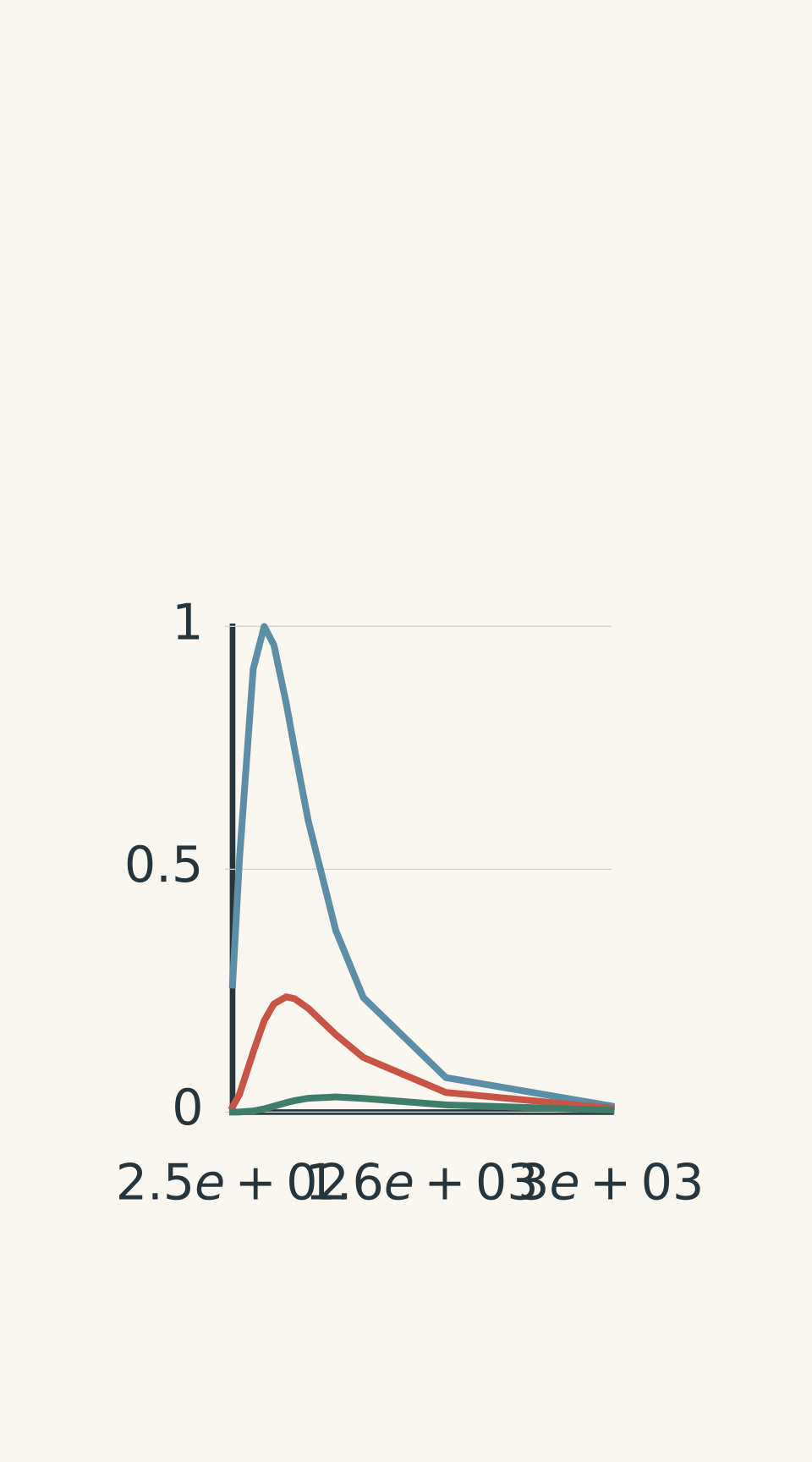
Figure 1 shows the spectral intensity curves for three ideal black bodies, labelled A, B, and C. The curves use the same wavelength and intensity scales.
- A
- B
- C
(a) Rank the three sources from highest to lowest temperature. (1 mark)
(b) Identify the source with the longest peak wavelength. (1 mark)
(c) Rank the sources from greatest to least total emitted intensity per unit surface area. (1 mark)
(d) Explain why comparing only the maximum height of each curve is not a complete way to compare the total emitted intensity of the sources. (2 marks)
(e) What does the finite width of each curve indicate about the wavelengths emitted by a black body? (1 mark)
Question 2 (6 marks)
An ideal black body has a peak wavelength of \(580\,\mathrm{nm}\).
(a) Calculate its absolute temperature using Wien’s displacement law. (3 marks)
(b) A second black body has a temperature of \(2900\,\mathrm{K}\). Calculate its peak wavelength in micrometres (\(\mu\mathrm{m}\)). (2 marks)
(c) If the absolute temperature of an ideal black body doubles, by what factor does its peak wavelength change? (1 mark)
Question 3 (8 marks)
(a) Explain what is meant by the classical ultraviolet catastrophe. In your answer, describe the classical prediction and how it differs from the observed black-body spectrum. (3 marks)
(b) Explain how Planck’s quantisation of energy addressed the ultraviolet catastrophe. Include the significance of the energy quantum and explain why the predicted radiation decreases at high frequencies. (4 marks)
(c) Does quantisation mean that every photon emitted by a black body has the same energy? Explain briefly. (1 mark)
Question 4 (6 marks)
A photon has a wavelength of \(450\,\mathrm{nm}\).
(a) Calculate the energy of this photon in joules. (3 marks)
(b) Compare a photon with a wavelength of \(450\,\mathrm{nm}\) with one having a wavelength of \(900\,\mathrm{nm}\). Determine which has the greater energy and calculate the ratio of their energies. (2 marks)
(c) Describe what happens to photon energy as wavelength increases. (1 mark)
Question 5 (7 marks)
Two monochromatic light pulses are detected. Each pulse delivers a total energy of \(1.40\times10^{-6}\,\mathrm{J}\).
- Pulse R consists entirely of photons with wavelength \(700\,\mathrm{nm}\).
- Pulse V consists entirely of photons with wavelength \(350\,\mathrm{nm}\).
Assume that all the energy in each pulse is carried by its photons and that no energy is lost.
(a) Calculate the energy of one photon in pulse R and one photon in pulse V. (4 marks)
(b) Calculate the number of photons in each pulse. (2 marks)
(c) State the ratio of the number of photons in pulse R to the number in pulse V. (1 mark)
Question 6 (7 marks)
Three monochromatic light beams have wavelengths of \(400\,\mathrm{nm}\), \(600\,\mathrm{nm}\), and \(1000\,\mathrm{nm}\). Each beam initially delivers the same number of photons per second per square metre to a detector.
(a) Rank the three beams from greatest to least energy per photon. (1 mark)
(b) Rank the beams from greatest to least energy delivered per second per square metre. Explain your ranking. (2 marks)
(c) A second trial compares a \(400\,\mathrm{nm}\) beam with a \(1000\,\mathrm{nm}\) beam. The \(1000\,\mathrm{nm}\) beam now delivers twice as many photons per second per square metre as the \(400\,\mathrm{nm}\) beam. Calculate the ratio of their energy delivery rates, \(1000\,\mathrm{nm}\) beam to \(400\,\mathrm{nm}\) beam. (2 marks)
(d) The peak wavelength of a black-body spectrum shifts from \(800\,\mathrm{nm}\) to \(400\,\mathrm{nm}\). Calculate the ratio of the final temperature to the initial temperature. Then state how the energy of a photon at the peak wavelength changes. (2 marks)
03Worked solutions and marking guide
Award marks for the demonstrated physics and correct working, not just the final answer. Equivalent mathematical methods are acceptable. Follow-through marks should be awarded where a student consistently uses an earlier numerical result and applies the correct method.
Solution 1
(a) Highest to lowest temperature: A, B, C.
Wien’s displacement law states that
\[ \lambda_{\max}=\frac{b}{T} \]
The peak wavelength decreases as temperature increases. Source A has the shortest peak wavelength, followed by B and then C.
Marking:
- 1 mark for the correct order, A, B, C.
(b) Source C.
Its peak occurs at the longest wavelength of the three sources.
Marking:
- 1 mark for identifying C.
(c) A, B, C.
The total emitted intensity per unit surface area is related to the area under the spectral intensity curve across all wavelengths. Source A has the greatest area, followed by B and then C.
Marking:
- 1 mark for the correct order, A, B, C.
(d) The area under the curve matters, not just its maximum height.
The peak height gives the spectral intensity at one particular wavelength. It does not describe the intensity across the full range of wavelengths.
A curve with a lower peak could still have a substantial total intensity if it extends over a wider range. Comparing the area under each complete curve gives a better measure of total emitted intensity per unit surface area.
Marking:
- 1 mark for identifying the area under the curve as the relevant measure of total intensity.
- 1 mark for explaining why peak height alone is insufficient.
(e) Each black body emits a range of wavelengths.
A black-body spectrum is continuous rather than consisting of radiation at only one wavelength.
Marking:
- 1 mark for identifying the continuous range of emitted wavelengths.
Solution 2
(a) The temperature is \(5.00\times10^3\,\mathrm{K}\).
Wien’s displacement law is
\[ \lambda_{\max}=\frac{b}{T} \]
Rearrange to make temperature the subject:
\[ T=\frac{b}{\lambda_{\max}} \]
Convert the peak wavelength to metres:
\[ 580\,\mathrm{nm}=5.80\times10^{-7}\,\mathrm{m} \]
Substitute:
\[ \begin{aligned} T&=\frac{2.90\times10^{-3}}{5.80\times10^{-7}}\\ &=5.00\times10^3\,\mathrm{K} \end{aligned} \]
Therefore,
\[ \boxed{T=5000\,\mathrm{K}} \]
Marking:
- 1 mark for converting the wavelength to metres.
- 1 mark for the correct rearrangement and substitution.
- 1 mark for the correct temperature and unit.
(b) The peak wavelength is \(1.00\,\mu\mathrm{m}\).
Rearrange Wien’s displacement law to find wavelength:
\[ \lambda_{\max}=\frac{b}{T} \]
Substitute \(T=2900\,\mathrm{K}\):
\[ \begin{aligned} \lambda_{\max} &=\frac{2.90\times10^{-3}}{2900}\\ &=1.00\times10^{-6}\,\mathrm{m}\\ &=1.00\,\mu\mathrm{m} \end{aligned} \]
Marking:
- 1 mark for the correct substitution and calculation.
- 1 mark for the correct wavelength in micrometres.
(c) The peak wavelength halves.
Because \(\lambda_{\max}\) is inversely proportional to absolute temperature, doubling the temperature halves the peak wavelength.
Marking:
- 1 mark for stating that the peak wavelength is reduced by a factor of two.
Solution 3
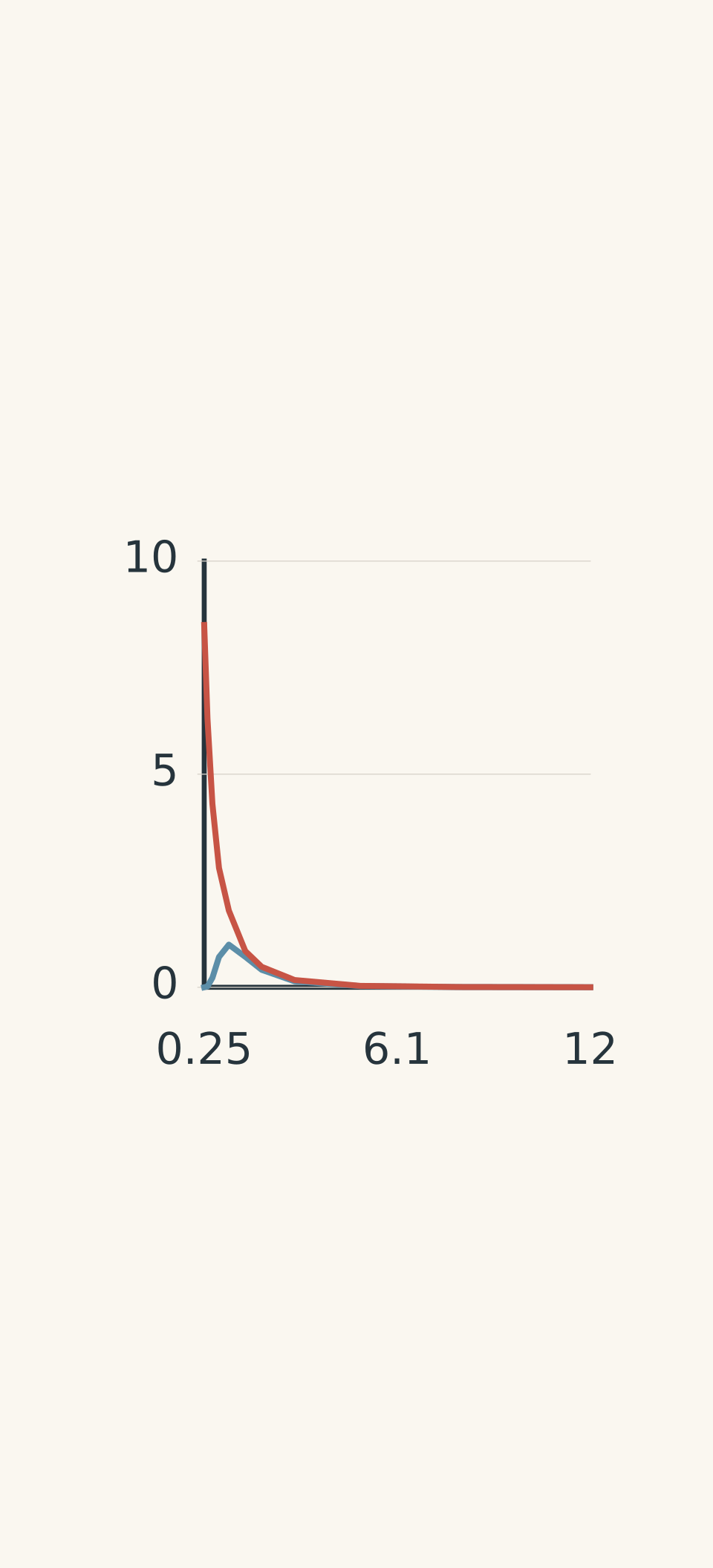
(a) The ultraviolet catastrophe was the failure of classical theory to predict the observed black-body spectrum.
Classical theory treated energy as continuous and predicted that radiation at higher frequencies would continue to increase without limit. This would give an infinite total emitted energy when contributions across all frequencies were added.
The observed spectrum behaves differently. It reaches a finite maximum and then decreases at high frequencies, corresponding to short wavelengths.
Marking:
- 1 mark for describing the classical prediction of increasing radiation at high frequencies.
- 1 mark for identifying the predicted divergence or infinite total energy.
- 1 mark for contrasting this with the observed spectrum, which peaks and falls.
- Observed black-body spectrum
- Classical Rayleigh–Jeans prediction
(b) Planck introduced discrete energy quanta.
Planck proposed that oscillators exchanging energy with radiation could occupy discrete energy levels rather than exchange arbitrary amounts of energy continuously. The allowed energies can be represented as
\[ E_n=nhf \]
where \(E_n\) is an oscillator’s energy, \(n\) is a non-negative integer, \(h\) is Planck’s constant, and \(f\) is the frequency.
The energy of one quantum is \(hf\). A higher-frequency quantum therefore requires more energy than a lower-frequency quantum.
At a fixed temperature, these larger energy exchanges become much less likely. This causes the predicted radiation at high frequencies to fall rather than increase without limit, avoiding the ultraviolet catastrophe.
Marking:
- 1 mark for identifying discrete energy exchanges or energy levels.
- 1 mark for stating the quantised energy relationship \(E_n=nhf\), or its equivalent.
- 1 mark for explaining that higher-frequency quanta require more energy and are less likely at a fixed temperature.
- 1 mark for linking quantisation to the decrease in high-frequency radiation and the removal of the classical divergence.
(c) No, photons can have different energies.
Quantisation does not require all photons to have one common energy. A black body emits a range of frequencies, and each photon’s energy depends on its frequency through \(E_{\text{photon}}=hf\).
Marking:
- 1 mark for stating that photon energies vary with frequency.
Solution 4
(a) The photon energy is \(4.42\times10^{-19}\,\mathrm{J}\).
Convert the wavelength to metres:
\[ 450\,\mathrm{nm}=4.50\times10^{-7}\,\mathrm{m} \]
Use the photon energy relationship:
\[ E_{\text{photon}}=\frac{hc}{\lambda} \]
Substitute the supplied constants:
\[ \begin{aligned} E_{\text{photon}} &=\frac{(6.63\times10^{-34})(3.00\times10^8)} {4.50\times10^{-7}}\\ &=4.42\times10^{-19}\,\mathrm{J} \end{aligned} \]
Marking:
- 1 mark for converting the wavelength to metres.
- 1 mark for the correct equation and substitution.
- 1 mark for the correct answer with units.
(b) The \(450\,\mathrm{nm}\) photon has twice the energy of the \(900\,\mathrm{nm}\) photon.
Using \(E=hc/\lambda\), the ratio is
\[ \begin{aligned} \frac{E_{450}}{E_{900}} &=\frac{\lambda_{900}}{\lambda_{450}}\\ &=\frac{900}{450}\\ &=2.00 \end{aligned} \]
The shorter-wavelength photon has the greater energy.
Marking:
- 1 mark for identifying the \(450\,\mathrm{nm}\) photon as having greater energy.
- 1 mark for calculating the energy ratio of \(2:1\).
(c) Photon energy decreases as wavelength increases.
Since \(c=f\lambda\), a longer wavelength corresponds to a lower frequency. Because \(E_{\text{photon}}=hf\), the photon energy also decreases.
Marking:
- 1 mark for correctly stating the inverse relationship between wavelength and photon energy.
Solution 5
(a) Photon energies
For pulse R, the wavelength is \(700\,\mathrm{nm}\):
\[ \lambda_R=7.00\times10^{-7}\,\mathrm{m} \]
Using \(E_{\text{photon}}=hc/\lambda\),
\[ \begin{aligned} E_R &=\frac{(6.63\times10^{-34})(3.00\times10^8)} {7.00\times10^{-7}}\\ &=2.84\times10^{-19}\,\mathrm{J} \end{aligned} \]
For pulse V, the wavelength is \(350\,\mathrm{nm}\):
\[ \lambda_V=3.50\times10^{-7}\,\mathrm{m} \]
Therefore,
\[ \begin{aligned} E_V &=\frac{(6.63\times10^{-34})(3.00\times10^8)} {3.50\times10^{-7}}\\ &=5.68\times10^{-19}\,\mathrm{J} \end{aligned} \]
The violet photons have twice the energy of the red photons because their wavelength is half as long.
Marking:
- 1 mark for the correct method and wavelength conversion for pulse R.
- 1 mark for the correct photon energy for pulse R.
- 1 mark for the correct method and wavelength conversion for pulse V.
- 1 mark for the correct photon energy for pulse V.
(b) Number of photons in each pulse
The total pulse energy equals the number of photons multiplied by the energy of one photon:
\[ N=\frac{E_{\text{total}}}{E_{\text{photon}}} \]
For pulse R:
\[ \begin{aligned} N_R &=\frac{1.40\times10^{-6}}{2.84\times10^{-19}}\\ &=4.93\times10^{12}\text{ photons} \end{aligned} \]
For pulse V:
\[ \begin{aligned} N_V &=\frac{1.40\times10^{-6}}{5.68\times10^{-19}}\\ &=2.46\times10^{12}\text{ photons} \end{aligned} \]
Marking:
- 1 mark for the correct number of photons in pulse R.
- 1 mark for the correct number of photons in pulse V.
(c) The ratio is \(2:1\).
Pulse R contains twice as many photons as pulse V.
Both pulses carry the same total energy, but each red photon carries half as much energy as each violet photon. Twice as many red photons are therefore needed to deliver the same total energy.
Marking:
- 1 mark for the correct ratio \(N_R:N_V=2:1\).
Solution 6
(a) Greatest to least photon energy:
\[ 400\,\mathrm{nm}>600\,\mathrm{nm}>1000\,\mathrm{nm} \]
Photon energy is inversely proportional to wavelength, so the shortest-wavelength photons have the greatest energy.
Marking:
- 1 mark for the correct ranking.
(b) Greatest to least energy delivery rate:
\[ 400\,\mathrm{nm}>600\,\mathrm{nm}>1000\,\mathrm{nm} \]
Each beam delivers the same number of photons per second per square metre. The energy delivered per second per square metre therefore depends on the energy of each photon. The beam with the greatest photon energy delivers the most energy.
Marking:
- 1 mark for the correct ranking.
- 1 mark for linking equal photon rates to the energy per photon.
(c) The energy delivery rate ratio is \(0.800:1\).
First, calculate the ratio of the energy of a \(1000\,\mathrm{nm}\) photon to that of a \(400\,\mathrm{nm}\) photon:
\[ \begin{aligned} \frac{E_{1000}}{E_{400}} &=\frac{\lambda_{400}}{\lambda_{1000}}\\ &=\frac{400}{1000}\\ &=0.400 \end{aligned} \]
The \(1000\,\mathrm{nm}\) beam delivers twice as many photons per second per square metre. Its energy delivery rate relative to the \(400\,\mathrm{nm}\) beam is therefore
\[ \begin{aligned} \frac{P_{1000}}{P_{400}} &=2(0.400)\\ &=0.800 \end{aligned} \]
Here, \(P_{1000}\) and \(P_{400}\) represent the energy delivery rates per unit area of the respective beams.
The \(1000\,\mathrm{nm}\) beam delivers \(80.0\%\) as much energy per second per square metre as the \(400\,\mathrm{nm}\) beam, despite having twice the photon rate.
Marking:
- 1 mark for calculating the photon energy ratio of \(0.400\).
- 1 mark for combining the energy ratio with the doubled photon rate to obtain \(0.800\).
(d) The final temperature is twice the initial temperature, and the photon energy at the peak wavelength doubles.
Wien’s displacement law gives
\[ \lambda_{\max}=\frac{b}{T} \]
Rearranging the relationship between the two temperatures:
\[ \begin{aligned} \frac{T_f}{T_i} &=\frac{\lambda_i}{\lambda_f}\\ &=\frac{800}{400}\\ &=2 \end{aligned} \]
The final temperature is twice the initial temperature.
For photons at the respective peak wavelengths, \(E=hc/\lambda\). Therefore,
\[ \frac{E_f}{E_i} =\frac{\lambda_i}{\lambda_f} =\frac{800}{400} =2 \]
The energy of a photon at the peak wavelength also doubles.
Marking:
- 1 mark for calculating \(T_f/T_i=2\).
- 1 mark for stating that the photon energy at the peak wavelength doubles.