
Year 11 Chemistry Chemical Reactions: Original Practice Exam
Test your understanding of the Year 11 Chemistry Chemical Reactions module with this original 100-mark timed practice paper. Includes questions across the specified 2025 syllabus scope, plus complete worked solutions and a detailed marking guide.
This original tutorgum practice paper assesses the Year 11 Chemistry 2025-edition scope for Chemical Reactions. It is a focused module assessment, covering the full content area specified in this paper. It is not a full-course Chemistry examination or an official, endorsed, past, or predicted NESA paper.
01Exam instructions
- Total marks: 100
- Suggested working time: 120 minutes
- Suggested reading time: 5 minutes
- Permitted equipment: Scientific calculator, periodic table, ruler, and writing materials.
- Reference material: All numerical data, constants, and reference information needed for the questions are supplied in the paper. Internet access is not required.
Assessed scope
This paper covers reaction types and balanced equations, conservation of atoms, acid-base and acid-carbonate reactions, precipitation, metal reactivity and displacement, activity series, periodic trends in metal reactivity, oxidation and reduction, redox half-equations, collision theory, factors affecting reaction rates, energy profiles, catalysts, bond enthalpies, calorimetry, molar enthalpy, indicators of chemical change, Aboriginal and Torres Strait Islander food detoxification chemistry, and chemical reactions in medicine and agriculture.
Content from other modules or syllabus editions is excluded.
Working requirements
- Answer every question.
- Show your working for all calculations. Include units, appropriate signs, and sensible significant figures.
- Balance chemical equations and include state symbols where requested.
- Distinguish between observations, conclusions, and explanations. An observation may provide evidence of a chemical reaction without proving that a reaction has occurred.
- For calorimetry, use the sign convention stated or implied in each question. Define quantities where needed.
- The timing and conditions above are suggested conditions for this practice paper, not claims about official NESA examination requirements.
02Questions
Question 1 (12 marks)
Writing and balancing chemical equations
(a) Magnesium reacts with oxygen in a synthesis reaction. Predict the product and write a balanced symbolic equation, including state symbols. (2 marks)
(b) Hydrogen peroxide, \(\ce{H2O2}\), undergoes decomposition. Predict the products and write a balanced symbolic equation, including state symbols. (2 marks)
(c) Propane, \(\ce{C3H8}\), burns in oxygen.
(i) Write a balanced equation for complete combustion, producing carbon dioxide and water. (1 mark)
(ii) Write a balanced equation for incomplete combustion in which carbon monoxide is the carbon-containing product and water is the other product. (1 mark)
(d) Calcium carbonate reacts with nitric acid. Predict the products and write a balanced equation, including state symbols. (2 marks)
(e) Sulfuric acid reacts with sodium hydroxide. Predict the products and write a balanced neutralisation equation, including state symbols. (2 marks)
(f) Explain why the number of atoms of each element must be the same on both sides of a balanced chemical equation, even though new substances form. Refer to one equation from this question. (2 marks)
Question 2 (12 marks)
Metal reactivity and the activity series
A student investigates the relative reactivity of magnesium, zinc, copper, and silver. The student uses cleaned metal samples and aqueous solutions under comparable conditions.
The following results are recorded during displacement tests.
| Metal added to solution | Observation |
|---|---|
| Magnesium in zinc sulfate solution | A grey coating forms, and some magnesium is consumed. |
| Zinc in copper(II) sulfate solution | A reddish-brown solid forms, and the blue colour fades. |
| Copper in silver nitrate solution | Grey crystals form, and the solution becomes blue. |
| Silver in copper(II) sulfate solution | No visible change occurs during the test period. |
Additional tests produce the following observations.
| Metal | Cold water | Dilute hydrochloric acid | Heated in oxygen |
|---|---|---|---|
| Magnesium | Very slow bubbling after an extended period | Rapid bubbling | Bright white light and a white solid |
| Zinc | No visible change | Steady bubbling | A white solid forms when heated strongly |
| Copper | No visible change | No visible change | A black coating forms on heating |
| Silver | No visible change | No visible change | No visible change under the conditions used |
For comparison, a secondary chemistry reference, Ausetute’s Activity Series (Reactivity Series) of Metals Chemistry Tutorial, gives the following extract, ordered from more reactive to less reactive. Some metals are omitted.
\[ \ce{Mg > Al > Zn > Fe > Ni > Sn > Pb > Cu > Ag} \]
Metal activity series
- ________
More reactive
- ________
- ________
- ________
Less reactive
(a) Construct an activity series for magnesium, zinc, copper, and silver using the displacement results. (2 marks)
(b) Write both the balanced molecular equation and the net ionic equation for zinc reacting with copper(II) sulfate solution. Include state symbols. (2 marks)
(c) Use at least two observations from the water, acid, and oxygen tests to support a comparison of the relative reactivity of the metals. (2 marks)
(d) Compare your activity series with the supplied secondary reference. State one agreement and identify one placement in the reference series that the practical results cannot establish. (2 marks)
(e) Potassium is more reactive than sodium in their reactions with water. Explain this trend using atomic radius, electron shielding, first ionisation energy, and electronegativity. Link these properties to the tendency of a metal atom to lose its outer electron. (4 marks)
Question 3 (12 marks)
Redox reactions and electron transfer
Magnesium metal is placed in aqueous copper(II) sulfate. Copper metal forms, and magnesium ions enter the solution. Assume sulfate ions are spectators.
(a) State the oxidation numbers of magnesium and copper before and after the reaction. (2 marks)
(b) Identify:
(i) the species that is oxidised; (1 mark)
(ii) the species that is reduced; (1 mark)
(iii) the reducing agent; and (1 mark)
(iv) the oxidising agent. (1 mark)
Explain your choices in terms of electron transfer. (The explanation is included in the marks above.)
(c) Write the oxidation and reduction half-equations, including electrons and state symbols. (2 marks)
(d) Combine the half-equations to produce the balanced net ionic equation. Then write the balanced molecular equation. (2 marks)
(e) Explain how combining the half-equations demonstrates conservation of charge and atoms. (2 marks)
Question 4 (10 marks)
Collision theory and reaction rates
A student investigates the reaction between calcium carbonate and hydrochloric acid.
The student measures the initial rate of carbon dioxide production under four sets of conditions. All trials use the same mass of calcium carbonate, the same acid volume, and the same stirring conditions. Only the variables listed in the table change.
| Trial | Temperature | HCl concentration | Calcium carbonate form | Initial rate of \(\ce{CO2}\) production (cm³ s⁻¹) |
|---|---|---|---|---|
| A | 20°C | 0.50 mol L⁻¹ | Large chips | 1.2 |
| B | 35°C | 0.50 mol L⁻¹ | Large chips | 2.1 |
| C | 20°C | 1.00 mol L⁻¹ | Large chips | 2.3 |
| D | 20°C | 0.50 mol L⁻¹ | Powder | 4.8 |
(a) For each comparison below, identify the factor being changed and state how the measured rate changes.
(i) Trial B compared with trial A. (1 mark)
(ii) Trial C compared with trial A. (1 mark)
(iii) Trial D compared with trial A. (1 mark)
(b) Explain the observed rate changes using collision theory. Your answer must address temperature, concentration, surface area, activation energy, and the conditions required for a successful collision. (3 marks)
(c) Calculate the percentage increase in the initial reaction rate from trial A to trial D. (2 marks)
(d) A separate experiment investigates hydrogen peroxide decomposition:
\[ \ce{2H2O2(aq) -> 2H2O(l) + O2(g)} \]
The initial oxygen production rate is \(0.40\ \mathrm{cm^3\,s^{-1}}\) without a catalyst and \(3.20\ \mathrm{cm^3\,s^{-1}}\) with manganese dioxide present.
Calculate the factor by which the rate increases, and explain the effect of the catalyst in terms of activation energy. (2 marks)
Question 5 (10 marks)
Energy profiles, catalysts, and bond enthalpy
(a) The following figure represents an energy profile for a reaction.
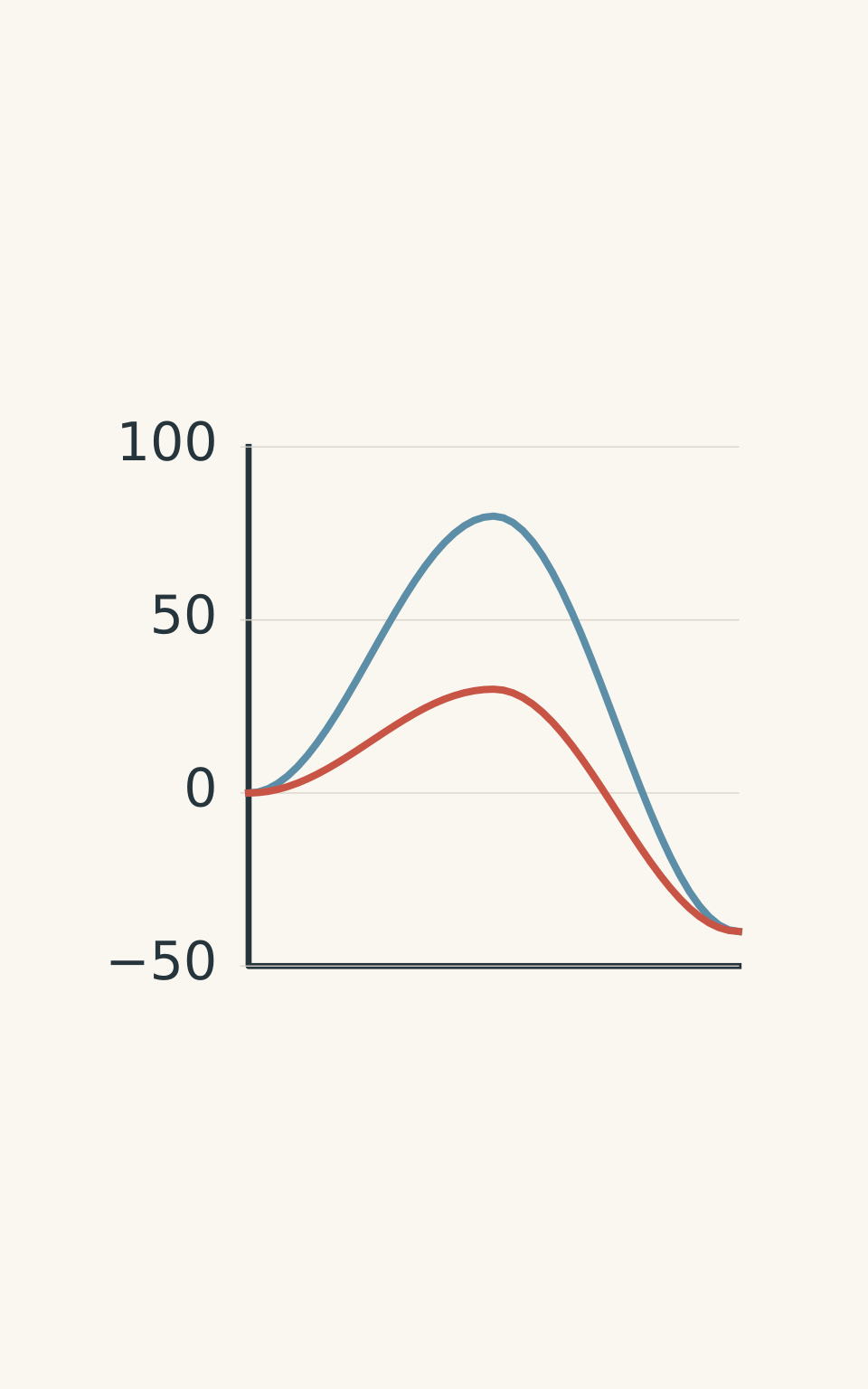
- Pathway A: ______
- Pathway B: ______
On the profile:
(i) Label the reactant and product energy levels. (1 mark)
(ii) Add forward activation-energy arrows for both pathways. (1 mark)
(iii) Add an arrow showing the enthalpy change, \(\Delta H\). (1 mark)
(iv) State whether \(\Delta H\) is positive or negative. (1 mark)
(b) Explain how a catalyst changes the reaction pathway and activation energy. State whether the catalyst changes the overall enthalpy change, \(\Delta H\). (2 marks)
(c) Consider the reaction:
\[ \ce{H2(g) + Cl2(g) -> 2HCl(g)} \]
The following mean bond enthalpies are supplied.
| Bond | Mean bond enthalpy (kJ mol⁻¹) |
|---|---|
| H-H | 436 |
| Cl-Cl | 243 |
| H-Cl | 431 |
Calculate the reaction enthalpy using the bond enthalpies. Explain whether the reaction is exothermic or endothermic, referring to the energy absorbed when bonds break and the energy released when bonds form. (4 marks)
Question 6 (12 marks)
Calorimetry and molar enthalpy
(a) A student dissolves \(5.00\ \mathrm{g}\) of ammonium nitrate, \(\ce{NH4NO3}\), in \(100.0\ \mathrm{g}\) of water. The initial temperature is \(22.0^\circ\mathrm{C}\), and the final temperature is \(18.7^\circ\mathrm{C}\).
For this calculation, assume the total solution mass is \(105.0\ \mathrm{g}\) and the specific heat capacity of the solution is \(4.18\ \mathrm{J\,g^{-1}\,^\circ C^{-1}}\).
Calculate:
(i) the heat change of the solution, \(q_{\text{solution}}\); (1 mark)
(ii) the heat change of the dissolving process, \(q_{\text{reaction}}\); (2 marks)
(iii) whether the dissolving process is endothermic or exothermic. (1 mark)
(b) The molar mass of ammonium nitrate is \(80.0\ \mathrm{g\,mol^{-1}}\).
Calculate the molar enthalpy of dissolution in \(\mathrm{kJ\,mol^{-1}}\), including its sign. (2 marks)
(c) A student burns \(0.800\ \mathrm{g}\) of ethanol, \(\ce{C2H5OH}\), to heat \(200.0\ \mathrm{g}\) of water from \(20.0^\circ\mathrm{C}\) to \(34.0^\circ\mathrm{C}\).
Use a specific heat capacity of \(4.18\ \mathrm{J\,g^{-1}\,^\circ C^{-1}}\) for water and a molar mass of \(46.0\ \mathrm{g\,mol^{-1}}\) for ethanol. For the calculation, assume all heat released by the ethanol is absorbed by the water.
Calculate the experimental molar enthalpy of combustion of ethanol in \(\mathrm{kJ\,mol^{-1}}\). (4 marks)
(d) A reference value for the complete combustion of liquid ethanol to carbon dioxide and liquid water is \(-1367\ \mathrm{kJ\,mol^{-1}}\).
Compare this value with your experimental result. Identify one likely experimental limitation and one improvement that could reduce its effect. (2 marks)
Question 7 (10 marks)
Acid-base and precipitation reactions
(a) Consider the reaction:
\[ \ce{NH3(aq) + HCl(aq) -> NH4+(aq) + Cl-(aq)} \]
Identify the Brønsted-Lowry acid and base. Explain the proton transfer that occurs. (2 marks)
(b) Nitric acid reacts with potassium hydroxide in aqueous solution.
Write:
(i) the balanced molecular equation, including state symbols; and (1 mark)
(ii) the net ionic equation. (1 mark)
(c) Aqueous lead(II) nitrate is mixed with aqueous potassium iodide.
Predict the products and write the balanced molecular equation, including state symbols. (3 marks)
(d) Write the net ionic equation for the reaction in part (c), and identify the spectator ions. (3 marks)
Question 8 (8 marks)
Aboriginal and Torres Strait Islander food detoxification chemistry
Aboriginal and Torres Strait Islander Peoples hold diverse, place-specific knowledge about food plants and their preparation. Some documented Aboriginal practices involve carefully controlled processing of particular cycad seeds before consumption. The methods differ across communities and Country, and should not be treated as a single universal practice.
Certain cycad seeds contain cycasin, a toxic glycoside. In a simplified chemical model, hydrolysis uses water to split cycasin into glucose and methylazoxymethanol (MAM). MAM is toxic and water-soluble. Leaching can transfer dissolved MAM out of plant material and into water.
Some traditional processing methods use several stages, which may include increasing the exposed surface area, heat, and leaching. The actual chemistry is more complex than this model. The question is not a recipe or guidance for preparing wild foods.
A background account is available in the Australian Curriculum’s teacher information on food detoxification. All information needed to answer this question is supplied above.
(a) Write a word equation for the hydrolysis described. Identify what changes chemically during this process. (2 marks)
(b) Explain the different roles of:
(i) increasing the exposed surface area of the plant material; (1 mark)
(ii) increasing temperature under controlled processing conditions; and (1 mark)
(iii) leaching with water. (1 mark)
Include one limitation of the simplified chemical model in your explanation. (1 mark)
(c) State two principles that should guide the respectful discussion or investigation of traditional food detoxification knowledge. (2 marks)
Question 9 (8 marks)
Chemical reactions in medicine and agriculture
(a) Some antacid tablets contain calcium carbonate, \(\ce{CaCO3}\), which reacts with hydrochloric acid in the stomach.
A tablet contains \(0.500\ \mathrm{g}\) of calcium carbonate. Use a molar mass of \(100.1\ \mathrm{g\,mol^{-1}}\).
Write a balanced equation for the reaction and calculate the maximum number of moles of hydrochloric acid that this amount of calcium carbonate can neutralise. (3 marks)
(b) Explain why this stoichiometric maximum is not, by itself, a safe or complete recommendation for how much antacid a person should take. (1 mark)
(c) Agricultural limestone, which consists mainly of calcium carbonate, can be used to reduce soil acidity.
Write the net ionic equation for calcium carbonate reacting with hydrogen ions. Explain how the reaction changes the acidity of the soil. (2 marks)
(d) Identify two factors that should be considered when deciding how much agricultural lime a particular soil needs. (2 marks)
Question 10 (6 marks)
Indicators of chemical change
For each observation below, identify the indicator or indicators of possible chemical change.
(a)
(i) A magnesium ribbon burns with bright white light and leaves a white powder. Identify two indicators. (2 marks)
(ii) Two colourless aqueous solutions are mixed. A yellow solid forms, and the mixture changes appearance. Identify the two indicators. (2 marks)
(iii) An acid is added to a carbonate, and bubbles appear. Identify the indicator. (1 mark)
(iv) A mixture warms from \(20.0^\circ\mathrm{C}\) to \(26.0^\circ\mathrm{C}\) without external heating. Identify the indicator. (1 mark)
03Worked solutions and marking guide
Marking allocations are shown for every subpart. Equivalent scientifically correct explanations and balanced equations should be accepted. Where a student uses a correct method but makes a minor arithmetic error, follow-through marks may be awarded when appropriate.
Solution 1
(a) Synthesis of magnesium oxide
The product is magnesium oxide, \(\ce{MgO}\).
\[ \ce{2Mg(s) + O2(g) -> 2MgO(s)} \]
The equation is balanced because there are two magnesium atoms and two oxygen atoms on each side.
- 1 mark for the correct product and formula.
- 1 mark for the correctly balanced equation with state symbols.
(b) Decomposition of hydrogen peroxide
The products are water and oxygen gas.
\[ \ce{2H2O2(aq) -> 2H2O(l) + O2(g)} \]
Hydrogen peroxide breaks down into simpler substances, so this is a decomposition reaction.
- 1 mark for predicting the products.
- 1 mark for balancing the equation correctly.
(c) Combustion of propane
(i) Complete combustion:
\[ \ce{C3H8(g) + 5O2(g) -> 3CO2(g) + 4H2O(g)} \]
Complete combustion produces carbon dioxide and water when oxygen is sufficient.
- 1 mark for the correct balanced equation.
(ii) Incomplete combustion to carbon monoxide:
\[ \ce{2C3H8(g) + 7O2(g) -> 6CO(g) + 8H2O(g)} \]
Incomplete combustion can produce carbon monoxide when oxygen is insufficient for complete combustion.
- 1 mark for the correct balanced equation.
(d) Acid-carbonate reaction
Calcium carbonate reacts with nitric acid to form calcium nitrate, water, and carbon dioxide.
\[ \ce{CaCO3(s) + 2HNO3(aq) -> Ca(NO3)2(aq) + H2O(l) + CO2(g)} \]
The equation contains the same number of each type of atom on both sides.
- 1 mark for the correct products.
- 1 mark for the balanced equation.
(e) Neutralisation
Sulfuric acid reacts with sodium hydroxide to form sodium sulfate and water.
\[ \ce{H2SO4(aq) + 2NaOH(aq) -> Na2SO4(aq) + 2H2O(l)} \]
The coefficient of sodium hydroxide must be 2 because sulfuric acid provides two acidic hydrogen ions per formula unit in complete neutralisation.
- 1 mark for the correct products.
- 1 mark for the balanced equation.
(f) Conservation of atoms
Chemical reactions rearrange atoms into new combinations. They do not create or destroy atoms, so each element must have the same number of atoms before and after the reaction.
For example, in \(\ce{2Mg + O2 -> 2MgO}\), two magnesium atoms and two oxygen atoms are present on each side. The atoms have formed a new substance, but their identities and total numbers are conserved.
- 1 mark for explaining conservation of atoms.
- 1 mark for a relevant, correctly explained example.
Total: 12 marks
Solution 2
(a) Constructing the activity series
The correct order, from most reactive to least reactive, is:
\[ \ce{Mg > Zn > Cu > Ag} \]
Magnesium displaces zinc from zinc sulfate, zinc displaces copper from copper(II) sulfate, and copper displaces silver from silver nitrate. A more reactive metal can displace a less reactive metal from a solution containing its ions.
- 1 mark for the complete correct order.
- 1 mark for correctly using the displacement evidence.
(b) Zinc and copper(II) sulfate
The balanced molecular equation is:
\[ \ce{Zn(s) + CuSO4(aq) -> ZnSO4(aq) + Cu(s)} \]
The net ionic equation is:
\[ \ce{Zn(s) + Cu^2+(aq) -> Zn^2+(aq) + Cu(s)} \]
The sulfate ions are spectators. Zinc atoms lose electrons to form zinc ions, while copper(II) ions gain electrons to form copper metal.
- 1 mark for the balanced molecular equation.
- 1 mark for the correct net ionic equation.
(c) Interpreting the water, acid, and oxygen tests
Magnesium is more reactive than zinc under the tested conditions. It reacts more vigorously with dilute hydrochloric acid and shows a more energetic reaction when heated in oxygen. Magnesium also shows slow bubbling in cold water, while zinc shows no visible change during the test period.
- 1 mark for a valid comparison of relative reactivity.
- 1 mark for supporting the comparison with relevant observations from at least two tests.
The observations describe behaviour under particular conditions. No visible change does not prove that a metal can never react; different temperatures, reaction times, or reactants may produce different results.
(d) Comparing with the secondary reference
The practical order \(\ce{Mg > Zn > Cu > Ag}\) agrees with the supplied reference for those four metals.
However, the practical tests do not establish the position of aluminium relative to magnesium and zinc, or the position of iron relative to zinc and copper, because those metals were not tested.
- 1 mark for identifying agreement between the practical results and the reference.
- 1 mark for identifying a placement that the practical data cannot establish.
(e) Periodic trends and metal reactivity
Potassium and sodium are both Group 1 metals. Potassium is below sodium in the periodic table.
Atomic radius increases down the group, so potassium’s outer electron is farther from the nucleus.
Electron shielding also increases, reducing the effective attraction between the nucleus and the outer electron.
First ionisation energy decreases down the group, and electronegativity also generally decreases.
The outer electron is therefore easier to remove from potassium. Potassium loses this electron more readily and is more reactive in its reaction with water.
1 mark for the increase in atomic radius.
1 mark for increased shielding.
1 mark for the decrease in first ionisation energy and electronegativity.
1 mark for linking these trends to easier electron loss and greater reactivity.
Total: 12 marks
Solution 3
(a) Oxidation numbers
Magnesium begins as elemental magnesium, so its oxidation number is 0. It forms \(\mathrm{Mg}^{2+}\), where its oxidation number is +2.
Copper begins as \(\mathrm{Cu}^{2+}\), where its oxidation number is +2. It forms elemental copper, whose oxidation number is 0.
- 1 mark for the magnesium oxidation numbers.
- 1 mark for the copper oxidation numbers.
(b) Identifying oxidation and reduction
Oxidation is the loss of electrons. Reduction is the gain of electrons.
The magnesium atoms are oxidised because they lose two electrons.
The copper(II) ions are reduced because they gain two electrons.
Magnesium is the reducing agent because it donates electrons and causes the copper(II) ions to be reduced.
Copper(II) ions are the oxidising agent because they accept electrons and cause magnesium to be oxidised.
1 mark for identifying magnesium as oxidised.
1 mark for identifying copper(II) ions as reduced.
1 mark for identifying magnesium as the reducing agent.
1 mark for identifying copper(II) ions as the oxidising agent.
(c) Half-equations
Oxidation half-equation:
\[ \ce{Mg(s) -> Mg^2+(aq) + 2e^-} \]
Reduction half-equation:
\[ \ce{Cu^2+(aq) + 2e^- -> Cu(s)} \]
Both half-equations transfer two electrons, so they can be combined directly.
- 1 mark for each correct half-equation.
(d) Overall equations
The balanced net ionic equation is:
\[ \ce{Mg(s) + Cu^2+(aq) -> Mg^2+(aq) + Cu(s)} \]
Including the spectator sulfate ions gives the molecular equation:
\[ \ce{Mg(s) + CuSO4(aq) -> MgSO4(aq) + Cu(s)} \]
- 1 mark for the net ionic equation.
- 1 mark for the balanced molecular equation.
(e) Conservation of charge and atoms
The two electrons lost by magnesium are the same two electrons gained by copper(II) ions. When the half-equations are added, the electrons cancel.
The net ionic equation has a total charge of +2 on both sides. One magnesium atom and one copper atom also appear on each side. Sulfate ions remain unchanged in the full molecular equation.
- 1 mark for explaining electron cancellation and charge conservation.
- 1 mark for explaining conservation of atoms.
Total: 12 marks
Solution 4
(a) Comparing the reaction rates
(i) Trial B compared with A: temperature increases from \(20^\circ\mathrm{C}\) to \(35^\circ\mathrm{C}\), and the rate rises from \(1.2\) to \(2.1\ \mathrm{cm^3\,s^{-1}}\).
- 1 mark for identifying temperature and the increase in rate.
(ii) Trial C compared with A: HCl concentration doubles from \(0.50\) to \(1.00\ \mathrm{mol\,L^{-1}}\), and the rate rises from \(1.2\) to \(2.3\ \mathrm{cm^3\,s^{-1}}\).
- 1 mark for identifying concentration and the increase in rate.
(iii) Trial D compared with A: calcium carbonate changes from large chips to powder, increasing its exposed surface area. The rate rises from \(1.2\) to \(4.8\ \mathrm{cm^3\,s^{-1}}\).
- 1 mark for identifying surface area and the increase in rate.
(b) Explaining the results using collision theory
A reaction occurs when particles collide with sufficient energy to overcome the activation energy and with a suitable orientation.
- Increasing temperature increases particle kinetic energy. A greater fraction of collisions have enough energy to overcome the activation energy.
- Increasing acid concentration places more acid particles in a given volume, increasing the frequency of collisions with the calcium carbonate surface.
- Powder exposes more calcium carbonate surface to the acid, increasing the number of collisions that can occur at the solid surface.
These changes increase the number of successful collisions per second.
- 1 mark for explaining the effect of concentration and surface area on collision frequency.
- 1 mark for explaining the effect of temperature on particle energy and the fraction of collisions that overcome activation energy.
- 1 mark for identifying the energy and orientation requirements for a successful collision.
(c) Percentage increase in rate
Percentage increase is calculated by dividing the change in rate by the initial rate and multiplying by 100.
\[ \begin{aligned} \text{Change in rate} &= 4.8 - 1.2\\ &= 3.6\ \mathrm{cm^3\,s^{-1}}\\[4pt] \text{Percentage increase} &= \frac{3.6}{1.2}\times100\\ &= 300\% \end{aligned} \]
The rate increases by 300%. The final rate is four times the initial rate.
- 1 mark for calculating the change relative to the initial rate.
- 1 mark for the correct percentage.
(d) Effect of the catalyst
The rate increase factor is:
\[ \frac{3.20}{0.40}=8.0 \]
The reaction rate is eight times greater with manganese dioxide present.
The catalyst provides an alternative pathway with a lower activation energy. A greater fraction of particle collisions can then lead to reaction at the same temperature.
- 1 mark for the factor of 8.0.
- 1 mark for explaining the lower activation energy and increased rate.
Total: 10 marks
Solution 5
(a) Interpreting the energy profile
The reactant level is the starting energy level, and the product level is the lower finishing energy level.
The forward activation energy for each pathway is the energy difference between the reactant level and that pathway’s peak. The enthalpy change is the energy difference between the product and reactant levels.
Because the products have lower enthalpy than the reactants, the enthalpy change is negative:
\[ \Delta H < 0 \]
The forward reaction is exothermic.
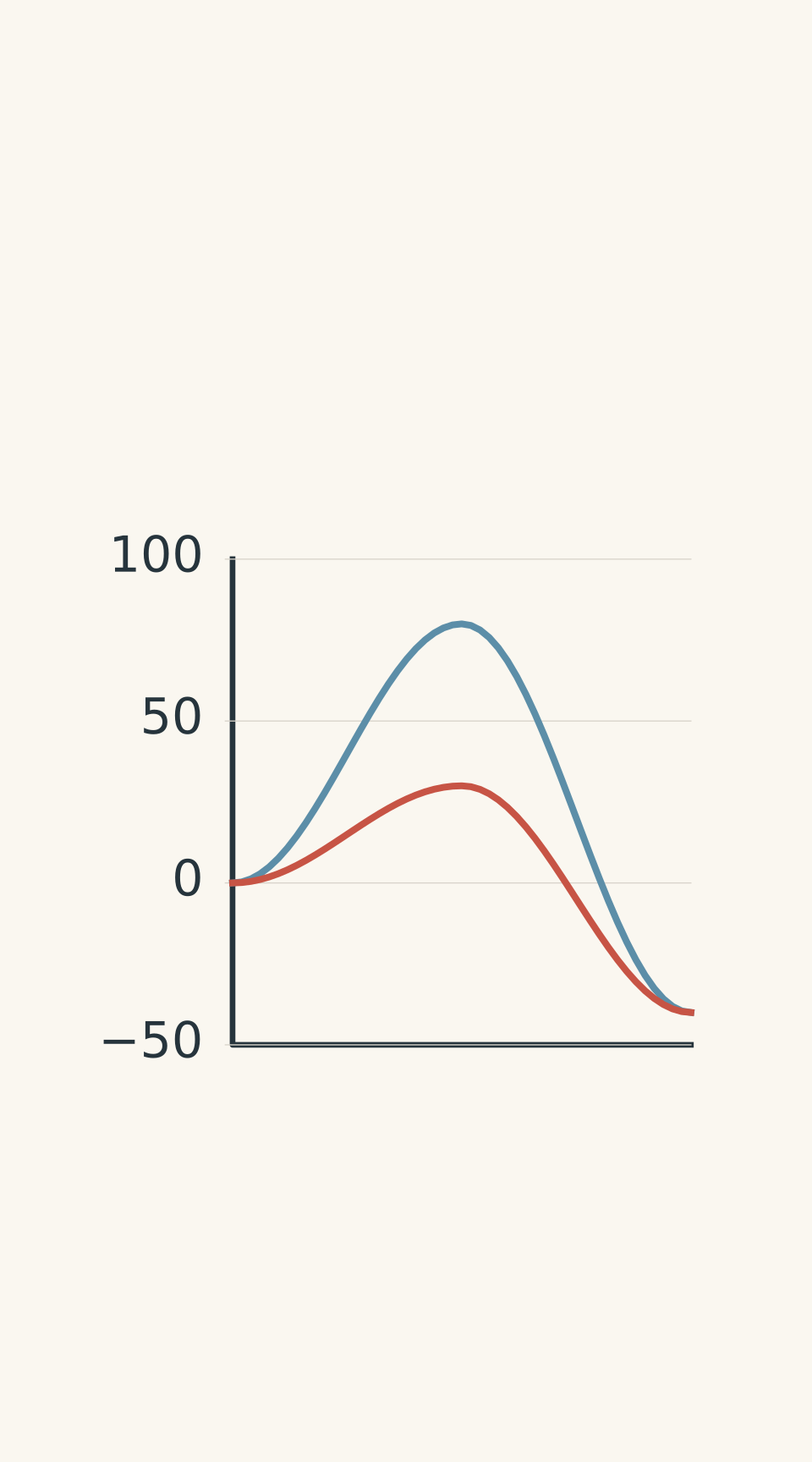
- Uncatalysed
- Catalysed
- 1 mark for correctly identifying reactant and product levels.
- 1 mark for correctly showing both forward activation energies.
- 1 mark for correctly showing the enthalpy-change arrow.
- 1 mark for stating that \(\Delta H\) is negative.
(b) The effect of a catalyst
A catalyst provides an alternative reaction pathway with a lower activation energy. It increases the reaction rate by allowing more collisions to be successful.
The catalyst does not change the enthalpy of the reactants or products, so the overall enthalpy change remains unchanged.
- 1 mark for the alternative pathway and lower activation energy.
- 1 mark for stating that \(\Delta H\) remains unchanged.
(c) Calculating reaction enthalpy from bond enthalpies
The energy absorbed when bonds break is:
\[ \begin{aligned} E_{\text{broken}} &= 436 + 243\\ &= 679\ \mathrm{kJ\,mol^{-1}} \end{aligned} \]
Two H-Cl bonds form, releasing:
\[ \begin{aligned} E_{\text{formed}} &= 2(431)\\ &= 862\ \mathrm{kJ\,mol^{-1}} \end{aligned} \]
The reaction enthalpy is the energy required to break the reactant bonds minus the energy released when the product bonds form.
\[ \begin{aligned} \Delta H &= E_{\text{broken}}-E_{\text{formed}}\\ &=679-862\\ &=-183\ \mathrm{kJ\,mol^{-1}} \end{aligned} \]
The reaction is exothermic because bond formation releases more energy than bond breaking absorbs. The difference is transferred to the surroundings. Energy is conserved; it is transferred between the reacting system and its surroundings rather than created or destroyed.
- 1 mark for calculating the energy absorbed in bond breaking.
- 1 mark for calculating the energy released in bond formation.
- 1 mark for the correct enthalpy change, including sign and units.
- 1 mark for classifying the reaction and explaining the energy transfer.
Total: 10 marks
Solution 6
(a) Heat change during ammonium nitrate dissolution
First, calculate the temperature change:
\[ \begin{aligned} \Delta T &= T_f-T_i\\ &=18.7-22.0\\ &=-3.3^\circ\mathrm{C} \end{aligned} \]
Using \(q=mc\Delta T\), where \(q\) is the heat change in joules, \(m\) is the solution mass in grams, \(c\) is the specific heat capacity, and \(\Delta T\) is the temperature change:
\[ \begin{aligned} q_{\text{solution}} &=105.0\times4.18\times(-3.3)\\ &=-1448\ \mathrm{J}\\ &\approx -1.45\ \mathrm{kJ} \end{aligned} \]
The solution loses thermal energy. Assuming the heat exchange is between the solution and the dissolving process:
\[ q_{\text{reaction}}=-q_{\text{solution}} \]
Therefore:
\[ q_{\text{reaction}}=+1.45\ \mathrm{kJ} \]
The positive reaction heat change means the dissolving process absorbs energy. It is endothermic.
- 1 mark for the correct temperature change.
- 1 mark for calculating \(q_{\text{solution}}\).
- 1 mark for the correct sign and magnitude of \(q_{\text{reaction}}\).
- 1 mark for classifying the process as endothermic.
(b) Molar enthalpy of dissolution
The amount of ammonium nitrate is:
\[ \begin{aligned} n&=\frac{m}{M}\\ &=\frac{5.00}{80.0}\\ &=0.0625\ \mathrm{mol} \end{aligned} \]
The molar enthalpy of dissolution is:
\[ \begin{aligned} \Delta H_{\text{diss}} &=\frac{q_{\text{reaction}}}{n}\\ &=\frac{1.45}{0.0625}\\ &=+23.2\ \mathrm{kJ\,mol^{-1}} \end{aligned} \]
The positive sign indicates an endothermic process.
- 1 mark for the amount in moles.
- 1 mark for the correct molar enthalpy, including sign and units.
(c) Experimental molar enthalpy of ethanol combustion
The temperature change of the water is:
\[ \Delta T=34.0-20.0=14.0^\circ\mathrm{C} \]
The heat absorbed by the water is:
\[ \begin{aligned} q_{\text{water}} &=mc\Delta T\\ &=200.0\times4.18\times14.0\\ &=11704\ \mathrm{J}\\ &=11.704\ \mathrm{kJ} \end{aligned} \]
Under the stated assumption, the combustion reaction releases the same amount of heat:
\[ q_{\text{combustion}}=-11.704\ \mathrm{kJ} \]
The amount of ethanol burned is:
\[ \begin{aligned} n&=\frac{0.800}{46.0}\\ &=0.01739\ \mathrm{mol} \end{aligned} \]
The experimental molar enthalpy is:
\[ \begin{aligned} \Delta H_{\text{comb}} &=\frac{-11.704}{0.01739}\\ &\approx -673\ \mathrm{kJ\,mol^{-1}} \end{aligned} \]
The negative value indicates an exothermic reaction.
- 1 mark for calculating the heat absorbed by the water.
- 1 mark for calculating the amount of ethanol.
- 1 mark for using the correct molar enthalpy relationship.
- 1 mark for the final value, including sign and units.
(d) Evaluating the experimental result
The experimental value is approximately \(-673\ \mathrm{kJ\,mol^{-1}}\), which is less negative than the reference value of \(-1367\ \mathrm{kJ\,mol^{-1}}\). The experiment therefore measures a smaller energy release per mole than expected for complete combustion.
One limitation is heat loss to the surroundings or the calorimeter. Incomplete combustion or evaporation of ethanol can also reduce the measured heat transferred to the water.
An improvement would be to insulate the calorimeter and use a suitable lid to reduce heat loss. Improving the oxygen supply may also help promote complete combustion.
- 1 mark for identifying a valid limitation.
- 1 mark for a relevant improvement.
Total: 12 marks
Solution 7
(a) Brønsted-Lowry acid and base
A Brønsted-Lowry acid donates a proton, \(\mathrm{H}^{+}\), while a Brønsted-Lowry base accepts a proton.
In the given reaction, HCl is the acid because it donates a proton to \(\ce{NH3}\). Ammonia, \(\ce{NH3}\), is the base because it accepts the proton and forms \(\ce{NH4+}\).
- 1 mark for correctly identifying the acid and base.
- 1 mark for explaining the proton transfer.
(b) Neutralisation equations
The balanced molecular equation is:
\[ \ce{HNO3(aq) + KOH(aq) -> KNO3(aq) + H2O(l)} \]
The net ionic equation is:
\[ \ce{H+(aq) + OH-(aq) -> H2O(l)} \]
The essential chemical change is the reaction of hydrogen ions with hydroxide ions to form water.
- 1 mark for the balanced molecular equation.
- 1 mark for the correct net ionic equation.
(c) Precipitation reaction
The products are lead(II) iodide, \(\ce{PbI2}\), and potassium nitrate, \(\ce{KNO3}\).
The balanced equation is:
\[ \ce{Pb(NO3)2(aq) + 2KI(aq) -> PbI2(s) + 2KNO3(aq)} \]
Lead(II) iodide is the yellow precipitate.
- 1 mark for the correct lead(II) iodide formula and state.
- 1 mark for the correct potassium nitrate product.
- 1 mark for balancing the equation.
(d) Net ionic equation and spectator ions
The net ionic equation is:
\[ \ce{Pb^2+(aq) + 2I-(aq) -> PbI2(s)} \]
The spectator ions are \(\mathrm{K}^{+}\) and \(\ce{NO3-}\). They remain dissolved in solution and do not participate directly in forming the precipitate.
- 2 marks for the correct net ionic equation.
- 1 mark for identifying both spectator ions.
Total: 10 marks
Solution 8
(a) Hydrolysis of cycasin
The word equation is:
Cycasin + water → glucose + methylazoxymethanol
Hydrolysis is a chemical reaction in which water helps break a chemical bond. In this simplified model, the bond linking the glucose group to the MAM group is broken, producing two different substances.
- 1 mark for the correct word equation.
- 1 mark for explaining the chemical change during hydrolysis.
(b) Roles of surface area, temperature, and leaching
Increasing the exposed surface area allows more of the plant material to contact water. This can increase the rate at which the relevant reaction occurs.
Increasing temperature generally increases particle kinetic energy and the rate of a reaction, so hydrolysis may occur more quickly under suitable controlled conditions.
Leaching is different: it transfers water-soluble substances from the plant material into the surrounding water. Removing the water can remove dissolved MAM from the material.
These are distinct processes. Increasing surface area and temperature can affect reaction rate, while leaching transfers dissolved substances out of the material.
A limitation is that the model considers only one simplified pathway. It does not establish that every toxic compound is removed or that any particular plant material is safe to eat.
Leaching: transferring a soluble compound
- Plant material
Contains a water-soluble compound.
- Transfer into water
Dissolved compound moves into the surrounding water.
- Water removed
The removed water carries dissolved compound away.
- 1 mark for linking increased surface area to greater contact and potentially faster reaction.
- 1 mark for linking increased temperature to a faster reaction under suitable conditions.
- 1 mark for explaining leaching as the transfer and removal of a water-soluble compound.
- 1 mark for identifying a valid limitation of the simplified model.
(c) Respectful discussion of traditional knowledge
Appropriate principles include:
Recognising that practices and knowledge are specific to particular communities and Country, rather than generalising across all Aboriginal and Torres Strait Islander Peoples.
Consulting the relevant knowledge holders and seeking permission before recording or sharing culturally held knowledge.
Acknowledging cultural ownership and the expertise behind the knowledge.
Avoiding the presentation of culturally specific practices as a universal recipe or encouraging untrained people to prepare poisonous wild foods.
1 mark for each of two valid principles.
Total: 8 marks
Solution 9
(a) Antacid neutralisation
The balanced equation is:
\[ \ce{CaCO3(s) + 2HCl(aq) -> CaCl2(aq) + H2O(l) + CO2(g)} \]
The amount of calcium carbonate is:
\[ \begin{aligned} n(\ce{CaCO3}) &=\frac{m}{M}\\ &=\frac{0.500}{100.1}\\ &=0.004995\ \mathrm{mol} \end{aligned} \]
The equation shows that one mole of calcium carbonate reacts with two moles of hydrochloric acid.
Therefore:
\[ \begin{aligned} n(\ce{HCl}) &=2(0.004995)\\ &=0.00999\ \mathrm{mol}\\ &\approx 1.00\times10^{-2}\ \mathrm{mol} \end{aligned} \]
The maximum amount of hydrochloric acid neutralised is approximately \(0.0100\ \mathrm{mol}\).
- 1 mark for the balanced equation.
- 1 mark for calculating the amount of calcium carbonate.
- 1 mark for applying the mole ratio correctly.
(b) Limitation of the stoichiometric calculation
The calculation describes a theoretical maximum for the stated amount of calcium carbonate. It does not determine an appropriate medical dose. Actual stomach acidity varies, and tablet composition, reaction conditions, and individual medical circumstances also matter.
- 1 mark for identifying a valid limitation.
(c) Agricultural limestone
The net ionic equation is:
\[ \ce{CaCO3(s) + 2H+(aq) -> Ca^2+(aq) + H2O(l) + CO2(g)} \]
The reaction consumes hydrogen ions, reducing the acidity of the soil and generally increasing its pH.
- 1 mark for the correct net ionic equation.
- 1 mark for explaining the reduction in acidity.
(d) Factors affecting lime application
Relevant factors include:
- The soil’s initial pH and buffering capacity.
- Soil type and composition.
- The purity and particle size of the lime.
- The target pH for the intended crop.
Different soils have different capacities to resist changes in pH. A soil test helps determine an appropriate application rate rather than relying on a single rate for every soil.
- 1 mark for identifying one relevant factor.
- 1 mark for identifying a second relevant factor.
Total: 8 marks
Solution 10
(a) Indicators of chemical change
(i) Magnesium burning with bright white light and leaving white powder provides two indicators:
- Emission of light.
- Formation of a new solid product.
Award 1 mark for each indicator.
(ii) Two colourless solutions forming a yellow precipitate provide two indicators:
- Formation of a precipitate, meaning a new insoluble solid forms.
- A colour change in the mixture.
Award 1 mark for each indicator.
(iii) Bubbles appearing when acid is added to a carbonate indicate gas production.
- 1 mark for identifying gas formation.
(iv) A temperature rise from \(20.0^\circ\mathrm{C}\) to \(26.0^\circ\mathrm{C}\), without external heating, indicates a temperature change associated with the process.
- 1 mark for identifying the temperature change.
These observations are evidence consistent with chemical change. Their interpretation depends on the conditions and the other evidence available.
Total: 6 marks
End of paper – 100 marks