
How to Identify Two Unknown Ions Using Precipitation Tests
Learn how to identify an unknown cation and anion using solubility rules, separate aliquots, and characteristic precipitate observations. Worked examples show how to write net ionic equations and interpret positive and negative test results without jumping to conclusions.
A clear unknown solution produces a pale precipitate when silver nitrate is added. Have you identified the ion, or have you simply made an insoluble compound? You haven’t necessarily identified it yet. Several ions can produce precipitates with similar appearances, and the reagent itself can introduce ions that weren’t originally in the sample.
Reliable qualitative analysis means choosing reagents that distinguish between possible ions, testing separate aliquots of the original solution, and checking that every positive and negative result fits the same explanation.
01Start with a plan, not a guess
A precipitate is an insoluble solid that forms when dissolved ions combine in solution. A precipitation test uses this reaction to help identify an unknown ion.
Suppose a question tells you that an aqueous sample contains exactly one unknown cation and one unknown anion from a given list. Your task is to identify both.
The most reliable method is to separate the investigation into two parts:
- Anion tests: identify the negative ion, such as chloride, bromide, iodide, sulfate, or carbonate.
- Cation tests: identify the positive ion, such as copper(II), iron(II), iron(III), zinc, or aluminium.
You should also establish which ions are possible before interpreting the results. A white precipitate might distinguish two candidates in one question but leave several possibilities in another.
Why separate aliquots matter
An aliquot is a small portion taken from a larger sample. Take fresh aliquots for tests that need different reagents.
Imagine testing for sulfate by adding barium chloride, then testing for chloride by adding silver nitrate to the same mixture. The silver nitrate can produce silver chloride from the chloride you just introduced with the barium chloride. Your second test would no longer tell you whether chloride was present in the original sample.
That is a preventable mistake.
Four tests, four fresh aliquots
| Carbonate test | CO₃²⁻ Dilute acid; effervescence; CO₂ turns limewater milky. |
|---|---|
| Halide test | Cl⁻, Br⁻, I⁻ Dilute HNO₃, then AgNO₃: white AgCl, cream AgBr, yellow AgI. |
| Sulfate test | SO₄²⁻ Dilute HNO₃, then Ba(NO₃)₂: white BaSO₄ persists in acid. |
| Cation test | Metal ions NaOH dropwise, then excess; record colour and dissolution. Use fresh NH₃ aliquot if needed. |
Use this sequence throughout the investigation:
- List the possible cations and anions.
- Select reagents using solubility rules.
- Test fresh aliquots and record the exact observations.
- Use positive results to identify likely ions and negative results to eliminate candidates.
- Check that the two identified ions are consistent with every test.
- Write balanced net ionic equations for the reactions that produced precipitates.
02Choose the right reagent for the anion
The key is to choose a reagent that forms an insoluble compound with the ion you’re looking for, while avoiding misleading reactions with other ions.
A few solubility rules do most of the work.
| Solubility rule | How it helps |
|---|---|
| All common nitrate salts are soluble. | Nitrate ions usually remain dissolved during these precipitation tests. |
| Most sodium and potassium salts are soluble. | Sodium and potassium ions generally remain as spectator ions. |
| Silver chloride, silver bromide, and silver iodide are insoluble. | Silver nitrate can distinguish the three common halide ions. |
| Barium sulfate is insoluble, including in dilute acid. | A barium reagent can identify sulfate ions. |
| Many carbonates are insoluble. | Carbonate can produce misleading precipitates unless it is removed before certain tests. |
These rules tell you which reagent to choose. Your observations then tell you which candidates remain possible.
Test 1: Identify halide ions
The common halide ions are chloride, \(\mathrm{Cl}^{-}\), bromide, \(\mathrm{Br}^{-}\), and iodide, \(\mathrm{I}^{-}\).
Take a fresh aliquot, acidify it with dilute nitric acid, and then add silver nitrate solution.
| Possible ion | Precipitate | Observation |
|---|---|---|
| \(\mathrm{Cl}^{-}\) | \(\ce{AgCl(s)}\) | White |
| \(\mathrm{Br}^{-}\) | \(\ce{AgBr(s)}\) | Cream |
| \(\mathrm{I}^{-}\) | \(\ce{AgI(s)}\) | Yellow |
The net ionic equation for the chloride test is:
\[ \ce{Ag+(aq) + Cl-(aq) -> AgCl(s)} \]
Silver ions combine with chloride ions to form solid silver chloride. The nitrate ions and the other spectator ions remain dissolved.
The same principle applies to bromide and iodide:
\[ \ce{Ag+(aq) + Br-(aq) -> AgBr(s)} \]
\[ \ce{Ag+(aq) + I-(aq) -> AgI(s)} \]
Identifying halide ions by precipitate colour
| Silver chloride | AgCl · Cl⁻ White precipitate |
|---|---|
| Silver bromide | AgBr · Br⁻ Cream precipitate |
| Silver iodide | AgI · I⁻ Yellow precipitate |
Why use nitric acid first?
Carbonate ions can also react with silver ions to form a precipitate. Acidification converts carbonate into carbon dioxide and water before silver nitrate is added, reducing this interference.
Use nitric acid, not hydrochloric acid. Hydrochloric acid introduces chloride ions, which would produce silver chloride even if the original sample contained no chloride.
This is a useful general rule: a reagent must not introduce the very ion you’re trying to detect.
Test 2: Identify sulfate ions
To test for sulfate, \(\mathrm{SO_{4}}^{2-}\), acidify a fresh aliquot with dilute nitric acid and add barium nitrate solution.
A white precipitate that persists in dilute acid supports the presence of sulfate ions.
The net ionic equation is:
\[ \ce{Ba^2+(aq) + SO4^2-(aq) -> BaSO4(s)} \]
The white solid is barium sulfate, \(\ce{BaSO4}\).
Why acidify before adding the barium reagent? Carbonate can also form a white precipitate with barium ions. The acid removes carbonate as carbon dioxide before the barium ions are introduced.
The important observation is not simply white precipitate. It is white precipitate after the appropriate acidification step, remaining in dilute acid.
Test 3: Identify carbonate ions
For carbonate, \(\mathrm{CO_{3}}^{2-}\), add dilute acid to a fresh aliquot.
Effervescence indicates that a gas is being produced. If the gas turns limewater milky, that supports the presence of carbon dioxide and therefore carbonate ions in the original sample.
The net ionic equation is:
\[ \ce{CO3^2-(aq) + 2H+(aq) -> CO2(g) + H2O(l)} \]
The carbon dioxide reacts with limewater to form calcium carbonate:
\[ \ce{CO2(g) + Ca(OH)2(aq) -> CaCO3(s) + H2O(l)} \]
The calcium carbonate is the solid that makes the limewater appear milky.
This test is particularly useful because it can explain an otherwise confusing silver nitrate or barium reagent result. A carbonate-containing sample can form an insoluble carbonate before acidification, but the carbonate is removed by the acid in the correctly performed test.
What if none of these tests produces a precipitate?
A negative result is useful, but it does not automatically identify the remaining ion.
For example, if acidified silver nitrate produces no precipitate, you can rule out detectable chloride, bromide, and iodide under suitable test conditions. You cannot conclude that the anion must be nitrate unless the candidate list is complete and the other possible anions have been excluded.
Nitrate salts are generally soluble, so nitrate is not identified by the same precipitation pattern as the halides or sulfate.
Keep three things in mind:
- A positive result supports an ion only if other possible reactions have been considered.
- A negative result eliminates candidates only when the reagent, conditions, and concentration make the test reliable.
- If two candidates produce the same observations, you need another independent test.
03Identify the cation using hydroxide precipitation
Once you’ve investigated the anion, turn to the positive ion.
Sodium hydroxide provides hydroxide ions, \(\mathrm{OH}^{-}\). Many metal cations form insoluble metal hydroxides when these ions are added.
For example, copper(II) ions form blue copper(II) hydroxide:
\[ \ce{Cu^2+(aq) + 2OH-(aq) -> Cu(OH)2(s)} \]
The colour and behaviour of the precipitate can help identify the cation.
Common observations with sodium hydroxide
Add sodium hydroxide dropwise first. Record the precipitate that forms, then add excess sodium hydroxide to see whether it dissolves.
| Cation | With NaOH, dropwise | In excess NaOH |
|---|---|---|
| \(\mathrm{Cu}^{2+}\) | Blue precipitate | Remains |
| \(\mathrm{Fe}^{2+}\) | Green precipitate | Remains |
| \(\mathrm{Fe}^{3+}\) | Reddish-brown precipitate | Remains |
| \(\mathrm{Zn}^{2+}\) | White precipitate | Dissolves |
| \(\mathrm{Al}^{3+}\) | White precipitate | Dissolves |
| \(\mathrm{Mg}^{2+}\) | White precipitate | Remains |
| \(\mathrm{Pb}^{2+}\) | White precipitate | Dissolves |
These are characteristic patterns, not a guarantee that one observation uniquely identifies an ion. The candidate list and the other test results still matter.
For example, zinc, aluminium, and lead can all produce white hydroxide precipitates that dissolve in excess sodium hydroxide. The sodium hydroxide test alone cannot distinguish those three.
Why add sodium hydroxide dropwise before adding excess?
Some hydroxides form a precipitate initially but dissolve when more sodium hydroxide is added. If you jump straight to excess reagent, you may miss the initial precipitate and lose useful evidence.
The ability of certain hydroxides to react with both acids and strong bases is called amphoteric behaviour. Zinc hydroxide and aluminium hydroxide are common examples.
Use ammonia to distinguish similar results
A second fresh aliquot can be tested with aqueous ammonia, \(\ce{NH3}\).
Ammonia acts as a weak base, producing hydroxide ions in water. It can also form soluble complexes with some metal ions, which changes the appearance of the mixture.
| Cation | With ammonia, dropwise | In excess ammonia |
|---|---|---|
| \(\mathrm{Cu}^{2+}\) | Blue precipitate | Dissolves to form a deep-blue solution |
| \(\mathrm{Fe}^{2+}\) | Green precipitate | Remains |
| \(\mathrm{Fe}^{3+}\) | Reddish-brown precipitate | Remains |
| \(\mathrm{Zn}^{2+}\) | White precipitate | Dissolves |
| \(\mathrm{Al}^{3+}\) | White precipitate | Remains |
| \(\mathrm{Mg}^{2+}\) | White precipitate | Remains |
| \(\mathrm{Pb}^{2+}\) | White precipitate | Remains |
Identifying metal cations
| Copper(II), Cu²⁺ | Cu(OH)₂ NaOH: blue precipitate, remains. NH₃: dissolves in excess to deep blue solution. |
|---|---|
| Iron(II), Fe²⁺ | Fe(OH)₂ Both: green precipitate, remains in excess. Can turn brown in air. |
| Iron(III), Fe³⁺ | Fe(OH)₃ Both: reddish-brown precipitate, remains in excess. |
| Zinc, Zn²⁺ | Zn(OH)₂ Both: white precipitate, dissolves in excess. |
| Aluminium, Al³⁺ | Al(OH)₃ NaOH: white precipitate dissolves. NH₃: remains white. |
| Magnesium, Mg²⁺ | Mg(OH)₂ Both: white precipitate, remains in excess. |
The zinc-aluminium comparison is especially useful:
- Both produce white hydroxide precipitates that dissolve in excess sodium hydroxide.
- Zinc hydroxide also dissolves in excess ammonia.
- Aluminium hydroxide remains as a white precipitate in excess ammonia.
Therefore, the second test resolves an ambiguity left by the first.
Iron(II) hydroxide has another useful feature. Its green precipitate can turn brown as it reacts with oxygen in the air, forming iron(III) hydroxide. Record the initial colour as well as any change over time.
The tables above cover several common precipitation-test cations. If sodium, potassium, ammonium, calcium, or barium remains a candidate, you may need a different specific test. Not every cation can be identified by hydroxide precipitation alone.
For example, warming a fresh aliquot containing ammonium ions with sodium hydroxide releases ammonia gas. The gas turns damp red litmus paper blue. This is a separate identification method, not a precipitation test.
04Write net ionic equations from the observations
Identifying an ion is only part of a complete chemistry answer. You should also be able to explain the reaction that produced the observed solid.
A net ionic equation includes the particles that actually react. It leaves out spectator ions, which remain dissolved and do not participate in the formation of the precipitate.
For example, if silver nitrate reacts with a solution containing chloride ions, sodium ions and nitrate ions may remain in the solution. They do not need to appear in the net ionic equation.
\[ \ce{Ag+(aq) + Cl-(aq) -> AgCl(s)} \]
Notice that the equation is balanced for both atoms and charge. The total charge on the left is zero, and the product is neutral.
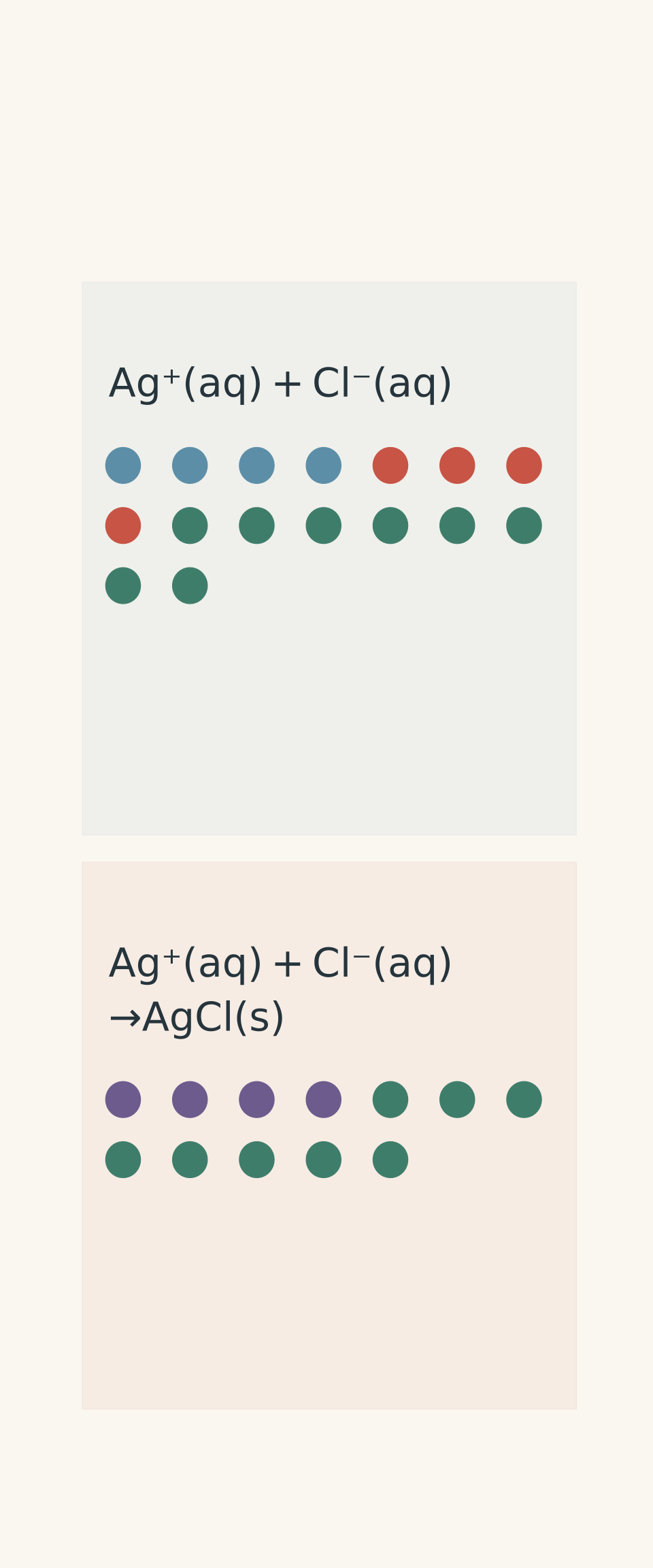
- Ag⁺(aq)
- Cl⁻(aq)
- Spectator ions (aq)
- AgCl(s)
Use this method when writing any precipitation equation:
- Identify the cation and anion that form the insoluble compound.
- Write the correct formula for the solid, balancing the ionic charges.
- Balance the equation so the number of atoms and total charge are conserved.
- Add the phase labels: \((aq)\) for aqueous ions, \((s)\) for a solid, \((g)\) for a gas, and \((l)\) for a liquid.
- Remove spectator ions.
For metal hydroxides, the equation follows directly from the charge on the cation.
For zinc ions:
\[ \ce{Zn^2+(aq) + 2OH-(aq) -> Zn(OH)2(s)} \]
Two hydroxide ions are required to balance the \(2+\) charge on zinc.
For aluminium ions:
\[ \ce{Al^3+(aq) + 3OH-(aq) -> Al(OH)3(s)} \]
Three hydroxide ions are required to balance the \(3+\) charge on aluminium.
Cation charge determines hydroxide ratio
| Zinc ions | Zn²⁺(aq) + 2OH⁻(aq) → Zn(OH)₂(s) Two OH⁻ ions balance the 2+ charge. |
|---|---|
| Aluminium ions | Al³⁺(aq) + 3OH⁻(aq) → Al(OH)₃(s) Three OH⁻ ions balance the 3+ charge. |
05Work through the complete identification
Worked example: Identify copper(II) chloride
A clear unknown solution contains one cation from \(\mathrm{Cu}^{2+}\), \(\mathrm{Fe}^{3+}\), and \(\mathrm{Zn}^{2+}\), and one anion from \(\mathrm{Cl}^{-}\), \(\mathrm{Br}^{-}\), and \(\mathrm{SO_{4}}^{2-}\).
On a fresh aliquot, acidified silver nitrate produces a white precipitate. On a separate aliquot, sodium hydroxide produces a blue precipitate that remains in excess reagent.
Identify both ions and write the net ionic equations for the two precipitation reactions.
Step 1
The white precipitate formed after acidification with nitric acid indicates chloride in the stated candidate set. Silver chloride is insoluble and white, whereas silver bromide is cream and barium sulfate is not the product of this test.
\[ \ce{Ag+(aq) + Cl-(aq) -> AgCl(s)} \]
Step 2
The blue precipitate is characteristic of copper(II) hydroxide. Iron(III) hydroxide would be reddish-brown, while zinc hydroxide would be white.
The fact that the precipitate remains in excess sodium hydroxide is also consistent with copper(II) hydroxide.
\[ \ce{Cu^2+(aq) + 2OH-(aq) -> Cu(OH)2(s)} \]
Step 3
The two ions are \(\mathrm{Cu}^{2+}\) and \(\mathrm{Cl}^{-}\). The observations support the identification of copper(II) chloride as the dissolved ionic compound.
Notice that each ion was identified using a different aliquot. The anion test did not depend on the colour of the hydroxide precipitate, and the cation test did not depend on the colour of the silver halide.
Worked example: Distinguish zinc ions from aluminium ions
An unknown solution contains one cation from \(\mathrm{Zn}^{2+}\), \(\mathrm{Al}^{3+}\), and \(\mathrm{Mg}^{2+}\), and one anion from \(\mathrm{Cl}^{-}\), \(\mathrm{SO_{4}}^{2-}\), and \(\mathrm{CO_{3}}^{2-}\).
On a fresh aliquot, adding dilute nitric acid causes no effervescence. After acidification, barium nitrate produces a white precipitate that remains when more dilute nitric acid is added.
On a second aliquot, sodium hydroxide produces a white precipitate that dissolves in excess reagent. On a third aliquot, ammonia produces a white precipitate that also dissolves in excess reagent.
Identify both ions and write the relevant net ionic equations.
Step 1
The lack of effervescence argues against carbonate under the stated conditions. More importantly, the white precipitate that persists in dilute acid after the barium nitrate test supports sulfate.
The precipitate is barium sulfate:
\[ \ce{Ba^2+(aq) + SO4^2-(aq) -> BaSO4(s)} \]
The acidification step is important because carbonate could otherwise form a white precipitate with barium ions.
Step 2
The white precipitate that dissolves in excess sodium hydroxide is consistent with zinc hydroxide or aluminium hydroxide. Magnesium hydroxide does not dissolve in excess sodium hydroxide under the usual qualitative-analysis conditions.
The sodium hydroxide test therefore narrows the cation to zinc or aluminium, but it does not yet distinguish them.
\[ \ce{Zn^2+(aq) + 2OH-(aq) -> Zn(OH)2(s)} \]
Step 3
The white precipitate dissolves in excess ammonia. Zinc hydroxide dissolves because zinc ions form a soluble ammonia complex. Aluminium hydroxide remains as a white precipitate in excess ammonia.
The dissolution can be represented by the equilibrium:
\[ \ce{Zn(OH)2(s) + 4NH3(aq) <=> [Zn(NH3)4]^2+(aq) + 2OH-(aq)} \]
The ammonia test therefore identifies zinc rather than aluminium.
Step 4
The ions are \(\mathrm{Zn}^{2+}\) and \(\mathrm{SO_{4}}^{2-}\). The two identifications are supported by independent observations: an acid-resistant barium sulfate precipitate and a white hydroxide precipitate that dissolves in excess sodium hydroxide and ammonia.
The key reasoning is that the first cation test narrowed the possibilities, while the second resolved the remaining ambiguity.
06Questions and solutions
Question 1
An unknown aqueous sample contains one cation from \(\mathrm{Fe}^{2+}\), \(\mathrm{Fe}^{3+}\), and \(\mathrm{Cu}^{2+}\), and one anion from \(\mathrm{Cl}^{-}\), \(\mathrm{Br}^{-}\), and \(\mathrm{SO_{4}}^{2-}\).
Acidified silver nitrate produces a cream precipitate. Sodium hydroxide added dropwise to a fresh aliquot produces a green precipitate that slowly turns brown in air.
Identify both ions and write the two net ionic equations. Assume the reagents are fresh and the concentrations are sufficient for the expected observations.
Solution 1
The ions are \(\mathrm{Fe}^{2+}\) and \(\mathrm{Br}^{-}\).
The cream precipitate is silver bromide, which identifies bromide in the stated candidate set:
\[ \ce{Ag+(aq) + Br-(aq) -> AgBr(s)} \]
The green precipitate is iron(II) hydroxide:
\[ \ce{Fe^2+(aq) + 2OH-(aq) -> Fe(OH)2(s)} \]
The green solid turns brown because iron(II) hydroxide reacts with oxygen in the air, forming iron(III) hydroxide. This colour change supports the initial identification of iron(II).
A common mistake is to interpret the final brown colour as proof that iron(III) ions were present in the original solution. The initial green precipitate is important evidence: the solid changes after it forms, so its final appearance does not necessarily reveal the original cation.
Question 2
A clear sample contains one cation from \(\mathrm{Zn}^{2+}\), \(\mathrm{Al}^{3+}\), and \(\mathrm{Mg}^{2+}\), and one anion from \(\mathrm{Cl}^{-}\), \(\mathrm{SO_{4}}^{2-}\), and \(\mathrm{CO_{3}}^{2-}\).
The following results are obtained:
- Adding dilute nitric acid to a fresh aliquot causes no effervescence.
- Acidifying another aliquot with dilute nitric acid and adding barium nitrate produces a white precipitate that remains after more dilute nitric acid is added.
- Sodium hydroxide produces a white precipitate that dissolves in excess reagent.
- Ammonia produces a white precipitate that remains in excess reagent.
Identify both ions and write the net ionic equations for the two precipitation reactions.
Solution 2
The ions are \(\mathrm{Al}^{3+}\) and \(\mathrm{SO_{4}}^{2-}\).
The acid-resistant white precipitate in the barium nitrate test identifies sulfate:
\[ \ce{Ba^2+(aq) + SO4^2-(aq) -> BaSO4(s)} \]
The lack of effervescence is consistent with the absence of detectable carbonate, although the sulfate result provides the stronger positive evidence for the anion.
The cation test requires two stages. The white precipitate dissolving in excess sodium hydroxide narrows the candidates to zinc and aluminium because magnesium hydroxide remains insoluble in excess reagent.
The ammonia result resolves the ambiguity. Zinc hydroxide dissolves in excess ammonia, but aluminium hydroxide does not. The persistent white precipitate therefore supports aluminium.
The net ionic equation for aluminium hydroxide formation is:
\[ \ce{Al^3+(aq) + 3OH-(aq) -> Al(OH)3(s)} \]
The tempting conclusion is that any white hydroxide that dissolves in excess sodium hydroxide must be zinc. The second test shows why that conclusion is premature: aluminium gives the same initial pattern but behaves differently in excess ammonia.
Question 3
A sample contains one cation from \(\mathrm{Cu}^{2+}\), \(\mathrm{Fe}^{3+}\), and \(\mathrm{Zn}^{2+}\), and one anion from \(\mathrm{Cl}^{-}\), \(\mathrm{I}^{-}\), and \(\mathrm{CO_{3}}^{2-}\).
An unacidified aliquot produces a pale yellow precipitate when silver nitrate is added. However:
- A fresh aliquot effervesces when dilute nitric acid is added, and the gas turns limewater milky.
- Acidified silver nitrate produces no precipitate in a different fresh aliquot.
- Sodium hydroxide produces a blue precipitate.
Identify the cation and anion. Explain why the first silver nitrate result could lead to the wrong conclusion, and write the relevant net ionic equations.
Solution 3
The ions are \(\mathrm{Cu}^{2+}\) and \(\mathrm{CO_{3}}^{2-}\).
The gas released by dilute nitric acid is carbon dioxide. Its ability to turn limewater milky supports the presence of carbonate ions:
\[ \ce{CO3^2-(aq) + 2H+(aq) -> CO2(g) + H2O(l)} \]
The blue precipitate produced by sodium hydroxide identifies copper(II) ions:
\[ \ce{Cu^2+(aq) + 2OH-(aq) -> Cu(OH)2(s)} \]
The first silver nitrate test does not establish iodide. Because that aliquot was not acidified, silver ions could react with carbonate ions to form silver carbonate:
\[ \ce{2Ag+(aq) + CO3^2-(aq) -> Ag2CO3(s)} \]
Silver carbonate is pale yellow, so its appearance can be confused with the yellow precipitate of silver iodide.
The correctly acidified silver nitrate test produces no precipitate. This argues against detectable iodide in the candidate set, while the acid test positively identifies carbonate.
The important distinction is between observing a precipitate and identifying the reaction that produced it. The same reagent can produce different solids with different ions.
Question 4
An unknown solution contains exactly one cation from \(\ce{NH4+}\), \(\mathrm{Cu}^{2+}\), and \(\mathrm{Fe}^{3+}\), and one anion from \(\mathrm{NO_{3}}^{-}\), \(\mathrm{Cl}^{-}\), \(\mathrm{SO_{4}}^{2-}\), and \(\mathrm{CO_{3}}^{2-}\).
The following observations are recorded on separate fresh aliquots:
- Warming with sodium hydroxide releases a gas that turns damp red litmus paper blue.
- Acidified silver nitrate produces no precipitate.
- Acidified barium nitrate produces no precipitate.
- Adding dilute acid causes no effervescence.
Identify both ions. Explain why one identification is made by a specific positive test, while the other relies on eliminating the remaining candidates.
Solution 4
The ions are \(\ce{NH4+}\) and \(\mathrm{NO_{3}}^{-}\), assuming the stated candidate lists are complete and all tests are reliable.
The gas released on warming with sodium hydroxide is ammonia. It turns damp red litmus paper blue, supporting the presence of ammonium ions.
The net ionic equation is:
\[ \ce{NH4+(aq) + OH-(aq) -> NH3(g) + H2O(l)} \]
The anion is identified differently. No precipitate with acidified silver nitrate argues against chloride. No precipitate with acidified barium nitrate argues against sulfate. The absence of effervescence with dilute acid argues against carbonate.
Nitrate is the only remaining candidate, so it is identified by elimination.
This conclusion depends on the complete candidate list. In an unrestricted sample, several other ions could also fail to produce these precipitates. A negative precipitation test alone is not a direct test for nitrate.
Question 5
A clear sample contains exactly one cation from \(\mathrm{Zn}^{2+}\), \(\mathrm{Al}^{3+}\), and \(\mathrm{Mg}^{2+}\), and one anion from \(\mathrm{Cl}^{-}\) and \(\mathrm{SO_{4}}^{2-}\). Assume that all reagents are fresh, the test concentrations are sufficient, and the listed ions are the only candidates.
Separate aliquots give these results:
- Sodium hydroxide produces a white precipitate that dissolves in excess reagent.
- Ammonia produces a white precipitate that dissolves in excess reagent.
- Acidified barium nitrate produces a white precipitate that remains after more dilute nitric acid is added.
- Acidified silver nitrate produces no precipitate.
A student then repeats the sulfate test using barium chloride instead of barium nitrate. A white precipitate forms, and the student adds silver nitrate to the same tube. Another white precipitate appears, so the student claims that the original sample contained both sulfate and chloride.
Identify the two ions in the original sample. Evaluate the student’s conclusion, and explain how the choice and order of reagents affect the validity of the identification.
Solution 5
The original sample contains \(\mathrm{Zn}^{2+}\) and \(\mathrm{SO_{4}}^{2-}\). The student’s conclusion that chloride was also present is not justified by the second white precipitate.
The cation is identified by combining the two hydroxide tests. Both zinc and aluminium hydroxides dissolve in excess sodium hydroxide, so the first result alone cannot distinguish them. Magnesium hydroxide remains insoluble in excess sodium hydroxide, so magnesium is eliminated.
The white precipitate also dissolves in excess ammonia. This supports zinc because zinc hydroxide dissolves in excess ammonia, whereas aluminium hydroxide remains as a white precipitate.
The zinc hydroxide precipitation equation is:
\[ \ce{Zn^2+(aq) + 2OH-(aq) -> Zn(OH)2(s)} \]
The anion is identified by the acidified barium nitrate test. The white precipitate that persists in dilute acid is barium sulfate:
\[ \ce{Ba^2+(aq) + SO4^2-(aq) -> BaSO4(s)} \]
The separate acidified silver nitrate test produces no precipitate. Under the stated conditions and candidate list, this argues against chloride in the original sample.
The student’s error occurs when they change the sulfate-test reagent from barium nitrate to barium chloride. Barium chloride introduces chloride ions into the test tube. When silver nitrate is added to that same tube, the introduced chloride ions react with silver ions to form silver chloride:
\[ \ce{Ag+(aq) + Cl-(aq) -> AgCl(s)} \]
This equation describes the second white precipitate, but it does not establish that chloride was present in the original sample. The chloride could have come entirely from the barium chloride reagent.
The key constraint is the source of the ions. A valid identification must trace each reacting ion back to the original sample or to the reagent that introduced it. Once a reagent has changed the mixture’s composition, later observations cannot automatically be attributed to the unknown sample.
The correct conclusion is therefore zinc ions and sulfate ions. The barium sulfate test identifies the anion, the two hydroxide tests identify the cation, and the fresh acidified silver nitrate test provides independent evidence against chloride.
Once you can identify ions from qualitative observations, the next useful step is predicting whether a precipitate will form before carrying out the experiment. That requires considering ion concentrations as well as solubility. In HSC Chemistry, the solubility product, \(K_{sp}\), connects these qualitative observations to quantitative predictions. See HSC Chemistry Module 5 Equilibrium: Complete Topic Summary.