
Alcohol Structures and Properties: HSC Chemistry Practice Exam
Test your understanding of alcohol structures and properties with this original 40-mark Chemistry practice exam. Includes timed exam conditions, questions aligned to the supplied Chemistry 2017 syllabus scope, and complete worked solutions with a marking guide.
This original tutorgum practice paper assesses alcohol structures and properties within the supplied Chemistry 2017 syllabus scope. It is not an official, endorsed, past, or predicted NESA paper. You will classify and name alcohols, draw structural formulae, and explain boiling-point and water-solubility trends using molecular structure and bonding.
01Exam instructions
Suggested time: 5 minutes reading time and 50 minutes working time.
Total marks: 40
Permitted equipment: A non-programmable calculator, a periodic table, and writing materials.
Assessed topics
- Primary, secondary, and tertiary alcohols: identification, naming, and structural formulae.
- Intramolecular polar covalent bonds and intermolecular forces in alcohols.
- Hydrogen bonding and London dispersion forces.
- Boiling-point trends across an alcohol homologous series and between structural isomers.
- Water solubility and the relationship between the hydroxyl group and the hydrocarbon chain.
Excluded topics
This paper does not assess alcohol oxidation or other chemical reactions, preparation and synthesis, reaction mechanisms, spectroscopy, or content from other syllabus editions.
How to answer
- Attempt every question. All questions are compulsory.
- Show your reasoning when explaining trends or comparing compounds.
- When drawing structural formulae, show the carbon skeleton, branches, and hydroxyl group clearly.
- Include units in numerical answers and use the supplied data where relevant.
- Unless stated otherwise, boiling points refer to pure compounds at a pressure of 1 atm. The water-solubility data supplied in Question 5 are approximate values at 20 °C.
02Questions
Question 1 (6 marks)
Four alcohols are represented by the following condensed structural formulae.
| Alcohol | Structural formula |
|---|---|
| A | \(\ce{CH3CH2CH2OH}\) |
| B | \(\ce{CH3CH(OH)CH3}\) |
| C | \(\ce{(CH3)3COH}\) |
| D | \(\ce{(CH3)2CHCH2OH}\) |
(a) Classify each alcohol as primary, secondary, or tertiary. (4 marks)
(b) Give the IUPAC name of each of alcohols C and D. (2 marks)
Question 2 (6 marks)
For each alcohol below, draw a structural formula that clearly shows the carbon skeleton, every branch, and the hydroxyl group, \(\ce{-OH}\). Then classify the alcohol as primary, secondary, or tertiary.
(a) 2-methylbutan-1-ol (2 marks)
(b) 3-methylbutan-2-ol (2 marks)
(c) 2-methylbutan-2-ol (2 marks)
Question 3 (6 marks)
The following table gives the boiling points of five alcohols at 1 atm.
| Alcohol | Boiling point (°C) |
|---|---|
| Methanol | 64.7 |
| Ethanol | 78.4 |
| Propan-1-ol | 97.2 |
| Butan-1-ol | 117.7 |
| Pentan-1-ol | 138.0 |
(a) Describe the trend in boiling point as the carbon chain increases in length. (1 mark)
(b) Explain this trend in terms of intermolecular forces and molecular structure. (3 marks)
(c) Explain how the hydroxyl group allows propan-1-ol molecules to form hydrogen bonds with one another. Refer to the O-H bond and the oxygen atom in your answer. (2 marks)
Question 4 (7 marks)
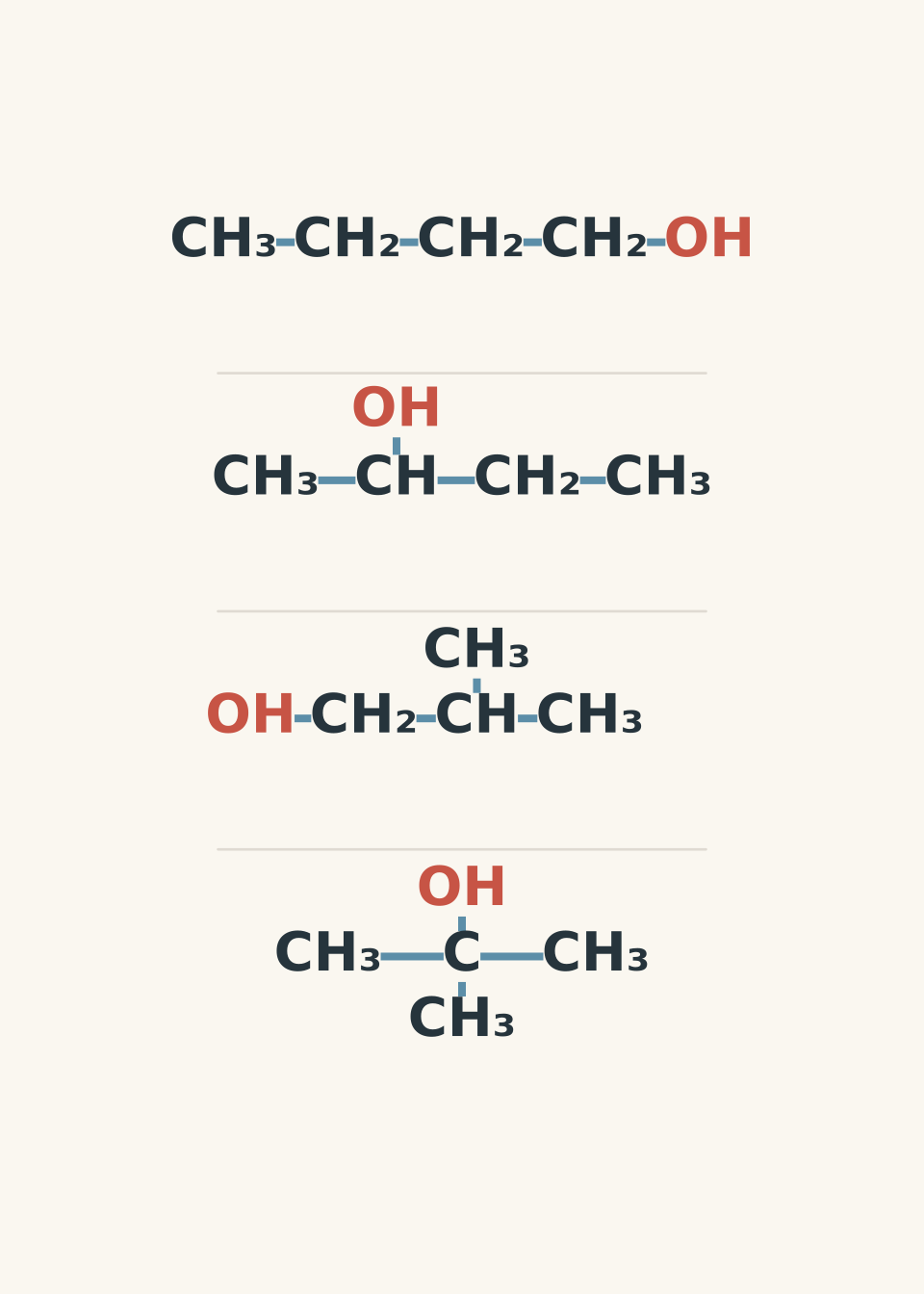
The following table compares four structural isomers of the molecular formula \(\ce{C4H10O}\) that are alcohols.
| Alcohol | Boiling point (°C) |
|---|---|
| Butan-1-ol | 117.7 |
| Butan-2-ol | 99.5 |
| 2-methylpropan-1-ol | 108.0 |
| 2-methylpropan-2-ol | 82.2 |
(a) Arrange the four alcohols in order of increasing boiling point. (2 marks)
(b) Butan-1-ol and 2-methylpropan-1-ol are both primary alcohols with the same molecular formula. Explain why butan-1-ol has the higher boiling point. (2 marks)
(c) Explain why 2-methylpropan-2-ol has a lower boiling point than butan-1-ol, even though both molecules can form hydrogen bonds. (3 marks)
Question 5 (7 marks)
The following table gives approximate water-solubility data for five alcohols at 20 °C.
| Alcohol | Approximate solubility in water |
|---|---|
| Methanol | Miscible |
| Ethanol | Miscible |
| Propan-1-ol | Miscible |
| Butan-1-ol | 7.7 g per 100 mL water |
| Pentan-1-ol | 2.2 g per 100 mL water |
Miscible means that two liquids mix in all proportions.
(a) Describe the trend in water solubility as the carbon chain increases from propan-1-ol to pentan-1-ol. (1 mark)
(b) Explain this trend using the hydroxyl group, hydrogen bonding, and the hydrocarbon chain. (3 marks)
(c) The diagram shows one propan-1-ol molecule and one water molecule in a possible relative orientation.
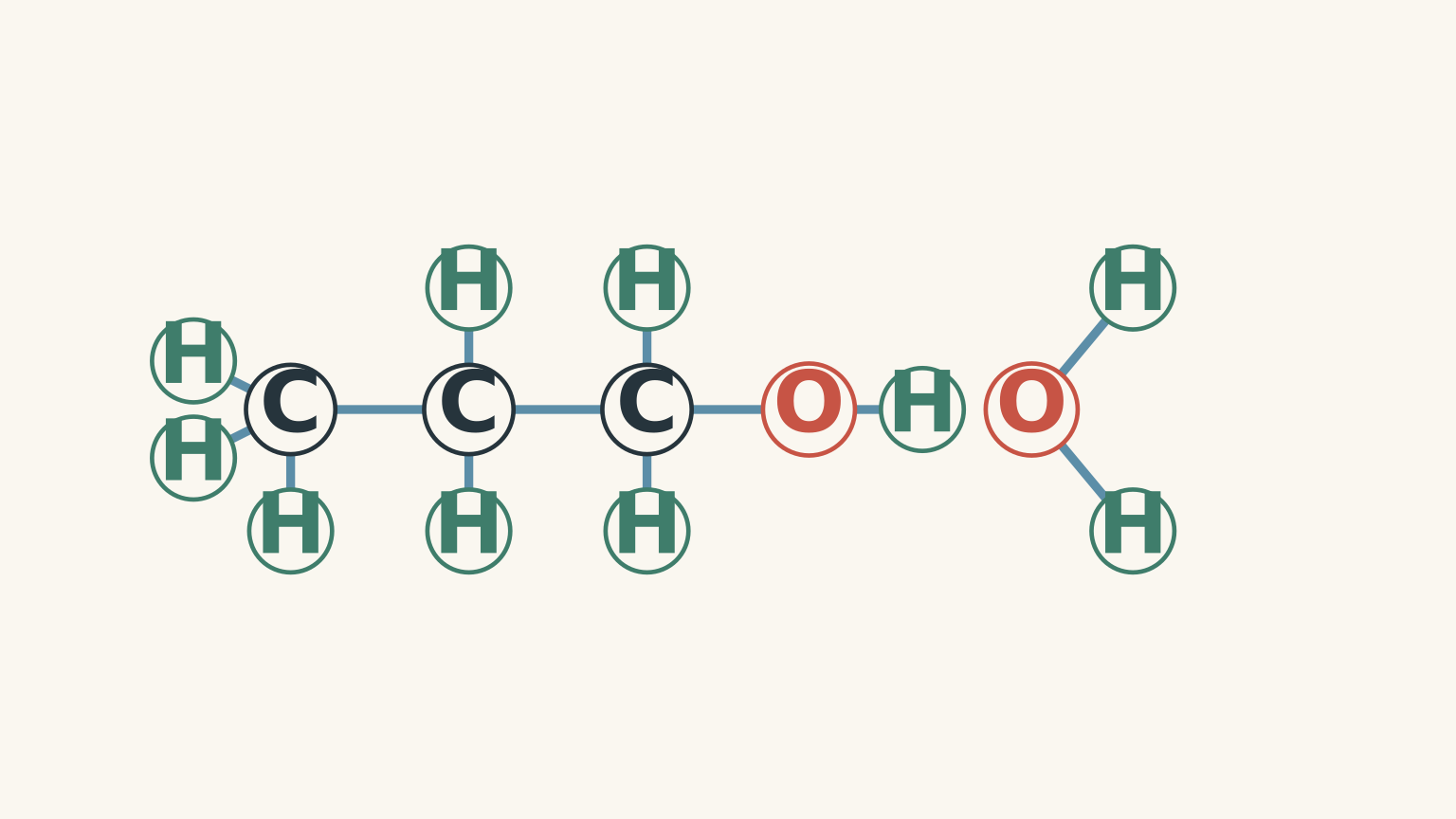
Add a dashed line to show one intermolecular attraction between the two molecules. Label the attraction, and explain why it is not an intramolecular covalent bond. (3 marks)
Question 6 (8 marks)
At 1 atm, ethanol has a boiling point of 78.4 °C, while ethane has a boiling point of −88.6 °C.
(a) State the only type of intermolecular force acting between ethane molecules. Then state the strongest intermolecular attraction between ethanol molecules. (2 marks)
(b) Use molecular polarity, the hydroxyl group, and relative molecular size to explain why ethanol has a much higher boiling point than ethane. (4 marks)
(c) When ethanol boils, state which interactions are overcome and which bonds within the ethanol molecules remain intact. Use the terms intermolecular and intramolecular in your answer. (2 marks)
03Worked solutions and marking guide
Solution 1
(a) Classification (4 marks)
- A: Primary alcohol.
- B: Secondary alcohol.
- C: Tertiary alcohol.
- D: Primary alcohol.
An alcohol is classified according to the number of carbon atoms directly attached to the carbon bearing the hydroxyl group.
- A has an \(\ce{-OH}\)-bearing carbon attached to one other carbon.
- B has an \(\ce{-OH}\)-bearing carbon attached to two other carbons.
- C has an \(\ce{-OH}\)-bearing carbon attached to three other carbons.
- D has an \(\ce{-OH}\)-bearing carbon attached to one other carbon.
Marking breakdown: 1 mark for each correct classification.
(b) IUPAC names (2 marks)
- C: 2-methylpropan-2-ol.
- D: 2-methylpropan-1-ol.
For C, the carbon bearing the hydroxyl group is carbon 2, and a methyl branch is also attached to carbon 2. For D, the hydroxyl group is on carbon 1, with a methyl branch on carbon 2.
Marking breakdown: 1 mark for each correct name.
Solution 2
Each part is worth 2 marks: 1 mark for a correct structural formula and 1 mark for the correct classification.
(a) 2-methylbutan-1-ol (2 marks)
Structural formula:
\[ \ce{HOCH2CH(CH3)CH2CH3} \]
Classification: primary alcohol.
The carbon bearing the hydroxyl group is a terminal \(\ce{CH2}\) carbon attached to only one other carbon.
Marking breakdown:
- Correct carbon skeleton, branch, and hydroxyl position: 1 mark.
- Correct classification: 1 mark.
(b) 3-methylbutan-2-ol (2 marks)
Structural formula:
\[ \ce{CH3CH(OH)CH(CH3)CH3} \]
Classification: secondary alcohol.
The carbon bearing the hydroxyl group is attached to two other carbon atoms.
Marking breakdown:
- Correct carbon skeleton, branch, and hydroxyl position: 1 mark.
- Correct classification: 1 mark.
(c) 2-methylbutan-2-ol (2 marks)
Structural formula:
\[ \ce{CH3C(OH)(CH3)CH2CH3} \]
Classification: tertiary alcohol.
The carbon bearing the hydroxyl group is attached to three other carbon atoms: two methyl groups and one ethyl group.
Marking breakdown:
- Correct carbon skeleton, branch, and hydroxyl position: 1 mark.
- Correct classification: 1 mark.
Equivalent full structural formulae are acceptable if all bonds, branches, and the hydroxyl group are shown correctly.
Solution 3
(a) Boiling-point trend (1 mark)
The boiling point increases as the carbon chain becomes longer, from methanol at 64.7 °C to pentan-1-ol at 138.0 °C.
Marking breakdown: 1 mark for identifying the increasing trend.
(b) Explanation of the trend (3 marks)
All five alcohols contain a hydroxyl group, so they can form hydrogen bonds between their molecules.
As the carbon chain gets longer, the molecules contain more electrons and have larger electron clouds. Their London dispersion forces become stronger.
More energy is therefore required to separate the molecules during boiling, so the boiling point increases.
Marking breakdown:
- Identifies that the alcohols can all form hydrogen bonds: 1 mark.
- Explains that increasing chain length increases electron-cloud size and strengthens London dispersion forces: 1 mark.
- Links stronger intermolecular attractions to the greater energy required for boiling: 1 mark.
(c) Hydrogen bonding in propan-1-ol (2 marks)
The O-H bond is polar covalent because oxygen attracts the shared electrons more strongly than hydrogen. This leaves the hydrogen partially positive, \(\delta^+\), and the oxygen partially negative, \(\delta^-\).
The partially positive hydrogen of one molecule is attracted to a lone pair on the oxygen atom of another molecule. This intermolecular attraction is a hydrogen bond.
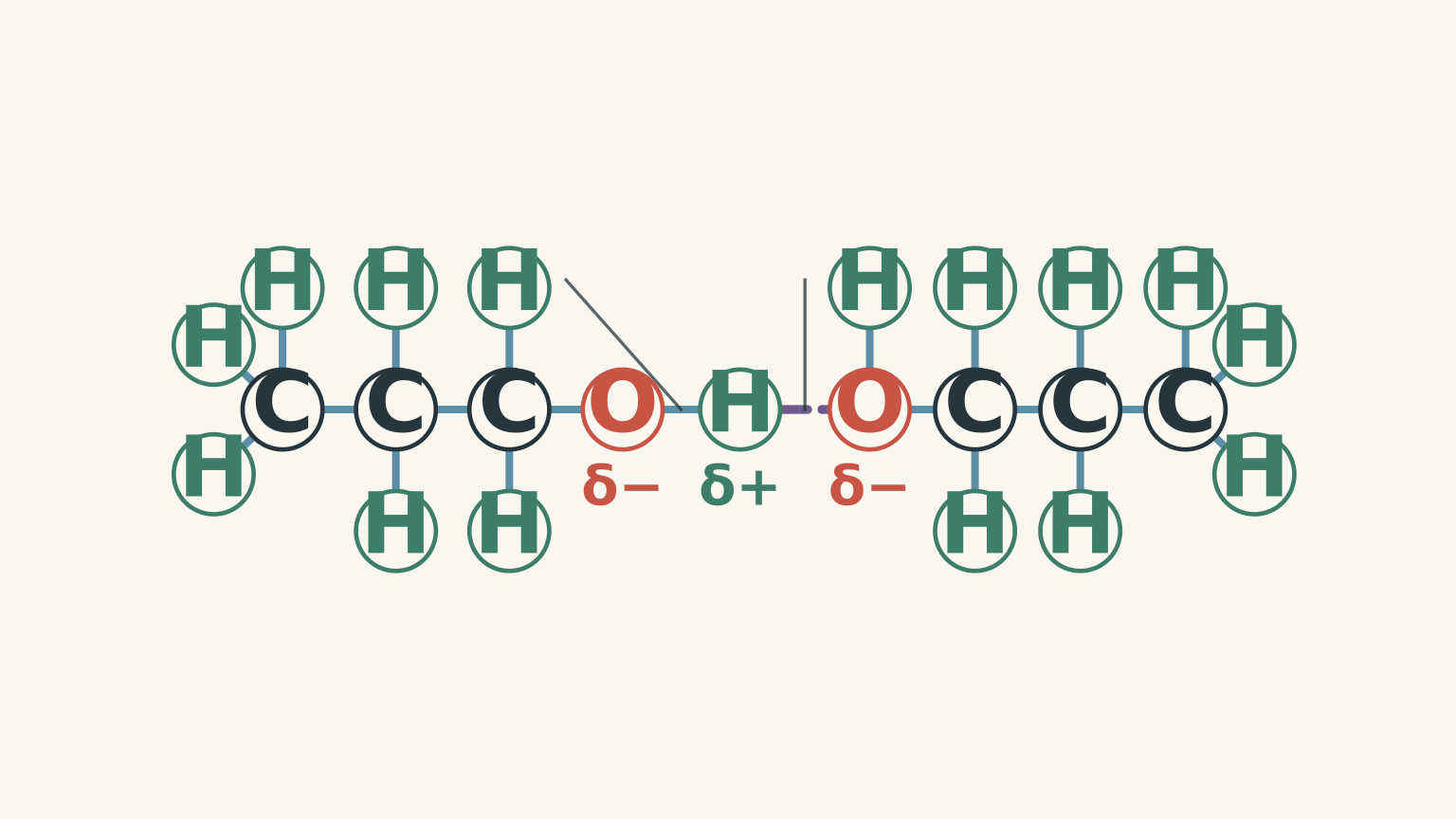
Marking breakdown:
- Identifies the polar O-H bond and the partially positive hydrogen: 1 mark.
- Explains the attraction between that hydrogen and the oxygen of another molecule, forming a hydrogen bond: 1 mark.
Solution 4
(a) Increasing boiling-point order (2 marks)
\[ \begin{aligned} &\text{2-methylpropan-2-ol}\\ &< \text{butan-2-ol}\\ &< \text{2-methylpropan-1-ol}\\ &< \text{butan-1-ol} \end{aligned} \]
The order follows the boiling points of 82.2 °C, 99.5 °C, 108.0 °C, and 117.7 °C.
Marking breakdown:
- Correct relative order of the two lowest-boiling alcohols: 1 mark.
- Correct relative order of the two highest-boiling alcohols: 1 mark.
(b) Butan-1-ol compared with 2-methylpropan-1-ol (2 marks)
Both molecules have the same molecular formula and one hydroxyl group. Both are primary alcohols and can form hydrogen bonds.
However, butan-1-ol has a less-branched, more elongated carbon chain. This allows greater contact between neighbouring molecules, producing stronger London dispersion forces than in the more compact 2-methylpropan-1-ol molecules.
The stronger overall intermolecular attractions mean that butan-1-ol has the higher boiling point.
Marking breakdown:
- Recognises that both alcohols can form hydrogen bonds because they contain the same functional group: 1 mark.
- Explains that the less-branched structure produces stronger London dispersion forces and a higher boiling point: 1 mark.
(c) 2-methylpropan-2-ol compared with butan-1-ol (3 marks)
Both molecules contain an O-H bond and can form hydrogen bonds between molecules.
However, 2-methylpropan-2-ol is highly branched and has a more compact structure. This reduces effective intermolecular contact compared with the more elongated butan-1-ol molecule, resulting in weaker London dispersion forces.
The overall intermolecular attractions in 2-methylpropan-2-ol are weaker, so less energy is required to separate its molecules during boiling. It therefore has a lower boiling point.
Marking breakdown:
- Recognises that 2-methylpropan-2-ol can form hydrogen bonds: 1 mark.
- Explains how its more compact, branched structure reduces London dispersion forces: 1 mark.
- Links the weaker overall intermolecular attractions to its lower boiling point: 1 mark.
Solution 5
(a) Solubility trend (1 mark)
Water solubility decreases as the carbon chain increases from propan-1-ol to pentan-1-ol. Propan-1-ol is miscible with water, whereas pentan-1-ol has a solubility of approximately 2.2 g per 100 mL water.
Marking breakdown: 1 mark for identifying the decreasing trend.
(b) Explanation of the trend (3 marks)
The hydroxyl group is polar and can form hydrogen bonds with water molecules. This helps alcohol molecules interact with water.
The hydrocarbon chain is largely non-polar and does not form hydrogen bonds with water. As the chain gets longer, the non-polar part becomes larger relative to the single hydroxyl group.
The effect of the non-polar part becomes increasingly important, so the alcohol becomes less soluble in water.
Marking breakdown:
- Explains that the hydroxyl group can form hydrogen bonds with water: 1 mark.
- Identifies the hydrocarbon chain as largely non-polar: 1 mark.
- Explains that increasing chain length reduces water solubility: 1 mark.
(c) Intermolecular attraction between propan-1-ol and water (3 marks)
The dashed line should connect the hydrogen attached to the oxygen of propan-1-ol to the oxygen atom of the water molecule.
This attraction is a hydrogen bond. It is an intermolecular force because it acts between two separate molecules. By contrast, the O-H bonds within each molecule are intramolecular covalent bonds.
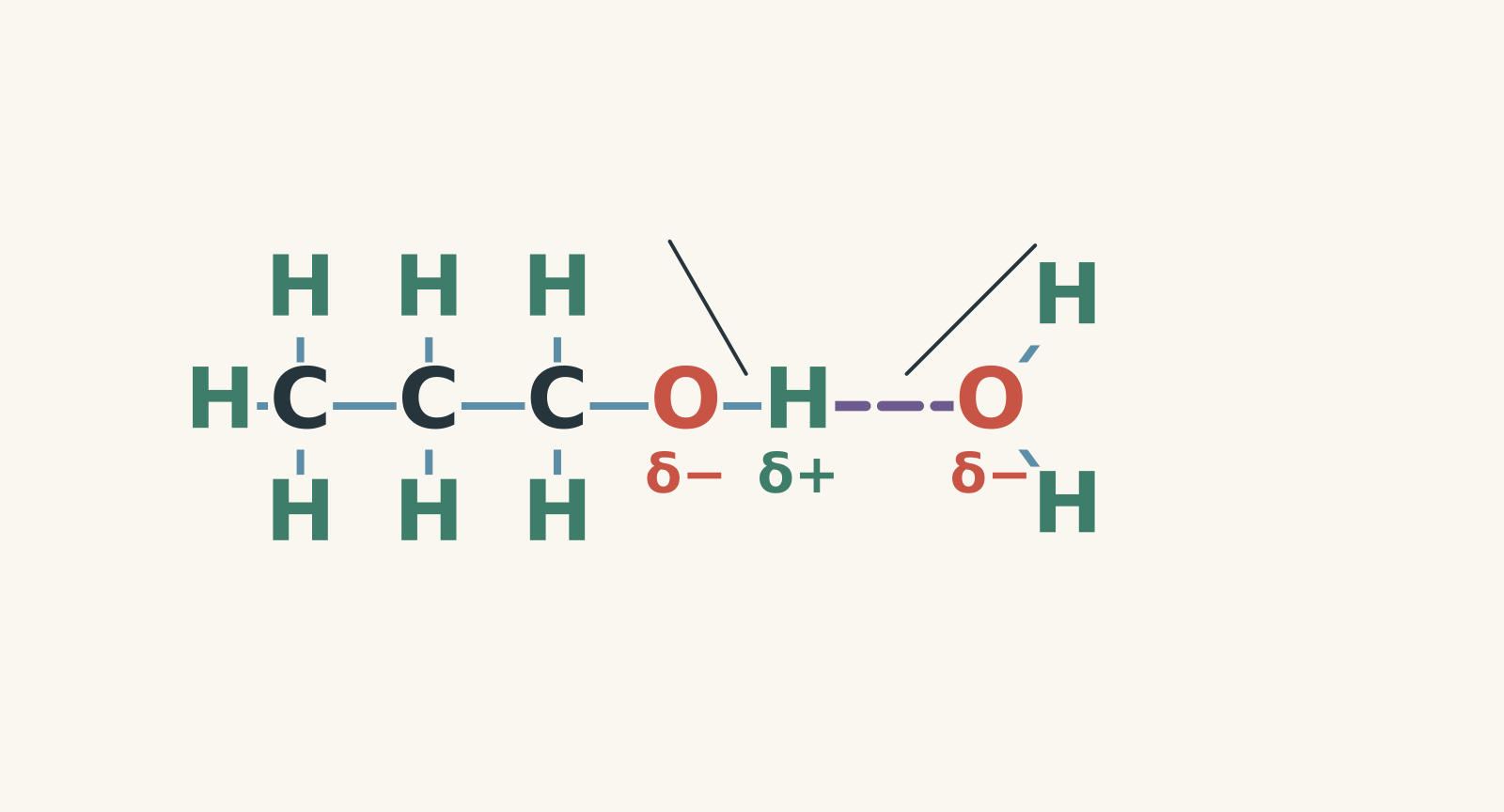
Marking breakdown:
- Correctly draws the dashed attraction between the alcohol’s hydroxyl hydrogen and the water oxygen: 1 mark.
- Correctly identifies the attraction as hydrogen bonding: 1 mark.
- Distinguishes the intermolecular hydrogen bond from intramolecular covalent bonds: 1 mark.
Solution 6
(a) Intermolecular forces (2 marks)
- Ethane: London dispersion forces only.
- Ethanol: hydrogen bonding is the strongest characteristic intermolecular attraction.
Ethanol also experiences London dispersion forces and other dipole-dipole attractions. Hydrogen bonding is particularly important because ethanol contains a polar O-H bond.
Marking breakdown:
- Identifies London dispersion forces as the only intermolecular force between ethane molecules: 1 mark.
- Identifies hydrogen bonding as the strongest characteristic attraction between ethanol molecules: 1 mark.
(b) Explaining the boiling-point difference (4 marks)
Ethanol has a much higher boiling point than ethane because its molecules experience stronger overall intermolecular attractions.
First, ethanol contains a polar O-H bond. Its molecules can form hydrogen bonds with one another, whereas ethane is non-polar and cannot form hydrogen bonds.
Second, ethanol has a larger electron cloud than ethane. Its London dispersion forces are therefore also stronger.
More energy is required to overcome the intermolecular attractions between ethanol molecules and separate them into the gas phase. Consequently, ethanol has a much higher boiling point than ethane.
Marking breakdown:
- Explains that ethanol has a polar O-H bond and can form hydrogen bonds: 1 mark.
- Contrasts ethanol’s hydrogen bonding with ethane’s lack of hydrogen bonding: 1 mark.
- Explains that ethanol’s larger electron cloud produces stronger London dispersion forces: 1 mark.
- Links the stronger overall attractions to greater energy required for boiling and the higher boiling point: 1 mark.
(c) What happens during boiling? (2 marks)
During boiling, intermolecular attractions between ethanol molecules, including hydrogen bonds and London dispersion forces, are overcome sufficiently for the molecules to separate into the gas phase.
The intramolecular covalent bonds within each ethanol molecule remain intact. The C-C, C-H, C-O, and O-H bonds are not broken by boiling.
Marking breakdown:
- Identifies intermolecular forces as the interactions overcome during boiling: 1 mark.
- Identifies intramolecular covalent bonds as remaining intact: 1 mark.
End of paper – 40 marks