
Atomic Models and Particle Discovery: HSC Physics Practice Paper
Test your understanding of atomic-model and particle-discovery experiments with this original 40-mark HSC Physics practice paper. Includes timed exam instructions, original questions, fully worked solutions, and a detailed marking guide.
This original tutorgum practice paper tests your understanding of atomic-model and particle-discovery experiments. You will interpret alpha-scattering data, evaluate Rutherford’s nuclear model, and analyse the evidence that led Chadwick to discover the neutron. The questions progress from interpreting observations to using conservation laws and evaluating the limits of experimental evidence.
01Exam instructions
- Suggested reading time: 5 minutes.
- Suggested working time: 60 minutes.
- Total marks: 40.
- Permitted equipment: Scientific calculator and writing materials. No notes.
- Working: Show your calculations, include units where appropriate, and explain your reasoning in written responses.
- Numerical answers: Give percentages to three significant figures and mass ratios to two significant figures unless otherwise stated.
These are suggested conditions for this practice paper, not official examination rules.
Assessed scope
This paper uses the supplied physics-2025 revision scope only.
- The Geiger-Marsden experiment and the evidence for a tiny, dense nucleus.
- Rutherford’s nuclear atomic model, its successes, and its unresolved problems.
- Chadwick’s discovery of the neutron and the experimental evidence for neutral nuclear particles.
- Conservation of energy and momentum when interpreting particle-recoil evidence.
- Comparing successive atomic models and distinguishing experimental observations from the conclusions they support.
Excluded topics: Bohr’s quantised atomic model, atomic spectra, and particle discoveries beyond the neutron. This is a focused topic paper, not a full-course HSC Physics examination.
All numerical scattering counts and the simplified collision data supplied in this paper are for this original practice assessment. They are not presented as historical experimental measurements.
02Questions
Question 1 (5 marks)
In an alpha-scattering experiment, a narrow beam of positively charged alpha particles is directed at a very thin metal foil. The following observations are recorded:
- Most alpha particles pass through with no measurable deflection.
- Some alpha particles are deflected through small angles.
- A very small number are deflected through angles greater than \(90^\circ\), including some that travel back towards the source.
(a) State what the observation of most alpha particles passing through with little deflection suggests about the volume inside an atom. (1 mark)
(b) Use the large-angle deflections to infer where the atom’s positive charge and most of its mass are concentrated. Explain your reasoning. (2 marks)
(c) Explain why the observations are difficult to reconcile with the plum-pudding model, in which positive charge is spread throughout the atom. (2 marks)
Question 2 (6 marks)
A scattering experiment records the number of alpha particles detected in each angular range. The table shows the results for every 100,000 incident alpha particles.
| Scattering angle, \(\theta\) | Number detected |
|---|---|
| \(0^\circ \leq \theta < 5^\circ\) | 99,850 |
| \(5^\circ \leq \theta < 30^\circ\) | 140 |
| \(30^\circ \leq \theta < 90^\circ\) | 9 |
| \(90^\circ \leq \theta \leq 180^\circ\) | 1 |
(a) Calculate the percentage of alpha particles scattered through angles of \(30^\circ\) or more. Show your working. (2 marks)
(b) If 350,000 alpha particles are incident under the same conditions, estimate the expected number scattered through angles of \(30^\circ\) or more. (2 marks)
(c) State one conclusion supported by the distribution of counts and one conclusion that the table cannot establish by itself. (2 marks)
Question 3 (6 marks)
Rutherford’s nuclear atomic model replaced the plum-pudding model with an atom containing a small central nucleus and electrons in the surrounding region.
(a) State two key features of Rutherford’s nuclear atomic model. (2 marks)
(b) Identify one success of the model and link it to specific evidence from the Geiger-Marsden experiment. (2 marks)
(c) Describe one major problem that Rutherford’s model left unresolved about electron behaviour and atomic stability. (2 marks)
Question 4 (5 marks)
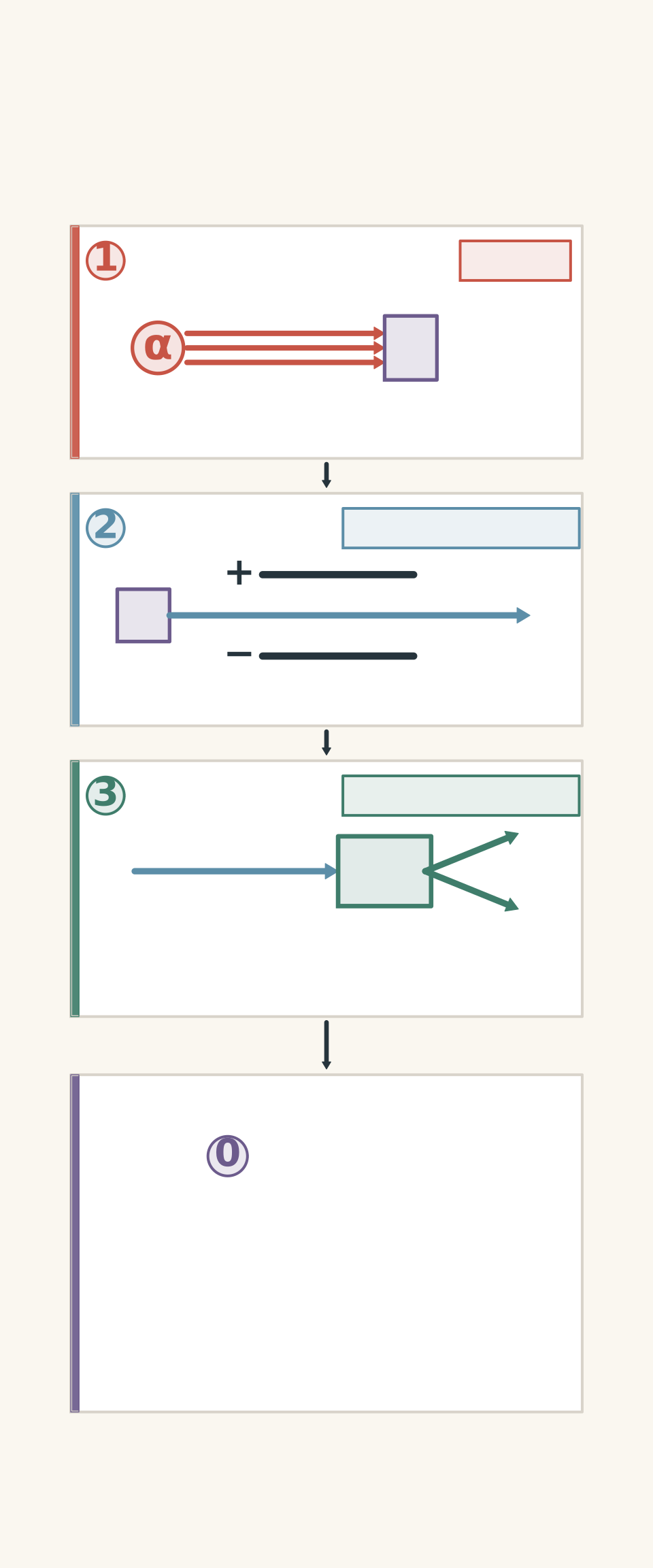
In his investigation, James Chadwick bombarded beryllium with alpha particles. Radiation emerged from the target. The radiation was highly penetrating and showed no deflection in an electric field. When directed at paraffin wax, it caused protons to be ejected at high speeds.
(a) Identify the particle Chadwick proposed and state its electric charge. (2 marks)
(b) Explain what the electric-field observation supports, and state one conclusion it cannot establish by itself. (2 marks)
(c) Explain why paraffin wax was useful in this investigation. (1 mark)
Question 5 (8 marks)
Chadwick investigated the radiation emitted when alpha particles struck beryllium. The energetic protons ejected from paraffin wax provided important evidence about the nature of the radiation.
For this question, use the following simplified model. In a head-on elastic collision, a massive projectile of mass \(m\) strikes a stationary proton of mass \(m_p\). The maximum fraction, \(f\), of the projectile’s initial kinetic energy transferred to the proton is
\[ f=\frac{4r}{(1+r)^2} \]
where
\[ r=\frac{m}{m_p} \]
is the dimensionless ratio of projectile mass to proton mass.
In an idealised analysis of the recoil evidence, take the maximum energy-transfer fraction to be \(f=0.99\).
For comparison, conservation-of-energy-and-momentum calculations for a gamma-ray explanation give a maximum transfer of \(1.0\%\) of the incident energy to a stationary proton at the radiation energy used in this idealised comparison.
(a) Substitute \(f=0.99\) into the supplied equation and show that the result can be written as a quadratic equation in \(r\). (2 marks)
(b) Solve the quadratic equation to determine the two possible values of \(r\), correct to two significant figures. (3 marks)
(c) State what the calculated values suggest about the mass of the incident particle compared with the proton mass. (1 mark)
(d) Use the supplied energy-transfer limits to evaluate whether the gamma-ray hypothesis can account for the observed proton recoil. Refer to conservation of energy and momentum. (2 marks)
Question 6 (5 marks)
A student writes the following statement after studying the Geiger-Marsden and Chadwick experiments:
“Rutherford proved that the nucleus contains only protons. Chadwick then proved that every nucleus has the same number of protons and neutrons.”
(a) Correct the first claim by explaining what the alpha-scattering evidence establishes and what it does not establish about the composition of the nucleus. (2 marks)
(b) Explain how Chadwick’s observations added to the evidence about nuclear composition. Refer to the electric-field and paraffin observations. (2 marks)
(c) State one reason these experiments do not establish the exact proton-to-neutron ratio in every nucleus. (1 mark)
Question 7 (5 marks)
A team repeats an alpha-scattering experiment to check whether large-angle events are reproducible. Each run uses 100,000 incident alpha particles under the same experimental conditions.
| Run | Number scattered through angles greater than \(30^\circ\) |
|---|---|
| A | 11 |
| B | 9 |
| C | 10 |
(a) Calculate the mean number of large-angle events per run. (1 mark)
(b) Use the results to assess the repeatability of the observations and state what they support about large-angle scattering. (2 marks)
(c) Recommend one control or additional check that would strengthen the conclusion that the large-angle events are caused by the foil. Explain why it would help. (2 marks)
03Worked solutions and marking guide
Solution 1
(a) Most of an atom’s volume is empty space, or contains very little matter that significantly deflects the alpha particles.
Marking (1 mark): 1 mark for identifying that most of the atom’s volume is effectively empty space.
(b) The atom’s positive charge and most of its mass are concentrated in a very small central region.
Alpha particles and the nucleus are both positively charged, so an alpha particle passing close to the nucleus experiences strong electrostatic repulsion. The rare large-angle deflections, including backscattering, indicate that this strong interaction occurs in a concentrated region rather than throughout the atom.
Marking (2 marks):
- 1 mark for linking strong deflection to close interaction with concentrated positive charge.
- 1 mark for identifying a small, dense region containing most of the atom’s mass.
(c) The plum-pudding model distributes positive charge throughout the atom. It would therefore predict relatively weak, distributed deflections rather than the observed rare, very large deflections.
The results require a concentrated region capable of producing a strong repulsive force. This is inconsistent with positive charge being spread uniformly throughout the atom.
Marking (2 marks):
- 1 mark for explaining that distributed positive charge does not account for the strong, localised interaction.
- 1 mark for linking the rare large-angle or backward scattering to the model’s failure.
Solution 2
(a) First, add the counts for angles of \(30^\circ\) or more:
\[ N=9+1=10 \]
The fraction of incident particles in these ranges is
\[ \frac{10}{100\,000}=1.00\times10^{-4} \]
Convert the fraction to a percentage:
\[ \begin{aligned} \text{Percentage} &=1.00\times10^{-4}\times100\\ &=0.0100\% \end{aligned} \]
The percentage is \(\boxed{0.0100\%}\).
Marking (2 marks):
- 1 mark for correctly identifying the 10 relevant events.
- 1 mark for calculating the percentage correctly.
(b) The fraction of particles scattered through \(30^\circ\) or more is \(10/100\,000\).
For 350,000 incident particles,
\[ \begin{aligned} N&=350\,000\times\frac{10}{100\,000}\\ &=35 \end{aligned} \]
The expected number is \(\boxed{35\text{ particles}}\).
Marking (2 marks):
- 1 mark for using the correct proportion.
- 1 mark for obtaining 35 particles.
(c) One supported conclusion is that most alpha particles experience little deflection, while large-angle scattering is rare. This is consistent with most of the atom being empty space and a small region producing strong deflections.
One conclusion the table cannot establish by itself is the exact radius of the nucleus. The counts support the nuclear model, but they do not directly reveal every detail of nuclear structure.
Marking (2 marks):
- 1 mark for a valid conclusion based on the distribution of counts.
- 1 mark for identifying a genuine limitation, such as the inability to determine the exact nuclear radius from these counts alone.
Solution 3
(a) Two key features of Rutherford’s nuclear model are:
- The atom contains a tiny, dense, positively charged nucleus that contains most of its mass.
- Electrons occupy the region surrounding the nucleus, so most of the atom’s volume is empty space.
Marking (2 marks):
- 1 mark for describing the small, positively charged nucleus containing most of the mass.
- 1 mark for describing the electrons surrounding the nucleus or identifying that most of the atom is empty space.
(b) A major success was explaining the alpha-scattering results.
Most alpha particles pass through because most of the atom’s volume is empty space. The rare large-angle deflections occur when alpha particles pass close to the concentrated positive charge of the nucleus.
This explains both the common observation of little deflection and the unusual observation of strong deflection within the same model.
Marking (2 marks):
- 1 mark for identifying a valid success of the nuclear model.
- 1 mark for linking that success to the relevant experimental observation.
(c) Rutherford’s model did not explain atomic stability under classical physics.
An electron moving in a classical orbit is accelerating because its direction of motion changes. An accelerating electric charge should radiate energy. The electron would therefore lose energy and spiral towards the nucleus, rather than remaining in a stable atom.
Rutherford’s model did not explain why atoms remain stable.
Marking (2 marks):
- 1 mark for explaining that orbiting electrons should radiate energy and lose it.
- 1 mark for linking this energy loss to the predicted collapse of the atom and the unresolved stability problem.
Two models of the atom
| Plum-pudding model | Positive charge spread throughout the atom. Electrons embedded within the positive charge; no central nucleus. |
|---|---|
| Rutherford nuclear model | Tiny central nucleus contains positive charge and most atomic mass. Electrons occupy the surrounding region; most atomic volume is empty space. |
Solution 4
(a) Chadwick proposed the neutron.
The neutron has zero electric charge, so it is electrically neutral.
Marking (2 marks):
- 1 mark for identifying the neutron.
- 1 mark for stating that its electric charge is zero.
(b) The lack of deflection in an electric field supports the conclusion that the radiation is electrically neutral.
However, this observation alone does not establish that the radiation consists of massive particles. A gamma ray is also electrically neutral, so the absence of electric deflection does not distinguish a neutron from neutral electromagnetic radiation.
Marking (2 marks):
- 1 mark for linking the absence of deflection to electrical neutrality.
- 1 mark for identifying a valid limitation, such as the inability to distinguish a neutron from a gamma ray using this observation alone.
(c) Paraffin wax contains many hydrogen nuclei. These protons can be struck by the incoming radiation and ejected at high speeds, providing evidence about the energy and momentum transferred by the radiation.
Marking (1 mark): 1 mark for explaining that hydrogen-rich paraffin provides protons that can be ejected and observed.
Solution 5
(a) The supplied relationship is
\[ f=\frac{4r}{(1+r)^2} \]
Substitute \(f=0.99\):
\[ 0.99=\frac{4r}{(1+r)^2} \]
Multiply both sides by \((1+r)^2\):
\[ 0.99(1+r)^2=4r \]
Expand and rearrange:
\[ \begin{aligned} 0.99(1+2r+r^2)&=4r\\ 0.99+1.98r+0.99r^2&=4r\\ 0.99r^2-2.02r+0.99&=0 \end{aligned} \]
The required quadratic equation is
\[ \boxed{0.99r^2-2.02r+0.99=0} \]
Marking (2 marks):
- 1 mark for correctly substituting \(f=0.99\) into the supplied relationship.
- 1 mark for obtaining the correctly rearranged quadratic equation.
(b) Use the quadratic formula for an equation \(ar^2+br+c=0\):
\[ r=\frac{-b\pm\sqrt{b^2-4ac}}{2a} \]
Here, \(a=0.99\), \(b=-2.02\), and \(c=0.99\).
Therefore,
\[ r=\frac{2.02\pm\sqrt{(2.02)^2-4(0.99)(0.99)}}{1.98} \]
Calculate the discriminant:
\[ \begin{aligned} \Delta&=4.0804-3.9204\\ &=0.1600 \end{aligned} \]
Hence,
\[ \begin{aligned} r&=\frac{2.02\pm0.40}{1.98}\\ r&=0.818\ldots \quad \text{or} \quad 1.222\ldots \end{aligned} \]
To two significant figures, the two possible values are
\[ \boxed{r=0.82 \quad \text{or} \quad r=1.2} \]
Marking (3 marks):
- 1 mark for correctly applying the quadratic formula and evaluating the discriminant.
- 1 mark for obtaining both roots.
- 1 mark for reporting both roots correctly to two significant figures.
(c) Both roots are close to 1. This suggests that the incident particle has a mass comparable to the proton mass.
That result is consistent with a neutron, whose mass is very close to the proton’s mass. The calculation concerns mass, however, and does not independently establish electrical neutrality.
Marking (1 mark): 1 mark for identifying that the particle’s mass is comparable to the proton mass.
(d) The observed recoil corresponds to a transfer of up to 99% of the incident energy. The supplied gamma-ray calculation allows a maximum transfer of only 1.0% at the same incident energy.
These results are incompatible with the gamma-ray explanation for the observed proton recoil. It cannot transfer enough energy to the proton while satisfying conservation of energy and momentum. A massive neutral particle with a mass comparable to the proton can account for the large energy transfer, supporting the neutron interpretation.
Marking (2 marks):
- 1 mark for identifying the mismatch between the 99% observed transfer and the 1.0% gamma-ray limit.
- 1 mark for explaining that the gamma-ray hypothesis cannot account for the recoil under the supplied conservation constraints, whereas the massive-particle interpretation is consistent with the evidence.
Solution 6
(a) Rutherford’s experiment supported the conclusion that the atom has a tiny, positively charged nucleus containing most of its mass.
However, alpha scattering does not establish that the nucleus contains only protons. It reveals the concentration of positive charge and mass, but does not determine every constituent of the nucleus.
Marking (2 marks):
- 1 mark for correctly identifying the concentrated, positively charged nucleus.
- 1 mark for explaining that alpha scattering alone does not establish the nucleus’s complete composition.
(b) Chadwick’s observations added evidence for a neutral nuclear particle.
The radiation was not deflected by an electric field, supporting electrical neutrality. When it struck paraffin wax, it ejected fast protons. Analysing the recoil evidence using conservation of energy and momentum supported the interpretation that the radiation consisted of massive particles rather than gamma rays.
Together, these observations supported the discovery of the neutron and refined the picture of nuclear composition.
Marking (2 marks):
- 1 mark for linking the electric-field observation to electrical neutrality.
- 1 mark for linking the proton-recoil evidence to the interpretation of a massive particle.
(c) These experiments do not count the protons and neutrons in every possible nucleus. They establish evidence for the nuclear model and the existence of the neutron, but they do not determine the exact proton-to-neutron ratio for every nucleus.
Marking (1 mark): 1 mark for identifying that the experiments do not establish the exact composition of every nucleus.
Solution 7
(a) Calculate the mean:
\[ \begin{aligned} \text{Mean}&=\frac{11+9+10}{3}\\ &=\frac{30}{3}\\ &=10 \end{aligned} \]
The mean is \(\boxed{10\text{ events per run}}\).
Marking (1 mark): 1 mark for calculating the mean correctly.
(b) The three runs produce 11, 9, and 10 large-angle events. These counts are close together, indicating reasonable repeatability under the stated conditions.
Large-angle events are rare compared with the 100,000 incident particles in each run, but they occur consistently across all three runs. This supports the conclusion that large-angle scattering is a reproducible feature of the experiment, rather than an isolated observation.
The results are consistent with the nuclear model, although a control is still needed to check whether background events contribute to the counts.
Marking (2 marks):
- 1 mark for recognising that the results are similar across the three runs.
- 1 mark for explaining that the repeated occurrence of rare large-angle events supports reproducible scattering.
(c) Repeat the experiment without the foil while keeping the source and detector settings unchanged.
This control measures the background event rate. If large-angle events are absent or much less frequent without the foil, the comparison supports the conclusion that the foil causes the observed scattering. If similar counts remain, background radiation or detector effects may contribute to the results.
Marking (2 marks):
- 1 mark for proposing a suitable control, such as a run without the foil.
- 1 mark for explaining how comparing the control with the foil experiment helps identify the source of the events.
End of paper. Total: 40 marks.