
Year 12 Physics: Matter, Energy and the Cosmos Practice Exam
Test your understanding of the Year 12 Physics: Matter, energy and the cosmos module with this original 100-mark timed practice exam. Includes exam instructions, syllabus-focused questions, fully worked solutions, and a detailed marking guide.
This original tutorgum practice paper is a timed revision exam for Year 12 Physics: Matter, energy and the cosmos. It covers the supplied Physics 2025 syllabus scope, with a mix of calculations, experimental evidence, conceptual explanations, and applications. It is an original practice resource, not an official, endorsed, past, or predicted NESA paper.
01Exam instructions
Suggested working time: 120 minutes
Suggested reading time: 5 minutes
Total marks: 100
Permitted equipment: Scientific calculator, ruler, pens, pencils, and blank working paper. Do not use notes or internet resources during the assessment. These are the conditions for this practice paper, not claims about official NESA examination rules.
- Answer all questions.
- Show your working for every calculation. A correct numerical answer without working may not earn full marks.
- Include appropriate units and round numerical answers to three significant figures unless otherwise stated.
- Explain your reasoning in written responses. Naming a concept without explaining how it applies may not earn full marks.
- Use the data and assumptions supplied in each question.
- Marks are shown beside each question and subpart.
Assessed topics: Atomic models and historical experiments; nuclear equations and radioactive decay; atomic spectra and matter waves; nuclear binding energy, fission, fusion, and reactors; particle physics and medical or industrial applications; stellar classification, evolution, nucleosynthesis, and the expanding Universe; and stellar colours in Aboriginal astronomy.
Exclusions: This is a module revision paper covering the supplied Physics 2025 scope for Matter, energy and the cosmos. It is not a full-course HSC Physics examination and does not assess other modules or other syllabus editions.
Useful constants
| Quantity | Value |
|---|---|
| Planck constant, \(h\) | \(6.626\times10^{-34}\ \mathrm{J\,s}\) |
| Speed of light, \(c\) | \(3.00\times10^8\ \mathrm{m\,s^{-1}}\) |
| Electron mass, \(m_e\) | \(9.11\times10^{-31}\ \mathrm{kg}\) |
| Elementary charge magnitude, \(e\) | \(1.602\times10^{-19}\ \mathrm{C}\) |
| Rydberg constant, \(R_H\) | \(1.097\times10^7\ \mathrm{m^{-1}}\) |
| Atomic mass unit, \(u\), expressed as energy | \(1u\,c^2=931.5\ \mathrm{MeV}\) |
| Electronvolt conversion | \(1\ \mathrm{eV}=1.602\times10^{-19}\ \mathrm{J}\) |
| Mega-electronvolt conversion | \(1\ \mathrm{MeV}=1.602\times10^{-13}\ \mathrm{J}\) |
02Questions
Question 1 (6 marks)
(a) (2 marks)
In the Geiger-Marsden experiment, alpha particles were directed at a very thin sheet of gold.
State two observations made during the experiment.
(b) (2 marks)
Explain how these observations led Rutherford to propose a nuclear model of the atom.
(c) (2 marks)
Rutherford’s model included electrons orbiting a small, positively charged nucleus. Explain why this model could not adequately explain the stability of atoms using classical physics.
Question 2 (9 marks)
(a) (2 marks)
Polonium-210 undergoes alpha decay to form lead-206. Write a balanced nuclear equation for this decay, using nuclide notation.
(b) (2 marks)
Carbon-14 undergoes beta-minus decay to form nitrogen-14. Write a balanced nuclear equation, including all particles emitted in the decay.
(c) (3 marks)
Consider the nuclear reaction
\[ {}^{27}_{13}\mathrm{Al}+{}^{4}_{2}\mathrm{He} \rightarrow {}^{30}_{15}\mathrm{P}+X \]
Determine the identity and nuclide notation of particle \(X\). Show how nucleon number and charge are conserved. Explain why the total rest mass of the reactants does not necessarily equal the total rest mass of the products.
(d) (2 marks)
Describe how gamma radiation is produced in a nucleus. Compare gamma radiation with alpha and beta radiation in terms of ionising ability and penetrating power.
Question 3 (6 marks)
A pure radioactive sample initially has a mass of \(800\ \mathrm{mg}\). Its half-life is \(6.0\ \mathrm{h}\). Assume the sample’s mass is proportional to the number of undecayed nuclei.
(a) (2 marks)
Calculate the decay constant, \(\lambda\), in \(\mathrm{h^{-1}}\).
(b) (2 marks)
Calculate the mass of radioactive material remaining after \(18\ \mathrm{h}\).
(c) (1 mark)
Starting from the exponential decay law,
\[ N=N_0e^{-\lambda t}, \]
obtain the relationship between half-life, \(t_{1/2}\), and decay constant, \(\lambda\).
(d) (1 mark)
Explain what the decay constant tells you about the decay of an individual nucleus.
Question 4 (9 marks)
(a) (3 marks)
Three spectra, labelled P, Q, and R, are shown below.
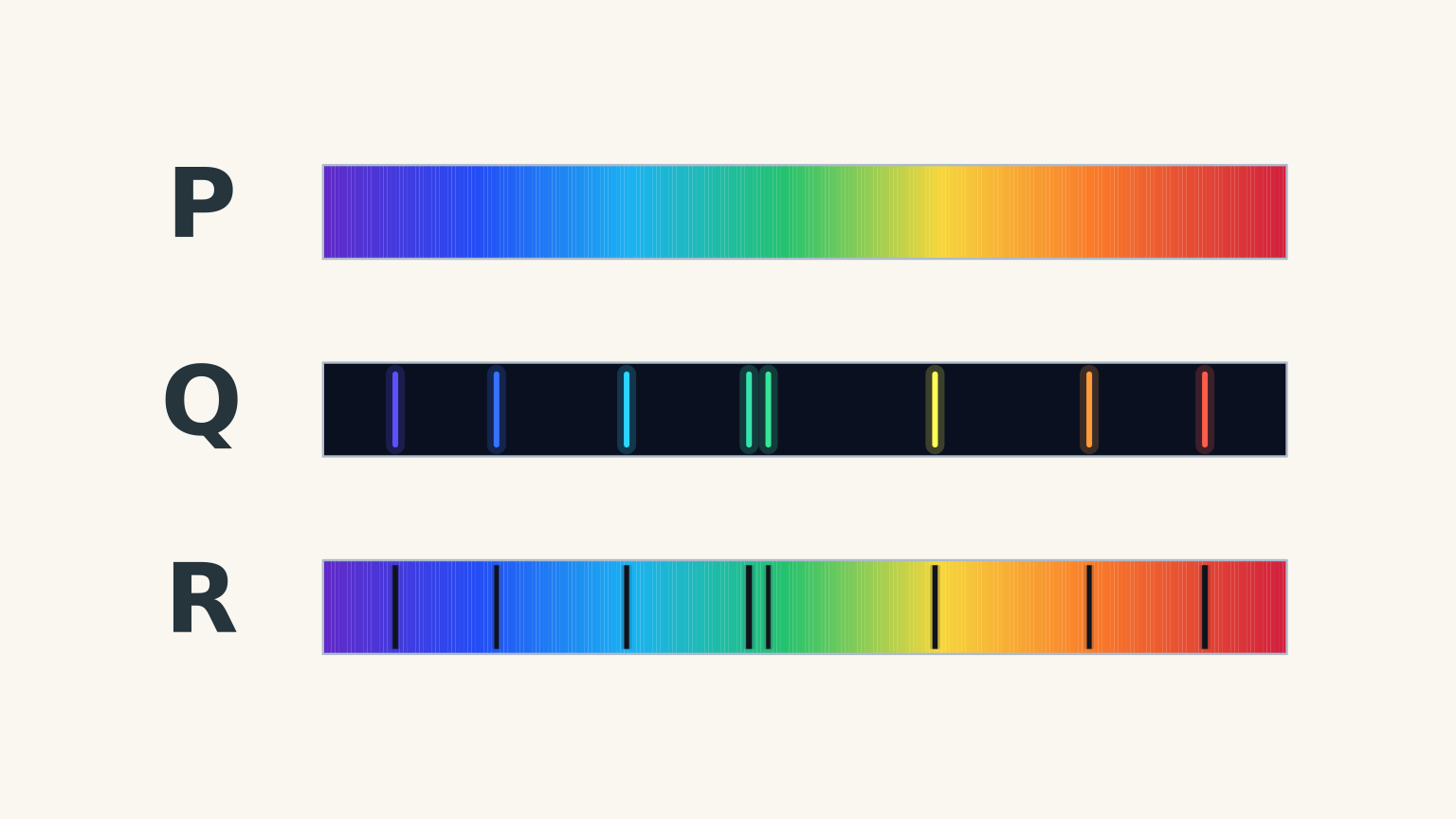
For each spectrum, identify its type and describe the physical conditions that produce it.
(b) (2 marks)
State the key assumption of the Bohr model that allows it to explain discrete hydrogen spectral lines. Give one limitation of the model.
(c) (2 marks)
Use the Rydberg equation to calculate the wavelength of a photon emitted when a hydrogen electron transitions from \(n_i=4\) to \(n_f=2\).
Use
\[ \frac{1}{\lambda_\gamma} =R_H\left(\frac{1}{n_f^2}-\frac{1}{n_i^2}\right), \]
where \(\lambda_\gamma\) is the photon wavelength, \(n_i\) is the initial energy level, and \(n_f\) is the final energy level.
Identify the spectral series to which this transition belongs.
(d) (2 marks)
Calculate the energy of a photon with wavelength \(486\ \mathrm{nm}\), using
\[ E_\gamma=\frac{hc}{\lambda_\gamma}. \]
Give your answer in joules.
Question 5 (5 marks)
(a) (3 marks)
An electron travels at \(2.0\times10^6\ \mathrm{m\,s^{-1}}\). Calculate its de Broglie wavelength using
\[ \lambda_{\mathrm{dB}}=\frac{h}{mv}, \]
where \(m\) is the electron mass and \(v\) is its speed.
(b) (2 marks)
Explain how electron diffraction provides evidence for de Broglie’s hypothesis. Explain why the wave behaviour of ordinary macroscopic objects is not usually observable.
Question 6 (10 marks)
The following nuclear masses are supplied. Treat all quoted masses as nuclear masses.
| Particle or nucleus | Mass (\(u\)) |
|---|---|
| Proton | 1.007276 |
| Neutron | 1.008665 |
| Helium-4 nucleus | 4.001506 |
(a) (2 marks)
Calculate the mass defect of a helium-4 nucleus. The mass defect is the difference between the combined mass of its separated nucleons and the actual nuclear mass.
(b) (2 marks)
Calculate the total nuclear binding energy of helium-4 in MeV.
(c) (1 mark)
Calculate the binding energy per nucleon of helium-4.
(d) (3 marks)
Two independent nuclear reactions have the following mass differences between their reactants and products:
- Fission reaction: \(\Delta m=0.2000\ u\)
- Deuterium-tritium fusion reaction: \(\Delta m=0.0189\ u\)
Calculate the energy released by each reaction in MeV, using mass-energy equivalence.
(e) (2 marks)
Use the following graph to explain why both the fusion of light nuclei and the fission of very heavy nuclei can release energy.
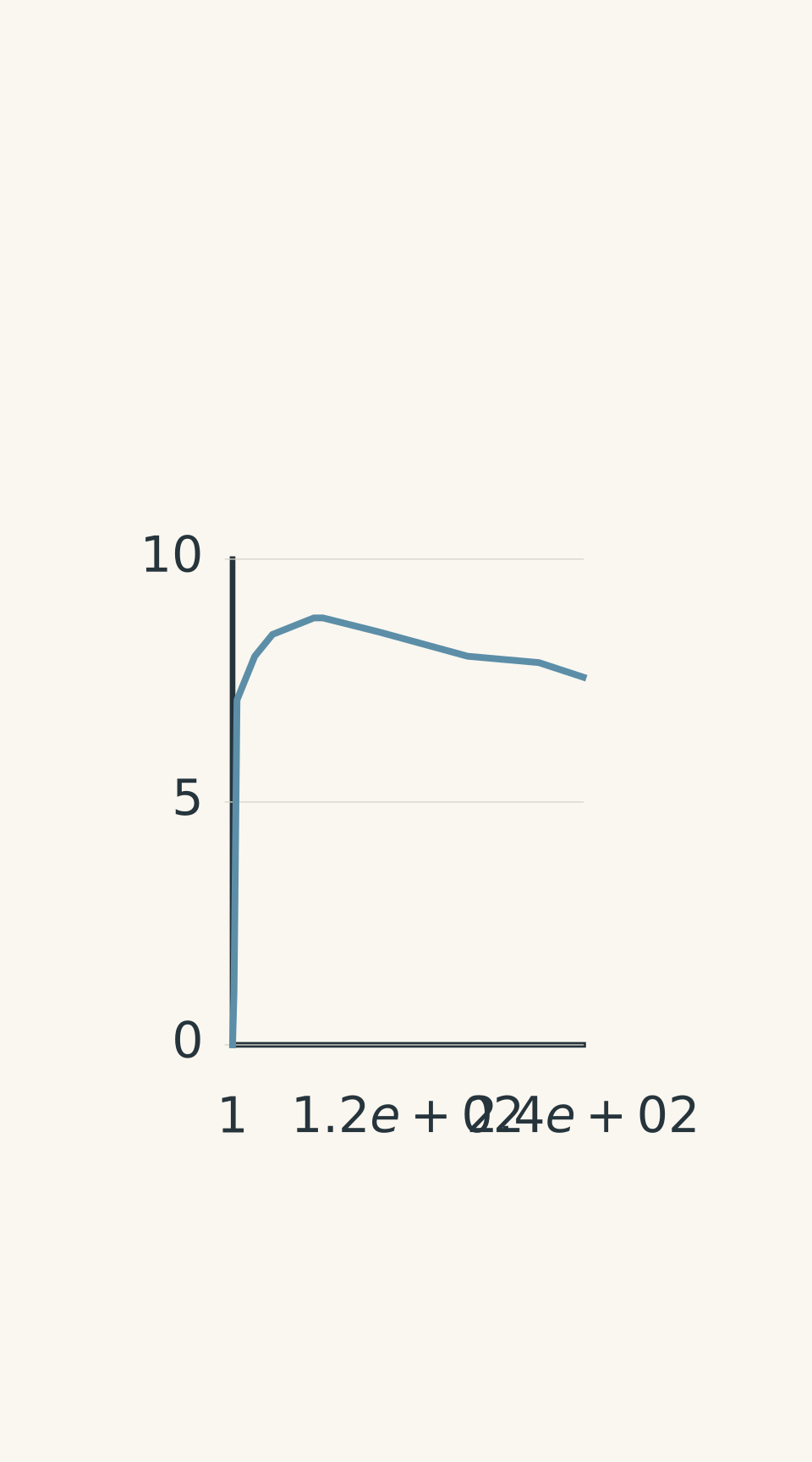
- Binding energy per nucleon
Question 7 (6 marks)
(a) (2 marks)
Explain how a fission chain reaction develops. Distinguish between a controlled chain reaction in a nuclear reactor and an uncontrolled chain reaction.
(b) (3 marks)
Describe the function of each of the following components in a fission reactor:
- Moderator
- Control rods
- Coolant
(c) (1 mark)
Explain why a reactor requires radiation shielding and containment even when its chain reaction is being controlled.
Question 8 (7 marks)
(a) (2 marks)
Explain how the strong nuclear force and electrostatic repulsion between protons affect nuclear stability. Include the role of the neutron-to-proton ratio.
(b) (2 marks)
Write the net nuclear reaction for the proton-proton chain in a Sun-like star. Explain why this fusion pathway is important in such stars.
Treat \({}^{1}_{1}\mathrm{p}\) as a proton and use \(\nu_e\) to represent an electron neutrino.
(c) (2 marks)
Explain the role of carbon, nitrogen, and oxygen in the CNO cycle. Identify the type of stars in which this pathway becomes particularly important.
(d) (1 mark)
Explain why very high temperatures and pressures are needed for nuclear fusion.
Question 9 (11 marks)
(a) (4 marks)
The six quark flavours are up, down, charm, strange, top, and bottom.
- Group the six flavours into their three generations.
- Give the quark composition of a proton and a neutron.
- Give the quark composition of a positively charged pion, \(\pi^+\).
- Distinguish between baryons, mesons, and leptons.
(b) (3 marks)
For each of the strong, weak, and electromagnetic interactions, state one role and name its force carrier or carriers. State whether gravity is included in the Standard Model.
(c) (2 marks)
Explain how high-energy scattering experiments provide evidence that protons and neutrons have internal structure rather than being indivisible particles.
(d) (2 marks)
Explain how a particle accelerator and its detectors can be used to test predictions made by particle physics theories.
Question 10 (6 marks)
(a) (2 marks)
An electron and a positron annihilate while initially at rest. Assume their combined rest energy is converted into two photons.
Calculate the total energy released in MeV, and state the energy and approximate relative directions of the two photons.
(b) (2 marks)
Explain how positron emission tomography (PET) uses positron annihilation to construct an image of a radioactive tracer’s distribution. State one limitation of the technique.
(c) (2 marks)
An industrial production line uses radiation to monitor the thickness of paper. A beta source is suitable because the amount of radiation reaching a detector changes with paper thickness.
Use the following data to select a suitable isotope and explain your choice. State one trade-off associated with using a long-lived source.
| Isotope | Main emitted radiation | Half-life |
|---|---|---|
| Fluorine-18 | Positrons | 110 min |
| Technetium-99m | Gamma | 6.0 h |
| Strontium-90 | Beta-minus | 28.8 y |
| Cobalt-60 | Gamma | 5.27 y |
Question 11 (7 marks)
(a) (2 marks)
Astronomers classify stars using the features of their spectra. Use the supplied reference table to classify a star with a surface temperature of \(9\,000\ \mathrm{K}\) and strong hydrogen Balmer absorption lines.
| Spectral class | Approximate surface temperature | Indicative spectral feature |
|---|---|---|
| O | Above 30,000 K | Ionised helium |
| B | 10,000-30,000 K | Neutral helium |
| A | 7,500-10,000 K | Strong hydrogen Balmer lines |
| F | 6,000-7,500 K | Increasingly prominent metal lines |
| G | 5,200-6,000 K | Numerous metal lines |
| K | 3,700-5,200 K | Neutral metal lines |
| M | Below 3,700 K | Molecular bands |
State the spectral class and justify your classification.
(b) (3 marks)
The following stars have been measured:
| Star | Surface temperature (K) | Luminosity (\(L_\odot\)) |
|---|---|---|
| A | 5,800 | 1 |
| B | 3,600 | 0.001 |
| C | 3,600 | 500 |
Here, \(L_\odot\) is the luminosity of the Sun.
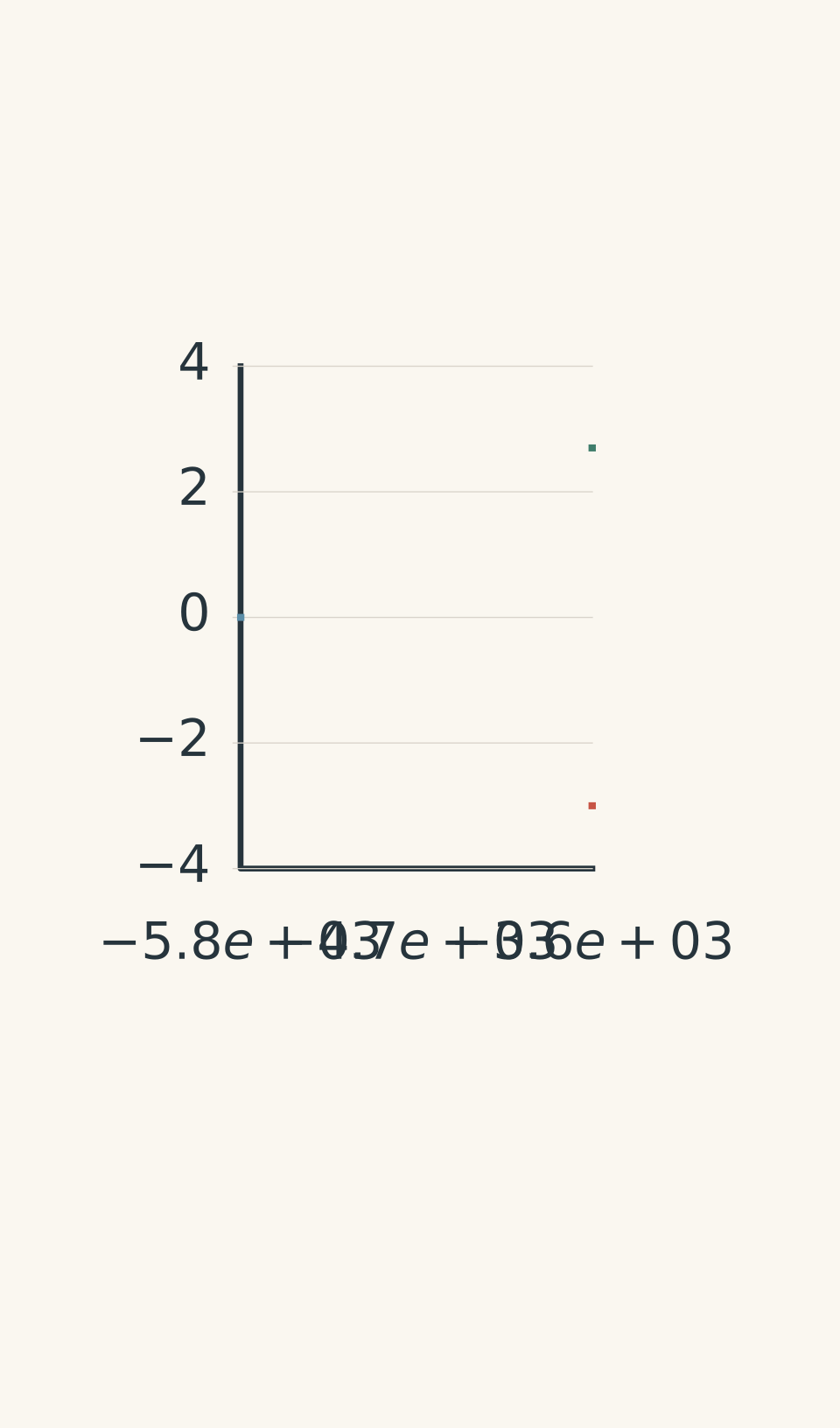
- A
- B
- C
Classify each star as a main-sequence star or a giant. Explain why stars B and C can have very different luminosities despite having the same surface temperature.
(c) (2 marks)
A student claims that stellar colour is purely a scientific measurement and has no place in Aboriginal astronomy. Evaluate this claim. Relate stellar colour to a physical property of stars, and explain why Aboriginal astronomical knowledge should be discussed in its specific cultural context.
Question 12 (5 marks)
Astronomers investigate the relationship between the distance of a galaxy and its recession speed. The following observations are obtained.
| Galaxy | Distance (Mpc) | Recession speed (\(\mathrm{km\,s^{-1}}\)) |
|---|---|---|
| A | 50 | 3,500 |
| B | 100 | 6,900 |
| C | 150 | 10,500 |
For this data set, assume the relationship \(v=H_0d\), where \(v\) is recession speed, \(d\) is distance, and \(H_0\) is the Hubble constant.
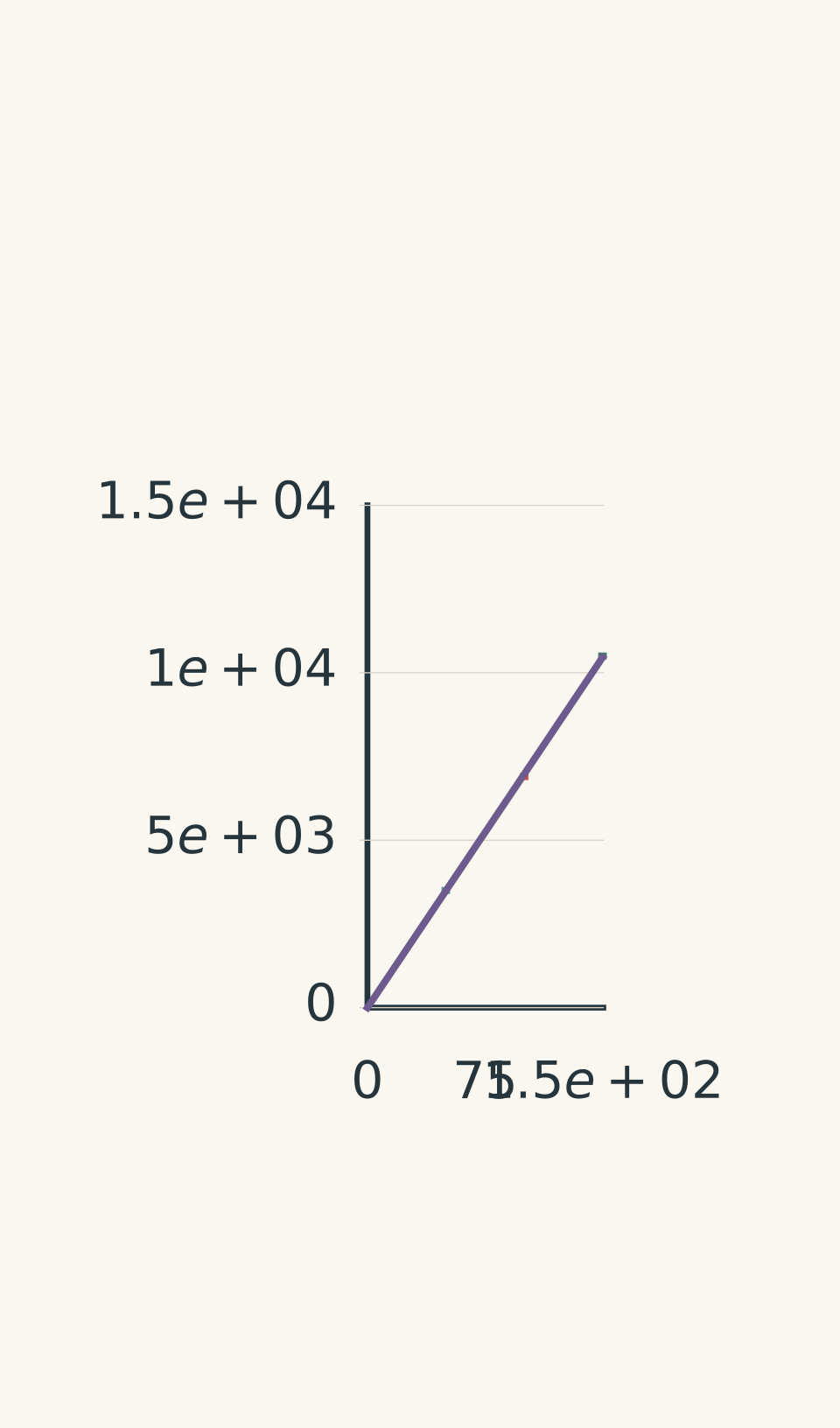
- A
- B
- C
- Trend line
(a) (2 marks)
Calculate an approximate value for the Hubble constant using the supplied observations.
(b) (2 marks)
Explain how galactic redshift and the relationship between distance and recession speed provide evidence for an expanding Universe.
(c) (1 mark)
Explain why the observed recession speed of a nearby galaxy may not closely follow the general relationship described by Hubble’s law.
Question 13 (6 marks)
(a) (3 marks)
Compare the later evolutionary stages of a Sun-like star and a high-mass star. Include their likely final remnants.
(b) (2 marks)
Explain how nucleosynthesis after the main sequence produces heavier elements. Include one example of an element produced during stellar evolution and explain how elements heavier than iron can form.
(c) (1 mark)
Explain the relationship between a star’s initial mass and its main-sequence lifetime.
Question 14 (7 marks)
(a) (2 marks)
Explain how cathode-ray experiments established the existence of negatively charged particles within atoms.
(b) (3 marks)
In a Thomson-style crossed-field experiment, an electron beam is undeflected when perpendicular electric and magnetic fields are applied.
The electric field strength is \(2.4\times10^4\ \mathrm{V\,m^{-1}}\), and the magnetic field strength is \(4.0\times10^{-3}\ \mathrm{T}\).
When the electric field is switched off, the magnetic field alone bends the beam into a circular path of radius \(8.5\times10^{-3}\ \mathrm{m}\).
For the undeflected beam,
\[ v=\frac{E}{B}, \]
where \(E\) is electric field strength and \(B\) is magnetic field strength.
In the magnetic field alone,
\[ \frac{|q|}{m}=\frac{v}{Br}, \]
where \(|q|/m\) is the magnitude of the charge-to-mass ratio and \(r\) is the circular path radius.
Calculate the electron speed and the magnitude of its charge-to-mass ratio.
(c) (2 marks)
Chadwick bombarded beryllium with alpha particles and observed penetrating neutral radiation that could eject protons from paraffin wax.
Explain how this evidence supported the discovery of the neutron.
03Worked solutions and marking guide
The marking allocations below show the specific evidence required for each mark. Accept mathematically equivalent methods and scientifically equivalent explanations. Award appropriate follow-through marks when a student uses a valid method with an earlier numerical error.
Solution 1
(a) Observations (2 marks)
Most alpha particles passed straight through the gold foil. A small fraction were deflected through large angles, and a very small number were scattered backwards.
- 1 mark for one valid observation.
- 1 mark for a second distinct valid observation.
(b) Rutherford’s nuclear model (2 marks)
Because most alpha particles passed through, most of an atom’s volume must be empty space. The rare, large-angle deflections indicated that positive charge and most of the atom’s mass were concentrated in a tiny, dense nucleus.
- 1 mark for explaining that atoms are mostly empty space.
- 1 mark for identifying a small, dense, positively charged nucleus containing most of the mass.
(c) Classical instability (2 marks)
An electron moving in a circular orbit is accelerating because its direction changes continuously. Classical electromagnetic theory predicts that an accelerating charge radiates energy. The electron would therefore lose energy and spiral into the nucleus, so Rutherford’s model could not explain why atoms remain stable.
- 1 mark for identifying energy radiation by an accelerating electron.
- 1 mark for explaining the resulting loss of orbital energy and predicted collapse.
Solution 2
(a) Alpha decay (2 marks)
The balanced equation is
\[ {}^{210}_{84}\mathrm{Po} \rightarrow {}^{206}_{82}\mathrm{Pb} + {}^{4}_{2}\mathrm{He}. \]
The alpha particle is a helium-4 nucleus.
- 1 mark for conserving nucleon number: \(210=206+4\).
- 1 mark for conserving charge number: \(84=82+2\).
(b) Beta-minus decay (2 marks)
The balanced equation is
\[ {}^{14}_{6}\mathrm{C} \rightarrow {}^{14}_{7}\mathrm{N} + {}^{0}_{-1}e + \bar{\nu}_e. \]
In beta-minus decay, a neutron transforms into a proton, an electron, and an electron antineutrino. The mass number stays the same, while the atomic number increases by one.
- 1 mark for the correct daughter nucleus and emitted electron.
- 1 mark for including the antineutrino and maintaining nuclear conservation.
(c) Balancing the transmutation equation (3 marks)
The total nucleon number on the left is
\[ 27+4=31. \]
Phosphorus-30 accounts for 30 nucleons, so \(X\) must have nucleon number 1.
The total charge number on the left is
\[ 13+2=15. \]
Phosphorus already has charge number 15, so \(X\) must be neutral. Therefore,
\[ \boxed{X={}^{1}_{0}\mathrm{n}} \]
The missing particle is a neutron. The reactants and products must conserve total mass-energy, but their total rest masses do not have to be identical. A difference in rest mass can appear as released or absorbed energy.
- 1 mark for balancing nucleon number.
- 1 mark for balancing charge and identifying the neutron.
- 1 mark for distinguishing rest-mass conservation from total mass-energy conservation.
(d) Gamma radiation (2 marks)
Gamma radiation consists of high-energy photons emitted when an excited nucleus loses energy. Gamma emission does not change the nucleus’s proton number or nucleon number.
Gamma radiation is generally the most penetrating of the three common nuclear radiations and the least ionising. Alpha radiation is strongly ionising but weakly penetrating, while beta radiation lies between alpha and gamma in both properties.
- 1 mark for explaining gamma emission and the unchanged nuclear numbers.
- 1 mark for correctly comparing ionising ability and penetration.
Solution 3
(a) Decay constant (2 marks)
The relationship between half-life and decay constant is
\[ \lambda=\frac{\ln 2}{t_{1/2}}. \]
Substituting \(t_{1/2}=6.0\ \mathrm{h}\),
\[ \lambda=\frac{0.693}{6.0} =0.1155\ \mathrm{h^{-1}}. \]
Therefore,
\[ \boxed{\lambda=0.116\ \mathrm{h^{-1}}} \]
- 1 mark for using the correct relationship.
- 1 mark for the numerical value and correct units.
(b) Remaining mass (2 marks)
The elapsed time corresponds to
\[ \frac{18}{6.0}=3 \]
half-lives.
The mass halves three times:
\[ 800\rightarrow400\rightarrow200\rightarrow100\ \mathrm{mg}. \]
Equivalently,
\[ m=800\left(\frac12\right)^3 =\boxed{100\ \mathrm{mg}}. \]
- 1 mark for identifying three half-lives or applying the correct decay calculation.
- 1 mark for the correct remaining mass.
(c) Deriving the half-life relationship (1 mark)
At one half-life, \(N=N_0/2\). Substituting into the decay law gives
\[ \frac12=e^{-\lambda t_{1/2}}. \]
Taking logarithms and rearranging gives
\[ \boxed{t_{1/2}=\frac{\ln 2}{\lambda}}. \]
- 1 mark for obtaining the correct relationship.
(d) Meaning of the decay constant (1 mark)
The decay constant describes the probability per unit time that an individual undecayed nucleus will decay. Radioactive decay is random, so it does not predict exactly when a particular nucleus will decay.
- 1 mark for identifying the probabilistic nature of decay and its application to individual nuclei.
Solution 4
(a) Types of spectra (3 marks)
- P is a continuous spectrum. A dense, hot source produces a broad range of wavelengths.
- Q is an emission-line spectrum. Excited atoms in a low-density gas emit photons at specific wavelengths when electrons transition to lower energy levels.
- R is an absorption-line spectrum. A cooler gas absorbs particular wavelengths from light passing through it, leaving dark lines in the continuous spectrum.
Each spectrum has its own physical origin.
- 1 mark for each correct identification and explanation.
(b) Bohr model (2 marks)
Bohr proposed that electrons in hydrogen occupy only certain allowed energy levels. When an electron transitions between levels, it absorbs or emits a photon with energy equal to the difference between those levels.
One limitation is that the model does not adequately describe multi-electron atoms. It also does not provide the full quantum-mechanical description of electrons.
- 1 mark for quantised energy levels and transitions.
- 1 mark for a valid limitation.
(c) Rydberg equation (2 marks)
For \(n_i=4\) and \(n_f=2\),
\[ \begin{aligned} \frac{1}{\lambda_\gamma} &=1.097\times10^7 \left(\frac{1}{2^2}-\frac{1}{4^2}\right)\\ &=1.097\times10^7 \left(\frac14-\frac1{16}\right)\\ &=2.057\times10^6\ \mathrm{m^{-1}}. \end{aligned} \]
Therefore,
\[ \lambda_\gamma =\frac{1}{2.057\times10^6} =4.86\times10^{-7}\ \mathrm{m}. \]
The wavelength is approximately
\[ \boxed{486\ \mathrm{nm}}. \]
Because the transition ends at \(n=2\), it belongs to the Balmer series.
- 1 mark for correct substitution and calculation.
- 1 mark for the wavelength and identification of the Balmer series.
(d) Photon energy (2 marks)
Using the wavelength \(486\ \mathrm{nm}=486\times10^{-9}\ \mathrm{m}\),
\[ \begin{aligned} E_\gamma &=\frac{hc}{\lambda_\gamma}\\ &=\frac{(6.626\times10^{-34})(3.00\times10^8)} {486\times10^{-9}}\\ &=4.09\times10^{-19}\ \mathrm{J}. \end{aligned} \]
Thus,
\[ \boxed{E_\gamma=4.09\times10^{-19}\ \mathrm{J}}. \]
- 1 mark for the correct equation and substitution.
- 1 mark for the correct energy and units.
Solution 5
(a) de Broglie wavelength (3 marks)
The de Broglie relationship is
\[ \lambda_{\mathrm{dB}}=\frac{h}{mv}. \]
Substituting the electron’s mass and speed,
\[ \begin{aligned} \lambda_{\mathrm{dB}} &=\frac{6.626\times10^{-34}} {(9.11\times10^{-31})(2.0\times10^6)}\\ &=3.64\times10^{-10}\ \mathrm{m}. \end{aligned} \]
Therefore,
\[ \boxed{\lambda_{\mathrm{dB}}=3.64\times10^{-10}\ \mathrm{m}} \]
or approximately \(0.364\ \mathrm{nm}\).
- 1 mark for the correct relationship.
- 1 mark for substitution of the correct values.
- 1 mark for the correct wavelength and units.
(b) Evidence for matter waves (2 marks)
Electrons passing through a suitable crystal produce a diffraction pattern, with intensity maxima and minima caused by wave interference. This behaviour supports de Broglie’s hypothesis that particles such as electrons have wave properties.
Macroscopic objects have much greater momentum than electrons. Their de Broglie wavelengths are consequently extremely small, making observable diffraction impractical under ordinary conditions.
- 1 mark for connecting electron diffraction to wave behaviour.
- 1 mark for explaining the extremely small wavelengths of macroscopic objects.
Solution 6
(a) Mass defect (2 marks)
A helium-4 nucleus contains two protons and two neutrons.
The combined mass of its separated nucleons is
\[ \begin{aligned} m_{\mathrm{separated}} &=2(1.007276)+2(1.008665)\\ &=4.031882\ u. \end{aligned} \]
The mass defect is
\[ \begin{aligned} \Delta m &=m_{\mathrm{separated}}-m_{\mathrm{nucleus}}\\ &=4.031882-4.001506\\ &=0.030376\ u. \end{aligned} \]
Therefore,
\[ \boxed{\Delta m=0.030376\ u}. \]
- 1 mark for calculating the combined nucleon mass.
- 1 mark for the correct mass defect.
(b) Nuclear binding energy (2 marks)
Using mass-energy equivalence,
\[ E=\Delta mc^2. \]
Since \(1u\,c^2=931.5\ \mathrm{MeV}\),
\[ \begin{aligned} E_{\mathrm{binding}} &=0.030376\times931.5\\ &=28.295\ \mathrm{MeV}. \end{aligned} \]
Hence,
\[ \boxed{E_{\mathrm{binding}}=28.3\ \mathrm{MeV}}. \]
- 1 mark for converting the mass defect into energy correctly.
- 1 mark for the correct binding energy.
(c) Binding energy per nucleon (1 mark)
Helium-4 contains four nucleons, so
\[ \frac{E_{\mathrm{binding}}}{A} =\frac{28.295}{4} =7.07\ \mathrm{MeV\ per\ nucleon}. \]
\[ \boxed{7.07\ \mathrm{MeV\ per\ nucleon}} \]
- 1 mark for the correct calculation and units.
(d) Energy released by fission and fusion (3 marks)
The energy released is related to the decrease in rest mass:
\[ E=\Delta mc^2. \]
Using \(1u\,c^2=931.5\ \mathrm{MeV}\):
For fission,
\[ \begin{aligned} E_{\mathrm{fission}} &=0.2000\times931.5\\ &=\boxed{186\ \mathrm{MeV}} \end{aligned} \]
to three significant figures.
For deuterium-tritium fusion,
\[ \begin{aligned} E_{\mathrm{fusion}} &=0.0189\times931.5\\ &=\boxed{17.6\ \mathrm{MeV}}. \end{aligned} \]
These are the energies released per reaction event for the supplied mass differences.
- 1 mark for applying mass-energy equivalence and the conversion factor.
- 1 mark for the fission energy.
- 1 mark for the fusion energy.
(e) Why fission and fusion release energy (2 marks)
The binding energy per nucleon generally increases as light nuclei become heavier, reaching a maximum around iron and nearby nuclei. It decreases for very heavy nuclei.
When light nuclei fuse, the resulting nucleus can have a greater binding energy per nucleon. When a very heavy nucleus undergoes fission, its medium-mass products can also have a greater binding energy per nucleon.
In both cases, the products are more tightly bound overall. The increase in total binding energy corresponds to energy released, with the mass difference accounted for by mass-energy equivalence.
- 1 mark for relating the graph to the greater binding energy per nucleon of the products.
- 1 mark for explaining that the increase in binding energy corresponds to released energy.
Solution 7
(a) Chain reactions (2 marks)
During fission, a heavy nucleus splits and releases energy and usually two or more neutrons. Those neutrons can cause further fission events, creating a chain reaction.
In a controlled reactor, neutron production and absorption are managed so that the fission rate remains at the required level. In an uncontrolled, rapidly multiplying chain reaction, the number of fissions increases rapidly rather than remaining regulated.
- 1 mark for explaining how neutrons sustain a fission chain reaction.
- 1 mark for distinguishing controlled and uncontrolled multiplication.
(b) Reactor components (3 marks)
- Moderator: Slows fast neutrons so that they are more likely to cause further fission in a thermal reactor.
- Control rods: Absorb neutrons, allowing the reaction rate to be regulated or stopped.
- Coolant: Removes thermal energy from the reactor core and transfers it to a system that can use the heat, such as steam generation.
- 1 mark for each correctly described component.
(c) Shielding and containment (1 mark)
Shielding reduces radiation exposure, while containment helps prevent radioactive materials from escaping into the environment. Controlling the chain reaction does not eliminate radiation from radioactive fission products.
- 1 mark for explaining the protective function of shielding or containment.
Solution 8
(a) Nuclear forces and stability (2 marks)
The strong nuclear force is attractive at short nuclear distances and can overcome the electrostatic repulsion between protons. Its short range means that the arrangement of nucleons within the nucleus matters.
Neutrons contribute to the strong nuclear attraction without adding positive electric charge. A suitable neutron-to-proton ratio helps maintain stability. A ratio that is too high or too low can make a nucleus unstable.
- 1 mark for explaining the short-range strong force and electrostatic repulsion.
- 1 mark for relating stability to the neutron-to-proton ratio.
(b) Proton-proton chain (2 marks)
The net reaction is
\[ 4\,{}^{1}_{1}\mathrm{p} \rightarrow {}^{4}_{2}\mathrm{He} +2e^+ +2\nu_e +\text{energy}. \]
Four protons are converted into a helium-4 nucleus, with positrons, electron neutrinos, and energy produced overall. This pathway is important in Sun-like stars because their core conditions allow hydrogen fusion through the proton-proton chain.
- 1 mark for the correct net reaction.
- 1 mark for explaining its importance in Sun-like stars.
(c) CNO cycle (2 marks)
In the CNO cycle, carbon, nitrogen, and oxygen nuclei participate in a sequence of nuclear reactions that converts hydrogen into helium. These nuclei act as catalysts because they are regenerated by the cycle rather than being consumed overall.
The CNO cycle becomes particularly important at the higher core temperatures of more massive main-sequence stars.
- 1 mark for explaining the catalytic role of carbon, nitrogen, and oxygen.
- 1 mark for identifying the type of stars in which the cycle is particularly important.
(d) Fusion conditions (1 mark)
High temperatures give nuclei enough kinetic energy to approach one another despite electrostatic repulsion, while high pressure or density increases the rate of collisions. Quantum tunnelling also allows some nuclei to fuse without classically overcoming the full Coulomb barrier.
- 1 mark for linking the conditions to overcoming the electrostatic barrier and enabling fusion.
Solution 9
(a) Quarks, hadrons, and leptons (4 marks)
The three generations of quarks are
- First: up and down.
- Second: charm and strange.
- Third: top and bottom.
The quark compositions are
\[ \begin{aligned} p&=uud,\\ n&=udd,\\ \pi^+&=u\bar d. \end{aligned} \]
Protons and neutrons are baryons, which contain three quarks. A positively charged pion is a meson, consisting of a quark and an antiquark.
Electrons and electron neutrinos are leptons. Unlike hadrons, leptons do not participate in the strong interaction.
- 1 mark for grouping the six quark flavours into generations.
- 1 mark for the proton and neutron compositions.
- 1 mark for the pion composition.
- 1 mark for distinguishing baryons, mesons, and leptons.
(b) Fundamental interactions (3 marks)
| Interaction | Role | Carrier |
|---|---|---|
| Strong | Binds quarks into hadrons and contributes to nuclear binding | Gluons |
| Weak | Enables processes such as beta decay and changes in quark flavour | \(W^+\), \(W^-\), and \(Z^0\) bosons |
| Electromagnetic | Acts between electrically charged particles | Photons |
Gravity is not included in the Standard Model. The model describes the strong, weak, and electromagnetic interactions but does not provide a complete quantum theory of gravity.
- 1 mark for the roles of the three interactions.
- 1 mark for the corresponding carriers.
- 1 mark for identifying gravity as outside the Standard Model.
(c) Evidence for nucleon structure (2 marks)
In high-energy scattering experiments, electrons are directed at protons or neutrons. The observed scattering patterns and energy transfers are consistent with the presence of smaller, point-like constituents inside the nucleons.
These results support the quark model: protons and neutrons are composite particles rather than indivisible objects.
- 1 mark for describing the scattering evidence.
- 1 mark for linking the evidence to internal constituents or quarks.
(d) Particle accelerators (2 marks)
Accelerators increase the energy of charged particles before directing them into collisions with other particles or a target. Detectors measure the tracks, energies, momenta, and decay products of particles created in these collisions.
Physicists compare the measured results with theoretical predictions. Agreement supports a model, while significant discrepancies can indicate missing physics or the need to revise a theory.
- 1 mark for explaining acceleration, collisions, and detection.
- 1 mark for explaining how detector data tests theoretical predictions.
Solution 10
(a) Electron-positron annihilation (2 marks)
The electron and positron have equal rest masses. Their combined rest energy is
\[ E=2m_ec^2. \]
Substituting,
\[ \begin{aligned} E &=2(9.11\times10^{-31})(3.00\times10^8)^2\\ &=1.64\times10^{-13}\ \mathrm{J}. \end{aligned} \]
Converting to MeV,
\[ E=\frac{1.64\times10^{-13}}{1.602\times10^{-13}} \approx1.02\ \mathrm{MeV}. \]
The total energy is approximately \(1.02\ \mathrm{MeV}\). For annihilation at rest, two photons are produced, each with energy approximately
\[ \boxed{0.511\ \mathrm{MeV}}, \]
travelling in approximately opposite directions to conserve momentum.
- 1 mark for the total energy.
- 1 mark for the energy and directions of the photons.
(b) PET imaging (2 marks)
A positron-emitting tracer is introduced into the body. When an emitted positron annihilates with an electron, two gamma photons are produced in nearly opposite directions.
PET detectors record pairs of photons arriving in coincidence. Their detection defines a line along which the annihilation occurred. Combining many detections allows a computer to reconstruct the distribution of the radioactive tracer.
One limitation is that the positron travels some distance before annihilation, which reduces spatial resolution. PET also involves exposure to ionising radiation.
- 1 mark for explaining coincidence detection and image reconstruction.
- 1 mark for identifying a valid limitation.
(c) Industrial radioisotopes (2 marks)
Strontium-90 is a suitable source for a paper-thickness gauge because it emits beta particles. The amount of beta radiation reaching a detector changes as the paper absorbs or scatters radiation, allowing changes in thickness to be monitored.
Its long half-life of 28.8 years provides a relatively stable source over extended periods. However, it remains radioactive for a long time and requires appropriate shielding, handling, and eventual disposal.
- 1 mark for selecting strontium-90 and explaining beta attenuation.
- 1 mark for identifying a benefit or trade-off associated with its long half-life.
Solution 11
(a) Spectral classification (2 marks)
The star belongs to spectral class A. Its surface temperature of \(9\,000\ \mathrm{K}\) falls within the supplied class A range of 7,500-10,000 K. Its strong hydrogen Balmer absorption lines provide additional evidence for this classification.
- 1 mark for identifying class A.
- 1 mark for using the temperature and spectral features to justify the classification.
(b) Hertzsprung-Russell diagram (3 marks)
Star A has a temperature close to the Sun’s and a luminosity of \(1L_\odot\). It is consistent with a main-sequence star.
Star B is cool and very faint. It is consistent with a red dwarf on the main sequence.
Star C has the same surface temperature as B but is much more luminous. It is consistent with a red giant.
The difference between B and C is their radius. At the same surface temperature, a star with a larger surface area emits more total energy per second and therefore has a greater luminosity.
- 1 mark for identifying A as a main-sequence star.
- 1 mark for identifying B as a red dwarf and C as a red giant.
- 1 mark for explaining the luminosity difference using stellar radius or surface area.
(c) Stellar colours in Aboriginal astronomy (2 marks)
Stellar colour is scientifically related to a star’s surface temperature. Blue-white stars are generally hotter than red stars.
However, astronomical observations can also hold cultural significance and form part of knowledge systems connecting the sky with seasonal, ecological, and cultural information. Aboriginal and Torres Strait Islander knowledge systems are diverse, so a documented interpretation from one community should not be treated as a universal belief shared by all communities.
- 1 mark for relating colour to surface temperature.
- 1 mark for recognising the cultural significance of astronomical knowledge and the need for community-specific context.
Solution 12
(a) Hubble constant (2 marks)
Using \(H_0=v/d\), calculate the ratio for each galaxy.
For galaxy A,
\[ H_0=\frac{3500}{50} =70\ \mathrm{km\,s^{-1}\,Mpc^{-1}}. \]
For galaxy B,
\[ H_0=\frac{6900}{100} =69\ \mathrm{km\,s^{-1}\,Mpc^{-1}}. \]
For galaxy C,
\[ H_0=\frac{10500}{150} =70\ \mathrm{km\,s^{-1}\,Mpc^{-1}}. \]
The results are consistent with an approximate Hubble constant of
\[ \boxed{H_0\approx70\ \mathrm{km\,s^{-1}\,Mpc^{-1}}}. \]
- 1 mark for correctly calculating the ratios.
- 1 mark for giving a reasonable approximate Hubble constant with units.
(b) Evidence for expansion (2 marks)
Redshift occurs when spectral lines are observed at longer wavelengths than their corresponding rest wavelengths. For distant galaxies, this generally indicates recession.
The observation that more distant galaxies tend to have larger recession speeds supports the conclusion that the Universe is expanding on large scales.
- 1 mark for explaining the relationship between redshift and recession.
- 1 mark for linking the distance-recession relationship to cosmic expansion.
(c) Nearby galaxies (1 mark)
A nearby galaxy’s motion can be strongly affected by local gravitational interactions with other galaxies. Its peculiar velocity may therefore be large relative to the general expansion velocity predicted by Hubble’s law.
- 1 mark for identifying local gravitational effects or peculiar velocity.
Solution 13
(a) Stellar evolution and mass (3 marks)
A Sun-like star spends most of its life on the main sequence, fusing hydrogen into helium in its core. After core hydrogen is depleted, it expands into a red giant. Later stages involve helium fusion, the loss of outer layers, and the formation of a white dwarf.
A high-mass star also begins on the main sequence, but its subsequent evolution can include a supergiant stage and successive fusion stages producing increasingly heavy nuclei. Once its core can no longer support itself against gravity, it may undergo core collapse and a supernova explosion, leaving a neutron star or black hole.
- 1 mark for the later stages of a Sun-like star and its likely remnant.
- 1 mark for the later stages of a high-mass star and its likely remnant.
- 1 mark for linking the different evolutionary pathways to initial stellar mass.
(b) Nucleosynthesis after the main sequence (2 marks)
During helium fusion, the triple-alpha process can produce carbon. Further burning stages in sufficiently massive stars can produce elements such as oxygen, neon, silicon, and iron.
Elements heavier than iron can form through neutron-capture processes, including those associated with explosive stellar events. Material expelled from stars and supernovae enriches the surrounding interstellar gas, providing material for later generations of stars and planets.
- 1 mark for describing the production of heavier elements during later stellar burning.
- 1 mark for explaining neutron capture or explosive production of elements heavier than iron, including their dispersal.
(c) Stellar lifetime (1 mark)
High-mass stars generally have shorter main-sequence lifetimes because their cores burn fuel at much higher rates. They consume their available hydrogen more quickly than lower-mass stars.
- 1 mark for linking greater initial mass to faster fuel consumption and a shorter lifetime.
Solution 14
(a) Cathode-ray evidence (2 marks)
Cathode rays were deflected towards a positively charged plate in an electric field, showing that the particles carried negative charge. Their properties were also found to be independent of the cathode material and the gas used in the tube.
This supported the conclusion that cathode rays consisted of a universal negatively charged constituent of matter: the electron.
- 1 mark for identifying the evidence of negative charge.
- 1 mark for explaining how the experiments supported the existence of electrons as constituents of atoms.
(b) Thomson’s charge-to-mass experiment (3 marks)
When the beam is undeflected, the electric and magnetic forces balance. The supplied relationship gives
\[ v=\frac{E}{B}. \]
Substituting,
\[ \begin{aligned} v&=\frac{2.4\times10^4}{4.0\times10^{-3}}\\ &=6.0\times10^6\ \mathrm{m\,s^{-1}}. \end{aligned} \]
Therefore, the electron speed is
\[ \boxed{v=6.0\times10^6\ \mathrm{m\,s^{-1}}}. \]
Using the magnetic-field relationship,
\[ \frac{|q|}{m}=\frac{v}{Br}, \]
\[ \begin{aligned} \frac{|q|}{m} &=\frac{6.0\times10^6} {(4.0\times10^{-3})(8.5\times10^{-3})}\\ &=\frac{6.0\times10^6}{3.4\times10^{-5}}\\ &=1.76\times10^{11}\ \mathrm{C\,kg^{-1}}. \end{aligned} \]
Thus, the magnitude of the electron’s charge-to-mass ratio is
\[ \boxed{\frac{|q|}{m}=1.76\times10^{11}\ \mathrm{C\,kg^{-1}}}. \]
- 1 mark for using \(v=E/B\) and calculating the speed.
- 1 mark for applying the magnetic-field charge-to-mass relationship.
- 1 mark for the correct charge-to-mass ratio and units.
(c) Chadwick’s neutron discovery (2 marks)
The radiation from the bombarded beryllium was penetrating but electrically neutral. Its ability to eject protons from paraffin indicated that it transferred momentum to the protons despite carrying no electric charge.
Chadwick concluded that the radiation consisted of neutral particles with masses comparable to that of a proton. These particles were identified as neutrons.
- 1 mark for explaining how the experimental observations indicated a neutral particle.
- 1 mark for identifying the neutron and its approximate mass relative to the proton.