
Year 11 Physics Waves: Original Revision Mock Exam
Test your understanding of the Year 11 Physics Waves topic with this original 100-mark tutorgum practice paper. Includes 18 questions, suggested exam conditions, complete worked solutions, and a marking guide covering the supplied physics-2025 syllabus scope.
This is an original tutorgum Year 11 Physics practice paper covering the supplied Waves content for the physics-2025 syllabus edition. It tests calculations, graph interpretation, physical reasoning, and applications across the topic. It is not an official, endorsed, past, or predicted NESA paper.
01Exam instructions
Suggested conditions
- Total marks: 100
- Suggested time: 120 minutes, including 5 minutes of reading time and 115 minutes of working time.
- Permitted equipment: scientific calculator, ruler, pencil, and blank paper for working and diagrams.
- No notes or separate formula sheet are supplied. Relevant relationships and constants are provided where needed.
- Unless otherwise stated, measure angles from the normal, include units, and give numerical answers to three significant figures where appropriate.
- Show your working. A correct numerical answer without supporting working may not receive full marks.
Assessed scope
This paper covers the supplied Year 11 Waves content: wave quantities and graphs, frequency and period, wave speed, mechanical and electromagnetic waves, sound, reflection, refraction, diffraction, superposition, progressive and standing waves, string harmonics, water-wave depth estimation, mirrors, lenses, refractive index, total internal reflection, vision correction, the electromagnetic spectrum, photon energy, light intensity, and the Doppler effect.
This is a Waves-topic revision paper, not a full-course Physics examination. It excludes unrelated modules and material from other syllabus editions. The conditions and mark allocations are suggested practice conditions, not claims about an official NESA examination format.
Useful constants
- Speed of light in vacuum: \(c=3.00\times10^8\ \text{m s}^{-1}\)
- Planck constant: \(h=6.63\times10^{-34}\ \text{J s}\)
- Gravitational acceleration: \(g=9.8\ \text{m s}^{-2}\)
- Speed of sound in air for Question 17: \(v=340\ \text{m s}^{-1}\)
- Refractive index of air: \(n_{\text{air}}=1.00\)
02Questions
Question 1 (8 marks)
The figure contains two graphs describing the same wave. Graph A records displacement at a fixed point as time passes. Graph B records displacement at different positions at one instant.
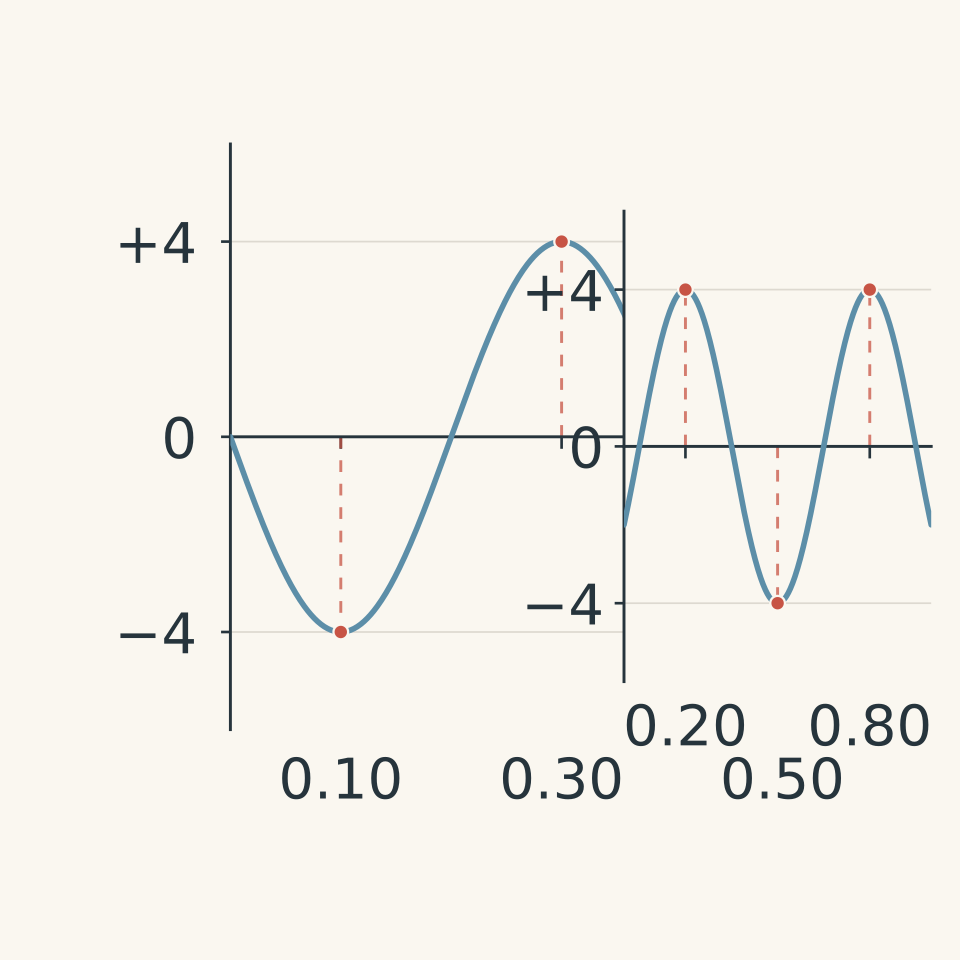
(a) Define instantaneous displacement and amplitude. Use the figure to state the amplitude. (2 marks)
(b) Explain what the horizontal axis represents in each graph and name one quantity that can be determined from each. (2 marks)
(c) Use Graph A to calculate the period and frequency of the wave. (2 marks)
(d) Use Graph B to calculate the wavelength and wave speed. (2 marks)
Question 2 (6 marks)
(a) A wave travels along a rope, while sound travels through air. Classify each wave as transverse or longitudinal, and compare the direction of particle oscillation with the direction of wave propagation. (2 marks)
(b) Explain how compressions and rarefactions in sound produce pressure variations. Explain how sound transfers energy without transporting air in bulk from the source to the listener. (2 marks)
(c) Distinguish pitch from loudness. State the wave property most directly associated with each. (2 marks)
Question 3 (4 marks)
A wave travels along a taut string at \(24\ \text{m s}^{-1}\). Its frequency is \(8.0\ \text{Hz}\).
Use the wave equation \(v=f\lambda\), where \(v\) is wave speed, \(f\) is frequency, and \(\lambda\) is wavelength.
(a) Calculate the wavelength. (2 marks)
(b) The source frequency increases to \(10\ \text{Hz}\), while the string tension and linear mass density remain unchanged. Determine the new wave speed and wavelength. Explain why the speed does not change. (2 marks)
Question 4 (6 marks)
(a) Compare progressive waves and standing waves in terms of their appearance and net energy transfer along the medium. (2 marks)
(b) Define a node and an antinode in a standing wave. State the displacement amplitude at each. (2 marks)
(c) Two waves overlap at points P and Q.
At P, their instantaneous displacements are \(+3\ \text{cm}\) and \(+2\ \text{cm}\).
At Q, their instantaneous displacements are \(+3\ \text{cm}\) and \(-5\ \text{cm}\).
Calculate the resultant displacement at each point and classify the interference as constructive or destructive. (2 marks)
Question 5 (6 marks)
(a) A wavefront strikes a straight reflecting boundary at \(35^\circ\) to the normal. State the reflected angle. For a pulse on a string, also state whether reflection at a fixed end and at a free end produces phase inversion. (2 marks)
(b) Waves pass through the same gap, which is \(0.15\ \text{m}\) wide. One wave has a wavelength of \(0.10\ \text{m}\), while another has a wavelength of \(0.60\ \text{m}\). Identify which wave spreads more after passing through the gap and explain why. (2 marks)
(c) A water wave enters shallow water at an oblique angle, and its speed decreases. State what happens to its frequency and wavelength, and explain how its direction changes. (2 marks)
Question 6 (5 marks)
A student estimates water depth using waves in a region assumed to be shallow.
The measured wave frequency is \(1.50\ \text{Hz}\), and the wavelength is \(0.80\ \text{m}\).
For shallow-water waves, assume the relationship
\[ v=\sqrt{gh} \]
is valid, where \(v\) is wave speed, \(g\) is gravitational acceleration, and \(h\) is water depth. Neglect currents.
(a) Calculate the wave speed. (2 marks)
(b) Estimate the water depth. (2 marks)
(c) State one limitation or assumption of this depth-estimation method. (1 mark)
Question 7 (6 marks)
A string of length \(0.750\ \text{m}\) is fixed at both ends. Its linear mass density is \(4.00\times10^{-3}\ \text{kg m}^{-1}\), and its tension is \(36.0\ \text{N}\).
Use
\[ v=\sqrt{\frac{F_T}{\mu}} \]
and
\[ f_n=\frac{nv}{2L} \]
where \(F_T\) is tension, \(\mu\) is linear mass density, \(L\) is string length, and \(n\) is the harmonic number.
(a) Calculate the wave speed on the string. (2 marks)
(b) Calculate the fundamental frequency and the frequency of the third harmonic. (2 marks)
(c) The tension is quadrupled while the string length and linear mass density remain unchanged. Determine how the fundamental frequency changes, explaining your reasoning. (2 marks)
Question 8 (7 marks)
A light ray travels from air into glass. The refractive indices are \(n_1=1.00\) for air and \(n_2=1.50\) for glass. The angle of incidence is \(40.0^\circ\).
Use
\[ n=\frac{c}{v} \]
and Snell’s law,
\[ n_1\sin i=n_2\sin r \]
where \(i\) is the angle of incidence and \(r\) is the angle of refraction. Both angles are measured from the normal.
(a) Calculate the speed of light in the glass. (2 marks)
(b) Calculate the angle of refraction. (3 marks)
(c) State how the ray bends relative to the normal. Explain what happens to its frequency and wavelength as it enters the glass. (2 marks)
Question 9 (6 marks)
A ray of light travels inside glass with refractive index \(1.50\) and reaches a boundary with air of refractive index \(1.00\).
(a) Calculate the critical angle for the glass-air boundary. (2 marks)
(b) State the two conditions required for total internal reflection. (2 marks)
(c) Predict what happens when the angle of incidence inside the glass is:
- \(35^\circ\)
- \(45^\circ\)
Justify each prediction using the critical angle. (2 marks)
Question 10 (5 marks)
A student measures the refractive index of a transparent material by directing a narrow, monochromatic light beam from air into the material. The angles are measured from the normal.
The following results are obtained.
| Angle of incidence, \(i\) | Angle of refraction, \(r\) |
|---|---|
| \(20.0^\circ\) | \(13.2^\circ\) |
| \(40.0^\circ\) | \(25.4^\circ\) |
| \(60.0^\circ\) | \(35.3^\circ\) |
Assume \(n_{\text{air}}=1.00\).
(a) Calculate the mean refractive index of the material using the three measurements. (2 marks)
(b) Describe how the student could obtain the angle measurements for a transparent block. Explain why taking several measurements is useful. (2 marks)
(c) State one assumption or limitation of this measurement method. (1 mark)
Question 11 (5 marks)
A concave mirror has a focal length of \(12\ \text{cm}\). An upright object is placed \(30\ \text{cm}\) in front of the mirror.
(a) On your answer paper, draw a labelled principal-ray diagram using two standard principal rays. Mark the focal point, centre of curvature, and image position. (2 marks)
(b) Calculate the image distance using
\[ \frac{1}{f}=\frac{1}{u}+\frac{1}{v} \]
where \(f\) is focal length, \(u\) is object distance, and \(v\) is image distance. Use positive distance magnitudes for this real object and real image. (1 mark)
(c) State whether the image is real or virtual, upright or inverted, and enlarged or reduced. (2 marks)
Question 12 (5 marks)
A converging lens has a focal length of \(10\ \text{cm}\). An upright object is placed \(15\ \text{cm}\) to the left of the lens.
(a) On your answer paper, draw a labelled principal-ray diagram using two standard principal rays. Mark the image position. (2 marks)
(b) Calculate the image distance using
\[ \frac{1}{f}=\frac{1}{u}+\frac{1}{v} \]
where \(f\) is focal length, \(u\) is object distance, and \(v\) is image distance. Use positive distance magnitudes for this real object and real image. (1 mark)
(c) Describe the image as real or virtual, upright or inverted, and enlarged or reduced. State the magnification. (2 marks)
Question 13 (4 marks)
A person can see nearby objects clearly but finds distant objects blurred. Assume a thin spectacle lens and an otherwise normally functioning eye.
(a) Identify the vision defect. (1 mark)
(b) State the type of spectacle lens used to correct it. (1 mark)
(c) Explain how this lens helps form a clear image on the retina. (2 marks)
Question 14 (7 marks)
(a) Arrange the following electromagnetic radiation types in order of increasing frequency:
Infrared, gamma rays, radio waves, X-rays, microwaves, ultraviolet, visible light. (2 marks)
(b) Select the most suitable electromagnetic radiation for each application and justify your choice using a relevant property.
- Thermal imaging of a warm roof.
- Medical imaging of bones. (2 marks)
(c) Explain how electromagnetic waves are produced and propagate. Contrast their need for a medium with that of mechanical waves. (3 marks)
Question 15 (4 marks)
Monochromatic light travels through a vacuum with a wavelength of \(400\ \text{nm}\).
For this question, use
\[ E=\frac{hc}{\lambda} \]
where \(E\) is the energy of one photon, \(h\) is Planck’s constant, and \(\lambda\) is the vacuum wavelength.
(a) Calculate the energy of one photon. (3 marks)
(b) Compare the energy of a photon with wavelength \(800\ \text{nm}\) with the energy calculated in part (a). State the relationship that supports your answer. (1 mark)
Question 16 (5 marks)
A point-like source radiates light uniformly in all directions. The intensity is \(18\ \text{W m}^{-2}\) at a distance of \(2.0\ \text{m}\).
Assume negligible absorption between the source and the measurement points.
(a) Calculate the intensity at a distance of \(6.0\ \text{m}\). (2 marks)
(b) Calculate the intensity at a distance of \(3.0\ \text{m}\). (2 marks)
(c) Explain why intensity decreases with distance from the source. (1 mark)
Question 17 (6 marks)
An ambulance siren emits a frequency of \(700\ \text{Hz}\). A stationary listener hears the siren as the ambulance moves directly towards and then away from them.
The ambulance travels at \(25\ \text{m s}^{-1}\). The speed of sound is \(340\ \text{m s}^{-1}\). Ignore wind.
For a stationary observer, use
\[ f_{\text{obs}}=\frac{f_s v}{v-v_s} \]
for an approaching source, and
\[ f_{\text{obs}}=\frac{f_s v}{v+v_s} \]
for a receding source, where \(f_s\) is the emitted frequency, \(v\) is the speed of sound, and \(v_s\) is source speed.
(a) Calculate the observed frequency as the ambulance approaches. (2 marks)
(b) Calculate the observed frequency as the ambulance moves away. (2 marks)
(c) Explain the change in perceived pitch and state whether the siren’s emitted frequency changes. (2 marks)
Question 18 (5 marks)
A water wave travels from deep water into shallow water. Its speed decreases from \(2.8\ \text{m s}^{-1}\) to \(1.8\ \text{m s}^{-1}\). The frequency remains \(2.0\ \text{Hz}\), and the angle of incidence is \(35^\circ\) to the normal.
Use the wave refraction relationship
\[ \frac{\sin i}{\sin r}=\frac{v_1}{v_2} \]
where \(v_1\) and \(v_2\) are the wave speeds before and after crossing the boundary, respectively.
(a) Calculate the wavelength in deep water and shallow water. (2 marks)
(b) Calculate the angle of refraction. (2 marks)
(c) State whether the wave bends towards or away from the normal, and whether its frequency changes. (1 mark)
03Worked solutions and marking guide
Solution 1
(a) Instantaneous displacement and amplitude
Instantaneous displacement is the signed distance of a point on the wave from its equilibrium position at a particular instant.
Amplitude is the maximum magnitude of displacement from equilibrium. The graph shows an amplitude of \(4.0\ \text{cm}\).
Marking: 2 marks
- 1 mark for defining instantaneous displacement relative to equilibrium.
- 1 mark for defining amplitude as maximum displacement and identifying \(4.0\ \text{cm}\).
(b) Interpreting the horizontal axes
In Graph A, the horizontal axis represents time at a fixed position. It can be used to determine the period or frequency.
In Graph B, the horizontal axis represents position at one instant. It can be used to determine the wavelength.
Marking: 2 marks
- 1 mark for correctly interpreting the time axis and identifying a temporal quantity.
- 1 mark for correctly interpreting the position axis and identifying wavelength.
(c) Period and frequency
The period is the time taken for one complete cycle. Using two consecutive troughs,
\[ \begin{aligned} T&=0.50-0.10\\ &=0.40\ \text{s} \end{aligned} \]
Frequency is the number of complete cycles per second:
\[ \begin{aligned} f&=\frac{1}{T}\\ &=\frac{1}{0.40}\\ &=2.5\ \text{Hz} \end{aligned} \]
Marking: 2 marks
- 1 mark for \(T=0.40\ \text{s}\).
- 1 mark for \(f=2.5\ \text{Hz}\), using \(f=1/T\).
(d) Wavelength and wave speed
Wavelength is the distance between corresponding points on consecutive cycles, such as two adjacent crests.
\[ \lambda=0.80-0.20=0.60\ \text{m} \]
Using \(v=f\lambda\),
\[ \begin{aligned} v&=2.5\times0.60\\ &=1.5\ \text{m s}^{-1} \end{aligned} \]
Marking: 2 marks
- 1 mark for \(\lambda=0.60\ \text{m}\).
- 1 mark for \(v=1.5\ \text{m s}^{-1}\).
Equivalent calculations using other corresponding points receive full credit.
Solution 2
(a) Transverse and longitudinal waves
A wave on a rope is transverse when the rope particles oscillate perpendicular to the direction of propagation.
Sound in air is longitudinal. Air particles oscillate parallel to the direction in which the sound wave travels.
Marking: 2 marks
- 1 mark for correctly classifying the rope wave and describing its particle motion.
- 1 mark for correctly classifying sound and describing its particle motion.
(b) Sound and energy transfer
A compression is a region where air particles are closer together, producing higher pressure. A rarefaction is a region where particles are more spread out, producing lower pressure.
Air particles oscillate around their equilibrium positions. Their interactions transfer the pressure disturbance and energy through the air, but the air itself is not transported in bulk from the source to the listener.
Marking: 2 marks
- 1 mark for explaining compressions, rarefactions, and pressure variation.
- 1 mark for explaining local particle oscillation and energy transfer without bulk matter transport.
(c) Pitch and loudness
Pitch is most directly associated with frequency. A higher-frequency sound is generally perceived as higher-pitched.
Loudness is most directly associated with sound intensity, which is related to wave amplitude. Greater amplitude generally produces greater intensity under comparable conditions. Perceived loudness also depends on factors such as frequency and the listener’s hearing sensitivity.
Marking: 2 marks
- 1 mark for relating pitch to frequency.
- 1 mark for relating loudness to amplitude or intensity, without treating frequency as the direct measure of loudness.
Solution 3
(a) Wavelength
The wave equation is
\[ v=f\lambda \]
Rearranging,
\[ \begin{aligned} \lambda&=\frac{v}{f}\\ &=\frac{24}{8.0}\\ &=3.0\ \text{m} \end{aligned} \]
Answer: \(3.0\ \text{m}\).
Marking: 2 marks
- 1 mark for correctly rearranging and substituting.
- 1 mark for the correct wavelength with units.
(b) New speed and wavelength
The string tension and linear mass density have not changed, so the wave speed remains \(24\ \text{m s}^{-1}\).
With the new frequency,
\[ \begin{aligned} \lambda&=\frac{v}{f}\\ &=\frac{24}{10}\\ &=2.4\ \text{m} \end{aligned} \]
The source sets the frequency, while the string properties determine the wave speed. Increasing frequency in the same unchanged medium therefore decreases the wavelength.
Marking: 2 marks
- 1 mark for stating that speed remains \(24\ \text{m s}^{-1}\) because the string properties are unchanged.
- 1 mark for calculating \(\lambda=2.4\ \text{m}\).
Solution 4
(a) Progressive and standing waves
A progressive wave travels through a medium and transfers energy from one location to another.
A standing wave has a stationary pattern of nodes and antinodes. It does not transfer net energy along the string in the ideal standing-wave model.
Marking: 2 marks
- 1 mark for describing the travelling pattern and net energy transfer of a progressive wave.
- 1 mark for describing the stationary pattern and absence of net energy transfer along an ideal standing wave.
(b) Nodes and antinodes
A node is a point that remains at zero displacement in a standing wave. Its oscillation amplitude is zero.
An antinode is a point where the oscillation amplitude is maximum.
Marking: 2 marks
- 1 mark for defining a node and its zero amplitude.
- 1 mark for defining an antinode and its maximum amplitude.
(c) Superposition
The principle of superposition states that the resultant displacement is the algebraic sum of the individual displacements.
At P,
\[ y_P=+3+2=+5\ \text{cm} \]
The displacements reinforce each other, so the interference is constructive.
At Q,
\[ y_Q=+3-5=-2\ \text{cm} \]
The displacements oppose each other, so the interference is destructive.
Marking: 2 marks
- 1 mark for the \(+5\ \text{cm}\) resultant and constructive interference at P.
- 1 mark for the \(-2\ \text{cm}\) resultant and destructive interference at Q.
Solution 5
(a) Reflection
For reflection at a straight boundary, the angle of reflection equals the angle of incidence. The reflected angle is therefore \(35^\circ\).
A pulse reflecting from a fixed end is inverted, corresponding to a phase change of \(180^\circ\). A pulse reflecting from a free end is not inverted.
Marking: 2 marks
- 1 mark for the reflected angle of \(35^\circ\).
- 1 mark for correctly distinguishing the phase behaviour at fixed and free ends.
(b) Diffraction
The wave with wavelength \(0.60\ \text{m}\) spreads more.
Diffraction is strongest when the gap width is comparable to or smaller than the wavelength. The \(0.60\ \text{m}\) wavelength is much larger than the \(0.15\ \text{m}\) gap, so it produces greater spreading than the \(0.10\ \text{m}\) wavelength.
Marking: 2 marks
- 1 mark for selecting the \(0.60\ \text{m}\) wave.
- 1 mark for explaining the relationship between wavelength, gap size, and diffraction.
(c) Refraction of water waves
The wave frequency remains unchanged because it is set by the source. Since \(v=f\lambda\), a decrease in wave speed produces a decrease in wavelength.
When the wave enters the slower region obliquely, it bends towards the normal.
Marking: 2 marks
- 1 mark for stating that frequency remains constant and wavelength decreases.
- 1 mark for identifying bending towards the normal.
Solution 6
(a) Wave speed
Use \(v=f\lambda\).
\[ \begin{aligned} v&=1.50\times0.80\\ &=1.20\ \text{m s}^{-1} \end{aligned} \]
Answer: \(1.20\ \text{m s}^{-1}\), before rounding to the precision supported by the measurements.
Marking: 2 marks
- 1 mark for using \(v=f\lambda\) correctly.
- 1 mark for the correct speed with units.
(b) Water depth
From the supplied shallow-water relationship,
\[ v=\sqrt{gh} \]
Squaring and rearranging gives
\[ h=\frac{v^2}{g} \]
Substituting,
\[ \begin{aligned} h&=\frac{(1.20)^2}{9.8}\\ &=\frac{1.44}{9.8}\\ &=0.147\ \text{m} \end{aligned} \]
Answer: Approximately \(0.15\ \text{m}\), or \(15\ \text{cm}\).
Marking: 2 marks
- 1 mark for correctly rearranging to \(h=v^2/g\).
- 1 mark for substitution and the correct depth with units.
(c) Limitation
The model assumes the water is shallow relative to the wavelength. If this condition is not satisfied, the relationship \(v=\sqrt{gh}\) may not give an accurate depth. Currents and measurement uncertainty can also affect the estimate.
Marking: 1 mark
- 1 mark for one valid limitation or assumption.
Solution 7
(a) Wave speed
Use
\[ v=\sqrt{\frac{F_T}{\mu}} \]
Substituting the given values,
\[ \begin{aligned} v&=\sqrt{\frac{36.0}{4.00\times10^{-3}}}\\ &=\sqrt{9000}\\ &=94.9\ \text{m s}^{-1} \end{aligned} \]
Marking: 2 marks
- 1 mark for correct substitution into the speed equation.
- 1 mark for \(v=94.9\ \text{m s}^{-1}\).
(b) Fundamental and third-harmonic frequencies
For the fundamental, \(n=1\):
\[ \begin{aligned} f_1&=\frac{v}{2L}\\ &=\frac{94.9}{2(0.750)}\\ &=63.2\ \text{Hz} \end{aligned} \]
For the third harmonic, \(n=3\):
\[ \begin{aligned} f_3&=\frac{3v}{2L}\\ &=3f_1\\ &=190\ \text{Hz} \end{aligned} \]
Answers: \(f_1=63.2\ \text{Hz}\) and \(f_3=190\ \text{Hz}\).
Marking: 2 marks
- 1 mark for the fundamental frequency.
- 1 mark for the third-harmonic frequency.
(c) Effect of quadrupling tension
Wave speed on the string is proportional to the square root of tension:
\[ v\propto\sqrt{F_T} \]
Quadrupling the tension multiplies the speed by \(\sqrt{4}=2\). Since the length is unchanged, the fundamental frequency also doubles.
The new fundamental frequency is approximately
\[ f_1'=2(63.2)=126\ \text{Hz} \]
Marking: 2 marks
- 1 mark for explaining that quadrupling tension doubles wave speed.
- 1 mark for concluding that the fundamental frequency doubles to approximately \(126\ \text{Hz}\).
Solution 8
(a) Speed of light in glass
The refractive index relationship is
\[ n=\frac{c}{v} \]
Rearranging,
\[ v=\frac{c}{n} \]
Therefore,
\[ \begin{aligned} v&=\frac{3.00\times10^8}{1.50}\\ &=2.00\times10^8\ \text{m s}^{-1} \end{aligned} \]
Answer: \(2.00\times10^8\ \text{m s}^{-1}\).
Marking: 2 marks
- 1 mark for correctly rearranging the refractive index equation.
- 1 mark for the correct speed with units.
(b) Angle of refraction
Snell’s law gives
\[ n_1\sin i=n_2\sin r \]
Rearranging,
\[ \sin r=\frac{n_1\sin i}{n_2} \]
Substituting,
\[ \begin{aligned} \sin r&=\frac{1.00\sin40.0^\circ}{1.50}\\ &=0.429 \end{aligned} \]
Taking the inverse sine,
\[ r=\sin^{-1}(0.429)=25.4^\circ \]
Answer: \(25.4^\circ\) to the normal.
Marking: 3 marks
- 1 mark for correctly applying Snell’s law.
- 1 mark for correct substitution and the value of \(\sin r\).
- 1 mark for the angle of refraction.
(c) Bending and wavelength
The ray bends towards the normal because it enters a medium with a higher refractive index and a lower light speed.
Its frequency remains constant at the boundary. Since the speed decreases while frequency stays constant, the wavelength also decreases.
Marking: 2 marks
- 1 mark for identifying bending towards the normal.
- 1 mark for stating that frequency is unchanged and wavelength decreases.
Solution 9
(a) Critical angle
At the critical angle, the refracted ray travels along the boundary, so its angle of refraction is \(90^\circ\).
Using Snell’s law,
\[ n_{\text{glass}}\sin c=n_{\text{air}}\sin90^\circ \]
Therefore,
\[ \begin{aligned} \sin c&=\frac{1.00}{1.50}\\ &=0.667 \end{aligned} \]
Thus,
\[ c=\sin^{-1}(0.667)=41.8^\circ \]
Answer: The critical angle is approximately \(41.8^\circ\).
Marking: 2 marks
- 1 mark for the correct critical-angle relationship.
- 1 mark for the correct angle.
(b) Conditions for total internal reflection
Both conditions must be satisfied:
- Light travels from a medium with a higher refractive index into one with a lower refractive index.
- The angle of incidence in the higher-index medium is greater than the critical angle.
Marking: 2 marks
- 1 mark for the correct direction of travel between media.
- 1 mark for requiring an angle of incidence greater than the critical angle.
(c) Predicting the outcome
For \(35^\circ\), the angle is less than \(41.8^\circ\). Total internal reflection does not occur, and a refracted ray enters the air.
For \(45^\circ\), the angle is greater than \(41.8^\circ\). Total internal reflection occurs.
Marking: 2 marks
- 1 mark for correctly predicting refraction at \(35^\circ\).
- 1 mark for correctly predicting total internal reflection at \(45^\circ\).
Solution 10
(a) Mean refractive index
For light travelling from air into the material, Snell’s law gives
\[ n_{\text{air}}\sin i=n_{\text{material}}\sin r \]
Since \(n_{\text{air}}=1.00\),
\[ n_{\text{material}}=\frac{\sin i}{\sin r} \]
Using the three measurements gives refractive index values close to \(1.50\) in each case. Their mean, to three significant figures, is
\[ \boxed{n_{\text{material}}=1.50} \]
Small differences between individual values arise from the rounding of the measured angles.
Marking: 2 marks
- 1 mark for using \(n=\sin i/\sin r\).
- 1 mark for obtaining a mean refractive index of \(1.50\).
(b) Measuring the angles
Direct a narrow light beam through the transparent block. Mark the incident and refracted ray paths, draw a normal at the boundary, and measure the angles between the rays and the normal with a protractor.
Repeat for several incident angles. Multiple measurements allow the student to average the calculated refractive indices or plot \(\sin i\) against \(\sin r\), reducing the effect of random measurement errors.
Marking: 2 marks
- 1 mark for a valid method of tracing the rays and measuring angles from the normal.
- 1 mark for explaining how repeated measurements, averaging, or a suitable graph improves reliability.
(c) Limitation
One limitation is uncertainty in measuring the angles. A thick beam, an unclear ray path, or limited protractor precision can affect the calculated refractive index.
The method also assumes the material is uniform and that the measurements correspond to the same wavelength of light.
Marking: 1 mark
- 1 mark for one valid limitation or assumption.
Solution 11
(a) Principal-ray diagram
For a concave mirror, mark the focal point \(F\) at \(12\ \text{cm}\) from the mirror and the centre of curvature \(C\) at \(24\ \text{cm}\).
Use two rays from the top of the object:
- A ray parallel to the principal axis reflects through \(F\).
- A ray passing through \(C\) reflects back along its original path.
The reflected rays intersect between \(F\) and \(C\), locating the image.
Marking: 2 marks
- 1 mark for a correctly drawn first principal ray.
- 1 mark for the second principal ray and the correct image intersection.
(b) Image distance
Using the mirror equation,
\[ \frac{1}{f}=\frac{1}{u}+\frac{1}{v} \]
Rearranging,
\[ \begin{aligned} \frac{1}{v}&=\frac{1}{f}-\frac{1}{u}\\ &=\frac{1}{12}-\frac{1}{30}\\ &=\frac{1}{20} \end{aligned} \]
Therefore,
\[ v=20\ \text{cm} \]
Answer: The image is \(20\ \text{cm}\) in front of the mirror.
Marking: 1 mark
- 1 mark for the correct image distance.
(c) Image characteristics
The image is real because the reflected rays physically meet. It is inverted and reduced.
The magnitude of the magnification is
\[ |m|=\frac{v}{u}=\frac{20}{30}=0.667 \]
The image is approximately two-thirds the object’s height.
Marking: 2 marks
- 1 mark for identifying the image as real and inverted.
- 1 mark for identifying the image as reduced, supported by the magnification.
Solution 12
(a) Principal-ray diagram
For a converging lens, mark the focal points \(10\ \text{cm}\) on either side of the lens.
Use two rays from the top of the object:
- A ray parallel to the principal axis refracts through the focal point on the opposite side.
- A ray through the optical centre continues approximately undeviated for a thin lens.
The rays intersect on the right-hand side of the lens, locating the image.
Marking: 2 marks
- 1 mark for a correctly drawn first principal ray.
- 1 mark for the second principal ray and the correct image intersection.
(b) Image distance
Using the lens equation,
\[ \frac{1}{f}=\frac{1}{u}+\frac{1}{v} \]
Rearranging,
\[ \begin{aligned} \frac{1}{v}&=\frac{1}{f}-\frac{1}{u}\\ &=\frac{1}{10}-\frac{1}{15}\\ &=\frac{1}{30} \end{aligned} \]
Therefore,
\[ v=30\ \text{cm} \]
Answer: The image forms \(30\ \text{cm}\) to the right of the lens.
Marking: 1 mark
- 1 mark for the correct image distance.
(c) Image characteristics
The image is real because the refracted rays meet on the opposite side of the lens. It is inverted and enlarged.
The magnification magnitude is
\[ |m|=\frac{v}{u}=\frac{30}{15}=2.0 \]
The image is twice the object’s height.
Marking: 2 marks
- 1 mark for identifying the image as real and inverted.
- 1 mark for identifying the image as enlarged, with magnification \(2.0\).
Solution 13
(a) Vision defect
The person has myopia, or short-sightedness. Distant objects appear blurred while nearby objects can remain clear.
Marking: 1 mark
- 1 mark for identifying myopia.
(b) Correcting lens
A diverging lens, also called a concave lens, is used to correct myopia.
Marking: 1 mark
- 1 mark for identifying a diverging lens.
(c) How the correction works
In a myopic eye, light from a distant object would focus in front of the retina rather than on it.
The diverging spectacle lens spreads the incoming rays before they enter the eye. This adjusts the combined optical system so the eye can focus the image on the retina.
Marking: 2 marks
- 1 mark for explaining that the uncorrected eye focuses distant light in front of the retina.
- 1 mark for explaining how the diverging lens shifts the focus back onto the retina.
Solution 14
(a) Electromagnetic spectrum
The correct order of increasing frequency is
\[ \text{Radio} \rightarrow \text{Microwave} \rightarrow \text{Infrared} \rightarrow \text{Visible} \rightarrow \text{Ultraviolet} \rightarrow \text{X-ray} \rightarrow \text{Gamma} \]
Frequency increases from radio waves to gamma rays. Wavelength decreases in the opposite direction.
Marking: 2 marks
- 1 mark for correctly ordering radio waves through visible light.
- 1 mark for correctly ordering visible light through gamma rays.
(b) Applications
- Thermal imaging: Infrared radiation is suitable because warm objects emit infrared radiation, which thermal imaging systems detect to show temperature differences.
- Bone imaging: X-rays are suitable because they pass through soft tissue more readily than bone, producing contrast in the resulting image.
Marking: 2 marks
- 1 mark for selecting infrared and linking it to thermal radiation.
- 1 mark for selecting X-rays and explaining their differing transmission through bone and soft tissue.
(c) Production and propagation
Electromagnetic waves can be produced by accelerating electric charges. The changing electric and magnetic fields form a wave that propagates through space.
The electric field and magnetic field oscillate perpendicular to each other and to the direction of propagation. The wave transports energy.
Unlike mechanical waves, electromagnetic waves do not require a material medium. They can travel through a vacuum, whereas mechanical waves require a medium whose particles or other physical elements can oscillate.
Marking: 3 marks
- 1 mark for linking accelerating charges to electromagnetic-wave production.
- 1 mark for describing the transverse electric and magnetic fields and energy propagation.
- 1 mark for correctly contrasting electromagnetic waves in a vacuum with mechanical waves that require a medium.
Solution 15
(a) Energy of one photon
First convert the wavelength to metres:
\[ 400\ \text{nm}=4.00\times10^{-7}\ \text{m} \]
Use
\[ E=\frac{hc}{\lambda} \]
Substituting,
\[ \begin{aligned} E&=\frac{(6.63\times10^{-34})(3.00\times10^8)} {4.00\times10^{-7}}\\ &=4.97\times10^{-19}\ \text{J} \end{aligned} \]
Answer: \(4.97\times10^{-19}\ \text{J}\) per photon.
Marking: 3 marks
- 1 mark for converting the wavelength to metres.
- 1 mark for correct substitution into the photon-energy equation.
- 1 mark for the correct energy with units.
(b) Comparing photon energies
The \(800\ \text{nm}\) wavelength is twice the \(400\ \text{nm}\) wavelength. Since
\[ E=\frac{hc}{\lambda} \]
photon energy is inversely proportional to wavelength. The \(800\ \text{nm}\) photon therefore has half the energy:
\[ E_{800}=\frac{4.97\times10^{-19}}{2} =2.49\times10^{-19}\ \text{J} \]
Marking: 1 mark
- 1 mark for stating that the longer-wavelength photon has half the energy, using the inverse relationship.
Solution 16
(a) Intensity at \(6.0\ \text{m}\)
For a point-like source radiating uniformly in all directions, intensity follows the inverse-square law:
\[ I\propto\frac{1}{r^2} \]
Therefore,
\[ I_2=I_1\left(\frac{r_1}{r_2}\right)^2 \]
Substituting,
\[ \begin{aligned} I_2&=18\left(\frac{2.0}{6.0}\right)^2\\ &=2.0\ \text{W m}^{-2} \end{aligned} \]
Answer: \(2.0\ \text{W m}^{-2}\).
Marking: 2 marks
- 1 mark for correctly applying the inverse-square relationship.
- 1 mark for the correct intensity.
(b) Intensity at \(3.0\ \text{m}\)
\[ \begin{aligned} I_2&=18\left(\frac{2.0}{3.0}\right)^2\\ &=8.0\ \text{W m}^{-2} \end{aligned} \]
Answer: \(8.0\ \text{W m}^{-2}\).
Marking: 2 marks
- 1 mark for correct substitution into the inverse-square relationship.
- 1 mark for the correct intensity.
(c) Why intensity decreases
The source’s energy spreads over an increasingly large spherical surface as distance increases. The surface area grows in proportion to \(r^2\), so the energy transferred per unit area per unit time decreases in proportion to \(1/r^2\), assuming no absorption.
Marking: 1 mark
- 1 mark for linking increasing spherical area to decreasing intensity.
Solution 17
(a) Ambulance approaching
Use
\[ f_{\text{obs}}=\frac{f_s v}{v-v_s} \]
Substituting,
\[ \begin{aligned} f_{\text{obs}}&=\frac{700\times340}{340-25}\\ &=\frac{238000}{315}\\ &=756\ \text{Hz} \end{aligned} \]
Answer: Approximately \(756\ \text{Hz}\).
Marking: 2 marks
- 1 mark for using the approaching-source equation with the correct values.
- 1 mark for the correct observed frequency.
(b) Ambulance receding
Use
\[ f_{\text{obs}}=\frac{f_s v}{v+v_s} \]
Substituting,
\[ \begin{aligned} f_{\text{obs}}&=\frac{700\times340}{340+25}\\ &=\frac{238000}{365}\\ &=652\ \text{Hz} \end{aligned} \]
Answer: Approximately \(652\ \text{Hz}\).
Marking: 2 marks
- 1 mark for using the receding-source equation with the correct values.
- 1 mark for the correct observed frequency.
(c) Explaining the Doppler effect
As the ambulance approaches, successive sound wavefronts are closer together in front of it. The listener receives wavefronts more frequently, so the observed frequency and pitch are higher.
As the ambulance moves away, successive wavefronts are more spread out. The observed frequency and pitch are lower.
The siren’s emitted frequency remains \(700\ \text{Hz}\). The change is in the frequency observed by the stationary listener because of the relative motion between source and listener.
Marking: 2 marks
- 1 mark for explaining the higher observed frequency when approaching and lower observed frequency when receding.
- 1 mark for stating that the emitted frequency does not change.
Solution 18
(a) Wavelength in each region
Use
\[ v=f\lambda \]
Rearranging,
\[ \lambda=\frac{v}{f} \]
In deep water,
\[ \lambda_1=\frac{2.8}{2.0}=1.4\ \text{m} \]
In shallow water,
\[ \lambda_2=\frac{1.8}{2.0}=0.90\ \text{m} \]
Answers: \(1.4\ \text{m}\) in deep water and \(0.90\ \text{m}\) in shallow water.
Marking: 2 marks
- 1 mark for the deep-water wavelength.
- 1 mark for the shallow-water wavelength.
(b) Angle of refraction
Use the supplied relationship
\[ \frac{\sin i}{\sin r}=\frac{v_1}{v_2} \]
Rearranging,
\[ \sin r=\sin i\frac{v_2}{v_1} \]
Substituting,
\[ \begin{aligned} \sin r&=\sin35^\circ\left(\frac{1.8}{2.8}\right)\\ &=0.369 \end{aligned} \]
Therefore,
\[ r=\sin^{-1}(0.369)=21.7^\circ \]
Answer: Approximately \(21.7^\circ\) to the normal.
Marking: 2 marks
- 1 mark for correctly rearranging and substituting into the wave-refraction relationship.
- 1 mark for the correct refracted angle.
(c) Direction and frequency
The wave bends towards the normal because its speed decreases on entering shallow water. Its frequency remains \(2.0\ \text{Hz}\), since the frequency is set by the source and remains unchanged across the boundary.
Marking: 1 mark
- 1 mark for identifying bending towards the normal and an unchanged frequency.