
M8: From the Universe to the Atom – Physics Practice Exam
Revise the NSW HSC Physics 2017 Module 8 syllabus with this original 100-mark timed practice exam. Test your understanding with exam-style questions, then check your working against complete worked solutions and a detailed marking guide.
This is an original tutorgum practice paper for mixed revision of the legacy NSW HSC Physics 2017 Module 8, From the Universe to the Atom. It assesses the supplied module scope, from nuclear radiation and atomic models to stellar evolution and particle physics. It is not an official, endorsed, past, or predicted NESA paper, and it is not a full-course HSC Physics exam.
01Exam instructions
Total marks: 100
Suggested reading time: 5 minutes
Suggested working time: 120 minutes
Permitted equipment: Scientific calculator, ruler, pens, and pencil. For this practice paper, do not use notes or internet resources. These are suggested conditions for this assessment, not claims about official NESA examination rules.
Assessed scope
Questions cover the supplied legacy Module 8 content:
- Nuclear equations, alpha, beta, and gamma radiation, and nuclear conservation laws.
- The historical development of atomic models, including Thomson, Millikan, Rutherford, Chadwick, Bohr, and Schrödinger.
- Atomic spectra, photon energy, the Balmer series, and the Rydberg equation.
- Radioactive decay, half-life, decay constants, matter waves, and electron diffraction.
- Stellar spectra, the Hertzsprung-Russell diagram, Hubble’s observations, and the expanding Universe.
- Nuclear mass defect, binding energy, fission, fusion, and stellar nucleosynthesis.
- The Standard Model, quarks, hadrons, leptons, fundamental interactions, particle accelerators, and pair production.
This is a focused module revision paper. It excludes material from other syllabus modules and other syllabus editions. No content outside the supplied scope is required.
General instructions
- Answer every question.
- Show working for calculations. A correct numerical answer without working may not earn full marks.
- Include units where appropriate and give numerical answers to three significant figures unless otherwise stated.
- Use consistent units in exponential decay calculations.
- In nuclear reactions, distinguish conservation of nucleon number and charge from conservation of total rest mass.
- In the worked solutions, mathematically equivalent methods are acceptable. Follow-through marks may be awarded when a correct method consistently uses an earlier numerical error.
Supplied constants
Use the following values where needed.
| Quantity | Value |
|---|---|
| Speed of light, \(c\) | \(3.00\times10^8\ \mathrm{m\,s^{-1}}\) |
| Speed of light for calculations in kilometres per second | \(3.00\times10^5\ \mathrm{km\,s^{-1}}\) |
| Planck constant, \(h\) | \(6.63\times10^{-34}\ \mathrm{J\,s}\) |
| Elementary charge magnitude, \(e\) | \(1.60\times10^{-19}\ \mathrm{C}\) |
| Natural logarithm of 2, \(\ln 2\) | \(0.693\) |
| Hydrogen Rydberg constant, \(R_H\) | \(1.097\times10^7\ \mathrm{m^{-1}}\) |
| Atomic mass unit energy equivalent, \(1\,\mathrm{u}\,c^2\) | \(931.5\ \mathrm{MeV}\) |
| Electron rest energy, \(m_ec^2\) | \(0.511\ \mathrm{MeV}\) |
The masses and other numerical data required for individual questions are supplied within those questions.
02Questions
Question 1 (7 marks)
Nuclear radiation can change a nucleus’s composition or release energy from an excited nuclear state.
(a) Complete the nuclear equation for alpha decay.
\[ {}^{226}_{88}\mathrm{Ra} \rightarrow \boxed{\phantom{{}^{222}_{86}\mathrm{Rn}}} + \boxed{\phantom{{}^{4}_{2}\mathrm{He}}} \]
[2 marks]
(b) Complete the beta-minus decay equation for phosphorus-32. Include all emitted particles.
\[ {}^{32}_{15}\mathrm{P} \rightarrow \boxed{\phantom{{}^{32}_{16}\mathrm{S}}} + \boxed{\phantom{{}^{0}_{-1}\mathrm{e}}} + \boxed{\phantom{\bar{\nu}_e}} \]
[2 marks]
(c) Write the nuclear equation for gamma emission from metastable technetium-99, \(^{99m}_{43}\mathrm{Tc}\), to its lower-energy state.
[1 mark]
(d) Compare alpha and gamma radiation in terms of ionising ability and penetrating power. State whether gamma emission changes the mass number or atomic number of the nucleus.
[2 marks]
Question 2 (4 marks)
A hypothetical nuclear transmutation is represented by
\[ {}^{14}_{7}\mathrm{N} + {}^{4}_{2}\mathrm{He} \rightarrow {}^{17}_{8}\mathrm{O} + X \]
(a) Identify particle \(X\). Show how conservation of nucleon number and charge determines your answer.
[2 marks]
(b) Explain how a nuclear reaction can conserve total energy even when the total rest mass of the products differs from the total rest mass of the reactants.
[2 marks]
Question 3 (6 marks)
(a) State two observations or experimental conclusions from cathode-ray investigations that supported the existence of a negatively charged particle common to all atoms.
[2 marks]
(b) In a crossed-field experiment, an electron beam passes through perpendicular electric and magnetic fields without deflection. The electric field strength is \(2.4\times10^4\ \mathrm{N\,C^{-1}}\), and the magnetic flux density is \(2.0\times10^{-3}\ \mathrm{T}\).
(i) Calculate the electron speed.
[1 mark]
(ii) Explain how Thomson could use this speed and the radius of curvature in a magnetic field alone to determine the magnitude of the electron’s charge-to-mass ratio.
[1 mark]
(c) Millikan’s oil-drop measurements showed that droplet charges were integer multiples of the elementary charge magnitude, \(1.60\times10^{-19}\ \mathrm{C}\). One negatively charged droplet has a charge of \(-4.80\times10^{-19}\ \mathrm{C}\).
(i) Determine the number of excess electrons on the droplet.
[1 mark]
(ii) Using Thomson’s measured ratio \(|e|/m_e=1.76\times10^{11}\ \mathrm{C\,kg^{-1}}\), calculate the electron mass.
[1 mark]
Question 4 (6 marks)
(a) In the Geiger-Marsden experiment, most alpha particles passed through a thin gold foil with little deflection, while a small fraction underwent large deflections.
Explain what these observations revealed about the structure of the atom. Give three distinct conclusions.
[3 marks]
(b) State the main problem with Rutherford’s atomic model when electrons are treated using classical electrodynamics.
[1 mark]
(c) Chadwick bombarded beryllium with alpha particles. The resulting neutral radiation could eject protons from paraffin wax.
Explain how this evidence supported the discovery of the neutron.
[2 marks]
Question 5 (10 marks)
Figure 1 shows three observed spectra labelled A, B, and C.
Spectrum-strip graphic unavailable
| A | Requires a smooth continuous visible-spectrum band. |
|---|---|
| B | Requires narrow bright lines on a dark background. |
| C | Requires narrow dark lines across a continuous band. |
Figure 1. Three observed spectra.
(a) Classify spectra A, B, and C as continuous, emission, or absorption spectra.
[3 marks]
(b) For each spectrum type, describe the source conditions and physical process responsible for producing it.
[3 marks]
(c) A photon has a wavelength of \(656\ \mathrm{nm}\). Calculate its energy in joules using
\[ E=\frac{hc}{\lambda} \]
where \(E\) is photon energy, \(h\) is Planck’s constant, \(c\) is the speed of light, and \(\lambda\) is wavelength.
[2 marks]
(d) In a hydrogen atom, an electron transitions from energy level \(n_i=4\) to \(n_f=2\). Use the Rydberg equation to calculate the emitted photon’s wavelength and identify the spectral series to which this transition belongs.
\[ \frac{1}{\lambda} = R_H\left(\frac{1}{n_f^2}-\frac{1}{n_i^2}\right) \]
Here, \(n_i\) and \(n_f\) are the initial and final principal quantum numbers, and \(R_H\) is the hydrogen Rydberg constant.
[2 marks]
Question 6 (4 marks)
(a) Explain how the Bohr model accounts for the discrete line spectrum of hydrogen. State one important limitation of the model.
[2 marks]
(b) In the Schrödinger model, the electron is described by a wavefunction, \(\psi\).
Explain what \(|\psi|^2\) represents and how an orbital differs from a fixed electron orbit in the Bohr model.
[2 marks]
Question 7 (7 marks)
A radioactive sample initially contains \(N_0=8.0\times10^{20}\) undecayed nuclei. Its half-life is \(6.0\ \mathrm{h}\).
The decay constant is represented by \(\lambda\), measured in inverse units of time. The number of undecayed nuclei after time \(t\) is \(N\).
Use
\[ \lambda=\frac{\ln 2}{t_{1/2}} \]
and, where required, the exponential decay law
\[ N=N_0e^{-\lambda t} \]
(a) Calculate the decay constant in \(\mathrm{h^{-1}}\).
[2 marks]
(b) Calculate the number of undecayed nuclei remaining after \(18\ \mathrm{h}\), using repeated halving.
[2 marks]
(c) Calculate the number of undecayed nuclei remaining after \(10\ \mathrm{h}\), using the exponential decay law.
[2 marks]
(d) Explain what the decay constant represents physically.
[1 mark]
Question 8 (4 marks)
The de Broglie hypothesis proposes that matter has wave properties. For a particle of mass \(m\) moving at speed \(v\), its de Broglie wavelength is
\[ \lambda=\frac{h}{mv} \]
An electron has mass \(9.11\times10^{-31}\ \mathrm{kg}\) and moves at \(2.00\times10^6\ \mathrm{m\,s^{-1}}\).
(a) Calculate the electron’s de Broglie wavelength.
[2 marks]
(b) Describe how electron-diffraction experiments provided evidence for de Broglie’s hypothesis.
[2 marks]
Question 9 (6 marks)
Astronomers use stellar spectra and the Hertzsprung-Russell (H-R) diagram to investigate stellar properties and evolutionary stages.
The following table gives data for four stars.
| Star | Surface temperature (K) | Luminosity relative to the Sun, \(L/L_\odot\) | Spectral evidence |
|---|---|---|---|
| A | 30,000 | 10,000 | Strong ionised helium lines |
| B | 5,800 | 1 | Metal lines and some hydrogen lines |
| C | 3,500 | 0.01 | Strong molecular bands |
| D | 3,500 | 1,000 | Strong molecular bands |
Here, \(L\) is the star’s luminosity and \(L_\odot\) is the Sun’s luminosity.
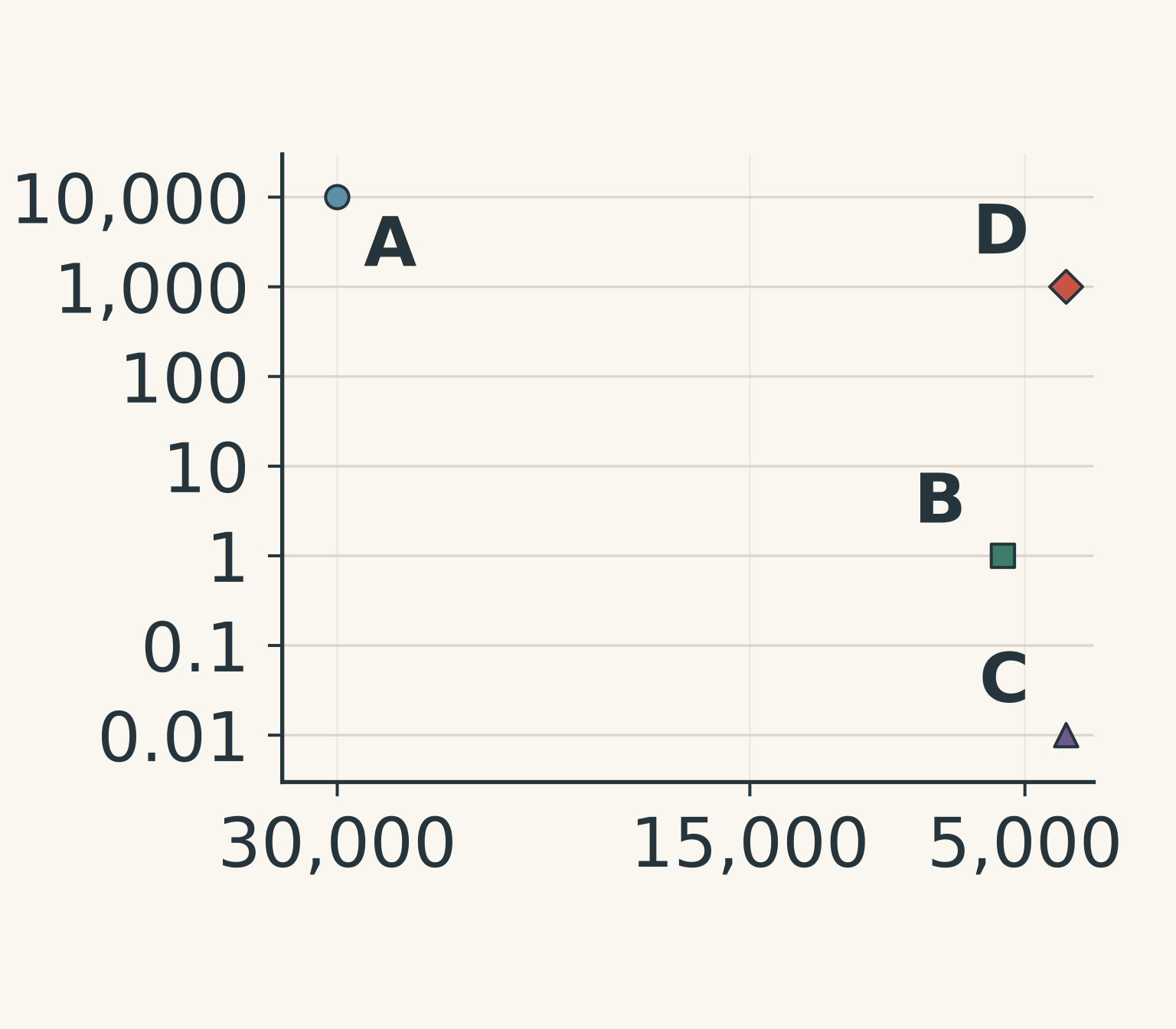
Figure 2. Stellar data plotted on an H-R diagram.
(a) Order the stars from hottest to coolest. State the general colour trend from the hottest to the coolest stars.
[2 marks]
(b) Identify the likely main-sequence stars and the red giant. Explain how stars C and D can have similar surface temperatures but very different luminosities.
[2 marks]
(c) Use the temperature and spectral evidence to assign an approximate spectral class to star A and star C.
[2 marks]
Question 10 (4 marks)
A galaxy has a known spectral line with a rest wavelength of \(500.0\ \mathrm{nm}\). An astronomer measures the line at \(510.0\ \mathrm{nm}\). The galaxy is \(120\ \mathrm{Mpc}\) away.
For this question, use
\[ z=\frac{\lambda_{\mathrm{obs}}-\lambda_0}{\lambda_0}, \qquad v\approx zc, \qquad v=H_0d \]
where \(z\) is redshift, \(\lambda_{\mathrm{obs}}\) is observed wavelength, \(\lambda_0\) is rest wavelength, \(v\) is recessional speed, \(H_0\) is the Hubble constant, and \(d\) is distance.
(a) Calculate the galaxy’s redshift.
[1 mark]
(b) Estimate its recessional speed in \(\mathrm{km\,s^{-1}}\).
[1 mark]
(c) Calculate the Hubble constant in \(\mathrm{km\,s^{-1}\,Mpc^{-1}}\) using these data.
[1 mark]
(d) Explain how the observed relationship between galaxy redshift, recessional speed, and distance provides evidence for an expanding Universe.
[1 mark]
Question 11 (7 marks)
A helium-4 nucleus contains two protons and two neutrons. Use the following nuclear masses:
- Proton mass: \(m_p=1.007276\ \mathrm{u}\)
- Neutron mass: \(m_n=1.008665\ \mathrm{u}\)
- Helium-4 nucleus mass: \(m_{\mathrm{He}}=4.001506\ \mathrm{u}\)
The mass defect is the difference between the total mass of the separated nucleons and the mass of the bound nucleus.
(a) Calculate the mass defect of the helium-4 nucleus in atomic mass units.
[3 marks]
(b) Calculate its nuclear binding energy in MeV using
\[ E=\Delta mc^2 \]
and the supplied conversion \(1\ \mathrm{u}\,c^2=931.5\ \mathrm{MeV}\).
[2 marks]
(c) Calculate the binding energy per nucleon.
[1 mark]
(d) Explain why the mass defect does not violate conservation of energy.
[1 mark]
Question 12 (8 marks)
Nuclear fission and fusion can both release substantial amounts of energy.
(a) Consider the fission reaction
\[ {}^{235}_{92}\mathrm{U} + {}^{1}_{0}\mathrm{n} \rightarrow {}^{141}_{56}\mathrm{Ba} + {}^{92}_{36}\mathrm{Kr} + 3\,{}^{1}_{0}\mathrm{n} \]
For one event, the total initial rest mass is \(236.0526\ \mathrm{u}\), and the total final rest mass is \(235.8666\ \mathrm{u}\).
Calculate the energy released in MeV.
[3 marks]
(b) Consider the fusion reaction
\[ {}^{2}_{1}\mathrm{H} + {}^{3}_{1}\mathrm{H} \rightarrow {}^{4}_{2}\mathrm{He} + {}^{1}_{0}\mathrm{n} \]
The nuclear masses are:
- Deuterium nucleus: \(2.013553\ \mathrm{u}\)
- Tritium nucleus: \(3.015501\ \mathrm{u}\)
- Helium-4 nucleus: \(4.001506\ \mathrm{u}\)
- Neutron: \(1.008665\ \mathrm{u}\)
Calculate the energy released in MeV.
[3 marks]
(c) Distinguish between fission and fusion, and explain why the reactions in parts (a) and (b) can release energy.
[2 marks]
Question 13 (4 marks)
In a nuclear chain reaction, neutrons released by one fission event can trigger further fissions.
Figure 3 shows two possible patterns of successive fission generations.
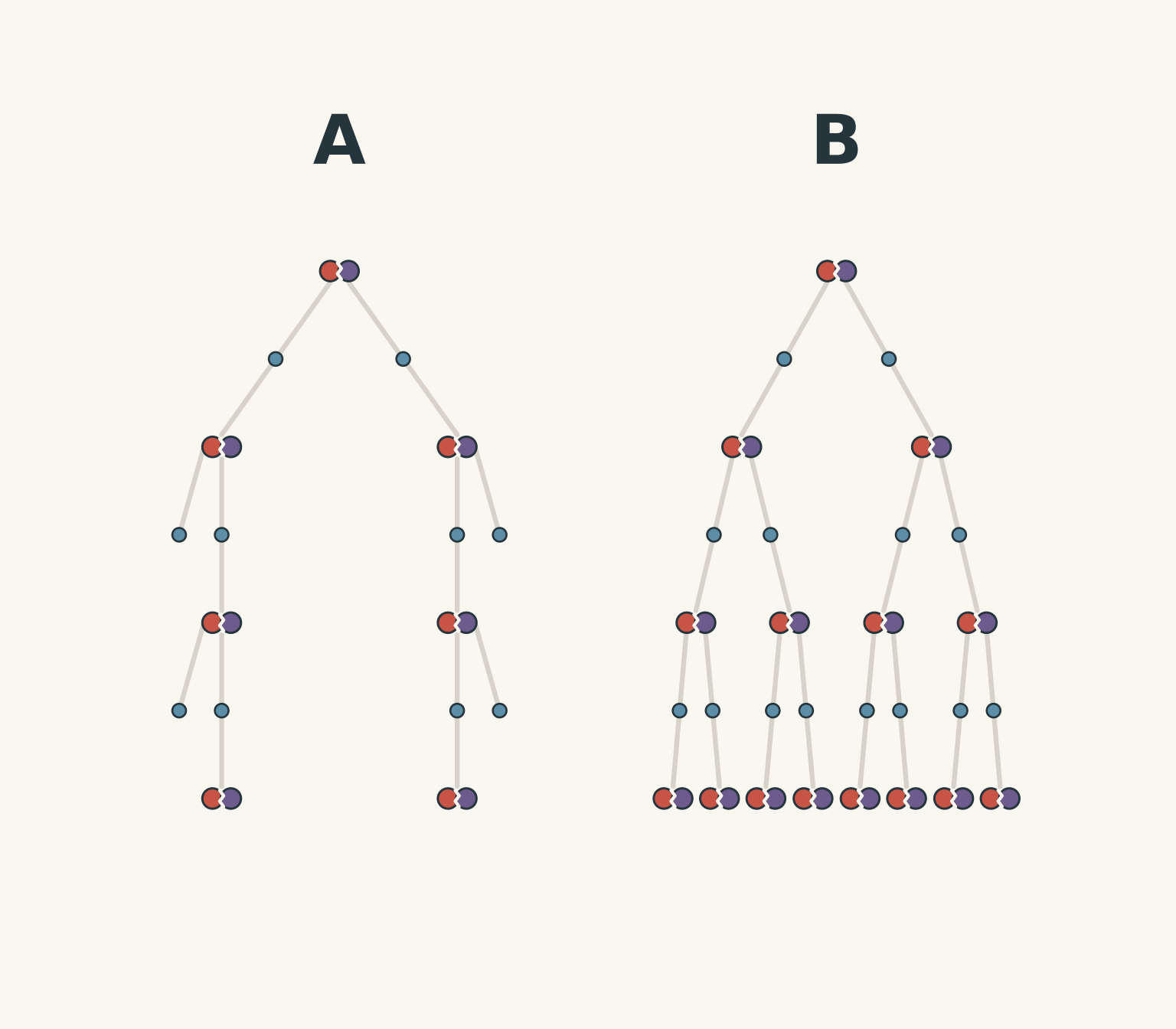
Figure 3. Two possible chain-reaction patterns.
(a) Identify which pattern represents a controlled chain reaction and which represents an uncontrolled chain reaction.
[1 mark]
(b) Explain how control rods and a moderator can help maintain a controlled chain reaction in a thermal nuclear reactor.
[2 marks]
(c) Explain why an uncontrolled chain reaction can release a large amount of energy in a short time.
[1 mark]
Question 14 (7 marks)
Stars produce energy through nuclear reactions, and their changing internal conditions influence which elements they form.
(a) Write the net reaction for the proton-proton chain, showing four hydrogen nuclei forming one helium-4 nucleus. Include the other products and the energy released. Explain why the high temperature inside a star is important for fusion.
[3 marks]
(b) Explain the role of carbon, nitrogen, and oxygen in the CNO cycle.
[1 mark]
(c) Describe how massive stars form heavier elements during later evolutionary stages and how stellar explosions contribute to the formation of elements heavier than iron.
[2 marks]
(d) A star converts mass to energy at a rate of \(4.0\times10^9\ \mathrm{kg\,s^{-1}}\). Calculate the power produced by this mass conversion.
[1 mark]
Question 15 (9 marks)
The Standard Model organises fundamental matter particles and the interactions between them.
(a) Classify the electron, electron neutrino, proton, and positive pion (\(\pi^+\)) as leptons or hadrons. Give the quark composition of the proton and the positive pion, and identify the relevant hadron type for each.
[3 marks]
(b) List the six quark flavours and group them into their three generations.
[2 marks]
(c) Name the three charged leptons and state how neutrinos are associated with these particles.
[1 mark]
(d) Compare the strong, electromagnetic, and weak interactions. Name the force carriers associated with these three interactions, and state one major limitation of the Standard Model.
[3 marks]
Question 16 (4 marks)
(a) High-energy electrons are scattered from protons and neutrons. The measured distributions of scattered electrons differ from those expected if the nucleons were pointlike particles.
Explain what this evidence indicates about the internal structure of protons and neutrons.
[2 marks]
(b) Outline how a particle accelerator experiment can test a proposed particle theory. Include the role of collisions, detectors, and comparison with theoretical predictions.
[2 marks]
Question 17 (3 marks)
Pair production occurs when a sufficiently energetic photon produces a particle-antiparticle pair. For electron-positron pair production, use the electron rest energy \(m_ec^2=0.511\ \mathrm{MeV}\).
(a) Calculate the minimum photon energy required to produce an electron-positron pair, ignoring any kinetic energy of the products.
[1 mark]
(b) Explain why a nearby nucleus or another body is generally needed for pair production by a photon.
[1 mark]
(c) Explain how pair production and matter-antimatter annihilation are relevant to the formation of matter in the early Universe.
[1 mark]
03Worked solutions and marking guide
Solution 1
(a) Alpha decay
\[ {}^{226}_{88}\mathrm{Ra} \rightarrow {}^{222}_{86}\mathrm{Rn} + {}^{4}_{2}\mathrm{He} \]
The mass number is conserved because \(226=222+4\). The atomic number is conserved because \(88=86+2\).
Marking (2 marks): 1 mark for the correct daughter nucleus, radon-222; 1 mark for the alpha particle and a balanced nuclear equation.
(b) Beta-minus decay
\[ {}^{32}_{15}\mathrm{P} \rightarrow {}^{32}_{16}\mathrm{S} + {}^{0}_{-1}\mathrm{e} + \bar{\nu}_e \]
In beta-minus decay, a neutron changes into a proton, an electron, and an electron antineutrino. The mass number remains 32, while the atomic number increases from 15 to 16.
Marking (2 marks): 1 mark for the correct daughter nucleus; 1 mark for including the electron and electron antineutrino.
(c) Gamma emission
\[ {}^{99m}_{43}\mathrm{Tc} \rightarrow {}^{99}_{43}\mathrm{Tc} + \gamma \]
Gamma emission releases energy as a photon when an excited nucleus moves to a lower-energy state.
Marking (1 mark): Correct gamma-emission equation.
(d) Radiation properties
Alpha radiation is strongly ionising but has relatively low penetrating power. Gamma radiation is less ionising but much more penetrating.
A gamma photon carries energy away from the nucleus without changing its numbers of protons or nucleons. Therefore, neither the atomic number nor the mass number changes.
Marking (2 marks): 1 mark for the comparison of ionising ability and penetration; 1 mark for stating that gamma emission changes neither nuclear number.
Solution 2
(a) Identify particle \(X\)
Conservation of nucleon number gives
\[ 14+4=17+A_X \]
\[ A_X=1 \]
Conservation of charge gives
\[ 7+2=8+Z_X \]
\[ Z_X=1 \]
Therefore,
\[ \boxed{X={}^{1}_{1}\mathrm{H}} \]
Particle \(X\) is a proton.
Marking (2 marks): 1 mark for determining \(A_X=1\); 1 mark for determining \(Z_X=1\) and identifying the proton.
(b) Conservation of mass-energy
The total rest mass of the products does not have to equal the total rest mass of the reactants. A difference in rest mass corresponds to a change in energy through \(E=\Delta mc^2\).
The total energy is conserved when all relevant forms are included, including the rest energy of particles, kinetic energy, and any emitted radiation.
Marking (2 marks): 1 mark for relating the mass difference to an energy change; 1 mark for explaining that total energy remains conserved.
Solution 3
(a) Cathode-ray evidence
Cathode rays were deflected towards a positively charged plate, indicating that they carried negative charge.
Their properties were also found to be independent of the cathode material and the gas used in the tube. This supported the conclusion that the rays consisted of a common subatomic particle present in all atoms: the electron.
Marking (2 marks): 1 mark for the evidence of negative charge; 1 mark for the evidence that the particles were universal constituents of matter.
(b) Thomson’s crossed-field experiment
For an undeflected electron beam, the electric and magnetic forces balance in magnitude:
\[ |e|E=|e|vB \]
Cancel the charge magnitude:
\[ v=\frac{E}{B} \]
Substituting the supplied values,
\[ v=\frac{2.4\times10^4}{2.0\times10^{-3}} \]
\[ \boxed{v=1.2\times10^7\ \mathrm{m\,s^{-1}}} \]
In a magnetic field alone, the magnetic force supplies the centripetal force:
\[ |e|vB=\frac{m_ev^2}{r} \]
Rearranging,
\[ \frac{|e|}{m_e}=\frac{v}{Br} \]
Thomson could use the measured speed, magnetic field, and radius of curvature to determine the electron’s charge-to-mass ratio.
Marking (2 marks): 1 mark for the correct speed; 1 mark for explaining how the magnetic deflection determines \(|e|/m_e\).
(c) Millikan’s oil-drop experiment
(i) The number of excess electrons is
\[ n=\frac{|q|}{e} =\frac{4.80\times10^{-19}}{1.60\times10^{-19}} \]
\[ \boxed{n=3} \]
(ii) Using the magnitude of the charge-to-mass ratio,
\[ m_e=\frac{e}{e/m_e} \]
\[ m_e=\frac{1.60\times10^{-19}}{1.76\times10^{11}} \]
\[ \boxed{m_e=9.09\times10^{-31}\ \mathrm{kg}} \]
Millikan’s measurements showed that droplet charges occurred in integer multiples of a common smallest charge. This established the magnitude of the elementary charge. Combining it with Thomson’s charge-to-mass ratio allowed the electron mass to be determined.
Marking (2 marks): 1 mark for the number of excess electrons; 1 mark for the calculated electron mass.
Solution 4
(a) Geiger-Marsden experiment
The observations support three conclusions.
- Most alpha particles passed through the foil with little deflection, showing that most of an atom is empty space.
- A small fraction underwent large deflections, indicating that positive charge is concentrated in a very small region.
- The ability of the small central region to cause large deflections showed that the nucleus is dense and contains most of the atom’s mass.
The positive alpha particles were repelled by the positively charged nucleus when they passed sufficiently close to it.
Marking (3 marks): 1 mark for each distinct, scientifically valid conclusion.
(b) Rutherford model limitation
In classical electrodynamics, an orbiting electron is an accelerating charge. It should radiate energy, lose orbital energy, and spiral towards the nucleus. The model therefore cannot explain the observed stability of atoms.
Marking (1 mark): Correct explanation of the classical instability.
(c) Chadwick’s neutron
The neutral radiation produced when alpha particles struck beryllium could eject protons from paraffin wax. This indicated that the radiation carried energy and momentum despite having no electric charge.
Chadwick concluded that the radiation contained neutral particles with masses comparable to that of the proton. These particles were identified as neutrons.
Marking (2 marks): 1 mark for describing the experimental evidence; 1 mark for identifying the neutron and its approximate mass relative to the proton.
Solution 5
(a) Classifying the spectra
- A: continuous spectrum.
- B: emission spectrum.
- C: absorption spectrum.
Marking (3 marks): 1 mark for each correct classification.
(b) Producing the spectra
A continuous spectrum is produced by a hot, dense source, such as a hot solid, liquid, or sufficiently dense gas. It contains a broad range of wavelengths.
An emission spectrum is produced by a hot, low-density gas. Electrons in its atoms move from higher to lower energy levels and emit photons at particular wavelengths.
An absorption spectrum forms when continuous light passes through a cooler, low-density gas. Atoms absorb photons with energies that match allowed upward electron transitions, leaving dark lines in the transmitted spectrum.
For the same element, emission and absorption lines occur at matching characteristic wavelengths because the allowed energy differences are the same.
Marking (3 marks): 1 mark for each correctly explained source condition and physical process.
(c) Photon energy
Use
\[ E=\frac{hc}{\lambda} \]
Convert the wavelength:
\[ 656\ \mathrm{nm}=656\times10^{-9}\ \mathrm{m} \]
Substitute:
\[ E=\frac{(6.63\times10^{-34})(3.00\times10^8)} {656\times10^{-9}} \]
\[ \boxed{E=3.03\times10^{-19}\ \mathrm{J}} \]
Marking (2 marks): 1 mark for the correct substitution; 1 mark for the numerical answer with units.
(d) Rydberg equation and Balmer series
For the transition from \(n_i=4\) to \(n_f=2\),
\[ \frac{1}{\lambda} = 1.097\times10^7 \left(\frac{1}{2^2}-\frac{1}{4^2}\right) \]
\[ \frac{1}{\lambda} = 1.097\times10^7 \left(\frac14-\frac1{16}\right) \]
\[ \frac{1}{\lambda}=2.06\times10^6\ \mathrm{m^{-1}} \]
Therefore,
\[ \lambda=\frac{1}{2.06\times10^6} \]
\[ \boxed{\lambda=4.86\times10^{-7}\ \mathrm{m} =486\ \mathrm{nm}} \]
This transition belongs to the Balmer series because the electron finishes at \(n_f=2\). The wavelength lies in the visible region.
Marking (2 marks): 1 mark for the correct Rydberg substitution and calculation; 1 mark for the wavelength and correct series identification.
Solution 6
(a) Bohr model
Bohr proposed that hydrogen electrons can occupy only particular allowed energy levels. When an electron moves between levels, it absorbs or emits a photon whose energy equals the difference between those levels. This explains why hydrogen produces discrete spectral lines rather than a continuous range of photon energies.
A major limitation is that the model does not adequately describe the spectra and electron structure of more complex, multi-electron atoms.
Marking (2 marks): 1 mark for explaining quantised energy levels and spectral transitions; 1 mark for a valid limitation.
(b) Schrödinger model
The quantity \(|\psi|^2\) represents the probability density for detecting an electron at a particular position.
An orbital describes a spatial distribution of electron probability. Unlike a Bohr orbit, it does not represent a definite classical path followed by the electron.
Marking (2 marks): 1 mark for the probability-density interpretation; 1 mark for distinguishing an orbital from a fixed trajectory.
Solution 7
(a) Decay constant
The half-life is \(t_{1/2}=6.0\ \mathrm{h}\).
\[ \lambda=\frac{\ln2}{t_{1/2}} =\frac{0.693}{6.0} \]
\[ \boxed{\lambda=0.1155\ \mathrm{h^{-1}}} \]
Marking (2 marks): 1 mark for using the half-life relationship; 1 mark for the correct value and units.
(b) Repeated halving after 18 hours
The number of elapsed half-lives is
\[ n=\frac{18}{6.0}=3 \]
After three half-lives,
\[ N=\frac{N_0}{2^3} =\frac{8.0\times10^{20}}{8} \]
\[ \boxed{N=1.0\times10^{20}\ \text{nuclei}} \]
Marking (2 marks): 1 mark for identifying three half-lives and applying repeated halving; 1 mark for the correct result.
(c) Exponential decay after 10 hours
Using \(N=N_0e^{-\lambda t}\),
\[ N=(8.0\times10^{20})e^{-(0.1155)(10)} \]
\[ N=(8.0\times10^{20})e^{-1.155} \]
\[ \boxed{N=2.52\times10^{20}\ \text{nuclei}} \]
The exponential law gives a continuous model of radioactive decay and agrees with repeated halving at exact multiples of the half-life.
Marking (2 marks): 1 mark for the correct substitution; 1 mark for the correct numerical result.
(d) Physical meaning of the decay constant
The decay constant describes the rate of decay per unit time for an undecayed nucleus. For a sufficiently short interval \(\Delta t\), the probability that a particular undecayed nucleus decays is approximately \(\lambda\Delta t\).
Marking (1 mark): Correct interpretation as a decay-rate parameter or probability rate.
Solution 8
(a) de Broglie wavelength
Use
\[ \lambda=\frac{h}{mv} \]
Substitute the given values:
\[ \lambda= \frac{6.63\times10^{-34}} {(9.11\times10^{-31})(2.00\times10^6)} \]
\[ \boxed{\lambda=3.64\times10^{-10}\ \mathrm{m}} \]
This is approximately \(0.364\ \mathrm{nm}\).
Marking (2 marks): 1 mark for the correct formula and substitution; 1 mark for the numerical answer with units.
(b) Electron diffraction
When electrons interact with a crystal, they can produce a diffraction pattern with maxima and minima. Diffraction is characteristic of wave behaviour, so this observation provides evidence that electrons have wave properties.
The wavelength inferred from the diffraction pattern agrees with the de Broglie prediction, supporting the relationship \(\lambda=h/(mv)\).
Marking (2 marks): 1 mark for describing the observed diffraction pattern; 1 mark for connecting the observation to matter waves and de Broglie’s hypothesis.
Solution 9
(a) Temperature and colour
The order from hottest to coolest is
\[ \boxed{A,\ B,\ C=D} \]
Stars C and D have equal surface temperatures. Hotter stars generally appear blue or blue-white, while cooler stars appear orange or red.
Marking (2 marks): 1 mark for the correct ordering; 1 mark for the colour trend.
(b) Evolutionary stages
Stars A, B, and C are consistent with main-sequence stars. Star D is a red giant.
Stars C and D have the same surface temperature, but their luminosities differ enormously. Star C has only \(0.01L_\odot\), consistent with a small, faint red dwarf. Star D has luminosity \(1000L_\odot\), consistent with a red giant with a much larger radius.
At the same surface temperature, a much larger stellar surface area produces a much higher total luminosity.
Marking (2 marks): 1 mark for the main-sequence and red-giant classification; 1 mark for distinguishing C and D using their luminosities.
(c) Spectral classes
Star A is approximately class O. Its very high surface temperature and strong ionised helium lines support this classification.
Star C is approximately class M. Its low surface temperature and strong molecular bands are characteristic of cool M-type stars.
Marking (2 marks): 1 mark for each correct spectral class with appropriate supporting evidence.
Solution 10
(a) Redshift
The rest wavelength is \(\lambda_0=500.0\ \mathrm{nm}\), and the observed wavelength is \(510.0\ \mathrm{nm}\).
\[ z=\frac{510.0-500.0}{500.0} \]
\[ \boxed{z=0.0200} \]
Marking (1 mark): Correct redshift.
(b) Recessional speed
Using the low-redshift approximation,
\[ v\approx zc \]
\[ v=(0.0200)(3.00\times10^5) \]
\[ \boxed{v=6.00\times10^3\ \mathrm{km\,s^{-1}}} \]
Marking (1 mark): Correct speed and units.
(c) Hubble constant
Using \(v=H_0d\),
\[ H_0=\frac{v}{d} =\frac{6000}{120} \]
\[ \boxed{H_0=50.0\ \mathrm{km\,s^{-1}\,Mpc^{-1}}} \]
This value follows from the supplied hypothetical data; it is not intended as a measurement of the present-day Hubble constant.
Marking (1 mark): Correct calculation and units.
(d) Evidence for expansion
In a wider survey, galaxies generally show redshifts, and more distant galaxies tend to have larger recessional speeds. This systematic redshift-distance relationship supports the conclusion that the Universe is expanding.
Marking (1 mark): Correctly links increasing distance and recessional speed to cosmic expansion.
Solution 11
(a) Mass defect
The total mass of the separated nucleons is
\[ m_{\mathrm{separated}}=2m_p+2m_n \]
\[ m_{\mathrm{separated}} =2(1.007276)+2(1.008665) \]
\[ m_{\mathrm{separated}}=4.031882\ \mathrm{u} \]
The mass defect is the separated-nucleon mass minus the actual nuclear mass:
\[ \Delta m=m_{\mathrm{separated}}-m_{\mathrm{He}} \]
\[ \Delta m=4.031882-4.001506 \]
\[ \boxed{\Delta m=0.030376\ \mathrm{u}} \]
Marking (3 marks): 1 mark for the total mass of the separated nucleons; 1 mark for subtracting the actual nuclear mass; 1 mark for the correct mass defect.
(b) Nuclear binding energy
Using the supplied mass-energy conversion,
\[ E=\Delta mc^2 \]
\[ E=(0.030376)(931.5)\ \mathrm{MeV} \]
\[ \boxed{E=28.3\ \mathrm{MeV}} \]
Marking (2 marks): 1 mark for applying the mass-energy conversion; 1 mark for the correct binding energy.
(c) Binding energy per nucleon
Helium-4 contains four nucleons.
\[ \frac{E_{\mathrm{binding}}}{A} =\frac{28.3}{4} \]
\[ \boxed{7.07\ \mathrm{MeV\ per\ nucleon}} \]
Marking (1 mark): Correct division and result.
(d) Conservation of energy
The bound nucleus has less rest mass than its separated nucleons because energy was released when the nucleus formed. The missing rest-mass energy corresponds to the binding energy. Total energy is conserved.
Marking (1 mark): Correctly relates the mass defect to binding energy and energy conservation.
Solution 12
(a) Fission energy
The mass defect for the supplied fission event is
\[ \Delta m=236.0526-235.8666 \]
\[ \Delta m=0.1860\ \mathrm{u} \]
Convert this mass difference to energy:
\[ E=\Delta mc^2 \]
\[ E=(0.1860)(931.5)\ \mathrm{MeV} \]
\[ \boxed{E=173\ \mathrm{MeV}} \]
The energy released appears mainly as kinetic energy of the fission products and neutrons, with some energy potentially carried by radiation and later decay products.
Marking (3 marks): 1 mark for the mass defect; 1 mark for the mass-energy conversion; 1 mark for the correct energy.
(b) Fusion energy
First calculate the initial total mass:
\[ m_i=2.013553+3.015501 \]
\[ m_i=5.029054\ \mathrm{u} \]
Calculate the final total mass:
\[ m_f=4.001506+1.008665 \]
\[ m_f=5.010171\ \mathrm{u} \]
Therefore,
\[ \Delta m=m_i-m_f \]
\[ \Delta m=5.029054-5.010171 =0.018883\ \mathrm{u} \]
The released energy is
\[ E=(0.018883)(931.5)\ \mathrm{MeV} \]
\[ \boxed{E=17.6\ \mathrm{MeV}} \]
Marking (3 marks): 1 mark for the initial and final masses and mass defect; 1 mark for the energy conversion; 1 mark for the correct energy.
(c) Why fission and fusion release energy
Fission splits a heavy nucleus into smaller nuclei. Fusion combines light nuclei to form a heavier nucleus.
Both reactions can release energy when the products have a greater binding energy per nucleon than the reactants. The resulting mass difference corresponds to released energy through \(E=\Delta mc^2\).
Marking (2 marks): 1 mark for distinguishing fission from fusion; 1 mark for explaining the energy release through binding energy and mass defect.
Solution 13
(a) Classifying the chain reactions
Diagram A represents a controlled chain reaction because the number of fissions remains approximately constant from one generation to the next.
Diagram B represents an uncontrolled chain reaction because the number of fissions increases rapidly with successive generations.
Marking (1 mark): Correctly identifies both patterns.
(b) Maintaining control in a reactor
Control rods absorb neutrons. Inserting them further into the reactor increases neutron absorption, while withdrawing them reduces absorption.
A moderator slows neutrons to energies at which they are more likely to induce fission in a thermal reactor. By adjusting neutron absorption, the reactor can be maintained near a critical state, where each fission leads to approximately one further fission on average.
Marking (2 marks): 1 mark for the role of control rods; 1 mark for the role of the moderator and/or maintaining a controlled chain reaction.
(c) Uncontrolled chain reaction
In an uncontrolled chain reaction, each generation produces more fissions than the previous generation. The number of reactions can therefore increase rapidly, releasing a large amount of energy over a short period.
Marking (1 mark): Correct explanation of rapid multiplication and energy release.
Solution 14
(a) Proton-proton chain
The net reaction is
\[ 4\,{}^1_1\mathrm{H} \rightarrow {}^4_2\mathrm{He} + 2e^+ + 2\nu_e + \text{energy} \]
Four hydrogen nuclei ultimately form one helium-4 nucleus, with two positrons, two electron neutrinos, and energy produced in the net reaction.
The high temperature inside a star gives nuclei greater kinetic energy. This helps them approach closely enough for the strong nuclear interaction to bind them, despite their electrostatic repulsion. Quantum tunnelling also allows fusion to occur at stellar temperatures where a purely classical collision model would predict a much lower reaction rate.
Marking (3 marks): 2 marks for the correct net reaction and products; 1 mark for explaining the importance of high temperature and overcoming the Coulomb barrier.
(b) CNO cycle
Carbon, nitrogen, and oxygen participate in a sequence of nuclear reactions that converts hydrogen into helium. These nuclei are regenerated by the end of the cycle, so they act as catalysts rather than being consumed overall.
Marking (1 mark): Correctly identifies the CNO nuclei as catalysts in hydrogen fusion.
(c) Nucleosynthesis after the main sequence
In massive stars, later evolutionary stages involve successive fusion reactions that produce increasingly heavy nuclei, with ordinary stellar fusion building elements up to the iron group.
Many elements heavier than iron are formed through neutron-capture processes during late stellar stages and explosive events. Stellar explosions also disperse newly formed elements into space, where they can become part of later generations of stars and planets.
Marking (2 marks): 1 mark for successive fusion stages in massive stars; 1 mark for neutron capture and the role of stellar explosions in forming or dispersing heavier elements.
(d) Mass-energy equivalence in stars
Power is the energy released per unit time. If mass is converted to energy at a rate of \(4.0\times10^9\ \mathrm{kg\,s^{-1}}\),
\[ P=\frac{\Delta E}{\Delta t} =\frac{\Delta m}{\Delta t}c^2 \]
\[ P=(4.0\times10^9)(3.00\times10^8)^2 \]
\[ \boxed{P=3.6\times10^{26}\ \mathrm{W}} \]
Marking (1 mark): Correct application of mass-energy equivalence and the resulting power.
Solution 15
(a) Leptons, hadrons, baryons, and mesons
The electron and electron neutrino are leptons. They are not made of quarks.
The proton and positive pion are hadrons, meaning they are composite particles made from quarks.
The proton has quark composition
\[ \boxed{p=uud} \]
It contains two up quarks and one down quark, making it a baryon.
The positive pion has quark composition
\[ \boxed{\pi^+=u\bar d} \]
It contains an up quark and an anti-down quark, making it a meson.
Marking (3 marks): 1 mark for classifying the leptons and hadrons; 1 mark for the proton’s quark content and baryon classification; 1 mark for the pion’s quark content and meson classification.
(b) Quark generations
The six quark flavours are up, down, charm, strange, top, and bottom.
They are grouped into three generations:
- First generation: up and down.
- Second generation: charm and strange.
- Third generation: top and bottom.
The up-type quarks are up, charm, and top. The down-type quarks are down, strange, and bottom.
Marking (2 marks): 1 mark for listing all six flavours; 1 mark for the correct generation groupings.
(c) Charged leptons
The three charged leptons are the electron, muon, and tau. Each has an associated neutrino: the electron neutrino, muon neutrino, and tau neutrino.
Marking (1 mark): Correctly identifies the three charged leptons and their neutrino partners.
(d) Fundamental interactions and the Standard Model
The strong interaction binds quarks together and, through the residual strong interaction, holds protons and neutrons together in nuclei. Its force carriers are gluons.
The electromagnetic interaction acts between electrically charged particles. Its force carrier is the photon.
The weak interaction can change quark flavour and is responsible for processes such as beta decay. Its force carriers are the \(W^+\), \(W^-\), and \(Z^0\) bosons.
Gravity is not incorporated into the Standard Model as a quantum interaction. The model therefore does not provide a complete description of all fundamental interactions.
Marking (3 marks): 1 mark for the roles of the three interactions; 1 mark for the corresponding force carriers; 1 mark for identifying gravity as outside the Standard Model or stating a valid related limitation.
Solution 16
(a) Evidence for composite nucleons
If protons and neutrons were pointlike particles, high-energy scattering would follow the predictions for particles without resolvable internal structure. The observed scattering distributions differ from those predictions.
This indicates that nucleons have internal structure. Scattering experiments provide evidence that protons and neutrons contain quarks, whose distributions and interactions influence how incoming particles scatter.
Marking (2 marks): 1 mark for concluding that nucleons are not pointlike; 1 mark for linking the scattering evidence to internal quark structure.
(b) Particle accelerators
Accelerators increase the kinetic energy of charged particles before bringing particle beams into collision. High-energy collisions can produce particles or interactions that are not readily observed at lower energies.
Detectors measure the tracks, energies, momenta, and other properties of the collision products. Scientists compare these observations with the predictions of a proposed theory to determine whether the theory is supported or needs revision.
Marking (2 marks): 1 mark for acceleration and collisions; 1 mark for detecting the products and comparing observations with theoretical predictions.
Solution 17
(a) Minimum pair-production energy
An electron and a positron each have a rest energy of \(0.511\ \mathrm{MeV}\).
Ignoring kinetic energy, the minimum required energy is
\[ E_{\min}=2m_ec^2 \]
\[ E_{\min}=2(0.511) \]
\[ \boxed{E_{\min}=1.022\ \mathrm{MeV}} \]
Marking (1 mark): Correct minimum energy.
(b) Momentum conservation
A photon has energy and momentum. A single photon cannot ordinarily produce an electron-positron pair in empty space while conserving both energy and momentum. A nearby nucleus or another body can absorb recoil momentum, allowing the reaction to occur consistently with conservation laws.
Marking (1 mark): Correct explanation involving momentum conservation and the recoil body.
(c) Matter formation in the early Universe
The early Universe contained intense radiation capable of producing particle-antiparticle pairs. As the Universe expanded and cooled, pair production became less favourable, while many existing particles and antiparticles annihilated. A small excess of matter over antimatter remained, providing the matter from which stars, planets, and other structures later formed.
Marking (1 mark): Correctly links early pair production, annihilation, cooling, and the surviving matter excess.