
Moderator vs Control Rod vs Coolant: Reactor Roles Explained
Learn how fuel, moderators, control rods, and coolant perform different jobs in a thermal-neutron reactor. Trace neutron behaviour and heat transfer, work through practical examples, and test your understanding with HSC-style questions and solutions.
Suppose a thermal-neutron reactor’s power is rising. An operator inserts the control rods and increases the coolant flow. Both actions matter, but which one actually slows the neutrons? And why doesn’t increasing the coolant flow automatically stop the fission reaction?
The key is to track what each component acts on. Fuel releases energy through fission, the moderator slows neutrons, control rods absorb neutrons, and the coolant carries thermal energy away. These functions interact, but they are not interchangeable.
01Quick decision rule
When a question describes something happening inside a nuclear reactor, use this rule to identify the component responsible.
- Fuel: Where does the energy come from? Nuclear fission in the fuel.
- Moderator: How do fast neutrons lose kinetic energy? They scatter off nuclei in the moderator.
- Control rods: How does the reactor reduce the number of neutrons available to continue the chain reaction? The rods absorb them.
- Coolant: How does thermal energy leave the fuel and reach a heat exchanger? The coolant carries it away.
If a question asks about reactor temperature, don’t automatically choose the moderator. You need to consider both the rate at which energy is generated and the rate at which energy is removed.
Reactor components: two separate paths
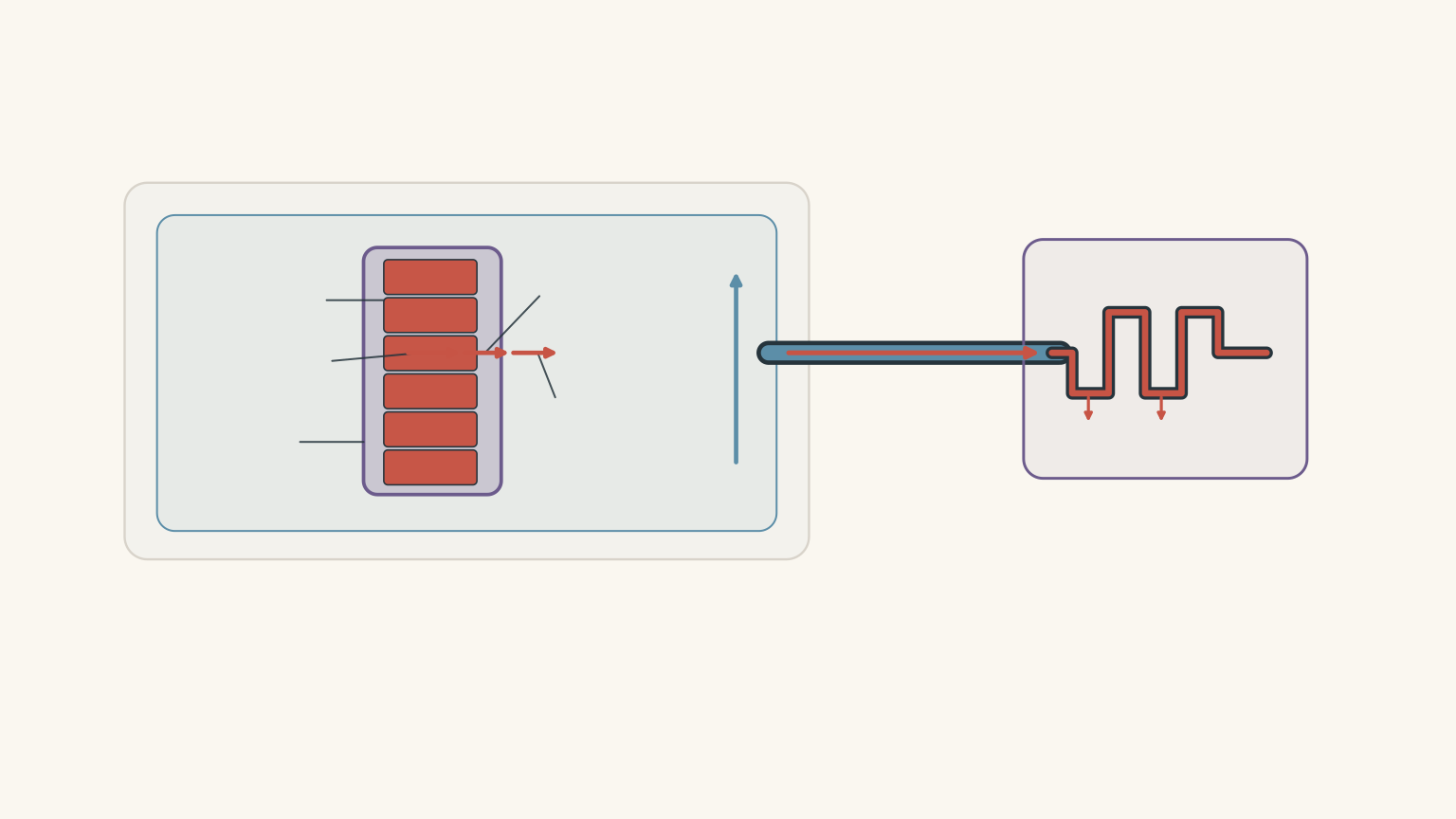
| 1. Core cross-section | Fuel assemblies sit inside the reactor vessel. Light water surrounds fuel; control rods enter from above. |
|---|---|
| 2. Neutron path | Fast neutron → water collisions → thermal neutron → fission Fission releases fast neutrons; water scattering slows them. A thermal neutron enters another fissile nucleus and triggers fission. |
| 3. Control rod | Neutron → absorption A separate neutron is absorbed by a control rod. Fewer neutrons remain available to sustain the chain reaction. |
| 4. Heat path | Fuel → cladding → rising coolant → heat exchanger Heat passes from fuel through metal cladding into the water. Upward-flowing coolant carries heat to an external heat exchanger. |
Read the cross-section along two separate paths.
- The neutron path explains how the chain reaction continues or slows down.
- The energy path explains how heat travels out of the core.
Keeping these paths separate is the easiest way to avoid mixing up the four components.
02How to tell the four components apart
| Component | What it acts on | Main job | What it does not primarily do |
|---|---|---|---|
| Fuel | Atomic nuclei | Releases energy through fission | Slow or absorb excess neutrons as its main function |
| Moderator | Neutrons | Reduces neutron kinetic energy through scattering | Directly regulate reactor temperature |
| Control rods | Neutrons | Absorb neutrons and influence the chain reaction | Slow neutrons as their main function |
| Coolant | Thermal energy | Transfers heat away from the core | Directly control the chain reaction simply by carrying heat |
One important qualification: these are four functions, not necessarily four different materials. In many light-water reactors, the same water acts as both moderator and coolant. The functions remain different even when one material performs both.
01Fuel: where the energy comes from
The fuel contains nuclei capable of undergoing nuclear fission. Common examples include uranium-235 and plutonium-239.
When a suitable neutron is absorbed by a fissile nucleus, the nucleus can split into two smaller nuclei. This process is called fission.
A simplified representation of uranium-235 fission is:
\[ ^{235}\mathrm{U}+n \rightarrow \text{fission fragments} \]
\[ +\\,2\text{-}3n+\text{energy} \]
Here, \(n\) represents a neutron. This is a schematic equation: the exact fission fragments vary, and the number of neutrons released is not always the same.
The energy comes from the change in nuclear binding energy. Much of it initially appears as kinetic energy of the fission fragments, which collide with surrounding atoms and transfer energy to the fuel as thermal energy.
The emitted neutrons can then trigger further fissions. This creates a chain reaction.
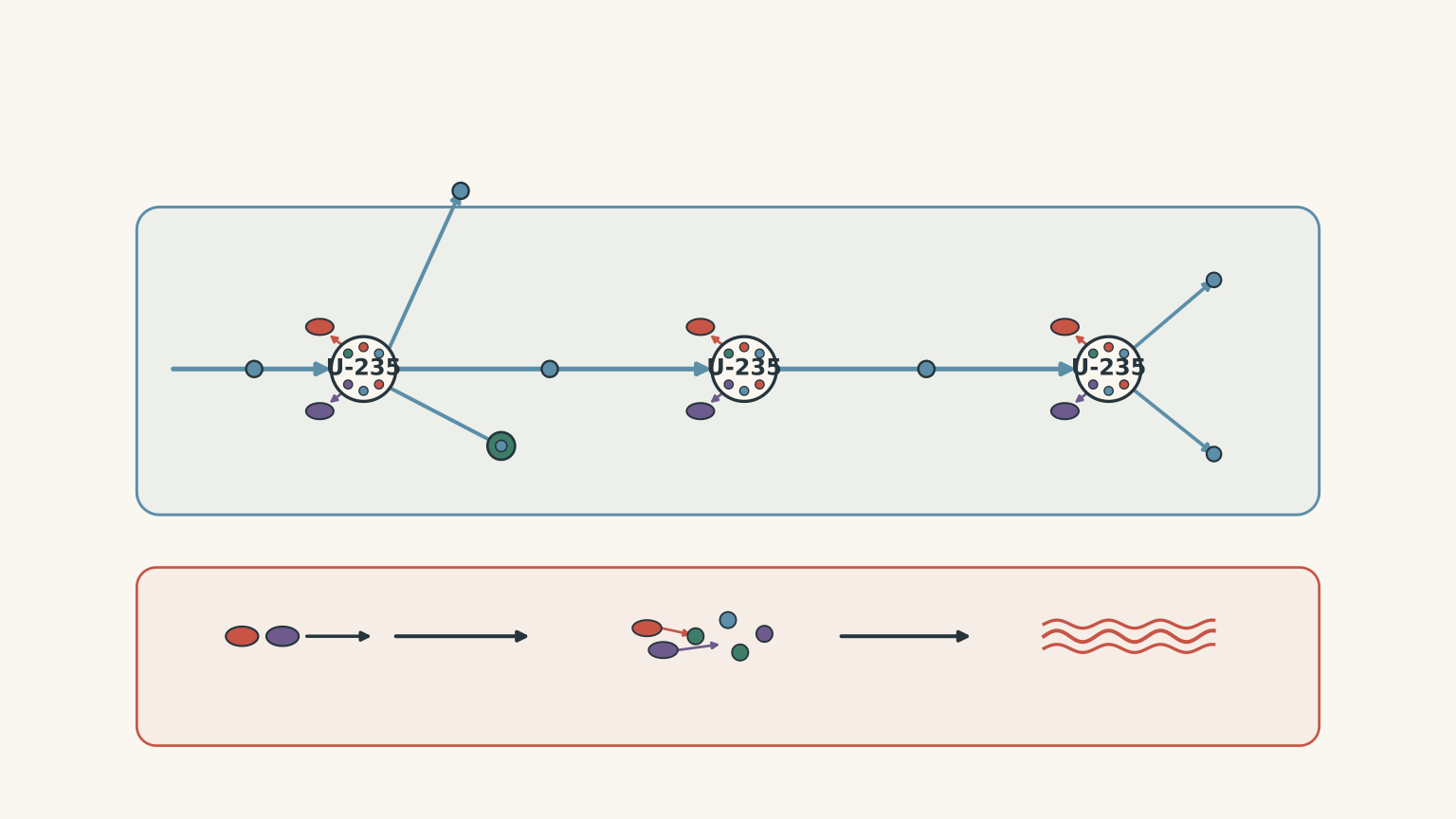
Not every neutron released in a fission event causes another fission. Some escape the core, and others are absorbed by materials that do not produce a subsequent fission.
The reactor’s power depends on the rate at which fissions occur. More fissions per second generally mean more thermal energy released per second.
That leads to an important distinction: fuel is the source of the energy, but the fuel alone does not determine how quickly the chain reaction proceeds. Neutron behaviour matters too.
02Moderator: slow the neutrons down
Fission releases neutrons with high kinetic energies. These are called fast neutrons.
In a thermal-neutron reactor, many of these neutrons need to be slowed down because thermal neutrons are much more likely to induce further fissions in the fissile fuel used by the reactor.
The material that does this is the moderator.
How moderation works
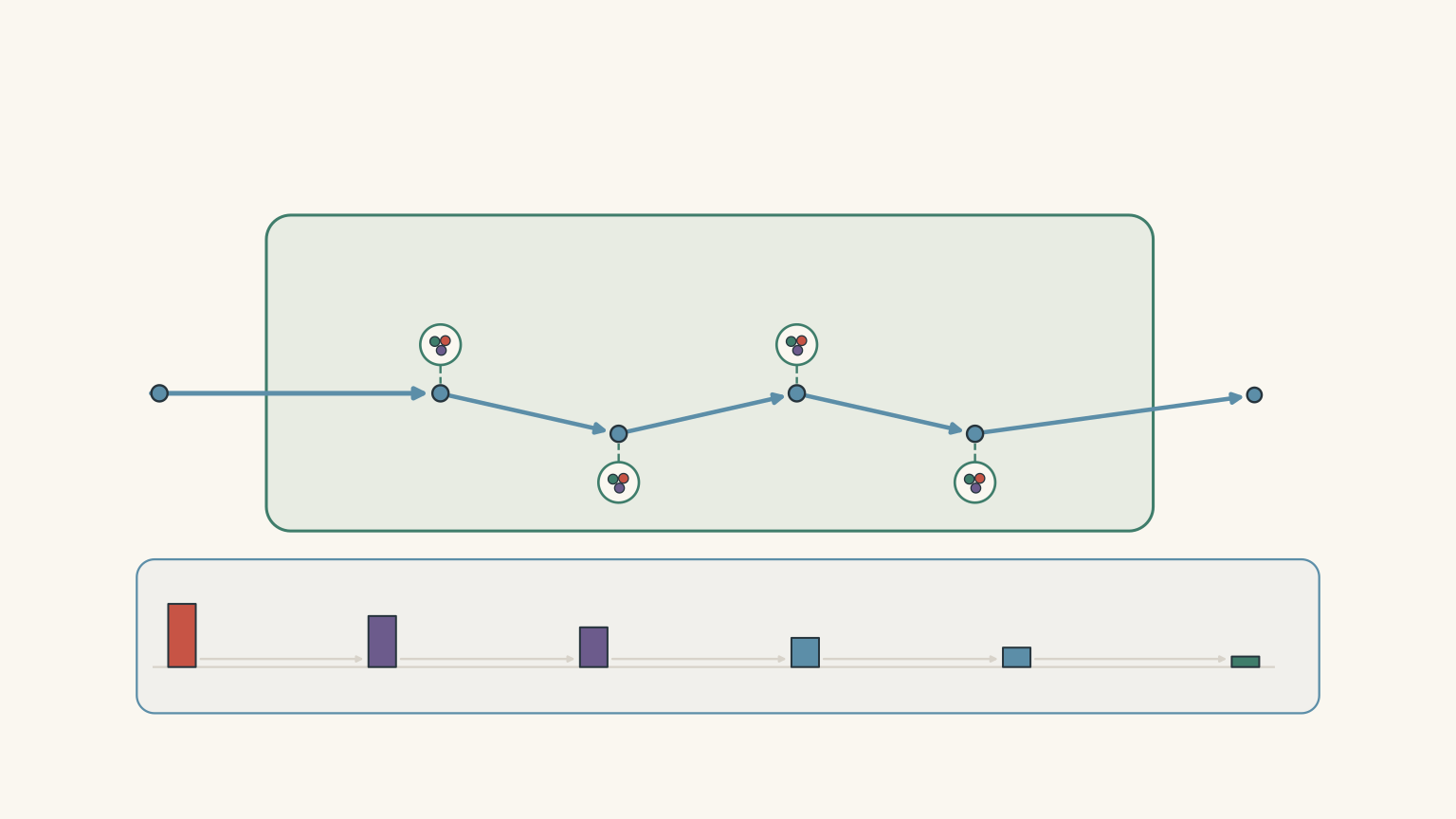
Imagine a fast neutron as a ping-pong ball moving quickly through a crowd of other balls. Each collision can transfer some of its kinetic energy to another ball, leaving the original ball with less energy.
A moderator works through repeated scattering collisions. The neutron transfers energy to nuclei in the moderator, reducing its kinetic energy.
The analogy has a limit: neutrons and nuclei are quantum particles, not rigid ping-pong balls. The useful idea is simply that collisions can transfer kinetic energy from a neutron to the surrounding material.
Suitable moderators include:
- Ordinary water, which contains hydrogen nuclei.
- Heavy water, which contains deuterium.
- Graphite, which contains carbon.
Hydrogen is particularly effective at slowing neutrons because a hydrogen nucleus has approximately the same mass as a neutron. A collision can therefore transfer a substantial fraction of the neutron’s kinetic energy.
A thermal neutron has a kinetic energy comparable to the thermal energy of the surrounding material. At room temperature, a commonly quoted energy is approximately \(0.025\ \mathrm{eV}\), although the actual neutron energy distribution depends on the moderator temperature.
The word thermal describes the neutron’s energy. It does not mean the neutron is responsible for making the reactor hot.
Why a moderator is not a control rod
This is the distinction to remember.
A moderator primarily slows neutrons through scattering. A well-chosen moderator has relatively low neutron absorption, allowing many neutrons to remain available for further fissions.
A control rod, by contrast, is designed to absorb neutrons. Once a neutron is captured, it is no longer available to continue the chain reaction.
So a moderator changes the energy distribution of the neutrons, while control rods change how many neutrons remain available to sustain fission.
Does the moderator control temperature?
Not directly.
The moderator can affect the fission rate because changing neutron energies can change the probability of further fissions. That can change the rate at which thermal energy is generated.
However, the core’s temperature also depends on how quickly the coolant removes that energy. The moderator is not a thermostat.
In real reactors, changes in moderator temperature or density can influence reactivity. The direction and size of that effect depend on the reactor design and operating conditions.
03Control rods: absorb neutrons to regulate the chain reaction
Control rods are made from materials that absorb neutrons effectively. Examples include boron-containing materials, cadmium, and hafnium.
Their main purpose is to control the neutron population available to cause further fissions.
What happens when control rods move?
When control rods are inserted further into the core, they absorb more neutrons. Fewer neutrons remain available to trigger the next generation of fissions, so the fission rate tends to decrease.
When the rods are withdrawn, neutron absorption by the rods decreases. More neutrons may remain available for further fissions, so the fission rate can increase.
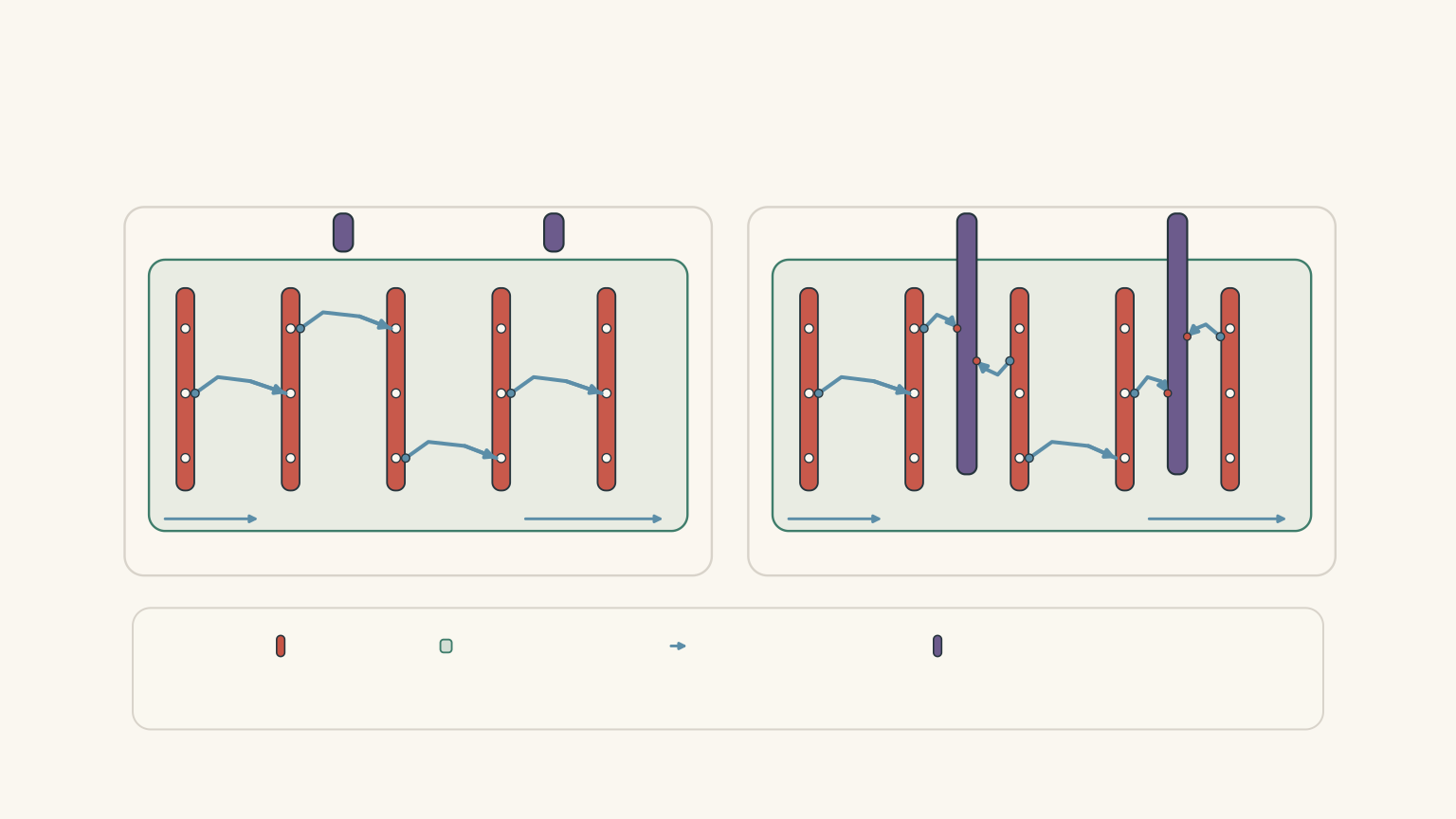
The crucial point is that control rods are not primarily designed to slow neutrons. They remove neutrons from the chain reaction by absorbing them.
A rod may scatter a neutron in some circumstances, but scattering is not its defining function.
What does a stable chain reaction mean?
In a simplified reactor model, imagine that each fission produces three neutrons on average. Some neutrons are lost, while others are absorbed by control rods or other materials.
For steady operation, an average of one effective neutron from each fission must cause a subsequent fission. The chain reaction then sustains itself without the neutron population systematically growing or shrinking.
This is called a critical state. In this context, critical does not mean that the reactor is about to explode. It describes a self-sustaining chain reaction.
- If fewer than one effective neutron per fission causes the next fission, the chain reaction tends to die away.
- If more than one does so, the neutron population and fission rate tend to grow.
- If exactly one does so on average, the chain reaction can sustain a steady fission rate.
Control rods help change this neutron balance.
One more distinction matters: reducing fission power does not instantly remove the heat already stored in the fuel and other reactor materials. After a reactor is shut down, radioactive fission products continue to release decay heat. Cooling is still required.
04Coolant: transfer thermal energy away from the core
The coolant has a different job from both the moderator and the control rods.
Fission releases energy in the fuel. That energy must be transferred away from the fuel so the core does not continue accumulating thermal energy.
The heat follows a path:
- Fission fragments transfer energy to the fuel.
- Thermal energy travels through the fuel and its cladding by conduction.
- The coolant receives energy from the hot cladding.
- Moving coolant carries the energy to a heat exchanger or another part of the power-conversion system.
Coolants can include water, gases, and liquid metals, depending on the reactor design.
In a pressurised-water reactor, for example, water transfers heat from the core to a steam generator while remaining liquid in the core. In a graphite-moderated, gas-cooled reactor, graphite slows the neutrons while the gas carries away heat.
These designs make the distinction especially clear: the moderator and coolant can be different substances, even though their functions interact.
What determines whether the core heats up or cools down?
The key is the energy balance.
Let:
- \(P_{\text{fission}}\) be the rate at which fission releases thermal energy, measured in watts (W).
- \(\dot Q_{\text{removed}}\) be the rate at which thermal energy is carried away, also measured in watts.
- \(E_{\text{thermal}}\) be the thermal energy stored in the core.
For a simplified energy balance,
\[ \frac{\Delta E_{\text{thermal}}}{\Delta t} = P_{\text{fission}}-\dot Q_{\text{removed}} \]
This equation describes the difference between the two rates.
- If \(P_{\text{fission}}>\dot Q_{\text{removed}}\), thermal energy accumulates in the core, so its temperature tends to rise.
- If \(P_{\text{fission}}<\dot Q_{\text{removed}}\), stored thermal energy decreases, so its temperature tends to fall.
- If the two rates are equal, the stored thermal energy is steady in this simplified model.
Real reactors have temperature gradients, heat-storage effects, and decay heat, so the temperature at a particular point does not necessarily change instantly in line with this equation.
The practical lesson is that a lower fission rate does not guarantee an immediate temperature decrease. If the coolant removes heat even more slowly, the core can still heat up.
07Worked applications
Worked example: The rods are inserted, but the coolant is still heating up
A thermal-neutron reactor is operating at high power. The operator inserts the control rods. The outlet coolant temperature continues to rise for a short time. Has the rod insertion failed, and did the rods slow the neutrons?
Step 1: Identify what the control rods do.
The rods absorb neutrons, reducing the number available to trigger further fissions. Their primary function is not to slow neutrons.
Step 2: Separate fission power from stored thermal energy.
Inserting the rods can reduce the fission rate, but the fuel and coolant already contain thermal energy. That energy still has to move through the core and into the coolant.
Step 3: Account for the delay and remaining heat sources.
The coolant temperature may continue rising temporarily if heat is still moving out of hotter fuel and into the coolant faster than it can be carried away. In a real reactor, decay heat also remains after shutdown.
Conclusion: A short-term rise in outlet temperature does not, by itself, prove that control rod insertion has failed. The neutron population, fission power, coolant flow, and temperature trends need to be considered together.
Worked example: Calculate the thermal power carried by the coolant
Water flows through a simplified reactor core at \(2.0\ \mathrm{kg\\,s^{-1}}\). It enters at \(290^\circ\mathrm{C}\) and leaves at \(300^\circ\mathrm{C}\).
Take the specific heat capacity of water as \(4.2\times10^3\ \mathrm{J\\,kg^{-1}\\,K^{-1}}\). Estimate the thermal power transferred to the water. Assume steady flow, no phase change, and negligible heat loss to the surroundings.
Step 1: Recognise that the question asks for an energy transfer rate.
The coolant carries energy away as it warms. For a steady stream with no phase change, use
\[ \dot Q=\dot m c\Delta T \]
Here, \(\dot m\) is the mass flow rate, \(c\) is the specific heat capacity, and \(\Delta T\) is the temperature rise.
Step 2: Calculate the temperature rise.
\[ \Delta T=300-290=10\ \mathrm{K} \]
A temperature difference of \(10^\circ\mathrm{C}\) is equivalent to \(10\ \mathrm{K}\).
Step 3: Substitute the values.
The units combine as \(\mathrm{kg\\,s^{-1}}\times\mathrm{J\\,kg^{-1}\\,K^{-1}}\times\mathrm{K}=\mathrm{J\\,s^{-1}}\).
\[ \begin{aligned} \dot Q&=(2.0)(4.2\times10^3)(10)\\\ &=8.4\times10^4\ \mathrm{J\\,s^{-1}}\\\ &=84\ \mathrm{kW} \end{aligned} \]
Step 4: Interpret the result.
The water carries away thermal energy at a rate of \(84\ \mathrm{kW}\).
This calculation tells you about heat transfer, not the neutron population. It does not, on its own, tell you how many fissions are occurring.
08Common mistakes
– Mistake: Control rods slow neutrons. Their primary job is neutron absorption. Moderators slow neutrons through scattering; control rods remove neutrons from the chain reaction.
– Mistake: The moderator directly controls reactor temperature. The moderator affects neutron energies and can influence the fission rate. Temperature depends on the balance between heat generation and heat removal.
– Mistake: More coolant flow automatically means less fission. Increasing coolant flow can improve heat removal, but it does not automatically reduce the fission rate. In some designs, changes to the coolant’s density or temperature can also affect moderation and reactivity.
– Mistake: A reactor cools immediately when the rods are inserted. The fission rate can decrease before the stored thermal energy has been removed. Decay heat also persists after shutdown.
– Mistake: A thermal neutron is a neutron that heats the reactor. Thermal describes its kinetic energy relative to the surrounding material. The fuel’s fission energy is what supplies most of the heat during normal power operation.
09Questions and solutions
Question 1
A simplified thermal-neutron reactor contains fuel, a moderator, control rods, and a coolant.
Identify which component:
(a) releases energy through nuclear fission;
(b) slows fast neutrons through scattering;
(c) absorbs neutrons to reduce the chain reaction;
(d) transfers thermal energy away from the core.
Explain the difference between the functions in parts (b) and (c).
Solution 1
The answers are (a) fuel, (b) moderator, (c) control rods, and (d) coolant.
The fuel contains fissile nuclei that release energy when they undergo fission. The moderator reduces neutron kinetic energy through collisions, helping thermal neutrons cause further fissions in a thermal reactor.
Control rods perform a different task: they absorb neutrons, making those neutrons unavailable to continue the chain reaction. The coolant transfers thermal energy away from the fuel and towards a heat exchanger.
The important distinction is that moderation changes neutron energy, whereas control rod absorption removes neutrons from the chain reaction.
Question 2
Water flows through a reactor core at \(3.0\ \mathrm{kg\\,s^{-1}}\). Its temperature rises from \(285^\circ\mathrm{C}\) to \(297^\circ\mathrm{C}\).
Take the specific heat capacity of water as \(4.2\times10^3\ \mathrm{J\\,kg^{-1}\\,K^{-1}}\).
(a) Calculate the thermal power transferred to the water.
(b) If the mass flow rate falls to \(2.0\ \mathrm{kg\\,s^{-1}}\), what temperature rise would be required to transfer the same thermal power?
Assume steady flow, no phase change, and constant specific heat capacity.
Solution 2
The coolant initially carries away approximately \(151\ \mathrm{kW}\). At the lower flow rate, it needs a temperature rise of \(18\ \mathrm{K}\) to carry away the same power.
Part (a)
First, calculate the temperature rise:
\[ \Delta T=297-285=12\ \mathrm{K} \]
Use the coolant energy-transfer rate:
\[ \dot Q=\dot m c\Delta T \]
Substituting,
\[ \begin{aligned} \dot Q&=(3.0)(4.2\times10^3)(12)\\\ &=1.512\times10^5\ \mathrm{W}\\\ &\approx151\ \mathrm{kW} \end{aligned} \]
The units are watts because the mass flow rate is measured in kilograms per second.
Part (b)
For the same thermal power,
\[ \dot Q=\dot m_{\text{new}}c\Delta T_{\text{new}} \]
Rearranging,
\[ \Delta T_{\text{new}} =\frac{\dot Q}{\dot m_{\text{new}}c} \]
Substituting,
\[ \begin{aligned} \Delta T_{\text{new}} &=\frac{1.512\times10^5} {(2.0)(4.2\times10^3)}\\\ &=18\ \mathrm{K} \end{aligned} \]
With less water flowing each second, each kilogram must carry away more energy to maintain the same heat-transfer rate. The required temperature rise therefore increases from \(12\ \mathrm{K}\) to \(18\ \mathrm{K}\).
This result concerns heat transfer. It does not mean that the fission rate must remain constant in a real reactor, because temperature and density changes can affect reactor behaviour.
Question 3
In a simplified neutron budget, each fission releases an average of \(2.5\) neutrons.
On average, per fission:
- \(0.5\) neutrons escape or are absorbed by other materials;
- \(1.0\) neutron is absorbed by control rods;
- all remaining neutrons are available to cause further fissions.
(a) How many neutrons per fission are available to cause the next fission?
(b) Is the chain reaction stable, growing, or shrinking under this model?
(c) If control rod absorption falls to \(0.5\) neutrons per fission, with all other losses unchanged, predict what happens to the chain reaction. Explain why simply increasing coolant flow is not equivalent to this change.
Assume the average neutron numbers remain valid throughout the comparison.
Solution 3
Initially, \(1.0\) neutron per fission causes the next fission on average, so the model is critical. After control rod absorption falls, \(1.5\) neutrons per fission become available to cause further fissions, so the chain reaction grows under the stated assumptions.
Part (a)
Subtract the neutrons lost from the total released:
\[ \begin{aligned} N_{\text{available}} &=2.5-0.5-1.0\\\ &=1.0 \end{aligned} \]
Part (b)
An average of one effective neutron per fission causes the next fission. The number of fissions can therefore remain steady from one generation to the next.
Part (c)
With the lower control rod absorption,
\[ \begin{aligned} N_{\text{available}} &=2.5-0.5-0.5\\\ &=1.5 \end{aligned} \]
More than one neutron per fission is now available to trigger the next generation. Under the simplified model, the number of fissions grows.
Increasing coolant flow is not equivalent to withdrawing control rods. The rods change neutron absorption directly, whereas coolant flow primarily affects heat transport. Coolant changes can influence reactivity in some designs, but no such effect is specified in this model.
The trap is to treat every change that affects reactor operation as if it changes the neutron population in the same way.
Question 4
Reactor A uses ordinary water as both its moderator and coolant. Reactor B uses graphite as its moderator and helium gas as its coolant.
Both reactors are initially operating at steady power. A pump fault halves the coolant mass flow in each reactor.
For the first few seconds, assume that:
- the water density in Reactor A remains unchanged;
- the graphite conditions in Reactor B remain unchanged;
- control rod positions and other relevant conditions remain unchanged.
A student claims that both reactors must immediately produce half as much fission power because half as much coolant passes through their cores.
Evaluate the claim. Explain what can be concluded immediately and what additional information would be needed to predict longer-term changes in fission power.
Solution 4
The claim is incorrect. Halving coolant flow does not, by itself, halve fission power in either reactor under the stated assumptions.
In Reactor A, water performs two distinct jobs. It slows neutrons through scattering and carries thermal energy away from the core. The reduction in flow directly affects heat transport, but the water density is specified to remain unchanged initially. There is therefore no stated change in the moderator conditions that would justify concluding that the fission rate immediately halves.
In Reactor B, graphite moderates the neutrons, while helium carries heat away. Since the graphite conditions and control rod positions remain unchanged, halving the helium flow does not directly change the moderation process under the assumptions given.
For both reactors, the reduced flow impairs heat removal. If fission power initially remains constant, the core’s stored thermal energy tends to increase.
Longer-term predictions require more information. As fuel and coolant temperatures change, reactivity may also change. In Reactor A, changes in water density can affect moderation. In either reactor, temperature feedback may influence the fission rate, and the direction of the effect depends on the design and operating conditions.
The key lesson is that coolant flow and fission power are different quantities. You cannot infer one directly from the other without considering the physical mechanisms connecting them.
Question 5
Consider a deliberately simplified light-water reactor initially operating at steady power:
- Fission power is \(100\ \mathrm{MW}\).
- Heat removal from the core is \(100\ \mathrm{MW}\).
The reactor is under-moderated, meaning that a reduction in core-water density reduces moderation and lowers the fission rate.
A fault halves the coolant flow. For the first short interval, assume that:
- the reduced flow halves heat removal to \(50\ \mathrm{MW}\) at the original temperature difference;
- the reduction in water density lowers fission power to \(70\ \mathrm{MW}\).
The operator then inserts control rods, reducing fission power to \(40\ \mathrm{MW}\). For the next short interval, assume heat removal remains at \(50\ \mathrm{MW}\).
Ignore decay heat, and treat the stated power values as constant within each interval.
(a) Calculate the rate of change of the core’s stored thermal energy after the coolant fault but before control rod insertion.
(b) Calculate the rate of change of stored thermal energy after the control rods are inserted.
(c) Explain why the reduced moderation does not guarantee that the core cools during the first interval. Identify the separate roles of the moderator, control rods, and coolant in this situation.
Solution 5
Before control rod insertion, the core’s stored thermal energy increases at \(20\ \mathrm{MW}\). After insertion, it decreases at \(10\ \mathrm{MW}\) for the stated interval.
The decisive point is that the core’s temperature depends on the difference between the rate of heat generation and the rate of heat removal, not on fission power alone.
Part (a)
Use the simplified energy balance:
\[ \frac{\Delta E_{\text{thermal}}}{\Delta t} =P_{\text{fission}}-\dot Q_{\text{removed}} \]
Substitute the values for the first interval:
\[ \begin{aligned} \frac{\Delta E_{\text{thermal}}}{\Delta t} &=70-50\\\ &=+20\ \mathrm{MW} \end{aligned} \]
The positive result means that thermal energy is accumulating in the core. Its temperature therefore tends to rise, despite the decrease in fission power.
The tempting conclusion is that less moderation must mean less heating. But the reduction in coolant flow has also reduced heat removal, and the specified reduction in heat removal is larger than the reduction in fission power.
Part (b)
After control rod insertion, the fission power falls to \(40\ \mathrm{MW}\), while heat removal remains \(50\ \mathrm{MW}\) over the next short interval.
\[ \begin{aligned} \frac{\Delta E_{\text{thermal}}}{\Delta t} &=40-50\\\ &=-10\ \mathrm{MW} \end{aligned} \]
The negative result means that heat is being removed faster than it is generated under the assumptions of the question. The core’s stored thermal energy decreases, so its temperature tends to fall during this interval.
Part (c)
Each component has a different role.
The moderator changes neutron kinetic energies. Here, reduced water density means less effective moderation, which lowers the fission power because the reactor is specified to be under-moderated.
The control rods absorb neutrons. Inserting them reduces the number of neutrons available to cause further fissions, lowering fission power further.
The coolant transports thermal energy away from the core. Halving its flow reduces the rate of heat removal in the specified model.
The important interaction is that these effects can oppose one another. Reduced moderation lowers heat generation, while reduced coolant flow lowers heat removal. The first effect does not guarantee that the second effect will be small enough for the core to cool.
In an actual reactor, decay heat would remain even after fission power falls, and changes in temperature and coolant conditions would require a more complete analysis. The numerical conclusions above follow from the deliberately simplified assumptions in the question.
When you tackle more complex reactor problems, keep two balances separate: first track the neutron balance to understand how fission power changes, then track the heat balance to understand how temperature changes. Real reactor feedback connects these two balances, but neither one can replace the other.