
Kepler’s Laws vs Newton’s Model: Predicting Orbital Motion
Learn how Kepler’s three laws describe orbital motion and how Newton’s model uses gravity to calculate orbital periods, satellite motion, and central masses. Includes worked examples and challenging HSC-style questions with fully explained solutions.
A satellite 400 km above Earth’s surface circles Earth in about 92 minutes. If a second satellite had twice the orbital radius, would its orbital period be twice as long?
That sounds reasonable: twice the radius means a longer lap. But the second satellite also moves more slowly. The relationship between orbital radius and period is not as simple as comparing the distances travelled.
Kepler’s laws describe the patterns of orbital motion. Newton’s model explains those patterns using gravity, and lets you calculate how an orbit’s size and the central body’s mass determine its period.
Unsupported construction: orbital schematic
| Required spatial geometry | Two concentric circular orbits centred on Earth, with radii r and 2r. Earth’s radius R_E and altitude h above the surface, with h = r – R_E for the inner orbit. |
|---|---|
| Required motion indicators | Tangent arrows showing orbital motion, perpendicular to the radial directions. The supplied schema cannot draw these spatial relationships; this notice is not the requested orbital SVG. |
01Kepler’s three laws: what do they tell you?
Kepler developed three laws that describe how planets move around the Sun. The same relationships apply to bound satellite orbits around planets.
Each law tells you something different. Together, they describe an orbit’s shape, how an orbiting object’s speed changes, and how orbital size relates to period.
1. The law of ellipses: what shape is an orbit?
Imagine drawing the path of a planet as it travels around the Sun. You might picture a perfect circle, with the Sun sitting right in the middle.
That is a useful first guess, but it is not generally correct. A gravitationally bound orbit is an ellipse, with the central body at one focus of the ellipse.
An ellipse is a stretched circle. It has two foci, and the central body occupies one of them. The centre of the ellipse and the position of the central body are therefore not generally the same point.
A circle is a special case in which the two foci coincide at the centre.
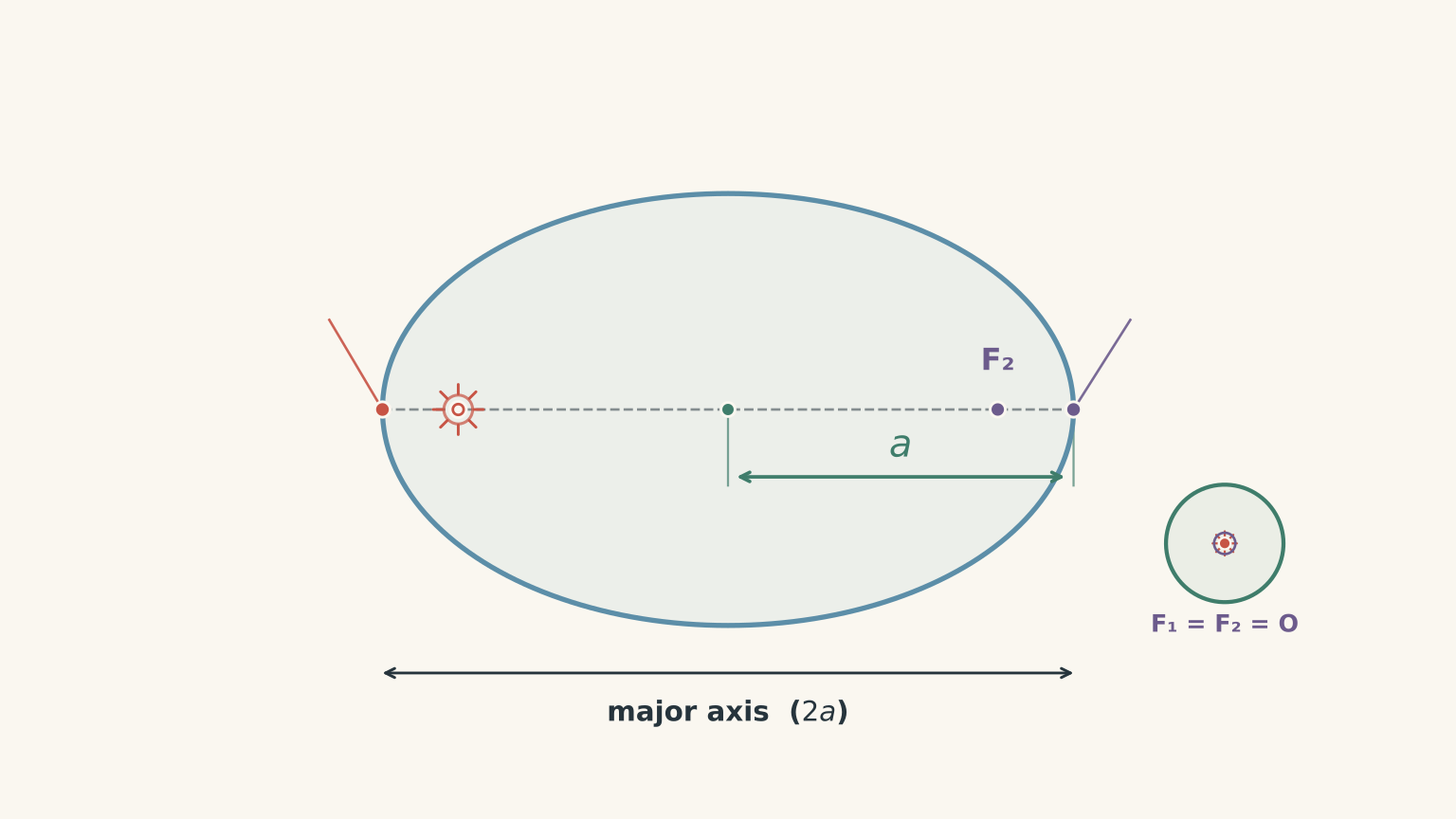
The semi-major axis, \(a\), is half the length of the ellipse’s longest diameter. It is one of the most important quantities in orbital calculations.
The closest point to the central body is called periapsis, and the farthest point is called apoapsis. For an orbit around the Sun, these points are called perihelion and aphelion.
For a circular orbit, the distance from the central body stays constant. For an elliptical orbit, that distance changes throughout the revolution.
This distinction becomes important when we calculate orbital periods.
2. The law of equal areas: why does orbital speed change?
Picture a planet moving along an elliptical orbit. As it approaches the Sun, it speeds up. As it moves farther away, it slows down.
Kepler’s second law gives a precise description of this behaviour:
A line joining the central body to the orbiting object sweeps out equal areas in equal intervals of time.
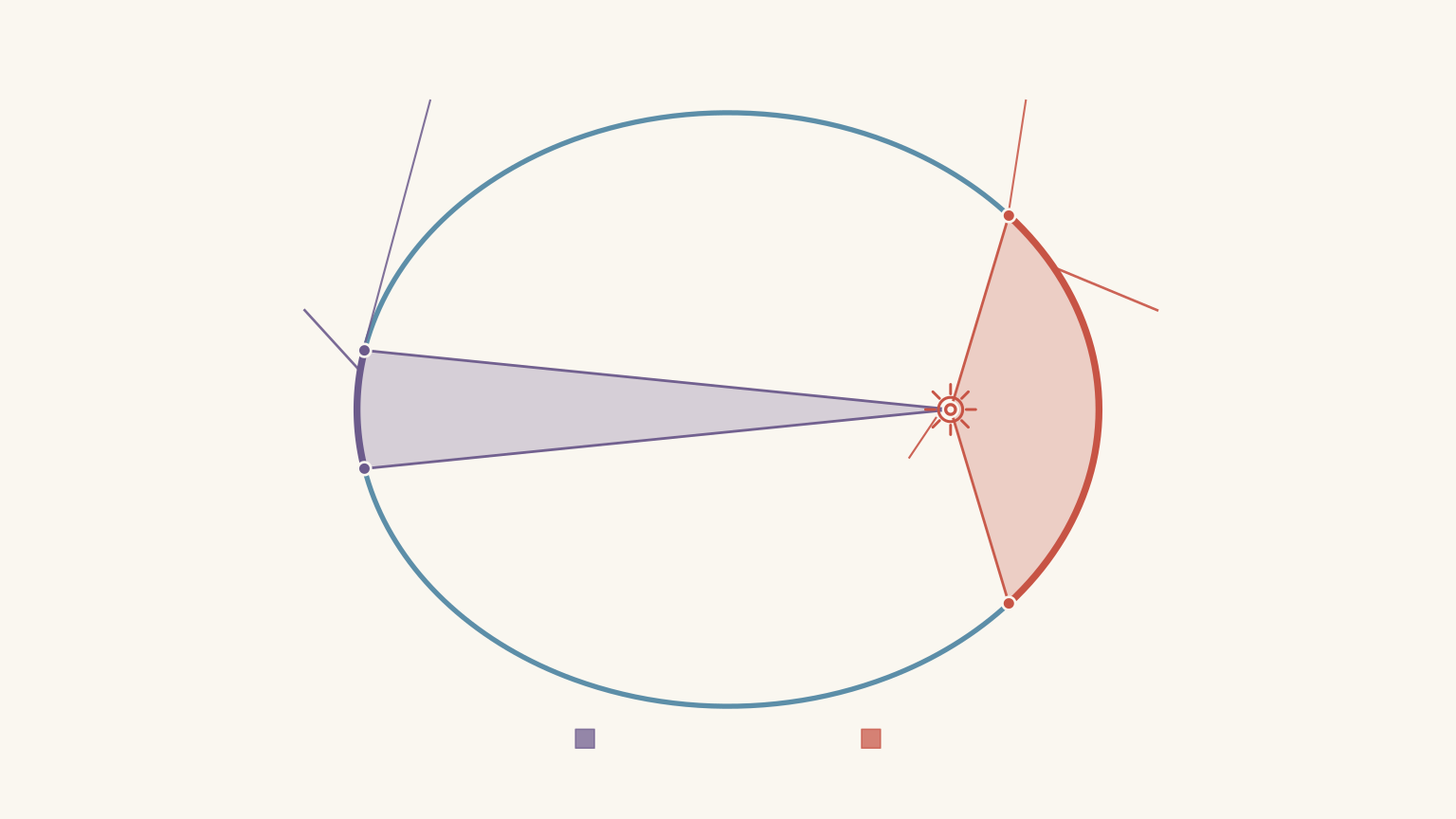
Think about two equal intervals of 10 minutes: one when the planet is close to the Sun, and one when it is far away.
Which interval covers more distance along the orbit?
The interval near the Sun covers more distance. The planet is moving faster there.
Why does equal area lead to different distances? Near periapsis, the distance to the Sun is smaller. To sweep out the same area in the same time, the planet must move through a larger angle, covering a longer section of its path.
At apoapsis, the greater distance means the same area can be swept out through a smaller angle. The planet travels a shorter section of its path in that time.
This is not an approximation about planets being faster when they feel a stronger gravitational pull. It is the specific relationship Kepler’s second law describes. Newton’s model will explain how gravity produces the motion.
3. The law of periods: how does orbital size affect period?
Now consider two planets orbiting the same star. One follows a small orbit, and the other follows a much larger one.
The larger orbit has a longer circumference. However, the planet also moves more slowly in its larger orbit. You cannot determine the period from circumference alone.
Kepler’s third law connects the orbital period to the semi-major axis:
\[ T^2 \propto a^3 \]
Here:
- \(T\) is the orbital period, or time taken to complete one revolution.
- \(a\) is the semi-major axis of the orbit.
- The symbol \(\propto\) means “is proportional to”.
For two objects orbiting the same central body, this becomes
\[ \frac{T_2^2}{T_1^2} = \frac{a_2^3}{a_1^3} \]
Taking the square root gives the more useful form:
\[ \frac{T_2}{T_1} = \left(\frac{a_2}{a_1}\right)^{3/2} \]
For circular orbits, the semi-major axis is simply the orbital radius, so we can replace \(a\) with \(r\).
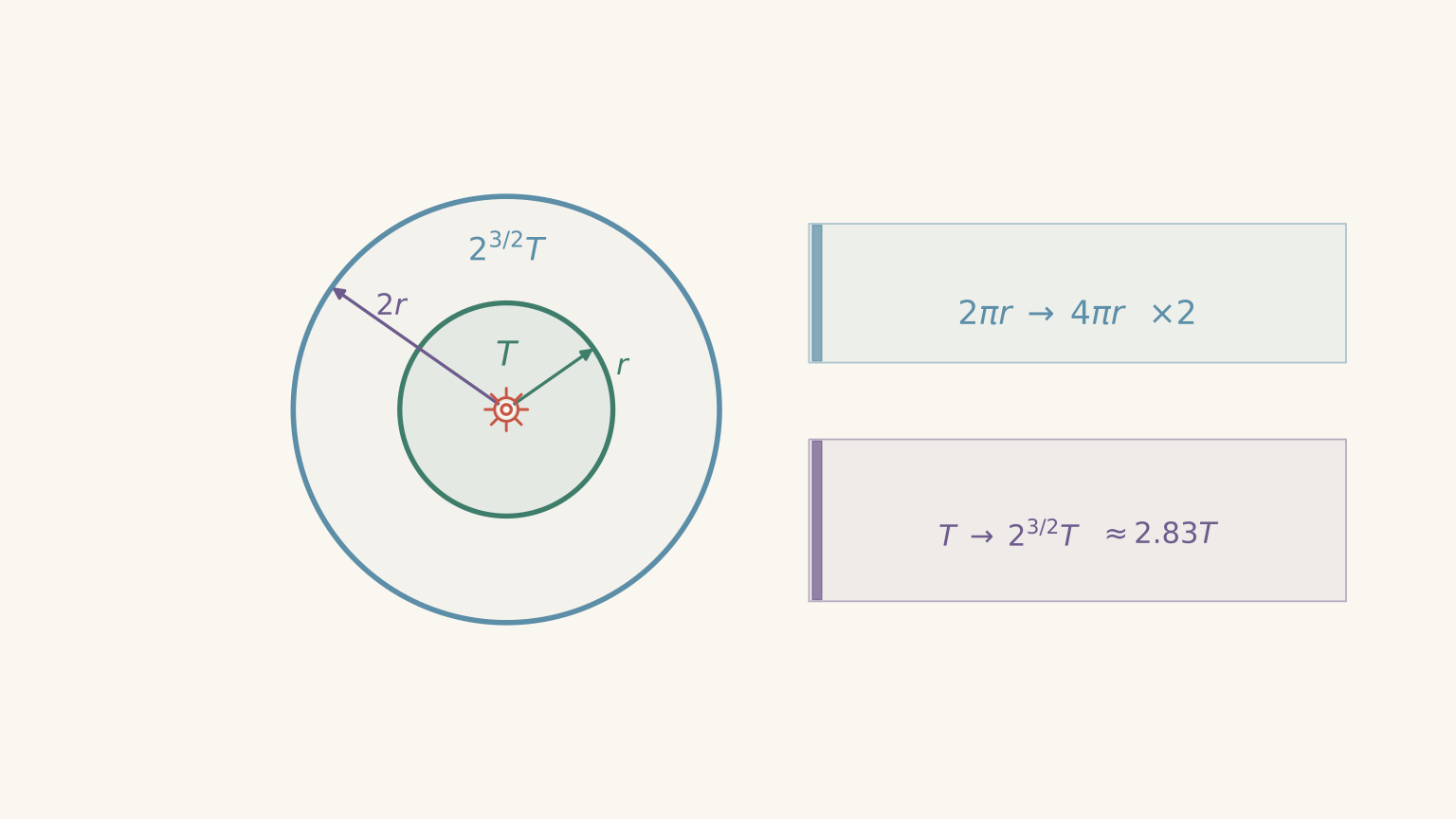
Return to the opening prediction. If the orbital radius doubles, the period changes by a factor of
\[ \frac{T_2}{T_1} =2^{3/2} \approx 2.83 \]
The period becomes approximately 2.83 times as long, not twice as long.
This is the first major distinction between the laws:
- Kepler’s first law describes orbital shape.
- Kepler’s second law describes how orbital speed changes.
- Kepler’s third law quantitatively relates orbital size to period.
Kepler’s laws are already useful for making predictions. But the third law, by itself, does not tell you the period from an orbital radius and central mass unless you also know the relevant proportionality constant. Newton’s model provides that missing connection.
02Newton’s orbital model: where do the numbers come from?
Newton’s model starts with a physical cause: gravity.
The universal law of gravitation gives the magnitude of the gravitational force between two bodies:
\[ F_g=\frac{GMm}{r^2} \]
Here:
- \(F_g\) is the gravitational force, measured in newtons (N).
- \(G\) is the gravitational constant, approximately \(6.67\times10^{-11}\ \mathrm{N\,m^2\,kg^{-2}}\).
- \(M\) is the mass of the central body, in kilograms.
- \(m\) is the mass of the orbiting body, in kilograms.
- \(r\) is the centre-to-centre separation, in metres.
Let’s first assume a circular orbit, with the central body much more massive than the satellite.
Deriving the orbital-period equation
For an object to move in a circle, it needs a net force directed towards the centre. The required magnitude is
\[ F_{\text{net}}=\frac{mv^2}{r} \]
where \(v\) is the orbital speed in metres per second.
For a satellite in a circular orbit, gravity provides this inward net force. Equating the two expressions gives
\[ \frac{GMm}{r^2}=\frac{mv^2}{r} \]
Cancel the satellite mass \(m\) and rearrange:
\[ v^2=\frac{GM}{r} \]
Therefore, the orbital speed is
\[ v=\sqrt{\frac{GM}{r}} \]
This equation already tells us something important: for a given central mass, a satellite in a larger circular orbit moves more slowly.
Now connect speed to period. One complete revolution covers a circumference of \(2\pi r\), so
\[ v=\frac{2\pi r}{T} \]
Substituting this into the previous equation gives
\[ \frac{GM}{r}=\frac{4\pi^2r^2}{T^2} \]
Rearranging for \(T\):
\[ \boxed{T^2=\frac{4\pi^2r^3}{GM}} \]
This is the Newtonian orbital-period equation for a circular orbit when the central body’s mass dominates.
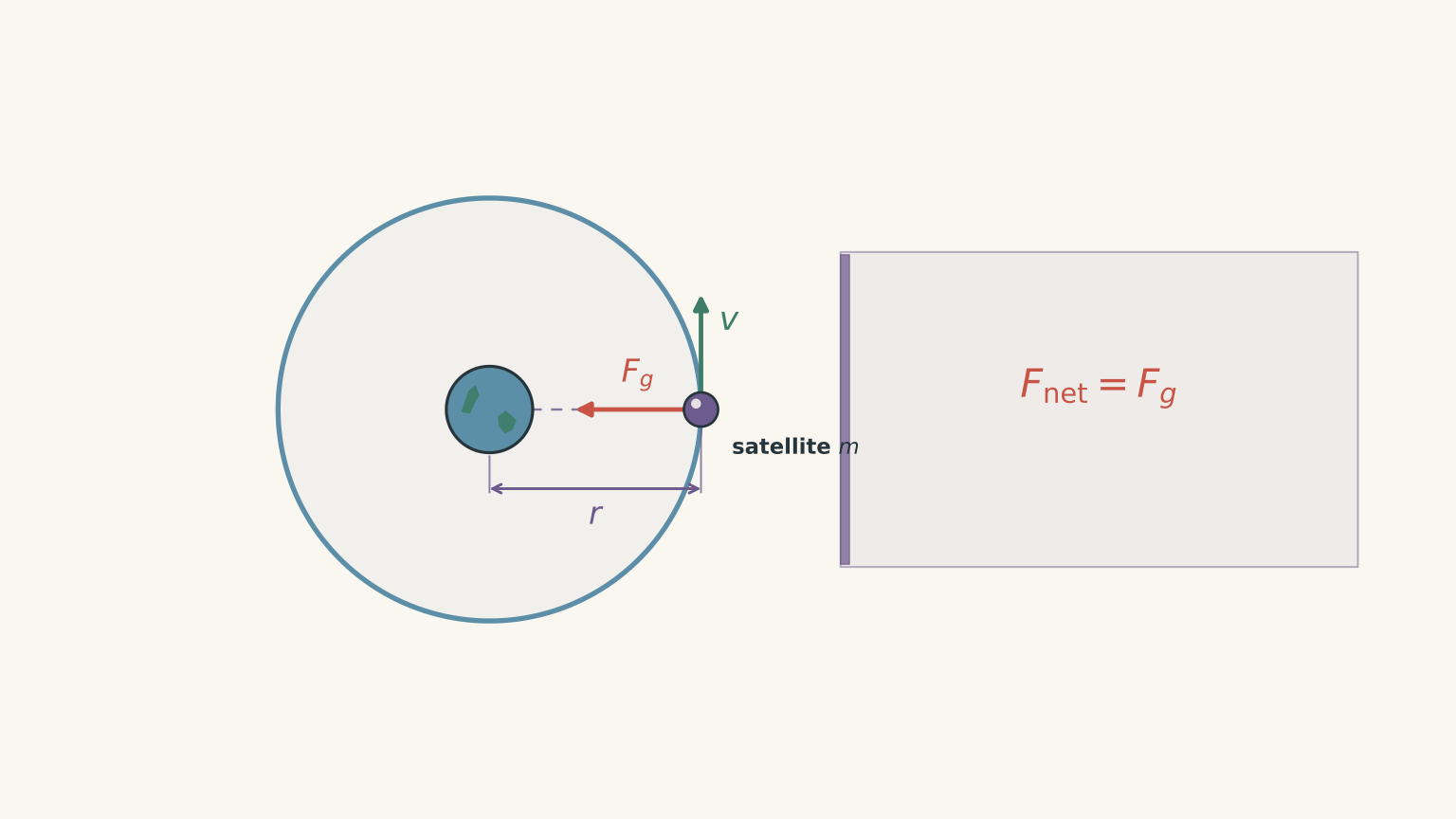
Notice what the equation tells you.
- Increasing \(r\) increases the period.
- Increasing \(M\) decreases the period at a fixed orbital radius.
- The satellite’s own mass \(m\) has cancelled out.
That last result can seem strange. Predict what happens if you double the mass of a satellite without changing its circular orbital radius.
Its orbital period stays the same in this model. The gravitational force doubles, but so does the mass that must be accelerated. The two effects cancel.
This is an approximation for an ordinary satellite orbiting a much more massive planet. In the exact two-body model, the combined mass of both bodies appears in the period equation. For an Earth satellite, the correction is negligible.
What changes for an elliptical orbit?
There is an important limitation to the equation we just derived. It assumes a circular orbit, so \(r\) stays constant.
For an ellipse, the distance between the satellite and the central body changes throughout the orbit. You cannot substitute its instantaneous distance into the circular-orbit period equation and expect the correct period.
Newton’s model gives the corresponding relationship for an elliptical orbit:
\[ T^2=\frac{4\pi^2a^3}{GM} \]
Here, \(a\) is the semi-major axis, not the instantaneous orbital radius. As before, we assume the central mass \(M\) is much greater than the orbiting mass. The exact ideal two-body relationship uses \(M+m\) in the denominator.
If you know the closest and farthest distances, \(r_p\) and \(r_a\), the semi-major axis is
\[ a=\frac{r_p+r_a}{2} \]
This follows because the two extreme distances together span the ellipse’s major axis, whose length is \(2a\).
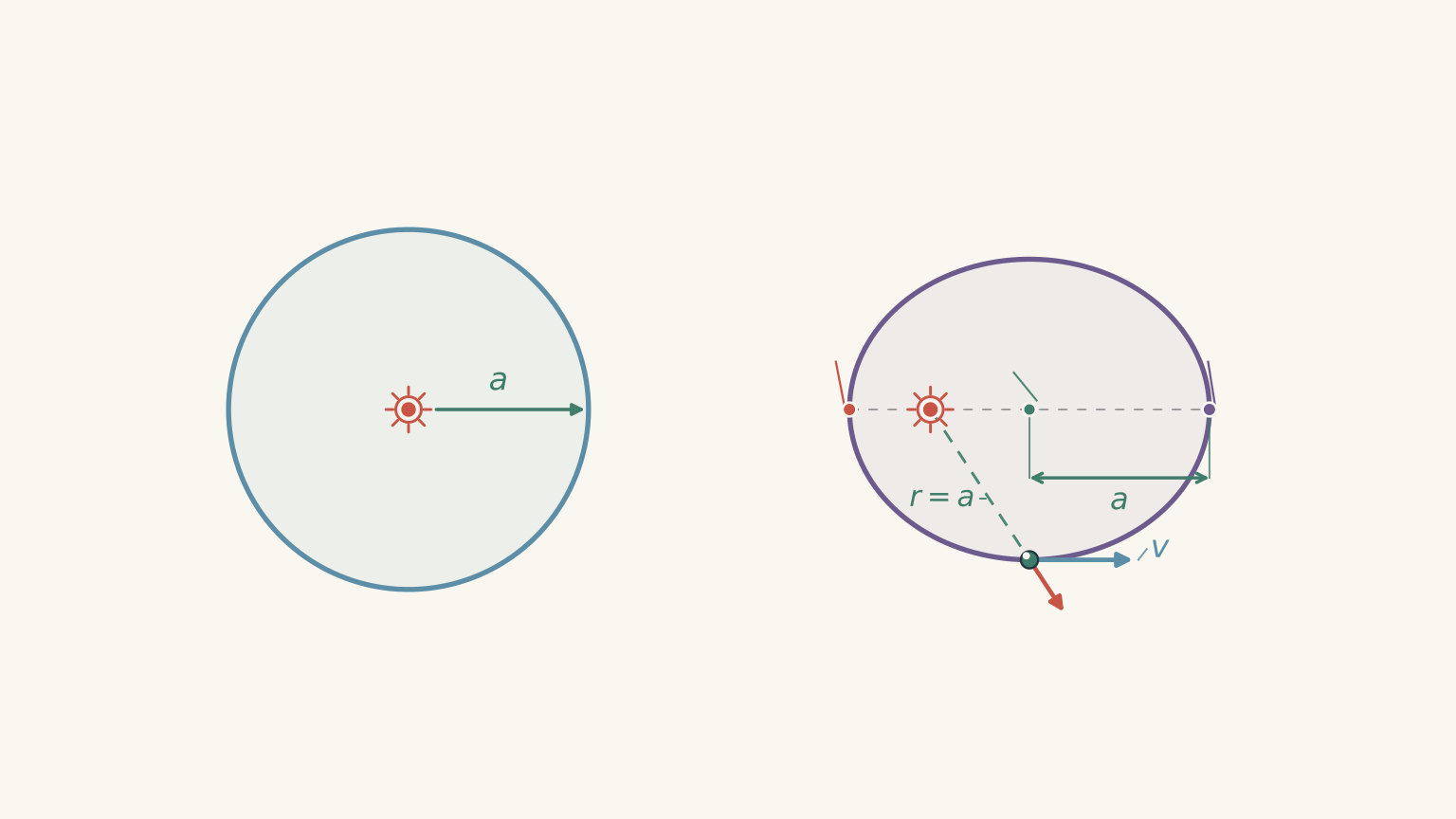
The key idea is that an elliptical orbit can have the same period as a circular orbit with radius \(a\), even though its distance from the central body is not constant.
Newton’s model explains why Kepler’s third law works: for objects orbiting the same dominant central mass, the factor \(4\pi^2/(GM)\) is constant. The remaining relationship is \(T^2\propto a^3\).
Newton’s model also explains the equal-area law. Gravity acts along the line joining the two bodies, preserving the equal-area relationship for an ideal gravitational orbit.
Kepler’s laws and Newton’s model are therefore not competing explanations. Kepler describes the orbital patterns; Newton supplies the physical model that accounts for them and connects them to mass and force.
03Which model should you use in an exam?
| If the question asks you to… | Start with… |
|---|---|
| Identify the shape of a bound orbit | Kepler’s first law |
| Explain why a satellite speeds up near its closest approach | Kepler’s second law |
| Compare periods around the same central body | Kepler’s third law |
| Calculate a circular orbital period from mass and radius | Newton’s orbital-period equation |
| Estimate a central mass from an observed period and radius | Rearrange Newton’s equation |
| Calculate the period of an elliptical orbit | Use the semi-major axis \(a\) |
There are three common traps to avoid.
Trap 1: Confusing altitude with orbital radius. Altitude is measured above the planet’s surface. Orbital radius is measured from its centre. If the planet has radius \(R\) and the satellite’s altitude is \(h\), then
\[ r=R+h \]
Trap 2: Treating centripetal force as an extra force. Centripetal force is the name for the net inward force required for circular motion. For a satellite in a circular orbit, gravity provides that force.
Trap 3: Using instantaneous radius for an elliptical period. Use the semi-major axis \(a\). Also, remember that \(v=\sqrt{GM/r}\) is the circular-orbit speed equation, not a general formula for the speed at every point on an ellipse.
04Worked example 1: Find a satellite’s orbital period
A satellite moves in a circular orbit 400 km above Earth’s surface. Estimate its orbital period using the following data:
- Earth’s radius: \(R_E=6.37\times10^6\ \mathrm{m}\)
- Earth’s mass: \(M_E=5.97\times10^{24}\ \mathrm{kg}\)
- Gravitational constant: \(G=6.67\times10^{-11}\ \mathrm{N\,m^2\,kg^{-2}}\)
Step 1
Convert the altitude to metres:
\[ h=400\ \mathrm{km}=4.00\times10^5\ \mathrm{m} \]
Add the altitude to Earth’s radius:
\[ \begin{aligned} r&=R_E+h\\ &=6.37\times10^6+4.00\times10^5\\ &=6.77\times10^6\ \mathrm{m} \end{aligned} \]
The satellite is \(6.77\times10^6\ \mathrm{m}\) from Earth’s centre, not \(4.00\times10^5\ \mathrm{m}\).
Step 2
We know the central mass and orbital radius, so use
\[ T=2\pi\sqrt{\frac{r^3}{GM}} \]
Step 3
Using SI units throughout,
\[ \begin{aligned} T&=2\pi\sqrt{ \frac{(6.77\times10^6)^3} {(6.67\times10^{-11})(5.97\times10^{24})} }\\[6pt] &\approx5.54\times10^3\ \mathrm{s} \end{aligned} \]
Step 4
\[ T=\frac{5.54\times10^3}{60} \approx92.4\ \mathrm{min} \]
The satellite takes approximately 92.4 minutes per orbit.
The result is physically reasonable for a low Earth orbit. Notice that the calculation required the planet’s mass and the satellite’s distance from the planet’s centre. Kepler’s third law would give a period ratio if a suitable reference orbit were known, but Newton’s equation lets us calculate the period directly.
05Worked example 2: Estimate a planet’s mass from a moon’s orbit
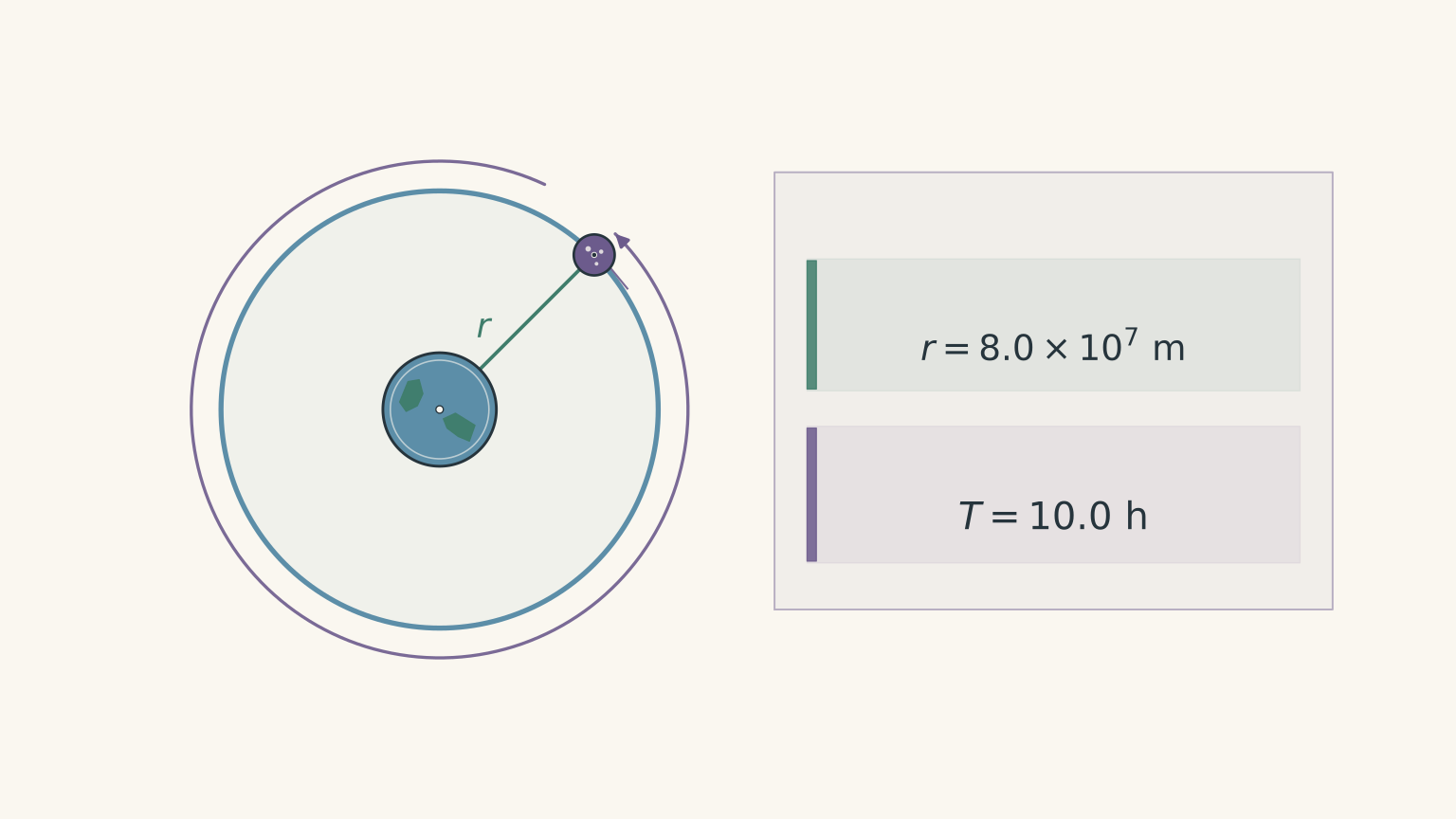
A moon moves in a circular orbit around a planet. Its orbital radius is \(8.0\times10^7\ \mathrm{m}\), and its period is 10.0 hours.
Assuming the moon’s mass is negligible compared with the planet’s mass, estimate the planet’s mass.
Step 1
Start with
\[ T^2=\frac{4\pi^2r^3}{GM} \]
Rearranging gives
\[ M=\frac{4\pi^2r^3}{GT^2} \]
We can now calculate the mass from the observed orbit.
Step 2
The equation requires SI units:
\[ T=10.0\times3600 =3.60\times10^4\ \mathrm{s} \]
The orbital radius is already in metres.
Step 3
\[ \begin{aligned} M&=\frac{4\pi^2r^3}{GT^2}\\[4pt] &=\frac{4\pi^2(8.0\times10^7)^3} {(6.67\times10^{-11})(3.60\times10^4)^2}\\[4pt] &\approx2.34\times10^{26}\ \mathrm{kg} \end{aligned} \]
To two significant figures,
\[ \boxed{M\approx2.3\times10^{26}\ \mathrm{kg}} \]
Step 4
The estimated mass of the planet is \(2.3\times10^{26}\ \mathrm{kg}\). We inferred it from the moon’s orbital radius and period.
This is a powerful feature of Newton’s model. You can use an observed orbit to estimate the mass of a body even when you cannot directly measure its mass. The calculation assumes a circular orbit, a negligible moon mass, and an orbit governed by the planet’s gravity.
06Questions and solutions
Question 1
A planet orbits the same star as Earth, but its semi-major axis is four times Earth’s semi-major axis. Earth’s orbital period is 1.00 year.
Assuming the planet’s mass is negligible compared with the star’s mass, calculate the planet’s orbital period.
Solution 1
The planet’s orbital period is 8.00 years. Kepler’s third law relates the period to the semi-major axis for objects orbiting the same central body.
Use the ratio equation:
\[ \frac{T_2}{T_1} =\left(\frac{a_2}{a_1}\right)^{3/2} \]
Substitute \(a_2/a_1=4\) and \(T_1=1.00\ \mathrm{year}\):
\[ \begin{aligned} T_2&=1.00\times4^{3/2}\\ &=1.00\times8\\ &=8.00\ \mathrm{years} \end{aligned} \]
The planet takes eight times as long to complete one orbit. The tempting prediction is four years because the semi-major axis is four times as large. That ignores the change in orbital speed.
Question 2
Two satellites orbit Earth in circular orbits.
- Satellite L has an altitude of 400 km.
- Satellite H has an altitude of 1600 km.
Earth’s radius is 6400 km.
Calculate the ratio \(T_H/T_L\), where \(T_H\) and \(T_L\) are the satellites’ orbital periods. Explain why using the ratio of their altitudes directly gives the wrong answer.
Solution 2
The higher satellite’s period is approximately 1.28 times the lower satellite’s period. The calculation must use orbital radii measured from Earth’s centre, not altitudes measured from its surface.
First, calculate both orbital radii:
\[ \begin{aligned} r_L&=6400+400=6800\ \mathrm{km}\\ r_H&=6400+1600=8000\ \mathrm{km} \end{aligned} \]
Both satellites orbit the same central body, so Kepler’s third law gives
\[ \frac{T_H}{T_L} =\left(\frac{r_H}{r_L}\right)^{3/2} \]
Substitute:
\[ \begin{aligned} \frac{T_H}{T_L} &=\left(\frac{8000}{6800}\right)^{3/2}\\ &\approx1.28 \end{aligned} \]
The higher satellite takes about 28% longer to complete one orbit.
The tempting route is to divide the altitudes, \(1600/400=4\), and predict a period ratio of \(4^{3/2}=8\). But those altitudes are measured from Earth’s surface, not its centre. Since Earth is already 6400 km in radius, the actual orbital radii differ by a much smaller proportion.
Question 3
A satellite orbits Planet A, which has mass \(M\), in a circular orbit of radius \(r\) and period \(T_A\).
A second satellite orbits Planet B, which has mass \(4M\), in a circular orbit of radius \(2r\).
Assume the satellite masses are negligible compared with their respective planets.
Determine \(T_B/T_A\), and explain how the increased orbital radius competes with the increased central mass.
Solution 3
The second satellite’s period is \(\sqrt{2}\,T_A\), or approximately 1.41 times the first satellite’s period. The larger orbital radius increases the period more than the greater central mass decreases it.
Newton’s orbital-period equation is
\[ T=2\pi\sqrt{\frac{r^3}{GM}} \]
Taking the ratio cancels the common factors:
\[ \frac{T_B}{T_A} = \sqrt{ \frac{r_B^3/M_B}{r_A^3/M_A} } \]
Substitute \(r_B=2r\), \(M_B=4M\), \(r_A=r\), and \(M_A=M\):
\[ \begin{aligned} \frac{T_B}{T_A} &=\sqrt{\frac{(2r)^3/(4M)}{r^3/M}}\\[4pt] &=\sqrt{\frac{8}{4}}\\[4pt] &=\sqrt{2}\\[4pt] &\approx1.41 \end{aligned} \]
The two changes work in opposite directions. Doubling the radius, by itself, would increase the period by \(2^{3/2}\approx2.83\). Increasing the central mass by a factor of four, at the same radius, would halve the period.
Combining the changes gives \(2.83/2\approx1.41\). The larger orbit wins: the second satellite takes longer to complete one revolution.
Question 4
A satellite follows an elliptical orbit around a planet. Its closest distance to the planet’s centre is
\[ r_p=7.0\times10^6\ \mathrm{m} \]
Its farthest distance is
\[ r_a=2.8\times10^7\ \mathrm{m} \]
Compare its orbital period with the period of a circular orbit at radius \(r_p\). Also determine the ratio of its speed at periapsis to its speed at apoapsis.
Solution 4
The elliptical orbit takes approximately 3.95 times as long as the circular orbit at \(r_p\), and the satellite’s periapsis speed is four times its apoapsis speed. The period follows from the semi-major axis, while the speed ratio follows from Kepler’s equal-area law.
Step 1: Calculate the semi-major axis.
For an ellipse,
\[ a=\frac{r_p+r_a}{2} \]
Substituting the given distances,
\[ \begin{aligned} a&=\frac{7.0\times10^6+2.8\times10^7}{2}\\[4pt] &=1.75\times10^7\ \mathrm{m} \end{aligned} \]
Relative to the radius of the circular reference orbit,
\[ \frac{a}{r_p} =\frac{1.75\times10^7}{7.0\times10^6} =2.5 \]
Step 2: Compare the orbital periods.
Both orbits are around the same planet. Kepler’s third law therefore gives
\[ \begin{aligned} \frac{T_{\text{ellipse}}}{T_{\text{circle}}} &=\left(\frac{a}{r_p}\right)^{3/2}\\[4pt] &=2.5^{3/2}\\[4pt] &\approx3.95 \end{aligned} \]
The elliptical orbit takes about 3.95 times as long as the circular orbit at the closest-approach radius.
Notice that we used \(a\), not \(r_a\) or \(r_p\), in the period ratio.
Step 3: Compare the speeds at periapsis and apoapsis.
Kepler’s second law says equal areas are swept out in equal times. At periapsis and apoapsis, the velocity is perpendicular to the radius line, so the area swept per unit time is proportional to \(rv\).
Therefore,
\[ r_pv_p=r_av_a \]
Rearranging,
\[ \begin{aligned} \frac{v_p}{v_a} &=\frac{r_a}{r_p}\\[4pt] &=\frac{2.8\times10^7}{7.0\times10^6}\\[4pt] &=4 \end{aligned} \]
The satellite travels four times faster at periapsis than at apoapsis.
This result also confirms that its speed cannot remain constant throughout the elliptical orbit. The changing distance and speed are linked by the equal-area law.
Question 5
Two spacecraft orbit the same planet.
Spacecraft A follows a circular orbit of radius \(R\) and period \(T\). Spacecraft B has a measured orbital period of \(8T\).
A tracking observation places spacecraft B at a distance \(4R\) from the planet’s centre.
A student concludes that spacecraft B must be in a circular orbit of radius \(4R\).
(a) Is the conclusion necessarily correct from the period and distance measurements alone?
(b) Now suppose the tracking observation also shows that spacecraft B’s instantaneous velocity is perpendicular to the line joining it to the planet. Does this additional information make the conclusion correct?
Explain both parts using Kepler’s laws and the geometry of an ellipse. Assume both spacecraft follow bound gravitational orbits around the same dominant central mass.
Solution 5
(a) No. (b) Yes. The period fixes the semi-major axis, but a single distance measurement does not establish that an orbit is circular. The additional information about the direction of motion rules out a non-circular ellipse at that particular distance.
Step 1: Use the measured period to find the semi-major axis of B’s orbit.
Spacecraft A is in a circle, so its semi-major axis is \(R\). Kepler’s third law gives
\[ \frac{T_B}{T_A} =\left(\frac{a_B}{R}\right)^{3/2} \]
The measured period ratio is \(8\), so
\[ \begin{aligned} 8&=\left(\frac{a_B}{R}\right)^{3/2}\\[4pt] \frac{a_B}{R}&=8^{2/3}\\[4pt] a_B&=4R \end{aligned} \]
The semi-major axis of B’s orbit is \(4R\).
Step 2: Decide whether this proves the orbit is circular.
It does not. The tracking observation tells us that B’s instantaneous distance is \(4R\), which happens to equal its semi-major axis.
But an elliptical orbit can pass through a point where its distance from the focus equals its semi-major axis. At that point, the spacecraft is not at periapsis or apoapsis. It has a velocity component towards or away from the planet.
Therefore, the period and distance measurements alone are consistent with a circular orbit, but they do not require one. A non-circular ellipse is also possible.
The tempting route is to say that a period of \(8T\) matches a circular orbit of radius \(4R\), so B must be in that circle. The error is treating the semi-major axis as if it were the instantaneous orbital radius at every point.
Step 3: Use the additional information about the direction of motion.
If B’s velocity is perpendicular to the line joining it to the planet, it has no instantaneous velocity component towards or away from the planet. For a bound gravitational orbit, this means B is at an apsis: either periapsis or apoapsis.
For an ellipse, let \(e\) be its eccentricity, which measures how stretched the ellipse is. A circle has \(e=0\), while a non-circular ellipse has \(0<e<1\). The extreme orbital distances are
\[ r_p=a_B(1-e) \]
and
\[ r_a=a_B(1+e) \]
If B is at an apsis and its distance is \(r=4R=a_B\), then either
\[ a_B(1-e)=a_B \]
or
\[ a_B(1+e)=a_B \]
Both equations require \(e=0\).
That means B’s orbit must be circular. The extra velocity-direction measurement changes the conclusion because it establishes that B is at an apsis, where a non-circular ellipse cannot have a distance equal to its semi-major axis.
This is the difference between identifying an orbit’s size and identifying its shape. Kepler’s third law determines the semi-major axis from the period, but you need additional information about the orbit’s geometry or motion to establish whether it is circular.
Once you can relate orbital period to semi-major axis and central mass, the next useful step is orbital energy. It lets you explain why a spacecraft changes speed during an orbit, how transfer orbits work, and what distinguishes a bound orbit from a trajectory that escapes a planet’s gravity.