
Why Branched and Straight-Chain Isomers Boil Differently
Why do hydrocarbons with the same molecular formula have different boiling points? Learn how molecular shape affects London dispersion forces, compare straight-chain and branched alkane isomers, and practise applying the trend with worked examples and HSC-style questions.
At 1 atm, straight-chain n-pentane boils at about \(36.1^\circ\text{C}\), while its branched isomer, neopentane, boils at about \(9.5^\circ\text{C}\). Both have the molecular formula \(\ce{C5H12}\), so they have the same molar mass and the same number of electrons. Why does n-pentane need to be heated much more before it boils?
Before reading on, predict which shape should be harder to pull apart into a gas: an extended chain or a compact, branched molecule.
Pentane isomers: same formula, different boiling points
| n-pentane | CH₃CH₂CH₂CH₂CH₃ Straight-chain isomer of C₅H₁₂ Normal boiling point: 36.1 °C Less compact shape; typically more extensive intermolecular contact |
|---|---|
| Neopentane | C(CH₃)₄ Highly branched isomer of C₅H₁₂ Normal boiling point: 9.5 °C Compact, symmetrical structure; weaker overall cohesive interactions in the liquid |
01Start with molecular shape
Picture molecules moving, rotating, and sliding past one another in a liquid. They are constantly changing their positions, but their shapes still influence how they interact with their neighbours.
A straight-chain molecule is relatively elongated. It can lie alongside neighbouring molecules over an extended region. A branched molecule tends to be more compact, so its shape often allows less extensive close contact with surrounding molecules.
Think of a crowded lift. A person standing with their arms stretched out can make contact with more people than someone standing with their elbows tucked in. The straight-chain molecule is a bit like the first person; the compact branched molecule is like the second.
The analogy has a limit: molecules do not have literal arms or hard surfaces. Their attractions arise from interactions between electron clouds. The analogy simply helps you picture why shape matters.
Text fallback: shape and dispersion
| Straight-chain n-pentane | CH₃CH₂CH₂CH₂CH₃ Elongated shape permits more extended close contact with neighbours. |
|---|---|
| Compact neopentane | C(CH₃)₄ Compact shape typically permits less extensive close contact with neighbours. |
Which arrangement would typically require more energy to separate into a gas?
The straight-chain arrangement. Its shape tends to allow more extensive close contact with neighbouring molecules, increasing the overall intermolecular attraction in the liquid.
Now we need to identify the force responsible for that attraction.
02Why dispersion forces depend on shape
Hydrocarbons such as pentane are treated as non-polar molecules at HSC level. They do not have permanent dipoles, and they cannot form hydrogen bonds.
Their dominant intermolecular forces are London dispersion forces.
These forces arise because electrons are constantly moving. At any instant, the electron distribution in a molecule can become uneven, creating a temporary dipole. This temporary dipole can distort the electron cloud of a neighbouring molecule, inducing another dipole. The two molecules then attract one another.
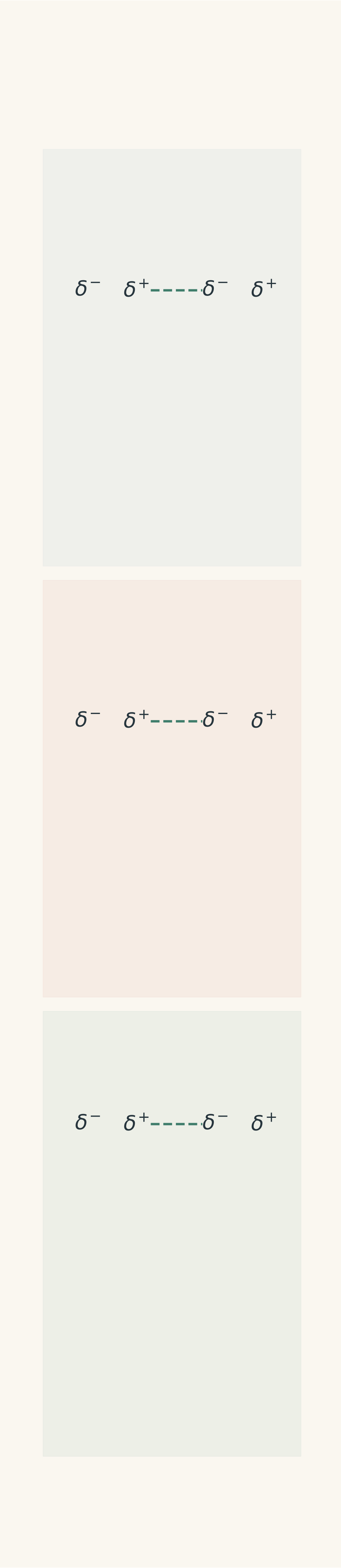
Every alkane experiences London dispersion forces, including both straight-chain and branched isomers.
The important point is that these isomers have the same molecular formula. They contain the same types and numbers of atoms, have the same molar mass, and have broadly similar overall polarizability. Branching does not remove electrons or change the substance into a different functional group.
Instead, branching changes the arrangement of the atoms and therefore the way neighbouring molecules can approach one another.
For a typical comparison between straight-chain and more highly branched alkanes:
- A more extended shape tends to permit more extensive close contact between neighbouring molecules.
- More extensive close contact tends to produce stronger overall dispersion attractions in the liquid.
- A compact shape tends to reduce that effective contact, weakening the overall intermolecular attractions.
This is a useful model, not an exact calculation of molecular forces. Molecules move and rotate, and their electron clouds do not behave like rigid surfaces. Shape helps explain the trend, but a structural drawing alone cannot predict every boiling point exactly.
03From intermolecular forces to boiling point
A liquid boils when its vapour pressure equals the external pressure.
The vapour pressure is the pressure exerted by a vapour in equilibrium with its liquid at a particular temperature. The normal boiling point is the temperature at which that vapour pressure reaches 1 atm.
Consider two isomers at the same temperature.
If one has stronger average intermolecular attractions, its molecules are held more strongly within the liquid. Its equilibrium vapour pressure is generally lower, so it must be heated further before its vapour pressure reaches 1 atm.
If the other has weaker average attractions, it can develop a higher vapour pressure at the same temperature. It reaches 1 atm at a lower temperature, giving it a lower normal boiling point.
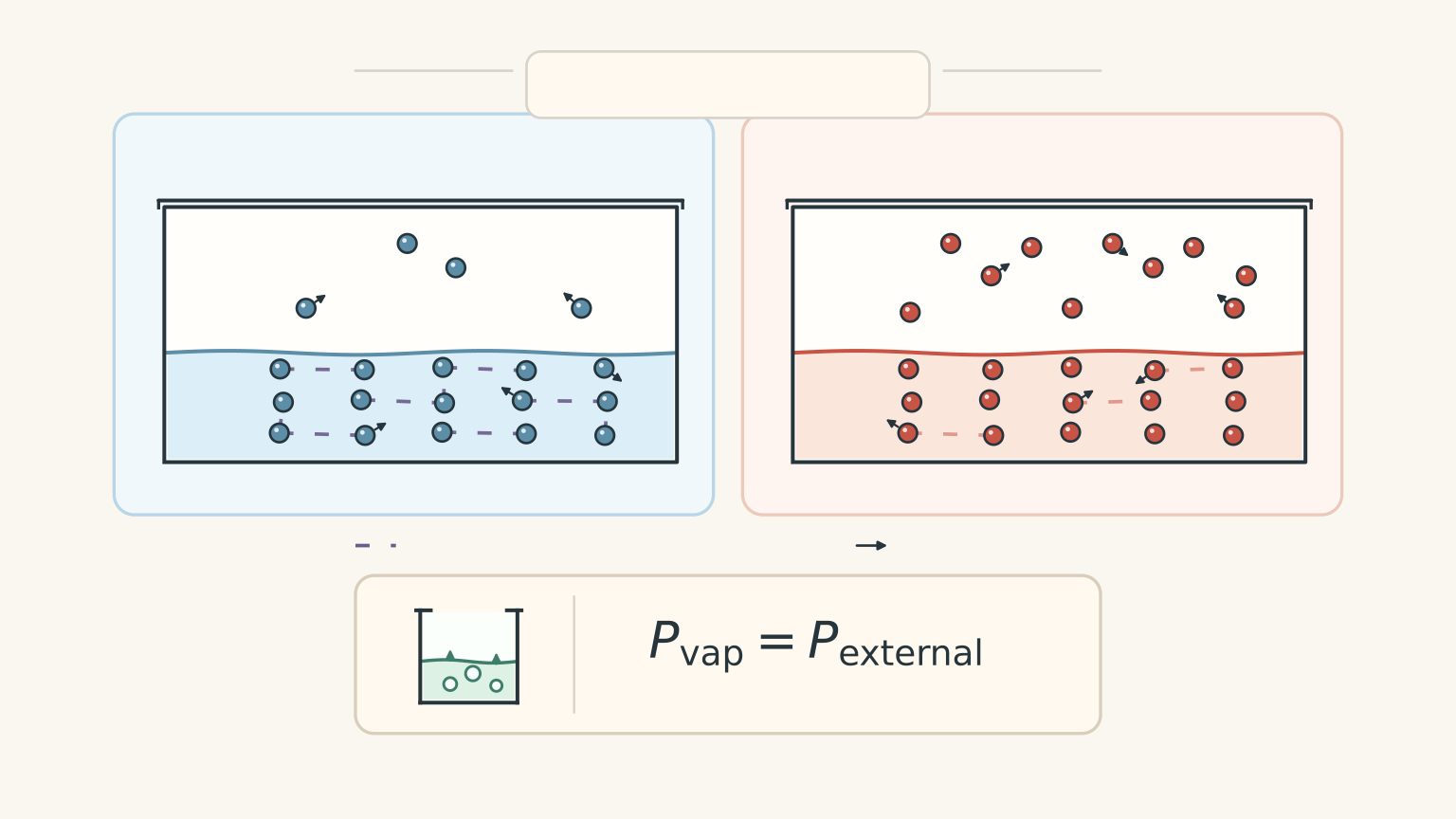
For these hydrocarbons, the reasoning chain is:
Molecular shape → effective close contact → overall dispersion attractions → vapour pressure → boiling point.
One distinction is worth getting right in an exam: boiling does not break the covalent C-C or C-H bonds within each hydrocarbon molecule. The molecules separate from one another as the liquid becomes a gas. Their covalent bonds remain intact.
04Compare the pentane isomers
The three structural isomers of \(\ce{C5H12}\) make the trend easy to see.
| Isomer | Condensed structural formula | Normal boiling point |
|---|---|---|
| n-pentane | \(\ce{CH3CH2CH2CH2CH3}\) | \(36.1^\circ\text{C}\) |
| 2-methylbutane | \(\ce{CH3CH(CH3)CH2CH3}\) | \(27.8^\circ\text{C}\) |
| 2,2-dimethylpropane (neopentane) | \(\ce{C(CH3)4}\) | \(9.5^\circ\text{C}\) |
All three have the same molecular formula and molar mass. They are all alkanes, so their dominant intermolecular attractions are London dispersion forces.
Yet their boiling points differ substantially.
The straight-chain isomer, n-pentane, has the highest boiling point. The highly branched, compact isomer, neopentane, has the lowest. The intermediate structure, 2-methylbutane, falls between them.
For these isomers, increasing branching is associated with a more compact shape and weaker overall intermolecular attractions in the liquid.
However, be careful with the rule you take from this comparison.
More branching often lowers the boiling point of an alkane, but branch count alone does not determine the exact boiling point. The position of each branch changes the overall shape, and different shapes can produce different patterns of intermolecular contact.
That distinction becomes important when two molecules are both branched.
05Worked example: Compare two butane isomers
At 1 atm, n-butane boils at \(-0.5^\circ\text{C}\), while 2-methylpropane boils at \(-11.7^\circ\text{C}\). Calculate the difference between their boiling points and explain which isomer has stronger average intermolecular attractions.
Step 1
Both molecules have the formula \(\ce{C4H10}\), so they have the same molar mass. Let \(T_b\) represent a boiling point and \(\Delta T_b\) the difference between the two boiling points.
Subtract the lower boiling point from the higher one:
\[ \Delta T_b = T_b(\text{n-butane})- T_b(\text{2-methylpropane}) \]
Step 2
\[ \begin{aligned} \Delta T_b &= (-0.5)-(-11.7)\\ &= -0.5+11.7\\ &= 11.2^\circ\text{C} \end{aligned} \]
The difference is \(11.2^\circ\text{C}\).
Step 3
n-Butane is the less-branched, more extended isomer. Its shape tends to allow more extensive close contact with neighbouring molecules, producing stronger overall dispersion attractions in the liquid.
It therefore requires a higher temperature to reach a vapour pressure of 1 atm. n-Butane boils \(11.2^\circ\text{C}\) higher than 2-methylpropane.
06Why branch count is not enough
Suppose two isomers both have two methyl branches. Should they have the same boiling point?
No. The positions of the branches can give the molecules different overall shapes, even when their molecular formulas and branch counts match.
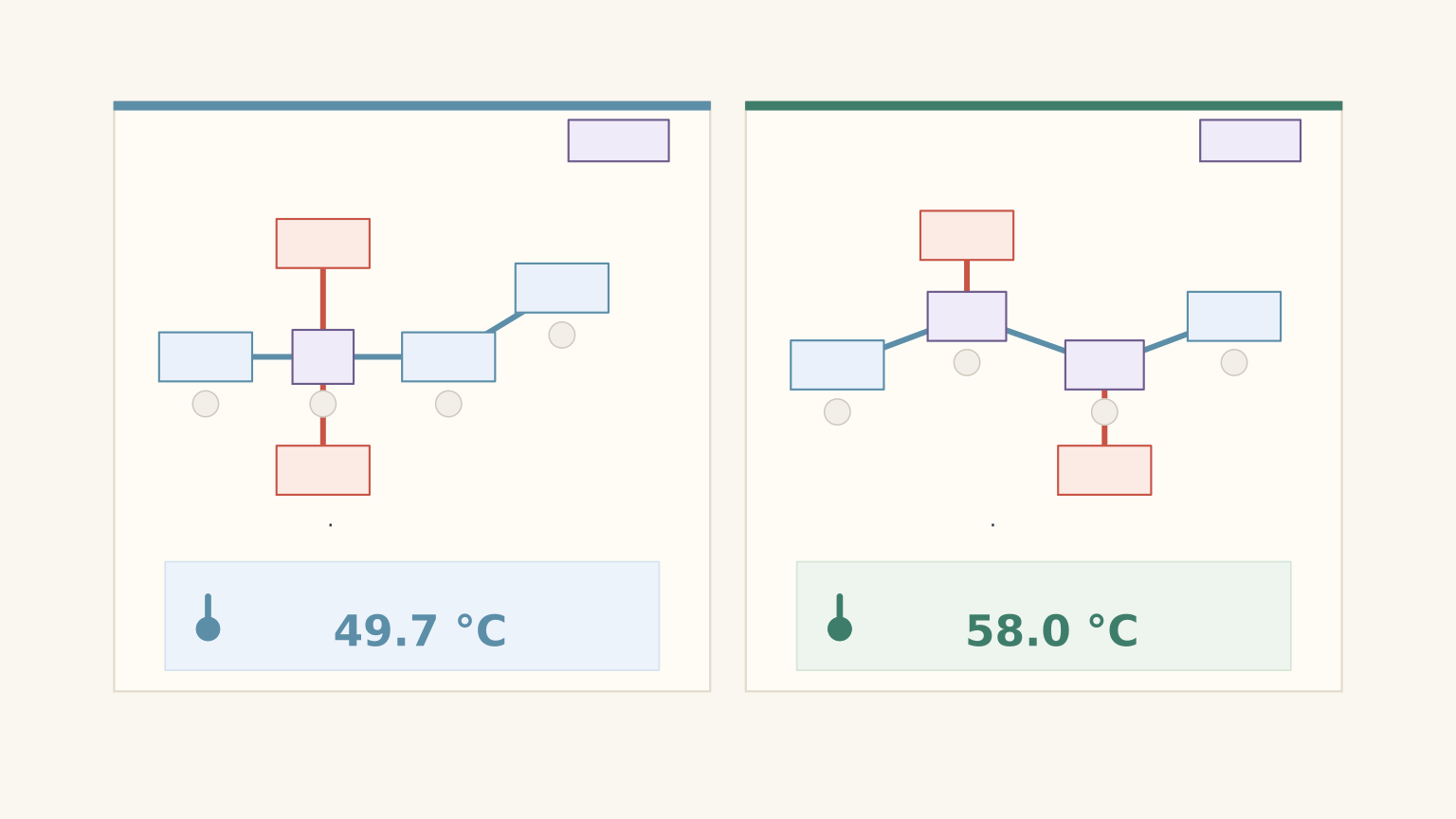
These two \(\ce{C6H14}\) isomers demonstrate why the simple rule needs care. Both have two methyl branches, but 2,2-dimethylbutane boils at about \(49.7^\circ\text{C}\), while 2,3-dimethylbutane boils at about \(58.0^\circ\text{C}\).
The second isomer has the higher boiling point. Its different arrangement produces stronger overall cohesive effects in the liquid than those of the more compact 2,2-dimethylbutane.
The exact boiling point depends on the molecule’s overall shape and intermolecular interactions, not simply on counting branches.
07Worked example: Two isomers with the same number of branches
At 1 atm, 2,2-dimethylbutane boils at \(49.7^\circ\text{C}\) and 2,3-dimethylbutane boils at \(58.0^\circ\text{C}\). Both have the formula \(\ce{C6H14}\) and two methyl branches. Calculate the boiling-point difference and explain why the results do not contradict the usual branching trend.
Step 1
The molecules have the same molecular formula and molar mass. Their different boiling points cannot be explained by a difference in the number of atoms or by a different functional group.
Step 2
\[ \begin{aligned} \Delta T_b &= T_b(\text{2,3-dimethylbutane})\\ &\quad -T_b(\text{2,2-dimethylbutane})\\ &=58.0^\circ\text{C}-49.7^\circ\text{C}\\ &=8.3^\circ\text{C} \end{aligned} \]
The difference is \(8.3^\circ\text{C}\).
Step 3
2,3-dimethylbutane boils \(8.3^\circ\text{C}\) higher because its arrangement produces stronger overall intermolecular attractions in the liquid than those of 2,2-dimethylbutane.
The more compact 2,2-dimethylbutane structure tends to allow less extensive close contact. The branch positions matter, so counting two branches in each molecule is not enough to predict equal boiling points.
The general trend remains useful, but the exact order between branched isomers requires attention to their structures and, for close comparisons, reliable boiling-point data.
08A reliable way to explain boiling-point trends
When an HSC question asks you to explain why two hydrocarbon isomers have different boiling points, build your answer in this order:
- Establish what is the same. The isomers have the same molecular formula and molar mass.
- Identify the intermolecular force. London dispersion forces dominate for these non-polar alkanes.
- Compare the shapes. Explain how branching changes the effective close contact between neighbouring molecules.
- Connect shape to attraction. More extensive contact generally gives stronger overall dispersion attractions.
- Finish with boiling point. Stronger average attractions generally mean a lower vapour pressure at a given temperature and a higher boiling point at the same external pressure.
Avoid saying that branching weakens the covalent bonds within the molecule. It does not. Also avoid saying that branched molecules have fewer electrons: structural isomers have the same total number of electrons.
One final boundary matters. Do not automatically apply the boiling-point trend to melting points. Boiling compares a liquid with its gas, whereas melting compares a solid crystal with its liquid. How efficiently molecules pack into a crystal can strongly affect the melting point.
09Questions and solutions
Question 1
At 1 atm, n-pentane boils at \(36.1^\circ\text{C}\), while 2-methylbutane boils at \(27.8^\circ\text{C}\).
Calculate the difference between their boiling points and explain why n-pentane has the higher value.
Solution 1
n-Pentane boils \(8.3^\circ\text{C}\) higher than 2-methylbutane because its more extended shape tends to produce stronger overall dispersion attractions in the liquid.
Both isomers have the formula \(\ce{C5H12}\), so their molar masses are identical.
Let \(\Delta T_b\) be the difference between their boiling points:
\[ \begin{aligned} \Delta T_b &=36.1^\circ\text{C}-27.8^\circ\text{C}\\ &=8.3^\circ\text{C} \end{aligned} \]
The result is \(8.3^\circ\text{C}\).
The less-branched n-pentane molecules tend to make more extensive close contact with neighbouring molecules. This strengthens the overall dispersion attractions, so a higher temperature is needed for the vapour pressure to reach 1 atm.
Question 2
Three isomers of \(\ce{C6H14}\) have the following normal boiling points:
| Isomer | Normal boiling point |
|---|---|
| n-hexane | \(68.7^\circ\text{C}\) |
| 2-methylpentane | \(60.3^\circ\text{C}\) |
| 3-methylpentane | \(63.3^\circ\text{C}\) |
A student argues that 2-methylpentane and 3-methylpentane must have identical boiling points because each has one methyl branch.
State the correct boiling-point order, calculate the difference between the two branched isomers, and explain the student’s error.
Solution 2
The correct order is:
\[ \text{n-hexane} > \text{3-methylpentane} > \text{2-methylpentane} \]
The difference between the two branched isomers is \(3.0^\circ\text{C}\):
\[ \begin{aligned} \Delta T_b &=63.3^\circ\text{C}-60.3^\circ\text{C}\\ &=3.0^\circ\text{C} \end{aligned} \]
All three molecules have the same molecular formula and molar mass. The difference between the branched isomers comes from the arrangement of their atoms, not the number of methyl branches.
Moving a branch changes the molecule’s overall shape and how it can interact with neighbouring molecules. The measured values show that 3-methylpentane has stronger overall intermolecular attractions in the liquid than 2-methylpentane.
The tempting assumption is that the same branch count means the same molecular shape. It does not. Branch position matters.
Question 3
At \(20^\circ\text{C}\), equilibrium vapour-pressure measurements in separate sealed vessels show that neopentane has a higher vapour pressure than n-pentane.
A student objects:
“They have the same molecular formula and are at the same temperature, so their molecules have the same average kinetic energy. Their vapour pressures should therefore be equal.”
Explain why this argument is incorrect, and identify which isomer has the higher normal boiling point.
Solution 3
Neopentane has the higher vapour pressure at \(20^\circ\text{C}\), while n-pentane has the higher normal boiling point.
The student’s first statement is consistent with the temperature being the same: at the same temperature, molecules have the same average kinetic energy in the usual kinetic model.
The mistake is assuming that kinetic energy alone determines vapour pressure. Vapour pressure also depends on how readily molecules escape from the liquid, which is affected by intermolecular attractions.
Neopentane is more compact and tends to have weaker overall dispersion attractions in the liquid. It can therefore sustain a higher equilibrium vapour pressure at the same temperature.
Because neopentane reaches a vapour pressure of 1 atm at a lower temperature, its normal boiling point is lower. n-Pentane’s more extended shape generally produces stronger overall attractions, so it must be heated further before it boils at 1 atm.
Question 4
Two groups compare n-pentane and neopentane.
Group A reports that neopentane has a lower boiling point because it reaches boiling first when heated. However, Group A used a smaller sample, a hotter heat source, and a thermometer positioned differently from the one used for n-pentane.
Is this evidence sufficient to establish the difference in boiling points? Describe how the comparison should be made fairly, and identify at least two variables that must be controlled.
Solution 4
No. Reaching boiling first does not, by itself, establish a lower boiling point. It may simply mean that the sample received heat more quickly.
The time taken to reach boiling depends on factors such as the sample’s starting temperature, the amount of material, the heating rate, and heat losses. These factors affect how quickly the sample heats up, rather than directly determining its equilibrium boiling temperature.
A fair comparison requires the same external pressure, pure samples, calibrated thermometers, and consistent thermometer placement and measurement methods. The temperature should be recorded during sustained boiling, rather than inferred from which sample starts boiling first.
Using comparable sample amounts, starting temperatures, and heating rates also helps make the experiment easier to compare, although these do not determine the equilibrium boiling point when the pressure and sample purity are the same.
The key distinction is between the time taken to reach boiling and the temperature at which boiling occurs. Only a reliable boiling-point measurement supports the conclusion that one isomer has a lower boiling point.
Question 5
At 1 atm, n-pentane has a normal boiling point of \(36.1^\circ\text{C}\) and a melting point of approximately \(-129.7^\circ\text{C}\). Neopentane has a normal boiling point of \(9.5^\circ\text{C}\) and a melting point of approximately \(-16.6^\circ\text{C}\).
A student argues that the melting-point data must be wrong. Their reasoning is that if neopentane’s compact shape leads to weaker dispersion attractions and a lower boiling point, it should also have a lower melting point.
Resolve the apparent contradiction. Distinguish the molecular interactions relevant to boiling from the role of solid crystal packing in melting. Explain why neopentane’s higher melting point does not prove that it has stronger intermolecular attractions in the liquid.
Solution 5
The data are consistent: neopentane has a lower boiling point but a much higher melting point than n-pentane because boiling and melting involve different phase changes.
For boiling, a liquid changes into a gas. The boiling point depends on the balance between the liquid’s intermolecular attractions and the vapour pressure required to match the external pressure. Neopentane’s compact shape tends to produce weaker overall cohesive effects in the liquid, so its vapour pressure reaches 1 atm at a lower temperature.
For melting, a solid crystal changes into a liquid. The melting point depends on the relative stability of the solid and liquid, including how effectively the molecules pack together in the solid crystal.
Neopentane is highly symmetrical. Its shape allows it to pack efficiently in a crystal, helping to stabilise the solid and giving it a much higher melting point than n-pentane.
The student’s tempting route is to assume that weaker liquid-phase attractions must lower both the boiling point and the melting point. That overlooks the additional role of crystal packing in the solid state.
The two observations therefore do not contradict each other. The lower boiling point is consistent with weaker overall intermolecular attractions in the liquid, while the higher melting point reflects the unusual stability of neopentane’s crystal packing.
The broader lesson is that molecular shape affects several physical properties, but not always in the same way. For boiling points, focus on intermolecular attractions in the liquid. For melting points, consider how the molecules arrange themselves in the solid as well.
Once you can connect shape to dispersion forces and vapour pressure, you can use the same reasoning to predict volatility and understand distillation. The more volatile component is generally favoured in the vapour, but separating two isomers with close boiling points can be difficult. The size of the boiling-point difference, measured under the same pressure, is more useful than simply labelling one molecule “branched” and the other “straight-chain”.