
Why Astronauts Feel Weightless Even Though Gravity Acts
Astronauts in orbit feel weightless even though Earth's gravity is still strong. Learn how continuous free fall keeps spacecraft in orbit, why apparent weight differs from gravitational force, and how orbital speed determines motion around Earth.
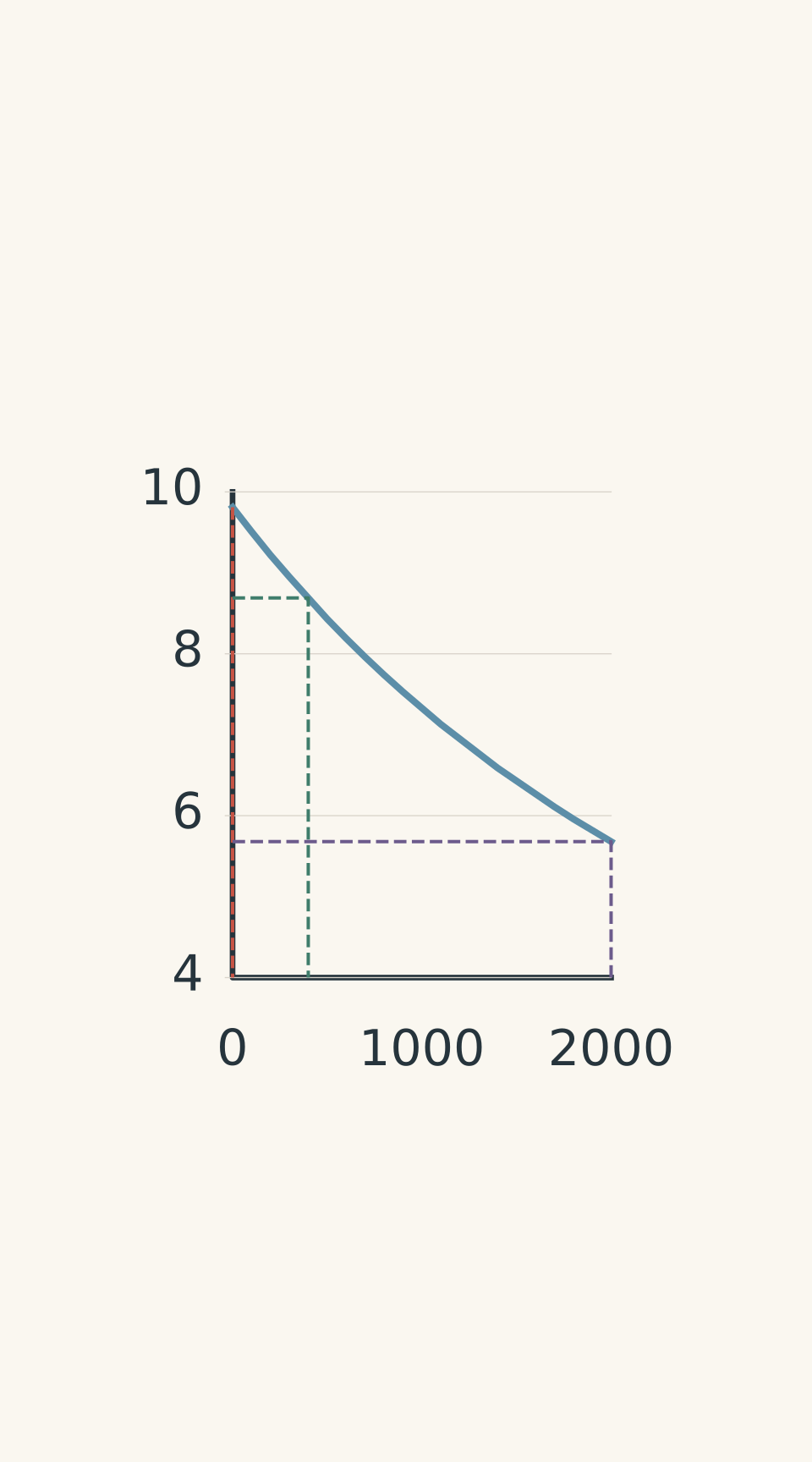
At an altitude of about 400 km above Earth, gravity is still roughly \(8.7\ \text{m s}^{-2}\), close to the \(9.8\ \text{m s}^{-2}\) we experience at Earth’s surface. Yet astronauts in orbit float beside the cabin wall instead of standing on the floor.
If gravity is still pulling them towards Earth, why do they feel weightless?
Predict what a scale beneath a freely floating astronaut would read: approximately their normal Earth weight, or zero? In an ideal orbit, the reading is zero. The surprising part is that gravity has not disappeared. The astronaut and the spacecraft are both falling under its influence.
01The force you feel is not the same as gravity
Stand on a bathroom scale. Earth pulls you downwards because of gravity, while the scale pushes upwards on you. These two forces balance when you are standing still.
The gravitational force on an object near Earth is
\[ F_g=mg \]
where \(F_g\) is gravitational force in newtons, \(m\) is mass in kilograms, and \(g\) is the local gravitational acceleration in \(\text{m s}^{-2}\).
The upward force from the scale is called the normal force, represented by \(N\). It is a contact force exerted perpendicular to a surface.
When you stand still, the forces balance, so
\[ N=mg \]
The scale measures the force you exert on it through contact. Because the scale’s support force equals your gravitational force in this situation, the two seem like the same thing.
They aren’t.
In this guide, apparent weight means the support force acting on you, such as the normal force from a floor or scale. In some physics contexts, the word weight refers directly to gravitational force, so pay attention to the wording of an exam question.
| Situation | Does gravity act? | Support force | Apparent weight |
|---|---|---|---|
| Standing still on Earth | Yes | Non-zero | Non-zero |
| Freely falling | Yes | Zero | Zero |
| Freely floating in an ideal orbit | Yes | Zero | Zero |
Gravity acts in all three situations
| Standing on Earth | Gravity: YES Support force: NON-ZERO Apparent weight: NON-ZERO |
|---|---|
| Free fall | Gravity: YES Support force: ZERO Apparent weight: ZERO |
| Ideal orbit | Gravity: YES Support force: ZERO Apparent weight: ZERO |
A useful thought experiment is a lift in free fall. Imagine that you, the lift floor, and a scale are all accelerating downwards together. The floor no longer needs to push upwards on you to keep you moving with it, so the scale reads zero.
The lift analogy explains the missing support force. However, a falling lift moves mainly vertically, while an orbiting spacecraft has a large sideways velocity. That sideways motion is what allows it to keep circling Earth.
02An orbit is continuous free fall
Imagine throwing a ball horizontally. Gravity bends its motion downwards, and the ball eventually hits the ground.
Throw it faster, and it travels further before reaching the ground. Earth curves away beneath the ball as it moves forward.
In orbit, the sideways speed is high enough for the spacecraft to keep moving forward as gravity continually bends its motion towards Earth. It keeps falling, but it keeps missing the ground.
This is not a special region where gravity switches off. It is a particular combination of motion and gravity.
How orbit produces weightlessness
- 01 · Existing sideways motion
The spacecraft already has forward sideways speed.
Inertia carries it forward as it moves.
- 02 · Gravity continuously changes motion
GRAVITY ACTS THROUGHOUT.
Gravity continually changes the direction of motion towards Earth.
It never switches off.
- 03 · Shared free fall
The astronaut and spacecraft share nearly the same free-fall acceleration.
Support force on the astronaut: ZERO.
Apparent weight: ZERO.
Gravity supplies the centripetal acceleration
For an object travelling in a circle, its velocity must continually change direction. Even if its speed stays constant, its velocity changes because velocity includes direction.
The inward acceleration required for circular motion is called centripetal acceleration:
\[ a_c=\frac{v^2}{r} \]
Here, \(a_c\) is centripetal acceleration in \(\text{m s}^{-2}\), \(v\) is orbital speed in \(\text{m s}^{-1}\), and \(r\) is the distance from Earth’s centre in metres.
What supplies this acceleration?
In an ideal circular orbit, gravity is the only significant force acting on the spacecraft. Newton’s law of gravitation gives
\[ F_g=\frac{GMm}{r^2} \]
where \(G\) is the universal gravitational constant, \(M\) is Earth’s mass, and \(m\) is the mass of the spacecraft or astronaut.
Using Newton’s second law, the net inward force must equal mass multiplied by centripetal acceleration:
\[ \frac{GMm}{r^2}=m\frac{v^2}{r} \]
Cancel \(m\) from both sides:
\[ \frac{GM}{r^2}=\frac{v^2}{r} \]
Therefore,
\[ v=\sqrt{\frac{GM}{r}} \]
This equation tells us the speed needed for a circular orbit at a given radius. Gravity supplies exactly the inward acceleration required to keep the spacecraft moving around Earth.
One important detail: centripetal force is not an additional force. It is the name for the net inward force required for circular motion. In an ideal orbit, that force is gravity.
03Worked example: How strong is gravity 400 km above Earth?
A spacecraft orbits Earth at an altitude of \(400\ \text{km}\). Earth’s radius is \(6.37\times10^6\ \text{m}\), and the gravitational acceleration at Earth’s surface is \(9.81\ \text{m s}^{-2}\).
Estimate the gravitational acceleration at the spacecraft’s altitude. What does the result tell us about weightlessness?
Step 1
The orbital radius is Earth’s radius plus the altitude:
\[ \begin{aligned} r&=R+h\\ &=6.37\times10^6+4.00\times10^5\\ &=6.77\times10^6\ \text{m} \end{aligned} \]
Step 2
Since \(g=GM/r^2\), gravitational acceleration decreases with the square of the distance from Earth’s centre. Let \(R\) represent Earth’s radius and \(g_0\) represent surface gravitational acceleration.
\[ g(r)=g_0\left(\frac{R}{r}\right)^2 \]
Substitute the values:
\[ \begin{aligned} g(r)&=9.81\left(\frac{6.37}{6.77}\right)^2\\ &=8.69\ \text{m s}^{-2} \end{aligned} \]
Step 3
The gravitational acceleration is approximately \(8.69\ \text{m s}^{-2}\), or about \(89\%\) of its surface value.
Gravity is still strong at this altitude. The astronaut feels weightless because the spacecraft and astronaut are falling together, not because Earth’s gravitational field has vanished.
04Worked example: Calculate orbital speed and centripetal acceleration
A spacecraft is in a circular orbit with radius \(6.77\times10^6\ \text{m}\). Earth’s gravitational parameter, the product \(GM\), is \(3.986\times10^{14}\ \text{m}^3\text{s}^{-2}\).
Calculate the spacecraft’s orbital speed and centripetal acceleration.
Step 1
For an ideal circular orbit, gravity provides the centripetal force:
\[ \frac{GMm}{r^2}=m\frac{v^2}{r} \]
Rearranging gives
\[ v=\sqrt{\frac{GM}{r}} \]
Step 2
\[ \begin{aligned} v&=\sqrt{\frac{3.986\times10^{14}}{6.77\times10^6}}\\ &=\sqrt{5.89\times10^7}\\ &=7.67\times10^3\ \text{m s}^{-1} \end{aligned} \]
The orbital speed is approximately \(7.67\ \text{km s}^{-1}\).
Step 3
Use \(a_c=v^2/r\):
\[ \begin{aligned} a_c&=\frac{(7.67\times10^3)^2}{6.77\times10^6}\\ &=8.69\ \text{m s}^{-2} \end{aligned} \]
The centripetal acceleration is approximately \(8.69\ \text{m s}^{-2}\), directed towards Earth’s centre.
Step 4
This acceleration matches the gravitational acceleration calculated in the previous example. That is exactly what we expect: in an ideal circular orbit, gravity supplies the centripetal acceleration.
The spacecraft is not free from forces. It is freely falling under gravity, and the resulting acceleration continually changes the direction of its velocity.
05The misconception to avoid in an HSC response
The tempting explanation is that astronauts float because gravity is too weak in space. It feels reasonable because we associate the sensation of heaviness with gravity.
But the sensation of being supported comes from contact forces. On Earth, the ground pushes up on you. In orbit, the spacecraft floor does not need to push up on a freely floating astronaut because both are accelerating under gravity together.
Keep these three ideas separate:
- Gravitational force: the attraction between masses. For an object near Earth, \(F_g=mg\).
- Apparent weight: the support force acting on an object. It is zero for a freely floating astronaut in an ideal orbit.
- Centripetal acceleration: the inward acceleration required for circular motion. In an ideal circular orbit, gravity supplies it.
If a question asks for the gravitational force on an astronaut, calculate \(mg\) using the local value of \(g\). If it asks for apparent weight or a scale reading, consider the support force instead.
A freely floating astronaut can have a substantial gravitational force and zero apparent weight at the same time.
In real spacecraft, microgravity is often a more precise term than perfect weightlessness. Gravity varies slightly across the spacecraft, and vibrations, atmospheric drag, and manoeuvres can produce small additional accelerations. These effects do not change the central explanation.
06Free fall does not mean identical motion
There is one more subtle point. Two objects can both be in free fall without staying beside each other.
If an astronaut and a pen begin at the same position with the same velocity, and gravity is the only significant force on each, they follow the same path in the ideal model. The pen stays beside the astronaut.
Give the pen a small extra velocity, however, and its motion changes. It may follow a different orbit even though gravity still acts on it and its apparent weight remains zero.
Same release position, different initial velocities
| 1. Same velocity as the spacecraft | Released at the spacecraft’s position with exactly the same velocity. Continues on the same circular orbit in the ideal model. Gravity acts: YES. Support force: ZERO. |
|---|---|
| 2. Small additional tangential velocity | Released at the same position with a small extra forward velocity. Follows a different bound orbit. Gravity acts: YES. Support force: ZERO. |
This distinction becomes important whenever a spacecraft changes its velocity. Gravity determines how an object accelerates, but its initial position and velocity also determine the path it follows.
07Questions and solutions
Question 1
An astronaut has a mass of \(70\ \text{kg}\) and is freely floating in a circular orbit where gravitational acceleration is \(8.7\ \text{m s}^{-2}\).
(a) Calculate the gravitational force acting on the astronaut.
(b) Determine the astronaut’s apparent weight, assuming they are not touching or attached to the spacecraft. Explain why the answers differ.
Solution 1
(a) The gravitational force is \(609\ \text{N}\) towards Earth.
Use
\[ F_g=mg \]
Substituting the values:
\[ \begin{aligned} F_g&=70\times8.7\\ &=609\ \text{N} \end{aligned} \]
The astronaut experiences a substantial gravitational force.
(b) The astronaut’s apparent weight is \(0\ \text{N}\).
Apparent weight is the support force acting on the astronaut. Because the astronaut is freely floating and has no contact with the spacecraft, there is no support force acting on them.
The trap is to assume that zero apparent weight means zero gravitational force. The astronaut is weightless in the apparent-weight sense while still accelerating towards Earth under gravity.
Question 2
Two identical pens are released inside a spacecraft in an ideal circular orbit.
Pen A is released with zero velocity relative to the cabin. Pen B is released with a small velocity towards Earth relative to the cabin.
(a) Explain why pen A initially remains beside the astronaut.
(b) Explain why pen B moves relative to the cabin.
(c) Does pen B acquire a non-zero apparent weight simply because it moves towards Earth? Justify your answer.
Solution 2
(a) Pen A initially remains beside the astronaut because it has the same position and velocity as the cabin and experiences essentially the same gravitational acceleration.
In the ideal model, both follow the same circular orbit. Neither needs a contact force to maintain that motion.
(b) Pen B moves relative to the cabin because its initial velocity differs from the cabin’s velocity.
Although both objects experience gravity, their different initial velocities mean they do not follow the same path. Pen B begins moving towards Earth relative to the cabin and can enter a different orbit.
(c) Pen B’s apparent weight remains zero while it is freely floating and not touching anything.
Its motion relative to the cabin does not create a support force. Gravity still acts on the pen, but no contact force is required to make it follow its own free-fall path.
The important distinction is that sharing the same gravitational acceleration at the instant of release does not guarantee that two objects with different velocities will remain together.
Question 3
A satellite moves from a circular orbit of radius \(r\) to a circular orbit of radius \(2r\). Assume the satellite’s mass is unchanged and the astronaut on board is freely floating in both orbits.
Determine:
(a) The ratio of gravitational acceleration in the new orbit to that in the original orbit.
(b) The ratio of the new orbital speed to the original orbital speed.
(c) The ratio of the new orbital period to the original orbital period.
(d) What happens to the gravitational force on the astronaut and their apparent weight?
Solution 3
The gravitational acceleration becomes one-quarter of its original value, the orbital speed decreases by a factor of \(\sqrt{2}\), and the orbital period increases by a factor of \(2\sqrt{2}\). The astronaut’s gravitational force becomes one-quarter of its original value, but their apparent weight remains zero in both ideal orbits.
(a) Gravitational acceleration
Using
\[ g=\frac{GM}{r^2} \]
the ratio is
\[ \begin{aligned} \frac{g_2}{g_1} &=\frac{GM/(2r)^2}{GM/r^2}\\ &=\frac{1}{4} \end{aligned} \]
Doubling the orbital radius reduces gravitational acceleration to one-quarter.
(b) Orbital speed
For a circular orbit,
\[ v=\sqrt{\frac{GM}{r}} \]
Therefore,
\[ \begin{aligned} \frac{v_2}{v_1} &=\sqrt{\frac{GM/(2r)}{GM/r}}\\ &=\frac{1}{\sqrt{2}}\\ &\approx0.707 \end{aligned} \]
The satellite needs a lower speed to maintain a circular orbit at the larger radius.
(c) Orbital period
The orbital period \(T\) is the time taken to complete one revolution. Since \(T=2\pi r/v\),
\[ \begin{aligned} \frac{T_2}{T_1} &=\frac{2r/v_2}{r/v_1}\\ &=2\sqrt{2}\\ &\approx2.83 \end{aligned} \]
The new orbital period is approximately \(2.83\) times the original period. The satellite travels around a larger circumference at a lower speed.
(d) Gravitational force and apparent weight
For an astronaut of unchanged mass, \(F_g=mg\), so the gravitational force becomes one-quarter of its original value.
However, the apparent weight remains zero in both ideal orbits because the astronaut is freely floating without a support force.
This illustrates why gravitational force and apparent weight must be treated separately. One changes with orbital radius, while the other remains zero under the stated conditions.
Question 4
A spacecraft in circular orbit briefly fires its engine to accelerate in the direction of travel. An astronaut is floating freely inside the cabin and is not touching or attached to anything.
Assume the engine burn is short, and ignore air resistance and differences in gravity across the spacecraft.
(a) Does the astronaut’s apparent weight immediately become non-zero when the engine fires?
(b) Describe the astronaut’s motion relative to the cabin.
(c) What happens to their apparent weight if they subsequently hit the rear wall of the cabin?
Solution 4
(a) No. The astronaut’s apparent weight remains zero while they are freely floating without contact.
The engine exerts a force on the spacecraft, accelerating it forwards. It does not directly exert that force on the unrestrained astronaut. Gravity continues to act on both.
(b) The astronaut appears to drift towards the rear of the cabin.
In an inertial frame, the astronaut continues along their gravitationally determined motion while the spacecraft accelerates forwards under thrust. Their relative positions therefore change.
The tempting assumption is that the astronaut must automatically acquire the spacecraft’s acceleration. That would only be true if a force, such as a seat or wall contact force, also accelerated the astronaut.
(c) Once the astronaut hits the rear wall, the wall exerts a contact force on them, so their apparent weight becomes non-zero during the contact.
The wall pushes the astronaut forwards, changing their velocity. This is a genuine support force, unlike the gravitational force that was already acting before the collision.
The key distinction is that firing the engine changes the spacecraft’s motion, but it does not make a freely floating astronaut feel supported unless a contact or restraint force acts on them.
Question 5
Two astronauts, A and B, begin at the same point in a circular orbit around Earth.
Astronaut A is released from the spacecraft with exactly the spacecraft’s velocity and receives no additional push.
Astronaut B is released from the same point but receives a tiny additional velocity in the forward tangential direction. The push is small enough that B remains gravitationally bound to Earth.
After release, both astronauts experience gravity only, with no further contact or thrust. Ignore atmospheric drag and gravitational differences across the astronauts.
(a) Are both astronauts weightless immediately after release?
(b) Does B remain ahead of A forever because B initially has the greater speed?
(c) Compare their angular positions after one full circular-orbit period of the spacecraft. Explain why the result differs from what a simple comparison of their initial speeds suggests.
Solution 5
(a) Yes. Both astronauts have zero apparent weight immediately after release, provided neither is touching or attached to the spacecraft.
Gravity acts on both astronauts, but neither requires a support force to maintain its free-fall motion.
A follows the spacecraft’s original circular orbit because A begins with the same position and velocity. B, however, has a slightly different velocity and therefore follows a different orbit.
(b) No. B initially moves ahead of A, but B does not remain ahead forever.
At the instant of release, both astronauts are at the same orbital radius \(r\). Let the circular orbital speed be
\[ v_c=\sqrt{\frac{GM}{r}} \]
B’s additional forward velocity means that
\[ v_B>v_c \]
Since angular speed is tangential speed divided by radius, B initially has a greater angular speed than A. It is reasonable to predict that B will pull ahead.
The missing piece is that B’s higher speed changes the orbit itself. Assuming B’s speed remains below escape speed, B enters an elliptical orbit with the release point at its closest approach to Earth, called perigee.
B’s orbit has a semi-major axis \(a\) greater than \(r\). The semi-major axis is half the longest diameter of an ellipse.
For a bound orbit, the specific orbital energy is
\[ \epsilon=\frac{v^2}{2}-\frac{GM}{r} \]
where \(\epsilon\) is orbital energy per unit mass. Increasing the speed at the same radius makes \(\epsilon\) less negative, so the semi-major axis increases. Kepler’s third law then gives
\[ T^2\propto a^3 \]
where \(T\) is orbital period. Because B’s semi-major axis is greater than A’s, B’s orbital period is longer.
(c) After one full circular-orbit period of the spacecraft, A is ahead of B in angular position.
A has completed one revolution and returned to its starting angular position. B’s longer orbital period means it has not yet completed a full revolution, even though it initially moved ahead.
The tempting prediction was that the astronaut with the greater initial speed would stay ahead. That reasoning treats the speed as if it were the only thing that mattered. In reality, the extra velocity changes the orbit’s shape and period, so the angular separation changes over time.
Both astronauts remain in free fall and have zero apparent weight. Yet they do not follow the same orbit or maintain the same relative position.
This is the link to orbital energy and Kepler’s third law: changing an object’s velocity can change the size and period of its orbit without removing gravity or ending its weightless free fall.