
Polyprotic Acids: Why Each Proton Has a Different Ka
Learn how diprotic acids ionise in successive steps, why each proton has a different Ka, and how to identify conjugate acid-base pairs. Worked examples show you how to decide when later ionisations can be neglected in HSC Chemistry calculations.
You use one \(K_a\) to calculate the pH of a diprotic acid, then either reuse that same constant for the second proton or assume the second ionisation is zero without checking. Both shortcuts can lead to incorrect answers. Each ionisation has its own equilibrium constant, and a second ionisation can be negligible for pH calculations while still mattering if the question asks for the concentration of a particular ion.
Before doing any algebra, predict this: if an acid can lose two protons, should losing the second proton be just as easy as losing the first?
It might seem reasonable. Both protons came from the same molecule. But after the first proton leaves, the remaining species has a different charge and different interactions with water. You’re no longer dealing with the same acid species, so you shouldn’t expect the same equilibrium constant.
Each proton has its own equilibrium
- H₂A
H₂A + H₂O ⇌ HA⁻ + H₃O⁺
First ionisation: one proton transfers to water.
Equilibrium constant: Kₐ₁.
- HA⁻
HA⁻ + H₂O ⇌ A²⁻ + H₃O⁺
Second ionisation: one proton transfers to water.
Equilibrium constant: Kₐ₂.
- A²⁻
A²⁻
The conjugate base after two proton losses.
All three acid species can coexist at equilibrium; not every molecule must lose both protons.
01The two ionisations are two different reactions
A diprotic acid can donate two protons. We’ll represent it as \(\ce{H2A}\), where A stands for the rest of the molecule.
In water, the first ionisation is:
\[ \ce{H2A(aq) + H2O(l) <=> H3O+(aq) + HA-(aq)} \]
The acid \(\ce{H2A}\) donates a proton to water. Water accepts that proton and becomes \(\ce{H3O+}\), while the acid becomes its conjugate base, \(\ce{HA-}\).
The equilibrium constant for this first ionisation is \(K_{a1}\):
\[ K_{a1} = \frac{[\ce{H3O+}][\ce{HA-}]}{[\ce{H2A}]} \]
The square brackets represent equilibrium concentrations, usually measured in \(\mathrm{mol\,L^{-1}}\). Liquid water is omitted from the expression because its concentration is effectively constant.
Now look at the second ionisation. The species donating the next proton is no longer \(\ce{H2A}\). It’s \(\ce{HA-}\).
\[ \ce{HA-(aq) + H2O(l) <=> H3O+(aq) + A^2-(aq)} \]
This reaction has its own equilibrium constant, \(K_{a2}\):
\[ K_{a2} = \frac{[\ce{H3O+}][\mathrm{A}^{2-}]}{[\ce{HA-}]} \]
Notice the change in the denominator. The first expression contains \([\ce{H2A}]\), while the second contains \([\ce{HA-}]\). Each constant describes a different reaction.
Never use \(K_{a1}\) as though it automatically applies to the second proton.
Identify the conjugate acid-base pairs
A conjugate acid-base pair consists of two species that differ by exactly one proton.
| Ionisation step | Acid and conjugate base | Other conjugate pair |
|---|---|---|
| First | \(\ce{H2A / HA-}\) | \(\ce{H3O+ / H2O}\) |
| Second | \(\ce{HA- / A^2-}\) | \(\ce{H3O+ / H2O}\) |
In the first reaction, \(\ce{H2A}\) acts as the acid and \(\ce{HA-}\) is its conjugate base. Water acts as the base, and \(\ce{H3O+}\) is its conjugate acid.
In the second reaction, \(\ce{HA-}\) acts as the acid and \(\mathrm{A}^{2-}\) is its conjugate base. The water-hydronium pair is unchanged.
There’s an important detail here: \(\ce{HA-}\) can act as a base in the reverse of the first reaction and as an acid in the second reaction. Its role depends on which reaction you’re considering.
Also, the two ionisations are simultaneous equilibria. You don’t have to imagine every molecule losing its first proton before any molecule can lose its second. At equilibrium, \(\ce{H2A}\), \(\ce{HA-}\), and \(\mathrm{A}^{2-}\) can all be present.
02Why does each proton have a different \(K_a\)?
The key is that an equilibrium constant belongs to a particular reaction, not simply to the name of an acid.
There are two useful reasons why successive ionisations usually become less favourable.
1. The charge changes after each proton leaves
The first ionisation changes a neutral acid into a negatively charged ion:
\[ \ce{H2A -> HA- + H+} \]
The second changes a negatively charged ion into one with an even greater negative charge:
\[ \ce{HA- -> A^2- + H+} \]
Removing a proton from \(\ce{HA-}\) is generally less favourable than removing one from neutral \(\ce{H2A}\). The negatively charged species attracts the positively charged proton, and the second ionisation produces a more highly charged anion.
This is a useful physical explanation, but it isn’t the whole story. Molecular structure and interactions with water also influence the values of the dissociation constants.
Why the second proton is harder to remove
| First ionisation — generally more favourable | H₂A + H₂O ⇌ HA⁻ + H₃O⁺ Neutral H₂A loses H⁺, forming singly charged HA⁻. For many common acids, the first ionisation has the larger equilibrium constant: Ka₁ > Ka₂. |
|---|---|
| Second ionisation — generally less favourable | HA⁻ + H₂O ⇌ A²⁻ + H₃O⁺ HA⁻ loses another H⁺, forming doubly charged A²⁻. The negatively charged reactant generally holds its proton more strongly; electrostatics, molecular structure and solvation all matter. |
For many common polyprotic acids, the successive constants follow the pattern
\[ K_{a1} > K_{a2} > K_{a3} \]
The first ionisation is usually the most favourable, and later ionisations are progressively less favourable.
2. The first ionisation produces a product of the second
Look again at the two equations. Both ionisations produce \(\ce{H3O+}\).
As the first ionisation occurs, the hydronium concentration increases. That extra hydronium suppresses the second ionisation, because the second equilibrium also produces \(\ce{H3O+}\).
This is an example of the common-ion effect: increasing the concentration of an ion already involved in an equilibrium can shift that equilibrium towards the reactants.
So, in a solution made by dissolving a typical polyprotic acid in water, the first ionisation often dominates the pH. The second ionisation is suppressed both by the nature of the negatively charged reactant and by the hydronium produced in the first step.
But don’t turn that observation into a universal rule. The importance of the second ionisation depends on the conditions in the solution, especially its hydronium concentration.
03How to decide whether the second ionisation matters
Suppose you need to calculate the pH of a diprotic acid solution. You suspect the first ionisation dominates, but how can you justify ignoring the second?
The answer is to compare the equilibrium concentrations, not simply to look at whether \(K_{a2}\) is smaller than \(K_{a1}\).
Start with the second ionisation:
\[ K_{a2} = \frac{[\ce{H3O+}][\mathrm{A}^{2-}]}{[\ce{HA-}]} \]
Rearrange it:
\[ \boxed{ \frac{[\mathrm{A}^{2-}]}{[\ce{HA-}]} = \frac{K_{a2}}{[\ce{H3O+}]} } \]
This ratio tells you how much \(\mathrm{A}^{2-}\) is present relative to \(\ce{HA-}\).
If the ratio is very small, the second ionisation contributes very little \(\mathrm{A}^{2-}\). If the ratio approaches 1, the two species have comparable concentrations.
For example:
- If the ratio is \(0.001\), then \([\mathrm{A}^{2-}]\) is just \(0.1\%\) of \([\ce{HA-}]\).
- If the ratio is \(0.1\), then \([\mathrm{A}^{2-}]\) is \(10\%\) of \([\ce{HA-}]\).
- If the ratio is \(1\), then the two concentrations are equal.
A ratio below \(0.01\) is often small enough to neglect the second ionisation when estimating pH to ordinary exam precision. The accuracy required by the question still matters.
The crucial distinction: a species can be negligible for a pH calculation without having a concentration of exactly zero. If the question specifically asks for \([\mathrm{A}^{2-}]\), you must calculate it even when it is very small.
What if the pH is already given?
If the pH is known, you can calculate the hydronium concentration directly:
\[ [\ce{H3O+}] = 10^{-\mathrm{pH}} \]
Substitute this concentration into the ratio:
\[ \frac{[\mathrm{A}^{2-}]}{[\ce{HA-}]} = \frac{K_{a2}}{10^{-\mathrm{pH}}} \]
This gives you an immediate test of whether the second ionisation matters.
You can also use the first equilibrium to compare the first two species:
\[ \frac{[\ce{HA-}]}{[\ce{H2A}]} = \frac{K_{a1}}{[\ce{H3O+}]} \]
Together, these ratios describe how the relative amounts of the three species change as the pH changes.
A real example: phosphoric acid
Phosphoric acid, \(\ce{H3PO4}\), is triprotic, meaning it can donate three protons in successive ionisations.
Its reactions in water are:
\[ \ce{H3PO4 + H2O <=> H3O+ + H2PO4-} \]
\[ \ce{H2PO4- + H2O <=> H3O+ + HPO4^2-} \]
\[ \ce{HPO4^2- + H2O <=> H3O+ + PO4^3-} \]
The corresponding equilibrium constants are approximately:
| Ionisation | \(K_a\) at 25°C | \(pK_a\) |
|---|---|---|
| First | \(7.1\times10^{-3}\) | 2.15 |
| Second | \(6.3\times10^{-8}\) | 7.20 |
| Third | \(4.2\times10^{-13}\) | 12.38 |
Here, \(pK_a=-\log_{10}(K_a)\). A smaller \(pK_a\) corresponds to a larger \(K_a\), meaning a more favourable ionisation.
The first constant is enormously larger than the second. However, that doesn’t mean \(\mathrm{HPO_{4}}^{2-}\) can never become abundant.
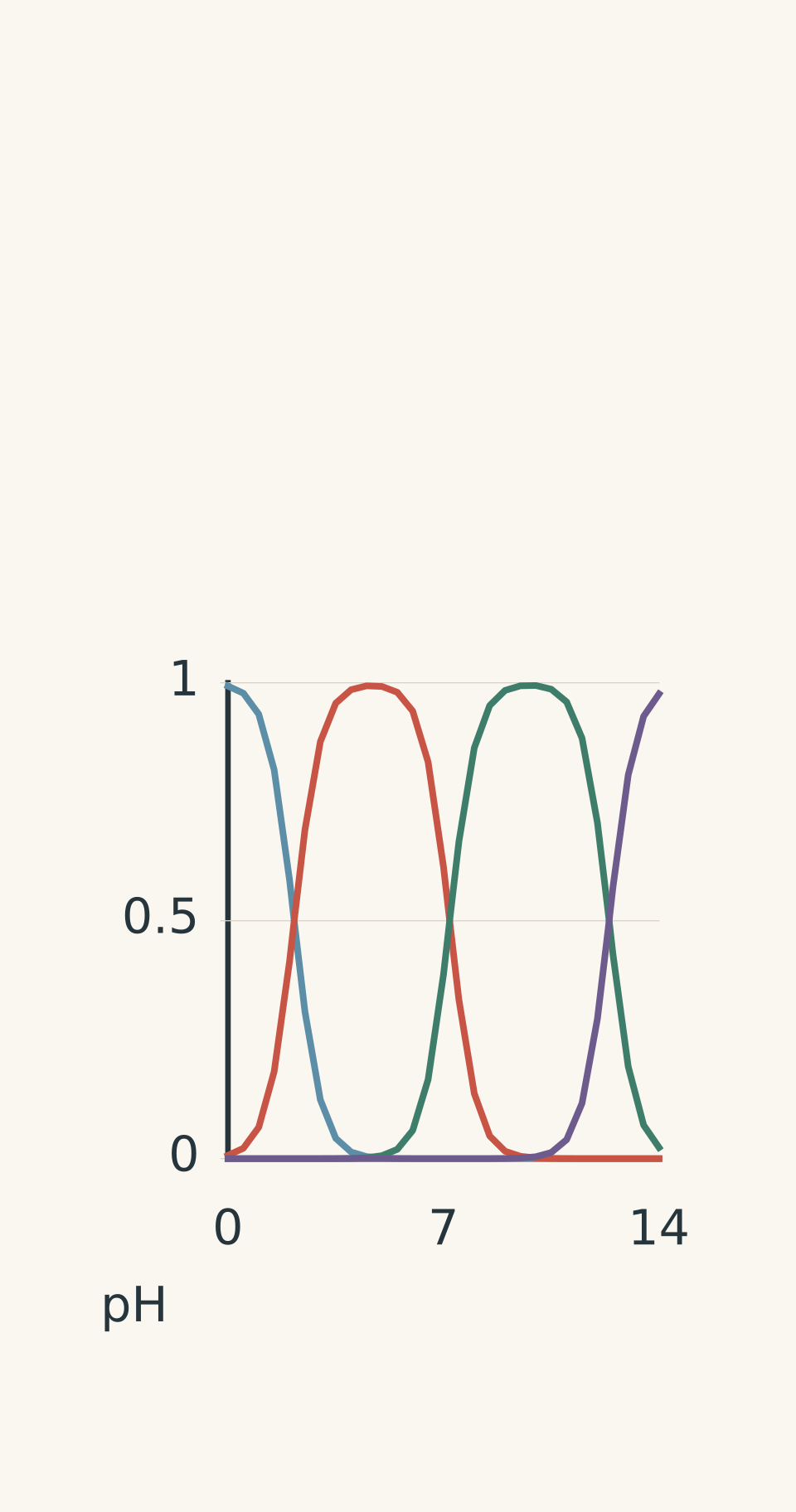
- H₃PO₄
- H₂PO₄⁻
- HPO₄²⁻
- PO₄³⁻
At pH values around 7.2, the second ionisation becomes particularly important because the hydronium concentration is comparable to \(K_{a2}\). We’ll calculate this explicitly in the second worked example.
04A dependable decision method for exams
When you encounter a polyprotic acid question, use this sequence rather than memorising a rule that the first ionisation always dominates.
Step 1: Write every relevant ionisation equation.
Remove one proton per step. Balance the atoms and charges, and identify the acid and conjugate base in each reaction.
Step 2: Write a separate \(K_a\) expression for each step.
Use the species in that particular equilibrium. Don’t reuse \(K_{a1}\) for later steps.
Step 3: Identify exactly what the question asks you to calculate.
A pH calculation and a concentration calculation have different requirements. You might safely neglect a tiny contribution to pH but still need that contribution to calculate \([\mathrm{A}^{2-}]\).
Step 4: Estimate or calculate \([\ce{H3O+}]\).
For a weak diprotic acid of initial concentration \(C\), if the first ionisation dominates and the acid is not too dilute, you can begin with
\[ [\ce{H3O+}] \approx \sqrt{K_{a1}C} \]
This approximation assumes that the amount ionised is small compared with \(C\). If that assumption is poor, solve the first equilibrium more accurately.
For the first ionisation alone, letting \(x=[\ce{H3O+}]\) gives
\[ K_{a1}=\frac{x^2}{C-x} \]
Step 5: Test the second ionisation.
Calculate
\[ r=\frac{K_{a2}}{[\ce{H3O+}]} \]
If \(r\) is very small, the second ionisation is usually negligible for pH. If it is not small, include the second equilibrium when determining the species present.
If the pH is already given, use it directly rather than estimating it from the initial acid concentration.
Step 6: Check the conditions.
If the solution is extremely dilute, water’s own ionisation may matter. If a strong base has been added or the solution is a buffer, the pH may be quite different from that of the acid dissolved in water alone. In either case, reassess the ratio using the actual equilibrium conditions.
Decide whether the second ionisation matters
- Identify the requested quantity
Check whether pH or a species concentration is required.
Calculate [A²⁻] separately if its concentration is explicitly requested.
- Determine hydronium concentration
[H₃O⁺] = 10^(−pH)
If pH is given, use it directly.
Otherwise estimate [H₃O⁺] from the relevant equilibrium; use √(Ka₁C) only when valid.
- Test the second ionisation
r = Ka₂ / [H₃O⁺]
If r is very small, the second ionisation is usually negligible for pH.
Otherwise include the second equilibrium in the calculation.
05Worked examples
Worked example: Can the second ionisation affect the pH?
A \(0.10\ \mathrm{mol\,L^{-1}}\) solution of diprotic acid \(\ce{H2A}\) has \(K_{a1}=1.0\times10^{-5}\) and \(K_{a2}=1.0\times10^{-8}\). Estimate the pH and justify whether the second ionisation can be neglected.
Tempting wrong path: use \(K_{a1}\) for both ionisations, or simply set \([\mathrm{A}^{2-}]=0\) because \(K_{a2}\) is small.
The first approach uses the wrong equilibrium constant. The second assumes the result before checking it.
Step 1
If the second ionisation is negligible, the weak-acid approximation gives
\[ [\ce{H3O+}] \approx \sqrt{K_{a1}C} \]
Substitute the values:
\[ \begin{aligned} [\ce{H3O+}] &\approx \sqrt{(1.0\times10^{-5})(0.10)}\\ &=1.0\times10^{-3}\ \mathrm{mol\,L^{-1}} \end{aligned} \]
This is only \(1\%\) of the initial acid concentration, so the approximation is reasonable.
Step 2
\[ \begin{aligned} \mathrm{pH} &=-\log_{10}[\ce{H3O+}]\\ &=-\log_{10}(1.0\times10^{-3})\\ &=3.00 \end{aligned} \]
Step 3
Use the equilibrium ratio:
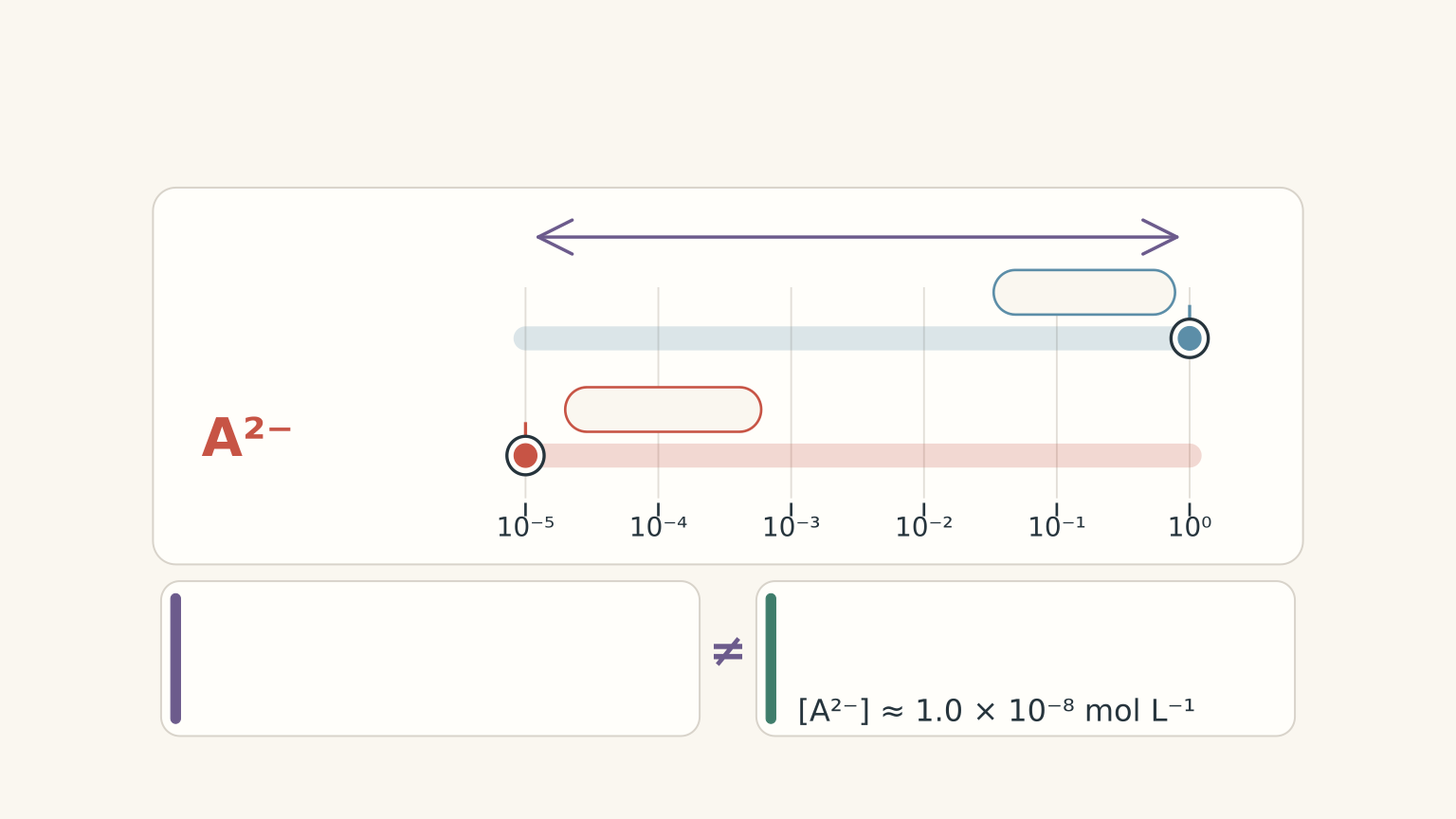
\[ \begin{aligned} \frac{[\mathrm{A}^{2-}]}{[\ce{HA-}]} &=\frac{K_{a2}}{[\ce{H3O+}]}\\ &=\frac{1.0\times10^{-8}}{1.0\times10^{-3}}\\ &=1.0\times10^{-5} \end{aligned} \]
The concentration of \(\mathrm{A}^{2-}\) is only \(0.001\%\) of the concentration of \(\ce{HA-}\). The second ionisation makes a negligible contribution to the hydronium concentration, so the estimated pH of \(3.00\) is justified.
Step 4
You must not set the concentration to zero. Instead, use the ratio you just calculated:
\[ \begin{aligned} [\mathrm{A}^{2-}] &\approx (1.0\times10^{-5})[\ce{HA-}]\\ &\approx (1.0\times10^{-5})(1.0\times10^{-3})\\ &=1.0\times10^{-8}\ \mathrm{mol\,L^{-1}} \end{aligned} \]
The concentration is tiny, but it is not zero. Whether you can neglect it depends on what you’re calculating.
Worked example: When the second ionisation is significant
A phosphate solution has a pH of \(7.00\). For the second ionisation of phosphoric acid, \(K_{a2}=6.3\times10^{-8}\). Calculate the ratio \([\mathrm{HPO_{4}}^{2-}]/[\ce{H2PO4-}]\) and decide whether the second ionisation can be neglected when describing the phosphate species.
Step 1
\[ \ce{H2PO4- + H2O <=> H3O+ + HPO4^2-} \]
Its equilibrium expression is
\[ K_{a2} = \frac{[\ce{H3O+}][\mathrm{HPO_{4}}^{2-}]} {[\ce{H2PO4-}]} \]
Step 2
\[ [\ce{H3O+}] =10^{-7.00} =1.0\times10^{-7}\ \mathrm{mol\,L^{-1}} \]
Step 3
\[ \begin{aligned} \frac{[\mathrm{HPO_{4}}^{2-}]}{[\ce{H2PO4-}]} &=\frac{K_{a2}}{[\ce{H3O+}]}\\ &=\frac{6.3\times10^{-8}}{1.0\times10^{-7}}\\ &=0.63 \end{aligned} \]
Step 4
The concentration of \(\mathrm{HPO_{4}}^{2-}\) is approximately \(63\%\) of the concentration of \(\ce{H2PO4-}\). These concentrations are comparable, so the second ionisation cannot be neglected when describing the phosphate species present.
This doesn’t contradict the fact that \(K_{a2}\) is much smaller than \(K_{a1}\). The pH is close to the second \(pK_a\), which is approximately \(7.20\). The hydronium concentration is now low enough for the second ionisation to produce a substantial amount of \(\mathrm{HPO_{4}}^{2-}\).
06Before you move on: a 10-second self-check
Before finalising a polyprotic-acid answer, ask yourself:
- Have I written a separate equation and \(K_a\) for each ionisation?
- Does every conjugate acid-base pair differ by one proton?
- Have I used the actual or estimated \([\ce{H3O+}]\) to test the second ionisation?
- Am I calculating pH, or a particular species concentration?
- If I have neglected a later ionisation, have I shown why that approximation is justified?
07Questions and solutions
Question 1
Write the two ionisation equations for the generic diprotic acid \(\ce{H2X}\) in water. Identify both conjugate acid-base pairs in each equation.
Solution 1
The two ionisation equations are:
\[ \ce{H2X + H2O <=> H3O+ + HX-} \]
\[ \ce{HX- + H2O <=> H3O+ + X^2-} \]
In the first equation, the conjugate pairs are \(\ce{H2X/HX-}\) and \(\ce{H3O+/H2O}\). In the second, they are \(\ce{HX-/X^2-}\) and \(\ce{H3O+/H2O}\).
Each pair differs by exactly one proton. The first acid species, \(\ce{H2X}\), loses one proton to form \(\ce{HX-}\). That ion can then lose another proton to form \(\mathrm{X}^{2-}\). Each step has a different equilibrium constant because each describes a different reaction.
Question 2
A \(0.050\ \mathrm{mol\,L^{-1}}\) solution of \(\ce{H2A}\) has \(K_{a1}=2.0\times10^{-5}\) and \(K_{a2}=5.0\times10^{-10}\).
Estimate the pH to two decimal places and justify whether the second ionisation can be neglected for this calculation.
Solution 2
The pH is approximately \(3.00\), and the second ionisation is negligible for this pH calculation.
Step 1: Calculate the hydronium concentration using the first ionisation.
Let \(x=[\ce{H3O+}]\) and \(C=0.050\ \mathrm{mol\,L^{-1}}\). If the second ionisation is initially neglected,
\[ K_{a1}=\frac{x^2}{C-x} \]
Rearranging gives
\[ x^2+K_{a1}x-K_{a1}C=0 \]
Using the positive solution,
\[ \begin{aligned} x &=\frac{-K_{a1}+\sqrt{K_{a1}^2+4K_{a1}C}}{2}\\ &=\frac{-2.0\times10^{-5} +\sqrt{(2.0\times10^{-5})^2+ 4(2.0\times10^{-5})(0.050)}}{2}\\ &=9.90\times10^{-4}\ \mathrm{mol\,L^{-1}} \end{aligned} \]
Step 2: Calculate the pH.
\[ \begin{aligned} \mathrm{pH} &=-\log_{10}(9.90\times10^{-4})\\ &=3.004\ldots\\ &\approx 3.00 \end{aligned} \]
Step 3: Test the second ionisation.
\[ \begin{aligned} \frac{[\mathrm{A}^{2-}]}{[\ce{HA-}]} &=\frac{K_{a2}}{[\ce{H3O+}]}\\ &=\frac{5.0\times10^{-10}}{9.90\times10^{-4}}\\ &=5.1\times10^{-7} \end{aligned} \]
The second ionisation contributes a negligible amount of \(\mathrm{A}^{2-}\) relative to \(\ce{HA-}\). Its contribution to the hydronium concentration is also negligible at this precision, so the pH estimate is justified.
Question 3
At equilibrium, a solution of \(\ce{H2A}\) has
\[ [\ce{H3O+}]=2.0\times10^{-3}\ \mathrm{mol\,L^{-1}} \]
and
\[ [\ce{HA-}]=0.020\ \mathrm{mol\,L^{-1}} \]
If \(K_{a2}=5.0\times10^{-7}\), calculate \([\mathrm{A}^{2-}]\). Explain why it would be incorrect to set this concentration to zero simply because the second ionisation is negligible for pH.
Solution 3
The concentration is \([\mathrm{A}^{2-}]=5.0\times10^{-6}\ \mathrm{mol\,L^{-1}}\). It is small relative to \([\ce{HA-}]\), but it is not zero.
Step 1: Start with the second equilibrium expression.
\[ K_{a2} = \frac{[\ce{H3O+}][\mathrm{A}^{2-}]} {[\ce{HA-}]} \]
Rearrange to find the unknown concentration:
\[ [\mathrm{A}^{2-}] = \frac{K_{a2}[\ce{HA-}]}{[\ce{H3O+}]} \]
Step 2: Substitute the values.
\[ \begin{aligned} [\mathrm{A}^{2-}] &=\frac{(5.0\times10^{-7})(0.020)} {2.0\times10^{-3}}\\ &=5.0\times10^{-6}\ \mathrm{mol\,L^{-1}} \end{aligned} \]
Step 3: Interpret the concentration.
The relative concentration is
\[ \frac{[\mathrm{A}^{2-}]}{[\ce{HA-}]} = \frac{5.0\times10^{-6}}{0.020} = 2.5\times10^{-4} \]
This is \(0.025\%\) of the \(\ce{HA-}\) concentration. The second ionisation has a negligible effect on the pH at ordinary exam precision, but the question specifically asks for \([\mathrm{A}^{2-}]\). Therefore, its small equilibrium concentration must still be calculated.
Question 4
A diprotic acid has \(K_{a1}=1.0\times10^{-4}\) and \(K_{a2}=1.0\times10^{-8}\).
Two solutions of this acid have pH values of \(3.00\) and \(5.00\).
For each solution, calculate:
- The ratio \([\ce{HA-}]/[\ce{H2A}]\).
- The ratio \([\mathrm{A}^{2-}]/[\ce{HA-}]\).
Identify the predominant acid species in each solution and explain why the second ratio changes even though \(K_{a2}\) remains constant.
Solution 4
At pH \(3.00\), \(\ce{H2A}\) predominates. At pH \(5.00\), \(\ce{HA-}\) predominates. The relative amount of \(\mathrm{A}^{2-}\) compared with \(\ce{HA-}\) increases by a factor of 100.
Step 1: Calculate the ratios at pH \(3.00\).
The hydronium concentration is
\[ [\ce{H3O+}]=10^{-3} =1.0\times10^{-3}\ \mathrm{mol\,L^{-1}} \]
For the first ionisation,
\[ \begin{aligned} \frac{[\ce{HA-}]}{[\ce{H2A}]} &=\frac{K_{a1}}{[\ce{H3O+}]}\\ &=\frac{1.0\times10^{-4}}{1.0\times10^{-3}}\\ &=0.10 \end{aligned} \]
For the second ionisation,
\[ \begin{aligned} \frac{[\mathrm{A}^{2-}]}{[\ce{HA-}]} &=\frac{K_{a2}}{[\ce{H3O+}]}\\ &=\frac{1.0\times10^{-8}}{1.0\times10^{-3}}\\ &=1.0\times10^{-5} \end{aligned} \]
The concentration of \(\ce{HA-}\) is one-tenth that of \(\ce{H2A}\), and \(\mathrm{A}^{2-}\) is even less abundant. Therefore, \(\ce{H2A}\) predominates.
Step 2: Calculate the ratios at pH \(5.00\).
Now,
\[ [\ce{H3O+}]=10^{-5} =1.0\times10^{-5}\ \mathrm{mol\,L^{-1}} \]
For the first ionisation,
\[ \begin{aligned} \frac{[\ce{HA-}]}{[\ce{H2A}]} &=\frac{1.0\times10^{-4}}{1.0\times10^{-5}}\\ &=10 \end{aligned} \]
For the second ionisation,
\[ \begin{aligned} \frac{[\mathrm{A}^{2-}]}{[\ce{HA-}]} &=\frac{1.0\times10^{-8}}{1.0\times10^{-5}}\\ &=1.0\times10^{-3} \end{aligned} \]
The concentration of \(\ce{HA-}\) is now ten times that of \(\ce{H2A}\), so \(\ce{HA-}\) predominates. The concentration of \(\mathrm{A}^{2-}\) remains small relative to \(\ce{HA-}\).
Step 3: Explain the change.
The hydronium concentration falls by a factor of 100 as the pH rises from 3.00 to 5.00. Since
\[ \frac{[\mathrm{A}^{2-}]}{[\ce{HA-}]} = \frac{K_{a2}}{[\ce{H3O+}]} \]
and \(K_{a2}\) is unchanged, the ratio increases by a factor of 100.
The equilibrium constant has not changed. The conditions have changed, shifting the relative concentrations of the species.
Question 5
At \(25^\circ\mathrm{C}\), a diprotic acid \(\ce{H2A}\) has
\[ K_{a1}=1.0\times10^{-4}, \qquad K_{a2}=1.0\times10^{-8} \]
A student claims that because \(K_{a2}\) is 10,000 times smaller than \(K_{a1}\), the second ionisation can always be ignored.
Test this claim in two situations:
(i) An unbuffered \(0.10\ \mathrm{mol\,L^{-1}}\) solution of \(\ce{H2A}\).
(ii) A solution containing the same acid species, adjusted to pH \(8.00\) by adding \(\ce{NaOH}\).
For each situation, estimate \([\mathrm{A}^{2-}]/[\ce{HA-}]\) and explain what the ratio tells you about the species present. State whether the second ionisation can be neglected, and explain precisely why comparing \(K_{a2}\) with \(K_{a1}\) is not enough to decide.
Assume ideal dilute-solution behaviour. For situation (i), you may neglect water autoionisation.
Solution 5
The student’s claim is incorrect. The second ionisation is negligible in situation (i), but it is essential for describing the species distribution in situation (ii). The difference is the hydronium concentration, not a change in either equilibrium constant.
Step 1: Analyse the unbuffered \(0.10\ \mathrm{mol\,L^{-1}}\) solution.
First, estimate the hydronium concentration from the first ionisation, temporarily neglecting the second.
Let \(x=[\ce{H3O+}]\). Then
\[ K_{a1}=\frac{x^2}{C-x} \]
Rearranging and solving the quadratic gives
\[ x= \frac{-K_{a1}+ \sqrt{K_{a1}^{2}+4K_{a1}C}}{2} \]
Substitute \(K_{a1}=1.0\times10^{-4}\) and \(C=0.10\ \mathrm{mol\,L^{-1}}\):
\[ \begin{aligned} x &=\frac{-1.0\times10^{-4} +\sqrt{(1.0\times10^{-4})^2+ 4(1.0\times10^{-4})(0.10)}}{2}\\ &=3.11\times10^{-3}\ \mathrm{mol\,L^{-1}} \end{aligned} \]
This corresponds to a pH of approximately \(2.51\).
Now test the second ionisation:
\[ \begin{aligned} \frac{[\mathrm{A}^{2-}]}{[\ce{HA-}]} &=\frac{K_{a2}}{[\ce{H3O+}]}\\ &=\frac{1.0\times10^{-8}}{3.11\times10^{-3}}\\ &=3.2\times10^{-6} \end{aligned} \]
The ratio is extremely small. The concentration of \(\mathrm{A}^{2-}\) is only about \(0.00032\%\) of the concentration of \(\ce{HA-}\).
The second ionisation can safely be neglected when estimating the pH of this solution to ordinary exam precision. The first-stage estimate is self-consistent because the second stage contributes almost no additional hydronium.
Step 2: Analyse the solution adjusted to pH \(8.00\).
The hydronium concentration is now
\[ [\ce{H3O+}] =10^{-8.00} =1.0\times10^{-8}\ \mathrm{mol\,L^{-1}} \]
Use the same ratio:
\[ \begin{aligned} \frac{[\mathrm{A}^{2-}]}{[\ce{HA-}]} &=\frac{K_{a2}}{[\ce{H3O+}]}\\ &=\frac{1.0\times10^{-8}}{1.0\times10^{-8}}\\ &=1 \end{aligned} \]
Therefore,
\[ [\mathrm{A}^{2-}]=[\ce{HA-}] \]
The two species have equal equilibrium concentrations. The second ionisation cannot be neglected when describing the acid species present.
We can go one step further. For the first ionisation,
\[ \begin{aligned} \frac{[\ce{HA-}]}{[\ce{H2A}]} &=\frac{K_{a1}}{[\ce{H3O+}]}\\ &=\frac{1.0\times10^{-4}}{1.0\times10^{-8}}\\ &=10^4 \end{aligned} \]
Thus, \(\ce{H2A}\) is present at only one ten-thousandth of the concentration of \(\ce{HA-}\). Almost all the acid species are split approximately equally between \(\ce{HA-}\) and \(\mathrm{A}^{2-}\).
Step 3: Identify the student’s exact mistake.
The ratio \(K_{a2}/K_{a1}=10^{-4}\) compares the two equilibrium constants. It does not directly give the ratio of \(\mathrm{A}^{2-}\) to \(\ce{HA-}\).
That species ratio is determined by
\[ \frac{[\mathrm{A}^{2-}]}{[\ce{HA-}]} = \frac{K_{a2}}{[\ce{H3O+}]} \]
In the unbuffered acid solution, the hydronium concentration is relatively high, suppressing the second ionisation. After adding \(\ce{NaOH}\), the hydronium concentration is much lower, and the second ionisation becomes significant.
The equilibrium constants have not changed. The solution conditions have.
The next useful step is learning to read polyprotic-acid speciation diagrams. Once you can connect \(K_a\), pH, and the ratios of adjacent species, you can predict which form of an acid predominates across a range of pH values without assuming that later ionisations are always negligible.