
Calorimetry and Phase Changes: Original Physics Practice Exam
Test your understanding of specific heat capacity, latent heat, phase changes, and energy conservation with this original 40-mark Physics practice paper. Includes a suggested 60-minute working time, exam-style questions, fully worked solutions, and a detailed marking guide.
This is an original tutorgum practice paper on calorimetry and phase-change problems. It assesses specific heat capacity, latent heat, heating and cooling stages, and energy conservation in mixtures within the supplied Physics 2017 syllabus scope. It is a focused topic paper, not a full-course exam, and it is not an official, endorsed, past, or predicted NESA paper.
01Exam instructions
- Suggested reading time: 5 minutes.
- Working time: 60 minutes.
- Total marks: 40.
- Permitted equipment: Scientific calculator, pen or pencil, and ruler. Do not use notes or online resources. These are suggested conditions for this practice paper, not official exam rules.
Assessed content
This paper covers:
- Specific heat capacity and the relationship between energy transferred and temperature change.
- Latent heat and energy transfer during changes of state.
- Calculations involving successive stages of heating.
- Energy conservation when substances at different temperatures are mixed.
- Interpretation of heating data, including constant-temperature intervals.
It excludes power and heating-rate calculations, electrical circuits, gas laws, and unrelated Physics modules.
Data and equations
Use the following equations where appropriate.
For a temperature change:
\[ Q=mc\Delta T \]
For a change of state:
\[ Q=mL \]
Here, \(Q\) is the magnitude of thermal energy transferred, measured in joules (J); \(m\) is mass in kilograms (kg); \(c\) is specific heat capacity in joules per kilogram per degree Celsius (\(\mathrm{J\,kg^{-1}\,^\circ C^{-1}}\)); \(\Delta T\) is the magnitude of the temperature change in degrees Celsius (°C); and \(L\) is specific latent heat in joules per kilogram (\(\mathrm{J\,kg^{-1}}\)).
Use these values unless a question provides different data:
| Quantity | Value |
|---|---|
| Specific heat capacity of liquid water | \(4.20\times10^3\ \mathrm{J\,kg^{-1}\,^\circ C^{-1}}\) |
| Specific heat capacity of ice | \(2.10\times10^3\ \mathrm{J\,kg^{-1}\,^\circ C^{-1}}\) |
| Specific latent heat of fusion of ice | \(3.34\times10^5\ \mathrm{J\,kg^{-1}}\) |
Unless stated otherwise, assume no energy is lost to the surroundings, container heat capacity is negligible, and the given material properties remain constant over each stage.
Show your working, include units, and give numerical answers to an appropriate number of significant figures.
02Questions
Question 1 (5 marks)
A \(0.80\ \mathrm{kg}\) sample of material X absorbs \(6.4\ \mathrm{kJ}\) of energy. Its temperature rises from \(18^\circ\mathrm{C}\) to \(38^\circ\mathrm{C}\). Assume all the transferred energy heats the sample.
(a) Calculate the specific heat capacity of material X. (3 marks)
(b) A sample of material Y has the same mass and absorbs the same amount of energy. Its specific heat capacity is \(800\ \mathrm{J\,kg^{-1}\,^\circ C^{-1}}\).
Calculate the temperature rise of material Y, then compare it with the temperature rise of material X. (2 marks)
Question 2 (6 marks)
A \(0.25\ \mathrm{kg}\) sample of ice at \(0^\circ\mathrm{C}\) receives \(83.5\ \mathrm{kJ}\) of energy and melts completely.
(a) Calculate the specific latent heat of fusion of the ice. (2 marks)
(b) Explain why the temperature of the ice remains constant while it melts, even though energy is transferred to it. (2 marks)
(c) Calculate the additional energy required to heat the resulting \(0.25\ \mathrm{kg}\) of water from \(0^\circ\mathrm{C}\) to \(35^\circ\mathrm{C}\). (2 marks)
Question 3 (7 marks)
A \(0.400\ \mathrm{kg}\) block of ice at \(-10^\circ\mathrm{C}\) is heated until all the ice has melted and the resulting water reaches \(20^\circ\mathrm{C}\).
Use the following data:
- Specific heat capacity of ice: \(2.10\times10^3\ \mathrm{J\,kg^{-1}\,^\circ C^{-1}}\).
- Specific latent heat of fusion of ice: \(3.34\times10^5\ \mathrm{J\,kg^{-1}}\).
- Specific heat capacity of water: \(4.20\times10^3\ \mathrm{J\,kg^{-1}\,^\circ C^{-1}}\).
(a) Calculate the energy required to heat the ice from \(-10^\circ\mathrm{C}\) to \(0^\circ\mathrm{C}\). (2 marks)
(b) Calculate the energy required to melt all the ice at \(0^\circ\mathrm{C}\). (2 marks)
(c) Calculate the energy required to heat the resulting water from \(0^\circ\mathrm{C}\) to \(20^\circ\mathrm{C}\). (2 marks)
(d) Calculate the total energy transferred to the ice and water over the entire process. (1 mark)
Question 4 (6 marks)
An insulated container holds \(0.30\ \mathrm{kg}\) of water at \(80^\circ\mathrm{C}\). A further \(0.20\ \mathrm{kg}\) of water at \(20^\circ\mathrm{C}\) is added. The water mixes until it reaches a uniform equilibrium temperature.
Assume the container absorbs negligible energy and both samples have the same specific heat capacity.
(a) Calculate the final equilibrium temperature of the mixture. (4 marks)
(b) Explain why the final temperature is not the simple arithmetic mean of the two initial temperatures. (2 marks)
Question 5 (9 marks)
A cup contains \(0.400\ \mathrm{kg}\) of water at \(30^\circ\mathrm{C}\). A \(0.100\ \mathrm{kg}\) sample of ice at \(0^\circ\mathrm{C}\) is added.
Assume the cup is insulated and absorbs negligible energy. Use the specific heat capacity of water and the specific latent heat of fusion of ice given in the exam instructions.
(a) Calculate the energy released by the original water if it cools from \(30^\circ\mathrm{C}\) to \(0^\circ\mathrm{C}\). (2 marks)
(b) Calculate the energy required to melt all the ice. (2 marks)
(c) Use your results to determine whether all the ice melts. Show the energy comparison supporting your conclusion. (2 marks)
(d) Calculate the final equilibrium temperature of the mixture. Show your energy balance. (3 marks)
Question 6 (7 marks)
A pure substance is heated at constant pressure. It begins as a solid and ends as a gas. Its mass is \(0.20\ \mathrm{kg}\).
The table shows the cumulative energy supplied to the substance and its temperature during heating.
| Cumulative energy supplied (kJ) | Temperature (°C) |
|---|---|
| 0 | -20 |
| 4 | -10 |
| 8 | 0 |
| 12 | 0 |
| 16 | 0 |
| 20 | 20 |
| 24 | 40 |
| 28 | 60 |
| 32 | 60 |
| 36 | 60 |
| 40 | 60 |
| 44 | 80 |
(a) Identify the phase change occurring during each constant-temperature interval. (2 marks)
(b) Calculate the specific latent heat of vaporisation of the substance. (2 marks)
(c) Calculate the specific heat capacity of the substance in its liquid phase. (2 marks)
(d) Which phase change requires more energy for this sample, melting or vaporisation? By what factor? (1 mark)
03Worked solutions and marking guide
Solution 1
(a) Specific heat capacity of material X (3 marks)
First, convert the energy into joules and calculate the temperature change.
\[ Q=6.4\ \mathrm{kJ}=6400\ \mathrm{J} \]
\[ \Delta T=38-18=20^\circ\mathrm{C} \]
Rearrange \(Q=mc\Delta T\) to make \(c\) the subject.
\[ \begin{aligned} c&=\frac{Q}{m\Delta T}\\[4pt] &=\frac{6400}{0.80\times20}\\[4pt] &=400\ \mathrm{J\,kg^{-1}\,^\circ C^{-1}} \end{aligned} \]
The specific heat capacity of material X is \(400\ \mathrm{J\,kg^{-1}\,^\circ C^{-1}}\).
Marking guide:
- 1 mark for the correct temperature change and equation.
- 1 mark for correct substitution using energy in joules.
- 1 mark for the answer with appropriate units.
(b) Temperature response of material Y (2 marks)
Rearrange the equation to calculate the temperature rise.
\[ \begin{aligned} \Delta T_Y&=\frac{Q}{mc}\\[4pt] &=\frac{6400}{0.80\times800}\\[4pt] &=10^\circ\mathrm{C} \end{aligned} \]
Material X rises by \(20^\circ\mathrm{C}\), while material Y rises by \(10^\circ\mathrm{C}\). Material X therefore experiences twice the temperature rise of material Y.
Both samples receive the same energy and have the same mass. Material Y has twice the specific heat capacity, so its temperature changes by half as much.
Marking guide:
- 1 mark for calculating the temperature rise of Y as \(10^\circ\mathrm{C}\).
- 1 mark for a valid comparison with X.
Solution 2
(a) Specific latent heat of fusion (2 marks)
The ice melts without changing temperature, so use \(Q=mL\).
Convert the energy to joules:
\[ 83.5\ \mathrm{kJ}=83\,500\ \mathrm{J} \]
Rearrange and substitute.
\[ \begin{aligned} L_f&=\frac{Q}{m}\\[4pt] &=\frac{83\,500}{0.25}\\[4pt] &=3.34\times10^5\ \mathrm{J\,kg^{-1}} \end{aligned} \]
The specific latent heat of fusion is \(3.34\times10^5\ \mathrm{J\,kg^{-1}}\).
Marking guide:
- 1 mark for the correct equation and energy conversion.
- 1 mark for the correct value with units.
(b) Why the temperature remains constant (2 marks)
During melting, the supplied energy is used to change the arrangement of the particles and overcome intermolecular attractions. It increases their potential energy rather than their average kinetic energy.
Temperature is related to the average kinetic energy of the particles. Because that average does not increase during the phase change, the temperature remains at the melting point until all the ice has melted.
Marking guide:
- 1 mark for explaining that the energy changes the particles’ arrangement or potential energy.
- 1 mark for linking the unchanged average kinetic energy to constant temperature.
(c) Heating the liquid water (2 marks)
Once melting is complete, the water’s temperature can increase. Use the specific heat capacity of liquid water.
\[ \begin{aligned} Q&=mc\Delta T\\[4pt] &=0.25\times4200\times(35-0)\\[4pt] &=36\,750\ \mathrm{J}\\[4pt] &=36.8\ \mathrm{kJ} \end{aligned} \]
The additional energy required is \(36.8\ \mathrm{kJ}\).
Marking guide:
- 1 mark for the correct equation and substitution.
- 1 mark for the answer with appropriate units.
Solution 3
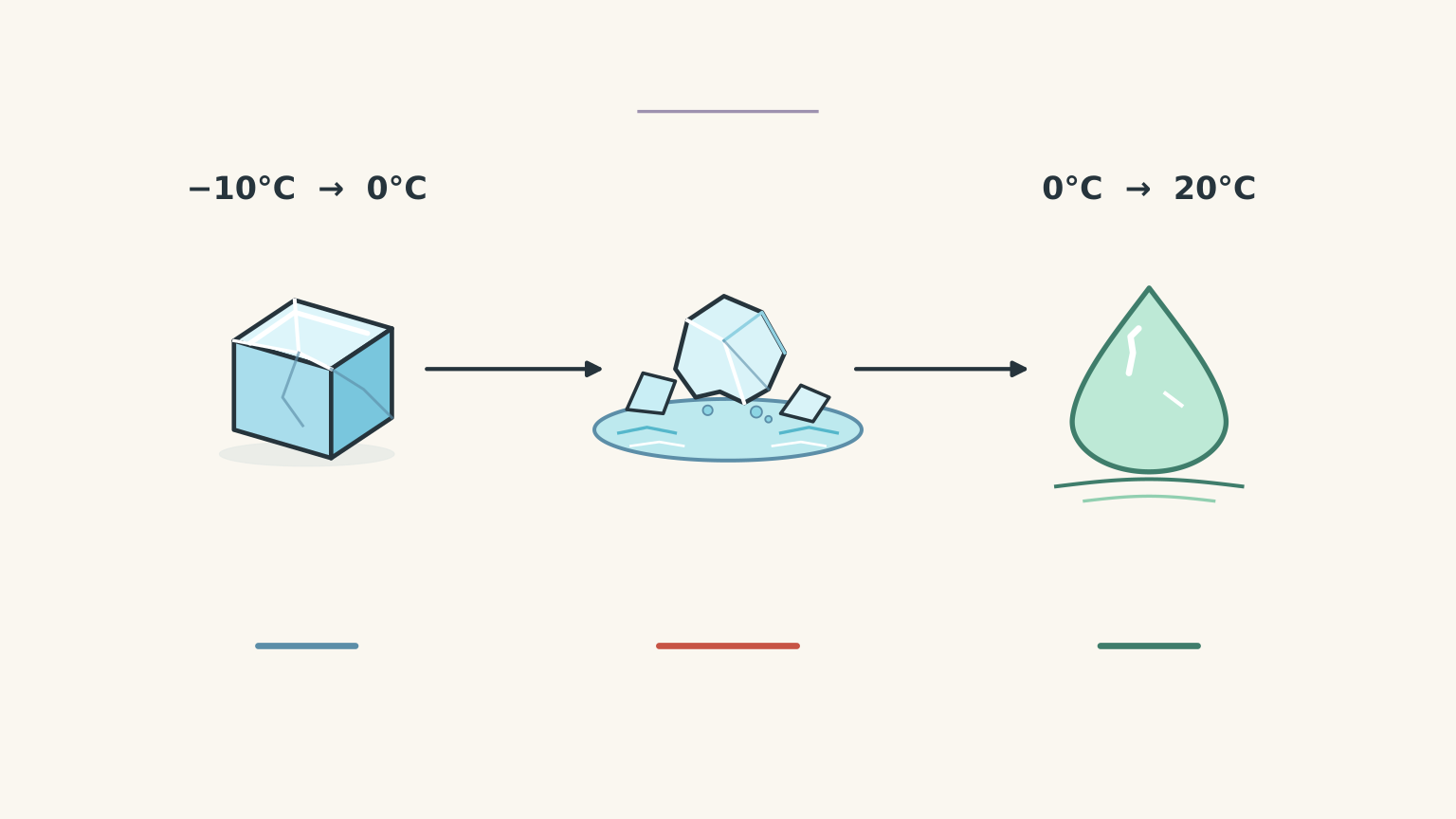
The process has three distinct stages. First, the solid warms to its melting point. Next, the ice melts at constant temperature. Finally, the liquid water warms.
(a) Heating the ice to \(0^\circ\mathrm{C}\) (2 marks)
The ice changes temperature but remains solid. Use the specific heat capacity of ice.
\[ \begin{aligned} Q_1&=mc_{\text{ice}}\Delta T\\[4pt] &=0.400\times2100\times10\\[4pt] &=8400\ \mathrm{J}\\[4pt] &=8.40\ \mathrm{kJ} \end{aligned} \]
The energy required is \(8.40\ \mathrm{kJ}\).
Marking guide:
- 1 mark for the correct equation and substitution.
- 1 mark for the correct answer with units.
(b) Melting the ice (2 marks)
During melting, the temperature stays at \(0^\circ\mathrm{C}\). Use the specific latent heat of fusion.
\[ \begin{aligned} Q_2&=mL_f\\[4pt] &=0.400\times3.34\times10^5\\[4pt] &=133\,600\ \mathrm{J}\\[4pt] &=133.6\ \mathrm{kJ} \end{aligned} \]
The energy required to melt the ice is \(133.6\ \mathrm{kJ}\).
Marking guide:
- 1 mark for using \(Q=mL_f\) with the correct values.
- 1 mark for the correct answer with units.
(c) Heating the resulting water (2 marks)
After all the ice melts, the liquid water warms from \(0^\circ\mathrm{C}\) to \(20^\circ\mathrm{C}\).
\[ \begin{aligned} Q_3&=mc_{\text{water}}\Delta T\\[4pt] &=0.400\times4200\times20\\[4pt] &=33\,600\ \mathrm{J}\\[4pt] &=33.6\ \mathrm{kJ} \end{aligned} \]
The energy required is \(33.6\ \mathrm{kJ}\).
Marking guide:
- 1 mark for the correct equation and substitution.
- 1 mark for the correct answer with units.
(d) Total energy transferred (1 mark)
Add the energy required for all three stages.
\[ \begin{aligned} Q_{\text{total}}&=Q_1+Q_2+Q_3\\[4pt] &=8.40+133.6+33.6\\[4pt] &=175.6\ \mathrm{kJ} \end{aligned} \]
To three significant figures, the total energy is \(176\ \mathrm{kJ}\).
Marking guide:
- 1 mark for correctly adding the three stage energies.
Solution 4
(a) Final equilibrium temperature (4 marks)
The container is insulated, so energy lost by the hot water equals energy gained by the cold water.
Let the final equilibrium temperature be \(T\).
For the hot water, the temperature drop is \(80-T\). For the cold water, the temperature rise is \(T-20\).
\[ m_hc(80-T)=m_cc(T-20) \]
Both samples have the same specific heat capacity, so \(c\) cancels.
\[ 0.30(80-T)=0.20(T-20) \]
Expand both sides.
\[ 24-0.30T=0.20T-4 \]
Rearrange to solve for \(T\).
\[ \begin{aligned} 28&=0.50T\\[4pt] T&=56^\circ\mathrm{C} \end{aligned} \]
The final equilibrium temperature is \(56^\circ\mathrm{C}\).
Marking guide:
- 1 mark for stating that energy lost equals energy gained.
- 1 mark for setting up the correct energy balance.
- 1 mark for correctly solving for \(T\).
- 1 mark for the final answer with units.
(b) Why the arithmetic mean is incorrect (2 marks)
The arithmetic mean of \(80^\circ\mathrm{C}\) and \(20^\circ\mathrm{C}\) is \(50^\circ\mathrm{C}\). However, this calculation gives both starting temperatures equal weight.
The hot sample has a greater mass than the cold sample. Because both samples have the same specific heat capacity, the larger mass of hot water has a greater thermal capacity. The final temperature must be found by balancing the energy lost and gained, giving \(56^\circ\mathrm{C}\), not \(50^\circ\mathrm{C}\).
Marking guide:
- 1 mark for identifying that the two samples have unequal masses.
- 1 mark for explaining that the final temperature depends on the energy balance, not the simple arithmetic mean.
Solution 5
(a) Energy released by the original water (2 marks)
Calculate the magnitude of the energy released as the water cools from \(30^\circ\mathrm{C}\) to \(0^\circ\mathrm{C}\).
\[ \begin{aligned} Q_{\text{water}}&=mc\Delta T\\[4pt] &=0.400\times4200\times30\\[4pt] &=50\,400\ \mathrm{J}\\[4pt] &=50.4\ \mathrm{kJ} \end{aligned} \]
The water releases \(50.4\ \mathrm{kJ}\) as it cools to \(0^\circ\mathrm{C}\).
Marking guide:
- 1 mark for the correct equation and substitution.
- 1 mark for the correct answer with units.
(b) Energy required to melt the ice (2 marks)
The ice is already at its melting point, so use the latent heat equation.
\[ \begin{aligned} Q_{\text{melt}}&=mL_f\\[4pt] &=0.100\times3.34\times10^5\\[4pt] &=33\,400\ \mathrm{J}\\[4pt] &=33.4\ \mathrm{kJ} \end{aligned} \]
The energy required to melt all the ice is \(33.4\ \mathrm{kJ}\).
Marking guide:
- 1 mark for the correct equation and substitution.
- 1 mark for the correct answer with units.
(c) Does all the ice melt? (2 marks)
Compare the energy available from cooling the original water to \(0^\circ\mathrm{C}\) with the energy needed to melt the ice.
\[ 50.4\ \mathrm{kJ}>33.4\ \mathrm{kJ} \]
The original water releases more energy than the ice requires to melt completely. Therefore, all the ice melts.
Marking guide:
- 1 mark for comparing the two energy values correctly.
- 1 mark for concluding that all the ice melts.
(d) Final equilibrium temperature (3 marks)
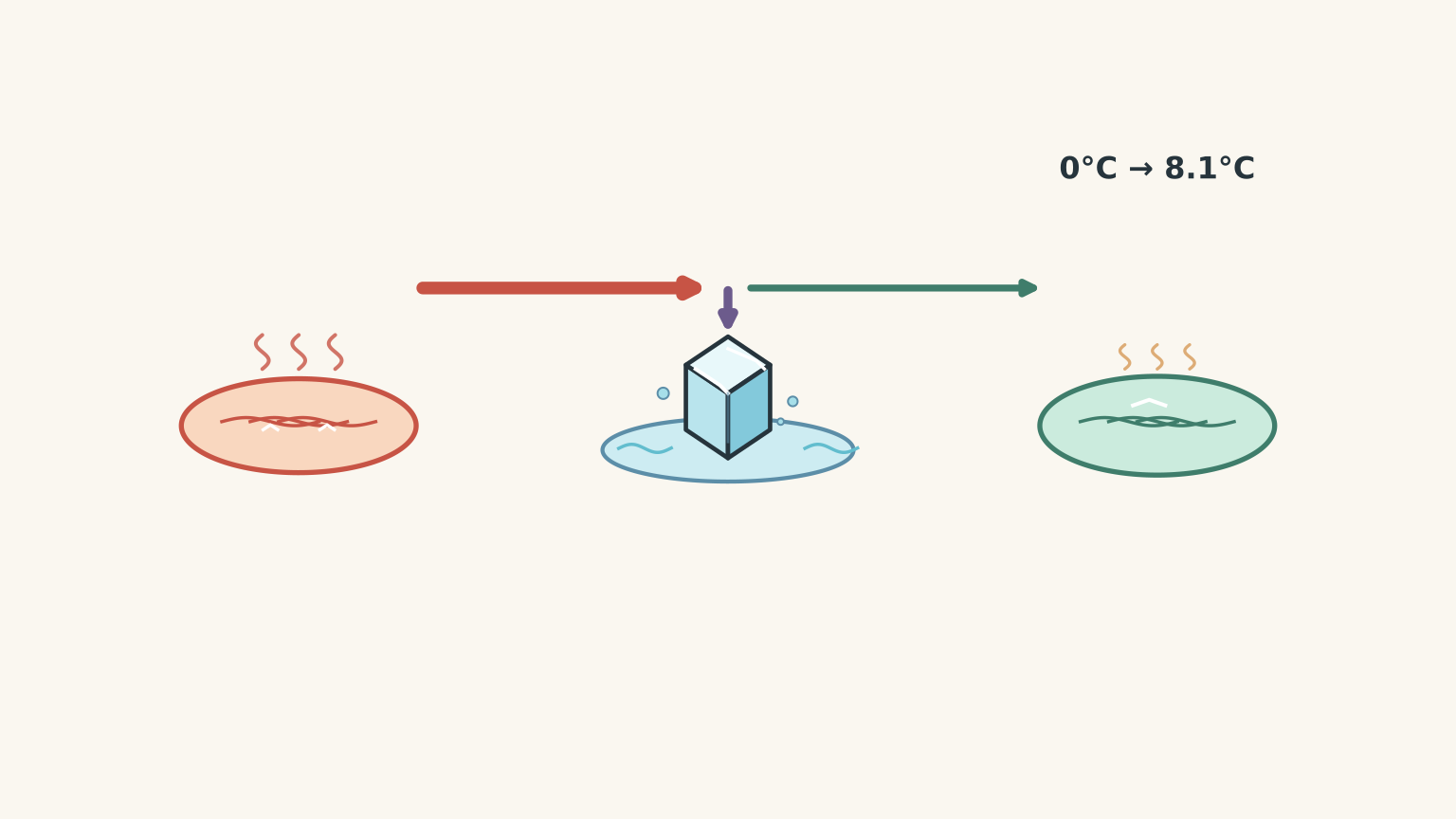
After the ice melts, the energy remaining from the original water’s cooling warms the combined liquid water.
First, calculate the energy remaining.
\[ \begin{aligned} Q_{\text{remaining}}&=50.4-33.4\\[4pt] &=17.0\ \mathrm{kJ}\\[4pt] &=17\,000\ \mathrm{J} \end{aligned} \]
The total mass of liquid water is
\[ m_{\text{total}}=0.400+0.100=0.500\ \mathrm{kg} \]
All the ice has melted at \(0^\circ\mathrm{C}\), so the combined water starts this final stage at \(0^\circ\mathrm{C}\).
Use \(Q=mc\Delta T\).
\[ \begin{aligned} 17\,000&=0.500\times4200\times(T-0)\\[4pt] T&=\frac{17\,000}{0.500\times4200}\\[4pt] T&=8.095\ldots^\circ\mathrm{C} \end{aligned} \]
The final equilibrium temperature is approximately \(8.1^\circ\mathrm{C}\).
Marking guide:
- 1 mark for calculating the remaining energy as \(17.0\ \mathrm{kJ}\).
- 1 mark for using the combined mass of \(0.500\ \mathrm{kg}\) and the correct temperature-change equation.
- 1 mark for the final temperature with appropriate units.
Solution 6
(a) Identify the phase changes (2 marks)
The first constant-temperature interval occurs at \(0^\circ\mathrm{C}\), while the cumulative energy increases from \(8\ \mathrm{kJ}\) to \(16\ \mathrm{kJ}\). The substance is melting, changing from solid to liquid.
The second constant-temperature interval occurs at \(60^\circ\mathrm{C}\), while the cumulative energy increases from \(28\ \mathrm{kJ}\) to \(40\ \mathrm{kJ}\). The substance is vaporising, changing from liquid to gas.
Marking guide:
- 1 mark for identifying melting at \(0^\circ\mathrm{C}\).
- 1 mark for identifying vaporisation at \(60^\circ\mathrm{C}\).
(b) Specific latent heat of vaporisation (2 marks)
During vaporisation, the energy supplied increases from \(28\ \mathrm{kJ}\) to \(40\ \mathrm{kJ}\).
The energy used for this phase change is
\[ Q_v=40-28=12\ \mathrm{kJ}=12\,000\ \mathrm{J} \]
Use \(Q=mL_v\).
\[ \begin{aligned} L_v&=\frac{Q_v}{m}\\[4pt] &=\frac{12\,000}{0.20}\\[4pt] &=60\,000\ \mathrm{J\,kg^{-1}} \end{aligned} \]
The specific latent heat of vaporisation is \(6.0\times10^4\ \mathrm{J\,kg^{-1}}\).
Marking guide:
- 1 mark for identifying the energy supplied during vaporisation and using \(Q=mL_v\).
- 1 mark for the correct value with units.
(c) Specific heat capacity of the liquid (2 marks)
The liquid warms between the end of melting and the start of vaporisation. During this stage, the energy supplied increases from \(16\ \mathrm{kJ}\) to \(28\ \mathrm{kJ}\), while the temperature rises from \(0^\circ\mathrm{C}\) to \(60^\circ\mathrm{C}\).
The energy transferred is
\[ Q=28-16=12\ \mathrm{kJ}=12\,000\ \mathrm{J} \]
The temperature change is \(60^\circ\mathrm{C}\).
\[ \begin{aligned} c&=\frac{Q}{m\Delta T}\\[4pt] &=\frac{12\,000}{0.20\times60}\\[4pt] &=1000\ \mathrm{J\,kg^{-1}\,^\circ C^{-1}} \end{aligned} \]
The specific heat capacity of the liquid is \(1.0\times10^3\ \mathrm{J\,kg^{-1}\,^\circ C^{-1}}\).
Marking guide:
- 1 mark for selecting the correct liquid-heating interval and applying \(Q=mc\Delta T\).
- 1 mark for the correct value with units.
(d) Compare the energy required for melting and vaporisation (1 mark)
The energy supplied during melting is
\[ Q_f=16-8=8\ \mathrm{kJ} \]
The energy supplied during vaporisation is \(12\ \mathrm{kJ}\).
For this sample,
\[ \frac{Q_v}{Q_f}=\frac{12}{8}=1.5 \]
Vaporisation requires \(1.5\) times as much energy as melting.
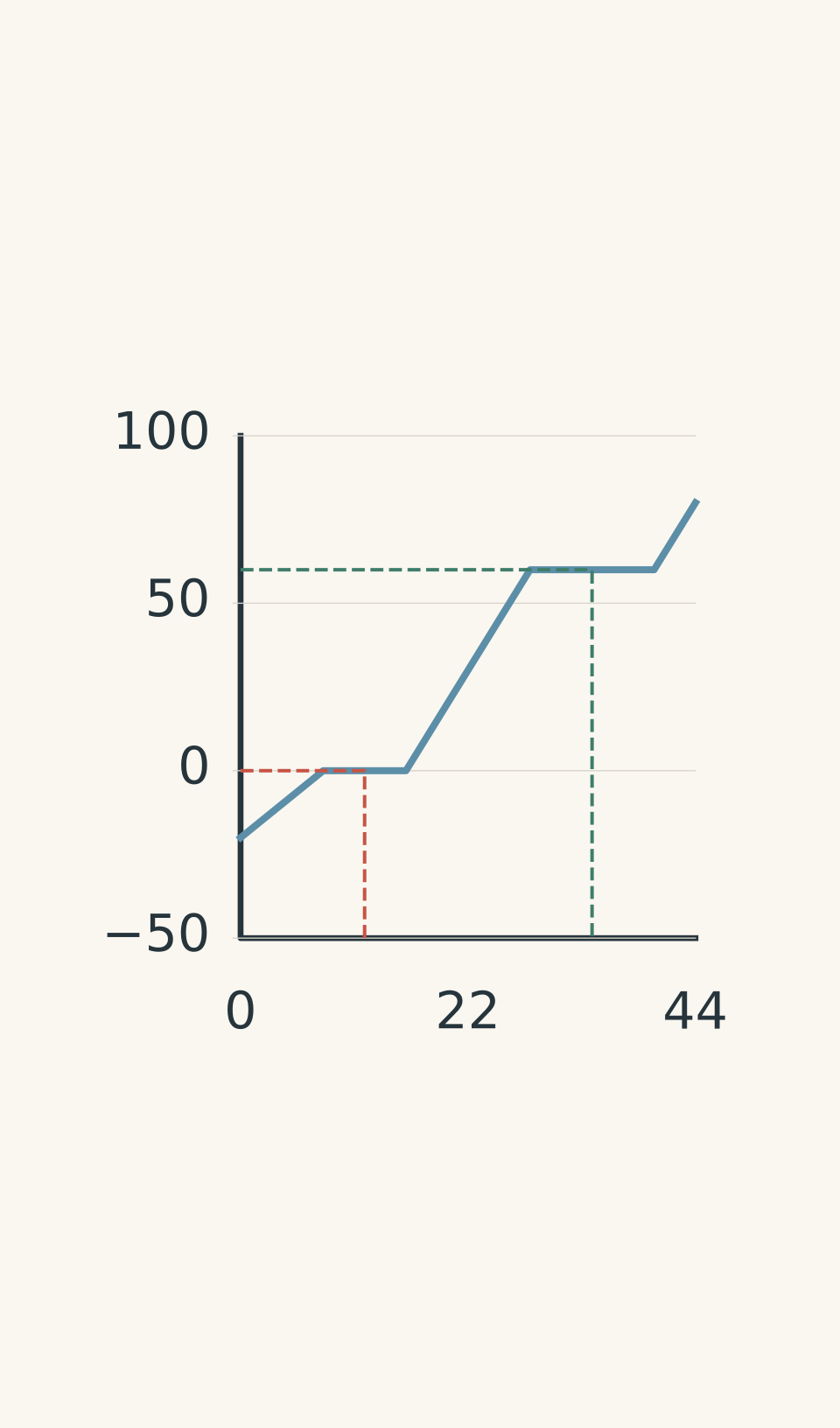
- Heating curve
- Melting: 8–16 kJ
- Vaporisation: 28–40 kJ
Marking guide:
- 1 mark for stating that vaporisation requires \(1.5\) times as much energy as melting for this sample.