
When Does Like Dissolves Like Actually Predict Solubility?
Learn why “like dissolves like” is a useful starting point, not an absolute rule. Compare how molecular polarity, intermolecular forces, and molecular size affect solubility in water and non-polar solvents.
You identify water as polar, identify a solute as polar, and write “it dissolves because like dissolves like”. That prediction might work for one molecule and fail for another with the same functional group. The mistake is treating polarity as a yes-or-no test for solubility.
Try this prediction before reading on: should methanol, \(\ce{CH3OH}\), and octan-1-ol, \(\ce{CH3(CH2)7OH}\), have similar solubility in water because both contain an \(\ce{-OH}\) group?
No. Methanol mixes with water in all proportions, whereas octan-1-ol is only sparingly soluble. Both can form hydrogen bonds with water, but their molecular sizes change the balance of interactions. That’s the part the shortcut misses.
Same polar group, different solubility
| Methanol | CH₃OH Polar OH group; small nonpolar region Miscible with water |
|---|---|
| Octan-1-ol | CH₃(CH₂)₇OH Same polar OH group; large nonpolar region Only sparingly soluble in water |
01Diagnose the mistake: what does “like dissolves like” actually mean?
“Like dissolves like” is a useful starting point because substances with similar intermolecular interactions often mix more readily. However, it does not mean that every polar molecule dissolves in every polar solvent, or that nonpolar substances are completely insoluble in water.
The shortcut fails when you ignore one or more of these factors:
| Tempting shortcut | Why it fails | Better question to ask |
|---|---|---|
| A polar molecule must dissolve in water. | A large nonpolar section can make the molecule poorly compatible with water. | How large is the polar region compared with the nonpolar region? |
| A molecule with an \(\ce{-OH}\) group must be highly soluble in water. | Hydrogen bonding helps, but the rest of the molecule still matters. | Can the favourable interactions compensate for the cost of mixing? |
| A nonpolar substance cannot dissolve in water. | Nonpolar molecules still experience dispersion forces with water molecules. | Are those interactions sufficient to make mixing favourable? |
| Larger molecules have stronger dispersion forces, so they must be more soluble. | Larger molecules can interact more strongly with a nonpolar solvent but become less compatible with water. | Which solvent are we considering? |
| The strongest intermolecular force determines solubility. | Solubility depends on the overall balance of interactions, not one force considered in isolation. | What interactions are disrupted, and what interactions form? |
The key correction is this: polarity helps you predict solubility, but the whole molecule and the solvent must be considered together.
02What dissolving actually requires
Imagine adding a molecular solute to a liquid solvent. For the solute to dissolve, its molecules must separate from one another and become distributed among the solvent molecules. The solvent molecules must also rearrange to make room.
Three things matter:
- Some solute-solute interactions are disrupted as the solute molecules separate.
- Some solvent-solvent interactions are disrupted or rearranged as space is made.
- New solute-solvent interactions form as the two substances mix.
Mixing also spreads particles through a larger range of possible arrangements, which can favour dissolution. The final outcome depends on the overall balance of these effects.
Think of dissolving as an interaction swap, not a magnet test. It is not enough to find one attractive interaction between the solute and solvent. You need to consider what is lost, what is gained, and how the molecules behave as a whole.
This model is a simplification: the interactions do not exchange one-for-one, and the number of molecules and their possible arrangements also matter. However, it gives you a much stronger starting point than simply labelling two substances polar or nonpolar.
03Identify the intermolecular forces correctly
Before predicting solubility, identify the interactions available to the solute and solvent.
| Interaction | Where it occurs | What it tells you |
|---|---|---|
| London dispersion forces | Between all atoms and molecules, including nonpolar ones | Generally become stronger as electron clouds become larger and more polarisable, or as molecules have greater contact area. |
| Dipole-dipole interactions | Between molecules with permanent dipoles | Can strengthen interactions between polar molecules. |
| Hydrogen bonding | Between a suitable hydrogen-bond donor and acceptor | Can provide particularly favourable interactions, including between water and alcohols or water and suitable carbonyl compounds. |
Two important details are easy to miss.
First, dispersion forces occur in all molecules. A polar molecule does not stop experiencing dispersion forces simply because it also has a permanent dipole.
Second, molecular polarity is not itself an intermolecular force. It describes an uneven distribution of electrical charge across a molecule. A polar molecule can experience dipole-dipole interactions, but the presence of a polar bond alone does not tell you how soluble the entire molecule will be.
Hydrogen bonding: check both the donor and the acceptor
At HSC level, look for a hydrogen atom covalently bonded to nitrogen, oxygen, or fluorine. That bond can provide a hydrogen-bond donor. A suitable lone pair on nitrogen, oxygen, or fluorine can act as a hydrogen-bond acceptor.
For example, an alcohol has an \(\ce{O-H}\) group. Its oxygen can accept hydrogen bonds, while its attached hydrogen can donate them.
Water can form hydrogen bonds with alcohols. However, hydrogen bonding is not an automatic guarantee of high solubility.

04Contrast 1: iodine in water versus iodine in hexane
Consider molecular iodine, \(\ce{I2}\), added separately to water and hexane.
Iodine is nonpolar. Hexane, \(\ce{C6H14}\), is also nonpolar, whereas water is polar and forms an extensive hydrogen-bonding network.
Predict which solvent will dissolve more iodine.
Iodine is much more soluble in hexane than in water. Here’s why.
In hexane: iodine and hexane molecules interact through London dispersion forces. Iodine has a large, polarisable electron cloud, so its dispersion interactions can be substantial. These interactions make iodine much more compatible with the nonpolar solvent.
In water: iodine can still interact with water through dispersion and related induced-dipole interactions. The attraction is not zero. However, incorporating iodine into water requires the water molecules to rearrange their hydrogen-bonding network, and the resulting interactions do not favour mixing as effectively as the interactions in hexane.
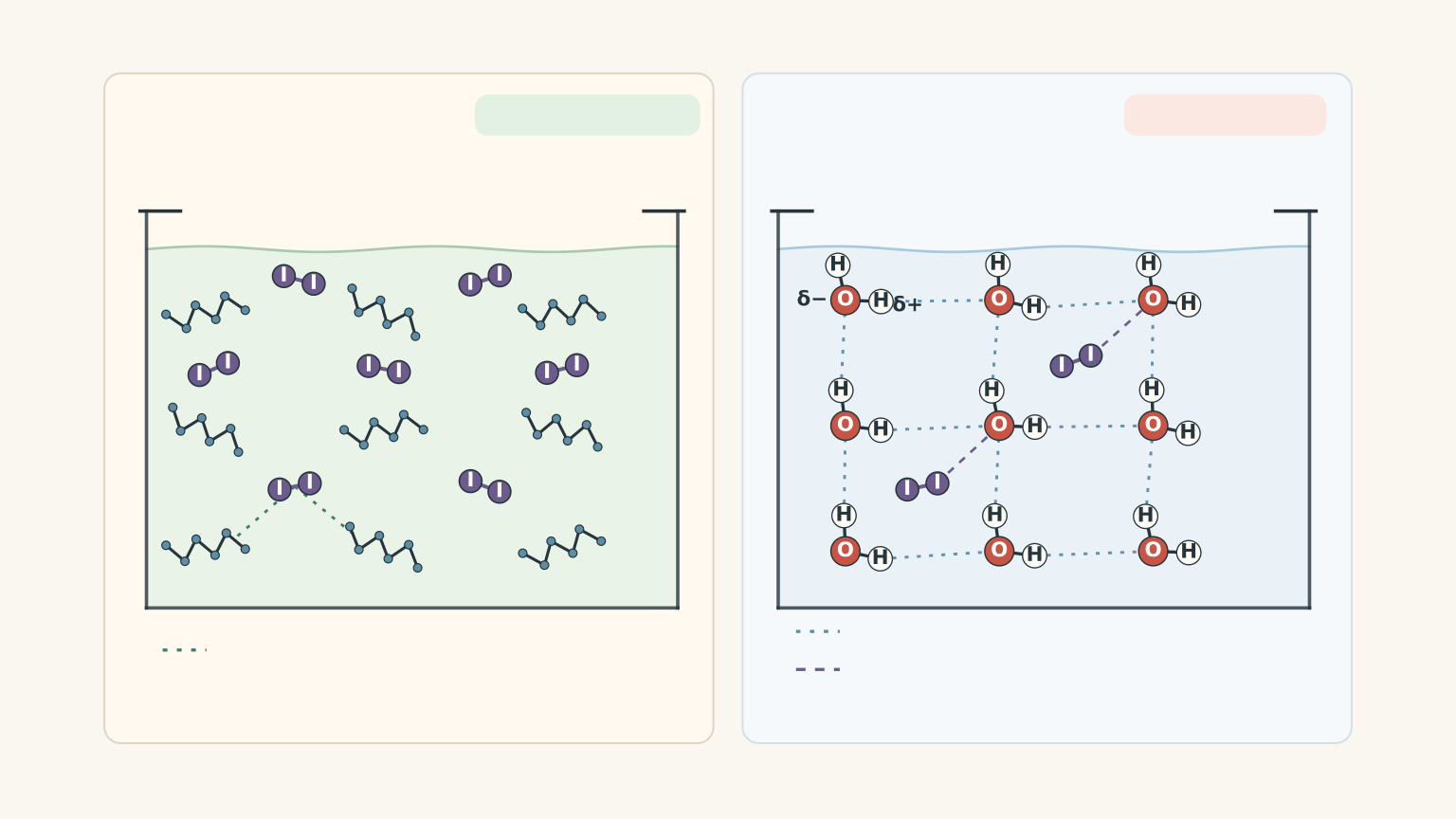
The important conclusion is not that iodine cannot interact with water. It is that the interactions available in each solvent lead to different overall solubilities.
This example also exposes a common error: nonpolar does not mean incapable of interacting with a polar molecule. All molecules experience dispersion forces, although those forces may not be enough to make a mixture favourable.
05Contrast 2: why alcohols become less soluble in water as their chains grow
Alcohols are particularly useful for testing whether you understand the limits of “like dissolves like”.
Each of these molecules contains one hydroxyl group, \(\ce{-OH}\):
| Alcohol | Condensed formula | Behaviour in water at about 20°C |
|---|---|---|
| Methanol | \(\ce{CH3OH}\) | Miscible |
| Ethanol | \(\ce{CH3CH2OH}\) | Miscible |
| Propan-1-ol | \(\ce{CH3(CH2)2OH}\) | Miscible |
| Butan-1-ol | \(\ce{CH3(CH2)3OH}\) | Limited solubility |
| Octan-1-ol | \(\ce{CH3(CH2)7OH}\) | Very low solubility |
Miscible means that two liquids mix in all proportions. A substance with limited solubility dissolves only up to a finite amount under the specified conditions.
The hydroxyl group can hydrogen-bond with water in every alcohol listed. So why does water solubility fall as the carbon chain grows?
The answer is the balance between the polar and nonpolar parts of the molecule.
- The \(\ce{-OH}\) group provides favourable interactions with water.
- The hydrocarbon chain is nonpolar and interacts mainly through dispersion forces.
- As the chain grows, the nonpolar region becomes larger relative to the single hydroxyl group.
- The favourable interactions involving the hydroxyl group become less able to compensate for the overall cost of mixing the larger nonpolar region with water.
The hydrocarbon chain does not actively repel water through some special force. Rather, the overall interaction balance becomes less favourable for dissolving the longer-chain alcohol.
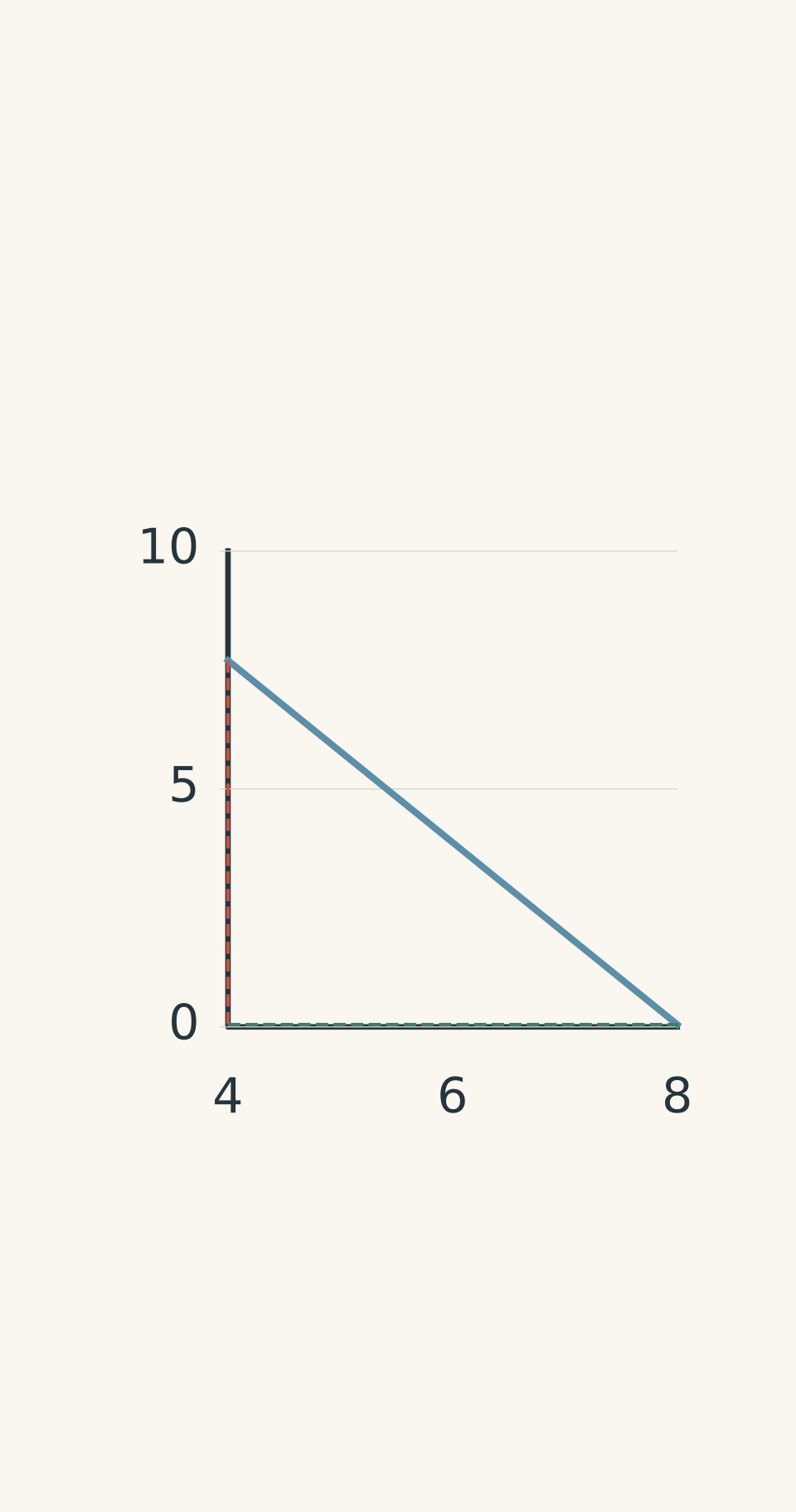
- Water solubility
- Butan-1-ol ≈ 7.7
- Octan-1-ol ≈ 0.05
Now change the solvent from water to hexane.
The prediction changes. A longer hydrocarbon chain generally makes an alcohol more compatible with a nonpolar solvent such as hexane because the chain can form dispersion interactions with the solvent. The same increase in chain length that reduces water solubility can improve compatibility with a hydrocarbon solvent.
This is why the statement “larger molecules have stronger dispersion forces” is not enough to predict solubility. Those stronger forces may favour interactions with one solvent much more than another.
06A reliable decision method for exam questions
Use the following sequence whenever you are asked to predict or compare solubility.
A six-step solubility decision method
- Identify the solvent
Name the actual solvent, such as water or hexane.
- Map molecular regions
Identify polar functional groups and nonpolar regions of the solute.
Consider the size of each region.
- List interactions
Dispersion forces: always present.
Dipole–dipole interactions: when permanent dipoles are present.
Hydrogen bonding: when suitable donors and acceptors are available.
- Compare interactions
Identify solute–solute and solvent–solvent interactions disrupted.
Compare these with the solute–solvent interactions formed.
- Consider molecular size
Assess the overall molecular size.
Compare the relative sizes of polar and nonpolar regions.
Consider how chain growth changes solvent compatibility.
- Justify the prediction
State whether solubility is high, limited or uncertain.
Support the prediction using the overall interaction balance.
Step 1: Identify the actual solvent.
Do not answer “it is soluble” without saying in what. Water and hexane provide very different interaction environments.
Step 2: Inspect the whole solute molecule.
Identify polar functional groups, possible hydrogen-bond donors and acceptors, and the size of the nonpolar regions. Do not stop after spotting an \(\ce{-OH}\) or \(\ce{C=O}\) group.
Step 3: List the relevant intermolecular interactions.
Remember that dispersion forces are always present. Add dipole-dipole interactions when permanent dipoles are present, and hydrogen bonding when suitable donors and acceptors can interact.
Step 4: Compare the interactions before and after mixing.
Ask which solute-solute and solvent-solvent interactions must be disrupted, and which solute-solvent interactions can form. Do not assume that one strong interaction automatically guarantees dissolution.
Step 5: Consider molecular size.
When comparing members of the same homologous series, the functional group may remain unchanged while the hydrocarbon region grows. This can shift the balance towards compatibility with nonpolar solvents and away from water.
Step 6: State the prediction at the right level of certainty.
If you can justify a trend, state the trend. Do not claim that a substance is completely insoluble just because it is nonpolar, or infinitely soluble just because it is polar.
Worked example: Which alcohol is more soluble in water?
Question: Compare butan-1-ol, \(\ce{CH3(CH2)3OH}\), and hexan-1-ol, \(\ce{CH3(CH2)5OH}\), in water at the same temperature. Which is more soluble? A student argues that hexan-1-ol should be more soluble because its larger electron cloud creates stronger dispersion forces. Explain the error.
Step 1
Both alcohols contain an \(\ce{-OH}\) group. Both can form hydrogen bonds with water, and both experience dispersion forces.
Step 2
Hexan-1-ol has two more carbon atoms than butan-1-ol. Its larger hydrocarbon chain gives it a greater nonpolar region and generally stronger dispersion interactions.
Step 3
The longer chain does not automatically improve water solubility. Although dispersion forces are stronger in hexan-1-ol, its larger nonpolar region makes the overall mixing process less favourable in water. The single hydroxyl group cannot compensate as effectively for that larger region.
Conclusion: Butan-1-ol is more soluble in water than hexan-1-ol. The student’s argument considers dispersion forces but ignores the solvent and the relative sizes of the polar and nonpolar regions.
07A polar molecule can accept hydrogen bonds without donating them
Consider acetone, also called propanone, with the formula \(\ce{(CH3)2CO}\).
Acetone is polar because of its carbonyl group, \(\ce{C=O}\). It is also miscible with water, even though it does not contain an \(\ce{O-H}\) bond.
How can it form hydrogen bonds with water if it has no hydrogen attached to oxygen?
The key is that hydrogen bonding requires a suitable donor and acceptor. Both do not need to belong to the same molecule.
The oxygen in acetone’s carbonyl group has lone pairs and can accept a hydrogen bond from a water molecule. Water provides the hydrogen-bond donor. Acetone also participates in dipole-dipole and dispersion interactions.
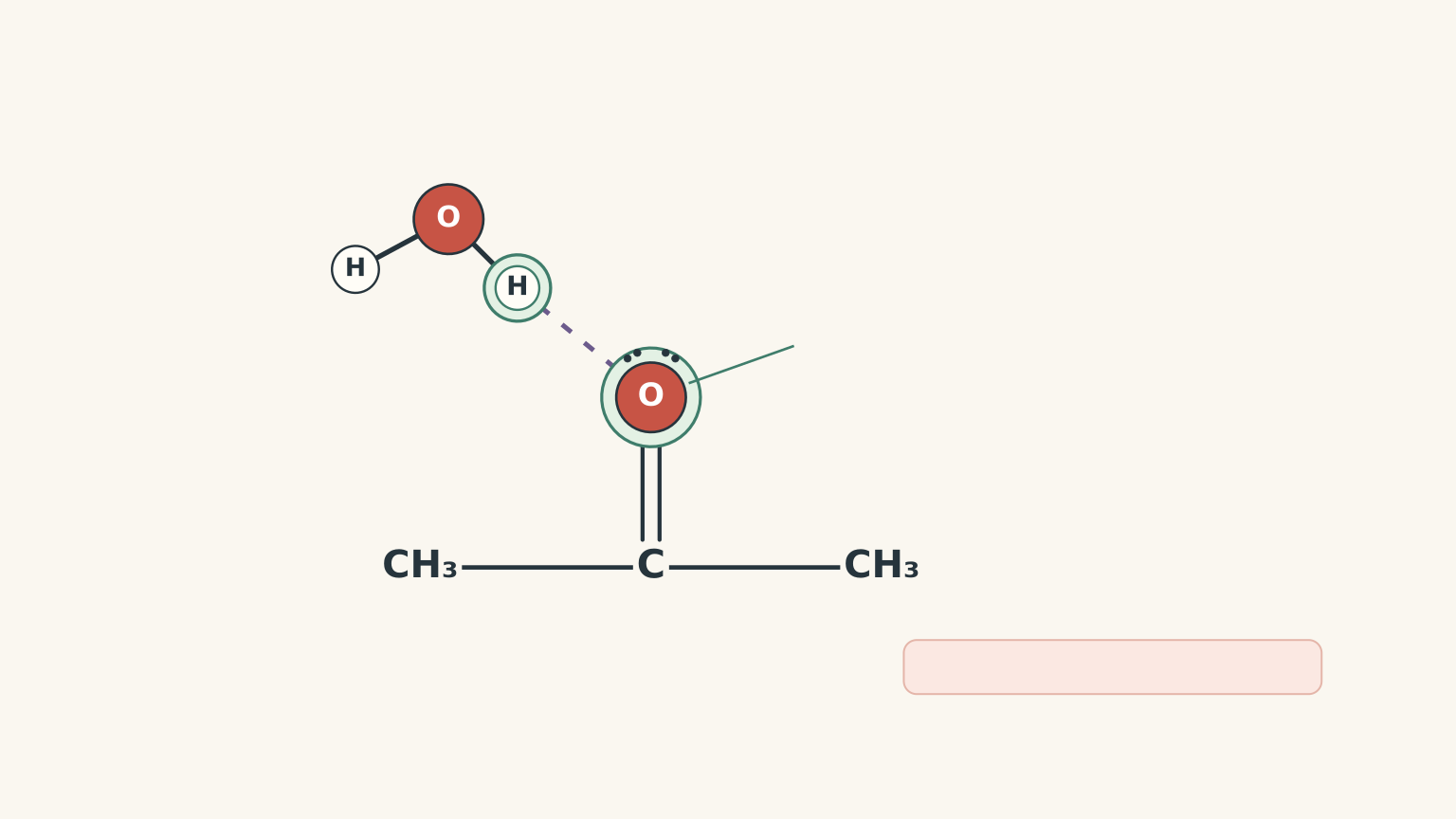
This example corrects a second shortcut: a molecule does not need an \(\ce{O-H}\) bond to accept hydrogen bonds from water.
Worked example: How does changing the solvent change the prediction?
Question: Propanone, \(\ce{CH3COCH3}\), is miscible with water. Octan-2-one, \(\ce{CH3CO(CH2)5CH3}\), contains the same carbonyl group but a much longer hydrocarbon chain. Predict which compound is more soluble in water and which is more compatible with hexane. Explain why the unchanged carbonyl group does not make their solubilities similar.
Step 1
Both contain a carbonyl group. The carbonyl oxygen can accept hydrogen bonds from water, and both compounds experience dispersion forces. Both are polar because of their carbonyl group.
Step 2
Propanone has a relatively small nonpolar region. Its carbonyl group can interact favourably with water, and the nonpolar region is small enough that propanone is miscible with water.
Octan-2-one has a much longer hydrocarbon chain. Although its carbonyl group can still accept hydrogen bonds, the larger nonpolar region makes mixing with water less favourable.
Step 3
Hexane is nonpolar and interacts mainly through dispersion forces. The longer hydrocarbon chain of octan-2-one provides a larger region for dispersion interactions with hexane, making it more compatible with this solvent than propanone is.
Conclusion: Propanone is more soluble in water, while octan-2-one is more compatible with hexane. The shared carbonyl group matters in both molecules, but the different chain lengths change the overall balance of interactions.
08Wording changes that commonly break the shortcut
In an exam, a small change in the question can change which part of your reasoning matters most.
| If the question asks… | Focus on… |
|---|---|
| Which molecule has stronger dispersion forces? | Electron-cloud size, polarisability, and molecular contact area. |
| Which molecule is more soluble in water? | Water-solute interactions, the nonpolar region, and the overall balance of mixing. |
| Can the molecule form hydrogen bonds with water? | Whether the solute can donate or accept hydrogen bonds; these are different abilities. |
| Which solvent is better for a nonpolar solute? | The interactions available in each solvent, especially dispersion forces. |
| Why does solubility decrease along a homologous series? | What stays the same, what grows, and how that changes the balance of interactions. |
| Is the solute completely insoluble? | Whether the evidence supports zero solubility or merely low solubility. |
A related trap is confusing stronger intermolecular forces with greater solubility. Stronger forces within the pure solute can make its molecules harder to separate. Stronger forces between solute and solvent can favour mixing. You must distinguish these effects rather than simply ranking the forces.
09Exam self-check
Before submitting a solubility prediction, ask yourself:
- Have I named the solvent?
- Have I considered the whole molecule, rather than just one functional group?
- Have I identified dispersion forces as well as any dipole-dipole interactions and hydrogen bonding?
- Have I considered the interactions disrupted and those formed?
- Have I accounted for molecular size?
- Have I justified the degree of solubility, rather than making an unsupported absolute claim?
If your explanation ends at “they are both polar”, you have identified a useful clue, but you have not finished the reasoning.
10Questions and solutions
Question 1
Water and hexane are shaken together and then left to stand. Two liquid layers form.
Explain why this happens using intermolecular forces. Is it correct to say that water and hexane have no attractive interactions with each other?
Solution 1
Water and hexane form separate layers because mixing is unfavourable overall, not because the molecules have zero attraction to each other.
Water molecules form hydrogen bonds with one another, whereas hexane molecules interact mainly through dispersion forces. Water and hexane can still experience dispersion interactions when they come into contact, but these interactions do not compensate sufficiently for the overall cost of mixing the two liquids.
The liquids therefore separate into distinct phases. The important distinction is between having some attractive interactions and having interactions that make mixing favourable.
Question 2
At 20°C, suppose the approximate water solubilities of two alcohols are:
- Butan-1-ol: \(7.7\ \mathrm{g}\) per \(100\ \mathrm{mL}\) of water.
- Octan-1-ol: \(0.05\ \mathrm{g}\) per \(100\ \mathrm{mL}\) of water.
(a) Calculate how many times greater the stated mass solubility of butan-1-ol is than that of octan-1-ol.
(b) Both alcohols contain one \(\ce{-OH}\) group. Explain why their solubilities differ so greatly.
Solution 2
(a) Butan-1-ol has approximately 154 times the stated mass solubility of octan-1-ol.
Calculate the ratio by dividing the larger solubility by the smaller one:
\[ \begin{aligned} \text{Solubility ratio} &= \frac{7.7}{0.05}\\ &= 154 \end{aligned} \]
Both values have the same units, \(\mathrm{g}/100\ \mathrm{mL}\), so the units cancel in the ratio.
The result means that, using the supplied approximate values, the same volume of water can dissolve about 154 times as much butan-1-ol by mass as octan-1-ol.
(b) The longer hydrocarbon chain in octan-1-ol makes it much less compatible with water.
Both molecules can hydrogen-bond with water through their hydroxyl groups. However, octan-1-ol has eight carbon atoms, compared with four in butan-1-ol. Its larger nonpolar region changes the overall balance of interactions, so its favourable interactions with water are less able to compensate for the cost of mixing.
The number of hydroxyl groups alone cannot predict solubility. Molecular size and the relative sizes of the polar and nonpolar regions also matter.
Question 3
Acetone, \(\ce{(CH3)2CO}\), is miscible with water. A student claims this is impossible because acetone has no \(\ce{O-H}\) bond and therefore cannot form hydrogen bonds.
Evaluate the student’s claim. Identify the intermolecular interactions between acetone and water.
Solution 3
The student’s claim is incorrect because acetone can accept hydrogen bonds from water, even though it cannot donate conventional hydrogen bonds through an \(\ce{O-H}\) group.
The oxygen atom in acetone’s carbonyl group has lone pairs and acts as a hydrogen-bond acceptor. A hydrogen atom attached to oxygen in a water molecule can donate a hydrogen bond to that carbonyl oxygen.
Acetone and water also experience dispersion forces, and both molecules are polar, allowing dipole-dipole interactions. These favourable interactions help explain why acetone and water are miscible.
The trap is assuming that a molecule must contain an \(\ce{O-H}\) bond to participate in hydrogen bonding. That bond is one way to provide a donor, but a molecule can also accept a hydrogen bond.
Question 4
Equal small samples of iodine, \(\ce{I2}\), are added separately to water and hexane. Iodine is sparingly soluble in water but much more soluble in hexane.
A student argues:
“Because iodine is nonpolar, it cannot attract water molecules. Its low solubility in water proves that there are no iodine-water interactions.”
Evaluate this argument and explain the difference in solubility.
Solution 4
The argument is incorrect because iodine and water can still interact through dispersion forces, even though iodine is nonpolar.
Iodine has a large, polarisable electron cloud, so it experiences significant dispersion interactions. These interactions are compatible with the dispersion forces present between hexane molecules, making hexane a much more suitable solvent for iodine.
In water, iodine can still interact with water molecules through dispersion and related induced-dipole interactions. However, these interactions do not favour mixing as effectively as the interactions available in hexane, particularly when the water hydrogen-bonding network must rearrange.
Iodine is therefore much more soluble in hexane, but its water solubility is not zero. Low solubility does not prove the absence of attractive interactions.
Question 5
Consider a series of neutral ketones in which each molecule contains one carbonyl group, \(\ce{C=O}\), but the hydrocarbon chain becomes progressively longer.
Suppose the shortest-chain member is miscible with water, whereas a much longer-chain member is only slightly soluble in water but dissolves readily in hexane.
Two students propose explanations:
- Student A: “The longer-chain molecule has become nonpolar, so its carbonyl group no longer matters.”
- Student B: “The carbonyl group makes the molecule polar, so it must remain highly soluble in water.”
(a) Explain why neither explanation is adequate.
(b) Predict how increasing chain length generally affects compatibility with water and hexane.
(c) A third student argues that the longer-chain molecule has stronger dispersion forces, so it must be more soluble in every solvent. Identify the flaw in this reasoning.
Solution 5
Neither Student A nor Student B is correct. The carbonyl group remains important, but increasing the hydrocarbon chain changes the balance of interactions between the molecule and each solvent.
(a) Both explanations ignore part of the molecule.
Student A is wrong because increasing the chain length does not make the carbonyl group cease to be polar. The carbonyl group can still accept hydrogen bonds from water, and the molecule can still experience dipole-dipole interactions.
Student B is wrong because the presence of a polar group does not guarantee high water solubility. A longer hydrocarbon chain creates a larger nonpolar region, which can make mixing with water less favourable even though the carbonyl group remains unchanged.
The molecule’s solubility reflects the combined behaviour of its polar and nonpolar regions, not a single functional group.
(b) Increasing chain length generally decreases water solubility and improves compatibility with hexane.
In water, the carbonyl group provides favourable interactions, including hydrogen bonding. However, as the nonpolar chain grows, those interactions become less able to compensate for the overall cost of mixing the larger molecule with water.
In hexane, the growing hydrocarbon region can participate in dispersion interactions with the nonpolar solvent. The longer chain therefore generally makes the molecule more compatible with hexane.
Shortening the chain tends to shift the balance towards water and away from hexane, all else being equal. It does not mean that the shorter-chain compound must become insoluble in hexane.
(c) Stronger dispersion forces do not guarantee greater solubility in every solvent.
The third student has considered only the strength of the forces, not where those forces act. A larger molecule can have stronger dispersion interactions with hexane, but it also has a larger nonpolar region that is poorly accommodated by water.
The same structural change can therefore improve compatibility with one solvent while reducing compatibility with another. Solubility depends on the overall balance of interactions and the conditions, not on the strength of one intermolecular force in isolation.
The observations establish a useful trend, but the words polar and nonpolar alone cannot give an exact solubility or identify the precise point at which one solvent becomes more suitable than another. That requires more specific solubility evidence.
Once you can make these predictions from molecular structure, the next useful step is to distinguish solubility from concentration: knowing which solvent is more suitable tells you about the tendency to dissolve, but not necessarily how much solute is present in a particular solution.