
From Copper Sulfide Ore to Pure Copper: Each Processing Stage
Follow copper sulfide ore through concentration, smelting, converting, and electrolytic refining. Learn how each stage works, interpret key chemical equations, and understand how ore grade, energy use, recovery, and waste influence processing decisions.
A tonne of copper sulfide ore might contain only 10 kg of copper. If you sent the entire tonne straight into a furnace, you’d spend energy heating and processing nearly a tonne of material that isn’t copper. But crushing the rock into powder doesn’t produce pure copper either. The copper is chemically bound inside minerals, mixed with iron sulfides and unwanted rock.
The process has to solve two different problems: first, separate the copper-bearing minerals from most of the unwanted material; then, use chemical reactions and electricity to turn those minerals into pure copper.
Predict this: if an ore contains 1.0% copper, does that mean the plant will recover 1.0% of the copper? No. The 1.0% describes the ore’s copper content, not the proportion recovered during processing. Keeping those two ideas separate will help you understand every stage that follows.
One tonne of copper sulfide ore contains 1.0% copper by mass
| Contained copper — 10 kg (1.0%) | Copper contained within copper-bearing sulfide minerals. Mass-balance quantity, not visible metallic copper. |
|---|---|
| Remaining material — 990 kg (99.0%) | Includes iron, sulfur and other mineral or rock constituents. Together with the contained copper, totals 1,000 kg of ore. |
01The complete copper sulfide processing route
The usual route for a concentrated copper sulfide ore follows this sequence:
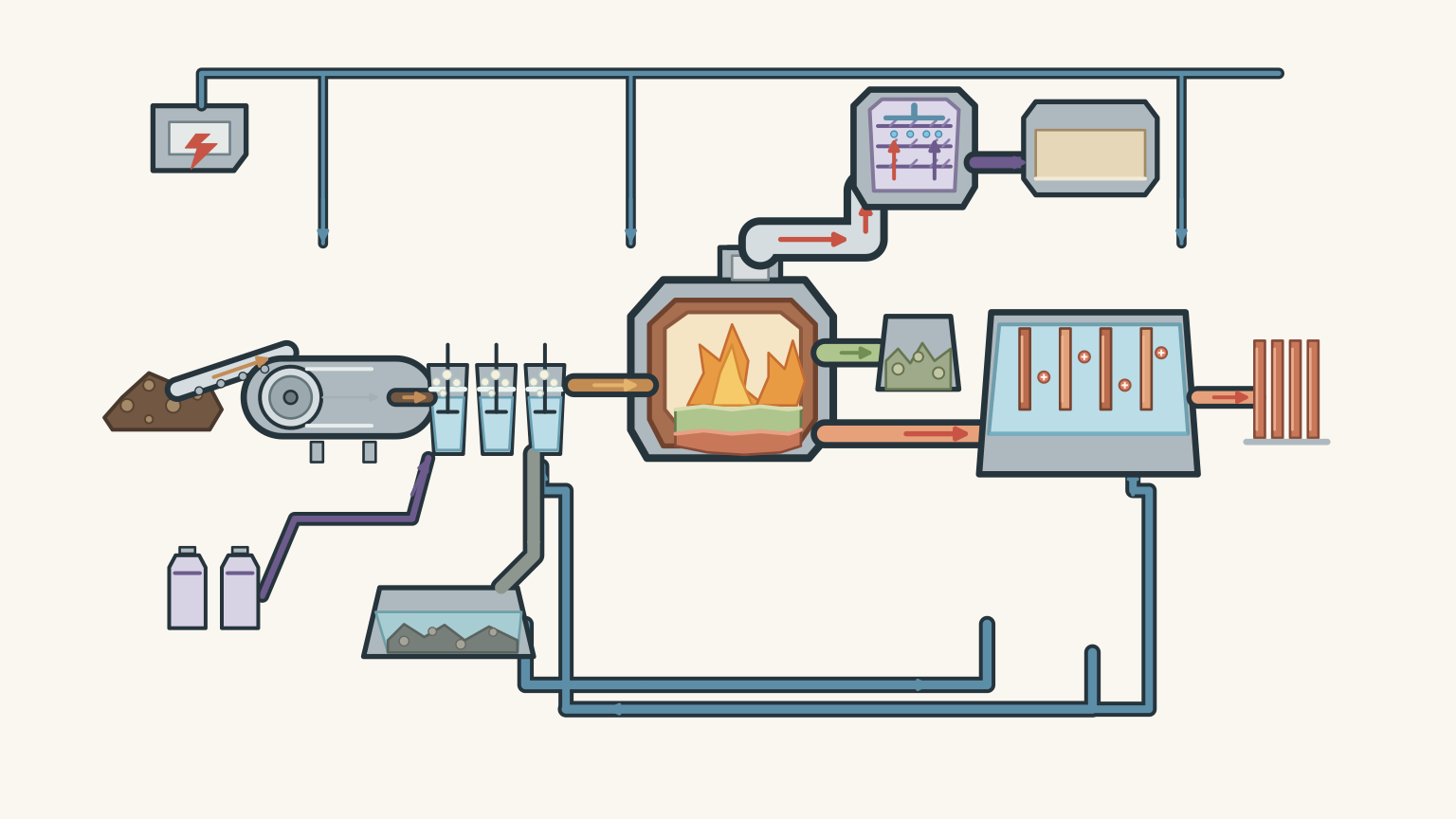
Ore assessment → Crushing and grinding → Froth flotation → Copper sulfide concentrate → Smelting → Copper-rich matte → Converting → Blister copper → Electrorefining → High-purity copper cathodes
Each stage has a different job. Some stages separate materials physically. Others use chemical reactions. The final stage uses electrolysis to purify the metal.
Copper sulfide processing route: required flowchart structure
| Main copper production route | Ore assessment → crushing and grinding → froth flotation → copper sulfide concentrate. Smelting → copper-rich matte → converting → blister copper → electrorefining → high-purity copper cathodes. |
|---|---|
| Required side streams | Flotation → tailings; smelting and converting → iron-rich slag. SO₂ off-gas → gas capture → sulfuric acid production; electrorefining → anode slime. |
01Assess the ore before processing it
Before choosing an extraction method, a mining company needs to know what the ore contains and how difficult it will be to process.
Three properties are especially important.
- Ore grade: the mass of copper present as a percentage of the ore’s total mass.
- Mineralogy: the minerals containing the copper, such as chalcopyrite, \(\ce{CuFeS2}\), or chalcocite, \(\ce{Cu2S}\).
- Liberation: how finely the rock must be crushed and ground before the copper-bearing mineral grains separate from the surrounding minerals.
Ore grade is usually measured by taking representative samples and analysing their copper content. This is an assay.
For example, an ore grade of 1.0% copper means that every 1,000 kg of ore contains 10 kg of copper, assuming the stated grade is a mass percentage of copper.
| Ore mass | Copper grade | Copper contained |
|---|---|---|
| 1,000 kg | 0.5% | 5 kg |
| 1,000 kg | 1.0% | 10 kg |
| 1,000 kg | 2.0% | 20 kg |
The calculation is:
\[ m_{\mathrm{Cu}}=m_{\mathrm{ore}}\times \frac{\text{grade}}{100} \]
Here, \(m_{\mathrm{Cu}}\) is the mass of copper in the ore, and \(m_{\mathrm{ore}}\) is the total ore mass.
A higher grade generally means less rock must be mined and processed to obtain the same amount of copper. That can reduce energy use, water consumption, transport requirements, and the amount of tailings produced per kilogram of copper.
But grade alone doesn’t determine whether an ore is worth processing. A high-grade ore may be difficult to grind or contain troublesome impurities. A lower-grade ore may be easier to process and have a much higher copper recovery.
That is why companies assess both the amount of copper present and how effectively they can extract it.
02Concentrate the copper minerals using flotation
Crushing and grinding
Run-of-mine ore contains interlocked mineral grains. Large rocks are crushed, then ground into smaller particles.
The goal is to liberate the copper-bearing minerals from the surrounding rock.
Grinding too coarsely leaves valuable copper minerals attached to unwanted material. Grinding excessively fine wastes energy and can make subsequent separation more difficult.
The ideal particle size depends on the ore’s mineralogy and texture.
Froth flotation
Once the ore has been ground, the copper sulfide minerals can be concentrated using froth flotation.
Unsupported construction: froth flotation tank cross-section
| Required flotation mechanism | Air bubbles rise through water containing ground ore. Hydrophobic copper sulfide particles attach to bubbles and collect in surface froth. |
|---|---|
| Required separation outlets | Gangue largely remains in the slurry and leaves through the tailings outlet. The cross-section must label the concentrate froth, water, sulfide particles, and air inlet. |
The idea is to exploit differences in the surfaces of the mineral particles.
The slurry is mixed with carefully selected reagents. These help the desired sulfide particles attach to air bubbles. As the bubbles rise, they carry the copper-bearing particles to the surface, where the froth is collected.
Most of the unwanted rock, called gangue, remains in the slurry and leaves as tailings.
Flotation is a physical separation process. It does not normally convert the copper sulfides into copper metal.
The product is a copper concentrate: a much smaller mass of material with a higher copper content than the original ore. It still contains other substances, including iron sulfides and sulfur.
Two quantities describe how well this stage works.
Concentrate grade is the percentage of the concentrate’s mass that is copper.
Copper recovery is the percentage of the copper in the original ore that ends up in the concentrate.
Recovery is calculated using:
\[ \text{Recovery}= \frac{m_{\mathrm{Cu,\ concentrate}}} {m_{\mathrm{Cu,\ feed}}}\times100\% \]
Here, \(m_{\mathrm{Cu,\ concentrate}}\) is the mass of copper in the concentrate, and \(m_{\mathrm{Cu,\ feed}}\) is the mass of copper in the ore entering flotation.
A concentrate grade of 25% does not mean that 25% of the original copper was recovered. It means that 25% of the concentrate’s mass is copper.
These are different measurements.
Worked example: How much copper reaches the concentrate?
An ore processing plant receives 2.0 tonnes of ore containing 1.5% copper. Flotation recovers 85% of the copper. Calculate the mass of copper entering the concentrate and the mass left in the tailings.
Step 1
Convert tonnes to kilograms:
\[ 2.0\ \mathrm{t}=2000\ \mathrm{kg} \]
Then apply the ore grade:
\[ m_{\mathrm{Cu,\ feed}} =2000\times\frac{1.5}{100} =30\ \mathrm{kg} \]
The ore contains 30 kg of copper.
Step 2
\[ \begin{aligned} m_{\mathrm{Cu,\ concentrate}} &=30\times\frac{85}{100}\\ &=25.5\ \mathrm{kg} \end{aligned} \]
The concentrate contains 25.5 kg of copper.
Step 3
\[ \begin{aligned} m_{\mathrm{Cu,\ tailings}} &=30-25.5\\ &=4.5\ \mathrm{kg} \end{aligned} \]
The tailings contain 4.5 kg of copper that was not recovered into the concentrate.
Notice that the plant has not lost 15% of the total ore mass. It has failed to recover 15% of the copper in the feed. Most of the ore’s mass is not copper in the first place.
Worked example: How much concentrate is produced?
A plant processes 1,200 tonnes of ore containing 0.90% copper. Flotation recovers 92% of the copper, and the resulting concentrate contains 27% copper by mass. Calculate the concentrate mass and the mass of copper remaining in the tailings.
Step 1
\[ \begin{aligned} m_{\mathrm{Cu,\ feed}} &=1200\ \mathrm{t}\times0.0090\\ &=10.8\ \mathrm{t} \end{aligned} \]
Step 2
\[ \begin{aligned} m_{\mathrm{Cu,\ concentrate}} &=10.8\times0.92\\ &=9.936\ \mathrm{t} \end{aligned} \]
Step 3
The concentrate is 27% copper, so copper represents 0.27 of its total mass.
\[ \begin{aligned} m_{\mathrm{concentrate}} &=\frac{9.936\ \mathrm{t}}{0.27}\\ &=36.8\ \mathrm{t} \end{aligned} \]
The plant produces approximately 36.8 tonnes of concentrate from 1,200 tonnes of ore.
Step 4
\[ \begin{aligned} m_{\mathrm{Cu,\ tailings}} &=10.8-9.936\\ &=0.864\ \mathrm{t} \end{aligned} \]
The tailings contain 0.864 tonnes, or 864 kg, of copper.
This is an idealised mass balance. It assumes the stated recovery applies to all copper in the feed and ignores any additional solid material introduced or lost during processing.
The key result is that flotation has reduced the feed from 1,200 tonnes of ore to just 36.8 tonnes of concentrate. That reduction makes the next high-temperature stages far more practical.
03Smelting: separate copper-rich matte from slag
Flotation has concentrated the copper minerals, but the concentrate is still a mixture of sulfides. The copper must now be separated from sulfur and much of the iron.
This is the job of smelting.
The concentrate is heated in a furnace, commonly with oxygen-enriched air and a flux such as silica, \(\ce{SiO2}\). At high temperatures, the material forms molten phases, and oxidation reactions change the composition of the sulfides.
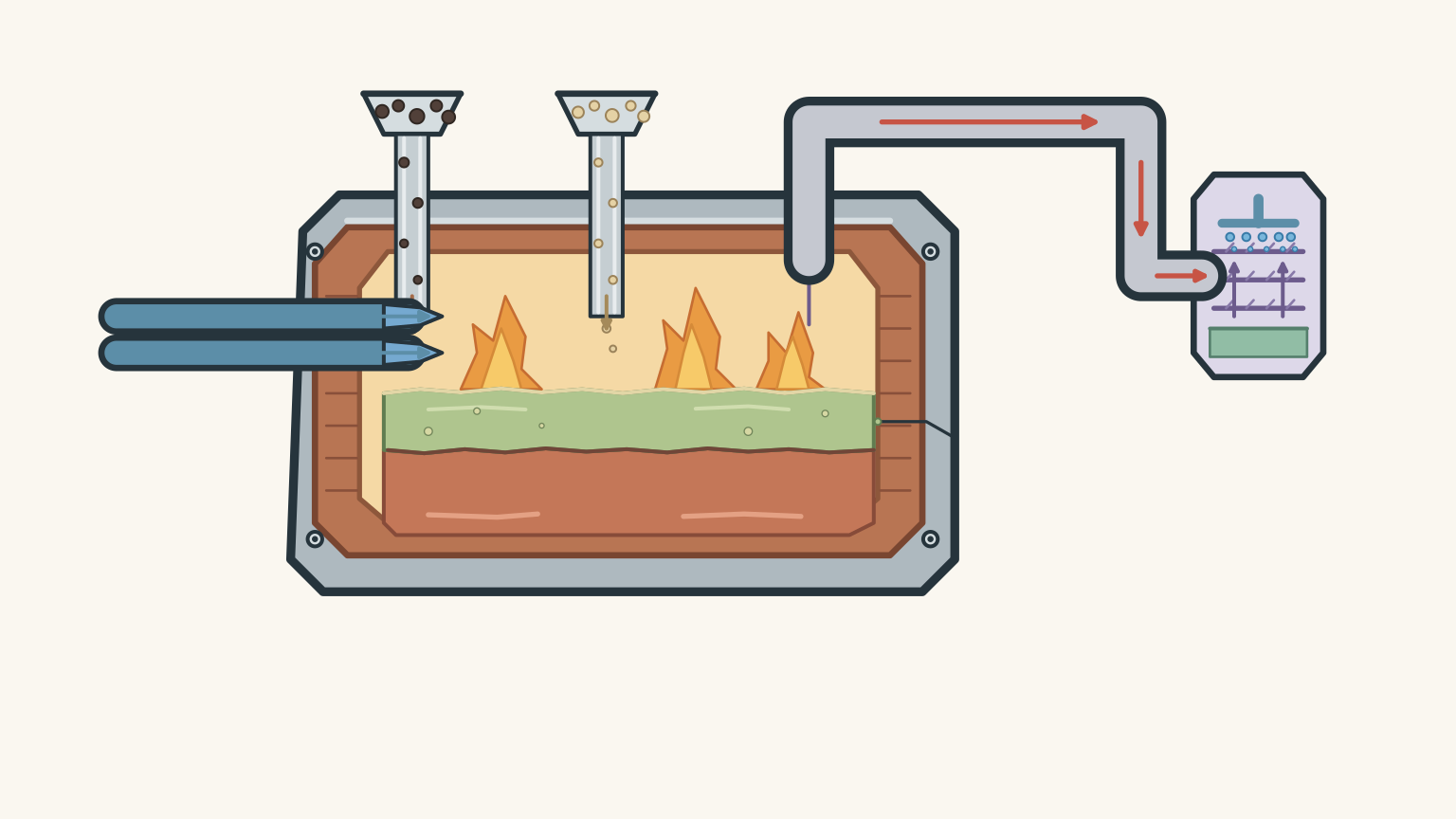
Two products are particularly important.
- Matte: a molten, copper-rich sulfide mixture containing mainly copper(I) sulfide, \(\ce{Cu2S}\), and iron(II) sulfide, \(\ce{FeS}\).
- Slag: a separate molten phase containing iron compounds, silica, and other oxides.
Matte is not pure copper. It is an intermediate that can be processed further.
What happens to the sulfur and iron?
Consider chalcopyrite, \(\ce{CuFeS2}\), a common copper sulfide mineral.
A simplified partial-oxidation equation is:
\[ \ce{2CuFeS2 + O2 -> Cu2S + 2FeS + SO2} \]
This represents the formation of copper-rich sulfide material and sulfur dioxide.
Some of the iron sulfide is then oxidised:
\[ \ce{2FeS + 3O2 -> 2FeO + 2SO2} \]
The iron(II) oxide, \(\ce{FeO}\), reacts with silica flux to form an iron silicate slag. A simplified equation for forming fayalite, \(\ce{Fe2SiO4}\), is:
\[ \ce{2FeO + SiO2 -> Fe2SiO4} \]
These equations represent important reactions, not a complete description of every reaction occurring inside an industrial furnace.
The purpose of the flux is worth remembering. Silica does not simply absorb iron like a sponge. It reacts with iron oxide to form a separate slag phase that can be removed from the copper-rich matte.
Smelting therefore performs two jobs: it produces a molten sulfide intermediate and separates much of the iron into slag.
It also releases sulfur dioxide, \(\ce{SO2}\), which must be managed carefully.
04Converting: turn the matte into blister copper
The matte still contains sulfur and some iron. It is transferred to a converter, where air or oxygen-enriched gas is blown through the molten material.
The remaining iron sulfide is oxidised, and the resulting iron oxide is removed into slag. Further reactions convert the copper sulfide into metallic copper.
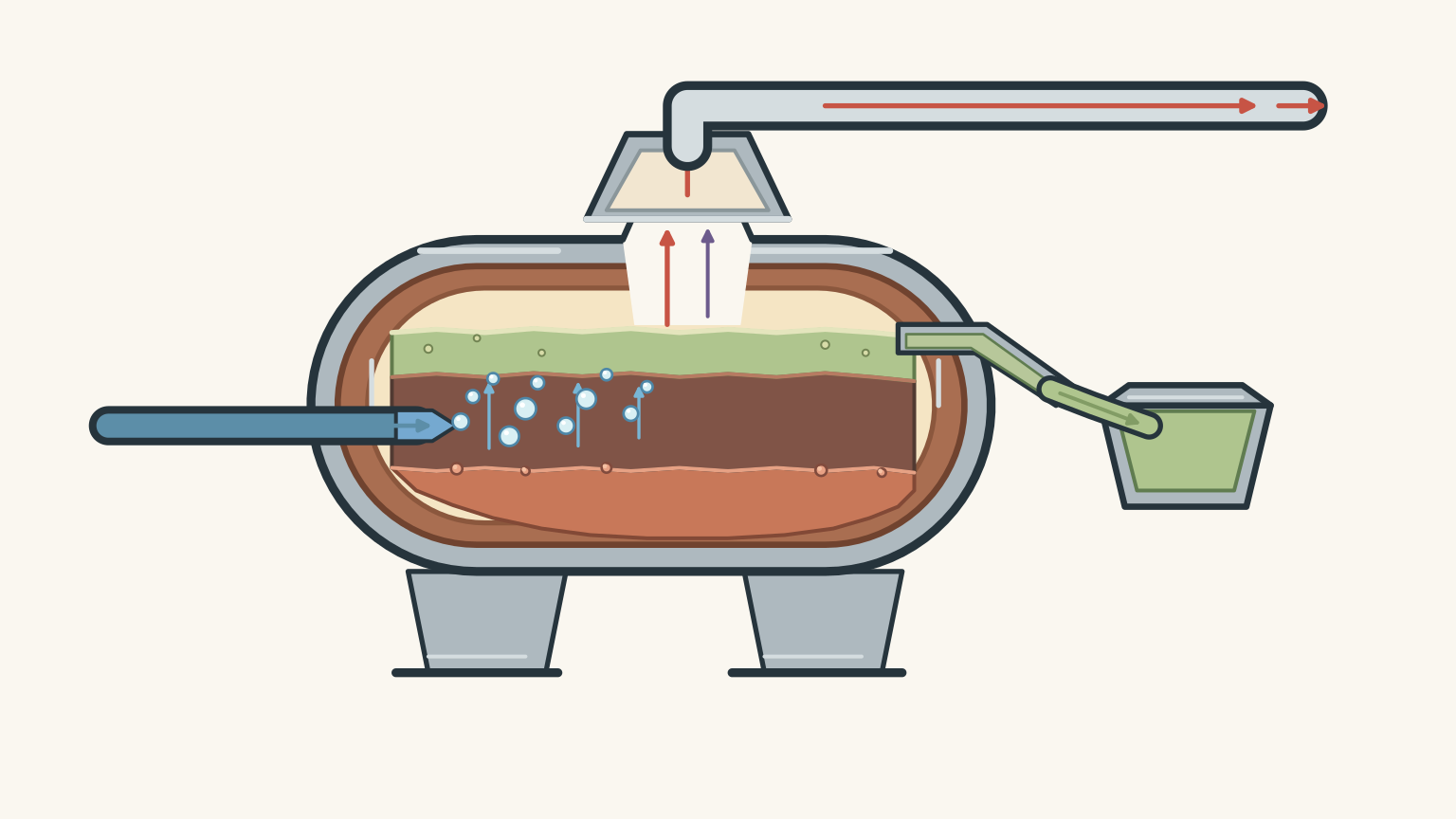
From copper sulfide to copper metal
Some copper(I) sulfide is oxidised to copper(I) oxide:
\[ \ce{2Cu2S + 3O2 -> 2Cu2O + 2SO2} \]
The copper(I) oxide then reacts with remaining copper(I) sulfide:
\[ \ce{2Cu2O + Cu2S -> 6Cu + SO2} \]
The second reaction is an example of self-reduction. The copper oxide reacts with copper sulfide, allowing copper metal to form without requiring a separate reducing agent for this step.
Together, these reactions can be represented by the simplified overall equation:
\[ \ce{Cu2S + O2 -> 2Cu + SO2} \]
This overall equation is useful for stoichiometric calculations, but the actual converting process involves several reactions and changing phases.
The product is called blister copper, typically around 98-99% copper. The name refers to the blistered surface that can form as gas escapes during solidification.
Why isn’t this the final product? Because small quantities of other elements remain. Applications requiring very pure copper need another stage.
What happens to the sulfur dioxide?
Sulfur dioxide is an important environmental concern in copper processing. If released without adequate control, it contributes to air pollution and can contribute to acid deposition.
Modern smelters can capture sulfur dioxide-rich off-gases and convert the sulfur dioxide into sulfuric acid. The conversion includes the catalytic oxidation of sulfur dioxide to sulfur trioxide:
\[ \ce{2SO2 + O2 <=> 2SO3} \]
The sulfur trioxide is then used in sulfuric acid production.
This creates a potentially valuable by-product while reducing emissions. However, the amount captured depends on the plant’s gas collection, treatment, and operating systems. Producing sulfuric acid is not an automatic consequence of every copper smelting operation.
The decision to invest in gas capture also involves energy, equipment, regulation, and access to markets for the acid.
05Electrorefining: use electricity to purify copper
Blister copper is much purer than the original ore, but it may still contain elements such as iron, zinc, nickel, silver, and gold.
Electrorefining removes many of these impurities and produces high-purity copper, commonly around 99.99%.
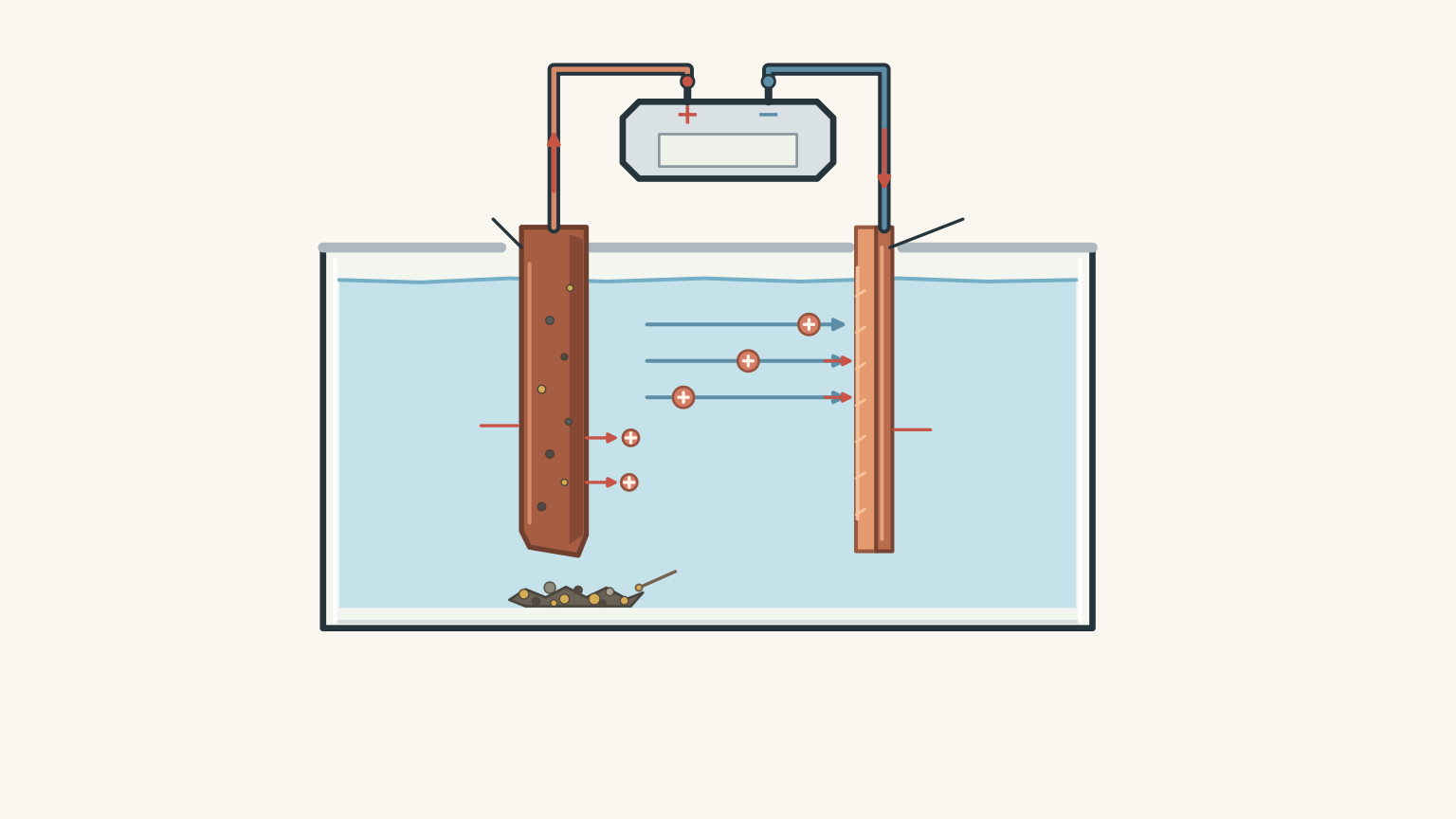
The cell contains three essential components:
- An impure copper anode connected to the positive terminal.
- A pure copper cathode connected to the negative terminal.
- An electrolyte containing copper ions, usually an acidified copper sulfate solution.
An external power supply drives the reactions.
At the anode: copper dissolves
Copper atoms lose electrons and enter the electrolyte as copper ions.
\[ \ce{Cu(s) -> Cu^2+(aq) + 2e-} \]
This is oxidation because copper loses electrons.
At the cathode: copper is deposited
Copper ions in the electrolyte gain electrons and form solid copper on the cathode.
\[ \ce{Cu^2+(aq) + 2e- -> Cu(s)} \]
This is reduction because copper ions gain electrons.
The electrical circuit transfers electrons through the external wire. Copper ions move through the electrolyte. These are two different parts of the same electrochemical process.
The result is that copper dissolves from the impure anode and deposits as much purer metal on the cathode.
What happens to the impurities?
Their behaviour depends on their chemistry. Some more reactive impurities dissolve into the electrolyte but do not readily deposit alongside copper under the operating conditions. Less reactive precious metals, including silver and gold, can collect as anode slime and may be recovered separately.
Electrorefining therefore improves purity while also creating opportunities to recover valuable by-products.
06Why grade, energy, waste, and value all matter
Copper extraction is not simply a race to recover the largest possible mass of copper. A plant must produce saleable copper while controlling its energy use, operating costs, emissions, and waste.
Consider the main decisions.
| Factor | Why it matters |
|---|---|
| Ore grade | Low-grade ore generally requires more rock to be mined and processed per kilogram of contained copper. |
| Flotation recovery | Copper left in the tailings is not available for sale unless it is recovered later. |
| Concentrate grade | A richer concentrate usually means less material must be heated, transported, and processed by the smelter per kilogram of copper. |
| Ore hardness and liberation | Harder ore or finer grinding requirements can increase energy use and processing costs. |
| Impurities | Some elements complicate processing, affect product quality, or attract treatment penalties. |
| Tailings and slag | These streams require suitable management and may contain recoverable metals. |
| Sulfur dioxide capture | Gas treatment can reduce emissions and provide sulfuric acid as a by-product. |
| Energy, water, and metal prices | These influence operating costs, the value of the recovered copper, and whether a deposit is economically viable. |
A common misconception: maximise concentrate grade at any cost
Imagine adjusting a flotation plant to produce a concentrate with a higher copper percentage.
That sounds beneficial, and it often is. A higher concentrate grade can reduce the mass sent to the smelter.
However, the adjustment might also cause more copper-bearing particles to leave with the tailings. The plant could produce a cleaner concentrate while recovering less of the copper it mined.
The opposite strategy has its own problem. Trying to recover every last copper-bearing particle may increase the amount of unwanted material reporting to the concentrate, making downstream processing more expensive.
The best operating conditions depend on the trade-off between recovery, concentrate quality, processing capacity, and cost. Maximising one measurement does not necessarily maximise profit or minimise environmental impact.
The same reasoning applies to the choice of ore. A high-grade deposit is attractive, but the full decision also depends on how easily its copper can be recovered and what resources are needed to do so.
07Why oxide copper ores often follow a different route
The route described above is typical for many copper sulfide ores. It is not the only way to extract copper, and it is not automatically suitable for every copper mineral.
Copper oxide ores can often be treated using acid leaching, followed by solvent extraction and electrowinning, commonly abbreviated to SX-EW.
For example, copper(II) oxide reacts with sulfuric acid:
\[ \ce{CuO + H2SO4 -> CuSO4 + H2O} \]
The copper enters the solution as copper ions. The solution is then processed to obtain a suitable electrolyte, and electrowinning deposits copper metal onto a cathode.
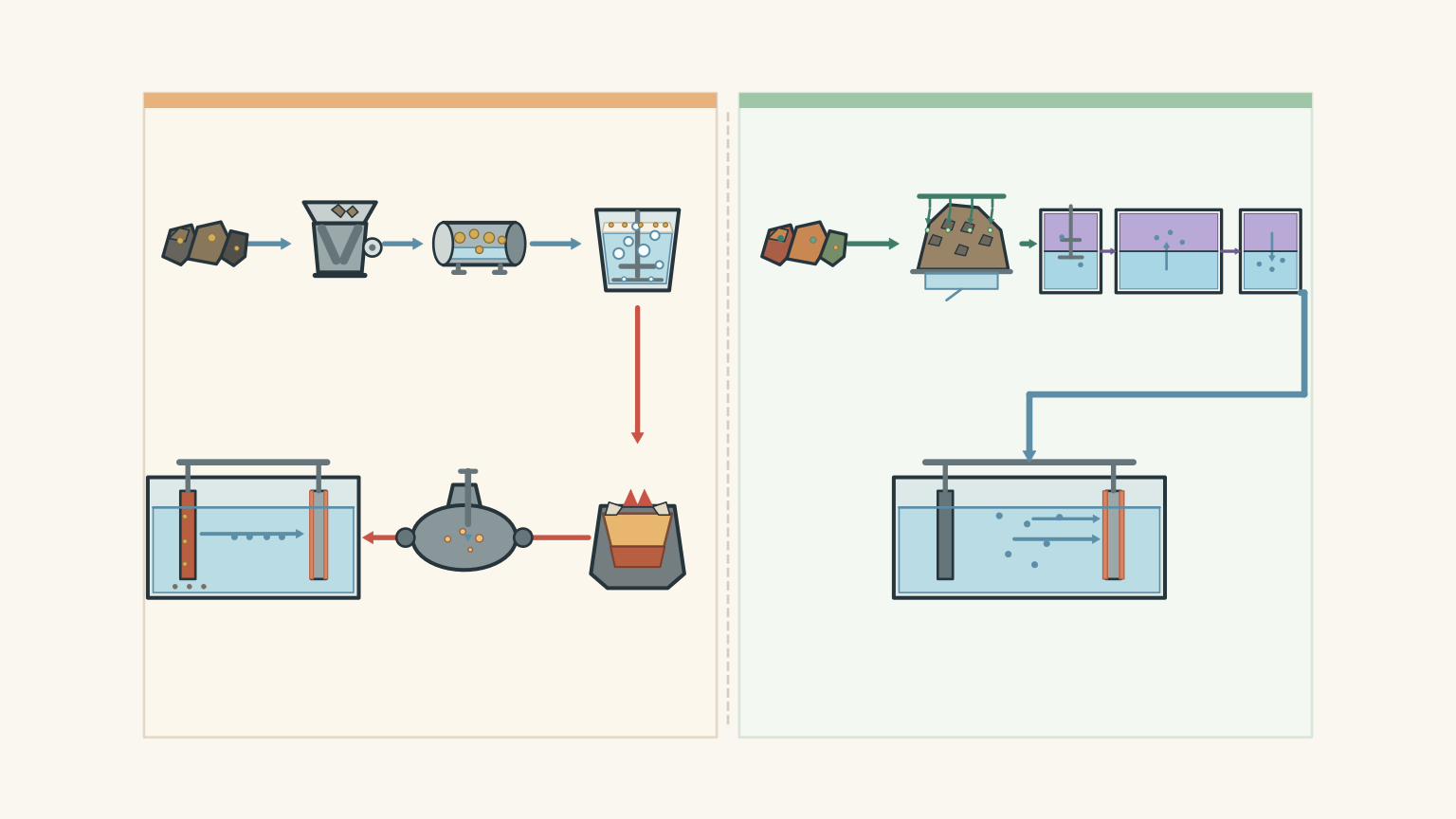
The distinction between the two electrical processes is important.
Electrorefining uses an impure copper anode as the source of copper. Copper dissolves from that anode and deposits onto a purer cathode.
Electrowinning deposits copper from a purified solution produced by leaching and solution treatment. It does not require an impure copper-metal anode as the feed.
Why not simply use dilute sulfuric acid to leach every copper sulfide ore? Sulfide minerals such as chalcopyrite do not generally dissolve readily under ordinary dilute-acid heap-leaching conditions. Their chemistry and reaction rates can make that route unsuitable without additional treatment.
Some sulfide ores can be processed through specialised leaching methods, including bioleaching or pressure leaching, under appropriate conditions. The point is not that sulfide ores can never be leached. It is that the mineralogy determines which route is practical.
The choice between processing routes comes back to the same question: which combination of physical separation, chemical reactions, energy use, recovery, and waste management can extract the copper effectively from this particular ore?
09Questions and solutions
Question 1
An ore sample contains 18.0 kg of copper in 1.50 tonnes of ore.
Calculate the copper grade. A manager claims that this means 1.2% of the copper will be recovered during flotation. Explain the error in this claim.
Solution 1
The ore grade is 1.20%, but the flotation recovery cannot be determined from the grade alone.
First, convert the ore mass to kilograms:
\[ 1.50\ \mathrm{t}=1500\ \mathrm{kg} \]
Calculate the grade:
\[ \begin{aligned} \text{Grade} &=\frac{18.0\ \mathrm{kg}}{1500\ \mathrm{kg}} \times100\%\\ &=1.20\% \end{aligned} \]
The grade tells us that copper represents 1.20% of the ore’s mass.
Recovery measures something different: the percentage of the copper in the original ore that enters the concentrate. To calculate recovery, we would need to know how much copper actually reaches the concentrate.
The tempting mistake is to treat two percentages as interchangeable simply because both describe copper. One measures composition; the other measures process performance.
Question 2
Two ore sources can each supply 1,000 tonnes of ore per day. Their properties are shown below.
| Property | Ore A | Ore B |
|---|---|---|
| Copper grade | 1.40% | 0.95% |
| Flotation recovery | 80% | 95% |
| Energy for mining and concentration | 0.45 GJ/t | 0.22 GJ/t |
Calculate the energy used per kilogram of copper recovered during mining and concentration for each ore. Which source is more energy-efficient at this stage?
Explain why your answer does not establish which source is more profitable overall.
Solution 2
Ore B uses less energy per kilogram of copper recovered: approximately 24.4 MJ/kg, compared with 40.2 MJ/kg for Ore A.
Start with Ore A.
Step 1: Calculate the copper contained in the ore.
\[ 1000\ \mathrm{t}\times0.0140=14.0\ \mathrm{t} \]
Step 2: Calculate the copper recovered by flotation.
\[ 14.0\ \mathrm{t}\times0.80=11.2\ \mathrm{t} \]
This is 11,200 kg of recovered copper.
Step 3: Calculate the energy used.
\[ 1000\ \mathrm{t}\times0.45\ \mathrm{GJ/t} =450\ \mathrm{GJ} \]
Convert to megajoules:
\[ 450\ \mathrm{GJ}=450\,000\ \mathrm{MJ} \]
Therefore,
\[ \begin{aligned} E_A &=\frac{450\,000\ \mathrm{MJ}}{11\,200\ \mathrm{kg}}\\ &=40.2\ \mathrm{MJ/kg} \end{aligned} \]
Now calculate Ore B.
Step 4: Calculate the copper recovered.
\[ \begin{aligned} m_{\mathrm{Cu,\ feed}}&=1000\times0.0095\\ &=9.50\ \mathrm{t} \end{aligned} \]
\[ \begin{aligned} m_{\mathrm{Cu,\ recovered}} &=9.50\times0.95\\ &=9.025\ \mathrm{t}\\ &=9025\ \mathrm{kg} \end{aligned} \]
Step 5: Calculate the energy used per kilogram of recovered copper.
\[ 1000\ \mathrm{t}\times0.22\ \mathrm{GJ/t} =220\ \mathrm{GJ} \]
\[ \begin{aligned} E_B &=\frac{220\,000\ \mathrm{MJ}}{9025\ \mathrm{kg}}\\ &=24.4\ \mathrm{MJ/kg} \end{aligned} \]
Ore B is more energy-efficient for the stages specified, despite its lower copper grade.
However, this does not prove that Ore B is more profitable. The comparison excludes downstream processing costs, concentrate quality, transport, capital costs, impurities, and the value of any by-products. It also doesn’t account for differences in copper prices or other operating constraints.
The lesson is that the most useful comparison is often energy or cost per unit of recovered copper, rather than energy or cost per tonne of ore.
Question 3
A converter processes 1.00 tonne of pure copper(I) sulfide, \(\ce{Cu2S}\). For this calculation, use the simplified overall reaction:
\[ \ce{Cu2S + O2 -> 2Cu + SO2} \]
Use the molar masses \(M(\ce{Cu2S})=159.2\ \mathrm{g/mol}\) and \(M(\ce{SO2})=64.1\ \mathrm{g/mol}\).
Calculate:
- The theoretical mass of sulfur dioxide produced.
- The mass of sulfur dioxide emitted if 95.0% is captured.
Explain why a high capture percentage does not mean emissions are negligible.
Solution 3
The reaction produces approximately 403 kg of sulfur dioxide, of which approximately 20.1 kg remains uncaptured.
Step 1: Identify the mole ratio.
The balanced equation shows that one mole of \(\ce{Cu2S}\) produces one mole of \(\ce{SO2}\).
Therefore, the mass ratio is:
\[ \frac{m_{\ce{SO2}}}{m_{\ce{Cu2S}}} =\frac{64.1}{159.2} \]
Step 2: Calculate the theoretical sulfur dioxide mass.
Convert the feed mass to grams:
\[ 1.00\ \mathrm{t}=1.00\times10^6\ \mathrm{g} \]
Using the mass ratio:
\[ \begin{aligned} m_{\ce{SO2}} &=1.00\times10^6\ \mathrm{g} \times\frac{64.1}{159.2}\\ &=4.03\times10^5\ \mathrm{g}\\ &=403\ \mathrm{kg} \end{aligned} \]
Step 3: Calculate the uncaptured fraction.
If 95.0% is captured, then 5.0% is not captured.
\[ \begin{aligned} m_{\mathrm{emitted}} &=403\ \mathrm{kg}\times0.050\\ &=20.2\ \mathrm{kg} \end{aligned} \]
Using unrounded intermediate values gives approximately 20.1 kg.
The result illustrates why capture efficiency and absolute emissions are different measures. Even a small uncaptured percentage can represent a substantial mass when the initial amount is large.
This calculation is an idealised estimate for pure \(\ce{Cu2S}\). An industrial plant processes mixtures of sulfides and may generate additional sulfur dioxide from iron sulfides and other sulfur-bearing material. Its total emissions therefore require a more complete material balance.
Question 4
An operator proposes sending both a copper oxide ore and a chalcopyrite concentrate through the same dilute-sulfuric-acid heap-leaching process, then feeding both resulting solutions directly into an electrorefining cell.
Identify two chemical or process errors in this proposal. Outline a typical processing route for each ore type, include a balanced equation for oxide leaching, and distinguish electrorefining from electrowinning.
Solution 4
The proposal confuses the chemical behaviour of different copper minerals and the purpose of two different electrochemical processes.
First error: assuming both ores will respond equally to dilute-acid leaching.
Copper oxide minerals can often dissolve in dilute sulfuric acid under suitable conditions. For example, copper(II) oxide reacts as follows:
\[ \ce{CuO + H2SO4 -> CuSO4 + H2O} \]
The copper enters the solution as copper ions.
Chalcopyrite, \(\ce{CuFeS2}\), behaves differently. It does not generally dissolve readily under ordinary dilute-acid heap-leaching conditions. Treating a chalcopyrite concentrate this way cannot be assumed to produce a suitable copper solution.
Second error: sending a leach solution directly to electrorefining.
Electrorefining requires an impure copper-metal anode. A leach solution does not provide that anode.
In a typical oxide-ore route, copper is leached into solution, the solution is purified and concentrated by solvent extraction, and copper is deposited by electrowinning.
In a typical sulfide-ore route, the ore is crushed and ground, copper sulfides are concentrated by flotation, the concentrate is smelted and converted to blister copper, and that copper is purified by electrorefining.
These are typical routes rather than absolute rules. Some sulfide ores can be treated by specialised leaching processes.
The central distinction is that electrorefining purifies copper metal by transferring copper from an impure anode to a cathode, while electrowinning produces copper from a prepared solution.
Question 5
A copper plant can process either of two ore sources, with each source supplying 1,000 tonnes of ore per day. The plant must choose one source for the day; it cannot blend them.
The flotation and downstream processing data are:
| Property | Ore A | Ore B |
|---|---|---|
| Copper grade in ore | 1.20% | 0.90% |
| Flotation recovery | 90% | 95% |
| Copper grade in concentrate | 20% | 30% |
The smelter can process at most 40 tonnes of concentrate per day. After smelting, converting, and electrorefining, 98% of the copper entering the smelter becomes pure cathode copper.
Assume the concentrates are uniform, the stated recoveries apply, and no additional losses occur beyond those specified.
Part A: Which ore source should the plant choose at the current smelter capacity? Calculate the daily mass of pure copper produced from each source.
Part B: At what smelter concentrate capacity does the preferred source switch? Assume the plant continues to process 1,000 tonnes of whichever ore it selects each day, and all other conditions remain unchanged.
Solution 5
At the current capacity of 40 tonnes of concentrate per day, the plant should choose Ore B. It produces 8.379 tonnes of pure copper per day, compared with 7.84 tonnes from Ore A.
The reason is that the smelter processes tonnes of concentrate, not tonnes of contained copper. Ore A produces more recovered copper at flotation, but its lower-grade concentrate requires more smelter capacity to process all of it.
Part A: Compare the two ore sources
Step 1: Calculate the copper recovered from Ore A.
The original ore contains:
\[ 1000\ \mathrm{t}\times0.0120=12.0\ \mathrm{t\ Cu} \]
After flotation:
\[ 12.0\ \mathrm{t}\times0.90=10.8\ \mathrm{t\ Cu} \]
Step 2: Calculate the concentrate mass from Ore A.
The concentrate contains 20% copper by mass.
\[ \begin{aligned} m_{\mathrm{concentrate,A}} &=\frac{10.8\ \mathrm{t}}{0.20}\\ &=54.0\ \mathrm{t} \end{aligned} \]
The plant produces 54 tonnes of concentrate, but the smelter can process only 40 tonnes.
Assuming the concentrate is uniform, the fraction processed is:
\[ \frac{40}{54}=0.7407 \]
The copper entering the smelter is therefore:
\[ 10.8\ \mathrm{t}\times\frac{40}{54} =8.00\ \mathrm{t\ Cu} \]
After downstream processing:
\[ \begin{aligned} m_{\mathrm{pure\ Cu,A}} &=8.00\ \mathrm{t}\times0.98\\ &=7.84\ \mathrm{t/day} \end{aligned} \]
Step 3: Calculate the copper recovered from Ore B.
The original ore contains:
\[ 1000\ \mathrm{t}\times0.0090 =9.00\ \mathrm{t\ Cu} \]
After flotation:
\[ 9.00\ \mathrm{t}\times0.95 =8.55\ \mathrm{t\ Cu} \]
Step 4: Calculate the concentrate mass from Ore B.
The concentrate contains 30% copper.
\[ \begin{aligned} m_{\mathrm{concentrate,B}} &=\frac{8.55\ \mathrm{t}}{0.30}\\ &=28.5\ \mathrm{t} \end{aligned} \]
All 28.5 tonnes fit within the 40-tonne smelter capacity.
The pure copper produced is:
\[ \begin{aligned} m_{\mathrm{pure\ Cu,B}} &=8.55\ \mathrm{t}\times0.98\\ &=8.379\ \mathrm{t/day} \end{aligned} \]
Ore B produces:
\[ 8.379-7.84=0.539\ \mathrm{t/day} \]
or 539 kg more pure copper per day.
The tempting answer is Ore A because its higher ore grade and flotation recovery give it more copper in concentrate. But that comparison ignores the bottleneck: Ore A produces 54 tonnes of concentrate, so some of its recovered copper must wait outside the smelter’s daily capacity.
Part B: Find the capacity at which the decision changes
Let \(C\) be the smelter’s capacity in tonnes of concentrate per day.
Ore B produces 28.5 tonnes of concentrate per day. Once the capacity reaches 28.5 tonnes, all of Ore B’s concentrate can be processed, giving a constant output of 8.379 tonnes of pure copper per day.
Ore A produces 54 tonnes of concentrate. For a capacity below 54 tonnes, only \(C\) tonnes can be processed. Since Ore A’s concentrate is 20% copper, the copper entering the smelter is \(0.20C\) tonnes.
After the 98% downstream recovery, Ore A produces:
\[ m_{\mathrm{pure\ Cu,A}}=0.98(0.20C) \]
Therefore,
\[ m_{\mathrm{pure\ Cu,A}}=0.196C \]
The preference switches when Ore A’s output equals Ore B’s output.
\[ \begin{aligned} 0.196C&=8.379\\ C&=\frac{8.379}{0.196}\\ C&=42.75\ \mathrm{t/day} \end{aligned} \]
At a capacity of 42.75 tonnes of concentrate per day, both sources produce 8.379 tonnes of pure copper per day.
Below this capacity, Ore B is preferred. Above it, Ore A is preferred, until its entire 54 tonnes of daily concentrate can be processed. Once that happens, Ore A’s greater copper recovery gives it the higher output.
This result exposes the key constraint: ore grade and flotation recovery determine how much copper is available, but the downstream capacity determines how much of that copper can actually become a saleable product each day.
The next useful step in evaluating an extraction process is to build a complete mass and energy balance across every stage. That lets you distinguish copper lost in tailings, copper waiting for downstream processing, energy consumed per kilogram of product, and emissions that require capture or treatment.