
Why a Galvanic Cell Needs a Salt Bridge to Keep Current Flowing
Learn how a salt bridge maintains electrical neutrality in a galvanic cell, why removing it stops sustained current, and how ions move to balance charge. Includes labelled diagrams, worked examples, cell potential calculations, and HSC-style practice questions with solutions.
Imagine a zinc strip sitting in zinc sulfate solution and a copper strip sitting in copper sulfate solution. Connect the two metals with a wire and a voltmeter. The electrodes have different potentials, so the cell can drive electrons through the wire. But if the two solutions have no ionic connection, the cell cannot sustain current.
The wire is connected. The metals are still there. So why does the reaction stall?
Unsupported construction: galvanic-cell apparatus
| Required spatial diagram | The available template cannot draw connected beakers, electrodes, a voltmeter, and a U-shaped salt bridge. It cannot accurately position and direct the separate electron-flow and ion-migration arrows. |
|---|---|
| Scientific relationships to preserve | Zn(s) → Zn²⁺(aq) + 2e⁻; Cu²⁺(aq) + 2e⁻ → Cu(s) Electrons flow from the zinc anode to the copper cathode through the external wire. NO₃⁻ migrates towards the zinc half-cell, K⁺ towards the copper half-cell, and Cu²⁺ reduction deposits copper onto the cathode. |
Predict what happens if you remove the salt bridge but leave the wire connected. Will electrons keep flowing because the wire is still intact?
Not for long. The problem is not the external wire. It’s the missing ionic pathway between the two solutions. Without that pathway, charge imbalances develop, opposing the reactions that drive the electrons through the wire.
01The wire and the salt bridge do different jobs
A galvanic cell converts chemical energy into electrical energy through a spontaneous redox reaction. The reaction is split into two half-reactions, each occurring at a different electrode.
Consider a zinc-copper cell.
At the zinc electrode, zinc atoms lose electrons and enter the solution as zinc ions. This is oxidation:
\[ \ce{Zn(s) -> Zn^2+(aq) + 2e^-} \]
At the copper electrode, copper ions gain electrons and form solid copper. This is reduction:
\[ \ce{Cu^2+(aq) + 2e^- -> Cu(s)} \]
The electrons released by zinc travel through the external wire to the copper electrode, where copper ions accept them.
The overall reaction is:
\[ \ce{Zn(s) + Cu^2+(aq) -> Zn^2+(aq) + Cu(s)} \]
Notice what happens to the ions. Zinc ions enter one solution, while copper ions are removed from the other. The two solutions do not simply remain unchanged while electrons travel between the metals.
For a sustained current, the cell needs two pathways:
- External circuit: electrons travel through the wire from the anode to the cathode.
- Internal circuit: ions move through the electrolyte solutions and salt bridge, allowing the redox reaction to continue without significant charge accumulation.
The salt bridge provides the second pathway. It does not provide the electrons.
02Why the cell stalls without a salt bridge
Follow what happens as the zinc-copper cell operates.
1. The zinc half-cell develops a positive charge imbalance.
Oxidation produces \(\mathrm{Zn}^{2+}\) ions. As these positive ions enter the solution, the solution tends to develop an excess of positive charge.
2. The copper half-cell develops a negative charge imbalance.
Reduction removes \(\mathrm{Cu}^{2+}\) ions from the solution. Their associated negative ions, such as \(\mathrm{SO_{4}}^{2-}\), remain behind. The solution therefore tends to develop an excess of negative charge.
3. These charge imbalances oppose further reaction.
The electric field created by the charge separation opposes continued electron transfer. Further oxidation and reduction become increasingly difficult, so the current rapidly decreases.
Why a galvanic cell needs a salt bridge
| Salt bridge connected | Zn(s) → Zn²⁺(aq) + 2e⁻ Electrons flow through the wire from zinc anode to copper cathode. NO₃⁻ moves towards zinc; K⁺ moves towards copper, maintaining approximate charge neutrality. |
|---|---|
| Salt bridge removed | Cu²⁺(aq) + 2e⁻ → Cu(s) The wire remains connected, but positive charge imbalance develops at zinc and negative imbalance at copper. The resulting electric field rapidly suppresses sustained current; charge imbalances remain small. |
A useful way to picture this is to imagine two dance floors connected by a doorway. One floor keeps gaining positively charged guests, while the other keeps losing them. The doorway lets other guests move between the rooms to keep the numbers balanced.
The salt bridge is that doorway. The wire is a separate corridor used by electrons.
The analogy has a limit: real ions are not deliberately balancing a guest list. Their movement is driven by electric fields and concentration gradients. Also, only a tiny charge imbalance is needed to oppose further reaction. The solutions do not need to become visibly charged before the cell stalls.
03Which ions move through the salt bridge?
A salt bridge contains an electrolyte with mobile positive and negative ions. A common choice is potassium nitrate, \(\ce{KNO3}\), because its ions can usually move through the bridge without interfering with the redox reactions in a suitable cell.
For the zinc-copper cell, the two ions have different jobs.
At the zinc anode:
- Zinc oxidation produces \(\mathrm{Zn}^{2+}\) ions.
- The solution tends to become more positively charged.
- Nitrate ions, \(\mathrm{NO_{3}}^{-}\), migrate into the zinc half-cell to counterbalance that charge.
At the copper cathode:
- Copper reduction consumes \(\mathrm{Cu}^{2+}\) ions.
- Negative ions such as \(\mathrm{SO_{4}}^{2-}\) remain in the solution.
- Potassium ions, \(\mathrm{K}^{+}\), migrate into the copper half-cell to counterbalance the excess negative charge.
Salt bridge ion movement
| Zinc anode | Zn(s) → Zn²⁺(aq) + 2e⁻ Zn²⁺ enters solution during oxidation. NO₃⁻ migrates from the KNO₃ bridge towards the zinc half-cell. |
|---|---|
| Copper cathode | Cu²⁺(aq) + 2e⁻ → Cu(s) Cu²⁺ is consumed; SO₄²⁻ remains in solution. K⁺ migrates towards the copper half-cell. Electrons travel separately through the external wire. |
The important point is that the salt bridge maintains approximate electrical neutrality in both half-cells. It does not make the two solutions chemically identical, and it does not stop the redox reaction.
The bridge ions generally act as spectator ions. They balance charge but are not consumed in the overall redox equation.
A common misconception: the bridge carries electrons
It doesn’t. In the external metallic wire, electrons carry charge. In the salt bridge and electrolyte solutions, moving ions carry charge.
| Claim | What actually happens |
|---|---|
| Electrons travel through the salt bridge. | Ions carry charge through the bridge. |
| The salt bridge produces the cell voltage. | The redox reactions and electrode potentials establish the cell’s driving force. |
| The salt bridge supplies the copper ions needed for reduction. | The copper ions come from the copper half-cell solution. |
| Anions can only ever move towards the anode. | Anions have a net migration direction, but diffusion can also move them in the opposite direction. |
That last distinction becomes important when choosing a suitable salt bridge.
04Where does the cell voltage come from?
The salt bridge helps the cell operate, but it does not determine the cell’s voltage.
The voltage arises from the different tendencies of the two electrode reactions to transfer electrons. These tendencies are represented by electrode potentials.
A standard reduction potential, \(E^\circ\), describes the tendency for a species to undergo reduction under standard conditions. Its value is measured relative to the standard hydrogen electrode.
For a galvanic cell, the standard cell potential is calculated using:
\[ E^\circ_{\text{cell}} = E^\circ_{\text{cathode}} - E^\circ_{\text{anode}} \]
Both values on the right-hand side are reduction potentials, even though oxidation occurs at the anode. This is why you subtract the anode’s reduction potential, including its sign.
A positive standard cell potential indicates that the reaction as written is spontaneous under standard conditions.
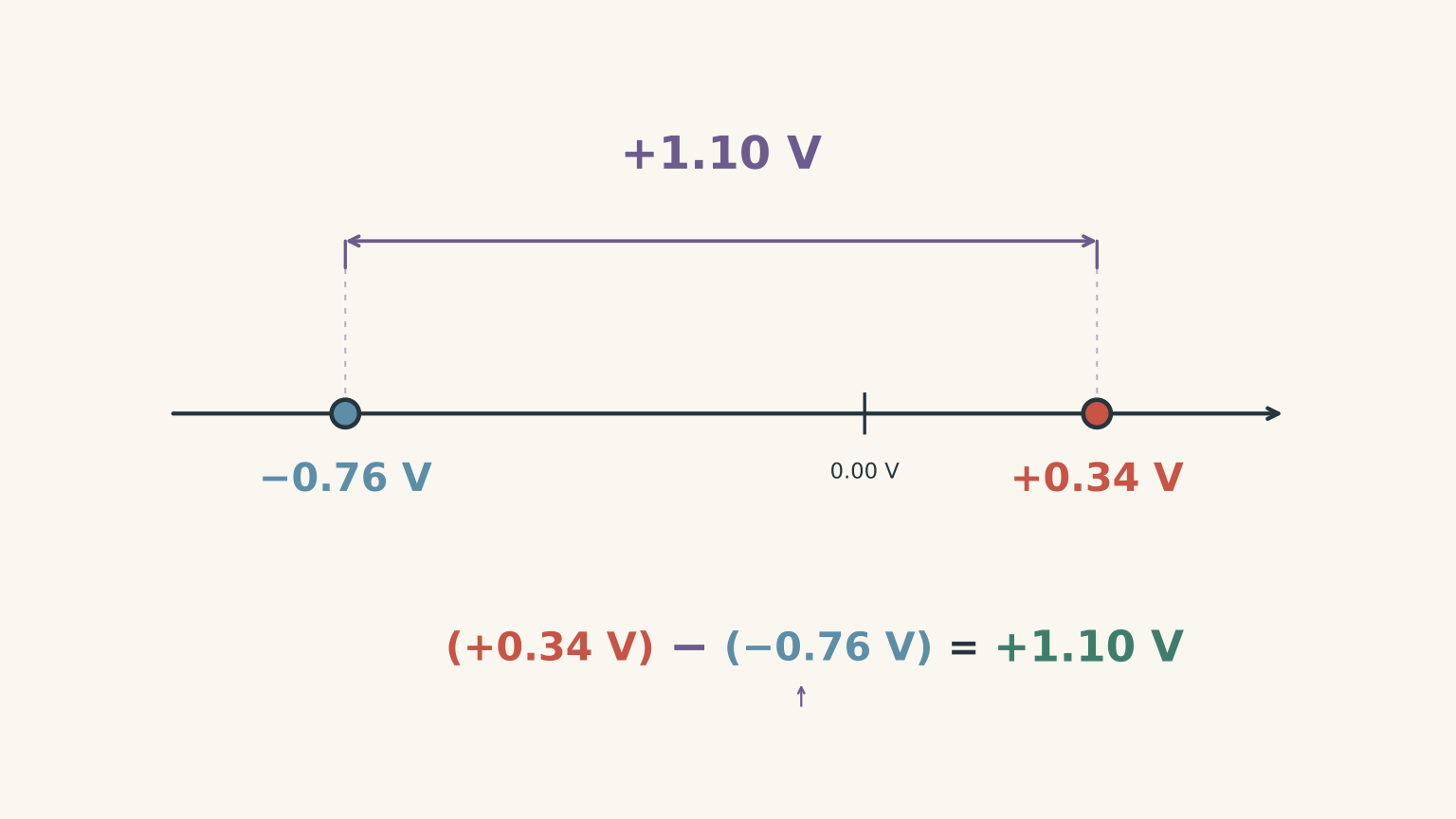
Worked example: Calculate the standard voltage of a zinc-copper cell
A galvanic cell uses the following standard reduction potentials:
- \(\ce{Cu^2+(aq) + 2e^- -> Cu(s)}\): \(+0.34\text{ V}\)
- \(\ce{Zn^2+(aq) + 2e^- -> Zn(s)}\): \(-0.76\text{ V}\)
Calculate the standard cell potential and identify the anode and cathode.
Step 1
Copper has the more positive reduction potential, so reduction occurs at the copper cathode. Zinc is oxidised at the zinc anode.
Step 2
\[ E^\circ_{\text{cell}} = E^\circ_{\text{cathode}} - E^\circ_{\text{anode}} \]
Step 3
\[ \begin{aligned} E^\circ_{\text{cell}} &= (+0.34\text{ V}) - (-0.76\text{ V})\\ &= +1.10\text{ V} \end{aligned} \]
Step 4
The standard cell potential is \(+1.10\text{ V}\). The positive value indicates a spontaneous reaction under standard conditions.
The salt bridge allows this reaction to continue by maintaining charge balance. It does not contribute an extra \(1.10\text{ V}\), and its ions do not supply the electrons.
05The voltage you measure is not always the standard voltage
The standard cell potential, \(E^\circ_{\text{cell}}\), is a reference value. A real cell’s potential depends on its actual conditions, including the concentrations of dissolved species and the temperature.
For example, if the concentration of \(\mathrm{Cu}^{2+}\) in the zinc-copper cell decreases, copper ions are less available for reduction. The cathode’s reduction potential decreases, so the cell potential also decreases, assuming the other conditions remain unchanged.
A suitable salt bridge does not reverse this change by supplying extra copper ions. Its job is to maintain charge balance, not to restore the concentrations of the reacting species.
A voltmeter measures the potential difference between the electrode terminals. With a high-resistance voltmeter, very little current is drawn, allowing the cell potential to be measured with minimal disturbance.
If the salt bridge is removed, the reading may fall or drift as charge imbalances develop. The exact reading depends on the circumstances; it is not correct to assume that the voltage must instantly become zero. What matters is that the cell can no longer sustain its normal electrochemical operation.
Also, a cell delivering current to a load may have a terminal voltage lower than its open-circuit voltage because of internal resistance and other losses.
Worked example: A cell with different electron counts
An idealised galvanic cell uses aluminium and silver half-cells. Their standard reduction potentials are:
- \(\ce{Al^3+(aq) + 3e^- -> Al(s)}\): \(-1.66\text{ V}\)
- \(\ce{Ag+(aq) + e^- -> Ag(s)}\): \(+0.80\text{ V}\)
The cell uses a \(\ce{KNO3}\) salt bridge. Calculate the standard cell potential, write the balanced overall equation, and predict the net movement of the bridge ions.
Step 1
Silver has the more positive reduction potential, so it is the cathode. Aluminium is the anode and undergoes oxidation.
Step 2
\[ \begin{aligned} E^\circ_{\text{cell}} &= E^\circ_{\text{cathode}} - E^\circ_{\text{anode}}\\ &= (+0.80\text{ V}) - (-1.66\text{ V})\\ &= +2.46\text{ V} \end{aligned} \]
The standard cell potential is \(+2.46\text{ V}\).
Step 3
Aluminium oxidation produces three electrons:
\[ \ce{Al(s) -> Al^3+(aq) + 3e^-} \]
Each silver ion accepts one electron, so multiply the silver reduction half-equation by three:
\[ \ce{3Ag+(aq) + 3e^- -> 3Ag(s)} \]
Adding the half-equations gives the overall reaction:
\[ \ce{Al(s) + 3Ag+(aq) -> Al^3+(aq) + 3Ag(s)} \]
Step 4
Nitrate ions, \(\mathrm{NO_{3}}^{-}\), migrate towards the aluminium anode, where positive \(\mathrm{Al}^{3+}\) ions are produced. Potassium ions, \(\mathrm{K}^{+}\), migrate towards the silver cathode, where positive \(\mathrm{Ag}^{+}\) ions are consumed.
The bridge ions do not appear in the overall equation because they are not the reactants driving the redox reaction.
06Choosing a salt bridge that does not interfere
A salt bridge must do more than contain mobile ions. Its electrolyte should also be chemically compatible with both half-cells.
A good bridge electrolyte should:
- contain mobile positive and negative ions;
- remain soluble in the solutions it contacts;
- avoid reacting with the electrode species or forming precipitates;
- avoid interfering with the redox reactions.
Potassium nitrate is a common choice because its ions are suitable for many galvanic cells. However, no salt bridge electrolyte is automatically suitable for every cell.
Consider a silver half-cell containing \(\mathrm{Ag}^{+}\) ions. If chloride ions enter this solution, they can react with silver ions to form solid silver chloride:
\[ \ce{Ag+(aq) + Cl^-(aq) -> AgCl(s)} \]
This removes \(\mathrm{Ag}^{+}\) from the solution and interferes with the intended silver half-cell chemistry.
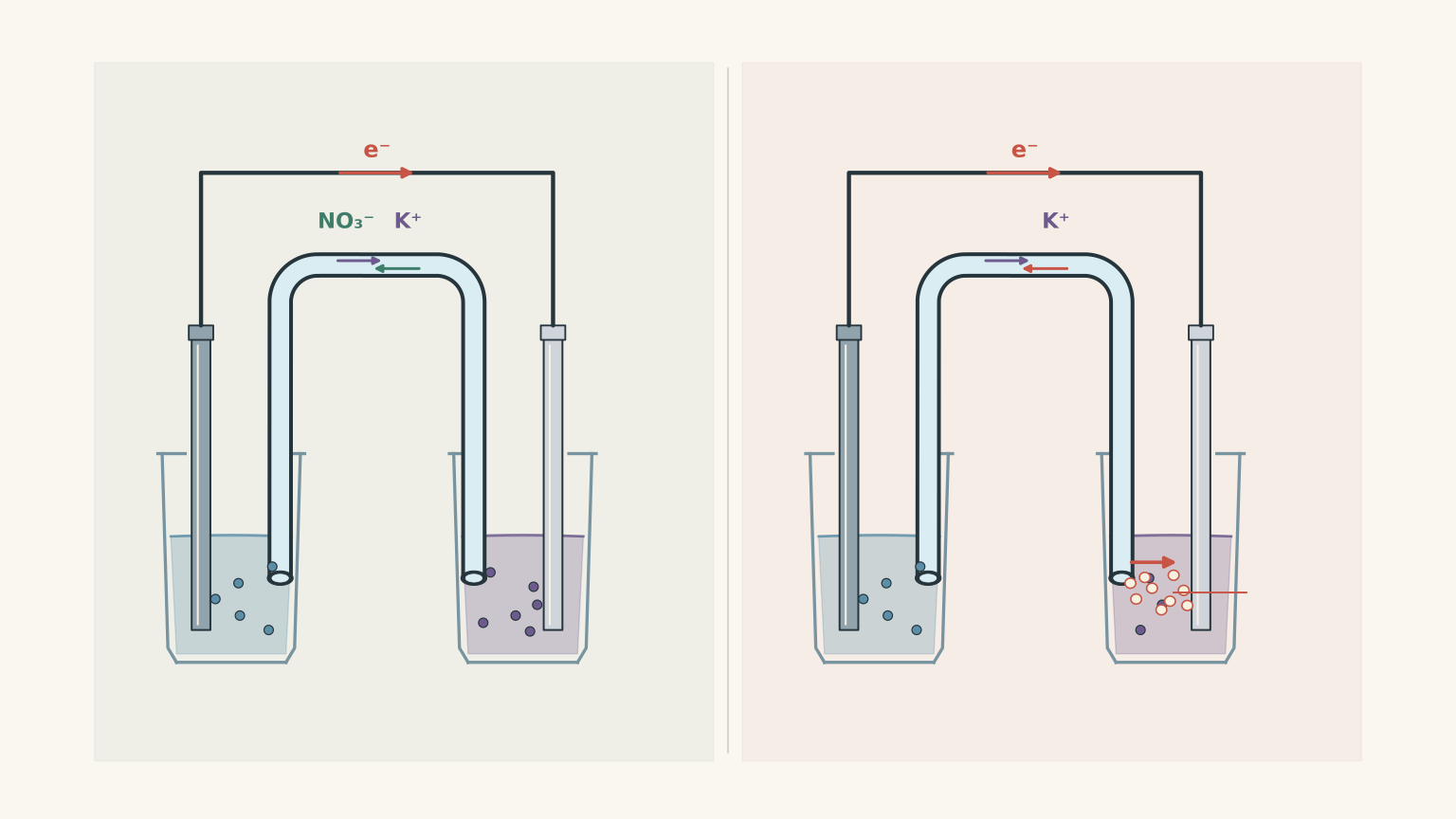
This example exposes an important detail: the arrows in a basic salt bridge diagram show the net migration of ions, not a one-way barrier that prevents all movement in the opposite direction. Diffusion can still carry ions across the boundary.
A bridge can therefore conduct ionic current and still be a poor choice because its ions interfere with the chemistry.
07Questions and solutions
Question 1
A zinc-copper galvanic cell uses a \(\ce{KNO3}\) salt bridge.
State the direction of electron flow through the external wire and the net direction of movement of each salt bridge ion. Explain why both movements are needed.
Solution 1
Electrons flow from the zinc anode to the copper cathode. Nitrate ions migrate towards the zinc half-cell, while potassium ions migrate towards the copper half-cell.
Zinc oxidation produces \(\mathrm{Zn}^{2+}\), creating a tendency towards excess positive charge in the zinc solution. Nitrate ions counterbalance this charge. At the copper cathode, reduction consumes \(\mathrm{Cu}^{2+}\), leaving excess negative charge from the remaining solution ions. Potassium ions counterbalance that charge.
Electron flow through the wire and ion movement through the bridge are different parts of the same electrochemical process. Neither pathway can replace the other.
Question 2
A galvanic cell contains the following half-cells under standard conditions:
- \(\ce{Fe^2+(aq) + 2e^- -> Fe(s)}\), \(E^\circ=-0.44\text{ V}\)
- \(\ce{Ag+(aq) + e^- -> Ag(s)}\), \(E^\circ=+0.80\text{ V}\)
Using a \(\ce{KNO3}\) salt bridge:
(a) Identify the anode and cathode.
(b) Calculate the standard cell potential.
(c) Write the balanced overall redox equation.
(d) State the net direction of movement of the bridge ions.
Solution 2
The iron electrode is the anode, the silver electrode is the cathode, and the standard cell potential is \(+1.24\text{ V}\). Nitrate ions migrate towards the iron half-cell, while potassium ions migrate towards the silver half-cell.
(a) Identify the electrodes.
Silver has the more positive reduction potential, so reduction occurs at the silver cathode. Iron is oxidised at the anode.
(b) Calculate the standard cell potential.
\[ \begin{aligned} E^\circ_{\text{cell}} &= E^\circ_{\text{cathode}} - E^\circ_{\text{anode}}\\ &= (+0.80\text{ V}) - (-0.44\text{ V})\\ &= +1.24\text{ V} \end{aligned} \]
The positive result indicates that the reaction is spontaneous under standard conditions.
(c) Write the overall equation.
Iron oxidation:
\[ \ce{Fe(s) -> Fe^2+(aq) + 2e^-} \]
Silver reduction, multiplied by two:
\[ \ce{2Ag+(aq) + 2e^- -> 2Ag(s)} \]
Combining the half-equations gives:
\[ \ce{Fe(s) + 2Ag+(aq) -> Fe^2+(aq) + 2Ag(s)} \]
(d) Determine ion movement.
Nitrate ions move towards the iron anode, where \(\mathrm{Fe}^{2+}\) is produced. Potassium ions move towards the silver cathode, where \(\mathrm{Ag}^{+}\) is consumed.
The salt bridge ions balance charge; they are not included in the net ionic equation.
Question 3
A zinc-copper cell initially delivers a steady current. A student then removes the salt bridge but leaves the external wire connected.
Explain why the current rapidly decreases. Describe the charge imbalance that develops in each half-cell, and explain why the solutions do not need to become strongly charged before the cell stops operating.
Solution 3
The current rapidly decreases because removing the salt bridge breaks the internal ionic pathway, allowing charge imbalances to develop and oppose further redox reactions.
At the zinc anode, oxidation continues briefly, producing \(\mathrm{Zn}^{2+}\) ions and a tendency towards excess positive charge. At the copper cathode, \(\mathrm{Cu}^{2+}\) ions are consumed, leaving a tendency towards excess negative charge.
These imbalances create an electric field that opposes further charge transfer. The cell therefore cannot sustain its normal current, even though the external wire remains connected.
The solutions do not need to become strongly charged. A very small separation of charge creates an electric field capable of opposing further reaction. The current is limited by the developing charge imbalance long before either beaker accumulates a large net charge.
The trap is to assume that the wire alone completes the circuit. It provides a pathway for electrons, but the cell also needs an ionic pathway.
Question 4
A zinc-copper galvanic cell operates with a suitable \(\ce{KNO3}\) salt bridge. The copper sulfate solution is then diluted substantially, while the zinc half-cell, salt bridge, and temperature remain unchanged.
A student claims that the salt bridge will supply the missing \(\mathrm{Cu}^{2+}\) ions, keeping the measured cell potential at \(+1.10\text{ V}\).
Evaluate both parts of the student’s claim.
Solution 4
The salt bridge does not replace the missing \(\mathrm{Cu}^{2+}\) ions, and the actual cell potential is not guaranteed to remain at \(+1.10\text{ V}\).
The bridge supplies mobile ions that help maintain charge balance. In this example, \(\mathrm{K}^{+}\) ions can migrate towards the copper half-cell, but they do not become copper ions or replace the reactant needed for reduction.
The value \(+1.10\text{ V}\) is the standard cell potential for the zinc-copper cell. It is not necessarily the measured potential under different conditions.
Diluting the copper sulfate solution decreases the concentration of \(\mathrm{Cu}^{2+}\) ions. This lowers the cathode’s reduction potential, so the cell potential decreases when the other conditions remain unchanged.
The important distinction is between maintaining electrical neutrality and maintaining reactant concentration. A salt bridge does the first, not the second.
Question 5
An idealised zinc-silver galvanic cell initially uses a \(\ce{KNO3}\) salt bridge. A student replaces it with a concentrated \(\ce{KCl}\) bridge.
The student argues that chloride ions migrate towards the zinc anode, away from the silver cathode, so chloride cannot enter the silver solution.
After some time, a white \(\ce{AgCl}\) precipitate appears near the silver half-cell, and the measured cell potential decreases.
Explain why the student’s argument is incomplete. Account for the precipitate and the changing potential, and recommend a more suitable bridge electrolyte.
Solution 5
The student’s argument is incomplete because the net migration direction of chloride ions does not prevent diffusion into the silver half-cell. The resulting precipitation removes silver ions from solution and changes the cathode potential.
First, distinguish migration from diffusion.
The electric field causes chloride ions to have a net migration towards the zinc anode. However, ions also move due to concentration gradients. Because the bridge contains a high concentration of chloride ions, some can diffuse into the silver solution even while their net migration is towards the zinc side.
The salt bridge is not a one-way valve.
Next, account for the precipitate.
Chloride ions react with silver ions:
\[ \ce{Ag+(aq) + Cl^-(aq) -> AgCl(s)} \]
Silver chloride is insoluble, so it forms a precipitate. This removes \(\mathrm{Ag}^{+}\) ions from the solution, reducing their concentration.
Finally, explain the changing potential.
The silver cathode’s reduction potential depends on the conditions in its half-cell, including the concentration of \(\mathrm{Ag}^{+}\). Removing silver ions lowers the cathode’s reduction potential. With the zinc half-cell otherwise unchanged, the cell potential therefore decreases.
The KCl bridge may still provide an ionic pathway, but it is chemically unsuitable because chloride interferes with the silver half-cell reaction. A \(\ce{KNO3}\) bridge is a better choice, provided its ions do not react with the species in either half-cell.
The deeper lesson is that a salt bridge must satisfy two conditions: it must allow ions to move so charge balance is maintained, and its ions must not interfere with the chemistry that generates the cell potential.
Once you can track electron flow, ion movement, and electrode potentials separately, you can use standard reduction potentials to predict the direction and voltage of a galvanic cell. The next step is understanding how changes in concentration alter the measured cell potential, even when the electrodes and salt bridge remain the same.