
When Is the Small-x Approximation Safe for Weak-Acid pH?
Learn how the small-x approximation simplifies weak-acid equilibrium calculations, how to check its accuracy using percentage ionisation, and when to solve the exact quadratic equation instead. Includes worked examples and challenging HSC-style questions with fully explained solutions.
For \(0.100\ \mathrm{mol\,L^{-1}}\) ethanoic acid, the usual shortcut for calculating pH gives \([H_3O^+]\approx1.34\times10^{-3}\ \mathrm{mol\,L^{-1}}\). Now apply the same shortcut to a much more dilute solution, \(1.00\times10^{-4}\ \mathrm{mol\,L^{-1}}\). It predicts \([H_3O^+]\approx1.34\times10^{-4}\ \mathrm{mol\,L^{-1}}\), more acid-generated hydronium than the initial acid concentration can supply. Something has gone wrong.
Before calculating further, predict which solution makes the shortcut safer: the concentrated one or the dilute one? The concentrated solution. The shortcut depends on how much acid ionises relative to the amount you started with, not simply on whether the acid is classified as weak.
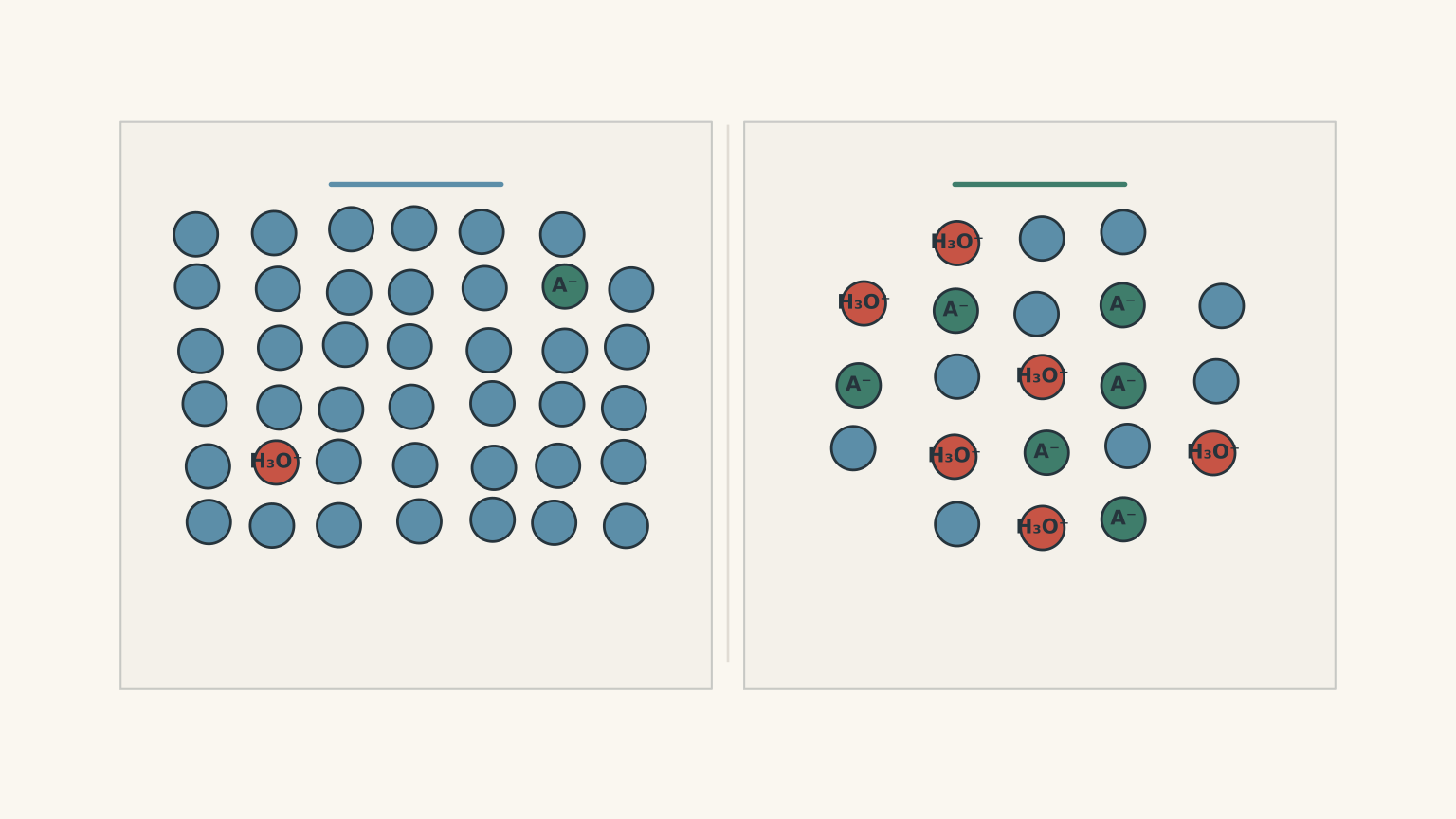
01Build the equilibrium model
A weak acid does not ionise completely in water. For a monoprotic acid, represented by \(\ce{HA}\), the equilibrium is
\[ \ce{HA + H2O <=> H3O+ + A-} \]
Each acid particle that ionises produces one hydronium ion, \(\ce{H3O+}\), and one conjugate base ion, \(\mathrm{A}^{-}\).
Let:
- \(C\) be the initial concentration of the acid, in \(\mathrm{mol\,L^{-1}}\).
- \(x\) be the concentration of acid that ionises, in \(\mathrm{mol\,L^{-1}}\).
- \(K_a\) be the acid dissociation constant.
- \([HA]\), \([H_3O^+]\), and \([A^-]\) be the equilibrium concentrations of the relevant species.
Assume initially that the acid is the only significant source of hydronium ions, and that no conjugate base is present before the acid ionises.
The equilibrium concentrations follow directly from the reaction stoichiometry.
| Species | Initial concentration | Change | Equilibrium concentration |
|---|---|---|---|
| \(\ce{HA}\) | \(C\) | \(-x\) | \(C-x\) |
| \(\ce{H3O+}\) | \(\approx 0\) | \(+x\) | \(x\) |
| \(\mathrm{A}^{-}\) | \(0\) | \(+x\) | \(x\) |
The key relationship is that ionising \(x\) of the acid leaves \(C-x\) un-ionised. It also produces \(x\) of each ion.
The acid dissociation constant is therefore
\[ K_a=\frac{[H_3O^+][A^-]}{[HA]} \]
Substituting the equilibrium concentrations gives
\[ \boxed{K_a=\frac{x^2}{C-x}} \]
This is the starting equation for the usual HSC weak-acid calculation.
02What the small-\(x\) approximation actually does
Look at the denominator, \(C-x\). If only a tiny fraction of the acid ionises, subtracting \(x\) barely changes the initial concentration \(C\).
For example, if \(C=0.100\ \mathrm{mol\,L^{-1}}\) and \(x=0.001\ \mathrm{mol\,L^{-1}}\), the equilibrium acid concentration is \(0.099\ \mathrm{mol\,L^{-1}}\). Replacing \(0.099\) with \(0.100\) introduces only a small difference.
That is the entire idea behind the approximation:
\[ x\ll C \quad\Rightarrow\quad C-x\approx C \]
Substitute this into the equilibrium expression:
\[ K_a\approx\frac{x^2}{C} \]
Rearranging gives the familiar shortcut:
\[ \boxed{x\approx\sqrt{K_aC}} \]
Because \(x\) represents the concentration of acid that ionises, it is also the approximate hydronium concentration:
\[ \boxed{[H_3O^+]\approx\sqrt{K_aC}} \]
Once you have \([H_3O^+]\), calculate pH using
\[ \mathrm{pH}=-\log_{10}[H_3O^+] \]
The shortcut is useful because it avoids solving a quadratic equation. But it only works well when \(x\) really is small relative to \(C\).
How do you check whether the approximation is safe?
Calculate the percentage ionisation:
\[ \boxed{\%\text{ ionisation}=\frac{x}{C}\times100\%} \]
Use your approximate value of \(x\) for this initial check.
A common HSC rule of thumb is:
- At or below 5%: the small-\(x\) approximation is generally acceptable.
- Above 5%: use the exact equilibrium equation and solve the quadratic.
- Close to 5%: consider solving the quadratic if greater accuracy is required.
The 5% rule is a practical guide, not a fundamental law. It tells you whether replacing \(C-x\) with \(C\) is likely to be reasonable for the calculation.
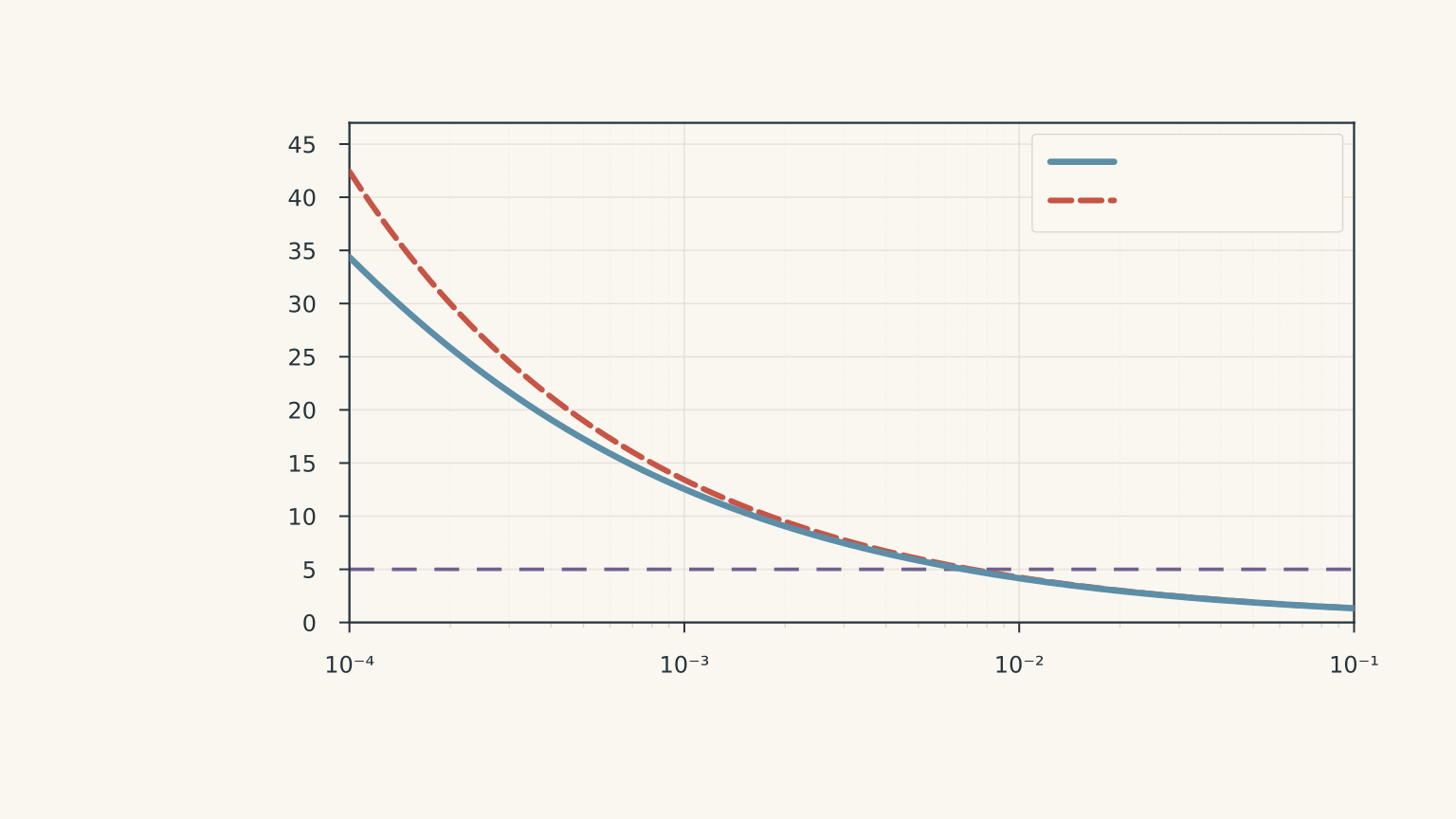
Worked example: A concentrated weak-acid solution
Calculate the pH of \(0.200\ \mathrm{mol\,L^{-1}}\) ethanoic acid, given \(K_a=1.8\times10^{-5}\). Use the small-\(x\) approximation and check its validity.
Step 1
For initial acid concentration \(C\),
\[ K_a=\frac{x^2}{C-x} \]
Assume initially that \(x\) is small compared with \(C\).
Step 2
Using \(x\approx\sqrt{K_aC}\),
\[ \begin{aligned} x&\approx\sqrt{K_aC}\\ &=\sqrt{(1.8\times10^{-5})(0.200)}\\ &=1.90\times10^{-3}\ \mathrm{mol\,L^{-1}} \end{aligned} \]
Therefore,
\[ [H_3O^+]\approx1.90\times10^{-3}\ \mathrm{mol\,L^{-1}} \]
Step 3
\[ \begin{aligned} \%\text{ ionisation} &=\frac{x}{C}\times100\%\\ &=\frac{1.90\times10^{-3}}{0.200}\times100\%\\ &=0.949\% \end{aligned} \]
Only about \(0.95\%\) of the acid ionises. This is comfortably below 5%, so the approximation is justified.
The equilibrium concentration of the un-ionised acid is approximately
\[ [HA]=0.200-0.00190 =0.1981\ \mathrm{mol\,L^{-1}} \]
Replacing \(0.1981\) with \(0.200\) makes only a small difference.
Step 4
\[ \begin{aligned} \mathrm{pH} &=-\log_{10}(1.90\times10^{-3})\\ &\approx2.72 \end{aligned} \]
The estimated pH is \(2.72\). The small-\(x\) approximation works well here because the amount ionised is small relative to the initial acid concentration.
03When the approximation fails, solve the quadratic
Suppose your percentage ionisation is 20%. You cannot reasonably claim that \(C-x\) is approximately equal to \(C\): the equilibrium acid concentration is only \(0.80C\).
In that situation, return to the original equation:
\[ K_a=\frac{x^2}{C-x} \]
Rearrange it without making the small-\(x\) assumption:
\[ \begin{aligned} K_a(C-x)&=x^2\\ K_aC-K_ax&=x^2\\ x^2+K_ax-K_aC&=0 \end{aligned} \]
This is a quadratic equation in \(x\). Applying the quadratic formula gives
\[ x=\frac{-K_a\pm\sqrt{K_a^2+4K_aC}}{2} \]
Concentration cannot be negative, so choose the positive root:
\[ \boxed{x=\frac{-K_a+\sqrt{K_a^2+4K_aC}}{2}} \]
This solution retains the \(C-x\) term, so it does not depend on the small-\(x\) approximation.
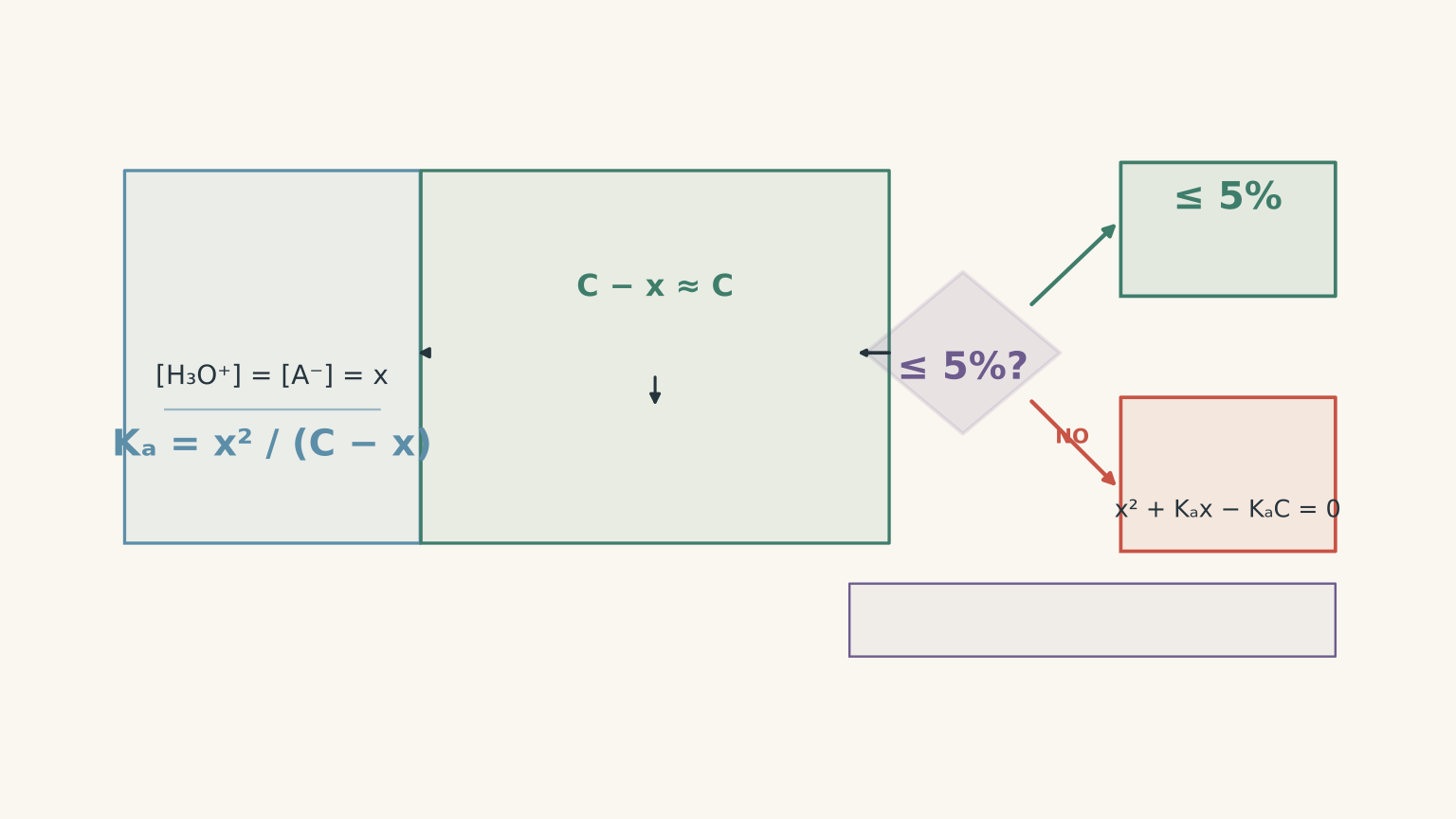
Worked example: A dilute weak-acid solution
A solution of ethanoic acid has an initial concentration of \(1.00\times10^{-4}\ \mathrm{mol\,L^{-1}}\). Given \(K_a=1.8\times10^{-5}\), calculate its pH. Test the small-\(x\) approximation before deciding which method to use.
Step 1
\[ \begin{aligned} x_{\text{approx}} &=\sqrt{K_aC}\\ &=\sqrt{(1.8\times10^{-5})(1.00\times10^{-4})}\\ &=4.24\times10^{-5}\ \mathrm{mol\,L^{-1}} \end{aligned} \]
Step 2
\[ \begin{aligned} \%\text{ ionisation} &=\frac{4.24\times10^{-5}}{1.00\times10^{-4}}\times100\%\\ &=42.4\% \end{aligned} \]
This is far above 5%. The assumption that \(x\) is small compared with \(C\) is not justified.
Notice the problem: the shortcut predicts that about 42% of the acid ionises, even though the shortcut itself assumes that the amount ionised is small. We need to solve the original equation.
Step 3
\[ x=\frac{-K_a+\sqrt{K_a^2+4K_aC}}{2} \]
Substitute the given values:
\[ \begin{aligned} x&=\frac{-1.8\times10^{-5} +\sqrt{(1.8\times10^{-5})^2+ 4(1.8\times10^{-5})(1.00\times10^{-4})}}{2}\\[4pt] &=\frac{-1.8\times10^{-5}+ \sqrt{7.524\times10^{-9}}}{2}\\[4pt] &=3.44\times10^{-5}\ \mathrm{mol\,L^{-1}} \end{aligned} \]
Therefore,
\[ [H_3O^+]=3.44\times10^{-5}\ \mathrm{mol\,L^{-1}} \]
Step 4
\[ \begin{aligned} \mathrm{pH} &=-\log_{10}(3.44\times10^{-5})\\ &\approx4.46 \end{aligned} \]
The actual percentage ionisation is
\[ \begin{aligned} \%\text{ ionisation} &=\frac{3.44\times10^{-5}}{1.00\times10^{-4}}\times100\%\\ &=34.4\% \end{aligned} \]
The exact calculation gives a pH of \(4.46\), compared with approximately \(4.37\) from the shortcut. The difference arises because the shortcut overestimates the hydronium concentration when the amount ionised is not small relative to the initial concentration.
The acid is still classified as weak. It simply ionises to a much greater percentage in this dilute solution.
04The misconception to avoid
A weak acid does not necessarily have a small percentage ionisation under every condition.
The acid dissociation constant \(K_a\) describes the acid’s equilibrium behaviour. The percentage ionisation also depends on the initial concentration \(C\).
For the same acid, the small-\(x\) model gives
\[ \frac{x}{C}\approx\sqrt{\frac{K_a}{C}} \]
As \(C\) decreases, the predicted fraction ionised increases. This explains why dilution can increase percentage ionisation even while the hydronium concentration decreases.
The important distinction is:
- \([H_3O^+]\) tells you the concentration of hydronium ions.
- \(x/C\) tells you the fraction of the original acid that ionised.
They measure different things. The second quantity is what you need to assess the small-\(x\) approximation.
05Questions and solutions
Question 1
A monoprotic weak acid, \(\ce{HA}\), has an initial concentration of \(0.0500\ \mathrm{mol\,L^{-1}}\) and \(K_a=1.0\times10^{-5}\).
Estimate \([H_3O^+]\) and the pH using the small-\(x\) approximation. Show whether the approximation is acceptable.
Solution 1
The approximation is acceptable: the estimated percentage ionisation is \(1.41\%\), and the pH is approximately \(3.15\).
Start with
\[ [H_3O^+]\approx\sqrt{K_aC} \]
Substitute the values:
\[ \begin{aligned} [H_3O^+] &\approx\sqrt{(1.0\times10^{-5})(0.0500)}\\ &=\sqrt{5.0\times10^{-7}}\\ &=7.07\times10^{-4}\ \mathrm{mol\,L^{-1}} \end{aligned} \]
Check the percentage ionisation:
\[ \begin{aligned} \%\text{ ionisation} &=\frac{7.07\times10^{-4}}{0.0500}\times100\%\\ &=1.41\% \end{aligned} \]
Because \(1.41\%\) is below 5%, the approximation is reasonable.
Calculate the pH:
\[ \begin{aligned} \mathrm{pH} &=-\log_{10}(7.07\times10^{-4})\\ &=3.15 \end{aligned} \]
The estimated hydronium concentration is \(7.07\times10^{-4}\ \mathrm{mol\,L^{-1}}\), and the estimated pH is \(3.15\).
Question 2
A weak monoprotic acid has an initial concentration of \(2.00\times10^{-4}\ \mathrm{mol\,L^{-1}}\) and \(K_a=1.00\times10^{-5}\).
(a) Use the small-\(x\) approximation to estimate the hydronium concentration and test its validity.
(b) Calculate the hydronium concentration and pH using the exact quadratic equation.
Solution 2
The small-\(x\) approximation is not acceptable because it predicts \(22.4\%\) ionisation. The exact calculation gives \([H_3O^+]=4.00\times10^{-5}\ \mathrm{mol\,L^{-1}}\) and \(\mathrm{pH}=4.40\).
(a) Test the approximation
\[ \begin{aligned} x_{\text{approx}} &=\sqrt{K_aC}\\ &=\sqrt{(1.00\times10^{-5})(2.00\times10^{-4})}\\ &=4.47\times10^{-5}\ \mathrm{mol\,L^{-1}} \end{aligned} \]
The estimated percentage ionisation is
\[ \begin{aligned} \%\text{ ionisation} &=\frac{4.47\times10^{-5}}{2.00\times10^{-4}}\times100\%\\ &=22.4\% \end{aligned} \]
This is too large to justify replacing \(C-x\) with \(C\).
(b) Solve the exact equation
Use the positive root:
\[ x=\frac{-K_a+\sqrt{K_a^2+4K_aC}}{2} \]
Substituting,
\[ \begin{aligned} x&=\frac{-1.00\times10^{-5} +\sqrt{1.00\times10^{-10}+8.00\times10^{-9}}}{2}\\[4pt] &=\frac{-1.00\times10^{-5}+9.00\times10^{-5}}{2}\\[4pt] &=4.00\times10^{-5}\ \mathrm{mol\,L^{-1}} \end{aligned} \]
The pH is
\[ \begin{aligned} \mathrm{pH} &=-\log_{10}(4.00\times10^{-5})\\ &=4.40 \end{aligned} \]
As a final check, the equilibrium acid concentration is
\[ [HA]=2.00\times10^{-4}-4.00\times10^{-5} =1.60\times10^{-4}\ \mathrm{mol\,L^{-1}} \]
The actual percentage ionisation is \(20.0\%\). The shortcut would have given a pH of approximately \(4.35\), so using the quadratic avoids a noticeable error.
Question 3
Ethanoic acid has \(K_a=1.8\times10^{-5}\). Two solutions are prepared, one with \(C_1=0.100\ \mathrm{mol\,L^{-1}}\) and the other with \(C_2=1.00\times10^{-3}\ \mathrm{mol\,L^{-1}}\).
For each solution, estimate the hydronium concentration using the small-\(x\) approximation. Decide whether the approximation is acceptable, and explain what dilution does to the hydronium concentration and percentage ionisation.
Solution 3
The approximation is acceptable for the \(0.100\ \mathrm{mol\,L^{-1}}\) solution but not for the \(1.00\times10^{-3}\ \mathrm{mol\,L^{-1}}\) solution. Dilution decreases the hydronium concentration while increasing the percentage ionisation.
For the more concentrated solution,
\[ \begin{aligned} x_{\text{approx},1} &=\sqrt{(1.8\times10^{-5})(0.100)}\\ &=1.34\times10^{-3}\ \mathrm{mol\,L^{-1}} \end{aligned} \]
The estimated percentage ionisation is
\[ \frac{1.34\times10^{-3}}{0.100}\times100\% =1.34\% \]
This is below 5%, so the approximation is reasonable.
For the dilute solution,
\[ \begin{aligned} x_{\text{approx},2} &=\sqrt{(1.8\times10^{-5})(1.00\times10^{-3})}\\ &=1.34\times10^{-4}\ \mathrm{mol\,L^{-1}} \end{aligned} \]
The estimated percentage ionisation is
\[ \frac{1.34\times10^{-4}}{1.00\times10^{-3}}\times100\% =13.4\% \]
The approximation is not sufficiently accurate under the 5% rule. Solving the exact quadratic gives approximately
\[ [H_3O^+]_2=1.25\times10^{-4}\ \mathrm{mol\,L^{-1}} \]
The actual percentage ionisation is about \(12.5\%\).
Comparing the two solutions, the hydronium concentration decreases from approximately \(1.33\times10^{-3}\) to \(1.25\times10^{-4}\ \mathrm{mol\,L^{-1}}\). However, the percentage ionisation increases from about \(1.33\%\) to \(12.5\%\).
The reason is that dilution reduces the total amount of acid per litre, but it also shifts the equilibrium towards a greater fraction of ionised acid. Absolute concentration and percentage ionisation are not interchangeable.
Question 4
A weak monoprotic acid has \(K_a=2.5\times10^{-5}\).
Using the small-\(x\) approximation, derive the minimum initial concentration \(C\) for which the estimated percentage ionisation is no greater than \(5.0\%\).
Then use the exact equilibrium equation to calculate the actual percentage ionisation at that concentration. Explain why the 5% rule does not mean the approximation has zero error.
Solution 4
The approximate criterion requires \(C\geq0.0100\ \mathrm{mol\,L^{-1}}\). At this concentration, the exact percentage ionisation is approximately \(4.88\%\), confirming that the approximation is reasonable but not exact.
From the small-\(x\) approximation,
\[ x\approx\sqrt{K_aC} \]
Therefore,
\[ \begin{aligned} \%\text{ ionisation} &\approx\frac{\sqrt{K_aC}}{C}\times100\%\\ &=100\sqrt{\frac{K_a}{C}} \end{aligned} \]
For the estimated percentage ionisation to be at most \(5.0\%\),
\[ \sqrt{\frac{K_a}{C}}\leq0.050 \]
Squaring both sides gives
\[ \frac{K_a}{C}\leq0.0025 \]
Rearranging,
\[ \begin{aligned} C&\geq\frac{K_a}{0.0025}\\ &=\frac{2.5\times10^{-5}}{0.0025}\\ &=0.0100\ \mathrm{mol\,L^{-1}} \end{aligned} \]
Now test the boundary using the exact expression. Define the fraction ionised as \(f=x/C\). Since \(x=fC\),
\[ K_a=\frac{f^2C}{1-f} \]
At \(C=0.0100\ \mathrm{mol\,L^{-1}}\),
\[ \frac{K_a}{C}=0.0025 \]
Hence,
\[ \begin{aligned} \frac{f^2}{1-f}&=0.0025\\ f^2+0.0025f-0.0025&=0 \end{aligned} \]
Taking the positive root gives
\[ f\approx0.0488 \]
Therefore, the exact percentage ionisation is approximately
\[ 0.0488\times100\%=4.88\% \]
The exact result is slightly below the approximate estimate of \(5.0\%\). This happens because the small-\(x\) method overestimates \(x\) by replacing \(C-x\) with the larger value \(C\).
The 5% rule is a practical accuracy check. It does not claim that the approximation produces the exact equilibrium concentrations.
Question 5
Two solutions of the same weak monoprotic acid, \(\ce{HA}\), are prepared at \(25^\circ\mathrm{C}\):
- Solution A has \(C_A=0.100\ \mathrm{mol\,L^{-1}}\) and a measured pH of \(2.88\).
- Solution B has \(C_B=1.00\times10^{-3}\ \mathrm{mol\,L^{-1}}\) and a measured pH of \(3.90\).
The pH values are rounded to two decimal places. Assume that hydronium from water is negligible in both solutions.
A student argues that the acid concentration decreases by a factor of 100, while the pH rises by only \(1.02\) units. Since the small-\(x\) approximation predicts a pH increase of \(1.00\) unit for a 100-fold dilution, the student concludes that the approximation must be valid in both solutions.
Evaluate this conclusion. Calculate the hydronium concentration and percentage ionisation in each solution, and use the exact equilibrium expression to estimate \(K_a\) from each pH reading. Explain why the student’s reasoning is tempting but insufficient.
Solution 5
The student’s conclusion is incorrect. Solution A is consistent with the small-\(x\) approximation, but Solution B is approximately \(12.6\%\) ionised, so the approximation is not sufficiently accurate for that solution under the 5% rule.
Step 1: Calculate the hydronium concentrations from the measured pH values.
Use
\[ [H_3O^+]=10^{-\mathrm{pH}} \]
For Solution A,
\[ [H_3O^+]_A=10^{-2.88} =1.32\times10^{-3}\ \mathrm{mol\,L^{-1}} \]
For Solution B,
\[ [H_3O^+]_B=10^{-3.90} =1.26\times10^{-4}\ \mathrm{mol\,L^{-1}} \]
Step 2: Calculate the percentage ionisation in each solution.
For Solution A,
\[ \begin{aligned} \%\text{ ionisation}_A &=\frac{1.32\times10^{-3}}{0.100}\times100\%\\ &=1.32\% \end{aligned} \]
This is below 5%, so the approximation is reasonable.
For Solution B,
\[ \begin{aligned} \%\text{ ionisation}_B &=\frac{1.26\times10^{-4}}{1.00\times10^{-3}}\times100\%\\ &=12.6\% \end{aligned} \]
This exceeds 5%, so the small-\(x\) approximation should not be used for Solution B.
Step 3: Check whether the two measurements are consistent with the same acid.
The exact concentration expression is
\[ K_a=\frac{[H_3O^+][A^-]}{[HA]} \]
Under the assumptions given, \([A^-]=[H_3O^+]=x\) and \([HA]=C-x\). Therefore,
\[ K_a=\frac{x^2}{C-x} \]
For Solution A,
\[ \begin{aligned} K_{a,A} &=\frac{(1.318\times10^{-3})^2} {0.100-1.318\times10^{-3}}\\ &\approx1.76\times10^{-5} \end{aligned} \]
For Solution B,
\[ \begin{aligned} K_{a,B} &=\frac{(1.259\times10^{-4})^2} {1.00\times10^{-3}-1.259\times10^{-4}}\\ &\approx1.81\times10^{-5} \end{aligned} \]
These values are reasonably consistent with the same acid having \(K_a\approx1.8\times10^{-5}\). Their small difference is compatible with the pH readings being rounded.
Step 4: Explain the misleading pH comparison.
The measured pH increases by
\[ 3.90-2.88=1.02 \]
units. This is close to the \(1.00\)-unit increase predicted by the small-\(x\) model for a 100-fold dilution.
That prediction comes from
\[ [H_3O^+]\approx\sqrt{K_aC} \]
For a fixed \(K_a\), reducing \(C\) by a factor of 100 reduces the estimated hydronium concentration by a factor of 10. A tenfold decrease in hydronium concentration corresponds to a one-unit increase in pH.
The student’s mistake is treating a close match in pH change as proof that the approximation is valid in both solutions. The pH difference describes a ratio between two hydronium concentrations. The approximation check depends on the fraction of acid ionised in each solution.
For Solution B, the small-\(x\) estimate would give
\[ x_{\text{approx}}=1.34\times10^{-4}\ \mathrm{mol\,L^{-1}} \]
or an estimated \(13.4\%\) ionisation. The measured pH implies an actual ionisation of about \(12.6\%\). The estimate is not sufficiently accurate under the 5% rule, even though the overall pH change is close to the square-root prediction.
The lesson is to check the assumption directly rather than infer its validity from a pattern that happens to look plausible.
Once you can decide whether \(x\) is small, the next step is to check whether the simple equilibrium table applies at all. If a conjugate-base salt is already present, or the solution is so dilute that water’s own ionisation matters, the equilibrium model must be adjusted before choosing the approximation.