
Charged Particles in Electric Fields: HSC Physics Practice Exam
Prepare for HSC Physics with this original 50-mark tutorgum practice paper on charged particles in electric fields. Complete the timed questions, then check your answers against worked solutions and a detailed marking guide.
This original tutorgum practice paper tests charged particles in electric fields, using the supplied Physics syllabus scope compatible with the 2017 and 2025 editions. It covers electric force and acceleration, fields between parallel plates, particle deflection, work and kinetic energy, and conceptual comparisons between electric and magnetic fields. It is an original revision resource, not an official, endorsed, past, or predicted NESA paper.
01Exam instructions
- Suggested reading time: 5 minutes.
- Suggested working time: 60 minutes.
- Total marks: 50.
- Permitted equipment: Scientific calculator, ruler, and writing equipment.
- Show your working for every calculation. Include units, directions, and signs where required.
- Give numerical answers to an appropriate number of significant figures, generally two or three.
- Assume electric fields are uniform away from plate edges. Ignore gravity and relativistic effects unless stated otherwise.
- For marking purposes, mathematically equivalent methods are acceptable.
Scope and exclusions: This paper assesses electric force, acceleration, uniform fields between parallel plates, charged-particle motion, work and energy, and conceptual electric-versus-magnetic force comparisons. It excludes numerical calculations of magnetic forces, point-charge electric fields, capacitor energy storage, and content from other Physics modules.
Data and notation
Use the following constants where required:
- Elementary charge magnitude: \(e=1.60\times10^{-19}\ \mathrm C\).
- Electron mass: \(m_e=9.11\times10^{-31}\ \mathrm{kg}\).
- Electron charge: \(-e\).
- Proton charge: \(+e\).
The symbols used throughout are \(E\), electric field strength in \(\mathrm{N\,C^{-1}}\) or \(\mathrm{V\,m^{-1}}\); \(V\), electric potential in volts; \(d\), separation in metres; \(q\), charge in coulombs; \(F\), force in newtons; \(m\), mass in kilograms; \(a\), acceleration in \(\mathrm{m\,s^{-2}}\); \(v\), velocity or speed in \(\mathrm{m\,s^{-1}}\); \(W\), work in joules; \(K\), kinetic energy in joules; and \(U\), electric potential energy in joules. The symbol \(\Delta\) means final value minus initial value.
02Questions
Question 1 (7 marks)
A uniform electric field has a magnitude of \(3.2\times10^3\ \mathrm{N\,C^{-1}}\) and is directed east.
(a) Calculate the magnitude and direction of the electric force on a proton placed in this field. (2 marks)
(b) An electron is placed in the same field. Calculate the magnitude and direction of its acceleration. (3 marks)
(c) Compare the forces experienced by a charge at rest in an electric field and a magnetic field. Then consider a charge moving perpendicular to a magnetic field. Explain which field can transfer energy to a charge through the work done by its force. (2 marks)
Question 2 (7 marks)
Two large, parallel conducting plates are separated by \(0.030\ \mathrm m\) and maintained at a potential difference of \(600\ \mathrm V\). Assume the field is uniform in the central region between the plates.
(a) Calculate the electric field strength between the plates. (2 marks)
(b) Plate A is at a potential of \(+600\ \mathrm V\) relative to plate B. State the direction of the electric field between the plates. (1 mark)
(c) The potential difference remains unchanged, but the separation is increased to \(0.045\ \mathrm m\). Calculate the new electric field strength and the percentage change in its magnitude. (2 marks)
(d) Explain why the uniform-field model becomes less accurate near the edges of the plates. (1 mark)
(e) State one condition that helps produce an approximately uniform electric field between parallel plates. (1 mark)
Question 3 (8 marks)
A singly charged positive ion starts from rest and is accelerated by an electric field through a potential difference of magnitude \(2.4\ \mathrm{kV}\). The ion has a mass of \(3.3\times10^{-26}\ \mathrm{kg}\).
Assume all work done by the electric field becomes kinetic energy.
(a) Calculate the work done by the electric field on the ion. (2 marks)
(b) Calculate the ion’s final speed. (3 marks)
(c) An electron also starts from rest and is accelerated through a potential difference of the same magnitude, with the polarity arranged to accelerate it. Compare the kinetic energy gained by the two particles, then calculate the ratio of their final speeds, \(v_e/v_i\). (3 marks)
Question 4 (10 marks)
An electron enters the region between two parallel plates with an initial horizontal speed of \(2.0\times10^7\ \mathrm{m\,s^{-1}}\). Its initial vertical velocity is zero.
The plates have the following properties:
- Length along the electron’s direction of motion: \(0.030\ \mathrm m\).
- Separation: \(0.040\ \mathrm m\).
- Potential difference: \(400\ \mathrm V\).
- The upper plate is positive, and the lower plate is negative.
Assume the electric field is uniform, the electron enters midway between the plates, and gravity and edge effects are negligible.
(a) Calculate the electric field strength between the plates. (2 marks)
(b) Calculate the magnitude and direction of the electron’s acceleration. (2 marks)
(c) Calculate the time the electron spends between the plates. (2 marks)
(d) Calculate the electron’s vertical displacement by the time it reaches the end of the plates. State the magnitude and direction of the displacement. (3 marks)
(e) Describe the electron’s trajectory while it is between the plates and identify which velocity component remains constant. (1 mark)
Question 5 (8 marks)
A particle with charge \(q=-2.0\times10^{-6}\ \mathrm C\) moves from point A to point B.
The electric potentials at the two points are:
- \(V_A=+120\ \mathrm V\).
- \(V_B=-80\ \mathrm V\).
At point A, the particle has a kinetic energy of \(1.2\times10^{-3}\ \mathrm J\). Its mass is \(4.0\times10^{-6}\ \mathrm{kg}\).
Assume the electric force is the only force doing work on the particle.
(a) Calculate the change in the particle’s electric potential energy as it moves from A to B. (2 marks)
(b) Calculate the work done by the electric field on the particle. Include the sign of your answer. (2 marks)
(c) Determine the particle’s kinetic energy at point B. (2 marks)
(d) Calculate the particle’s speed at point B. (2 marks)
Question 6 (10 marks)
A doubly charged positive ion has a charge of \(+3.2\times10^{-19}\ \mathrm C\) and a mass of \(6.64\times10^{-27}\ \mathrm{kg}\).
The ion moves through a uniform electric field of magnitude \(2.0\times10^3\ \mathrm{N\,C^{-1}}\), directed vertically upwards. The ion spends \(3.0\times10^{-7}\ \mathrm s\) in the field.
At entry, its velocity components are:
\[ v_x=+6.0\times10^4\ \mathrm{m\,s^{-1}} \]
\[ v_y=-2.0\times10^4\ \mathrm{m\,s^{-1}} \]
Take the positive \(x\)-direction as rightwards and the positive \(y\)-direction as upwards. Ignore gravity and edge effects.
(a) Calculate the horizontal and vertical acceleration components of the ion. (2 marks)
(b) Determine both velocity components at the end of the time interval. (2 marks)
(c) Calculate the horizontal and vertical displacement components during the time interval. (2 marks)
(d) Calculate the work done by the electric field using the displacement. Then verify your result by calculating the change in kinetic energy. (3 marks)
(e) State whether the ion’s horizontal speed changes during its motion through the field. Explain your answer. (1 mark)
03Worked solutions and marking guide
Award marks for the stated physical principles, correct substitutions, appropriate calculations, and justified conclusions. Accept equivalent methods. Follow-through marks are appropriate when a student uses an earlier result consistently, even if that result contains a minor arithmetic or rounding error.
Solution 1
(a) Electric force on a proton (2 marks)
The electric force on a charge is
\[ F=qE \]
A proton has charge \(q=+e\). Therefore,
\[ \begin{aligned} F&=(1.60\times10^{-19})(3.2\times10^3)\\ &=5.12\times10^{-16}\ \mathrm N \end{aligned} \]
Because the proton is positively charged, the force acts in the same direction as the electric field.
Answer: \(5.1\times10^{-16}\ \mathrm N\) east.
Marking guide:
- 1 mark for applying \(F=qE\) and substituting the values.
- 1 mark for the correct magnitude, unit, and direction.
(b) Acceleration of an electron (3 marks)
An electron has charge \(-e\), so the electric force on it acts opposite to the field.
The magnitude of the force is
\[ |F|=eE=5.12\times10^{-16}\ \mathrm N \]
Using Newton’s second law,
\[ F_{\text{net}}=ma \]
the acceleration magnitude is
\[ \begin{aligned} a&=\frac{|F|}{m_e}\\ &=\frac{5.12\times10^{-16}} {9.11\times10^{-31}}\\ &=5.62\times10^{14}\ \mathrm{m\,s^{-2}} \end{aligned} \]
Answer: \(5.6\times10^{14}\ \mathrm{m\,s^{-2}}\) west.
Marking guide:
- 1 mark for identifying the force direction from the negative charge.
- 1 mark for applying \(a=|F|/m_e\).
- 1 mark for the correct acceleration magnitude and direction.
(c) Electric forces versus magnetic forces (2 marks)
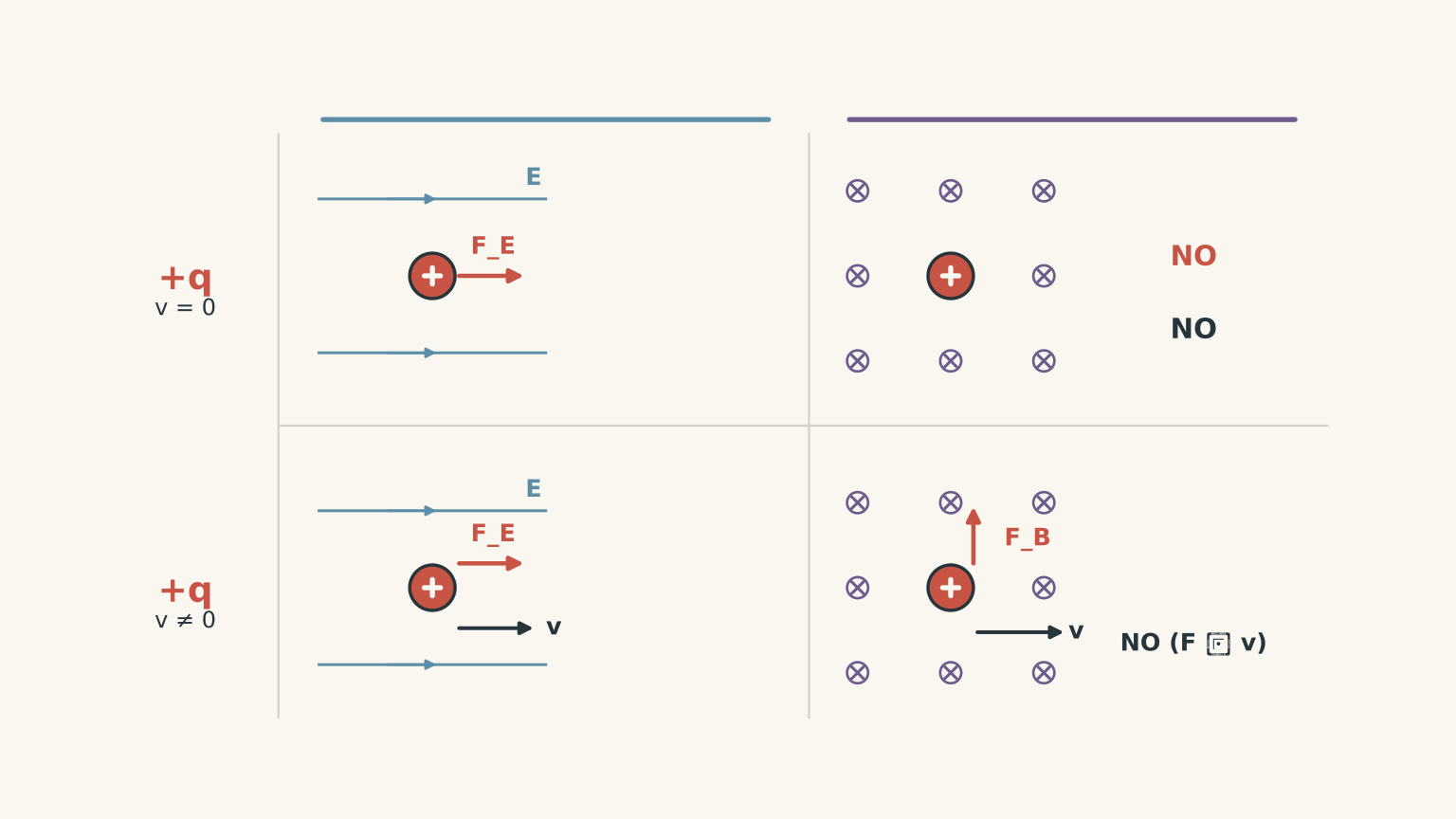
A stationary charge experiences an electric force if an electric field is present, because \(F=qE\) does not depend on the charge’s velocity. A stationary charge experiences no magnetic force.
For a moving charge, an electric field can change the particle’s speed and kinetic energy by doing work. A magnetic force acts perpendicular to the velocity when the charge moves perpendicular to the magnetic field. It changes the direction of motion but does no work, so it cannot change the particle’s kinetic energy.
Marking guide:
- 1 mark for correctly comparing the forces on stationary and moving charges.
- 1 mark for explaining that an electric field can do work, whereas a magnetic force does no work.
Solution 2
(a) Electric field strength (2 marks)
For a uniform electric field between parallel plates,
\[ E=\frac{V}{d} \]
where \(V\) is the magnitude of the potential difference and \(d\) is the plate separation.
Substituting,
\[ \begin{aligned} E&=\frac{600}{0.030}\\ &=2.0\times10^4\ \mathrm{V\,m^{-1}} \end{aligned} \]
Answer: \(2.0\times10^4\ \mathrm{V\,m^{-1}}\).
Marking guide:
- 1 mark for the correct relationship and substitution.
- 1 mark for the correct field strength and unit.
(b) Direction of the electric field (1 mark)
The electric field points from higher electric potential to lower electric potential. Plate A is at the higher potential.
Answer: From plate A to plate B.
Marking guide:
- 1 mark for the correct direction.
(c) Increasing the plate separation (2 marks)
The potential difference remains \(600\ \mathrm V\), while the new separation is \(0.045\ \mathrm m\).
The new field strength is
\[ \begin{aligned} E_{\text{new}}&=\frac{600}{0.045}\\ &=1.33\times10^4\ \mathrm{V\,m^{-1}} \end{aligned} \]
The original field strength was \(2.0\times10^4\ \mathrm{V\,m^{-1}}\). The percentage change is
\[ \begin{aligned} \%\text{ change} &=\frac{E_{\text{new}}-E_{\text{old}}} {E_{\text{old}}}\times100\\ &=\frac{1.33\times10^4-2.0\times10^4} {2.0\times10^4}\times100\\ &=-33.3\% \end{aligned} \]
Answer: The new field strength is \(1.33\times10^4\ \mathrm{V\,m^{-1}}\), a decrease of approximately \(33\%\).
Marking guide:
- 1 mark for the correct new field strength.
- 1 mark for the correct percentage decrease.
(d) Limitations near plate edges (1 mark)
Near the edges, the electric field lines spread out and curve. This produces a fringing field, so the field’s magnitude and direction are no longer uniform.
Marking guide:
- 1 mark for identifying fringing and linking it to the failure of the uniform-field approximation.
(e) A condition for a uniform field (1 mark)
The dimensions of the plates should be much larger than their separation, and the field should be considered well away from the edges.
Marking guide:
- 1 mark for a valid condition that makes the field approximately uniform.
Solution 3
(a) Work done by the electric field (2 marks)
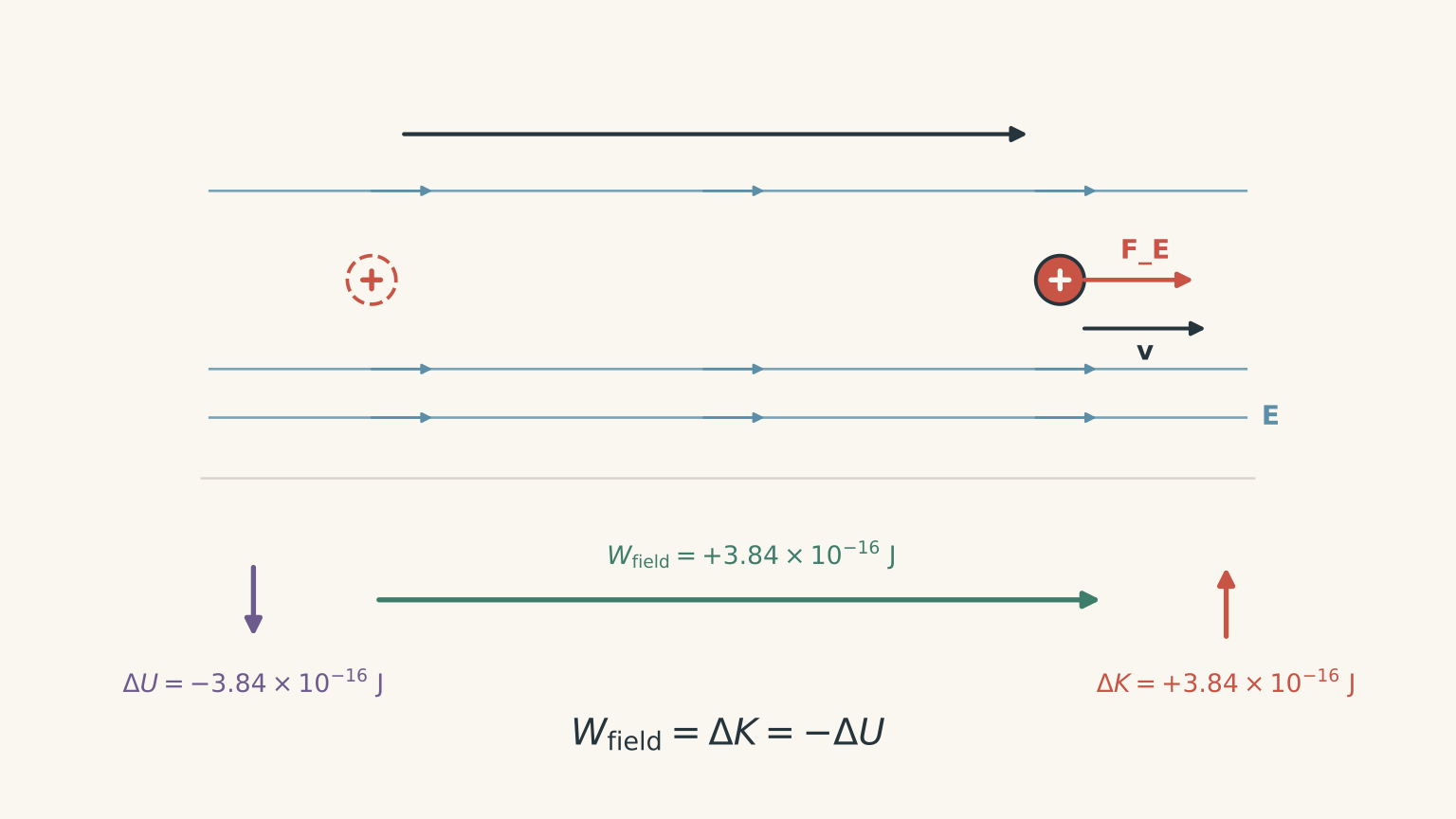
The ion has charge \(+e\) and is accelerated from rest by the electric field. The field transfers energy to the ion.
For a charge accelerated through a potential difference of magnitude \(\Delta V\),
\[ W_{\text{field}}=e\Delta V \]
Using \(\Delta V=2.4\times10^3\ \mathrm V\),
\[ \begin{aligned} W_{\text{field}} &=(1.60\times10^{-19})(2.4\times10^3)\\ &=3.84\times10^{-16}\ \mathrm J \end{aligned} \]
Answer: \(+3.84\times10^{-16}\ \mathrm J\).
The positive sign indicates that the field does positive work on the ion.
Marking guide:
- 1 mark for applying the charge-potential difference relationship.
- 1 mark for the correct positive work and unit.
(b) Final speed of the ion (3 marks)
The ion starts from rest, so its initial kinetic energy is zero. Assuming all work becomes kinetic energy,
\[ W_{\text{field}}=\Delta K=\frac12 mv^2 \]
Rearranging,
\[ v=\sqrt{\frac{2W_{\text{field}}}{m}} \]
Substitute the work and mass:
\[ \begin{aligned} v&=\sqrt{\frac{2(3.84\times10^{-16})} {3.3\times10^{-26}}}\\ &=\sqrt{2.33\times10^{10}}\\ &=1.53\times10^5\ \mathrm{m\,s^{-1}} \end{aligned} \]
Answer: \(1.5\times10^5\ \mathrm{m\,s^{-1}}\).
Marking guide:
- 1 mark for relating work to the change in kinetic energy.
- 1 mark for correct substitution and rearrangement.
- 1 mark for the correct final speed and unit.
(c) Comparing the ion and electron (3 marks)
Both particles have a charge magnitude of \(e\), and both are accelerated through the same potential difference magnitude.
Their kinetic energy gains are therefore equal:
\[ \Delta K=e\Delta V =3.84\times10^{-16}\ \mathrm J \]
The electron has a much smaller mass, so it reaches a much greater speed for the same kinetic energy.
Since \(K=\frac12 mv^2\), the speed ratio is
\[ \frac{v_e}{v_i}=\sqrt{\frac{m_i}{m_e}} \]
Substituting the masses,
\[ \begin{aligned} \frac{v_e}{v_i} &=\sqrt{\frac{3.3\times10^{-26}} {9.11\times10^{-31}}}\\ &\approx190 \end{aligned} \]
Answer: Both particles gain \(3.84\times10^{-16}\ \mathrm J\) of kinetic energy. The electron’s final speed is approximately 190 times the ion’s final speed.
Marking guide:
- 1 mark for identifying equal kinetic energy gains.
- 1 mark for deriving the speed-ratio relationship.
- 1 mark for the correct ratio.
Solution 4
(a) Electric field strength (2 marks)
The magnitude of the potential difference is \(400\ \mathrm V\), and the plate separation is \(0.040\ \mathrm m\).
\[ \begin{aligned} E&=\frac{V}{d}\\ &=\frac{400}{0.040}\\ &=1.00\times10^4\ \mathrm{V\,m^{-1}} \end{aligned} \]
Answer: \(1.00\times10^4\ \mathrm{V\,m^{-1}}\).
Marking guide:
- 1 mark for the correct relationship and substitution.
- 1 mark for the correct field strength and unit.
(b) Electron acceleration (2 marks)
The electric field points from the positive upper plate towards the negative lower plate. Therefore, the field is directed downwards.
An electron has negative charge, so its force and acceleration are opposite to the field direction.
Using \(F=ma\) and the magnitude of the electric force,
\[ a=\frac{eE}{m_e} \]
Substituting,
\[ \begin{aligned} a&=\frac{(1.60\times10^{-19})(1.00\times10^4)} {9.11\times10^{-31}}\\ &=1.76\times10^{15}\ \mathrm{m\,s^{-2}} \end{aligned} \]
Answer: \(1.76\times10^{15}\ \mathrm{m\,s^{-2}}\) upwards.
Marking guide:
- 1 mark for the correct acceleration relationship and magnitude.
- 1 mark for the correct direction, accounting for the negative charge.
(c) Time between the plates (2 marks)
There is no horizontal electric force, so the horizontal speed remains constant.
The time between the plates is the horizontal distance travelled divided by the horizontal speed:
\[ t=\frac{L}{v_x} \]
where \(L=0.030\ \mathrm m\) is the plate length and \(v_x=2.0\times10^7\ \mathrm{m\,s^{-1}}\).
\[ \begin{aligned} t&=\frac{0.030}{2.0\times10^7}\\ &=1.5\times10^{-9}\ \mathrm s \end{aligned} \]
Answer: \(1.5\times10^{-9}\ \mathrm s\).
Marking guide:
- 1 mark for the correct time relationship.
- 1 mark for the correct time and unit.
(d) Vertical displacement (3 marks)
The initial vertical velocity is zero. The electron therefore starts with no vertical motion, but accelerates upwards.
Using the constant-acceleration equation,
\[ \Delta y=v_{y0}t+\frac12 at^2 \]
Since \(v_{y0}=0\),
\[ \begin{aligned} \Delta y&=\frac12 at^2\\ &=\frac12(1.76\times10^{15}) (1.5\times10^{-9})^2\\ &=1.98\times10^{-3}\ \mathrm m \end{aligned} \]
Answer: \(1.98\times10^{-3}\ \mathrm m\), or approximately \(2.0\ \mathrm{mm}\), upwards.
Marking guide:
- 1 mark for selecting the correct constant-acceleration equation.
- 1 mark for correct substitution.
- 1 mark for the correct displacement, unit, and direction.
(e) Trajectory and velocity components (1 mark)
The electron follows a parabolic trajectory while it is between the plates. Its horizontal velocity component remains constant, while its vertical velocity component changes due to the electric force.
Marking guide:
- 1 mark for identifying the parabolic trajectory and constant horizontal velocity component.
Solution 5
(a) Change in electric potential energy (2 marks)
The change in electric potential from A to B is
\[ \begin{aligned} \Delta V&=V_B-V_A\\ &=-80-120\\ &=-200\ \mathrm V \end{aligned} \]
Electric potential energy changes according to
\[ \Delta U=q\Delta V \]
Therefore,
\[ \begin{aligned} \Delta U&=(-2.0\times10^{-6})(-200)\\ &=+4.0\times10^{-4}\ \mathrm J \end{aligned} \]
Answer: \(+4.0\times10^{-4}\ \mathrm J\). The particle’s electric potential energy increases.
Marking guide:
- 1 mark for calculating the potential difference.
- 1 mark for calculating the change in electric potential energy with the correct sign.
(b) Work done by the electric field (2 marks)
For an electric force acting as the only force doing work,
\[ W_{\text{field}}=-\Delta U \]
Thus,
\[ W_{\text{field}}=-4.0\times10^{-4}\ \mathrm J \]
Answer: \(-4.0\times10^{-4}\ \mathrm J\).
The work is negative because the electric potential energy increases. The particle moves against the electric force over the net displacement from A to B.
Marking guide:
- 1 mark for using \(W_{\text{field}}=-\Delta U\).
- 1 mark for the correct negative result and interpretation.
(c) Kinetic energy at B (2 marks)
The work-energy theorem states that the net work done equals the change in kinetic energy:
\[ W_{\text{field}}=K_B-K_A \]
Rearranging,
\[ \begin{aligned} K_B&=K_A+W_{\text{field}}\\ &=1.2\times10^{-3}-4.0\times10^{-4}\\ &=8.0\times10^{-4}\ \mathrm J \end{aligned} \]
Answer: \(8.0\times10^{-4}\ \mathrm J\).
Marking guide:
- 1 mark for applying the work-energy theorem.
- 1 mark for the correct final kinetic energy.
(d) Speed at B (2 marks)
Kinetic energy is related to speed by
\[ K_B=\frac12 mv_B^2 \]
Rearranging,
\[ \begin{aligned} v_B&=\sqrt{\frac{2K_B}{m}}\\ &=\sqrt{\frac{2(8.0\times10^{-4})} {4.0\times10^{-6}}}\\ &=\sqrt{400}\\ &=20\ \mathrm{m\,s^{-1}} \end{aligned} \]
Answer: \(20\ \mathrm{m\,s^{-1}}\).
Marking guide:
- 1 mark for the correct speed relationship and substitution.
- 1 mark for the correct speed and unit.
Solution 6
(a) Acceleration components (2 marks)
The electric field acts vertically upwards. Since the ion is positively charged, the electric force and acceleration are also upwards.
The vertical acceleration is
\[ a_y=\frac{qE}{m} \]
Substituting,
\[ \begin{aligned} a_y&=\frac{(3.2\times10^{-19})(2.0\times10^3)} {6.64\times10^{-27}}\\ &=9.64\times10^{10}\ \mathrm{m\,s^{-2}} \end{aligned} \]
There is no horizontal electric force, so \(a_x=0\).
Answer:
\[ a_x=0,\qquad a_y=+9.64\times10^{10}\ \mathrm{m\,s^{-2}} \]
Marking guide:
- 1 mark for applying \(a=qE/m\).
- 1 mark for the correct acceleration components and direction.
(b) Final velocity components (2 marks)
The horizontal velocity stays constant because \(a_x=0\):
\[ v_{x,f}=+6.0\times10^4\ \mathrm{m\,s^{-1}} \]
For the vertical component, use
\[ v_{y,f}=v_{y,i}+a_yt \]
Substituting,
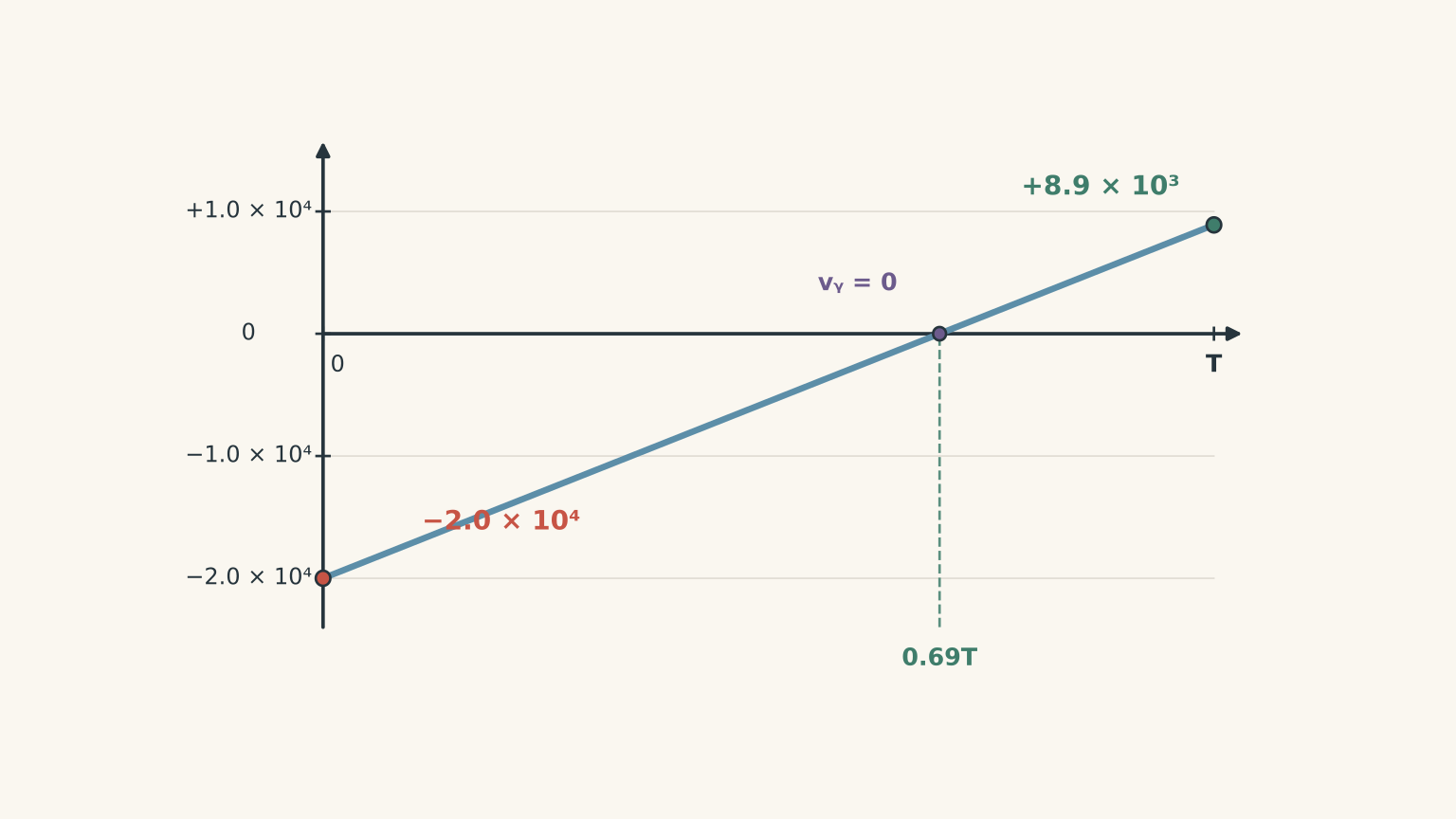
\[ \begin{aligned} v_{y,f}&=-2.0\times10^4\\ &\quad +(9.64\times10^{10})(3.0\times10^{-7})\\ &=+8.9\times10^3\ \mathrm{m\,s^{-1}} \end{aligned} \]
The positive final vertical velocity means the ion is moving upwards at the end of the interval.
Answer:
\[ v_{x,f}=+6.0\times10^4\ \mathrm{m\,s^{-1}} \]
\[ v_{y,f}=+8.9\times10^3\ \mathrm{m\,s^{-1}} \]
Marking guide:
- 1 mark for the correct horizontal velocity component.
- 1 mark for the correct vertical velocity component, including its sign.
(c) Displacement components (2 marks)
For horizontal motion,
\[ \begin{aligned} \Delta x&=v_xt\\ &=(6.0\times10^4)(3.0\times10^{-7})\\ &=+1.8\times10^{-2}\ \mathrm m \end{aligned} \]
For vertical motion, use the initial vertical velocity and constant vertical acceleration:
\[ \Delta y=v_{y,i}t+\frac12 a_yt^2 \]
Substituting,
\[ \begin{aligned} \Delta y&=(-2.0\times10^4)(3.0\times10^{-7})\\ &\quad+\frac12(9.64\times10^{10})(3.0\times10^{-7})^2\\ &=-6.0\times10^{-3}+4.34\times10^{-3}\\ &=-1.66\times10^{-3}\ \mathrm m \end{aligned} \]
Answer:
- Horizontal displacement: \(+1.8\times10^{-2}\ \mathrm m\), to the right.
- Vertical displacement: \(-1.66\times10^{-3}\ \mathrm m\), downwards.
Notice that the ion finishes with an upwards vertical velocity but a net downwards displacement. It initially moves downwards, slows, reverses direction, and then moves upwards for the remainder of the interval.
Marking guide:
- 1 mark for the correct horizontal displacement.
- 1 mark for the correct vertical displacement, including its sign.
(d) Work and change in kinetic energy (3 marks)
The electric field is vertical, so the work done by the field depends on the vertical displacement:
\[ W_{\text{field}}=qE\Delta y \]
Substituting,
\[ \begin{aligned} W_{\text{field}} &=(3.2\times10^{-19})(2.0\times10^3)\\ &\quad\times(-1.66\times10^{-3})\\ &=-1.06\times10^{-18}\ \mathrm J \end{aligned} \]
The work is negative because the net vertical displacement is downwards, opposite to the electric force.
To verify the result, calculate the change in kinetic energy. The initial and final speeds follow from their velocity components:
\[ v_i^2=(6.0\times10^4)^2+(-2.0\times10^4)^2 \]
\[ v_i^2=4.00\times10^9\ \mathrm{m^2\,s^{-2}} \]
Using the final velocity components,
\[ v_f^2=(6.0\times10^4)^2+(8.9\times10^3)^2 \]
\[ v_f^2\approx3.679\times10^9\ \mathrm{m^2\,s^{-2}} \]
The change in kinetic energy is
\[ \Delta K=\frac12m(v_f^2-v_i^2) \]
Substituting,
\[ \begin{aligned} \Delta K&=\frac12(6.64\times10^{-27})\\ &\quad\times(3.679\times10^9-4.00\times10^9)\\ &=-1.06\times10^{-18}\ \mathrm J \end{aligned} \]
The two methods give the same result within rounding:
\[ W_{\text{field}}=\Delta K =-1.06\times10^{-18}\ \mathrm J \]
Answer: The electric field does \(-1.06\times10^{-18}\ \mathrm J\) of work, matching the change in kinetic energy.
Marking guide:
- 1 mark for calculating work from the displacement with the correct sign.
- 1 mark for correctly calculating the change in kinetic energy.
- 1 mark for verifying that the two results agree.
(e) Horizontal speed (1 mark)
The horizontal speed remains constant because the electric force acts vertically and there is no horizontal acceleration.
Marking guide:
- 1 mark for stating that the horizontal speed is constant and linking this to zero horizontal force.
End of paper. Total: 50 marks.