
Charging and Electrostatic Interactions: Physics Practice Paper
Prepare for NSW HSC Physics with this original 40-mark tutorgum practice paper on charging and electrostatic interactions. Complete the timed questions, then check your understanding with worked solutions and a detailed marking guide.
This original tutorgum practice paper assesses charging by friction, contact, and induction; electron transfer and conservation of charge; polarisation and electrostatic forces; and the role of static electricity in lightning. It targets only the supplied Physics 11-12 (2025) scope, not the full course, and is not an official, endorsed, past, or predicted NESA paper.
01Exam instructions
- Suggested reading time: 5 minutes.
- Suggested working time: 45 minutes.
- Total marks: 40.
- Permitted equipment: Pen or pencil, ruler, and scientific calculator. A calculator is not essential.
- Conditions: Attempt all questions before consulting the worked solutions. These are suggested practice conditions, not official examination rules.
Assessed scope
This paper tests:
- Charging by friction, contact, and induction.
- Electron transfer and conservation of charge.
- Polarisation and the forces between charged and neutral objects.
- The role of static electricity in lightning.
It does not assess electric-field strength calculations, Coulomb’s law calculations, field-line diagrams, circuit behaviour, magnetic effects, or detailed atmospheric physics and lightning-protection engineering.
Assumptions and conventions
- Electrons can move between objects or through conductors. Protons remain bound within atomic nuclei during the charging processes in this paper.
- A neutral object has equal amounts of positive and negative charge.
- An object with an excess of electrons is negatively charged. An object with a deficit of electrons is positively charged.
- Objects are isolated from their surroundings unless a connection to Earth or another object is specified.
- Identical conducting spheres share charge equally when brought into contact and given enough time for charge to redistribute.
- For lightning, use a qualitative model rather than numerical calculations.
Show your reasoning in explanation questions. Include units in numerical answers and make the direction of electron transfer clear whenever it is requested.
02Questions
Question 1 (5 marks)
Two initially neutral, isolated objects, P and Q, are rubbed together. During the process, 14 electrons move from Q to P.
(a) State the net charge sign of each object after rubbing. Identify which object has an excess of electrons and which has a deficit. (2 marks)
(b) Explain why the combined net charge of P and Q remains unchanged after rubbing. (2 marks)
(c) A student claims that positive charge moved from P to Q. Explain why this is not the correct particle-level description of the process. (1 mark)
Question 2 (5 marks)
A negatively charged rod is brought close to a small, initially neutral metal sphere on an insulating stand. The rod does not touch the sphere.
(a) Describe how the electrons in the sphere redistribute when the rod approaches. (2 marks)
(b) Explain why the sphere is attracted to the rod even though the sphere has zero net charge. (2 marks)
(c) The rod is moved away without touching the sphere. State the sphere’s final net charge. (1 mark)
Question 3 (6 marks)
Two isolated, identical conducting spheres have initial charges of \(+8\ \mathrm{nC}\) and \(-2\ \mathrm{nC}\), respectively. Here, nC means nanocoulomb. The spheres are brought into contact and then separated. No charge is lost to the surroundings.
(a) Calculate the combined charge of the two-sphere system before contact. (1 mark)
(b) Calculate the final charge on each sphere after separation. (2 marks)
(c) State the direction of electron transfer during contact and explain why electrons move in this direction. (2 marks)
(d) Name the physical principle that must be satisfied when checking the combined charge before and after contact. (1 mark)
Question 4 (6 marks)
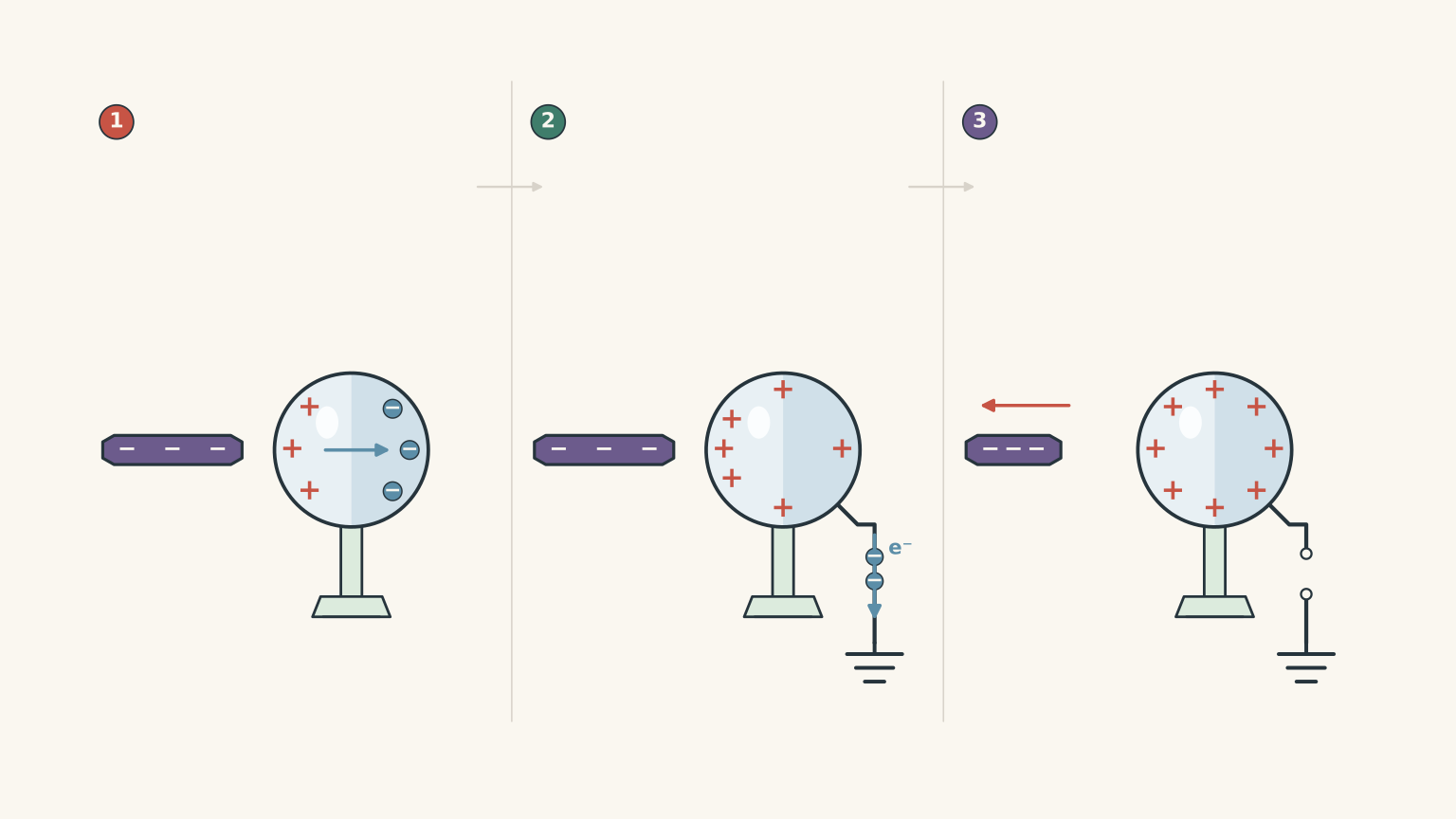
A neutral metal sphere is isolated on an insulating stand. A negatively charged rod is held close to the sphere without touching it. While the rod remains in place, the sphere is connected to Earth by a conducting wire.
The wire is disconnected first. The rod is removed afterwards.
(a) While the wire is connected to Earth, state the direction of electron movement and explain what causes it. (2 marks)
(b) What is the net charge on the sphere immediately after the wire is disconnected? (1 mark)
(c) State the sphere’s final net charge after the rod is removed. Explain why this charge remains. (2 marks)
(d) Predict what would happen if the rod were removed while the Earth connection was still in place. (1 mark)
Question 5 (5 marks)
A negatively charged rod, R, is brought near three separate objects. The following interactions are observed:
- R repels object A.
- R attracts object B.
- R attracts object C.
Independent evidence establishes that object C is neutral.
(a) Determine the sign of the net charge on A. (1 mark)
(b) State all possible net charge states of B that are consistent with the observation. (2 marks)
(c) Explain how C can be attracted to R despite having zero net charge. (2 marks)
Question 6 (7 marks)
Static electricity plays a role in the development of lightning.
(a) Describe how charge separation can develop within a thundercloud. (2 marks)
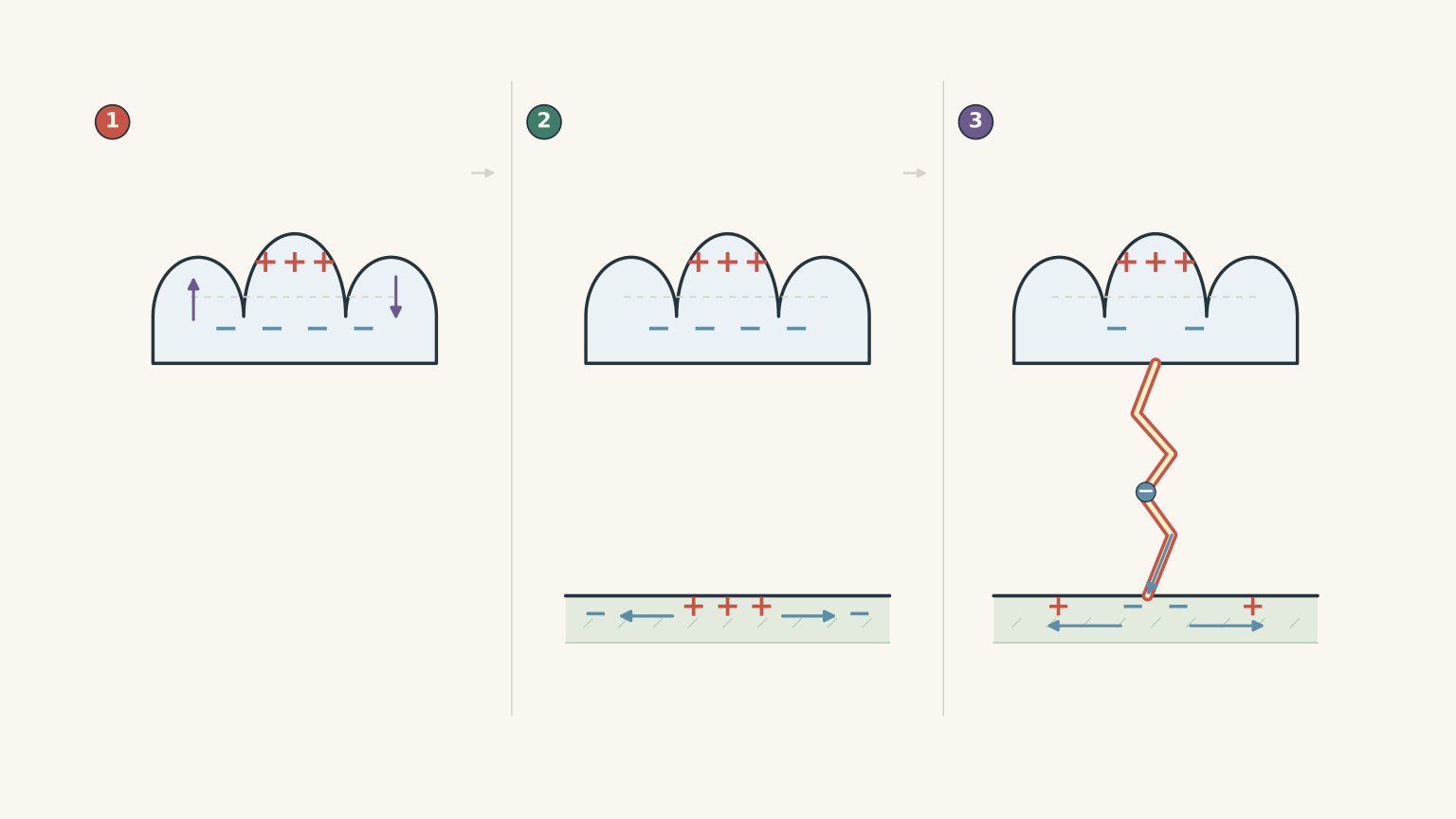
(b) For this part, assume that the lower region of a thundercloud is negatively charged. Explain how this charge separation can lead to a cloud-to-ground lightning strike. Include the role of the ground and the air between the cloud and ground. (3 marks)
(c) A student claims, “Lightning creates a new supply of charge when it flashes.” Evaluate this claim using the principle of conservation of charge and the energy transfers involved. (2 marks)
Question 7 (6 marks)
Two identical, initially neutral conducting spheres, A and B, are touching on insulating stands. The pair is isolated from Earth.
A negatively charged rod is brought close to sphere A without touching it. While the rod remains in place, the spheres are separated. The rod is then removed.
(a) Describe the movement of electrons while the spheres are touching. (2 marks)
(b) State the final net charge sign of each sphere after the spheres have been separated and the rod has been removed. (2 marks)
(c) Explain why the combined net charge of the two spheres remains zero. (1 mark)
(d) Predict the final charge on each sphere if the rod were removed before the spheres were separated. (1 mark)
03Worked solutions and marking guide
The marking breakdowns identify the specific ideas or working needed for each mark. Equivalent scientifically correct explanations are acceptable.
Solution 1
(a) P becomes negatively charged, and Q becomes positively charged.
P gains 14 electrons, giving it an excess of negative charge. Q loses those same electrons, leaving it with a deficit of electrons relative to its positive charge.
Marking (2 marks):
- P is negative and has an excess of electrons: 1 mark.
- Q is positive and has a deficit of electrons: 1 mark.
(b) The combined net charge remains zero because charge is transferred, not created or destroyed.
Initially, P and Q are both neutral, so their combined charge is zero. Electrons move from Q to P, but the electrons gained by P are exactly the electrons lost by Q. The total charge of the isolated pair therefore remains unchanged.
Marking (2 marks):
- Identifies that the initial combined charge is zero: 1 mark.
- Explains that electron transfer conserves the combined charge: 1 mark.
(c) Electrons moved from Q to P.
Electrons are the mobile charged particles in this process. Protons remain bound within the nuclei, so the particle-level description is electron transfer from Q to P, not the physical movement of positive charge from P to Q.
Marking (1 mark):
- Correctly identifies electron movement from Q to P: 1 mark.
Solution 2
(a) Electrons move away from the negatively charged rod.
The rod repels electrons within the conducting sphere. Electrons redistribute towards the far side, leaving the near side with an electron deficit and the far side with an electron excess.
This separation of charge within an object is called polarisation.
Marking (2 marks):
- Identifies that electrons redistribute away from the negative rod: 1 mark.
- Identifies the electron-deficient near side and electron-rich far side: 1 mark.
(b) The sphere experiences a net attractive force because the induced positive region is closer to the rod.
Although the sphere remains neutral overall, its charge is no longer distributed uniformly. The positively charged region on the near side is attracted to the negative rod, while the electron-rich region on the far side is repelled.
The attraction between the nearer opposite charges is stronger than the repulsion involving the more distant negative region. The resulting net force is towards the rod.
Polarisation of a neutral conductor
| Before the rod approaches | Electrons are distributed throughout the conductor. Positive and negative charges balance; net charge = 0. |
|---|---|
| Negative rod nearby | Electrons shift away from the rod, leaving the near side electron-deficient and the far side electron-rich. The positive lattice stays fixed; total positive and negative charge remains balanced. |
Marking (2 marks):
- Explains that polarisation produces an effectively positive region nearer the negative rod: 1 mark.
- Explains why the nearer attraction produces a net attractive force: 1 mark.
(c) The sphere remains neutral overall.
Moving the rod away removes the external influence causing polarisation. The electrons redistribute, but no charge has been transferred to or from the isolated sphere.
Marking (1 mark):
- States that the sphere’s final net charge is zero: 1 mark.
Solution 3
(a) The combined charge is \(+6\ \mathrm{nC}\).
Add the initial charges, including their signs:
\[ \begin{aligned} Q_{\text{total}} &= +8\ \mathrm{nC} + (-2\ \mathrm{nC})\\ &= +6\ \mathrm{nC} \end{aligned} \]
Marking (1 mark):
- Correctly calculates the combined charge, including signs and units: 1 mark.
(b) Each sphere finishes with a charge of \(+3\ \mathrm{nC}\).
The total charge remains \(+6\ \mathrm{nC}\). Since the spheres are identical and share charge equally, divide the combined charge by two:
\[ \begin{aligned} q_{\text{final}} &= \frac{Q_{\text{total}}}{2}\\ &= \frac{+6\ \mathrm{nC}}{2}\\ &= +3\ \mathrm{nC} \end{aligned} \]
Both A and B therefore have a final charge of \(+3\ \mathrm{nC}\).
Marking (2 marks):
- Applies equal sharing to the combined charge: 1 mark.
- Obtains \(+3\ \mathrm{nC}\) on each sphere: 1 mark.
Award follow-through credit if a student uses an incorrect total from part (a) but applies the equal-sharing method consistently.
(c) Electrons move from sphere B to sphere A.
Initially, B is negatively charged and has an excess of electrons. A is positively charged and has a deficit of electrons. When the spheres touch, electrons move from B to A. B loses electrons, and A gains electrons, until both spheres have the same final charge.
Marking (2 marks):
- Correctly states that electrons move from B to A: 1 mark.
- Explains the transfer using the initial electron excess on B and electron deficit on A: 1 mark.
(d) The principle is conservation of charge.
The total charge is \(+6\ \mathrm{nC}\) before contact and remains \(+6\ \mathrm{nC}\) after separation.
Marking (1 mark):
- Identifies conservation of charge: 1 mark.
Solution 4
(a) Electrons move from the sphere to Earth.
The negatively charged rod repels electrons in the sphere. The conducting wire provides a path for these electrons to leave the sphere and flow into Earth.
Marking (2 marks):
- Correctly states that electrons flow from the sphere to Earth: 1 mark.
- Explains that the negative rod repels the electrons and the wire provides a conducting path: 1 mark.
(b) The sphere becomes positively charged.
It has lost electrons while connected to Earth. Once the wire is disconnected, the sphere has an electron deficit.
Marking (1 mark):
- Identifies the sphere’s net charge as positive: 1 mark.
(c) The sphere remains positively charged after the rod is removed.
Removing the rod removes the external influence that caused the charge separation. However, the sphere is no longer connected to Earth, so electrons cannot return through the grounding wire. Its positive net charge remains, although the remaining charge can redistribute over the conducting surface.
This process is called charging by induction: an object acquires a net charge through the influence of a nearby charged object, without direct contact with that object.
Marking (2 marks):
- States that the sphere remains positively charged: 1 mark.
- Explains that removing the rod does not restore the lost electrons because the grounding path has been disconnected: 1 mark.
(d) The sphere would become neutral if the rod were removed while the Earth connection remained in place.
Without the rod’s repulsion, electrons could flow back from Earth into the sphere, removing its electron deficit.
Marking (1 mark):
- Identifies that the sphere would become neutral because electrons could return from Earth: 1 mark.
Solution 5
(a) A is negatively charged.
Like net charges repel. Since R is negative and repels A, A must also be negative within the standard model used in this paper.
Marking (1 mark):
- Correctly identifies A as negatively charged: 1 mark.
(b) B could be positively charged or neutral.
There are two possibilities consistent with the observation:
- B is positively charged, so it is attracted to the negatively charged rod.
- B is neutral, but polarisation produces an attractive force.
The observation of attraction alone does not distinguish these cases.
Marking (2 marks):
- Identifies a positively charged B as a possibility: 1 mark.
- Identifies a neutral B as a possibility: 1 mark.
(c) C is attracted because the negative rod polarises it.
Electrons within C redistribute away from R. This produces an electron-deficient region nearer the rod and an electron-rich region farther away. The nearer attractive interaction is stronger than the more distant repulsive interaction, so C experiences a net attractive force despite having zero net charge.
Marking (2 marks):
- Explains that polarisation separates charge within C without changing its total charge: 1 mark.
- Explains that the closer attractive interaction produces a net force towards R: 1 mark.
Solution 6
(a) Charge separation develops through charge transfer and the movement of particles within the thundercloud.
In a simplified model, collisions between ice and water particles can transfer charge. Air currents and gravity move different particles differently, allowing regions with different net charges to develop within the cloud.
Marking (2 marks):
- Identifies collisions between particles as a mechanism for charge transfer: 1 mark.
- Explains that particle movement separates the charges into different cloud regions: 1 mark.
(b) Charge separation in the cloud can lead to a rapid electrical discharge between the cloud and ground.
The process has three important stages:
- Induced charge on the ground: The negatively charged lower cloud region repels electrons within the ground. This leaves an induced positive region at the ground surface beneath the cloud.
- A conducting path develops: If the charge separation becomes sufficiently large, the air along a path can become ionised. Ionised air can conduct charge more readily than ordinary air.
- Lightning occurs: A rapid discharge takes place along the conducting path. Charge is redistributed between the cloud and ground, reducing some of the charge separation. The discharge releases energy as light, heat, and sound.
Marking (3 marks):
- Explains that the charged cloud induces an opposite charge at the ground surface: 1 mark.
- Explains that air along a path can become ionised and conductive: 1 mark.
- Explains that a rapid discharge redistributes charge and reduces the separation: 1 mark.
(c) The claim is incorrect. Lightning redistributes existing charge rather than creating a new supply of charge.
The total charge of an isolated system is conserved. During a lightning strike, charge moves between regions, but charge is not created from nothing. Energy is transferred into forms including light, heat, and sound.
Marking (2 marks):
- Explains that lightning transfers or redistributes charge while total charge is conserved: 1 mark.
- Distinguishes the energy released during the discharge from the creation of charge: 1 mark.
Solution 7
(a) Electrons move from sphere A to sphere B.
The negatively charged rod repels electrons in A. Because the spheres are touching, these electrons can move through the conducting contact into B.
Marking (2 marks):
- Correctly identifies electron movement from A to B: 1 mark.
- Explains that the negative rod repels electrons away from A: 1 mark.
(b) A becomes positively charged, and B becomes negatively charged.
A loses electrons, leaving it with an electron deficit. B gains those electrons, leaving it with an electron excess. Once the spheres are separated while the rod is still nearby, each sphere retains its own net charge. Removing the rod afterwards does not change those net charges.
Marking (2 marks):
- Identifies A as positive: 1 mark.
- Identifies B as negative: 1 mark.
(c) The combined net charge remains zero because electrons are transferred between the spheres, not into or out of the isolated pair.
The pair starts neutral, and no connection to Earth is made. The total charge is conserved even though the charge on each individual sphere changes.
Marking (1 mark):
- Explains that charge is conserved because electrons are redistributed within the isolated pair: 1 mark.
(d) Both spheres would finish neutral.
If the rod is removed while the spheres are still touching, the influence causing the electron redistribution disappears. Electrons redistribute across the connected pair, restoring a neutral state before the spheres are separated.
Marking (1 mark):
- States that both spheres would be neutral: 1 mark.