
Connected-Body Systems: Year 11-12 Physics Practice Exam
Test your understanding of connected-body systems and tension with this original 30-mark NSW Year 11-12 Physics practice exam. Includes timed exam conditions, a range of question difficulties, and fully worked solutions with marking guides.
This original tutorgum practice paper assesses connected-body systems and tension within the Physics 11-12 Syllabus (2025) revision scope. It tests your ability to choose between a whole-system and separate-body approach, calculate acceleration and tension, and keep force directions consistent across connected objects.
01Exam instructions
Paper: Original tutorgum practice paper
Subject: Physics 11-12 (2025)
Topic: Connected-body systems and tension
Working time: 50 minutes
Reading time: 5 minutes
Total marks: 30
This is a focused topic assessment, not a full-course Physics examination. All questions, numerical data, and solutions are original. This paper is not an official, endorsed, past, or predicted NESA examination.
Assessed content
- Connected bodies and tension.
- Applying Newton’s second law to a complete system.
- Applying Newton’s second law to individual bodies or subsystems.
- Determining acceleration and tension in connected systems.
- Maintaining consistent force directions and shared acceleration.
Excluded content
This paper does not assess frictional-force calculations, inclined planes, rotational dynamics of pulleys, or other Physics modules.
Permitted equipment
- Scientific calculator.
- Pen or pencil.
- Ruler.
No notes are permitted.
Assumptions and conventions
Unless a question states otherwise:
- Strings are light, inextensible, and remain taut.
- Pulleys are frictionless and massless.
- Horizontal surfaces are smooth.
- Air resistance is negligible.
- The gravitational field strength is \(g=9.8\,\mathrm{m\,s^{-2}}\).
Show your working for all calculations. Include units in numerical answers and state the direction of acceleration where requested. Give numerical answers to an appropriate number of significant figures.
Diagrams are schematic and not necessarily drawn to scale.
02Questions
Question 1 (6 marks)
Two blocks, A and B, are connected by a light string and rest on a smooth horizontal surface.
Block A has a mass of \(4.0\,\mathrm{kg}\), while block B has a mass of \(2.0\,\mathrm{kg}\). A horizontal force of \(24\,\mathrm{N}\) is applied to block B towards the right.
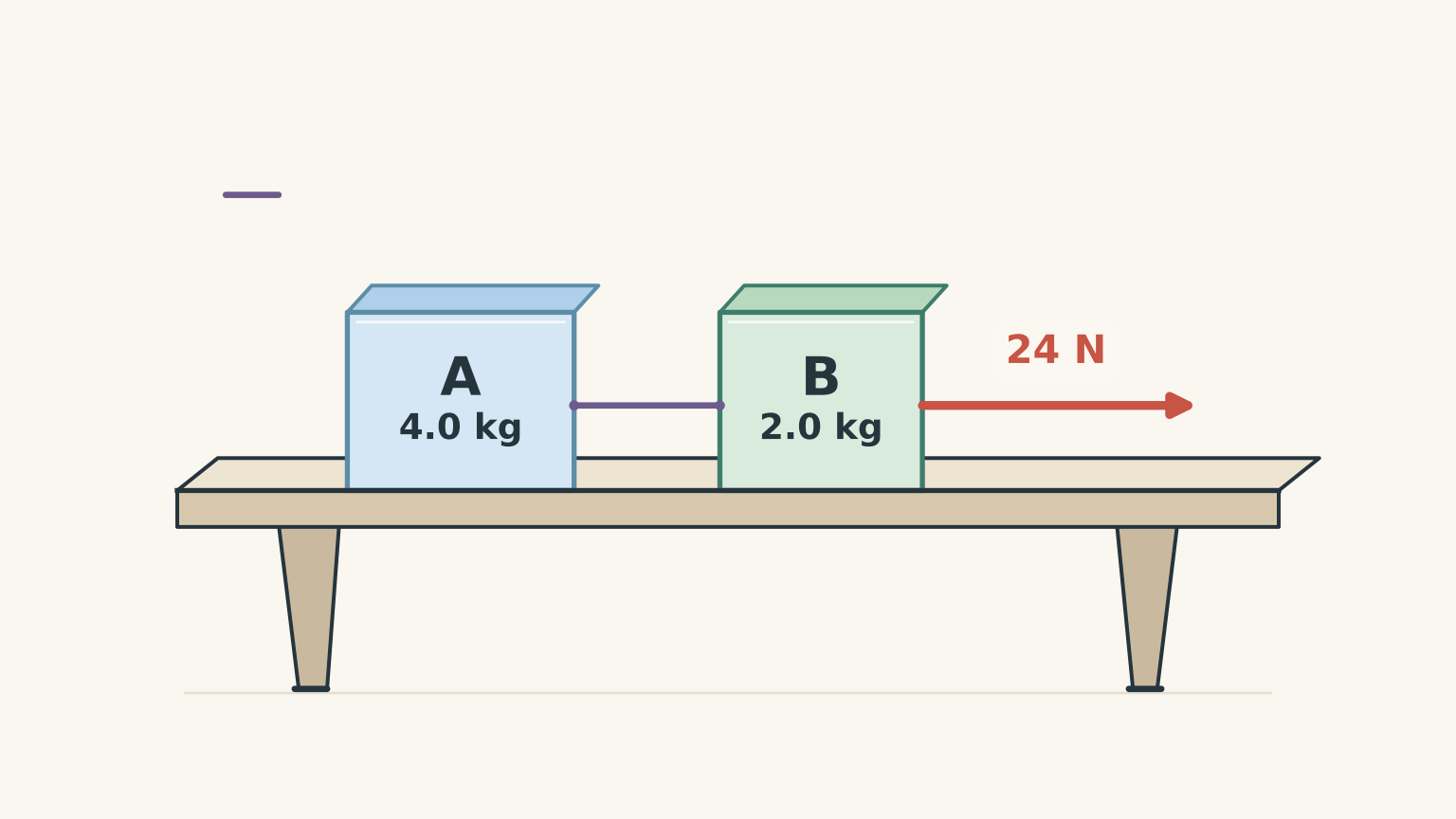
(a) Treat both blocks as a single system. Calculate their acceleration, including its direction. (2 marks)
(b) Draw a free-body diagram for block A. Use Newton’s second law to calculate the tension in the connecting string. (3 marks)
(c) Explain why the tension in the string is not equal to the applied force of \(24\,\mathrm{N}\). (1 mark)
Question 2 (7 marks)
Two masses are connected by a light string passing over a fixed, frictionless pulley.
The mass on the left is \(5.0\,\mathrm{kg}\), while the mass on the right is \(3.0\,\mathrm{kg}\). The system is released from rest.
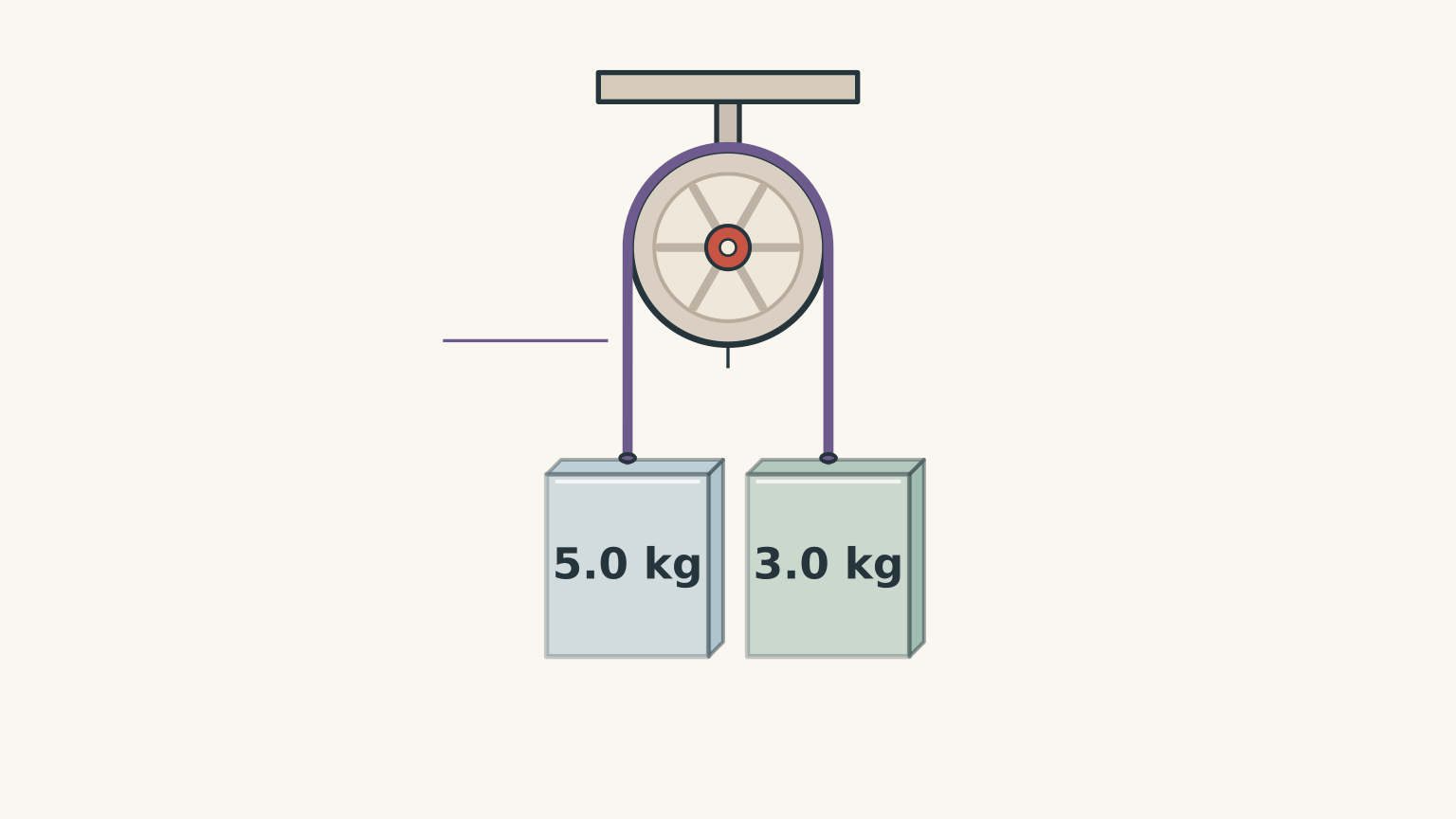
(a) State which mass accelerates downwards. (1 mark)
(b) Treat both masses as a single system and calculate the magnitude of their acceleration. (2 marks)
(c) Using the \(3.0\,\mathrm{kg}\) mass as a separate body, calculate the tension in the string. (3 marks)
(d) Explain why the tension is not equal to the weight of either mass. (1 mark)
Question 3 (8 marks)
Three blocks, A, B, and C, are arranged in a straight line on a smooth horizontal surface.
Their masses are:
- Block A: \(2.0\,\mathrm{kg}\)
- Block B: \(3.0\,\mathrm{kg}\)
- Block C: \(5.0\,\mathrm{kg}\)
The blocks are connected in sequence by two separate light strings. A horizontal force of \(40\,\mathrm{N}\) is applied to block C towards the right.
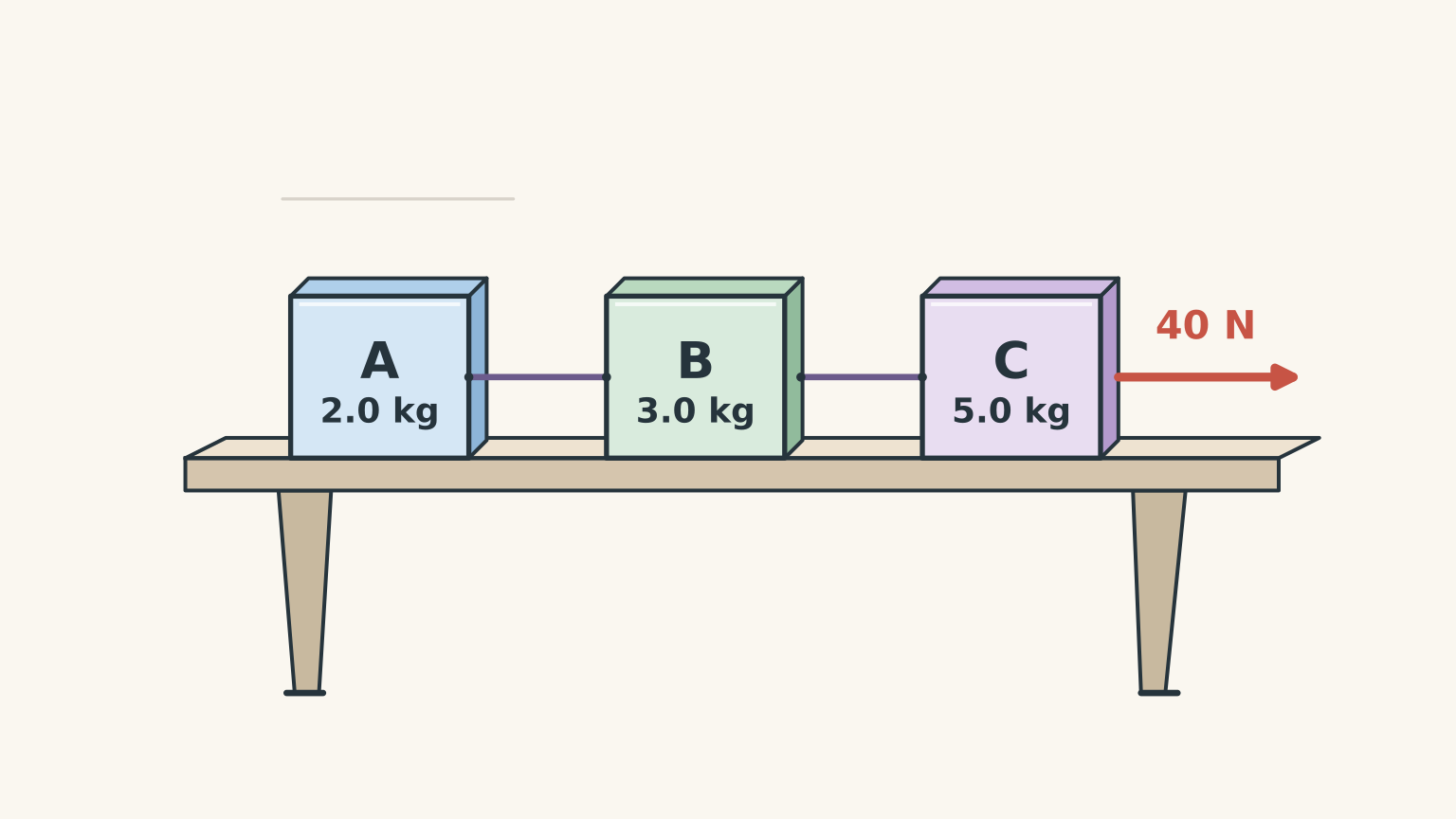
(a) Calculate the acceleration of the three-block system using the whole-system approach. (3 marks)
(b) Calculate the tension in the string connecting A and B. Use block A as a separate body. (2 marks)
(c) Calculate the tension in the string connecting B and C. Treat blocks A and B together as a subsystem. (2 marks)
(d) Explain why the tension in the string connecting B and C is greater than the tension in the string connecting A and B. (1 mark)
Question 4 (9 marks)
Block A, with a mass of \(5.0\,\mathrm{kg}\), rests on a smooth horizontal table. It is connected by a light string over a frictionless pulley to a hanging block B, with a mass of \(3.0\,\mathrm{kg}\).
A horizontal force of \(10\,\mathrm{N}\) acts on block A towards the left. The system is released from rest.
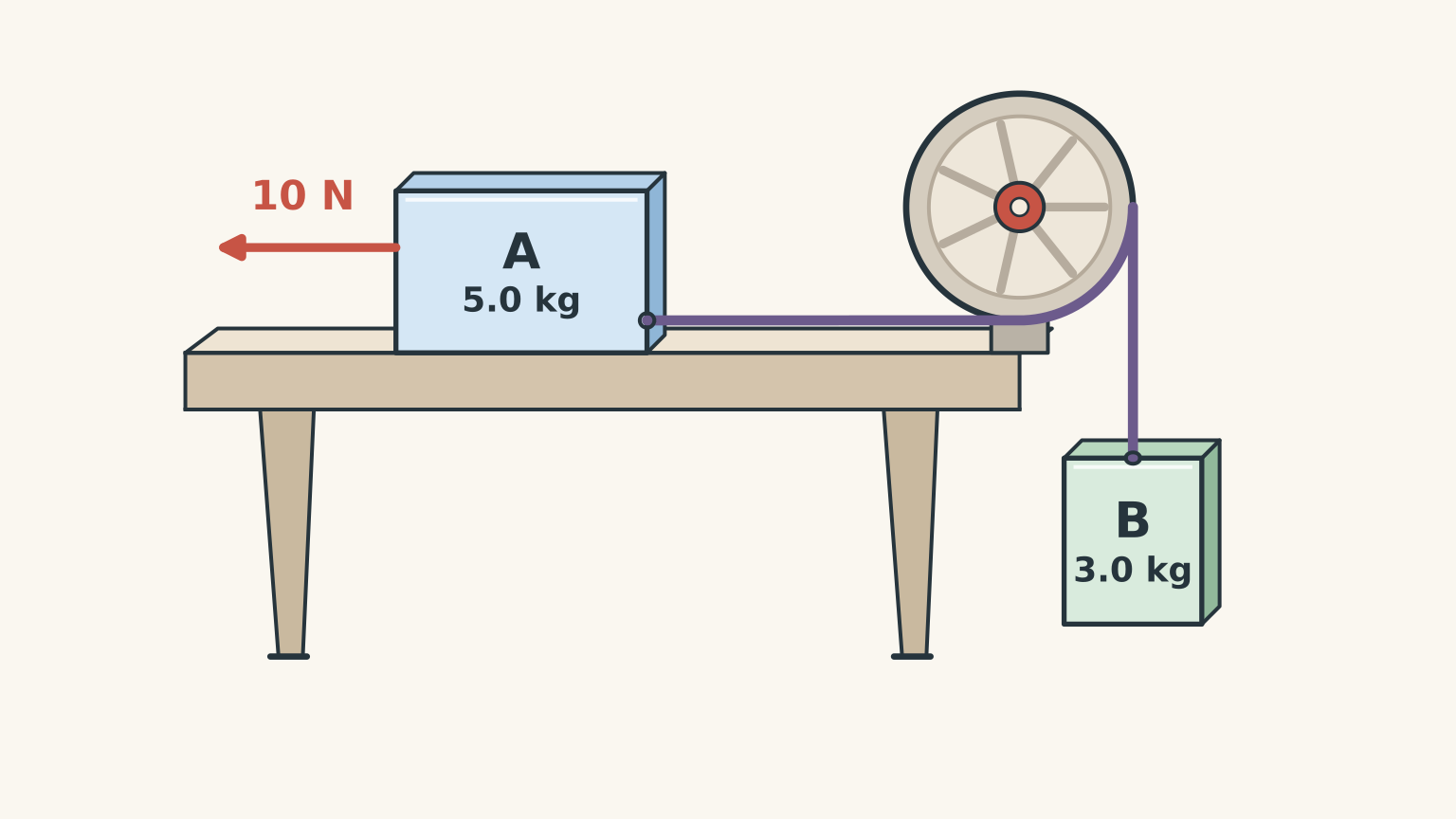
(a) Determine the direction in which the system accelerates. Justify your answer by considering the competing external forces. (2 marks)
(b) Calculate the magnitude of the acceleration using the whole-system approach. (3 marks)
(c) Calculate the tension in the connecting string using block A as a separate body. (3 marks)
(d) Suppose the leftward applied force on block A is increased to \(29.4\,\mathrm{N}\). If the system is released from rest again, describe what happens to the system. (1 mark)
03Worked solutions and marking guide
Solution 1
(a) Calculate the acceleration (2 marks)
The two blocks move together because they are connected by an inextensible string.
Let \(m_A\) and \(m_B\) represent the masses of blocks A and B, respectively. Let \(a\) represent their shared acceleration.
Treating both blocks as one system, the tension is an internal force. It acts between the two blocks and cancels when considering the system as a whole.
The only external horizontal force is \(24\,\mathrm{N}\).
Using Newton’s second law:
\[ F_{\mathrm{net}}=(m_A+m_B)a \]
Substituting:
\[ 24=(4.0+2.0)a \]
\[ a=\frac{24}{6.0} \]
\[ \boxed{a=4.0\,\mathrm{m\,s^{-2}}} \]
The acceleration is towards the right.
(b) Calculate the tension (3 marks)
Now isolate block A.
The forces acting on block A are:
- Tension, \(T\), towards the right.
- Weight, \(W_A\), vertically downwards.
- Normal force, \(N\), vertically upwards.
Here, \(T\) is the string tension, \(W_A=m_Ag\) is the weight of block A, and \(N\) is the normal contact force from the table.
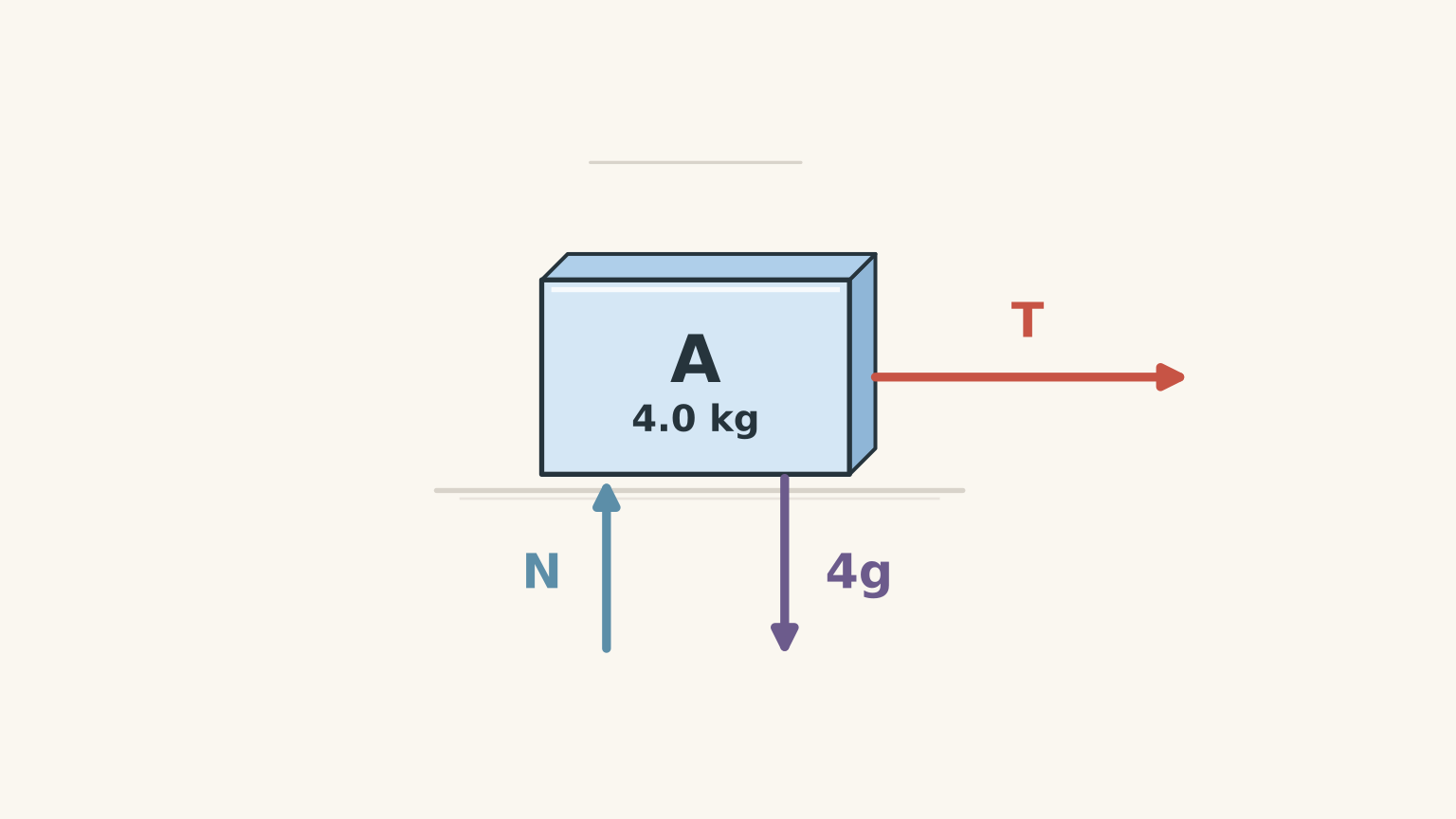
There is no vertical acceleration, so the normal force balances the weight.
Horizontally, tension is the only force acting on block A.
Taking right as positive:
\[ \sum F_x=m_Aa \]
\[ T=m_Aa \]
Substituting:
\[ T=4.0\times4.0 \]
\[ \boxed{T=16\,\mathrm{N}} \]
(c) Explain why tension is not equal to the applied force (1 mark)
The applied force of \(24\,\mathrm{N}\) acts on the entire two-block system.
The string tension only needs to provide the horizontal force that accelerates block A. The remaining net force accelerates block B.
For block B:
\[ 24-16=2.0\times4.0 \]
\[ 8=8 \]
Therefore, the applied force and the string tension have different values because they act on different parts of the system.
Marking breakdown
| Part | Expected working or understanding | Marks |
|---|---|---|
| (a) | Correct whole-system equation | 1 |
| (a) | Correct acceleration and direction | 1 |
| (b) | Correct free-body diagram | 1 |
| (b) | Correct application of Newton’s second law | 1 |
| (b) | Correct tension with unit | 1 |
| (c) | Explains the different roles of applied force and tension | 1 |
| Total | 6 |
Solution 2
(a) Identify the descending mass (1 mark)
The \(5.0\,\mathrm{kg}\) mass has the greater weight.
Its weight is:
\[ W_1=5.0\times9.8=49.0\,\mathrm{N} \]
The weight of the \(3.0\,\mathrm{kg}\) mass is:
\[ W_2=3.0\times9.8=29.4\,\mathrm{N} \]
Therefore, the \(5.0\,\mathrm{kg}\) mass accelerates downwards, pulling the \(3.0\,\mathrm{kg}\) mass upwards.
(b) Calculate the acceleration (2 marks)
Treat both masses as one complete system.
Let \(m_H\) represent the heavier mass and \(m_L\) the lighter mass.
The tension acts internally within the system. The net external force driving the motion is the difference between the two weights.
\[ F_{\mathrm{net}}=(m_H-m_L)g \]
Using Newton’s second law:
\[ (m_H-m_L)g=(m_H+m_L)a \]
Substituting:
\[ (5.0-3.0)\times9.8=(5.0+3.0)a \]
\[ 19.6=8.0a \]
\[ \boxed{a=2.45\,\mathrm{m\,s^{-2}}} \]
(c) Calculate the tension (3 marks)
Now consider the \(3.0\,\mathrm{kg}\) mass separately.
It accelerates upwards, so choose upwards as the positive direction.
The forces acting on it are:
- Tension, \(T\), upwards.
- Weight, \(m_Lg\), downwards.
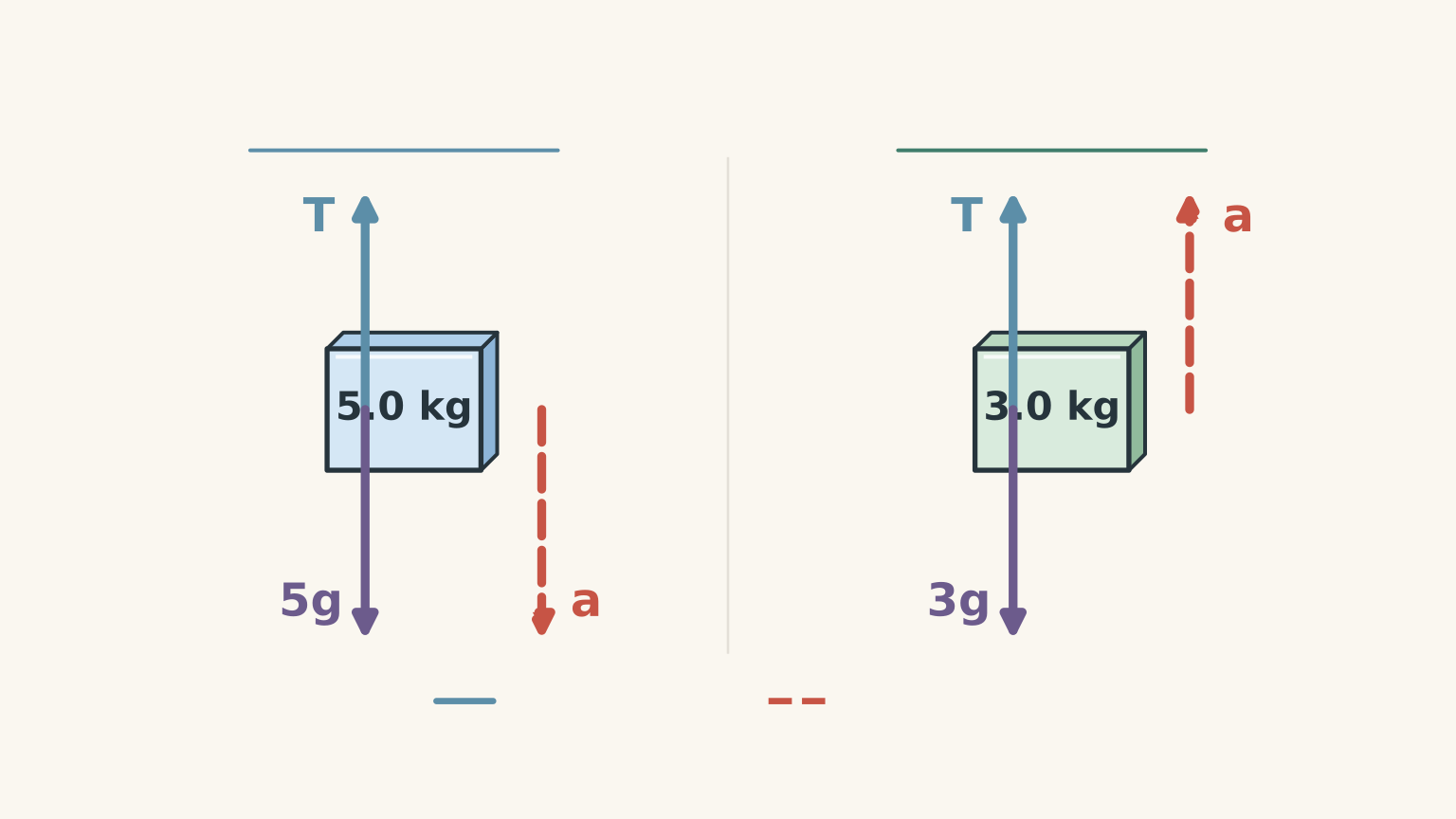
Applying Newton’s second law:
\[ T-m_Lg=m_La \]
Substituting:
\[ T-(3.0\times9.8)=3.0\times2.45 \]
\[ T-29.4=7.35 \]
\[ \boxed{T=36.75\,\mathrm{N}} \]
To three significant figures:
\[ \boxed{T=36.8\,\mathrm{N}} \]
(d) Explain why tension differs from both weights (1 mark)
Both masses accelerate, meaning the resultant force on each mass must be non-zero.
For the heavier mass, the tension is less than its weight because it accelerates downwards.
For the lighter mass, the tension is greater than its weight because it accelerates upwards.
Therefore, the tension cannot equal either weight.
Marking breakdown
| Part | Expected working or understanding | Marks |
|---|---|---|
| (a) | Identifies the 5.0 kg mass as descending | 1 |
| (b) | Correct whole-system net force equation | 1 |
| (b) | Correct acceleration | 1 |
| (c) | Correct force directions and Newton’s second law | 1 |
| (c) | Correct substitution | 1 |
| (c) | Correct tension with unit | 1 |
| (d) | Explains the non-zero resultant force on each mass | 1 |
| Total | 7 |
Solution 3
(a) Calculate the acceleration (3 marks)
Treat all three blocks as one system.
The individual tensions act internally between the blocks, so they cancel when considering the complete system.
The only external horizontal force is the applied \(40\,\mathrm{N}\) force.
The total mass is:
\[ m_{\mathrm{total}}=2.0+3.0+5.0 \]
\[ m_{\mathrm{total}}=10.0\,\mathrm{kg} \]
Applying Newton’s second law:
\[ F_{\mathrm{net}}=m_{\mathrm{total}}a \]
\[ 40=10.0a \]
\[ \boxed{a=4.0\,\mathrm{m\,s^{-2}}} \]
All three blocks accelerate towards the right with the same magnitude of acceleration.
(b) Calculate the tension between A and B (2 marks)
Now isolate block A.
The only horizontal force acting on A is the tension in the string connecting A and B.
Let \(T_{AB}\) represent this tension.
Applying Newton’s second law:
\[ T_{AB}=m_Aa \]
Substituting:
\[ T_{AB}=2.0\times4.0 \]
\[ \boxed{T_{AB}=8.0\,\mathrm{N}} \]
(c) Calculate the tension between B and C (2 marks)
Now consider blocks A and B together as a single subsystem.
The string connecting B and C pulls this subsystem towards the right.
Let \(T_{BC}\) represent the tension in that string.
The total mass of the subsystem is:
\[ m_{A+B}=2.0+3.0=5.0\,\mathrm{kg} \]
Applying Newton’s second law:
\[ T_{BC}=(m_A+m_B)a \]
Substituting:
\[ T_{BC}=5.0\times4.0 \]
\[ \boxed{T_{BC}=20\,\mathrm{N}} \]
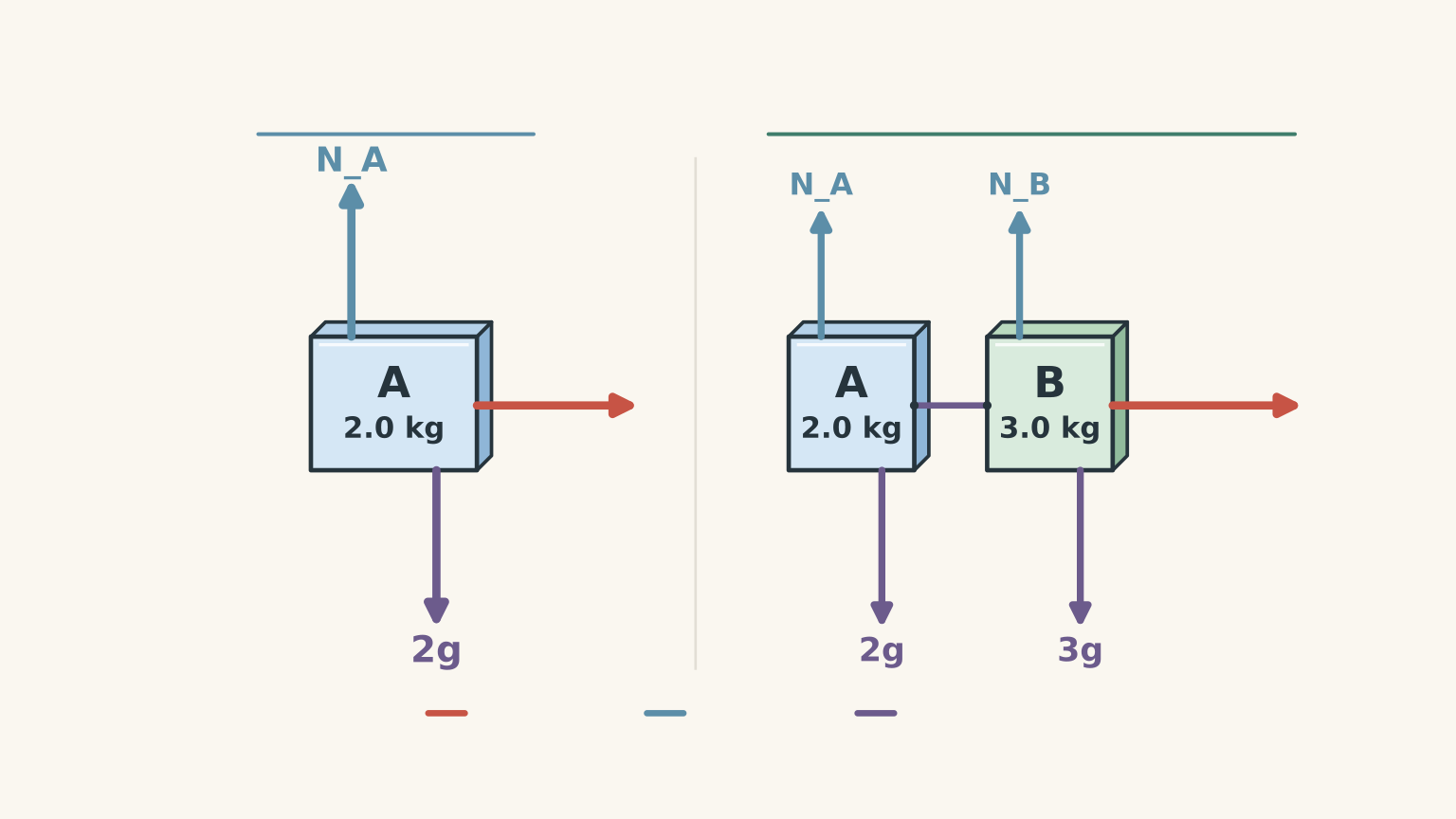
(d) Explain why the tensions differ (1 mark)
The string connecting A and B only needs to accelerate block A.
However, the string connecting B and C must accelerate both blocks A and B.
The second string therefore needs to exert a greater force.
This is why:
\[ T_{BC}>T_{AB} \]
Marking breakdown
| Part | Expected working or understanding | Marks |
|---|---|---|
| (a) | Correct total mass | 1 |
| (a) | Correct whole-system equation and substitution | 1 |
| (a) | Correct acceleration and direction | 1 |
| (b) | Correct equation for block A | 1 |
| (b) | Correct tension with unit | 1 |
| (c) | Correct equation for the A+B subsystem | 1 |
| (c) | Correct tension with unit | 1 |
| (d) | Explains why the second string accelerates a greater combined mass | 1 |
| Total | 8 |
Solution 4
(a) Determine the direction of acceleration (2 marks)
Block B has a mass of \(3.0\,\mathrm{kg}\).
Its weight is:
\[ W_B=m_Bg \]
\[ W_B=3.0\times9.8 \]
\[ W_B=29.4\,\mathrm{N} \]
This weight acts downwards on block B.
The applied force of \(10\,\mathrm{N}\) acts towards the left on block A, opposing the motion that would occur if B descended.
Since:
\[ 29.4>10 \]
the weight of block B is greater than the opposing applied force.
Therefore:
- Block B accelerates downwards.
- Block A accelerates towards the right.
(b) Calculate the acceleration (3 marks)
Treat both blocks as one system.
This is where choosing consistent positive directions matters.
For block A, choose right as positive. For block B, choose downwards as positive.
Both blocks have the same acceleration magnitude because they are connected by an inextensible string.
Let \(T\) represent the tension, \(F\) the applied force, and \(a\) the acceleration magnitude.
For block A:
\[ T-F=m_Aa \]
For block B:
\[ m_Bg-T=m_Ba \]
Adding the equations eliminates tension:
\[ m_Bg-F=(m_A+m_B)a \]
Substituting:
\[ (3.0\times9.8)-10=(5.0+3.0)a \]
\[ 29.4-10=8.0a \]
\[ 19.4=8.0a \]
\[ \boxed{a=2.425\,\mathrm{m\,s^{-2}}} \]
To three significant figures:
\[ \boxed{a=2.43\,\mathrm{m\,s^{-2}}} \]
(c) Calculate the tension (3 marks)
Now isolate block A.
The horizontal forces acting on A are:
- Tension \(T\) towards the right.
- Applied force \(F=10\,\mathrm{N}\) towards the left.
The block accelerates towards the right.
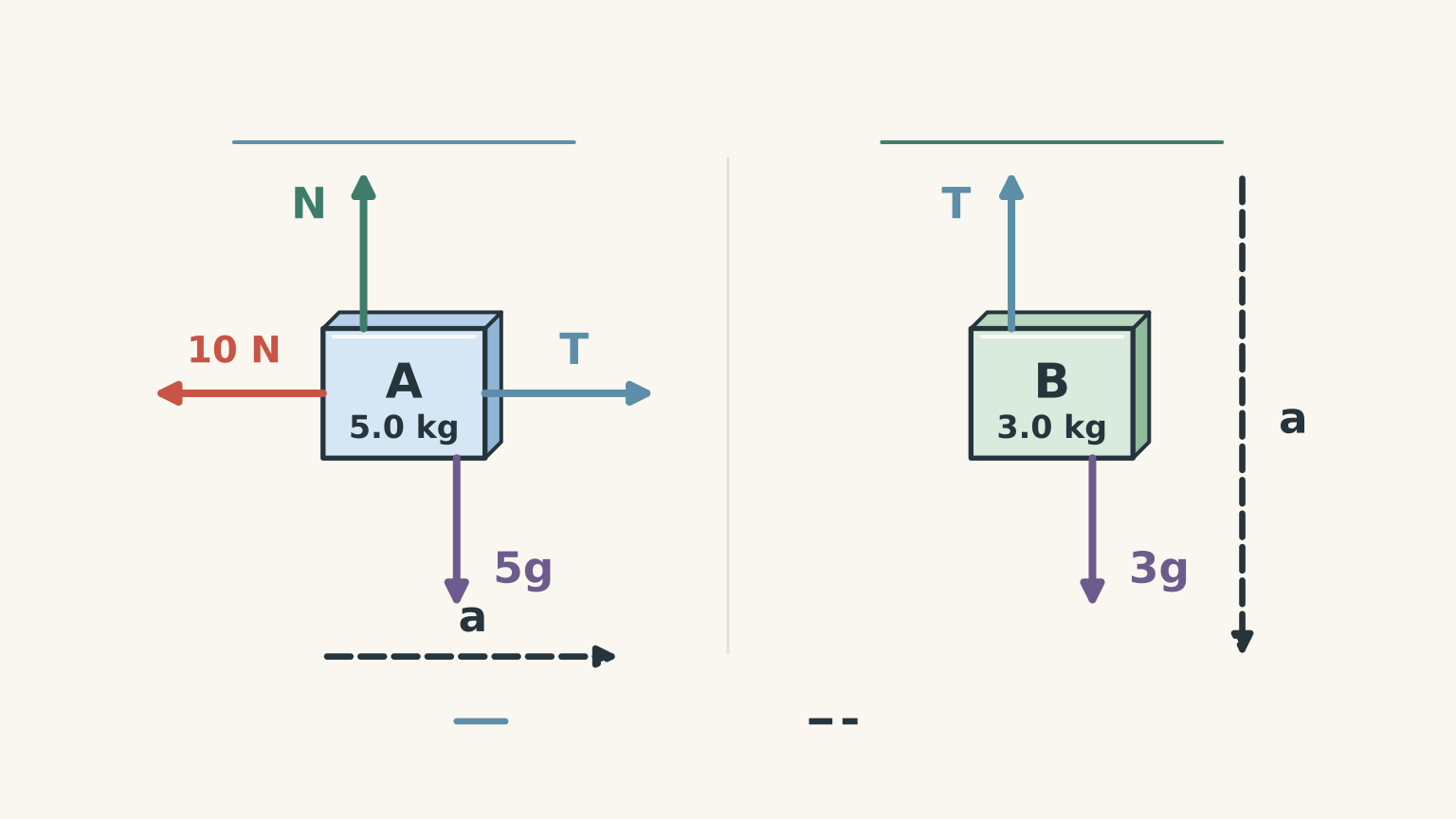
Taking right as positive for block A:
\[ T-F=m_Aa \]
Rearranging:
\[ T=F+m_Aa \]
Substituting:
\[ T=10+(5.0\times2.425) \]
\[ T=10+12.125 \]
\[ \boxed{T=22.125\,\mathrm{N}} \]
To three significant figures:
\[ \boxed{T=22.1\,\mathrm{N}} \]
We can check this result using block B.
Taking downwards as positive:
\[ m_Bg-T=m_Ba \]
\[ 29.4-22.125=3.0\times2.425 \]
\[ 7.275=7.275 \]
The result is consistent.
(d) Describe what happens when the applied force is increased (1 mark)
The new applied force is \(29.4\,\mathrm{N}\).
This exactly balances the weight of block B:
\[ F=m_Bg=29.4\,\mathrm{N} \]
The net driving force on the connected system is zero.
Therefore, its acceleration is zero.
Since the system is released from rest, both blocks remain at rest.
Marking breakdown
| Part | Expected working or understanding | Marks |
|---|---|---|
| (a) | Calculates the weight of block B | 1 |
| (a) | Correctly identifies the direction of motion | 1 |
| (b) | Correct net driving force equation | 1 |
| (b) | Correct total mass | 1 |
| (b) | Correct acceleration with unit | 1 |
| (c) | Correct force directions and Newton’s second law | 1 |
| (c) | Correct substitution | 1 |
| (c) | Correct tension with unit | 1 |
| (d) | Identifies zero acceleration and that the system remains at rest | 1 |
| Total | 9 |
End of paper – 30 marks