
HSC Chemistry: Conjugate Pairs and Acid-Base Practice Exam
Test your understanding of conjugate pairs and acid-base behaviour with this original 50-mark HSC Chemistry practice paper. Includes timed exam conditions, original questions, and complete worked solutions with a marking guide.
This original tutorgum practice paper assesses the supplied chemistry-2025 scope on conjugate pairs and acid-base behaviour. It is a focused topic assessment, not a full-course examination, an official or NESA-endorsed paper, or a prediction of an HSC examination.
Complete all questions before consulting the worked solutions. The paper includes reaction equations, equilibrium calculations, particle models, and explanations of acid-base behaviour.
01Exam instructions
| Condition | Details |
|---|---|
| Suggested reading time | 5 minutes |
| Suggested working time | 60 minutes |
| Total marks | 50 |
| Equipment | Scientific calculator and writing materials |
| Notes | No notes or internet access |
Assessed content
This paper assesses:
- Identification of conjugate acid-base pairs and proton transfer in aqueous solutions.
- Ionic equations for acid and base dissociation.
- Base dissociation constants (\(K_b\)) and \(pK_b\).
- Relationships between conjugate acid-base equilibrium constants.
- Differences between strong, weak, concentrated, and dilute acids and bases.
- Amphiprotic behaviour of hydrogen carbonate and dihydrogen phosphate ions.
The paper uses the supplied 2025 Chemistry scope only. It does not assess pH or pOH calculations, titrations, buffer calculations, or unrelated acid-base topics.
Given information
Unless otherwise stated:
- Assume a temperature of \(25^\circ\mathrm{C}\).
- Treat solutions as dilute aqueous solutions.
- Use molar concentrations in equilibrium expressions.
- Water is omitted from equilibrium constant expressions.
- Give numerical answers to three significant figures unless otherwise specified.
The ionic product of water at \(25^\circ\mathrm{C}\) is:
\[ K_w=1.00\times10^{-14} \]
The definitions of \(pK_a\) and \(pK_b\) are:
\[ pK_a=-\log_{10}K_a \]
\[ pK_b=-\log_{10}K_b \]
Show your working for all calculations. Balance chemical equations for both atoms and charge.
02Questions
Question 1 (6 marks)
Consider the following reaction in aqueous solution:
\[ \ce{NH3(aq) + H2O(l) <=> NH4+(aq) + OH-(aq)} \]
(a) Identify the Brønsted-Lowry acid and the Brønsted-Lowry base in the forward reaction. (2 marks)
(b) Identify the two conjugate acid-base pairs in this reaction. (2 marks)
Now consider a second reaction:
\[ \ce{HSO4^-(aq) + H2O(l) <=> SO4^2-(aq) + H3O+(aq)} \]
(c) Identify:
- The conjugate acid of water.
- The conjugate base of hydrogen sulfate.
(2 marks)
Question 2 (8 marks)
Write a balanced ionic equation for each of the following reactions. Include appropriate state symbols and arrows.
(a) Hydrobromic acid (\(\ce{HBr}\)) dissociates in water. (2 marks)
(b) Methanoic acid (\(\ce{HCOOH}\)) reacts with water. (2 marks)
(c) Solid sodium hydroxide (\(\ce{NaOH}\)) dissolves in water. (2 marks)
(d) Methylamine (\(\ce{CH3NH2}\)) acts as a base in water. (2 marks)
Question 3 (10 marks)
Four aqueous solutions are prepared at \(25^\circ\mathrm{C}\). Their concentrations and percentage ionisation or dissociation are recorded below.
| Solution | Substance | Initial concentration (mol L\(^{-1}\)) | Percentage ionised or dissociated |
|---|---|---|---|
| A | \(\ce{HCl}\) | 0.0200 | 100% |
| B | \(\ce{CH3COOH}\) | 0.200 | 0.95% |
| C | \(\ce{NaOH}\) | 0.0100 | 100% |
| D | \(\ce{NH3}\) | 0.500 | 0.60% |
For this question, treat all acids and bases as monoprotic. The percentage ionisation represents the fraction of the initial acid or base concentration that reacts to form ions. For sodium hydroxide, use the percentage dissociation.
(a) Rank the four solutions from highest to lowest concentration. (2 marks)
(b) Identify the stronger acid when comparing A and B, and the stronger base when comparing C and D. Use the percentage ionisation or dissociation data to support both choices. (2 marks)
(c) Explain how solution B can be more concentrated than solution A while containing a weaker acid. Also explain how solution D can be more concentrated than solution C while containing a weaker base. (2 marks)
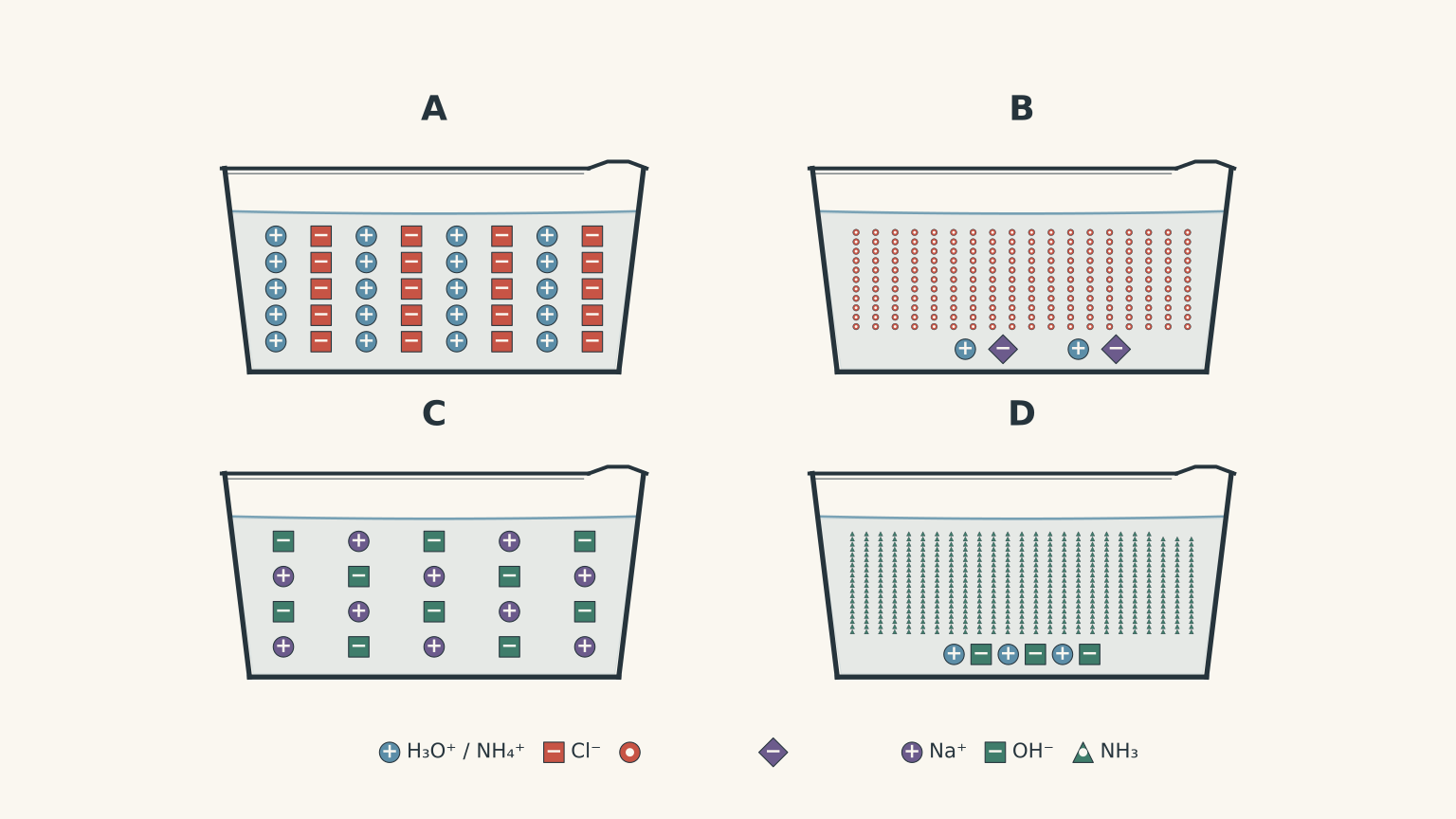
(d) Draw particle diagrams for equal-volume samples of A and B, and equal-volume samples of C and D.
Use a key to distinguish neutral molecules from ions. Your diagrams should represent the relative amount of dissolved solute and the extent of ionisation or dissociation in each solution. Schematic particle numbers are acceptable, provided the relative patterns are consistent with the data. (2 marks)
(e) Calculate:
- The hydronium ion concentration, \([\ce{H3O+}]\), in solution B.
- The hydroxide ion concentration, \([\ce{OH-}]\), in solution D.
Show your working. (2 marks)
Question 4 (8 marks)
A weak base, represented by \(\mathrm{X}\), reacts with water according to the following equilibrium:
\[ \mathrm{X(aq) + H_2O(l)} \rightleftharpoons \mathrm{XH^+(aq) + OH^-(aq)} \]
At equilibrium, the following concentrations are measured:
| Species | Equilibrium concentration (mol L\(^{-1}\)) |
|---|---|
| \(\mathrm{X}\) | 0.0800 |
| \(\mathrm{XH^+}\) | 0.00400 |
| \(\mathrm{OH^-}\) | 0.00400 |
(a) Write the equilibrium expression for the base dissociation constant, \(K_b\), of X. (2 marks)
(b) Calculate \(K_b\) using the equilibrium concentrations provided. (2 marks)
(c) Calculate the \(pK_b\) of X. (2 marks)
(d) A second base, Y, has a \(pK_b\) value of 4.80.
Compare the relative strengths of X and Y. Justify your answer using their \(pK_b\) values. (2 marks)
Question 5 (8 marks)
Consider a conjugate acid-base pair consisting of a weak base, \(\mathrm{B}\), and its conjugate acid, \(\mathrm{BH^+}\).
The base has the following dissociation constant at \(25^\circ\mathrm{C}\):
\[ K_b(\mathrm{B})=4.0\times10^{-6} \]
(a) State the relationship between \(K_a\), \(K_b\), and \(K_w\) for a conjugate acid-base pair.
Hence, state the corresponding relationship between \(pK_a\) and \(pK_b\) at \(25^\circ\mathrm{C}\). (2 marks)
(b) Calculate the \(K_a\) value of the conjugate acid, \(\mathrm{BH^+}\). (2 marks)
(c) Calculate the \(pK_b\) of B and the \(pK_a\) of \(\mathrm{BH^+}\).
Use the values obtained to classify B and \(\mathrm{BH^+}\) as strong or weak in water. (4 marks)
Question 6 (10 marks)
Sodium hydrogen carbonate (\(\ce{NaHCO3}\)) and potassium dihydrogen phosphate (\(\ce{KH2PO4}\)) both dissolve in water.
The ions \(\mathrm{Na}^{+}\) and \(\mathrm{K}^{+}\) are spectator ions. The relevant ions are \(\mathrm{HCO_{3}}^{-}\) and \(\mathrm{H_{2}PO_{4}}^{-}\).
(a) Define the term amphiprotic. (2 marks)
(b) Write a balanced ionic equation showing hydrogen carbonate, \(\mathrm{HCO_{3}}^{-}\), acting as an acid in water. (2 marks)
(c) Write a balanced ionic equation showing hydrogen carbonate, \(\mathrm{HCO_{3}}^{-}\), acting as a base in water. (2 marks)
(d) Write a balanced ionic equation showing dihydrogen phosphate, \(\mathrm{H_{2}PO_{4}}^{-}\), acting as an acid in water. (2 marks)
(e) Write a balanced ionic equation showing dihydrogen phosphate, \(\mathrm{H_{2}PO_{4}}^{-}\), acting as a base in water. (2 marks)
03Worked solutions and marking guide
Solution 1
(a) Identify the acid and base.
The reaction is:
\[ \ce{NH3 + H2O <=> NH4+ + OH-} \]
A Brønsted-Lowry acid donates a proton (\(\mathrm{H}^{+}\)), while a Brønsted-Lowry base accepts a proton.
- \(\ce{H2O}\) is the acid because it donates a proton.
- \(\ce{NH3}\) is the base because it accepts a proton.
Ammonia accepts a proton from water to become \(\ce{NH4+}\). Water loses a proton to become \(\ce{OH-}\).
Marking guide (2 marks)
- 1 mark: Correctly identifies \(\ce{H2O}\) as the acid.
- 1 mark: Correctly identifies \(\ce{NH3}\) as the base.
(b) Identify the conjugate acid-base pairs.
Conjugate acid-base pairs differ by exactly one proton.
The two pairs are:
- \(\ce{NH4+ / NH3}\)
- \(\ce{H2O / OH-}\)
In the first pair, ammonia accepts a proton to form its conjugate acid, \(\ce{NH4+}\).
In the second pair, water donates a proton to form its conjugate base, \(\ce{OH-}\).
Marking guide (2 marks)
- 1 mark: Correctly identifies \(\ce{NH4+ / NH3}\).
- 1 mark: Correctly identifies \(\ce{H2O / OH-}\).
(c) Identify the conjugate acid and conjugate base.
The reaction is:
\[ \ce{HSO4^- + H2O <=> SO4^2- + H3O+} \]
Water accepts a proton and becomes \(\ce{H3O+}\).
Therefore, the conjugate acid of water is:
\[ \ce{H3O+} \]
Hydrogen sulfate donates a proton and becomes \(\mathrm{SO_{4}}^{2-}\).
Therefore, the conjugate base of hydrogen sulfate is:
\[ \mathrm{SO_{4}}^{2-} \]
Marking guide (2 marks)
- 1 mark: Identifies \(\ce{H3O+}\) as the conjugate acid of water.
- 1 mark: Identifies \(\mathrm{SO_{4}}^{2-}\) as the conjugate base of hydrogen sulfate.
Solution 2
(a) Hydrobromic acid in water.
Hydrobromic acid is a strong acid. It ionises essentially completely in water.
The balanced ionic equation is:
\[ \ce{HBr(aq) + H2O(l) -> H3O+(aq) + Br-(aq)} \]
Hydrobromic acid transfers a proton to water, forming hydronium and bromide ions.
A single forward arrow is appropriate because the reaction proceeds essentially to completion.
Marking guide (2 marks)
- 1 mark: Correctly identifies the products, \(\ce{H3O+}\) and \(\mathrm{Br}^{-}\).
- 1 mark: Provides a balanced equation with the appropriate forward arrow and state symbols.
(b) Methanoic acid in water.
Methanoic acid is a weak acid. It only partially ionises in water, so an equilibrium arrow is required.
The balanced ionic equation is:
\[ \ce{HCOOH(aq) + H2O(l) <=> H3O+(aq) + HCOO-(aq)} \]
Methanoic acid donates a proton to water.
The resulting ions are hydronium, \(\ce{H3O+}\), and methanoate, \(\ce{HCOO-}\).
Marking guide (2 marks)
- 1 mark: Correctly identifies the products and their charges.
- 1 mark: Provides a balanced equation with an equilibrium arrow and appropriate state symbols.
(c) Sodium hydroxide in water.
Sodium hydroxide is an ionic compound that dissociates into its constituent ions when dissolved.
The equation is:
\[ \ce{NaOH(s) -> Na+(aq) + OH-(aq)} \]
Each formula unit of sodium hydroxide produces one sodium ion and one hydroxide ion.
The equation is balanced for both atoms and charge.
Marking guide (2 marks)
- 1 mark: Correctly identifies \(\mathrm{Na}^{+}\) and \(\ce{OH-}\) as the products.
- 1 mark: Provides the balanced dissociation equation with appropriate state symbols.
(d) Methylamine in water.
Methylamine is a weak base. It accepts a proton from water, producing methylammonium and hydroxide ions.
The balanced ionic equation is:
\[ \ce{CH3NH2(aq) + H2O(l) <=> CH3NH3+(aq) + OH-(aq)} \]
An equilibrium arrow is used because methylamine only partially reacts with water.
Marking guide (2 marks)
- 1 mark: Correctly identifies \(\ce{CH3NH3+}\) and \(\ce{OH-}\) as products.
- 1 mark: Provides the balanced proton-transfer equation with an equilibrium arrow.
Solution 3
(a) Rank the solutions by concentration.
The initial concentrations are:
| Solution | Concentration (mol L\(^{-1}\)) |
|---|---|
| D | 0.500 |
| B | 0.200 |
| A | 0.0200 |
| C | 0.0100 |
Therefore, the correct order from highest to lowest concentration is:
\[ \boxed{D>B>A>C} \]
Solution D is the most concentrated, while solution C is the most dilute.
Marking guide (2 marks)
- 1 mark: Correctly places D and B as the two most concentrated solutions, in that order.
- 1 mark: Correctly places A and C as the two least concentrated solutions, in that order.
(b) Identify the stronger acid and stronger base.
For the two acids:
- Solution A contains \(\ce{HCl}\), which is 100% ionised.
- Solution B contains \(\ce{CH3COOH}\), which is only 0.95% ionised.
Therefore, \(\ce{HCl}\) is the stronger acid.
For the two bases:
- Solution C contains \(\ce{NaOH}\), which is 100% dissociated.
- Solution D contains \(\ce{NH3}\), which is only 0.60% ionised.
Therefore, \(\ce{NaOH}\) is the stronger base.
The greater extent of ionisation or dissociation indicates greater acid or base strength.
Marking guide (2 marks)
- 1 mark: Identifies \(\ce{HCl}\) as the stronger acid using the ionisation data.
- 1 mark: Identifies \(\ce{NaOH}\) as the stronger base using the dissociation data.
(c) Explain the difference between strength and concentration.
Concentration measures the amount of dissolved substance per unit volume of solution.
Strength describes how extensively an acid ionises or a base ionises or dissociates in water.
For the acids:
- Solution B has a concentration of 0.200 mol L\(^{-1}\), which is ten times the concentration of solution A.
- However, methanoic acid in B only ionises by 0.95%, while HCl in A ionises completely.
Therefore, B is more concentrated but contains a weaker acid.
For the bases:
- Solution D has a concentration of 0.500 mol L\(^{-1}\), which is fifty times the concentration of solution C.
- However, ammonia in D only ionises by 0.60%, while NaOH in C dissociates completely.
Therefore, D is more concentrated but contains a weaker base.
The key point is that concentration and strength describe different properties. A concentrated solution can contain a weak acid or base, while a dilute solution can contain a strong acid or base.
Marking guide (2 marks)
- 1 mark: Correctly explains the difference between concentration and strength using solutions A and B.
- 1 mark: Correctly explains the difference using solutions C and D.
(d) Draw particle diagrams.
A correct set of particle diagrams should show the following.
For the acid solutions:
- A contains relatively fewer acid formula units, but these are essentially all ionised into \(\ce{H3O+}\) and \(\mathrm{Cl}^{-}\).
- B contains approximately ten times as many acid formula units as A in the same volume. Most remain as neutral \(\ce{CH3COOH}\) molecules, with a small number of \(\ce{H3O+}\) and \(\ce{CH3COO-}\) ions.
For the base solutions:
- C contains \(\mathrm{Na}^{+}\) and \(\ce{OH-}\) ions because sodium hydroxide dissociates completely.
- D contains substantially more dissolved base formula units than C. Most remain as neutral \(\ce{NH3}\) molecules, with a small number of \(\ce{NH4+}\) and \(\ce{OH-}\) ions.
The particle diagrams should communicate two things at once:
- The number of dissolved solute formula units per equal volume.
- The proportion of those units that form ions.
Marking guide (2 marks)
- 1 mark: Correctly represents the relative concentrations and ionisation patterns of A and B.
- 1 mark: Correctly represents the relative concentrations and ionisation patterns of C and D.
(e) Calculate the ion concentrations.
For solution B:
The percentage ionisation is 0.95%.
First, convert this percentage into a decimal:
\[ \frac{0.95}{100}=0.0095 \]
The hydronium concentration is the initial acid concentration multiplied by the fraction ionised.
\[ \begin{aligned} [\ce{H3O+}]&=0.200\times0.0095\\ &=0.00190\ \mathrm{mol\,L^{-1}} \end{aligned} \]
Therefore:
\[ \boxed{[\ce{H3O+}]=1.90\times10^{-3}\ \mathrm{mol\,L^{-1}}} \]
For solution D:
The percentage ionisation is 0.60%.
Convert this to a decimal:
\[ \frac{0.60}{100}=0.0060 \]
The hydroxide concentration is:
\[ \begin{aligned} [\ce{OH-}]&=0.500\times0.0060\\ &=0.00300\ \mathrm{mol\,L^{-1}} \end{aligned} \]
Therefore:
\[ \boxed{[\ce{OH-}]=3.00\times10^{-3}\ \mathrm{mol\,L^{-1}}} \]
Each ionisation event involving ammonia produces one hydroxide ion, so the hydroxide concentration equals the concentration of ammonia that has reacted.
Marking guide (2 marks)
- 1 mark: Correctly calculates the hydronium concentration in B, including units.
- 1 mark: Correctly calculates the hydroxide concentration in D, including units.
Solution 4
(a) Write the \(K_b\) expression.
The equilibrium is:
\[ \mathrm{X+H_2O\rightleftharpoons XH^++OH^-} \]
The base dissociation constant is the product of the equilibrium concentrations of the products divided by the equilibrium concentration of the undissociated base.
Water is omitted because it is a pure liquid.
Therefore:
\[ \boxed{K_b=\frac{[\mathrm{XH^+}][\mathrm{OH^-}]}{[\mathrm{X}]}} \]
Marking guide (2 marks)
- 1 mark: Correctly places the two product concentrations in the numerator.
- 1 mark: Correctly places the undissociated base concentration in the denominator.
(b) Calculate \(K_b\).
Substitute the equilibrium concentrations:
\[ K_b=\frac{(0.00400)(0.00400)}{0.0800} \]
First, multiply the two product concentrations:
\[ 0.00400\times0.00400=1.60\times10^{-5} \]
Then divide by the concentration of X:
\[ K_b=\frac{1.60\times10^{-5}}{0.0800} \]
Therefore:
\[ \boxed{K_b=2.00\times10^{-4}} \]
Marking guide (2 marks)
- 1 mark: Correctly substitutes the equilibrium concentrations.
- 1 mark: Obtains \(K_b=2.00\times10^{-4}\).
(c) Calculate \(pK_b\).
The relationship is:
\[ pK_b=-\log_{10}K_b \]
Substitute the calculated value:
\[ pK_b=-\log_{10}(2.00\times10^{-4}) \]
Therefore:
\[ \boxed{pK_b=3.70} \]
Marking guide (2 marks)
- 1 mark: Correctly applies the negative logarithm.
- 1 mark: Obtains \(pK_b=3.70\).
(d) Compare the strength of X and Y.
The calculated value for X is:
\[ pK_b(\mathrm{X})=3.70 \]
The value for Y is:
\[ pK_b(\mathrm{Y})=4.80 \]
A lower \(pK_b\) corresponds to a larger \(K_b\), indicating a stronger base.
Since:
\[ 3.70<4.80 \]
X is the stronger base.
Final answer: X is stronger than Y because it has a lower \(pK_b\) and therefore a larger base dissociation constant.
Marking guide (2 marks)
- 1 mark: Recognises that a lower \(pK_b\) corresponds to a larger \(K_b\).
- 1 mark: Correctly identifies X as the stronger base.
Solution 5
(a) State the conjugate equilibrium relationships.
For a conjugate acid-base pair, the product of the acid and base dissociation constants equals the ionic product of water.
\[ \boxed{K_aK_b=K_w} \]
At \(25^\circ\mathrm{C}\):
\[ K_w=1.00\times10^{-14} \]
Taking the negative logarithm of both sides gives:
\[ pK_a+pK_b=pK_w \]
Since:
\[ pK_w=14.00 \]
The corresponding relationship is:
\[ \boxed{pK_a+pK_b=14.00} \]
This relationship applies to a conjugate acid-base pair at \(25^\circ\mathrm{C}\).
Marking guide (2 marks)
- 1 mark: Correctly states \(K_aK_b=K_w\).
- 1 mark: Correctly states \(pK_a+pK_b=14.00\) at \(25^\circ\mathrm{C}\).
(b) Calculate \(K_a\) of the conjugate acid.
We are given:
\[ K_b(\mathrm{B})=4.0\times10^{-6} \]
And:
\[ K_w=1.00\times10^{-14} \]
Using the conjugate equilibrium relationship:
\[ K_aK_b=K_w \]
Rearrange to make \(K_a\) the subject:
\[ K_a=\frac{K_w}{K_b} \]
Substitute:
\[ K_a=\frac{1.00\times10^{-14}}{4.0\times10^{-6}} \]
Therefore:
\[ \boxed{K_a=2.5\times10^{-9}} \]
Marking guide (2 marks)
- 1 mark: Correctly rearranges the relationship to calculate \(K_a\).
- 1 mark: Obtains \(K_a=2.5\times10^{-9}\).
(c) Calculate \(pK_b\), \(pK_a\), and classify the species.
First, calculate the \(pK_b\) of B:
\[ pK_b=-\log_{10}(4.0\times10^{-6}) \]
\[ \boxed{pK_b=5.40} \]
Next, calculate the \(pK_a\) of its conjugate acid:
\[ pK_a=-\log_{10}(2.5\times10^{-9}) \]
\[ \boxed{pK_a=8.60} \]
We can check these values using the relationship from part (a):
\[ pK_a+pK_b=14.00 \]
\[ 8.60+5.40=14.00 \]
The values are consistent.
Now consider what they tell us about strength.
For B:
\[ K_b=4.0\times10^{-6} \]
This is a relatively small equilibrium constant. The reaction with water favours the undissociated base, so B is a weak base.
For \(\ce{BH+}\):
\[ K_a=2.5\times10^{-9} \]
This is also a small equilibrium constant. The acid only partially ionises in water, so \(\ce{BH+}\) is a weak acid.
Final answers:
- \(pK_b(\mathrm{B})=5.40\): B is a weak base.
- \(pK_a(\mathrm{BH^+})=8.60\): \(\ce{BH+}\) is a weak acid.
Marking guide (4 marks)
- 1 mark: Correctly calculates \(pK_b=5.40\).
- 1 mark: Correctly calculates \(pK_a=8.60\).
- 1 mark: Correctly identifies B as a weak base.
- 1 mark: Correctly identifies \(\ce{BH+}\) as a weak acid.
Solution 6
(a) Define amphiprotic.
An amphiprotic substance can act as either an acid or a base, depending on the reaction partner.
It can:
- Donate a proton (\(\mathrm{H}^{+}\)) and act as an acid.
- Accept a proton (\(\mathrm{H}^{+}\)) and act as a base.
Both hydrogen carbonate, \(\mathrm{HCO_{3}}^{-}\), and dihydrogen phosphate, \(\mathrm{H_{2}PO_{4}}^{-}\), are amphiprotic ions.
Marking guide (2 marks)
- 1 mark: States that an amphiprotic substance can donate a proton.
- 1 mark: States that an amphiprotic substance can accept a proton.
(b) Hydrogen carbonate acting as an acid.
When hydrogen carbonate acts as an acid, it donates a proton to water.
The hydrogen carbonate ion loses one hydrogen and becomes carbonate:
\[ \ce{HCO3^-(aq) -> CO3^2-(aq) + H+(aq)} \]
Water accepts the proton to form hydronium.
Combining the proton transfer into one aqueous ionic equation gives:
\[ \boxed{ \ce{HCO3^-(aq) + H2O(l) <=> CO3^2-(aq) + H3O+(aq)} } \]
Hydrogen carbonate is the acid because it donates the proton.
Marking guide (2 marks)
- 1 mark: Correctly identifies carbonate and hydronium as the products.
- 1 mark: Provides a balanced equation with appropriate charges and an equilibrium arrow.
(c) Hydrogen carbonate acting as a base.
When hydrogen carbonate acts as a base, it accepts a proton from water.
It gains one hydrogen and becomes carbonic acid, \(\ce{H2CO3}\).
Water loses a proton and forms hydroxide.
The balanced ionic equation is:
\[ \boxed{ \ce{HCO3^-(aq) + H2O(l) <=> H2CO3(aq) + OH-(aq)} } \]
Hydrogen carbonate is the base because it accepts the proton.
Marking guide (2 marks)
- 1 mark: Correctly identifies carbonic acid and hydroxide as the products.
- 1 mark: Provides a balanced equation with appropriate charges and an equilibrium arrow.
(d) Dihydrogen phosphate acting as an acid.
When dihydrogen phosphate acts as an acid, it donates a proton to water.
It loses one hydrogen and becomes hydrogen phosphate, \(\mathrm{HPO_{4}}^{2-}\).
Water accepts the proton to form hydronium.
The balanced ionic equation is:
\[ \boxed{ \ce{H2PO4^-(aq) + H2O(l) <=> HPO4^2-(aq) + H3O+(aq)} } \]
Dihydrogen phosphate acts as the acid because it donates a proton.
Marking guide (2 marks)
- 1 mark: Correctly identifies hydrogen phosphate and hydronium as the products.
- 1 mark: Provides a balanced equation with appropriate charges and an equilibrium arrow.
(e) Dihydrogen phosphate acting as a base.
When dihydrogen phosphate acts as a base, it accepts a proton from water.
It gains one hydrogen and becomes phosphoric acid, \(\ce{H3PO4}\).
Water loses a proton and forms hydroxide.
The balanced ionic equation is:
\[ \boxed{ \ce{H2PO4^-(aq) + H2O(l) <=> H3PO4(aq) + OH-(aq)} } \]
Dihydrogen phosphate acts as the base because it accepts a proton.
Marking guide (2 marks)
- 1 mark: Correctly identifies phosphoric acid and hydroxide as the products.
- 1 mark: Provides a balanced equation with appropriate charges and an equilibrium arrow.
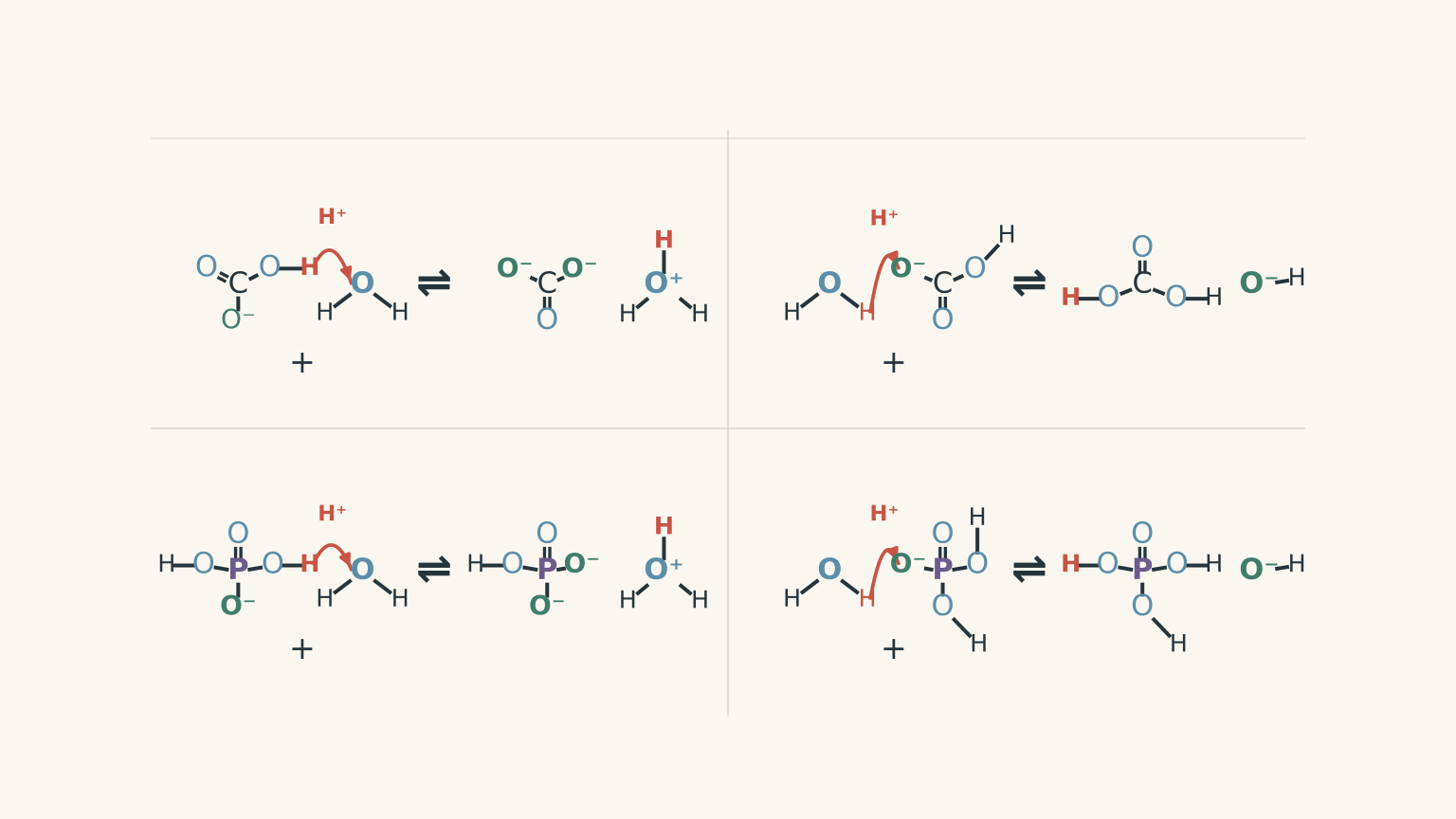
The two possible proton-transfer pathways for each ion can be represented as follows:
End of practice paper – 50 marks
Suggested revision priorities after marking:
- If you lost marks in Questions 1 or 2, revisit proton transfer, conjugate pairs, and the difference between ionisation and dissociation.
- If you lost marks in Questions 3 or 4, practise interpreting percentage ionisation data and calculating \(K_b\) and \(pK_b\).
- If you lost marks in Question 5, revise the relationship \(K_aK_b=K_w\) and its logarithmic form.
- If you lost marks in Question 6, practise identifying whether an amphiprotic ion gains or loses a proton in each reaction.
A useful standard to aim for is being able to identify the proton transfer first, then write the equation. Once you can do that reliably, conjugate pairs and amphiprotic reactions become much easier to handle.